


Deuteronomy 3:3
Bible text: King James Version (1769 Blayney text) · Public domain
Bible text: King James Version with Strong's numbers · Public domain
Bible text: Berean Standard Bible · Public domain
Bible text: American Standard Version (1901) · Public domain
Bible text: World English Bible, Messianic edition · Public domain
Bible text: Geneva Bible (1599) · Public domain
Bible text: Young's Literal Translation · Public domain
- וַיִּתֵּןvai·yi·Tenand he gaveH5414Conj-w ¦ V-Qal-ConsecImperf-3msVerb Qal Consecutive Imperfect 3rd Singular Masculineוַandיִּתֵּןhe gave
- יְהוָהYah·wehYahwehH3068N-properNoun Proper Title
- אֱלֹהֵינוּ'e·lo·Hei·nuour GodH430N-mpc ¦ 1cpNoun Plural Masculine ConstructאֱלֹהֵיGodנוּour
- בְּיָדֵנוּbe·ya·De·nuin our handH3027Prep-b ¦ N-csc ¦ 1cpNoun Singular common gender Constructבְּinיָדֵhandנוּour
- גַּםgamalsoH1571AdvAdverb
- אֶת'et<obj.>H853DirObjMParticle Object Indicator
- עוֹגogOgH5747N-proper-mNoun Proper Masculine
- מֶלֶךְMe·lekh[the] king ofH4428N-mscNoun Singular Masculine Construct
- הַבָּשָׁןha·ba·Shan<the> BashanH1316Art ¦ N-properNoun Proper Locationהַ<the>בָּשָׁןBashan
- וְאֶתve·'Etand <obj.>H853Conj-w ¦ DirObjMParticle Object Indicatorוְandאֶת<obj.>
- כָּלkolallH3605N-mscNoun Singular Masculine Construct
- עַמּוֹa·Mohis peopleH5971N-msc ¦ 3msNoun Singular Masculine Constructעַמּpeopleוֹhis
- וַנַּכֵּהוּva·na·Ke·huand we struck down himH5221Conj-w ¦ V-Hiphil-ConsecImperf-1cp ¦ 3msVerb Hiphil Consecutive Imperfect 1st Plural common genderוַandנַּכֵּwe struck downהוּhim
- עַד'aduntilH5704PrepPreposition
- בִּלְתִּיbil·TinotH1115N-csNoun Singular common gender Absolute
- הִשְׁאִירhish·'irhe had leftH7604V-Hiphil-Perf-3msVerb Hiphil Perfect 3rd Singular Masculine
- לוֹloto himPrep-l ¦ 3msSuffix Personal 3rd Singular Masculineלtoוֹhim
- שָׂרִידsa·Rida survivorH8300N-msNoun Singular Masculine Absolute
English is a literal word-by-word gloss of the Hebrew, not the KJV's wording. Why?
This is the original text the KJV's translators worked from — each Hebrew word with its own literal English meaning in this verse, prepared by scholars at Tyndale House, Cambridge. The KJV translates whole sentences, not word by word, so its wording differs: one Hebrew word can become several English words, and the KJV may choose “the LORD” where the gloss reads “Yahweh”. Both are faithful — they answer different questions. For the KJV's own rendering, switch to the KJV text.
Details
See on the biblical-era maps
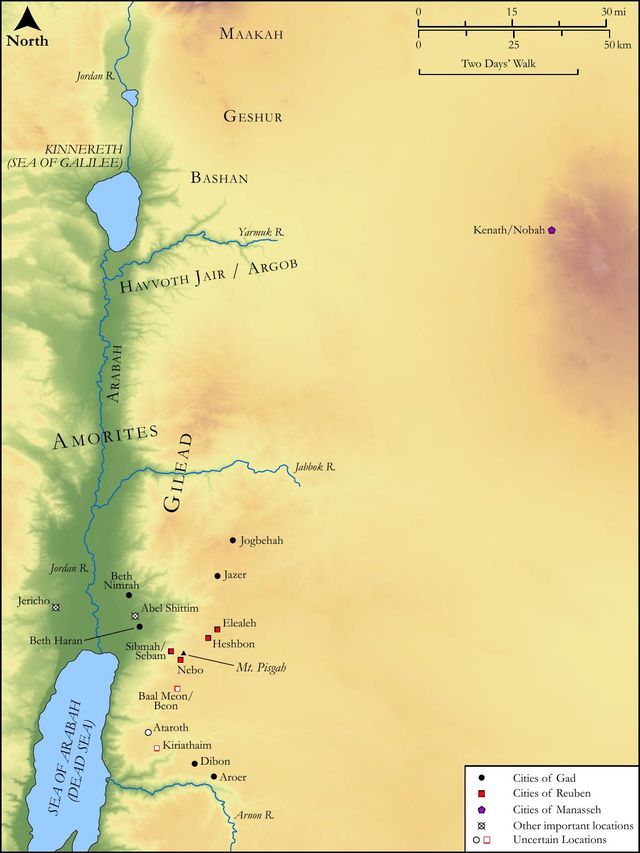
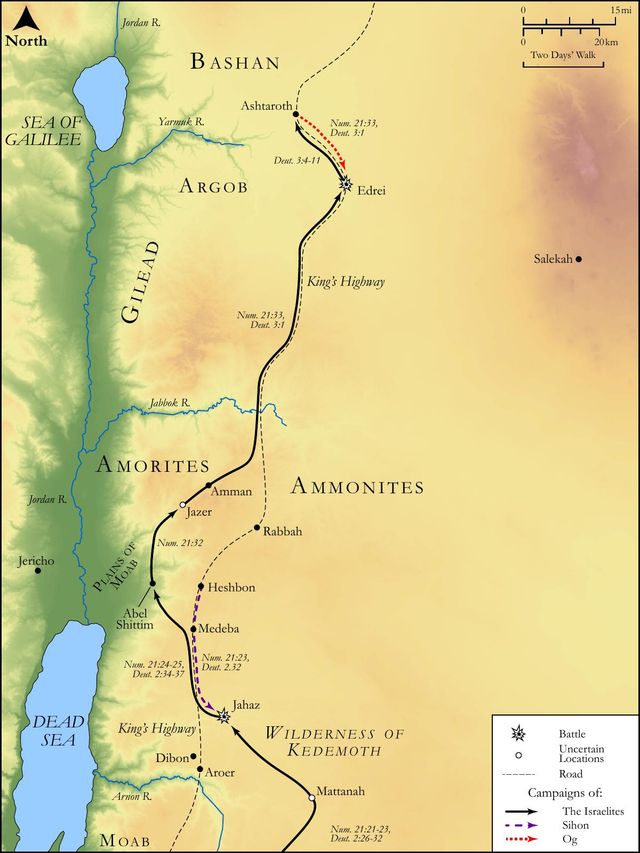
Study this verse
Public-domain commentary
Matthew Henry
From his Commentary on the Whole Bible. Henry comments on passages, not single verses — this entry covers Deuteronomy 3:1–11. His two-level outline is real structure in the source text, so it is rendered as structure.
We have here another brave country delivered into the hand of Israel, that of Bashan; the conquest of Sihon is often mentioned together with that of Og, to the praise of God, the rather because in these Israel's triumphs began, Psa 135:11; Psa 136:19, Psa 136:20. See,
I.How they got the mastery of Og, a very formidable prince,
1.Very strong, for he was of the remnant of the giants (Deu 3:11); his personal strength was extraordinary, a monument of which was preserved by the Ammonites in his bedstead, which was shown as a rarity in their chief city. You might guess at his weight by the materials of his bedstead; it was iron, as if a bedstead of wood were too weak for him to trust to: and you might guess at his stature by the dimensions of it; it was nine cubits long and four cubits broad, which, supposing a cubit to be but half a yard (and some learned men have made it appear to be somewhat more), was four yards and a half long, and two yards broad; and if we allow his bedstead to be two cubits longer than himself, and that is as much as we need allow, he was three yards and a half high, double the stature of an ordinary man, and every way proportionable, yet they smote him, Deu 3:3. Note, when God pleads his people's cause he can deal with giants as with grasshoppers. No man's might can secure him against the Almighty. The army of Og was very powerful, for he had the command of sixty fortified cities, besides the unwalled towns, Deu 3:5. Yet all this was nothing before God's Israel, when they came with commission to destroy him.
2.He was very bold and daring: He came out against Israel to battle, Deu 3:1. It was wonderful that he did not take warning by the ruin of Sihon, and send to desire conditions of peace; but he trusted to his own strength, and so was hardened to his destruction. Note, Those that are not awakened by the judgments of God upon others, but persist in their defiance of heaven, are ripening apace for the like judgments upon themselves, Jer 3:8. God bade Moses not fear him, Deu 3:2. If Moses himself was so strong in faith as not to need the caution, yet it is probable that the people needed it, and for them these fresh assurances are designed; "I will deliver him into thy hand; not only deliver thee out of his hand, that he shall not be thy ruin, but deliver him into thy hand, that thou shalt be his ruin, and make him pay dearly for his attempt." He adds, Thou shalt do to him as thou didst to Sihon, intimating that they ought to be encouraged by their former victory to trust in God for another victory, for he is God, and changeth not.
II.How they got possession of Bashan, a very desirable country.
They took all the cities (Deu 3:4), and all the spoil of them, Deu 3:7. They made them all their own, Deu 3:10. So that now they had in their hands all that fruitful country which lay east of Jordan, from the river Arnon unto Hermon, Deu 3:8. Their conquering and possessing these countries was intended, not only for the encouragement of Israel in the wars of Canaan, but for the satisfaction of Moses before his death. Since he must not live to see the completing of their victory and settlement, God thus gives him a specimen of it. Thus the Spirit is given to those that believe as the earnest of their inheritance, until the redemption of the purchased possession.
Continue studying Deuteronomy 3:3 across the web’s major study libraries — every link below opens this exact verse, chapter, or book on the destination site.
Read & Compare
 BibleGatewayThis verse in more than 200 translations and 70 languages.
 Bible.comThe YouVersion reader — hundreds of translations, reading plans, and highlights.
 ESV.orgCrossway's official English Standard Version reader.
 NET BibleThe NET translation with 60,000+ translators' notes on every rendering decision.
 STEP BibleTyndale House's free study tool — original text, vocabulary, and scholarly resources.
 BibliaLogos Bible Software's free web reader.
 USCCBThe New American Bible (Revised Edition) with the U.S. bishops' study notes.
Commentaries
 BibleHub CommentariesDozens of classic commentaries on this verse, gathered on one page.
 StudyLightMore than 100 commentary sets — the largest collection on the web.
 BibleRefPlain-English commentary on what this verse means, verse by verse.
 Enduring WordDavid Guzik's free commentary on this chapter, widely used by Bible teachers.
 Bible Study ToolsVerse commentary alongside Greek and Hebrew study aids.
Original Language & Research
- BibleHub InterlinearThe verse word by word — original language, transliteration, and English.
- BibleHub LexiconEvery word's original-language definition and Strong's entry.
 Blue Letter BibleDeep-study tools — Strong's numbers, concordance, and word studies.
 SefariaThe Hebrew text with Rashi and centuries of Jewish commentary.
Sermons, Hymns & Audio


TrulyRandomVerse is not affiliated with these sites and doesn’t control their content. They’re linked because they’re genuinely useful.
Summary
Deuteronomy 3:3 recounts the decisive victory granted by the LORD to Israel over Og, the formidable king of Bashan, and his entire populace. This verse emphasizes God's sovereign power and active intervention in fulfilling His covenant promises, demonstrating a complete and utterly destructive triumph that left no survivors, thereby securing the land east of the Jordan for the Israelite tribes. It stands as a powerful testament to divine faithfulness and the certainty of God's deliverance for His people.
Context
ShowHideLiterary Context
Deuteronomy 3:3 is situated within Moses' second major discourse to the Israelites, delivered on the plains of Moab just before they cross the Jordan River into the Promised Land. This section, specifically Deuteronomy 2 and Deuteronomy 3, serves as a historical review of God's faithfulness and mighty acts during their wilderness journey and initial conquests east of the Jordan. Following the detailed account of the defeat of Sihon, king of Heshbon, in Deuteronomy 2:26-37, this verse presents the subsequent, equally decisive victory over Og. Moses recounts these triumphs not merely as historical facts but as powerful theological lessons, designed to instill courage, faith, and obedience in a new generation poised to enter Canaan. The recounting of these victories also justifies the allocation of the Transjordanian territory to the tribes of Reuben, Gad, and the half-tribe of Manasseh, as detailed later in Deuteronomy 3:12-17.
Historical & Cultural Context
The defeat of Og, king of Bashan, was a monumental event for ancient Israel. Bashan was a fertile, strategically important region known for its strong cities and robust cattle, located northeast of Gilead. Og himself is depicted as a formidable figure, possibly one of the last of the Rephaim, a race of giants (Deuteronomy 3:11). His capital, Edrei, and his sixty fortified cities with high walls and gates, underscore the military challenge he posed. Among the nations of that day, military victories were often attributed to the patron deity of the conquering nation, and in Israel the complete destruction of an enemy, known as herem or "devotion to destruction," was a practice sometimes commanded by God to prevent the assimilation of idolatrous practices and to signify the complete triumph of His will. This victory, therefore, was not only a territorial gain but a profound theological statement about Yahweh's supremacy over local deities and His unwavering commitment to His covenant people.
Key Themes
ShowHideThe primary theme underscored by this verse is Divine Deliverance and Sovereignty. The phrase "the LORD our God delivered into our hands Og also" unequivocally attributes the victory to God's direct intervention, not Israel's military prowess alone. This reinforces God's absolute control over nations and His active role in fulfilling His promises to His people, a recurring motif throughout Deuteronomy. Another significant theme is Complete Victory and Judgment. The declaration "we smote him until none was left to him remaining" signifies a total and comprehensive defeat, leaving no survivors or remnants of Og's forces. This complete destruction reflects God's judgment against the wickedness of the Canaanite nations and ensures the purity of Israel's inheritance. Finally, the narrative powerfully illustrates God's Faithfulness to His Promises. This victory, following the defeat of Sihon, serves as concrete evidence of God's unwavering commitment to bring Israel into the land He promised their ancestors (Genesis 12:7). It provides reassurance to the new generation that God would continue to fight for them as they faced further challenges in possessing the land of Canaan, echoing the divine promise that "the LORD your God is He who goes with you, to fight for you against your enemies, to save you" (Deuteronomy 20:4).
Exposition and Analysis
ShowHideKey Word Analysis
ShowHideFrom the verb נָתַן (nathan, H5414), meaning "to give," "to place," or "to put." When used in the idiom "delivered into our hands" (נָתַן בְּיַד, natan b'yad), it signifies a transfer of power, authority, or control. This active verb highlights God's initiative and sovereign agency in granting the victory to Israel. It is not merely that Israel won, but that God gave them the victory, emphasizing divine empowerment and the theological truth that all true success comes from Him.
From the verb נָכָה (nakah, H5221), meaning "to strike," "to hit," or "to smite." This versatile verb is often used in a military context to describe a decisive, often fatal, blow or the complete destruction of an enemy. In this verse, its use, coupled with the phrase "until none was left to him remaining," underscores the totality and finality of the victory, indicating that the enemy was utterly annihilated, leaving no survivors or lingering threat.
Verse Breakdown
ShowHide"So the LORD our God delivered into our hands Og also, the king of Bashan, and all his people:"
This opening clause immediately establishes the divine source of the victory. The phrase "the LORD our God" highlights the covenant relationship and personal involvement of Yahweh with Israel. The idiom "delivered into our hands" unequivocally attributes the success not to Israel's military might but to God's sovereign act of granting control over Og and his entire populace. The inclusion of "Og also" links this victory to the previous defeat of Sihon, emphasizing a pattern of divine conquest. Og, identified as "the king of Bashan," underscores the significance of the enemy, a powerful ruler of a fertile and fortified region. The phrase "and all his people" indicates the comprehensive scope of the divine judgment and subsequent Israelite victory, encompassing the entire nation, not just its king or army.
"and we smote him until none was left to him remaining."
This second clause describes the outcome of the divine deliverance through the actions of the Israelites. The verb "smote" (Hebrew: nâkâh) denotes a decisive and destructive military action. The crucial phrase "until none was left to him remaining" conveys the absolute totality of the victory. This was not a partial defeat or a rout with survivors, but a complete annihilation. This level of destruction was often commanded by God in the conquest narratives, serving as a stark warning against idolatry and a means of preserving the purity of Israel's worship and covenant fidelity by eliminating the corrupting influence of the land's inhabitants.
Literary Devices
ShowHideDeuteronomy 3:3 employs several powerful literary devices to convey its message. The most prominent is Hyperbole, evident in the phrase "until none was left to him remaining." While likely reflecting a devastating and comprehensive military defeat, such language in accounts of conquest often emphasizes the totality of the victory rather than a literal, biological extinction of every single individual. It functions to underscore the completeness of God's triumph and the utter subjugation of the enemy. Furthermore, there is an implicit Divine Passive in "the LORD our God delivered into our hands." Although the verb "delivered" is active, the focus is on God as the subject, highlighting His agency and power as the true orchestrator of the victory, with Israel serving as His instrument. This theological framing elevates the narrative beyond a mere military report to a testament of divine intervention. The verse also utilizes Emphasis through Repetition and Totality Language, with "all his people" and "none was left," reinforcing the absolute nature of the conquest and the thoroughness of God's judgment against Og and Bashan.
Theological and Thematic Connections
ShowHideDeuteronomy 3:3 is a profound theological statement on God's active involvement in the affairs of His people and His unwavering commitment to His covenant promises. It demonstrates that the conquest of Canaan was not merely a human endeavor but a divine enterprise, orchestrated and empowered by Yahweh Himself. This victory over Og, a formidable foe, served as a powerful reminder that no obstacle is too great for the LORD, reinforcing the foundational truth that God fights for His people. It underscores the themes of divine judgment against wickedness, the fulfillment of prophecy concerning the land, and the establishment of Israel as God's chosen nation. The complete destruction of Og and his people also serves as a stark illustration of the consequences of resisting God's purposes and a testament to His holy justice.
Reflection and Application
ShowHideDeuteronomy 3:3 offers enduring lessons for believers today. It calls us to remember that the battles we face, whether spiritual, personal, or societal, are ultimately fought and won by God. Just as the seemingly insurmountable "giant" Og was delivered into Israel's hands, so too can God grant us victory over the daunting challenges in our lives. This verse encourages a profound reliance on divine power rather than solely on our own strength, wisdom, or strategies. It reminds us that God is faithful to His promises, and His past faithfulness serves as a powerful anchor for our present trust. When we feel overwhelmed by the magnitude of our adversaries or the complexity of our circumstances, we are called to look back at God's mighty acts of deliverance, both in biblical history and in our own lives, and to step forward in faith, knowing that the LORD our God is actively fighting for us. This truth should inspire courage, diminish fear, and cultivate a spirit of grateful obedience, as we acknowledge that every true victory is a gift from His sovereign hand.
Questions for Reflection
ShowHideFAQ
ShowHideWhy was the complete destruction of Og and his people necessary, and how does this align with God's character?
ShowHideThe complete destruction of Og and his people, often referred to as herem or "devotion to destruction," was a specific command given by God for the conquest of Canaan. This radical measure served several crucial purposes within the unique context of Israel's entry into the Promised Land. Firstly, it was an act of divine judgment against the extreme wickedness and idolatry of the Canaanite nations, whose practices, including child sacrifice and gross immorality, had filled up the measure of their iniquity (Genesis 15:16). Secondly, it was a protective measure for Israel. God knew that leaving remnants of these idolatrous cultures would inevitably lead to Israel's spiritual corruption and apostasy, as warned throughout Deuteronomy. The command for total destruction aimed to prevent the assimilation of pagan practices and preserve the purity of Israel's monotheistic worship and covenant relationship with Yahweh. While challenging to reconcile with modern sensibilities, understanding this in the light of the word given to Abraham that the iniquity of the Amorites was not yet full, and of God's sovereign right to judge nations, it underscores His holiness, justice, and unwavering commitment to His covenant people and their spiritual integrity. It was a unique, divinely ordained judgment for a specific time and purpose, not a general command for all warfare.
Christ-Centered Fulfillment
ShowHideThe decisive victory over Og, king of Bashan, in Deuteronomy 3:3, finds its ultimate and most profound fulfillment in the person and work of Jesus Christ. Just as God delivered a formidable earthly king into Israel's hands, so too has God, in Christ, delivered us from far greater and more powerful spiritual adversaries: sin, death, and the dominion of Satan. The "smoting" of Og "until none was left" foreshadows the complete and total triumph achieved by Jesus on the cross and through His resurrection. Through His atoning sacrifice, Christ utterly disarmed the powers and authorities, triumphing over them (Colossians 2:15). He is the true King who has conquered the ultimate enemies, leaving no remnant of their power to hold His people captive. The land promised to Israel, secured through divine victory, points to the spiritual inheritance and eternal rest that believers receive in Christ (Hebrews 4:9-10). Moreover, God's faithfulness in delivering Israel from Og is a testament to His unwavering commitment to His covenant people, a commitment perfectly demonstrated in His sending of His Son to secure our salvation (John 3:16). In Christ, we experience the ultimate divine deliverance, not just from physical enemies, but from the spiritual bondage that truly separated us from God, ushering us into His eternal kingdom and the abundant life promised through Him (John 10:10).