


Deuteronomy 2:33
Bible text: King James Version (1769 Blayney text) · Public domain
Bible text: Berean Standard Bible · Public domain
Bible text: American Standard Version (1901) · Public domain
Bible text: World English Bible, Messianic edition · Public domain
Bible text: Geneva Bible (1599) · Public domain
Bible text: Young's Literal Translation · Public domain
- וַיִּתְּנֵהוּvai·yi·te·Ne·huand he delivered up himH5414Conj-w ¦ V-Qal-ConsecImperf-3ms ¦ 3msVerb Qal Consecutive Imperfect 3rd Singular Masculineוַandיִּתְּנֵhe delivered upהוּhim
- יְהוָהYah·wehYahwehH3068N-properNoun Proper Title
- אֱלֹהֵינוּ'e·lo·Hei·nuour GodH430N-mpc ¦ 1cpNoun Plural Masculine ConstructאֱלֹהֵיGodנוּour
- לְפָנֵינוּle·fa·Nei·nu<to> before usH6440Prep-l ¦ N-mpc ¦ 1cpNoun Plural Masculine Constructלְ<to>פָנֵיbeforeנוּus
- וַנַּךְva·Nakhand we struck downH5221Conj-w ¦ V-Hiphil-ConsecImperf-1cpVerb Hiphil Consecutive Imperfect 1st Plural common genderוַandנַּךְwe struck down
- אֹתוֹ'o·To<obj.> himH853DirObjM ¦ 3msParticle Object Indicatorאֹת<obj.>וֹhim
- וְאֶתve·'Etand <obj.>H853Conj-w ¦ DirObjMParticle Object Indicatorוְandאֶת<obj.>
- בָּנָיוbe·novhis sonsH1121N-mpc ¦ 3msNoun Plural Masculine Constructבָּנָיsonsוhis
- וְאֶתve·'Etand <obj.>H853Conj-w ¦ DirObjMParticle Object Indicatorוְandאֶת<obj.>
- כָּלkolallH3605N-mscNoun Singular Masculine Construct
- עַמּוֹa·Mohis peopleH5971N-msc ¦ 3msNoun Singular Masculine Constructעַמּpeopleוֹhis
English is a literal word-by-word gloss of the Hebrew, not the KJV's wording. Why?
This is the original text the KJV's translators worked from — each Hebrew word with its own literal English meaning in this verse, prepared by scholars at Tyndale House, Cambridge. The KJV translates whole sentences, not word by word, so its wording differs: one Hebrew word can become several English words, and the KJV may choose “the LORD” where the gloss reads “Yahweh”. Both are faithful — they answer different questions. For the KJV's own rendering, switch to the KJV text.
Details
See on the biblical-era maps
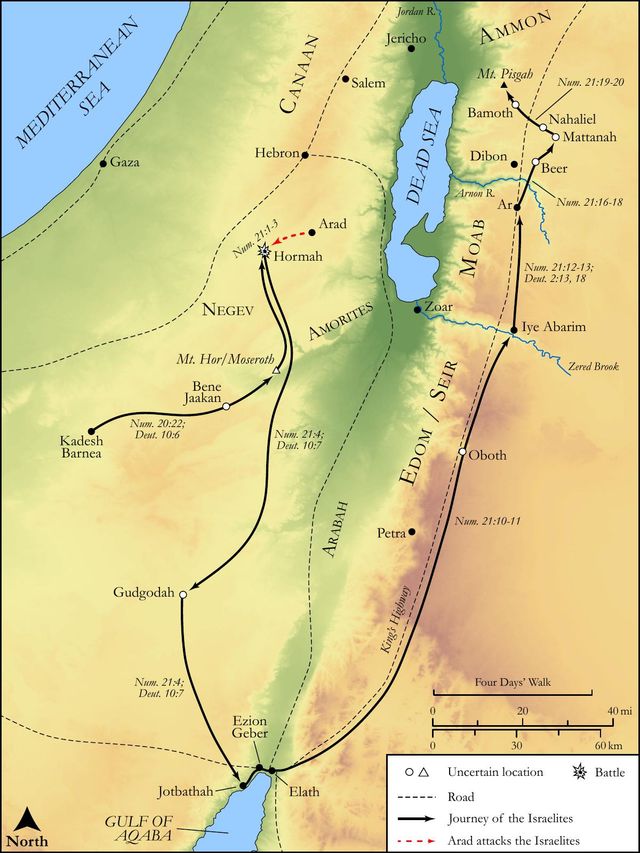
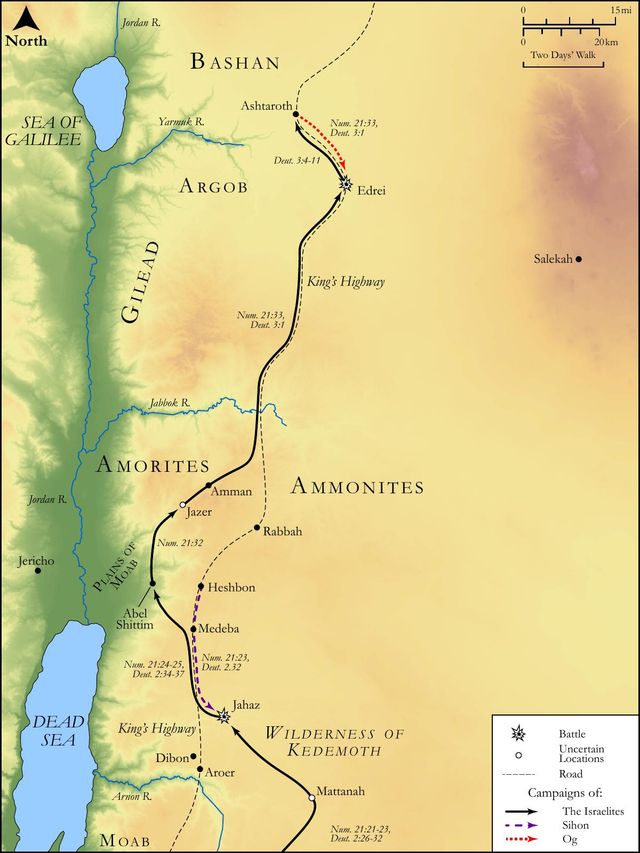
Study this verse
Public-domain commentary
Matthew Henry
From his Commentary on the Whole Bible. Henry comments on passages, not single verses — this entry covers Deuteronomy 2:24–37. His two-level outline is real structure in the source text, so it is rendered as structure.
God having tried the self-denial of his people in forbidding them to meddle with the Moabites and Ammonites, and they having quietly passed by those rich countries, and, though superior in number, not made any attack upon them, here he recompenses them for their obedience by giving them possession of the country of Sihon king of the Amorites. If we forbear what God forbids, we shall receive what he promises, and shall be no losers at last by our obedience, though it may seem for the present to be to our loss. Wrong not others, and God shall right thee.
I.God gives them commission to seize upon the country of Sihon king of Heshbon, Deu 2:24, Deu 2:25.
This was then God's way of disposing of kingdoms, but such particular grants are not now either to be expected or pretended. In this commission observe,
1.Though God assured them that the land should be their own, yet they must bestir themselves, and contend in battle with the enemy. What God gives we must endeavour to get.
2.God promises that when they fight he will fight for them. Do you begin to possess it, and I will begin to put the dread of you upon them. God would dispirit the enemy and so destroy them, would magnify Israel and so terrify all those against whom they were commissioned. See Exo 15:14.
II.Moses sends to Sihon a message of peace, and only begs a passage through his land, with a promise to give his country no disturbance, but the advantage of trading for ready money with so great a body, Deu 2:26-29. Moses herein did neither disobey God, who bade him contend with Sihon, nor dissemble with Sihon; but doubtless it was by divine direction that he did it, that Sihon might be left inexcusable, though God hardened his heart. This may illustrate the method of God's dealing with those to whom he gives his gospel, but does not give grace to believe it.
III.Sihon began the war (Deu 2:32), God having made his heart obstinate, and hidden from his eyes the thing that belonged to his peace (Deu 2:30), that he might deliver him into the hand of Israel. Those that meddle with the people of God meddle to their own hurt; and God sometimes ruins his enemies by their own resolves. See Mic 4:11-13; Rev 16:14.
IV.Israel was victorious.
1.They put all the Amorites to the sword, men, women, and children (Deu 2:33, Deu 2:34); this they did as the executioners of God's wrath; now the measure of the Amorites' iniquity was full (Gen 15:16), and the longer it was in the filling the sorer was the reckoning at last. This was one of the devoted nations. They died, not as Israel's enemies, but as sacrifices to divine justice, in the offering of which sacrifices Israel was employed, as a kingdom of priests. The case being therefore extraordinary, it ought not to be drawn into a precedent for military executions, which make no distinction and give no quarter: those will have judgment without mercy that show no mercy.
2.They took possession of all they had; their cities (Deu 2:34), their goods (Deu 2:35), and their land, Deu 2:36. The wealth of the sinner is laid up for the just. What a new world did Israel now come into! Most of them were born, and had lived all their days, in a vast howling wilderness, where they knew not what either fields or cities were, had no houses to dwell in, and neither sowed nor reaped; and now of a sudden to become masters of a country so well built, so well husbanded, this made them amends for their long waiting, and yet it was but the earnest of a great deal more. Much more joyful will the change be which holy souls will experience when they remove out of the wilderness of this world to the better country, that is, the heavenly, to the city that has foundations.
Continue studying Deuteronomy 2:33 across the web’s major study libraries — every link below opens this exact verse, chapter, or book on the destination site.
Read & Compare
 BibleGatewayThis verse in more than 200 translations and 70 languages.
 Bible.comThe YouVersion reader — hundreds of translations, reading plans, and highlights.
 ESV.orgCrossway's official English Standard Version reader.
 NET BibleThe NET translation with 60,000+ translators' notes on every rendering decision.
 STEP BibleTyndale House's free study tool — original text, vocabulary, and scholarly resources.
 BibliaLogos Bible Software's free web reader.
 USCCBThe New American Bible (Revised Edition) with the U.S. bishops' study notes.
Commentaries
 BibleHub CommentariesDozens of classic commentaries on this verse, gathered on one page.
 StudyLightMore than 100 commentary sets — the largest collection on the web.
 BibleRefPlain-English commentary on what this verse means, verse by verse.
 Enduring WordDavid Guzik's free commentary on this chapter, widely used by Bible teachers.
 Bible Study ToolsVerse commentary alongside Greek and Hebrew study aids.
Original Language & Research
- BibleHub InterlinearThe verse word by word — original language, transliteration, and English.
- BibleHub LexiconEvery word's original-language definition and Strong's entry.
 Blue Letter BibleDeep-study tools — Strong's numbers, concordance, and word studies.
 SefariaThe Hebrew text with Rashi and centuries of Jewish commentary.
Sermons, Hymns & Audio


TrulyRandomVerse is not affiliated with these sites and doesn’t control their content. They’re linked because they’re genuinely useful.
Summary
Deuteronomy 2:33 marks a pivotal moment in Israel's wilderness journey, chronicling the decisive victory over King Sihon of Heshbon. This verse powerfully attributes Israel's success not to their military might, but to the direct, sovereign intervention of Yahweh, who actively "delivered" Sihon into their hands. It underscores God's unwavering faithfulness to His covenant promises, enabling Israel to commence their territorial conquests east of the Jordan, a foundational step towards possessing the Promised Land and fulfilling their divine mandate.
Context
ShowHideLiterary Context
Deuteronomy 2 is situated within Moses' final discourses to the new generation of Israelites, delivered on the plains of Moab as they stand poised to enter Canaan. Following a review of their forty years of wilderness wandering, which highlighted God's consistent provision and disciplinary judgments, Moses transitions to recount their initial encounters with the inhabitants of the land. Specifically, Deuteronomy 2:26-30 details Israel's attempt at peaceful passage through King Sihon's territory. Crucially, Sihon's subsequent refusal and aggressive posture are presented not as a random act, but as divinely orchestrated: "the LORD your God hardened his spirit and made his heart obstinate, that He might deliver him into your hand" (Deuteronomy 2:30). Verse 33 directly follows this divine decree, serving as its immediate and forceful fulfillment, thereby setting the stage for the subsequent conquest of King Og in Deuteronomy 3.
Historical & Cultural Context
The events of Deuteronomy 2:33 transpired during the concluding phase of Israel's forty-year sojourn, as they approached the land of Canaan from the eastern Transjordanian plateau. King Sihon, an Amorite ruler, controlled Heshbon, a city of considerable strategic importance due to its location on vital trade routes. The refusal of passage was a common pretext for conflict among the nations of that day, often leading to full-scale warfare. For Israel, this battle transcended a mere territorial dispute; it was a divinely commanded act of conquest, integral to the fulfillment of God's promise of a land. The "smoting" of Sihon and his people reflects the brutal realities of ancient warfare, where complete victory often entailed the destruction of the enemy's military capacity and the subjugation or elimination of its populace. This practice, while harsh, is understood within the broader Old Testament context of herem (holy war), where certain enemies were devoted to destruction as an act of divine judgment and to prevent spiritual contamination of Israel.
Key Themes
ShowHideThe overarching theme permeating Deuteronomy 2 and powerfully underscored in verse 33 is Divine Sovereignty and Deliverance. The emphatic declaration, "the LORD our God delivered him before us," unequivocally asserts that the victory originated solely from Yahweh's initiative and power, not Israel's strength or military prowess. This reinforces the profound theological truth that God actively intervenes in human history to accomplish His purposes and fulfill His covenant promises, particularly His oath to Abraham concerning the land (Genesis 12:7). Another significant theme is Obedience and Consequence. Israel's actions in "smoting" Sihon were a direct and immediate response to God's prior declaration and command, illustrating that divine promises often necessitate human obedience for their realization. This victory also marks the crucial beginning of Israel's Territorial Acquisition, signifying a foundational step in their transformation from nomadic wanderers to a settled nation, laying the indispensable groundwork for the more extensive conquests detailed in the book of Joshua.
Exposition and Analysis
ShowHideKey Word Analysis
ShowHideThis verb (H5414, נָתַן) is a primitive root meaning "to give," used with great latitude of application, including "to put," "to make," or "to set." In the context of warfare, as seen here and in numerous other biblical passages (e.g., Joshua 10:8), it specifically conveys the nuance of "to hand over," "to surrender," or "to give into the hand of." The active voice and the explicit subject "the LORD our God" unequivocally establish God as the primary agent of this transfer of power. It signifies not merely a passive allowance but an active, intentional act of divine intervention, ensuring Israel's victory and demonstrating His sovereign control over the outcome of battles.
The verb (H5221, נָכָה) is a primitive root meaning "to strike" (lightly or severely, literally or figuratively). In military contexts, it denotes a decisive and often violent defeat, implying a comprehensive rout and slaughter of the enemy. It is a strong term that conveys the completeness of the victory and the severity of the judgment executed upon Sihon and his people. While Israel performs the action, the narrative frames it as the direct consequence and fulfillment of God's prior act of "delivering" Sihon, emphasizing that Israel's military action was divinely sanctioned, empowered, and successful because God had already secured the victory.
Verse Breakdown
ShowHide"And the LORD our God delivered him before us;"
This opening clause serves as the theological bedrock of the verse, immediately establishing Yahweh as the sovereign actor and the ultimate source of Israel's triumph. The possessive phrase "our God" highlights the intimate covenant relationship, underscoring God's unwavering faithfulness to His chosen people. The verb "delivered" (Hebrew, nâthan') signifies an active, intentional handing over of King Sihon and his forces into Israel's power, directly confirming God's prior declaration in Deuteronomy 2:30 that He would harden Sihon's heart precisely for this purpose. The phrase "before us" suggests a public, undeniable display of divine power, visible to all Israel, thereby reinforcing their trust in God's active presence.
"and we smote him, and his sons, and all his people."
This second clause describes the human action that immediately followed and completed the divine act. "We smote him" indicates Israel's obedient participation in the divinely ordained conquest, demonstrating their role as instruments of God's will. The comprehensive nature of the defeat is powerfully emphasized by the inclusion of "his sons" (implying the eradication of the royal line and key military leadership) and "all his people" (encompassing the entire populace, likely referring to the fighting men and their families, as the context of holy war often included the destruction of all who posed a threat to Israel's purity and possession of the land). This clause confirms the complete and decisive victory over Sihon's kingdom, fulfilling God's promise of deliverance and territorial acquisition.
Literary Devices
ShowHideDeuteronomy 2:33 masterfully employs several literary devices to amplify its profound theological message. The most prominent is Divine Agency, where the actions of God are explicitly foregrounded as the primary cause. The opening phrase, "And the LORD our God delivered him," immediately establishes Yahweh as the ultimate orchestrator, making Israel's subsequent military actions a direct response to divine initiative rather than an independent human achievement. This creates a powerful sense of Theological Determinism, where the outcome of the battle is predetermined by God's sovereign will, as explicitly foreshadowed in Deuteronomy 2:30. The verse also utilizes Conciseness and Directness, presenting a complex military encounter in a straightforward, declarative manner, which emphasizes the certainty and swiftness of God's judgment and Israel's assured victory. Furthermore, the enumeration of "him, and his sons, and all his people" is a form of Merism or Totality, signifying the complete and utter destruction of Sihon's kingdom, leaving no part unconquered. This reinforces the idea of a thorough, decisive, and divinely accomplished victory.
Theological and Thematic Connections
ShowHideDeuteronomy 2:33 stands as a profound testament to God's active sovereignty in the affairs of nations and His unwavering faithfulness to His covenant people. It is far more than a mere historical record of a battle; it is a theological declaration that Israel's success in possessing the land was entirely dependent on Yahweh's prior deliverance. This foundational truth permeates the entire Old Testament narrative, profoundly shaping Israel's understanding of their identity, their mission, and their reliance on divine power. The victory over Sihon serves as a paradigm for all subsequent conquests, demonstrating that when God "delivers," human effort becomes the indispensable instrument of divine will, not the source of power. It underscores that God actively fights for His people, clears their path, and fulfills His promises, even when faced with seemingly insurmountable opposition, thereby cultivating a deep trust in His unfailing power and purpose.
Reflection and Application
ShowHideDeuteronomy 2:33 offers profound encouragement and practical guidance for believers navigating the complexities of contemporary life. In a world that often champions self-reliance, human ingenuity, and individual achievement, this verse powerfully redirects our focus to the ultimate source of all true victory: God Himself. It serves as a potent reminder that our greatest battles—whether spiritual, personal, relational, or communal—are ultimately fought and won by the Lord. Just as God sovereignly "delivered" King Sihon into Israel's hands, He continues to go before us, preparing the way, removing formidable obstacles, and empowering us to overcome. This truth does not negate our responsibility to act in faith, courage, and obedience ("we smote him"), but it fundamentally reorients our perspective, ensuring that our trust is placed squarely in His sovereign power rather than our own limited strength or capabilities. When faced with seemingly insurmountable challenges or daunting tasks, we are called to remember that the battle ultimately belongs to the Lord, and our role is to walk in His commanded path, confident in His promised deliverance. This verse cultivates a spirit of profound humility, radical dependence, and deep gratitude for God's active, intervening involvement in every facet of our lives.
Questions for Reflection
ShowHideFAQ
ShowHideDoes "smote him, and his sons, and all his people" imply total annihilation, including women and children?
ShowHideThe phrase "smote him, and his sons, and all his people" (וַנַּךְ אֹתוֹ וְאֶת־בָּנָיו וְאֶת־כָּל־עַמּוֹ) in Deuteronomy 2:33 describes a decisive and comprehensive military victory. In the wars of that day, and particularly within the context of Israel's divinely commanded conquests, such language often implies the complete defeat of the enemy's military force and the subjugation or elimination of the populace that posed a direct threat. While the text in Deuteronomy 2 does not explicitly detail the fate of women and children for Sihon's kingdom at this precise point, later accounts of conquest within Sihon's territory, such as in Deuteronomy 2:34, explicitly state that "we utterly destroyed every city, men, women, and children; we left none to remain." This indicates that the command of herem (devotion to destruction) was indeed applied to Sihon's territory. The severity of these commands is understood within the theological framework of God's righteous judgment against the pervasive wickedness and idolatry of the Canaanite nations, and the necessity of preventing their corrupting practices from contaminating the nascent nation of Israel.
How does this verse reconcile with God's character of love and mercy?
ShowHideReconciling passages like Deuteronomy 2:33 with God's character of love and mercy requires a nuanced understanding of the broader biblical narrative and theological context. First, these conquests are consistently presented as divine judgment against the extreme moral depravity, idolatry, and abhorrent practices of the Canaanite nations, whose "iniquity... is not yet complete" (Genesis 15:16). God had demonstrated remarkable patience for centuries. Second, the establishment of Israel in the Promised Land was absolutely crucial for God's overarching redemptive plan for all humanity, as it was through this chosen nation that the Messiah, Jesus Christ, would eventually come. The removal of the corrupting influence of these nations was deemed necessary to preserve the spiritual purity of the covenant people and the lineage through which salvation would be offered to the world. Third, God's mercy and discernment are still evident even within these narratives; for instance, He explicitly commanded Israel not to provoke or attack the Edomites, Moabites, and Ammonites (Deuteronomy 2:4-9), demonstrating that His judgment was specific, purposeful, and not indiscriminate. Ultimately, the Bible presents a God who is both perfectly loving and perfectly just, and His actions, though sometimes difficult for human comprehension, are always consistent with His holy character and His overarching redemptive purposes for creation.
Christ-Centered Fulfillment
ShowHideDeuteronomy 2:33, while depicting an Old Testament military victory, finds its ultimate and profound Christ-centered fulfillment in the person and redemptive work of Jesus Christ. Just as "the LORD our God delivered" King Sihon into Israel's hands, so too did God the Father "deliver" the ultimate enemies of humanity—Satan, sin, and death—into the hands of His Son, Jesus. The decisive "smoting" of Sihon and his people powerfully foreshadows Christ's triumphant victory on the cross and through His resurrection, where He "disarmed the powers and authorities, he made a public spectacle of them, triumphing over them by the cross" (Colossians 2:15). Jesus, the true and perfect Israel, did not conquer through physical warfare but through self-sacrificial love and perfect obedience, becoming the Lamb of God who takes away the sin of the world. His resurrection is the supreme demonstration of God's "delivering" power, signifying the complete and final defeat of death's dominion and the grave's sting (1 Corinthians 15:54-57). For the believer, this means that our spiritual battles are fought not for victory, but from a position of Christ's already accomplished victory, for He has already "delivered us from the dominion of darkness and transferred us to the kingdom of his beloved Son" (Colossians 1:13). We are called not to conquer nations with swords, but to live in the freedom of Christ's finished work, participating in the spread of His kingdom through the power of the Gospel, knowing with absolute certainty that He has already overcome the world (John 16:33).