


Numbers 21:34
- וַיֹּאמֶרvai·Yo·merand he saidH559Conj-w ¦ V-Qal-ConsecImperf-3msVerb Qal Consecutive Imperfect 3rd Singular Masculineוַandיֹּאמֶרhe said
- יְהוָהYah·wehYahwehH3068N-properNoun Proper Title
- אֶל'eltoH413PrepPreposition
- מֹשֶׁהmo·ShehMosesH4872N-proper-mNoun Proper Masculine
- אַל'almay notH408NegParticle Negative
- תִּירָאti·Ra'you fearH3372V-Qal-Imperf-2msVerb Qal Imperfect 2nd Singular Masculine
- אֹתוֹ'o·To<obj.> himH853DirObjM ¦ 3msParticle Object Indicatorאֹת<obj.>וֹhim
- כִּיkiforH3588PrtParticle Conditional
- בְיָדְךָve·ya·de·Khain your handH3027Prep-b ¦ N-csc ¦ 2msNoun Singular common gender Constructבְinיָדְhandךָyour
- נָתַתִּיna·Ta·tiI have givenH5414V-Qal-Perf-1csVerb Qal Perfect 1st Singular common gender
- אֹתוֹ'o·To<obj.> himH853DirObjM ¦ 3msParticle Object Indicatorאֹת<obj.>וֹhim
- וְאֶתve·'Etand <obj.>H853Conj-w ¦ DirObjMParticle Object Indicatorוְandאֶת<obj.>
- כָּלkolallH3605N-mscNoun Singular Masculine Construct
- עַמּוֹa·Mohis peopleH5971N-msc ¦ 3msNoun Singular Masculine Constructעַמּpeopleוֹhis
- וְאֶתve·'Etand <obj.>H853Conj-w ¦ DirObjMParticle Object Indicatorוְandאֶת<obj.>
- אַרְצוֹ'ar·Tzohis landH776N-fsc ¦ 3msNoun Singular Feminine Constructאַרְצlandוֹhis
- וְעָשִׂיתָve·'a·Si·taand you will doH6213Conj-w ¦ V-Qal-ConsecPerf-2msVerb Qal Consecutive Perfect 2nd Singular Masculineוְandעָשִׂיתָyou will do
- לּוֹloto <the> himPrep-l ¦ 3msSuffix Personal 3rd Singular Masculineלּto <the>וֹhim
- כַּאֲשֶׁרka·'a·Sherjust asH834Prep-k ¦ RelParticle Relativeכַּjustאֲשֶׁרas
- עָשִׂיתָ'a·Si·tayou didH6213V-Qal-Perf-2msVerb Qal Perfect 2nd Singular Masculine
- לְסִיחֹןle·si·Chonto SihonH5511Prep-l ¦ N-proper-mNoun Proper MasculineלְtoסִיחֹןSihon
- מֶלֶךְMe·lekh[the] king ofH4428N-mscNoun Singular Masculine Construct
- הָאֱמֹרִיha·'e·mo·Rithe Amorite[s]H567Art ¦ N-msNoun Gentilic Singular Masculine AbsoluteהָtheאֱמֹרִיAmorite[s]
- אֲשֶׁר'a·SherwhoH834RelParticle Relative
- יוֹשֵׁבyo·Shev[was] dwellingH3427V-Qal-Prtcpl-msVerb Qal Participle Singular Masculine Absolute
- בְּחֶשְׁבּוֹןbe·chesh·Bonin HeshbonH2809Prep-b ¦ N-properNoun Proper LocationבְּinחֶשְׁבּוֹןHeshbon
English is a literal word-by-word gloss of the Hebrew, not the KJV's wording. Why?
This is the original text the KJV's translators worked from — each Hebrew word with its own literal English meaning in this verse, prepared by scholars at Tyndale House, Cambridge. The KJV translates whole sentences, not word by word, so its wording differs: one Hebrew word can become several English words, and the KJV may choose “the LORD” where the gloss reads “Yahweh”. Both are faithful — they answer different questions. For the KJV's own rendering, switch to the KJV text.
Details
See on the biblical-era maps
Study this verse
Public-domain commentary
Matthew Henry
From his Commentary on the Whole Bible. Henry comments on passages, not single verses — this entry covers Numbers 21:21–35. His four-level outline is real structure in the source text, so it is rendered as structure.
We have here an account of the victories obtained by Israel over Sihon and Og, which must be distinctly considered, not only because they are here distinctly related, but because long afterwards the memorial of them is distinctly celebrated, and they are severally assigned as instances of everlasting mercy. He slew Sihon king of the Amorites, for his mercy endureth for ever, and Og the king of Bashan, for his mercy endureth for ever, Psa 136:19, Psa 136:20.
I.Israel sent a peaceable message to Sihon king of the Amorites (Num 21:21), but received an unpeaceable return, worse than that of the Edomites to the like message, Num 20:18, Num 20:20. For the Edomites only refused them a passage, and stood upon their own defence to keep them out; but Sihon went out with his forces against Israel in the wilderness, out of his own borders, without any provocation given him (Num 21:23), and so ran himself upon his own ruin. Jephtha intimates that he was prompted by his politics to do this (Jdg 11:20), Sihon trusted not Israel to pass through his coast; but his politics deceived him, for Moses says, God hardened his spirit and made his heart obstinate, that he might deliver him into the hand of Israel, Deu 2:30. The enemies of God's church are often infatuated in those very counsels which they think most wisely taken. Sihon's army was routed, and not only so, but all his country came into the possession of Israel, Num 21:24, Num 21:25. This seizure is justified,
1.Against the Amorites themselves, for they were the aggressors, and provoked the Israelites to battle; and yet, perhaps, that would not have been sufficient to entitle Israel to their land, but that God himself, the King of nations, the Lord of the whole earth, had given them a grant of it. The Amorites formed one of the devoted nations whose land God had promised to Abraham and his seed, which promise should be performed when the iniquity of the Amorites should be full, Gen 15:16. Jephtha insists upon this grant as their title, Jdg 11:23, Jdg 11:24. The victory which God gave them over the Amorites put them in possession, and then, the promise made to their fathers having given them a right, by virtue of that they kept possession.
2.Against the Moabites, who had formerly been the lords-proprietors of this country. If they should ever lay claim to it, and should plead that God himself had provided that none of their land should be given to Israel for a possession (Deu 2:9), Moses here furnishes posterity with a replication to their plea, and Jephtha makes use of it against the Amorites 260 years afterwards, when Israel's title to this country was questioned.
(1.)The justification itself is that though it was true this country had belonged to the Moabites, yet the Amorites had taken it from them some time before, and were now in full and quiet possession of it, Num 21:26. The Israelites did not take it out of the hands of the Moabites, they had before lost it to the Amorites, and were constrained to give up their pretensions to it; and, when Israel had taken it from the Amorites, they were under no obligation to restore it to the Moabites, whose title to it was long since extinguished. See here the uncertainty of worldly possessions, how often they change their owners, and how soon we may be deprived of them, even when we think ourselves most sure of them; they make themselves wings. It is our wisdom therefore to secure the good part which cannot be taken away from us. See also the wisdom of the divine Providence and its perfect foresight, by which preparation is made long before for the accomplishment of all God's purposes in their season. This country being designed in due time for Israel, it is beforehand put into the hand of the Amorites, who little think that they have it but as trustees till Israel come of age, and then must surrender it. We understand not the vast reaches of Providence, but known unto God are all his works, as appears in this instance, that he set the bounds of the people according to the number of the children of Israel, Deu 32:8. All that land which he intended for his chosen people he put into the possession of the devoted nations, that were to be driven out.
(2.)For proof of the allegation, he refers to the authentic records of the country, for so their proverbs or songs were, one of which he quotes some passages out of (Num 21:27-30), which sufficiently proves what is vouched for, namely,
[1.]That such and such places that are here named, though they had been in the possession of the Moabites, had by right of war become the dominion of Sihon king of the Amorites. Heshbon had become his city, and he obtained such a quiet possession of it that it was built and prepared for him (Num 21:27), and the country to Dibon and Nophah was likewise subdued, and annexed to the kingdom of the Amorites, Num 21:30,
[2.]That the Moabites were utterly disabled ever to regain the possession. Even Ar of Moab, though not taken or attempted by Sihon, but still remaining the metropolis of Moab, yet was so wasted by this loss that is would never be able to make head, Num 21:28. The Moabites were undone, and even Chemosh their god had given them up, as unable to rescue them out of the hands of Sihon, Num 21:29. By all this it appears that the Moabites' claim to this country was barred for ever. There may be a further reason for inserting this Amorite poem, namely, to show that the triumphing of the wicked is short. Those that had conquered the Moabites, and insulted over them, were now themselves conquered and insulted over by the Israel of God. It is very probable that the same Sihon, king of the Amorites, that had got this country from the Moabites, now lost it to the Israelites; for, though it is said to be taken from a former king of Moab (Num 21:26), yet not by a former king of the Amorites; and then it shows how sometimes justice makes men to see the loss of that which they got by violence, and were puffed up with the gain of. They are exalted but for a little while, Job 24:24.
II.Og king of Bashan, instead of being warned by the fate of his neighbours to make peace with Israel, is instigated by it to make war with them, which proves in like manner to be his destruction. Og was also an Amorite, and therefore perhaps thought himself better able to deal with Israel than his neighbours were, and more likely to prevail, because of his own gigantic strength and stature, which Moses takes notice of, Deu 3:11, where he gives a more full account of this story. Here observe,
1.That the Amorite begins the war (Num 21:33): He went out to battle against Israel. His country was very rich and pleasant. Bashan was famous for the best timber (witness the oaks of Bashan), and the best breed of cattle, witness the bulls and kine of Bashan, and the lambs and rams of that country, which are celebrated, Deu 32:14. Wicked men do their utmost to secure themselves and their possessions against the judgments of God, but all in vain, when their day comes, on which they must fall.
2.That God interests himself in the cause, bids Israel not to fear this threatening force, and promises a complete victory: "I have delivered him into thy hand (Num 21:34); the thing is as good as done already, it is all thy own, enter and take possession." Giants are but worms before God's power.
3.That Israel is more than a conqueror, not only routs the enemies' army, but gains the enemies' country, which afterwards was part of the inheritance of the two tribes and a half that were first seated on the other side Jordan. God gave Israel these successes, while Moses was yet with them, both for his comfort (that he might see the beginning of that glorious work, which he must not live to see the finishing of) and for the encouragement of the people in the war of Canaan under Joshua. Though this was to them in comparison but as the day of small things, yet it was an earnest of great things.
Continue studying Numbers 21:34 across the web’s major study libraries — every link below opens this exact verse, chapter, or book on the destination site.
Read & Compare
 BibleGatewayThis verse in more than 200 translations and 70 languages.
 Bible.comThe YouVersion reader — hundreds of translations, reading plans, and highlights.
 ESV.orgCrossway's official English Standard Version reader.
 NET BibleThe NET translation with 60,000+ translators' notes on every rendering decision.
 STEP BibleTyndale House's free study tool — original text, vocabulary, and scholarly resources.
 BibliaLogos Bible Software's free web reader.
 USCCBThe New American Bible (Revised Edition) with the U.S. bishops' study notes.
Commentaries
 BibleHub CommentariesDozens of classic commentaries on this verse, gathered on one page.
 StudyLightMore than 100 commentary sets — the largest collection on the web.
 BibleRefPlain-English commentary on what this verse means, verse by verse.
 Enduring WordDavid Guzik's free commentary on this chapter, widely used by Bible teachers.
 Bible Study ToolsVerse commentary alongside Greek and Hebrew study aids.
Original Language & Research
- BibleHub InterlinearThe verse word by word — original language, transliteration, and English.
- BibleHub LexiconEvery word's original-language definition and Strong's entry.
 Blue Letter BibleDeep-study tools — Strong's numbers, concordance, and word studies.
 SefariaThe Hebrew text with Rashi and centuries of Jewish commentary.
Sermons, Hymns & Audio


TrulyRandomVerse is not affiliated with these sites and doesn’t control their content. They’re linked because they’re genuinely useful.
Summary
Numbers 21:34 records a pivotal divine declaration to Moses, dispelling any fear concerning Og, the formidable king of Bashan. This pronouncement is a powerful assurance of total victory, not only over Og himself but also over his entire people and their land. Critically, the LORD explicitly draws a parallel to Israel's recent, decisive triumph over Sihon, king of the Amorites, thereby establishing a divine precedent and reinforcing God's unwavering faithfulness. This declaration serves to instill profound courage and unwavering confidence in Moses and the Israelites, affirming God's active sovereignty and His commitment to leading His people to inherit the promised land.
Context
ShowHideLiterary Context
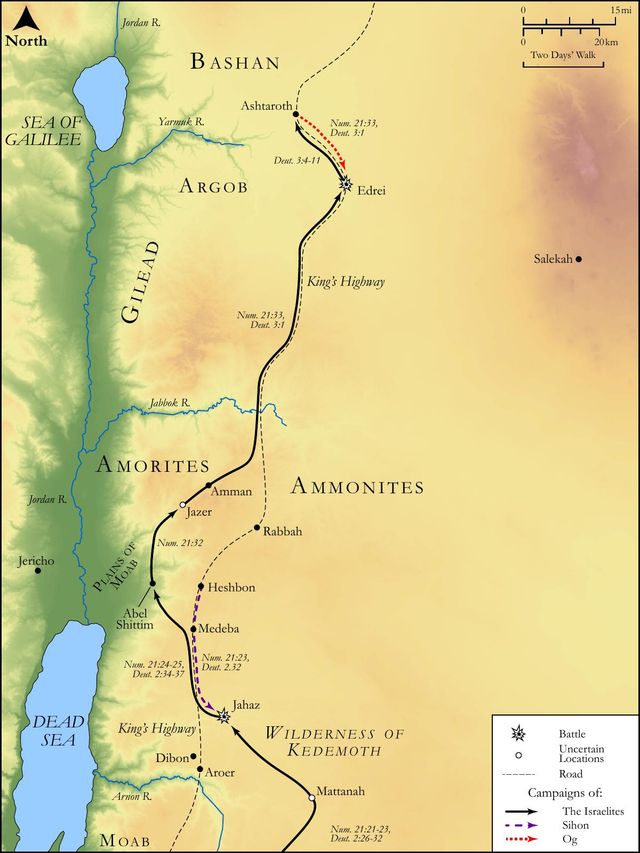
This verse is strategically positioned at a critical juncture in Israel's wilderness journey, immediately following their significant and divinely enabled victory over Sihon, king of the Amorites, as detailed in Numbers 21:21-32. Having successfully navigated the wilderness and overcome their first major military challenge in Transjordan, the Israelites are now poised to confront Og, a king renowned for his strength and the formidable region of Bashan. The narrative flow highlights a progression of conquest, where each victory serves as a divine precedent for the next, building Israel's confidence in God's power. The LORD's direct address to Moses in Numbers 21:34 mirrors similar divine assurances given before daunting tasks throughout the Pentateuch, reinforcing the idea that Israel's success is not by their own might but by God's decree and intervention. This immediate context sets the stage for the battle against Og, which is recounted in Numbers 21:33-35.
Historical & Cultural Context
The Amorites and Bashanites were powerful kingdoms in the Transjordan region, east of the Jordan River. Sihon's capital, Heshbon, was a strategic city, and his defeat signaled Israel's growing military prowess, albeit divinely enabled. Og, king of Bashan, was particularly formidable, described in later texts as one of the last of the Rephaim, a race of giants (Deuteronomy 3:11). His territory, Bashan, was known for its fertile pastures, strong cities, and strategic location. In ancient Near Eastern warfare, the defeat of such powerful kings and the capture of their land were monumental achievements, often attributed to the patron deity of the conquering nation. The fear Moses and Israel might have felt facing Og was understandable given his reputation and the sheer scale of his kingdom, making the LORD's "Fear him not" a crucial divine intervention against human apprehension and a clear declaration of divine agency in the impending conflict. This divine command served not only to reassure but also to underscore that the battle was the LORD's.
Key Themes
ShowHideNumbers 21:34 powerfully articulates several core themes central to the book of Numbers and the broader Pentateuch. Firstly, Divine Assurance and Sovereignty is paramount; God's command "Fear him not" coupled with "I have delivered him into thy hand" underscores His absolute control over human kings and nations, and His active, decisive role in Israel's destiny. This is not a mere prediction but a declaration of a divinely accomplished reality, emphasizing that God's will cannot be thwarted. Secondly, God's Faithfulness and Consistency is highlighted by the instruction "thou shalt do to him as thou didst unto Sihon king of the Amorites." This reminds Moses and the people that God's past acts of deliverance are a firm basis for future trust, demonstrating His unchanging character and commitment to His covenant promises. The victory over Sihon (Numbers 21:21-32) serves as a tangible pledge for the victory over Og. Finally, the verse reinforces the theme of Conquest as Divine Mandate. The military campaigns of Israel were not arbitrary acts of aggression but divinely ordained steps in the process of inheriting the land promised to Abraham, Isaac, and Jacob (Genesis 12:7). The defeat of Og secured the vital Transjordanian territory, paving the way for Israel's entry into Canaan proper, demonstrating God's meticulous fulfillment of His word.
Exposition and Analysis
ShowHideKey Word Analysis
ShowHideA primitive root meaning "to fear," but morally, "to revere" or "to be had in reverence." In this context, it is a direct imperative from the LORD to Moses, commanding him to overcome apprehension. It implies that the basis for not fearing is God's presence, power, and explicit promise of deliverance. Here, it directly addresses Moses' potential apprehension regarding Og, redirecting his focus from the enemy's might to God's omnipotence and the reverence due to Him.
A primitive root meaning "to give," used with great latitude of application, including "to put," "to make," "to bestow," or "to deliver (up)." The perfect tense "I have delivered" (nāṯattî) indicates a completed action from God's perspective, emphasizing that the victory is already assured and accomplished in the divine realm, even before the battle has physically begun. This underscores God's direct agency and sovereignty over the outcome of the conflict, making the victory a divine gift.
A primitive word for "hand," often used figuratively to denote power, means, control, or dominion. The idiom "delivered him into thy hand" signifies a complete, decisive, and irreversible victory, where the enemy is utterly subdued and brought under the control of the recipient. This powerful imagery reinforces the totality of the promised triumph and the transfer of authority from Og to Moses and Israel by divine intervention.
Verse Breakdown
ShowHide"And the LORD said unto Moses, Fear him not:"
This opening clause establishes the divine origin of the message and its direct recipient, Moses, the leader of Israel. The command "Fear him not" is a direct address to any apprehension Moses might harbor concerning Og, whose reputation and might were likely well-known. It is an imperative designed to bolster faith and courage, shifting focus from the perceived strength of the enemy to the absolute power of God, emphasizing that the human leader's confidence should rest solely on divine assurance.
"for I have delivered him into thy hand, and all his people, and his land;"
This provides the divine rationale for the command not to fear. The conjunction "for" (כִּי, kî) introduces the reason. The LORD declares a past-tense action ("I have delivered"), indicating that from His eternal perspective, the victory over Og is already a settled matter. This delivery encompasses not only Og himself but also his entire nation ("all his people") and his entire domain ("and his land"), signifying a comprehensive and total conquest, leaving no doubt about the completeness of the impending victory and the scope of God's sovereign power.
"and thou shalt do to him as thou didst unto Sihon king of the Amorites, which dwelt at Heshbon."
This final clause provides a concrete precedent and a specific instruction. By referencing the recent, successful campaign against Sihon, the LORD reminds Moses of His consistent faithfulness and power. The past victory serves as a template for the future one, assuring Moses that the same divine power that secured the defeat of Sihon will also ensure the defeat of Og. This instruction is both a command and a promise, linking God's past actions to His future intentions and providing a clear operational directive for Israel's military engagement, ensuring continuity in God's redemptive plan.
Literary Devices
ShowHideNumbers 21:34 employs several potent literary devices to convey its message of divine assurance and victory. The most prominent is the Divine Command, "Fear him not," which serves as a direct imperative from God to Moses, designed to dispel human apprehension and instill faith. This command is immediately followed by a Divine Declaration of Assurance, "for I have delivered him into thy hand," which acts as the foundation for the command, asserting God's sovereign control over the outcome. The phrase "delivered him into thy hand" is a powerful Hebraic Idiom or Metaphor, signifying complete and decisive victory, where the enemy is utterly subdued and brought under the control of the conquering party. Furthermore, the verse utilizes Analogy or Precedent by explicitly referencing the prior victory over Sihon: "as thou didst unto Sihon king of the Amorites." This draws a direct parallel between a past triumph and a future one, reinforcing God's consistency and faithfulness. This analogy also functions as Foreshadowing, signaling the guaranteed outcome of the battle with Og. The overall effect of these devices is to emphasize God's absolute sovereignty, His unwavering faithfulness, and the certainty of Israel's divinely-ordained conquest, building confidence in His leadership.
Theological and Thematic Connections
ShowHideNumbers 21:34 stands as a profound testament to God's active involvement in the affairs of His people and His unwavering commitment to His covenant promises. Theologically, it underscores the principle that true victory comes not from human strength or military might, but from divine decree and enablement. God's declaration, "I have delivered him into thy hand," reveals His sovereignty over all earthly powers and His capacity to orchestrate events according to His will, demonstrating that He is the ultimate arbiter of history. This verse also highlights God's faithfulness, reminding Israel that His past acts of deliverance (like the defeat of Sihon) are a guarantee of future victories, establishing a pattern of divine reliability. It teaches that obedience to God's command, even when facing formidable challenges, is met with divine empowerment and the assurance of His presence. The conquest of the land, though involving warfare, is presented as a fulfillment of God's ancient promises to Abraham, demonstrating His justice in dispossessing wicked nations and His grace in establishing His covenant people in their promised inheritance.
Reflection and Application
ShowHideNumbers 21:34 offers timeless encouragement for believers facing their own "Ogs" in life—those daunting challenges, overwhelming obstacles, or seemingly insurmountable adversaries that evoke fear and doubt. Just as God addressed Moses' potential apprehension directly, He speaks to our fears today, reminding us that no foe is too great for Him. The divine assurance, "Fear him not: for I have delivered him into thy hand," calls us to shift our gaze from the magnitude of the problem to the omnipotence of our God. It encourages us to recall God's past faithfulness in our lives, remembering how He has previously delivered us from trials, provided in scarcity, and guided through uncertainty. These personal "Sihon" victories become anchors for our faith, empowering us to step forward in obedience and courage, trusting that the same God who was faithful then will be faithful now. This verse is a powerful reminder that our battles, whether spiritual, emotional, or circumstantial, are ultimately God's battles, and He has already secured the victory for those who trust in Him. Our role is to obey His command, move forward in faith, and witness His power at work, knowing that His promises are steadfast and His power is limitless.
Questions for Reflection
ShowHideFAQ
ShowHideWhy did God command such warfare and the complete destruction of these kings and their people?
ShowHideGod's command for Israel to engage in warfare and dispossess nations like the Amorites and Bashanites was rooted in several theological and historical factors. Firstly, it was part of His covenant promise to Abraham, Isaac, and Jacob to give their descendants the land of Canaan (Genesis 15:18-21). Secondly, it was an act of divine judgment against the inhabitants of the land, whose wickedness and idolatry had reached a point of no return (Genesis 15:16, Leviticus 18:24-28). God, as the righteous Judge of all the earth, had the right to remove those who continually defied Him and engaged in abominable practices. Thirdly, it was essential for the preservation of Israel's spiritual purity. Allowing these idolatrous nations to remain would have led to Israel's corruption and turning away from the LORD, as later history tragically proved. The warfare was therefore a means of establishing His holy nation in a land where His unique covenant could flourish, free from the pervasive influence of paganism, and to demonstrate His absolute sovereignty over all nations.
What was particularly significant about Og, King of Bashan, that required such specific divine assurance?
ShowHideOg was not just any king; he was depicted as an exceptionally formidable figure, a remnant of a powerful, giant-like race. Deuteronomy 3:11 describes him as one of the last of the Rephaim, a race of giants, evidenced by his enormous iron bedstead (or sarcophagus) measuring nine cubits long (about 13.5 feet). His kingdom, Bashan, was known for its strength, its sixty fortified cities with high walls and gates, and its fertile, militarily significant territory. Facing such a powerful, giant-like king and his well-defended kingdom immediately after the battle with Sihon could have easily instilled fear and doubt in the Israelites, challenging their faith in God's continued provision. God's specific assurance in Numbers 21:34 was therefore crucial to counteract this natural human fear, emphasizing that even the most imposing human adversaries are no match for the LORD's power and His predetermined will for His people. It served as a direct challenge to human perception of strength, redirecting faith to divine omnipotence.
Christ-Centered Fulfillment
ShowHideNumbers 21:34, with its powerful message of divine assurance and guaranteed victory over a formidable foe, finds its ultimate and most profound fulfillment in Jesus Christ. The "Fear him not" spoken to Moses before the battle with Og echoes the divine reassurance given to humanity in the face of our greatest enemies: sin, death, and the devil. Just as God "delivered" Og into Moses' hand, so too has God "delivered" all spiritual adversaries into the hand of His Son, Jesus Christ. Through His death on the cross and triumphant resurrection, Jesus utterly disarmed the spiritual rulers and authorities, making a public spectacle of them and triumphing over them (Colossians 2:15). He became flesh and blood precisely "that through death he might destroy him that had the power of death, that is, the devil; and deliver them who through fear of death were all their lifetime subject to bondage" (Hebrews 2:14-15). The victory over Og was a physical conquest for a physical land; Christ's victory is a spiritual conquest for eternal life and a heavenly inheritance. He is the true King who has overcome the world (John 16:33), and He holds the keys of death and Hades (Revelation 1:18). For believers, the assurance given to Moses becomes a living reality in Christ: we are called not to fear, for our ultimate enemy has already been defeated by the Lamb of God, who came to destroy the works of the devil (1 John 3:8). In Him, we share in His victory and are more than conquerors (Romans 8:37).