


Numbers 21:33
- וַיִּפְנוּvai·yif·Nuand they turnedH6437Conj-w ¦ V-Qal-ConsecImperf-3mpVerb Qal Consecutive Imperfect 3rd Plural Masculineוַandיִּפְנוּthey turned
- וַיַּעֲלוּvai·ya·'a·Luand they went upH5927Conj-w ¦ V-Qal-ConsecImperf-3mpVerb Qal Consecutive Imperfect 3rd Plural Masculineוַandיַּעֲלוּthey went up
- דֶּרֶךְDe·rekh[the] direction ofH1870N-cscNoun Singular common gender Construct
- הַבָּשָׁןha·ba·Shan<the> BashanH1316Art ¦ N-properNoun Proper Locationהַ<the>בָּשָׁןBashan
- וַיֵּצֵאvai·ye·Tze'and he went outH3318Conj-w ¦ V-Qal-ConsecImperf-3msVerb Qal Consecutive Imperfect 3rd Singular Masculineוַandיֵּצֵאhe went out
- עוֹג'OgOgH5747N-proper-mNoun Proper Masculine
- מֶלֶךְMe·lekh[the] king ofH4428N-mscNoun Singular Masculine Construct
- הַבָּשָׁןha·ba·Shan<the> BashanH1316Art ¦ N-properNoun Proper Locationהַ<the>בָּשָׁןBashan
- לִקְרָאתָםlik·ra·Tamto meet themH7122Prep-l ¦ V-Qal-Inf ¦ 3mpVerb Qal Infinitive Constructלִtoקְרָאתָmeetםthem
- הוּאhu'heH1931Pro-3msPronoun Personal 3rd Singular Masculine
- וְכָלve·kholand allH3605Conj-w ¦ N-mscNoun Singular Masculine Constructוְandכָלall
- עַמּוֹa·Mohis peopleH5971N-msc ¦ 3msNoun Singular Masculine Constructעַמּpeopleוֹhis
- לַמִּלְחָמָהla·mil·cha·Mahfor <the> battleH4421Prep-l ¦ N-fsNoun Singular Feminine Absoluteלַfor <the>מִּלְחָמָהbattle
- אֶדְרֶעִי'ed·Re·'iEdreiH154N-properNoun Proper Location
English is a literal word-by-word gloss of the Hebrew, not the KJV's wording. Why?
This is the original text the KJV's translators worked from — each Hebrew word with its own literal English meaning in this verse, prepared by scholars at Tyndale House, Cambridge. The KJV translates whole sentences, not word by word, so its wording differs: one Hebrew word can become several English words, and the KJV may choose “the LORD” where the gloss reads “Yahweh”. Both are faithful — they answer different questions. For the KJV's own rendering, switch to the KJV text.
Details
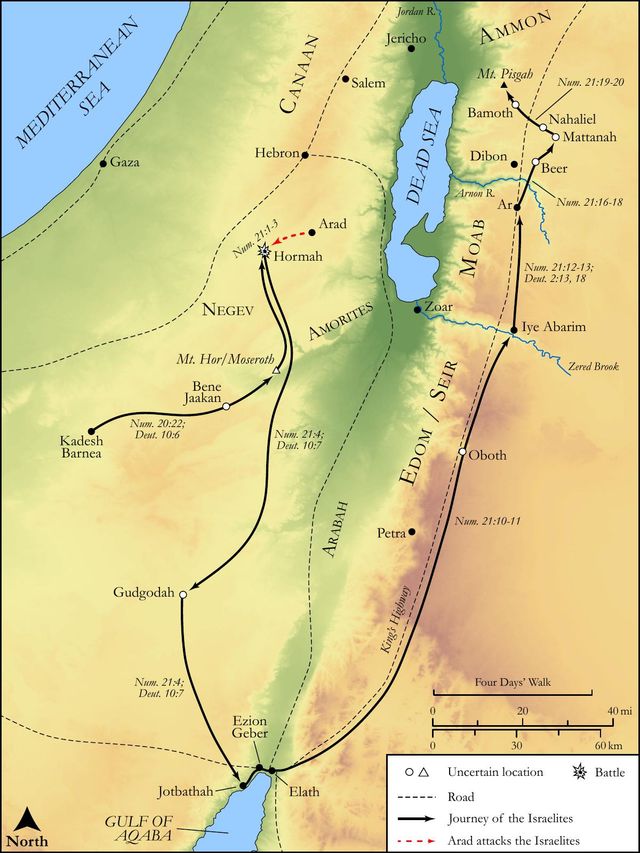
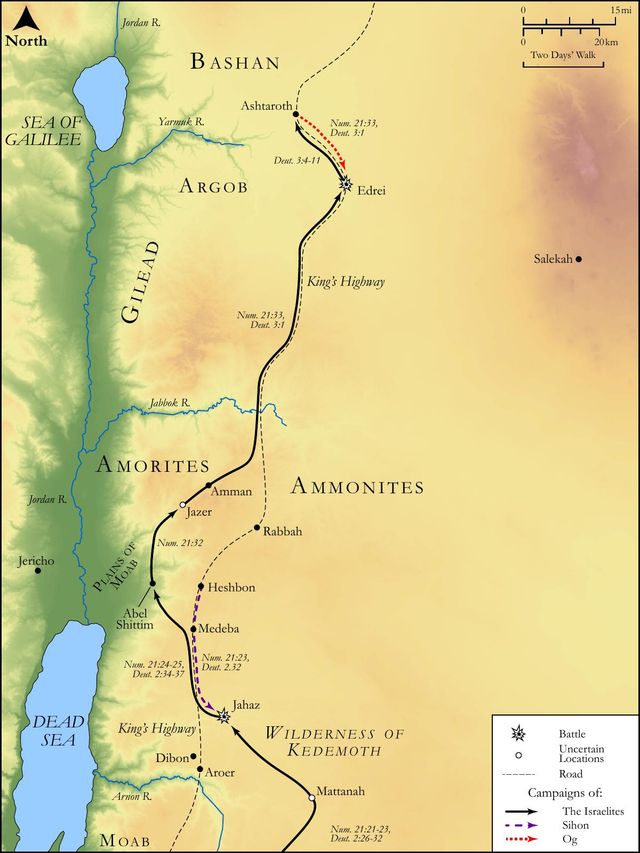
See on the biblical-era maps
Study this verse
Public-domain commentary
Matthew Henry
From his Commentary on the Whole Bible. Henry comments on passages, not single verses — this entry covers Numbers 21:21–35. His four-level outline is real structure in the source text, so it is rendered as structure.
We have here an account of the victories obtained by Israel over Sihon and Og, which must be distinctly considered, not only because they are here distinctly related, but because long afterwards the memorial of them is distinctly celebrated, and they are severally assigned as instances of everlasting mercy. He slew Sihon king of the Amorites, for his mercy endureth for ever, and Og the king of Bashan, for his mercy endureth for ever, Psa 136:19, Psa 136:20.
I.Israel sent a peaceable message to Sihon king of the Amorites (Num 21:21), but received an unpeaceable return, worse than that of the Edomites to the like message, Num 20:18, Num 20:20. For the Edomites only refused them a passage, and stood upon their own defence to keep them out; but Sihon went out with his forces against Israel in the wilderness, out of his own borders, without any provocation given him (Num 21:23), and so ran himself upon his own ruin. Jephtha intimates that he was prompted by his politics to do this (Jdg 11:20), Sihon trusted not Israel to pass through his coast; but his politics deceived him, for Moses says, God hardened his spirit and made his heart obstinate, that he might deliver him into the hand of Israel, Deu 2:30. The enemies of God's church are often infatuated in those very counsels which they think most wisely taken. Sihon's army was routed, and not only so, but all his country came into the possession of Israel, Num 21:24, Num 21:25. This seizure is justified,
1.Against the Amorites themselves, for they were the aggressors, and provoked the Israelites to battle; and yet, perhaps, that would not have been sufficient to entitle Israel to their land, but that God himself, the King of nations, the Lord of the whole earth, had given them a grant of it. The Amorites formed one of the devoted nations whose land God had promised to Abraham and his seed, which promise should be performed when the iniquity of the Amorites should be full, Gen 15:16. Jephtha insists upon this grant as their title, Jdg 11:23, Jdg 11:24. The victory which God gave them over the Amorites put them in possession, and then, the promise made to their fathers having given them a right, by virtue of that they kept possession.
2.Against the Moabites, who had formerly been the lords-proprietors of this country. If they should ever lay claim to it, and should plead that God himself had provided that none of their land should be given to Israel for a possession (Deu 2:9), Moses here furnishes posterity with a replication to their plea, and Jephtha makes use of it against the Amorites 260 years afterwards, when Israel's title to this country was questioned.
(1.)The justification itself is that though it was true this country had belonged to the Moabites, yet the Amorites had taken it from them some time before, and were now in full and quiet possession of it, Num 21:26. The Israelites did not take it out of the hands of the Moabites, they had before lost it to the Amorites, and were constrained to give up their pretensions to it; and, when Israel had taken it from the Amorites, they were under no obligation to restore it to the Moabites, whose title to it was long since extinguished. See here the uncertainty of worldly possessions, how often they change their owners, and how soon we may be deprived of them, even when we think ourselves most sure of them; they make themselves wings. It is our wisdom therefore to secure the good part which cannot be taken away from us. See also the wisdom of the divine Providence and its perfect foresight, by which preparation is made long before for the accomplishment of all God's purposes in their season. This country being designed in due time for Israel, it is beforehand put into the hand of the Amorites, who little think that they have it but as trustees till Israel come of age, and then must surrender it. We understand not the vast reaches of Providence, but known unto God are all his works, as appears in this instance, that he set the bounds of the people according to the number of the children of Israel, Deu 32:8. All that land which he intended for his chosen people he put into the possession of the devoted nations, that were to be driven out.
(2.)For proof of the allegation, he refers to the authentic records of the country, for so their proverbs or songs were, one of which he quotes some passages out of (Num 21:27-30), which sufficiently proves what is vouched for, namely,
[1.]That such and such places that are here named, though they had been in the possession of the Moabites, had by right of war become the dominion of Sihon king of the Amorites. Heshbon had become his city, and he obtained such a quiet possession of it that it was built and prepared for him (Num 21:27), and the country to Dibon and Nophah was likewise subdued, and annexed to the kingdom of the Amorites, Num 21:30,
[2.]That the Moabites were utterly disabled ever to regain the possession. Even Ar of Moab, though not taken or attempted by Sihon, but still remaining the metropolis of Moab, yet was so wasted by this loss that is would never be able to make head, Num 21:28. The Moabites were undone, and even Chemosh their god had given them up, as unable to rescue them out of the hands of Sihon, Num 21:29. By all this it appears that the Moabites' claim to this country was barred for ever. There may be a further reason for inserting this Amorite poem, namely, to show that the triumphing of the wicked is short. Those that had conquered the Moabites, and insulted over them, were now themselves conquered and insulted over by the Israel of God. It is very probable that the same Sihon, king of the Amorites, that had got this country from the Moabites, now lost it to the Israelites; for, though it is said to be taken from a former king of Moab (Num 21:26), yet not by a former king of the Amorites; and then it shows how sometimes justice makes men to see the loss of that which they got by violence, and were puffed up with the gain of. They are exalted but for a little while, Job 24:24.
II.Og king of Bashan, instead of being warned by the fate of his neighbours to make peace with Israel, is instigated by it to make war with them, which proves in like manner to be his destruction. Og was also an Amorite, and therefore perhaps thought himself better able to deal with Israel than his neighbours were, and more likely to prevail, because of his own gigantic strength and stature, which Moses takes notice of, Deu 3:11, where he gives a more full account of this story. Here observe,
1.That the Amorite begins the war (Num 21:33): He went out to battle against Israel. His country was very rich and pleasant. Bashan was famous for the best timber (witness the oaks of Bashan), and the best breed of cattle, witness the bulls and kine of Bashan, and the lambs and rams of that country, which are celebrated, Deu 32:14. Wicked men do their utmost to secure themselves and their possessions against the judgments of God, but all in vain, when their day comes, on which they must fall.
2.That God interests himself in the cause, bids Israel not to fear this threatening force, and promises a complete victory: "I have delivered him into thy hand (Num 21:34); the thing is as good as done already, it is all thy own, enter and take possession." Giants are but worms before God's power.
3.That Israel is more than a conqueror, not only routs the enemies' army, but gains the enemies' country, which afterwards was part of the inheritance of the two tribes and a half that were first seated on the other side Jordan. God gave Israel these successes, while Moses was yet with them, both for his comfort (that he might see the beginning of that glorious work, which he must not live to see the finishing of) and for the encouragement of the people in the war of Canaan under Joshua. Though this was to them in comparison but as the day of small things, yet it was an earnest of great things.
Continue studying Numbers 21:33 across the web’s major study libraries — every link below opens this exact verse, chapter, or book on the destination site.
Read & Compare
 BibleGatewayThis verse in more than 200 translations and 70 languages.
 Bible.comThe YouVersion reader — hundreds of translations, reading plans, and highlights.
 ESV.orgCrossway's official English Standard Version reader.
 NET BibleThe NET translation with 60,000+ translators' notes on every rendering decision.
 STEP BibleTyndale House's free study tool — original text, vocabulary, and scholarly resources.
 BibliaLogos Bible Software's free web reader.
 USCCBThe New American Bible (Revised Edition) with the U.S. bishops' study notes.
Commentaries
 BibleHub CommentariesDozens of classic commentaries on this verse, gathered on one page.
 StudyLightMore than 100 commentary sets — the largest collection on the web.
 BibleRefPlain-English commentary on what this verse means, verse by verse.
 Enduring WordDavid Guzik's free commentary on this chapter, widely used by Bible teachers.
 Bible Study ToolsVerse commentary alongside Greek and Hebrew study aids.
Original Language & Research
- BibleHub InterlinearThe verse word by word — original language, transliteration, and English.
- BibleHub LexiconEvery word's original-language definition and Strong's entry.
 Blue Letter BibleDeep-study tools — Strong's numbers, concordance, and word studies.
 SefariaThe Hebrew text with Rashi and centuries of Jewish commentary.
Sermons, Hymns & Audio


TrulyRandomVerse is not affiliated with these sites and doesn’t control their content. They’re linked because they’re genuinely useful.
Summary
Numbers 21:33 marks a pivotal juncture in Israel's wilderness journey, detailing their strategic turn northward into the fertile region of Bashan and the immediate confrontation with its formidable king, Og. This verse sets the stage for a divinely ordained battle, following their recent victory over Sihon, underscoring God's continued guidance and provision as His people advanced towards the Promised Land, encountering powerful regional rulers who sought to impede their progress and test their faith.
Context
ShowHideLiterary Context
Numbers 21:33 immediately follows Israel's decisive victory over Sihon, king of the Amorites, and the conquest of his territory (Numbers 21:21-32). This triumph secured Israel a significant portion of Transjordanian land east of the Jordan River. The narrative then shifts, indicating Israel's continued movement, now "by the way of Bashan," signaling a northward trajectory. This verse serves as the introduction to the next major military engagement, the battle against Og, which is fully recounted in the subsequent verses (Numbers 21:34-35) and further elaborated in Deuteronomy 3. It highlights a recurring pattern of divine leading into conflict, where God empowers His people to overcome seemingly insurmountable obstacles on their path to inheritance.
Historical & Cultural Context
Bashan was a highly fertile and strategically important region located northeast of Gilead, known for its rich pastures, strong oak forests, and fortified cities. Its king, Og, was a figure of significant renown and fear, described elsewhere as one of the last of the Rephaim, a race of giants (Deuteronomy 3:11). The city of Edrei, mentioned as the site of the battle, was a key stronghold within Og's kingdom, indicative of the formidable defenses Israel was about to face. The willingness of Og to "go out against them" suggests a preemptive strike, mirroring Sihon's earlier aggression, and reflects the common practice of regional kings defending their territories against perceived threats or encroaching powers.
Key Themes
ShowHideThis verse powerfully contributes to several overarching themes within Numbers and the Pentateuch. Firstly, it reinforces the theme of Divine Guidance and Providence, demonstrating that Israel's movements and encounters were not random but part of God's sovereign plan to lead them into the land He promised. Secondly, it underscores the theme of Facing Formidable Opposition, as Israel, having just defeated one powerful king, immediately confronts another even more imposing figure in Og. This highlights God's faithfulness to empower His people for victory over even the most formidable foes. Thirdly, the impending battle with Og is crucial for Conquest and Territorial Expansion, as the defeat of Bashan would secure all of Transjordan for Israel, fulfilling God's covenant promises to Abraham to give his descendants the land, even before they crossed the Jordan into Canaan proper.
Exposition and Analysis
ShowHideKey Word Analysis
ShowHideOf uncertain derivation, Bashan refers to a rich, fertile plateau region east of the Jordan River, north of Gilead. It was renowned for its robust cattle, strong oaks, and fortified cities. In biblical literature, Bashan is often associated with strength, prosperity, and at times, the presence of powerful, giant-like inhabitants (Rephaim). Its mention here immediately signals a formidable challenge for Israel, as it was a well-defended and significant kingdom.
Probably from עוּג, meaning "round," Og is the name of the king of Bashan. He is famously depicted as one of the last of the Rephaim, a race of giants, whose iron bedstead was over thirteen feet long (Deuteronomy 3:11). His personal stature and the strength of his kingdom made him a legendary figure and a symbol of overwhelming power. His appearance in this verse signifies a direct, imposing threat that only divine intervention could overcome.
From דָּרַךְ, meaning "a road (as trodden)," this term signifies a physical path or route. Figuratively, it can also denote a course of life or mode of action. In this context, "the way of Bashan" refers to a recognized route or path leading into this territory, signifying Israel's deliberate, divinely guided advance into new, hostile lands. It underscores the purposeful nature of their journey, not random wandering, but following a specific direction.
Verse Breakdown
ShowHide"And they turned and went up by the way of Bashan:"
This phrase indicates a significant change in direction for the Israelites. Having previously moved along a trajectory that led to the defeat of Sihon, they now pivot northward, deliberately entering the territory of Bashan. The phrase "by the way of Bashan" suggests a recognized and perhaps challenging route, emphasizing their intentional, divinely guided advance into a new and hostile region.
"and Og the king of Bashan went out against them,"
This clause introduces the formidable antagonist, Og, explicitly identifying him as the sovereign ruler of Bashan. His action of "going out against them" signifies an aggressive, confrontational stance, likely a preemptive strike intended to repel the Israelite advance and protect his kingdom. This mirrors Sihon's earlier decision to engage Israel in battle rather than grant them passage, highlighting a pattern of regional resistance.
"he, and all his people, to the battle at Edrei."
This final phrase specifies the scale and location of the impending confrontation. Og was not alone but brought "all his people," indicating a full-scale military engagement involving the entire strength of his kingdom. Edrei is identified as the specific location where the battle was joined, a significant city and stronghold within Bashan, emphasizing the strategic importance and intensity of the impending conflict.
Literary Devices
ShowHideNumbers 21:33 employs several literary devices to heighten the narrative tension and underscore the significance of the impending conflict. Foreshadowing is prominent, as the verse explicitly states that Og "went out against them... to the battle at Edrei," preparing the reader for the detailed account of the conquest that follows. This creates a powerful sense of Anticipation for the reader, building suspense around how Israel, having just overcome Sihon, will fare against this new, seemingly even more formidable foe. The precise naming of Geographical Markers like "Bashan" and "Edrei" grounds the narrative in a specific, tangible reality, lending credibility to the historical account and allowing the reader to visualize the strategic movements. The direct, declarative statement of Og's aggression also serves as a form of Direct Characterization, immediately establishing him as an enemy to be reckoned with.
Theological and Thematic Connections
ShowHideThe encounter with Og in Numbers 21:33, following the victory over Sihon, serves as a powerful theological statement about God's unwavering commitment to His covenant promises and His active presence in the lives of His people. It demonstrates that God not only leads His people but also clears the path before them, even when that path is blocked by seemingly insurmountable obstacles. The scale of the opposition, personified by the giant king Og and his entire kingdom, magnifies the greatness of God's power in granting victory. This narrative assures Israel, and future generations, that no enemy is too great for the Lord, and His purposes for His people will ultimately prevail. The conquest of Bashan was not merely a military victory but a theological declaration of God's sovereignty over all earthly powers and His faithfulness to deliver on His promise of land.
Reflection and Application
ShowHideNumbers 21:33 offers a profound lesson for believers navigating their own journeys of faith. Just as Israel, having overcome one significant challenge in Sihon, immediately faced another, even more imposing one in Og, so too does the Christian life often present successive trials. This verse reminds us that progress in God's will does not guarantee an absence of opposition; rather, it often leads us directly into confrontations with forces that seem overwhelming. The key takeaway is not the presence of giants, but the presence of God. Our response to such formidable adversaries should not be fear, but a renewed trust in the God who has already demonstrated His power to deliver. This passage encourages us to press forward, knowing that the same God who led Israel to victory over Og is faithful to equip and empower us to overcome every obstacle that stands in the way of His purposes for our lives, transforming perceived threats into opportunities for His glory to be revealed.
Questions for Reflection
ShowHideFAQ
ShowHideWhy was the confrontation with Og significant for Israel's journey?
ShowHideThe confrontation with Og was profoundly significant for several reasons. Firstly, it was crucial for Israel's territorial expansion and the fulfillment of God's covenant promise to give them the land. The defeat of Og secured the entire Transjordan region, from the Arnon to Mount Hermon, for the tribes of Reuben, Gad, and half of Manasseh, providing a vital staging ground before crossing the Jordan into Canaan proper. Secondly, it served as a powerful demonstration of God's power and faithfulness. Og was a legendary figure, one of the last of the Rephaim (giants), and his kingdom of Bashan was known for its strength and fortified cities. Overcoming such a formidable foe, especially immediately after the victory over Sihon, unequivocally proved that no enemy was too great for the Lord to deliver into Israel's hands. This victory built Israel's faith and confirmed God's active presence as their divine warrior, preparing them for the greater challenges of conquering Canaan (see Deuteronomy 3).
Christ-Centered Fulfillment
ShowHideThe encounter with Og, the formidable giant king, and Israel's subsequent victory, finds its ultimate Christ-centered fulfillment in the person and work of Jesus Christ. Just as Og represented an overwhelming physical obstacle to Israel's inheritance of the Promised Land, humanity faces spiritual enemies far more formidable: sin, death, and the devil. These spiritual "giants" stand in the way of our true inheritance—eternal life and fellowship with God. Jesus, the true and greater Israel, did not merely encounter these enemies; He decisively conquered them. Through His death and resurrection, Christ triumphed over all principalities and powers, making a public spectacle of them (Colossians 2:15). He disarmed the one who held the power of death, that is, the devil, and set free those who were held in slavery by their fear of death (Hebrews 2:14-15). Thus, the physical conquest of Og by Israel foreshadows the spiritual conquest of sin and death by Christ, who leads His people not into an earthly inheritance, but into the eternal Kingdom of God, securing for us a victory far greater than any earthly triumph (Revelation 19:11-16).