


Deuteronomy 3:6
Bible text: King James Version (1769 Blayney text) · Public domain
Bible text: Berean Standard Bible · Public domain
Bible text: American Standard Version (1901) · Public domain
Bible text: World English Bible, Messianic edition · Public domain
Bible text: Geneva Bible (1599) · Public domain
Bible text: Young's Literal Translation · Public domain
- וַנַּחֲרֵםva·na·cha·Remand we totally destroyedH2763Conj-w ¦ V-Hiphil-ConsecImperf-1cpVerb Hiphil Consecutive Imperfect 1st Plural common genderוַandנַּחֲרֵםwe totally destroyed
- אוֹתָם'o·Tam<obj.> themH853DirObjM ¦ 3mpParticle Object Indicatorאוֹתָ<obj.>םthem
- כַּאֲשֶׁרka·'a·Sherjust asH834Prep-k ¦ RelParticle Relativeכַּjustאֲשֶׁרas
- עָשִׂינוּ'a·Si·nuwe had doneH6213V-Qal-Perf-1cpVerb Qal Perfect 1st Plural common gender
- לְסִיחֹןle·si·Chonto SihonH5511Prep-l ¦ N-proper-mNoun Proper MasculineלְtoסִיחֹןSihon
- מֶלֶךְMe·lekh[the] king ofH4428N-mscNoun Singular Masculine Construct
- חֶשְׁבּוֹןchesh·BonHeshbonH2809N-properNoun Proper Location
- הַחֲרֵםha·cha·Remwe totally destroyedH2763V-Hiphil-InfAbsVerb Hiphil Infinitive Absolute
- כָּלkoleveryH3605N-mscNoun Singular Masculine Construct
- עִיר'ircity ofH5892N-fscNoun Singular Feminine Construct
- מְתִםme·TimmenH4962N-mpNoun Plural Masculine Absolute
- הַנָּשִׁיםha·na·Shimthe womenH802Art ¦ N-mpNoun Plural Masculine Absoluteהַtheנָּשִׁיםwomen
- וְהַטָּףve·ha·Tafand the little one[s]H2945Conj-w ¦ Art ¦ N-msNoun Singular Masculine Absoluteוְandהַtheטָּףlittle one[s]
English is a literal word-by-word gloss of the Hebrew, not the KJV's wording. Why?
This is the original text the KJV's translators worked from — each Hebrew word with its own literal English meaning in this verse, prepared by scholars at Tyndale House, Cambridge. The KJV translates whole sentences, not word by word, so its wording differs: one Hebrew word can become several English words, and the KJV may choose “the LORD” where the gloss reads “Yahweh”. Both are faithful — they answer different questions. For the KJV's own rendering, switch to the KJV text.
Details
See on the biblical-era maps
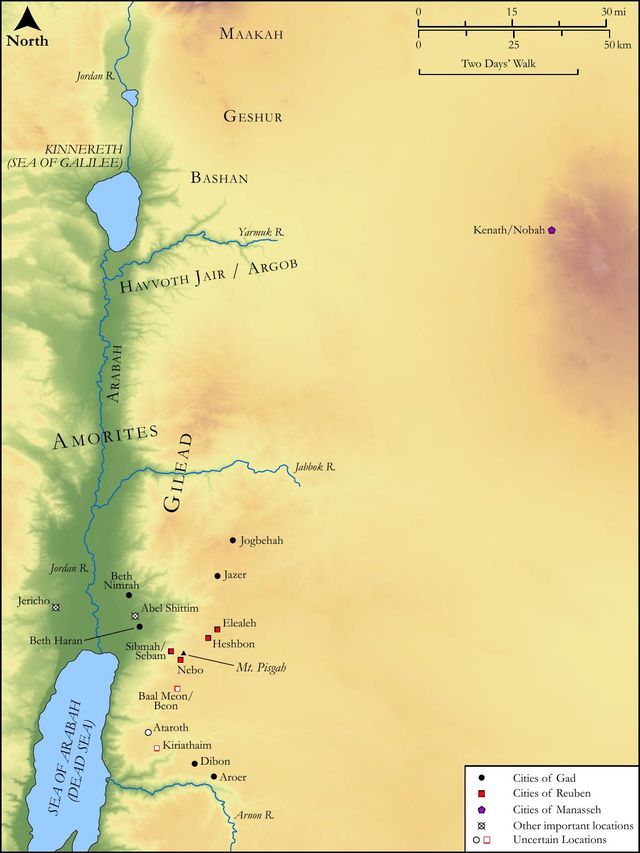
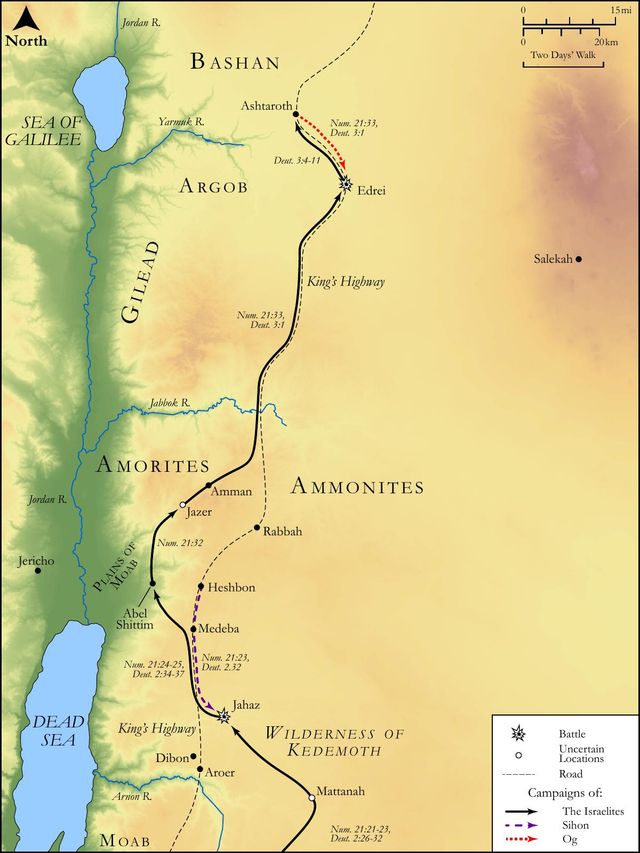
Study this verse
Public-domain commentary
Matthew Henry
From his Commentary on the Whole Bible. Henry comments on passages, not single verses — this entry covers Deuteronomy 3:1–11. His two-level outline is real structure in the source text, so it is rendered as structure.
We have here another brave country delivered into the hand of Israel, that of Bashan; the conquest of Sihon is often mentioned together with that of Og, to the praise of God, the rather because in these Israel's triumphs began, Psa 135:11; Psa 136:19, Psa 136:20. See,
I.How they got the mastery of Og, a very formidable prince,
1.Very strong, for he was of the remnant of the giants (Deu 3:11); his personal strength was extraordinary, a monument of which was preserved by the Ammonites in his bedstead, which was shown as a rarity in their chief city. You might guess at his weight by the materials of his bedstead; it was iron, as if a bedstead of wood were too weak for him to trust to: and you might guess at his stature by the dimensions of it; it was nine cubits long and four cubits broad, which, supposing a cubit to be but half a yard (and some learned men have made it appear to be somewhat more), was four yards and a half long, and two yards broad; and if we allow his bedstead to be two cubits longer than himself, and that is as much as we need allow, he was three yards and a half high, double the stature of an ordinary man, and every way proportionable, yet they smote him, Deu 3:3. Note, when God pleads his people's cause he can deal with giants as with grasshoppers. No man's might can secure him against the Almighty. The army of Og was very powerful, for he had the command of sixty fortified cities, besides the unwalled towns, Deu 3:5. Yet all this was nothing before God's Israel, when they came with commission to destroy him.
2.He was very bold and daring: He came out against Israel to battle, Deu 3:1. It was wonderful that he did not take warning by the ruin of Sihon, and send to desire conditions of peace; but he trusted to his own strength, and so was hardened to his destruction. Note, Those that are not awakened by the judgments of God upon others, but persist in their defiance of heaven, are ripening apace for the like judgments upon themselves, Jer 3:8. God bade Moses not fear him, Deu 3:2. If Moses himself was so strong in faith as not to need the caution, yet it is probable that the people needed it, and for them these fresh assurances are designed; "I will deliver him into thy hand; not only deliver thee out of his hand, that he shall not be thy ruin, but deliver him into thy hand, that thou shalt be his ruin, and make him pay dearly for his attempt." He adds, Thou shalt do to him as thou didst to Sihon, intimating that they ought to be encouraged by their former victory to trust in God for another victory, for he is God, and changeth not.
II.How they got possession of Bashan, a very desirable country.
They took all the cities (Deu 3:4), and all the spoil of them, Deu 3:7. They made them all their own, Deu 3:10. So that now they had in their hands all that fruitful country which lay east of Jordan, from the river Arnon unto Hermon, Deu 3:8. Their conquering and possessing these countries was intended, not only for the encouragement of Israel in the wars of Canaan, but for the satisfaction of Moses before his death. Since he must not live to see the completing of their victory and settlement, God thus gives him a specimen of it. Thus the Spirit is given to those that believe as the earnest of their inheritance, until the redemption of the purchased possession.
Continue studying Deuteronomy 3:6 across the web’s major study libraries — every link below opens this exact verse, chapter, or book on the destination site.
Read & Compare
 BibleGatewayThis verse in more than 200 translations and 70 languages.
 Bible.comThe YouVersion reader — hundreds of translations, reading plans, and highlights.
 ESV.orgCrossway's official English Standard Version reader.
 NET BibleThe NET translation with 60,000+ translators' notes on every rendering decision.
 STEP BibleTyndale House's free study tool — original text, vocabulary, and scholarly resources.
 BibliaLogos Bible Software's free web reader.
 USCCBThe New American Bible (Revised Edition) with the U.S. bishops' study notes.
Commentaries
 BibleHub CommentariesDozens of classic commentaries on this verse, gathered on one page.
 StudyLightMore than 100 commentary sets — the largest collection on the web.
 BibleRefPlain-English commentary on what this verse means, verse by verse.
 Enduring WordDavid Guzik's free commentary on this chapter, widely used by Bible teachers.
 Bible Study ToolsVerse commentary alongside Greek and Hebrew study aids.
Original Language & Research
- BibleHub InterlinearThe verse word by word — original language, transliteration, and English.
- BibleHub LexiconEvery word's original-language definition and Strong's entry.
 Blue Letter BibleDeep-study tools — Strong's numbers, concordance, and word studies.
 SefariaThe Hebrew text with Rashi and centuries of Jewish commentary.
Sermons, Hymns & Audio


TrulyRandomVerse is not affiliated with these sites and doesn’t control their content. They’re linked because they’re genuinely useful.
Summary
Deuteronomy 3:6 vividly recounts Israel's decisive victory over Og, king of Bashan, emphasizing the complete and utter destruction of his cities, mirroring their prior conquest of Sihon, king of Heshbon. This verse highlights the thoroughness of the divinely mandated ḥerem (devotion to destruction) against the inhabitants—men, women, and children—of every city. It underscores God's severe judgment against deeply entrenched wickedness and idolatry, His commitment to establishing a holy people in a land purged of corrupting influences, and Israel's obedience in executing this specific, time-bound command as they prepared to enter the Promised Land.
Context
ShowHideLiterary Context
Deuteronomy 3:6 is embedded within Moses' second major discourse to the Israelite generation poised to enter Canaan. This discourse, delivered on the plains of Moab, functions as a powerful review of God's faithfulness and Israel's history since Mount Horeb. Specifically, this verse details the successful conquest of Og, king of Bashan, which immediately follows the account of the defeat of Sihon, king of Heshbon, in Deuteronomy 2:26-37. The explicit comparison, "as we did unto Sihon king of Heshbon," serves to link these two pivotal Transjordanian victories, establishing a consistent pattern of divine empowerment and Israel's obedience to the ḥerem command. This recounting is not merely historical; it's a pedagogical strategy designed to instill courage, faith, and a renewed commitment to the covenant as the Israelites face the daunting task of conquering the heartland of Canaan. The narrative then transitions to the allocation of this newly acquired territory to the tribes of Reuben, Gad, and half of Manasseh, as detailed in Deuteronomy 3:12-17.
Historical & Cultural Context
The command for "utter destruction" (Hebrew: ḥerem) in Deuteronomy 3:6 must be understood within the unique historical and theological context of ancient Israel's conquest of Canaan. The Amorite kingdoms of Sihon and Og, like other Canaanite peoples, were deeply entrenched in practices deemed abhorrent by Yahweh. These included widespread idolatry, cultic prostitution, and child sacrifice, as explicitly condemned in Deuteronomy 12:29-31. Such practices represented a profound spiritual corruption that threatened the very fabric of God's covenant with Israel and the holiness of the land He was giving them. Geographically, the Transjordanian region controlled by Sihon and Og was strategically vital, encompassing fertile lands and crucial trade routes. The conquest of these formidable kings demonstrated God's ability to overcome powerful foes, preparing Israel for the even greater challenges ahead. The ḥerem command was a specific, time-bound judgment against these wicked cultures, intended to prevent their corrupting influence from infiltrating Israel and defiling the land, thereby preserving the holiness and distinctiveness of God's chosen people.
Key Themes
ShowHideDeuteronomy 3:6 contributes significantly to several overarching themes in Deuteronomy and the broader Pentateuch. Firstly, it powerfully illustrates Divine Judgment, showcasing God's righteous wrath against profound human wickedness and rebellion. The "utter destruction" was not arbitrary cruelty but a just recompense for generations of sin, as foreshadowed in Genesis 15:16. Secondly, it reinforces the theme of God's Faithfulness to His Covenant Promises, particularly the promise to Abraham that his descendants would inherit the land of Canaan, as seen in Genesis 12:7. The victories over Sihon and Og were tangible steps toward the fulfillment of this promise. Thirdly, the command for complete eradication underscores the theme of Holiness and Separation. God commanded Israel to be a distinct people, set apart for Him, and the removal of the Canaanites was essential to prevent spiritual contamination and syncretism, ensuring Israel's exclusive devotion to Yahweh, as articulated in Deuteronomy 7:2-6. Finally, it highlights God's Sovereignty in Warfare, demonstrating that Israel's victories were not due to their own strength but to God fighting on their behalf.
Exposition and Analysis
ShowHideKey Word Analysis
ShowHideThis verb (H2763), appearing twice in the verse, is central to its meaning. It signifies "to seclude," "to devote to religious uses (especially destruction)," or "to make accursed." In the context of warfare, châram implied that the spoils and inhabitants of a conquered city were not to be taken for personal gain but were irrevocably consecrated to God, usually by being completely destroyed. This was a unique, divinely mandated act of judgment, not a general principle for all warfare, designed to purge the land of its spiritual corruption and prevent Israel from adopting the detestable practices of the Canaanites.
This proper noun (H2809) refers to a significant city east of the Jordan River, the capital of Sihon's Amorite kingdom. Its inclusion here serves as a direct point of comparison, linking the current victory over Og to the previous, equally decisive conquest of Sihon. The mention of Heshbon underscores the continuity of God's judgment and Israel's obedient action across different enemy strongholds in the Transjordan region.
This noun (H2945) refers collectively to "a family" or "little children/ones." Its inclusion in the list of those utterly destroyed ("men, women, and children") emphasizes the comprehensive and absolute nature of the ḥerem command. This was not an act of indiscriminate cruelty but a precise, divinely ordained measure to eradicate the spiritual contagion of the Canaanite cultures, ensuring no remnant remained to corrupt Israel. It highlights the totality of God's judgment against a people whose iniquity had reached its full measure.
Verse Breakdown
ShowHide"And we utterly destroyed them"
This phrase refers to the Israelites' actions against the cities and inhabitants of Og, king of Bashan. The use of "we" indicates Israel's active participation, but always under divine command and empowerment. The verb "utterly destroyed" (from ḥāram) emphasizes the totality and irrevocability of the destruction, signifying that nothing was left alive or taken as spoil. This was a direct execution of God's righteous judgment.
"as we did unto Sihon king of Heshbon"
This clause provides a crucial comparative reference, linking the current victory over Og to the previous, equally decisive victory over Sihon, king of Heshbon, recounted in Deuteronomy 2:34. This comparison reinforces the pattern of God's consistent power and Israel's consistent obedience in carrying out the ḥerem command against wicked kingdoms in the Transjordan. It serves as a reminder of God's faithfulness and establishes a precedent for future conquests in Canaan.
"utterly destroying the men, women, and children, of every city"
This final clause specifies the comprehensive nature of the destruction. The repetition of "utterly destroying" reinforces the ḥerem command, emphasizing its absolute scope. The inclusion of "men, women, and children" underscores the totality of the judgment, leaving no survivors. This was not an act of indiscriminate cruelty but a precise, divinely ordained measure to eradicate the spiritual contagion of the Canaanite cultures and ensure Israel's complete separation from their idolatrous and immoral practices. It was a surgical act of judgment to prepare a holy land for a holy people.
Literary Devices
ShowHideDeuteronomy 3:6 employs several impactful literary devices to convey its message. The most prominent is Repetition, specifically the emphatic use of "utterly destroyed" (or "utterly destroying"). This reiteration serves to underscore the completeness and finality of the conquest, leaving no ambiguity about the extent of the ḥerem command. It emphasizes the thoroughness of God's judgment and Israel's obedience. Another device is Comparison or Analogy, seen in the phrase "as we did unto Sihon king of Heshbon." This direct parallel links the two major Transjordanian victories, establishing a consistent pattern of divine action and Israelite triumph. It serves to reinforce the narrative of God's unwavering support and to build confidence for future military endeavors. The stark enumeration of "men, women, and children" also functions as a form of Emphasis through comprehensive listing, highlighting the unsparing nature of the judgment and the absence of exceptions, further stressing the severity and totality of the divine command.
Theological and Thematic Connections
ShowHideDeuteronomy 3:6 stands as a stark reminder of God's absolute holiness and His righteous judgment against sin. While the physical act of "utter destruction" (ḥerem) was a unique, time-bound command for Israel's conquest of Canaan, the underlying theological principles remain eternally relevant. It reveals a God who is utterly intolerant of profound wickedness and idolatry, demonstrating that sin, when fully ripened, brings severe consequences. This passage forces us to grapple with the multifaceted nature of God, who is both merciful and just, patient and utterly holy. It underscores the necessity of spiritual separation from corrupting influences and the radical measures God sometimes takes to preserve the purity of His covenant people and the integrity of His redemptive plan. The divine command was not arbitrary but a necessary surgical act to prevent the spiritual cancer of Canaanite practices from infecting Israel, thereby safeguarding the lineage through which the Messiah would come.
Reflection and Application
ShowHideDeuteronomy 3:6, with its challenging depiction of "utter destruction," calls us to profound reflection on God's character and our own spiritual lives. While we no longer engage in physical warfare of this kind, the passage profoundly speaks to the seriousness of sin and the radical nature of God's holiness. It compels us to recognize that there are spiritual "strongholds" and "idols" in our lives and culture that God calls us to "utterly destroy"—not with physical weapons, but through spiritual warfare, repentance, and radical obedience. This means actively dismantling sinful patterns, renouncing worldly values that contradict God's word, and pursuing holiness with unwavering commitment. Just as God cleared the land for Israel to establish a pure worship, we are called to clear our hearts and minds of anything that hinders our devotion to Christ, ensuring our lives are set apart for His glory. This passage also reminds us that God's justice is real and that He will ultimately judge all unrighteousness, prompting us to live in reverent awe and humble submission to His will.
Questions for Reflection
ShowHideFAQ
ShowHideWhy did God command such extreme measures, including the destruction of women and children?
ShowHideThe command for "utter destruction" (Hebrew: ḥerem) in Deuteronomy 3:6 and similar passages is one of the most challenging aspects of Old Testament study. It's crucial to understand this within its specific historical and theological context, not as a universal principle for all warfare. The Canaanite peoples, including those ruled by Sihon and Og, were deeply entrenched in practices that were utterly abhorrent to God and profoundly corrupting, such as child sacrifice, cultic prostitution, and widespread idolatry (Leviticus 18:24-25). God's command was a unique act of divine judgment against generations of accumulated wickedness, intended to prevent the spiritual contamination of Israel. The inclusion of women and children, while jarring to modern sensibilities, reflected the ancient understanding of corporate identity and the necessity of completely eradicating the source of spiritual infection to preserve the purity of God's covenant people. It was a radical "spiritual quarantine" to safeguard Israel's unique role in salvation history and ensure the lineage through which the Messiah would come. This was a specific, time-bound judgment, not a general license for violence, and it underscores God's absolute holiness and His righteous intolerance of profound sin.
Christ-Centered Fulfillment
ShowHideWhile Deuteronomy 3:6 describes a physical conquest and a specific act of judgment in Old Testament history, its theological undercurrents find profound Christ-centered fulfillment. The "utter destruction" of wicked kingdoms foreshadows Christ's ultimate victory over the spiritual forces of evil, sin, and death. Just as Israel was commanded to clear the land of corrupting influences to establish a holy dwelling place for God, Christ, through His death and resurrection, utterly destroys the power of sin and Satan, establishing a new spiritual kingdom. His sacrifice on the cross was the ultimate act of ḥerem against sin, dedicating it to complete destruction, so that those who believe in Him might be set apart as a holy people (Colossians 2:13-15). The victory over Og and Sihon, achieved by God's power through His people, points to Christ's decisive triumph over the "prince of this world" (John 12:31). Moreover, the call for Israel to be separate and holy finds its ultimate expression in the New Covenant, where believers are called to be spiritually separated from the world's corruption, putting to death the deeds of the flesh and living in newness of life through the power of the Holy Spirit (Romans 8:13; 2 Corinthians 6:17). Thus, Deuteronomy 3:6, in its severe judgment against sin, ultimately points to the greater, spiritual victory achieved by Christ, who cleanses and sanctifies His people for Himself.