


Deuteronomy 3:7
Bible text: King James Version (1769 Blayney text) · Public domain
Bible text: Berean Standard Bible · Public domain
Bible text: American Standard Version (1901) · Public domain
Bible text: World English Bible, Messianic edition · Public domain
Bible text: Geneva Bible (1599) · Public domain
Bible text: Young's Literal Translation · Public domain
- וְכָלve·kholand allH3605Conj-w ¦ N-mscNoun Singular Masculine Constructוְandכָלall
- הַבְּהֵמָהha·be·he·Mahthe livestockH929Art ¦ N-fsNoun Singular Feminine Absoluteהַtheבְּהֵמָהlivestock
- וּשְׁלַלu·she·Laland [the] booty ofH7998Conj-w ¦ N-mscNoun Singular Masculine Constructוּandשְׁלַל[the] booty of
- הֶעָרִיםhe·'a·Rimthe citiesH5892Art ¦ N-mpNoun Plural Masculine Absoluteהֶtheעָרִיםcities
- בַּזּוֹנוּba·Zo·nuwe plunderedH962V-Qal-Perf-1cpVerb Qal Perfect 1st Plural common gender
- לָנוּLa·nufor ourselvesPrep-l ¦ 1cpSuffix Personal 1st Plural common genderלָforנוּourselves
English is a literal word-by-word gloss of the Hebrew, not the KJV's wording. Why?
This is the original text the KJV's translators worked from — each Hebrew word with its own literal English meaning in this verse, prepared by scholars at Tyndale House, Cambridge. The KJV translates whole sentences, not word by word, so its wording differs: one Hebrew word can become several English words, and the KJV may choose “the LORD” where the gloss reads “Yahweh”. Both are faithful — they answer different questions. For the KJV's own rendering, switch to the KJV text.
Details
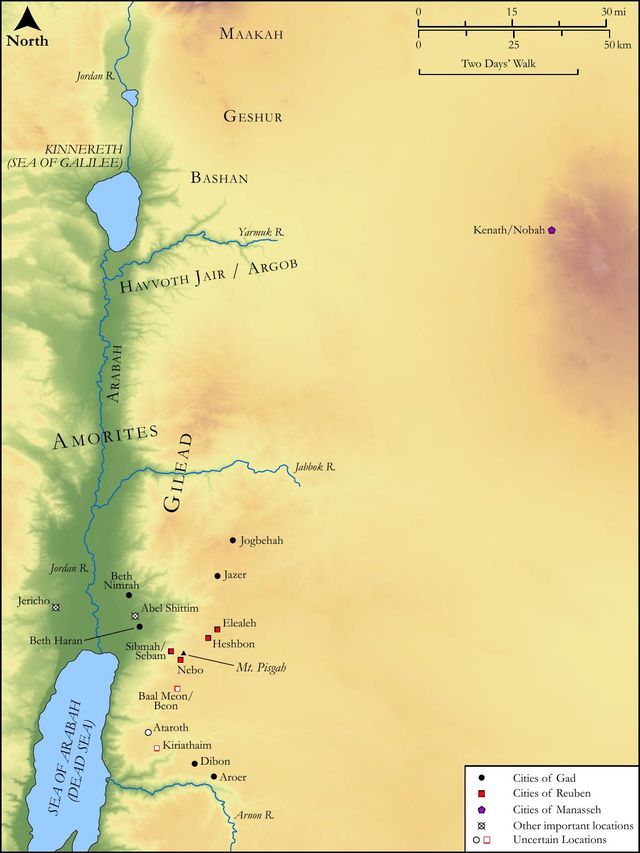
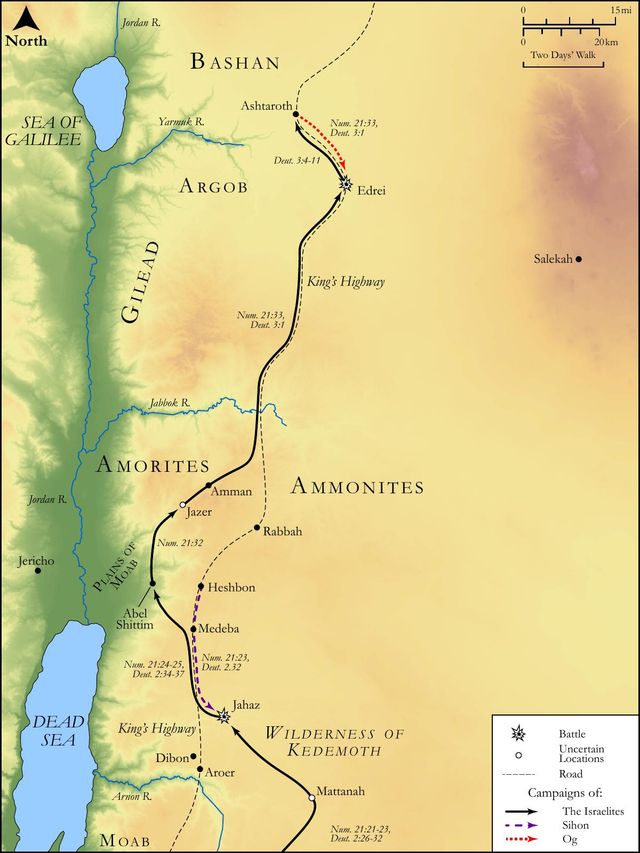
See on the biblical-era maps
Study this verse
Public-domain commentary
Matthew Henry
From his Commentary on the Whole Bible. Henry comments on passages, not single verses — this entry covers Deuteronomy 3:1–11. His two-level outline is real structure in the source text, so it is rendered as structure.
We have here another brave country delivered into the hand of Israel, that of Bashan; the conquest of Sihon is often mentioned together with that of Og, to the praise of God, the rather because in these Israel's triumphs began, Psa 135:11; Psa 136:19, Psa 136:20. See,
I.How they got the mastery of Og, a very formidable prince,
1.Very strong, for he was of the remnant of the giants (Deu 3:11); his personal strength was extraordinary, a monument of which was preserved by the Ammonites in his bedstead, which was shown as a rarity in their chief city. You might guess at his weight by the materials of his bedstead; it was iron, as if a bedstead of wood were too weak for him to trust to: and you might guess at his stature by the dimensions of it; it was nine cubits long and four cubits broad, which, supposing a cubit to be but half a yard (and some learned men have made it appear to be somewhat more), was four yards and a half long, and two yards broad; and if we allow his bedstead to be two cubits longer than himself, and that is as much as we need allow, he was three yards and a half high, double the stature of an ordinary man, and every way proportionable, yet they smote him, Deu 3:3. Note, when God pleads his people's cause he can deal with giants as with grasshoppers. No man's might can secure him against the Almighty. The army of Og was very powerful, for he had the command of sixty fortified cities, besides the unwalled towns, Deu 3:5. Yet all this was nothing before God's Israel, when they came with commission to destroy him.
2.He was very bold and daring: He came out against Israel to battle, Deu 3:1. It was wonderful that he did not take warning by the ruin of Sihon, and send to desire conditions of peace; but he trusted to his own strength, and so was hardened to his destruction. Note, Those that are not awakened by the judgments of God upon others, but persist in their defiance of heaven, are ripening apace for the like judgments upon themselves, Jer 3:8. God bade Moses not fear him, Deu 3:2. If Moses himself was so strong in faith as not to need the caution, yet it is probable that the people needed it, and for them these fresh assurances are designed; "I will deliver him into thy hand; not only deliver thee out of his hand, that he shall not be thy ruin, but deliver him into thy hand, that thou shalt be his ruin, and make him pay dearly for his attempt." He adds, Thou shalt do to him as thou didst to Sihon, intimating that they ought to be encouraged by their former victory to trust in God for another victory, for he is God, and changeth not.
II.How they got possession of Bashan, a very desirable country.
They took all the cities (Deu 3:4), and all the spoil of them, Deu 3:7. They made them all their own, Deu 3:10. So that now they had in their hands all that fruitful country which lay east of Jordan, from the river Arnon unto Hermon, Deu 3:8. Their conquering and possessing these countries was intended, not only for the encouragement of Israel in the wars of Canaan, but for the satisfaction of Moses before his death. Since he must not live to see the completing of their victory and settlement, God thus gives him a specimen of it. Thus the Spirit is given to those that believe as the earnest of their inheritance, until the redemption of the purchased possession.
Continue studying Deuteronomy 3:7 across the web’s major study libraries — every link below opens this exact verse, chapter, or book on the destination site.
Read & Compare
 BibleGatewayThis verse in more than 200 translations and 70 languages.
 Bible.comThe YouVersion reader — hundreds of translations, reading plans, and highlights.
 ESV.orgCrossway's official English Standard Version reader.
 NET BibleThe NET translation with 60,000+ translators' notes on every rendering decision.
 STEP BibleTyndale House's free study tool — original text, vocabulary, and scholarly resources.
 BibliaLogos Bible Software's free web reader.
 USCCBThe New American Bible (Revised Edition) with the U.S. bishops' study notes.
Commentaries
 BibleHub CommentariesDozens of classic commentaries on this verse, gathered on one page.
 StudyLightMore than 100 commentary sets — the largest collection on the web.
 BibleRefPlain-English commentary on what this verse means, verse by verse.
 Enduring WordDavid Guzik's free commentary on this chapter, widely used by Bible teachers.
 Bible Study ToolsVerse commentary alongside Greek and Hebrew study aids.
Original Language & Research
- BibleHub InterlinearThe verse word by word — original language, transliteration, and English.
- BibleHub LexiconEvery word's original-language definition and Strong's entry.
 Blue Letter BibleDeep-study tools — Strong's numbers, concordance, and word studies.
 SefariaThe Hebrew text with Rashi and centuries of Jewish commentary.
Sermons, Hymns & Audio


TrulyRandomVerse is not affiliated with these sites and doesn’t control their content. They’re linked because they’re genuinely useful.
Summary
Deuteronomy 3:7 provides a crucial detail regarding Israel's conquest of King Og's kingdom of Bashan, specifying that while the cities and their inhabitants were utterly destroyed, the Israelites were divinely permitted to take all the cattle and valuable spoils for themselves. This verse illuminates God's sovereign power in granting victory and His meticulous care in providing for His people's material needs, even amidst the execution of judgment upon wicked nations, as they prepared to inherit the Promised Land.
Context
ShowHideLiterary Context
Deuteronomy 3:7 is situated within Moses' second major discourse to the Israelites on the plains of Moab, delivered as they stand poised to enter Canaan. This chapter specifically recounts the decisive victory over King Og of Bashan, immediately following the narrative of the defeat of King Sihon of Heshbon in Deuteronomy 2:24-37. Moses' primary aim in recounting these past triumphs is to instill courage and faith in the new generation of Israelites, reminding them of God's unwavering faithfulness and formidable power, thereby preparing them for the daunting task of conquering the Promised Land. The preceding verses, Deuteronomy 3:3-6, emphasize the complete annihilation of the cities and their inhabitants, a practice known as cherem (devotion to destruction). Verse 7, however, introduces a vital distinction, clarifying that the livestock and other valuables were specifically taken as spoil, differentiating this particular conquest from instances where all possessions were also to be utterly destroyed.
Historical & Cultural Context
The historical setting is the plains of Moab, east of the Jordan River, around 1406 BC, marking the culmination of Israel's forty-year wilderness journey. The Amorites, including King Og of Bashan, were formidable inhabitants of the Transjordan region, renowned for their heavily fortified cities and military prowess. Bashan itself was a highly fertile and prosperous region, celebrated for its rich pastures and abundant livestock, making the "cattle" and "spoil" mentioned in this verse exceptionally valuable assets. Among the nations of that day, the taking of plunder was a standard and significant outcome of military victory, serving both as a reward for the conquering army and a vital means of sustaining the victorious nation. The Israelite practice of cherem (Hebrew: חרם, "devoted thing," "ban") was unique, involving the total dedication of certain enemies or their possessions to God, typically through utter destruction, often by fire, with nothing taken for personal gain. Deuteronomy 3:7 illustrates a nuanced application of this principle, where the people were destroyed, but the material wealth was permitted to be taken, indicating God's specific and varied instructions for different conquests, tailored to His divine purposes.
Key Themes
ShowHideThis verse significantly contributes to several overarching theological and narrative themes prevalent in Deuteronomy and the broader Pentateuch. It powerfully underscores the theme of Divine Provision and Victory, demonstrating unequivocally that God Himself fought for Israel, enabling them to conquer powerful kings and acquire vast resources. This act directly fulfills His promise to provide for His people as they entered the land, as seen in Deuteronomy 2:36. The explicit mention of "all the cattle, and the spoil of the cities" highlights the theme of Legitimate Spoils of War as a divinely sanctioned outcome, crucial for sustaining the Israelite population and establishing their economic foundation in the new territory. Furthermore, the verse illustrates a critical theme of Distinction in Conquest, revealing that God's commands regarding cherem were not monolithic or applied uniformly in every instance. While the inhabitants were utterly destroyed, the material wealth was specifically permitted to be taken, showcasing God's sovereign discretion and specific directives tailored to the circumstances and the nature of the enemy, always aligning with His ultimate purpose to bless His covenant people. This nuanced approach contrasts with other instances where all spoil was to be destroyed, emphasizing God's ultimate authority in the execution of both His judgment and His provision.
Exposition and Analysis
ShowHideKey Word Analysis
ShowHideThis term, derived from a root likely meaning "to be mute," refers to a "dumb beast," especially any large quadruped or animal, often used collectively. As with Abram, who was very rich in cattle, livestock represented immense wealth, serving as a primary source of food, hides, and a fundamental form of capital. The acquisition of "all the cattle" from Og's prosperous kingdom of Bashan thus signifies a substantial and immediate gain of resources for the Israelites, providing vital sustenance and a basis for their economic stability as they prepared for settlement.
Derived from a root meaning "to plunder," this word denotes booty, plunder, or the material possessions taken from a defeated enemy in warfare. It encompasses a wide range of valuable goods, treasures, and anything of worth found within the conquered cities that was not designated for utter destruction. The phrase "spoils of the cities" indicates that beyond livestock, the Israelites also appropriated other valuable items, further enriching them and demonstrating the comprehensive nature of the victory and God's abundant provision.
This primitive root means "to plunder" or "to take for a prey." When used as a noun, it refers to the plunder or booty itself. In Deuteronomy 3:7, the phrase "took for a prey" emphasizes the act of seizing and appropriating these valuable assets as legitimate spoils of war. It underscores the active role of the Israelites in taking possession of what God had delivered into their hands, highlighting the tangible benefits of their divinely-granted victory.
Verse Breakdown
ShowHide"But all the cattle,"
This clause serves as a crucial conjunction, introducing a specific exception or clarification to the preceding verses (Deuteronomy 3:3-6), which detailed the utter destruction of the inhabitants and cities. It signals that while human life was eradicated and urban structures were laid waste, the valuable livestock was explicitly preserved and taken.
"and the spoil of the cities,"
This phrase expands upon the previous one, indicating that not only the cattle but also other valuable possessions and goods found within the conquered cities were taken. This broad term encompasses everything from household items and agricultural produce to precious metals and other treasures, further emphasizing the extensive material benefits derived from the conquest.
"we took for a prey to ourselves."
This concluding phrase explicitly states the outcome and beneficiary: the Israelites appropriated these acquired resources for their own use and benefit. The phrase "for a prey" reinforces the idea of taking war spoils as a legitimate and divinely sanctioned act. The "we" refers collectively to the Israelite army and, by extension, the entire nation, indicating a shared, collective gain and God's direct provision for His people's material needs.
Literary Devices
ShowHideDeuteronomy 3:7 effectively employs several literary devices to convey its message. Recapitulation is a foundational element of Moses' entire discourse, as he recounts past events to instruct, encourage, and remind the new generation. This specific verse provides a crucial Contrast to the cherem (utter destruction) described in the immediately preceding verses, highlighting God's nuanced and specific commands regarding the spoils of war. While the people and cities were devoted to destruction, the material wealth was explicitly exempted and taken. This distinction serves to emphasize Divine Provision, showcasing God's meticulous care for Israel's physical and economic needs even amidst the execution of His righteous judgment. The straightforward, declarative statement also lends an air of Historical Veracity, reinforcing the idea that these events genuinely occurred as an integral part of God's unfolding redemptive plan for His covenant people.
Theological and Thematic Connections
ShowHideDeuteronomy 3:7 profoundly illustrates God's multifaceted character, revealing Him as both a righteous judge who executes justice upon wicked nations and a faithful provider who meticulously cares for His covenant people. While the preceding verses highlight His severe judgment against the Amorites, this verse underscores His unwavering faithfulness to Israel, ensuring their material well-being and equipping them for the challenges of settlement. The acquisition of wealth through divinely sanctioned warfare demonstrates that God's comprehensive plan for His people included not only spiritual and territorial inheritance but also practical sustenance and economic stability. This act of taking spoil was a direct fulfillment of God's promise to fight for Israel and provide for their needs as they entered the land, setting the stage for their establishment and prosperity. It serves as a powerful reminder that God's sovereignty extends over all aspects of life, including the material, and that His provisions are often intricately tied to His overarching redemptive purposes for His people.
Reflection and Application
ShowHideDeuteronomy 3:7, though set in the distinct context of ancient warfare and the conquest of the Promised Land, offers enduring principles and profound encouragement for believers today. It serves as a powerful reminder of God's meticulous and faithful care for His people, even in the midst of challenging or seemingly harsh circumstances. Just as God sovereignly provided for Israel's physical and economic needs through the spoils of war, He continues to be our faithful Provider, meeting our needs according to His glorious riches in Christ Jesus. This verse encourages us to cultivate a deep trust in His sovereign hand, recognizing that His plans for us encompass both spiritual blessings and practical, tangible provisions. It also prompts us to consider how God's commands, though sometimes difficult to fully grasp from a limited human perspective, are always purposeful, just, and ultimately designed for the good of His people and the advancement of His kingdom. We are called to discern and obey God's specific will for our lives, knowing that such obedience leads to His blessing and provision, enabling us to fulfill the unique purposes He has ordained for us in our own journey of faith.
Questions for Reflection
ShowHideFAQ
ShowHideWhy did God allow Israel to take spoil in this instance but commanded total destruction (cherem) in others?
ShowHideGod's commands regarding conquest, including the practice of cherem (utter destruction), were not uniform but varied based on specific divine directives and the nature of the enemy or the particular city. In cases like the conquest of Jericho (Joshua 6:17-19), everything was to be utterly destroyed as a sign of God's complete judgment against a particularly idolatrous and wicked city, and to prevent Israel from being corrupted by pagan practices and idolatry. However, in other instances, such as the conquest of King Og in Deuteronomy 3:7 or the Midianites in Numbers 31:9-11, God explicitly permitted Israel to take the livestock and other material spoils. This distinction highlights God's sovereign discretion and His dual purposes: executing righteous judgment on wicked nations while simultaneously providing for His covenant people. The valuable spoils served as a practical means of sustaining the Israelite nation as they settled the land, demonstrating God's faithfulness to meet their material needs and equip them for their new life.
Christ-Centered Fulfillment
ShowHideDeuteronomy 3:7, with its vivid portrayal of divine victory and abundant provision through the spoils of war, finds its ultimate and profound fulfillment in the person and work of Jesus Christ. While Israel's conquest involved physical warfare and the acquisition of material gain, Christ's victory is spiritual and eternal, securing for His people far greater and more enduring "spoils." He is the ultimate Conqueror who, through His crucifixion and resurrection, "disarmed the powers and authorities, he made a public spectacle of them, triumphing over them by the cross" (Colossians 2:15). Through His decisive victory over sin, death, and the devil, Christ plundered their dominion and set captives free from spiritual bondage. The "spoils" of Christ's triumph are not earthly cattle or silver, but an immeasurable wealth of spiritual blessings: complete forgiveness of sins (Ephesians 1:7), eternal life in His presence (John 3:16), adoption into God's family as beloved children (Galatians 4:5), and the indwelling presence of the Holy Spirit as a guarantee of our inheritance (Ephesians 1:13-14). Just as God meticulously provided for Israel's physical needs, Christ provides for our every spiritual need, offering abundant life and equipping us for His service and glory. We, as believers, are the blessed beneficiaries of His ultimate triumph, inheriting a spiritual kingdom and an imperishable, undefiled, and unfading inheritance reserved in heaven for us (1 Peter 1:4).