


Deuteronomy 3:5
Bible text: King James Version (1769 Blayney text) · Public domain
Bible text: Berean Standard Bible · Public domain
Bible text: American Standard Version (1901) · Public domain
Bible text: World English Bible, Messianic edition · Public domain
Bible text: Geneva Bible (1599) · Public domain
Bible text: Young's Literal Translation · Public domain
- כָּלkolallH3605N-msNoun Singular Masculine Absolute
- אֵלֶּה'E·lehtheseH428PrtParticle Demonstrative
- עָרִים'a·Rim[were] citiesH5892N-mpNoun Plural Masculine Absolute
- בְּצֻרוֹתbe·tzu·RotfortifiedH1219Adj-fpAdjective Plural Feminine Absolute
- חוֹמָהcho·MahwallH2346N-fsNoun Singular Feminine Absolute
- גְבֹהָהge·vo·HahhighH1364Adj-fsAdjective Singular Feminine Absolute
- דְּלָתַיִםde·la·Ta·yimgatesH1817N-fdNoun Dual Feminine Absolute
- וּבְרִיחַu·ve·Ri·achand bar[s]H1280Conj-w ¦ N-msNoun Singular Masculine Absoluteוּandבְרִיחַbar[s]
- לְבַדle·Vad<to> apartH905Prep-l ¦ N-mscNoun Singular Masculine Constructלְ<to>בַדapart
- מֵעָרֵיme·'a·Reifrom [the] cities ofH5892Prep-m ¦ N-mpcNoun Plural Masculine Constructמֵfromעָרֵי[the] cities of
- הַפְּרָזִיha·pe·ra·Zithe hamlet-dweller[s]H6521Art ¦ N-msNoun Singular Masculine Absoluteהַtheפְּרָזִיhamlet-dweller[s]
- הַרְבֵּהhar·BehmanyH7235V-Hiphil-InfAbsVerb Hiphil Infinitive Absolute
- מְאֹדme·'OdveryH3966Adj-msAdjective Numerical Singular Masculine Absolute
English is a literal word-by-word gloss of the Hebrew, not the KJV's wording. Why?
This is the original text the KJV's translators worked from — each Hebrew word with its own literal English meaning in this verse, prepared by scholars at Tyndale House, Cambridge. The KJV translates whole sentences, not word by word, so its wording differs: one Hebrew word can become several English words, and the KJV may choose “the LORD” where the gloss reads “Yahweh”. Both are faithful — they answer different questions. For the KJV's own rendering, switch to the KJV text.
Details
See on the biblical-era maps
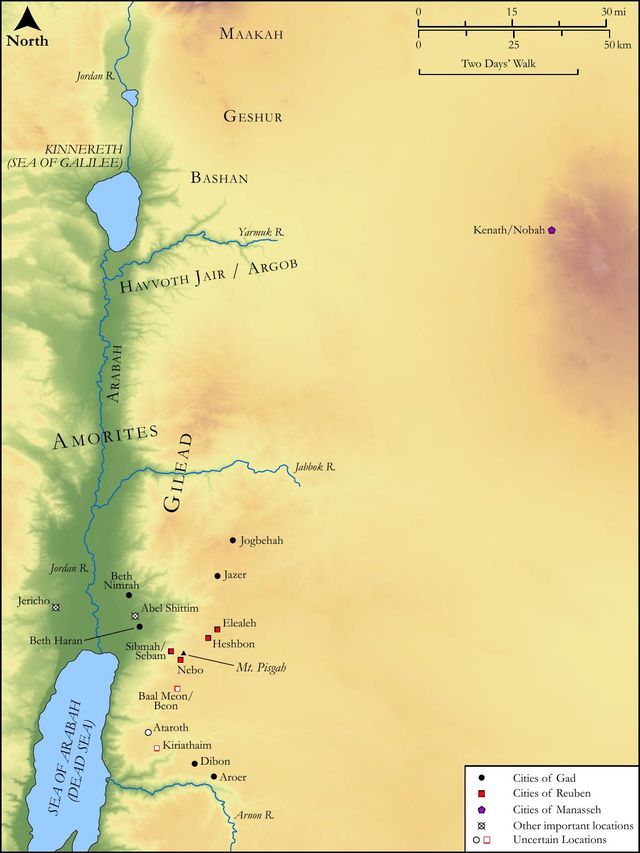
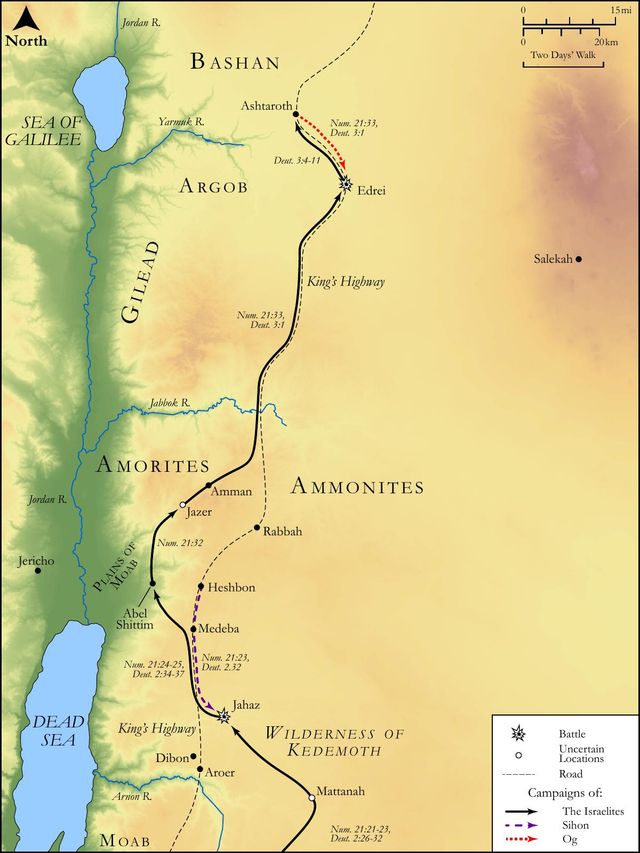
Study this verse
Public-domain commentary
Matthew Henry
From his Commentary on the Whole Bible. Henry comments on passages, not single verses — this entry covers Deuteronomy 3:1–11. His two-level outline is real structure in the source text, so it is rendered as structure.
We have here another brave country delivered into the hand of Israel, that of Bashan; the conquest of Sihon is often mentioned together with that of Og, to the praise of God, the rather because in these Israel's triumphs began, Psa 135:11; Psa 136:19, Psa 136:20. See,
I.How they got the mastery of Og, a very formidable prince,
1.Very strong, for he was of the remnant of the giants (Deu 3:11); his personal strength was extraordinary, a monument of which was preserved by the Ammonites in his bedstead, which was shown as a rarity in their chief city. You might guess at his weight by the materials of his bedstead; it was iron, as if a bedstead of wood were too weak for him to trust to: and you might guess at his stature by the dimensions of it; it was nine cubits long and four cubits broad, which, supposing a cubit to be but half a yard (and some learned men have made it appear to be somewhat more), was four yards and a half long, and two yards broad; and if we allow his bedstead to be two cubits longer than himself, and that is as much as we need allow, he was three yards and a half high, double the stature of an ordinary man, and every way proportionable, yet they smote him, Deu 3:3. Note, when God pleads his people's cause he can deal with giants as with grasshoppers. No man's might can secure him against the Almighty. The army of Og was very powerful, for he had the command of sixty fortified cities, besides the unwalled towns, Deu 3:5. Yet all this was nothing before God's Israel, when they came with commission to destroy him.
2.He was very bold and daring: He came out against Israel to battle, Deu 3:1. It was wonderful that he did not take warning by the ruin of Sihon, and send to desire conditions of peace; but he trusted to his own strength, and so was hardened to his destruction. Note, Those that are not awakened by the judgments of God upon others, but persist in their defiance of heaven, are ripening apace for the like judgments upon themselves, Jer 3:8. God bade Moses not fear him, Deu 3:2. If Moses himself was so strong in faith as not to need the caution, yet it is probable that the people needed it, and for them these fresh assurances are designed; "I will deliver him into thy hand; not only deliver thee out of his hand, that he shall not be thy ruin, but deliver him into thy hand, that thou shalt be his ruin, and make him pay dearly for his attempt." He adds, Thou shalt do to him as thou didst to Sihon, intimating that they ought to be encouraged by their former victory to trust in God for another victory, for he is God, and changeth not.
II.How they got possession of Bashan, a very desirable country.
They took all the cities (Deu 3:4), and all the spoil of them, Deu 3:7. They made them all their own, Deu 3:10. So that now they had in their hands all that fruitful country which lay east of Jordan, from the river Arnon unto Hermon, Deu 3:8. Their conquering and possessing these countries was intended, not only for the encouragement of Israel in the wars of Canaan, but for the satisfaction of Moses before his death. Since he must not live to see the completing of their victory and settlement, God thus gives him a specimen of it. Thus the Spirit is given to those that believe as the earnest of their inheritance, until the redemption of the purchased possession.
Continue studying Deuteronomy 3:5 across the web’s major study libraries — every link below opens this exact verse, chapter, or book on the destination site.
Read & Compare
 BibleGatewayThis verse in more than 200 translations and 70 languages.
 Bible.comThe YouVersion reader — hundreds of translations, reading plans, and highlights.
 ESV.orgCrossway's official English Standard Version reader.
 NET BibleThe NET translation with 60,000+ translators' notes on every rendering decision.
 STEP BibleTyndale House's free study tool — original text, vocabulary, and scholarly resources.
 BibliaLogos Bible Software's free web reader.
 USCCBThe New American Bible (Revised Edition) with the U.S. bishops' study notes.
Commentaries
 BibleHub CommentariesDozens of classic commentaries on this verse, gathered on one page.
 StudyLightMore than 100 commentary sets — the largest collection on the web.
 BibleRefPlain-English commentary on what this verse means, verse by verse.
 Enduring WordDavid Guzik's free commentary on this chapter, widely used by Bible teachers.
 Bible Study ToolsVerse commentary alongside Greek and Hebrew study aids.
Original Language & Research
- BibleHub InterlinearThe verse word by word — original language, transliteration, and English.
- BibleHub LexiconEvery word's original-language definition and Strong's entry.
 Blue Letter BibleDeep-study tools — Strong's numbers, concordance, and word studies.
 SefariaThe Hebrew text with Rashi and centuries of Jewish commentary.
Sermons, Hymns & Audio


TrulyRandomVerse is not affiliated with these sites and doesn’t control their content. They’re linked because they’re genuinely useful.
Summary
Deuteronomy 3:5 offers a vivid and striking description of the formidable defenses of the cities conquered by the Israelites in the land of Bashan, specifically those belonging to Og, the powerful king. This verse meticulously details how all sixty cities of the region of Argob were heavily fortified with "high walls, gates, and bars," in addition to numerous unwalled towns. This precise portrayal serves to underscore the immense strength and seemingly impenetrable nature of the enemy Israel faced, thereby profoundly magnifying the miraculous nature of God's intervention and unwavering faithfulness in delivering the land into the hands of His people against overwhelming odds.
Context
ShowHideLiterary Context
Deuteronomy 3:5 is strategically placed within Moses' extensive historical review, delivered to the second generation of Israelites on the plains of Moab as they stand poised to enter the Promised Land. This section, encompassing Deuteronomy 1-3, serves as a powerful reminder of God's past faithfulness and victories. Specifically, the preceding verses, Deuteronomy 3:1-4, recount the decisive defeat of Og, King of Bashan, and the capture of all sixty cities in the region of Argob. Verse 5 then elaborates on the architectural and defensive characteristics of these conquered cities, emphasizing their impressive fortifications. This detailed description is not merely an incidental note but functions to heighten the narrative's tension by highlighting the overwhelming odds Israel faced, thereby magnifying the divine power that secured their victory and fulfilled God's promise to give them the land. The account echoes and expands upon the original historical narrative found in Numbers 21:33-35.
Historical & Cultural Context
In that day, fortified cities were the paramount means of defense for kingdoms, serving as strategic strongholds to protect populations, resources, and trade routes. The construction of "high walls, gates, and bars" was a standard and essential practice, designed to withstand prolonged sieges and deter invaders. The mention of such comprehensive fortifications in Bashan indicates that these were not minor settlements but significant, strategically vital urban centers. Bashan itself was a fertile and prosperous region east of the Jordan River, making its conquest a substantial and valuable victory. King Og was famously described as one of the last of the Rephaim, a race of formidable giants, whose immense stature and iron bedstead (Deuteronomy 3:11) further emphasized the formidable nature of the enemy. This context underscores that Israel's victory was not attributable to superior military might, advanced siege technology, or numerical advantage, but solely to God's direct and miraculous intervention, making the conquest of such strongholds a testament to His power.
Key Themes
ShowHideThis verse, by meticulously detailing the formidable defenses of the conquered cities, profoundly contributes to several overarching themes within Deuteronomy and the broader Pentateuch. First, it powerfully underscores Divine Omnipotence and Faithfulness. The strength of the cities' fortifications, however impressive, was utterly inconsequential against the Lord's might, demonstrating His unwavering ability to fulfill His covenant promises to Abraham's descendants, even when the obstacles seemed humanly insurmountable (Deuteronomy 1:8). Second, it highlights the theme of Conquest and Inheritance, showcasing the tangible and significant progress Israel made towards possessing the land God had sworn to give them. The capture of such well-defended cities was a clear and undeniable sign of God's hand actively leading them to their promised inheritance. Finally, the verse reinforces the crucial theme that God Fights for His People. The swift and decisive fall of these seemingly impregnable strongholds, as implied by the broader narrative of Og's defeat, reiterates Moses' later encouragement to the people not to fear their enemies because the Lord their God would fight for them, a truth powerfully demonstrated in this victory.
Exposition and Analysis
ShowHideKey Word Analysis
ShowHideThis verb (H1219, בָּצַר, bâtsar') is a primitive root meaning "to clip off," but more significantly in this context, "to be isolated (i.e., inaccessible by height or fortification)." It conveys the idea of being "fortified," "de-fenced," or "walled up." When applied to cities, as here, it denotes strongholds that were made secure and difficult to access, emphasizing their defensive strength and the challenge they posed to any would-be conqueror.
The noun (H2346, חוֹמָה, chôwmâh') refers to a protective wall, specifically a city wall, typically constructed of stone or brick, and often of considerable height and thickness. In ancient warfare, city walls were the primary line of defense, designed to deter invaders and provide elevated positions for defenders. The accompanying adjective "high" (H1364, גָּבֹהַּ, gâbôahh') further emphasizes the imposing nature of these barriers, suggesting they were built to be particularly challenging to breach, towering over the landscape.
This noun (H1280, בְּרִיחַ, bᵉrîyach') denotes a bolt or a bar, typically a heavy wooden or metal beam used to secure a gate. Such bars would be slid into sockets on either side of the gateposts, making forced entry extremely difficult. The presence of "bars" alongside "gates" and "walls" signifies a complete and robust defensive system, indicating that the entrances to these cities were not merely closed but securely locked and reinforced, designed to withstand significant pressure from attackers.
Verse Breakdown
ShowHide"All these cities [were] fenced with high walls, gates, and bars;"
This clause provides a comprehensive and detailed description of the formidable defensive infrastructure of the sixty cities of Argob that were conquered from King Og. The phrase "fenced with high walls, gates, and bars" paints a vivid picture of impregnable fortresses. "High walls" denote physical barriers of significant height and strength, designed to repel attackers and provide a strategic advantage to defenders. "Gates" refer to the controlled entry points, which were themselves often massive and reinforced. "Bars" indicate the heavy locking mechanisms that secured these gates, ensuring they could not be easily forced open. The cumulative effect of these elements emphasizes the extraordinary defensive capabilities of these urban centers, highlighting the human impossibility of their capture without divine intervention.
"beside unwalled towns a great many."
This contrasting clause reveals the full scale and scope of the conquest beyond just the major fortresses. While the primary strategic centers were heavily fortified, there were also numerous smaller, undefended settlements. This detail underscores that the victory was not merely over a few isolated strongholds but encompassed a vast territory with a diverse range of settlements. The explicit mention of "unwalled towns" serves to make the emphasis on the "fenced cities" even more pronounced, drawing attention to the truly miraculous nature of overcoming such formidable strongholds, as opposed to the easier capture of the smaller, undefended villages.
Literary Devices
ShowHideDeuteronomy 3:5 employs several literary devices to achieve its powerful theological and narrative effect. The most prominent is Enumeration and Detail, specifically through the explicit listing of "high walls, gates, and bars." This meticulous detailing of the cities' defenses serves to emphasize the overwhelming challenge Israel faced, thereby magnifying the subsequent divine victory. There is also a clear Contrast established between the "fenced cities" and the "unwalled towns." This contrast highlights the strategic importance and seemingly impregnable nature of the former, making their conquest all the more remarkable and underscoring the divine power at work. Furthermore, the verse utilizes Descriptive Imagery, painting a vivid mental picture of these imposing fortresses. This imagery engages the reader's imagination, allowing them to grasp the sheer scale of the obstacles and, consequently, the magnitude of God's power in overcoming them against all human expectations.
Theological and Thematic Connections
ShowHideDeuteronomy 3:5 stands as a powerful testament to God's sovereign power and unwavering faithfulness to His covenant promises. The detailed description of the insurmountable fortifications of Og's cities serves a profound theological purpose: to highlight that no human obstacle, however formidable or seemingly impenetrable, can thwart the divine will or impede the fulfillment of God's purposes. This victory was not achieved through Israel's military prowess, superior siege tactics, or numerical advantage, but through the direct intervention of the Lord, who meticulously fought for His people. It teaches a foundational truth that God delights in demonstrating His strength precisely when human capabilities are exhausted and the situation appears hopeless, ensuring that all glory and credit belong to Him alone. This historical event serves as an enduring pattern throughout redemptive history, reminding believers that the God who broke down the walls of Bashan is the same God capable of overcoming any "walled city" or seemingly impossible barrier in their lives, whether these be physical limitations, emotional strongholds, spiritual battles, or societal injustices.
Reflection and Application
ShowHideThe detailed account of the fortified cities in Deuteronomy 3:5 offers a profound source of encouragement and a compelling call to faith for believers today. We frequently encounter "walled cities" in our own lives—challenges that appear insurmountable, obstacles that seem to block our path completely, or spiritual battles that feel overwhelming. These might manifest as chronic illnesses, financial distress, relational brokenness, deep-seated sin patterns, or pervasive societal injustices. Just as the high walls, gates, and bars of Og's cities were no match for the Lord's power, so too are our contemporary strongholds powerless before Him. This verse compels us to shift our gaze from the magnitude of our problems to the infinitude of God's power and His unwavering commitment to His people. It encourages us to trust that the God who fought for Israel against giants and seemingly impregnable cities will also fight for us, breaking down barriers and making a way where there seems to be none. Our call is not to muster greater strength or devise more clever strategies, but to cultivate deeper faith, surrender our perceived impossibilities to Him, and allow God to be God in our impossible situations, knowing His power is perfected in our weakness.
Questions for Reflection
ShowHideFAQ
ShowHideWhy does the text emphasize the fortifications so much?
ShowHideThe text emphasizes the fortifications of Og's cities not merely as a historical or architectural detail, but for a profound theological reason: to magnify the power and faithfulness of God. By meticulously detailing the "high walls, gates, and bars," the narrative highlights the seemingly impregnable nature of these strongholds, thereby underscoring the human impossibility of their conquest. This sets the stage for demonstrating that Israel's victory was not due to their own military might, strategic genius, or numerical superiority, but solely to the miraculous intervention of the Lord. It serves as a powerful reminder that no human defense, no matter how formidable, and no obstacle, however imposing, can stand against God's sovereign will and His power to fulfill His promises. The more formidable the enemy, the greater the glory for God in the victory, a principle consistent throughout the biblical narrative, as seen in the defeat of the giant Og himself, whose iron bedstead was a remarkable nine cubits long (Deuteronomy 3:11).
What was the significance of Bashan and King Og?
ShowHideBashan was a highly fertile and strategically important region located east of the Jordan River, known for its rich pastures, strong oak trees, and strategic location. Its conquest was crucial for Israel's secure occupation of the Transjordan territory, which was to be settled by the tribes of Reuben, Gad, and half of Manasseh. King Og of Bashan was particularly significant because he was one of the last remaining Rephaim, a race of formidable giants, making him a symbol of overwhelming power and a seemingly insurmountable enemy. His defeat, following that of King Sihon, represented a major triumph and a clear demonstration of God's faithfulness in beginning to give Israel the promised land, even against the most powerful and feared adversaries. The conquest of Og and his fortified cities served as a tangible sign that God was indeed fighting for Israel and would deliver the entire land into their hands, fulfilling His covenant with their ancestors (Deuteronomy 2:31).
Christ-Centered Fulfillment
ShowHideThe physical conquest of Og's fortified cities in Deuteronomy 3:5 finds its ultimate and profound Christ-centered fulfillment in the spiritual victory achieved by Jesus Christ. Just as the "high walls, gates, and bars" of Bashan represented insurmountable barriers to Israel's human strength and military prowess, so too did the strongholds of sin, death, and the dominion of Satan constitute an impenetrable prison for fallen humanity. No human effort, moral striving, or might could breach these spiritual walls or liberate humanity from their bondage. However, Jesus Christ, the true and ultimate Warrior, entered the fray. Through His sinless life, sacrificial death on the cross, and glorious resurrection, He decisively conquered these spiritual enemies. The Apostle Paul declares that Christ "disarmed the rulers and authorities and put them to open shame, by triumphing over them in Him" (Colossians 2:15). The tearing of the temple veil at His death symbolized the breaking down of the wall of separation between God and humanity, granting direct access to the Father (Ephesians 2:14). Furthermore, Christ's victory empowers believers to overcome spiritual strongholds in their own lives, for "the weapons of our warfare are not of the flesh but have divine power to destroy strongholds" (2 Corinthians 10:4). The physical inheritance promised to Israel foreshadows the far greater spiritual inheritance that believers receive in Christ—an eternal dwelling in God's presence, secured by His decisive victory over all the "walled cities" of sin, death, and the devil (Ephesians 1:11).