


Deuteronomy 3:8
Bible text: King James Version (1769 Blayney text) · Public domain
Bible text: King James Version with Strong's numbers · Public domain
Bible text: Berean Standard Bible · Public domain
Bible text: American Standard Version (1901) · Public domain
Bible text: World English Bible, Messianic edition · Public domain
Bible text: Geneva Bible (1599) · Public domain
Bible text: Young's Literal Translation · Public domain
- וַנִּקַּחva·ni·Kachand we tookH3947Conj-w ¦ V-Qal-ConsecImperf-1cpVerb Qal Consecutive Imperfect 1st Plural common genderוַandנִּקַּחwe took
- בָּעֵתba·'Etat the timeH6256Prep-b ¦ N-csNoun Singular common gender Absoluteבָּat theעֵתtime
- הַהִואha·hi·V'<the> thatH1931Art ¦ Pro-3fsPronoun Personal 3rd Singular Feminineהַ<the>הִואthat
- אֶת'et<obj.>H853DirObjMParticle Object Indicator
- הָאָרֶץha·'A·retzthe landH776Art ¦ N-fsNoun Singular Feminine Absoluteהָtheאָרֶץland
- מִיַּדmi·Yadfrom [the] hand ofH3027Prep-m ¦ N-cscNoun Singular common gender Constructמִfromיַּד[the] hand of
- שְׁנֵיshe·Nei[the] twoH8147N-cdcNoun Dual common gender Construct
- מַלְכֵיmal·Khei[the] kings ofH4428N-mpcNoun Plural Masculine Construct
- הָאֱמֹרִיha·'e·mo·Rithe Amorite[s]H567Art ¦ N-msNoun Gentilic Singular Masculine AbsoluteהָtheאֱמֹרִיAmorite[s]
- אֲשֶׁר'a·SherwhoH834RelParticle Relative
- בְּעֵבֶרbe·'E·ver[were] on [the] other side ofH5676Prep-b ¦ N-mscNoun Singular Masculine Constructבְּ[were] onעֵבֶר[the] other side of
- הַיַּרְדֵּןhai·yar·Denthe JordanH3383Art ¦ N-properNoun Proper LocationהַtheיַּרְדֵּןJordan
- מִנַּחַלmi·Na·chalfrom [the] wadi ofH5158Prep-m ¦ N-mscNoun Singular Masculine Constructמִfromנַּחַל[the] wadi of
- אַרְנֹן'ar·NonArnonH769N-properNoun Proper Location
- עַד'adtoH5704PrepPreposition
- הַרhar[the] mountain ofH2022N-mscNoun Singular Masculine Construct
- חֶרְמוֹןcher·MonHermonH2768N-properNoun Proper Location
English is a literal word-by-word gloss of the Hebrew, not the KJV's wording. Why?
This is the original text the KJV's translators worked from — each Hebrew word with its own literal English meaning in this verse, prepared by scholars at Tyndale House, Cambridge. The KJV translates whole sentences, not word by word, so its wording differs: one Hebrew word can become several English words, and the KJV may choose “the LORD” where the gloss reads “Yahweh”. Both are faithful — they answer different questions. For the KJV's own rendering, switch to the KJV text.
Details
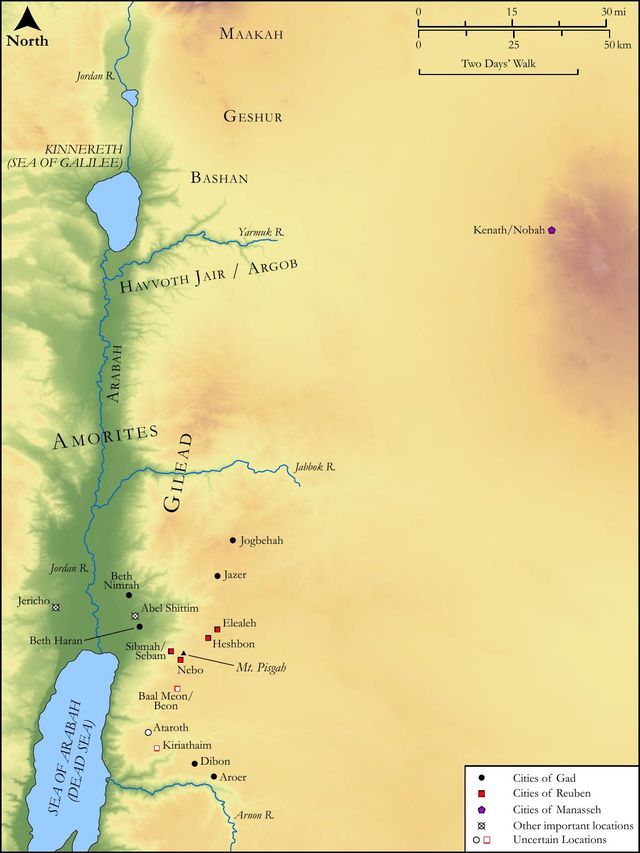
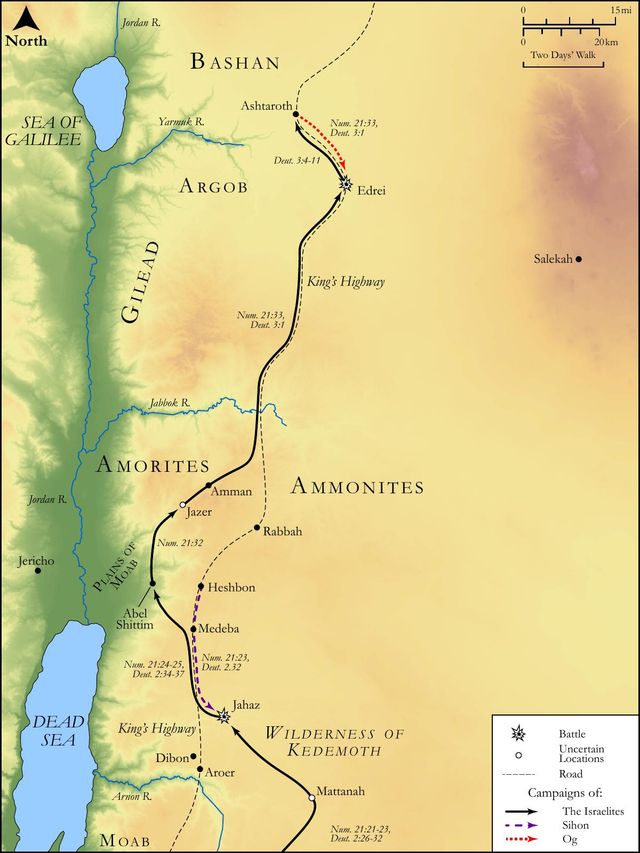
See on the biblical-era maps
Study this verse
Public-domain commentary
Matthew Henry
From his Commentary on the Whole Bible. Henry comments on passages, not single verses — this entry covers Deuteronomy 3:1–11. His two-level outline is real structure in the source text, so it is rendered as structure.
We have here another brave country delivered into the hand of Israel, that of Bashan; the conquest of Sihon is often mentioned together with that of Og, to the praise of God, the rather because in these Israel's triumphs began, Psa 135:11; Psa 136:19, Psa 136:20. See,
I.How they got the mastery of Og, a very formidable prince,
1.Very strong, for he was of the remnant of the giants (Deu 3:11); his personal strength was extraordinary, a monument of which was preserved by the Ammonites in his bedstead, which was shown as a rarity in their chief city. You might guess at his weight by the materials of his bedstead; it was iron, as if a bedstead of wood were too weak for him to trust to: and you might guess at his stature by the dimensions of it; it was nine cubits long and four cubits broad, which, supposing a cubit to be but half a yard (and some learned men have made it appear to be somewhat more), was four yards and a half long, and two yards broad; and if we allow his bedstead to be two cubits longer than himself, and that is as much as we need allow, he was three yards and a half high, double the stature of an ordinary man, and every way proportionable, yet they smote him, Deu 3:3. Note, when God pleads his people's cause he can deal with giants as with grasshoppers. No man's might can secure him against the Almighty. The army of Og was very powerful, for he had the command of sixty fortified cities, besides the unwalled towns, Deu 3:5. Yet all this was nothing before God's Israel, when they came with commission to destroy him.
2.He was very bold and daring: He came out against Israel to battle, Deu 3:1. It was wonderful that he did not take warning by the ruin of Sihon, and send to desire conditions of peace; but he trusted to his own strength, and so was hardened to his destruction. Note, Those that are not awakened by the judgments of God upon others, but persist in their defiance of heaven, are ripening apace for the like judgments upon themselves, Jer 3:8. God bade Moses not fear him, Deu 3:2. If Moses himself was so strong in faith as not to need the caution, yet it is probable that the people needed it, and for them these fresh assurances are designed; "I will deliver him into thy hand; not only deliver thee out of his hand, that he shall not be thy ruin, but deliver him into thy hand, that thou shalt be his ruin, and make him pay dearly for his attempt." He adds, Thou shalt do to him as thou didst to Sihon, intimating that they ought to be encouraged by their former victory to trust in God for another victory, for he is God, and changeth not.
II.How they got possession of Bashan, a very desirable country.
They took all the cities (Deu 3:4), and all the spoil of them, Deu 3:7. They made them all their own, Deu 3:10. So that now they had in their hands all that fruitful country which lay east of Jordan, from the river Arnon unto Hermon, Deu 3:8. Their conquering and possessing these countries was intended, not only for the encouragement of Israel in the wars of Canaan, but for the satisfaction of Moses before his death. Since he must not live to see the completing of their victory and settlement, God thus gives him a specimen of it. Thus the Spirit is given to those that believe as the earnest of their inheritance, until the redemption of the purchased possession.
Continue studying Deuteronomy 3:8 across the web’s major study libraries — every link below opens this exact verse, chapter, or book on the destination site.
Read & Compare
 BibleGatewayThis verse in more than 200 translations and 70 languages.
 Bible.comThe YouVersion reader — hundreds of translations, reading plans, and highlights.
 ESV.orgCrossway's official English Standard Version reader.
 NET BibleThe NET translation with 60,000+ translators' notes on every rendering decision.
 STEP BibleTyndale House's free study tool — original text, vocabulary, and scholarly resources.
 BibliaLogos Bible Software's free web reader.
 USCCBThe New American Bible (Revised Edition) with the U.S. bishops' study notes.
Commentaries
 BibleHub CommentariesDozens of classic commentaries on this verse, gathered on one page.
 StudyLightMore than 100 commentary sets — the largest collection on the web.
 BibleRefPlain-English commentary on what this verse means, verse by verse.
 Enduring WordDavid Guzik's free commentary on this chapter, widely used by Bible teachers.
 Bible Study ToolsVerse commentary alongside Greek and Hebrew study aids.
Original Language & Research
- BibleHub InterlinearThe verse word by word — original language, transliteration, and English.
- BibleHub LexiconEvery word's original-language definition and Strong's entry.
 Blue Letter BibleDeep-study tools — Strong's numbers, concordance, and word studies.
 SefariaThe Hebrew text with Rashi and centuries of Jewish commentary.
Sermons, Hymns & Audio


TrulyRandomVerse is not affiliated with these sites and doesn’t control their content. They’re linked because they’re genuinely useful.
Summary
Deuteronomy 3:8 serves as Moses' concise yet profound summary of a pivotal moment in Israel's wilderness journey: the successful conquest and acquisition of significant territory east of the Jordan River. This verse highlights the divine enablement and military triumph over the formidable Amorite kings, Sihon and Og, securing a vast expanse of land stretching from the Arnon River in the south to Mount Hermon in the north. It underscores God's unwavering faithfulness in fulfilling His covenant promises and establishes a tangible foundation for Israel's impending inheritance of the Promised Land, demonstrating His power to overcome seemingly insurmountable obstacles.
Context
ShowHideLiterary Context
Deuteronomy 3:8 is strategically placed within Moses' second major discourse to the new generation of Israelites, delivered on the plains of Moab just prior to their entry into Canaan. This discourse, encompassing Deuteronomy 1 through Deuteronomy 4, functions as a comprehensive historical review of their journey from Horeb (Mount Sinai) and a fervent exhortation to covenant obedience. Specifically, this verse encapsulates the victorious campaigns against Sihon, king of Heshbon, detailed in Deuteronomy 2:26-37, and Og, king of Bashan, recounted in Deuteronomy 3:1-7. These conquests represent Israel's initial, tangible land acquisitions, serving as powerful evidence of God's active involvement and faithfulness in their history, designed to instill confidence and foster trust as they prepared to cross the Jordan.
Historical & Cultural Context
The "two kings of the Amorites," Sihon and Og, were formidable rulers controlling strategically vital and agriculturally rich territories east of the Jordan River. The Amorites were a prominent people, known for their fortified cities and military prowess in the days of Moses. Sihon's kingdom was centered on Heshbon, a key city controlling trade routes, while Og's kingdom of Bashan was renowned for its fertile plains and the extraordinary stature of its king (Deuteronomy 3:11). The geographical scope, "from the river of Arnon unto mount Hermon," describes a vast region known as Transjordan, extending from the southern border of Moab (Arnon River) northward to the imposing foothills of Mount Hermon, near modern-day Syria and Lebanon. The conquest of these powerful kingdoms, though executed by Israelite forces, was understood by the Israelites as a direct divine intervention, a miraculous fulfillment of God's ancient promise to grant them land (Genesis 15:18-21).
Key Themes
ShowHideDeuteronomy 3:8 significantly contributes to several foundational themes woven throughout Deuteronomy and the broader Pentateuch. Firstly, it powerfully illustrates Divine Victory and Fulfillment, serving as concrete proof that Israel's success was not born of their own strength but was a direct result of God fighting on their behalf, actively fulfilling His promise of territory. Secondly, it highlights the theme of Progressive Inheritance. This initial conquest of Transjordanian territory marked the first tangible step in Israel's possession of the Promised Land, serving as a "down payment" and a powerful encouragement for the greater task of conquering Canaan proper. It demonstrated that God's plan for Israel to inherit a land "flowing with milk and honey" was actively unfolding, building their faith for future challenges. Finally, the recounting of these victories powerfully reinforces God's Unwavering Faithfulness. Moses repeatedly emphasizes that God consistently keeps His word, reminding the new generation that if God had delivered them from Egyptian bondage and granted them this significant victory, He would certainly enable them to conquer the remaining land.
Exposition and Analysis
ShowHideKey Word Analysis
ShowHideThis verb signifies "to take," "to seize," or "to acquire." In the context of warfare, it denotes a decisive and successful act of possession, implying conquest and gaining control. While the action is attributed to "we" (Israel), the broader theological framework of Deuteronomy consistently emphasizes that Israel's military successes are ultimately divinely enabled. Therefore, "took" here implies a God-empowered acquisition, not merely a human military feat, highlighting God's agency behind Israel's actions.
This primitive word for "hand" is used here idiomatically in the phrase "out of the hand of." It signifies power, control, and dominion. To take something "out of the hand of" implies wresting control, overcoming superior force, and decisively defeating an adversary. In this context, it emphasizes the complete subjugation of the Amorite kings, indicating that their power and control were utterly broken by Israel, empowered by God.
This term, often translated as "across" or "the other side," is crucial for understanding the geographical perspective. Since Moses is speaking from the plains of Moab, east of the Jordan River, "on this side Jordan" specifically refers to the Transjordan region, the land situated to the east of the river. This geographical marker is vital for distinguishing this initial conquest from the main land of Canaan, which lay to the west of the Jordan, and for understanding the subsequent tribal allotments.
Verse Breakdown
ShowHide"And we took at that time out of the hand of the two kings of the Amorites"
This opening clause immediately establishes the victorious subject ("we," referring to the Israelites under Moses' leadership) and the successful outcome ("took"). The phrase "out of the hand of" powerfully conveys a decisive victory, signifying that Israel wrested control and dominion from formidable adversaries. The explicit mention of "the two kings of the Amorites"—Sihon of Heshbon and Og of Bashan—underscores the formidable nature of the opposition and, by extension, magnifies the greatness of God's power in overcoming them.
"the land that [was] on this side Jordan"
This clause precisely specifies the territory acquired. "The land" refers to the entire region previously controlled by Sihon and Og. "On this side Jordan" (from Moses' perspective) clarifies that this conquest occurred in the Transjordanian region, east of the Jordan River, before Israel entered the main portion of the Promised Land to the west. This geographical detail is key to understanding the progressive unfolding of Israel's inheritance and the distinct nature of this initial acquisition.
"from the river of Arnon unto mount Hermon"
This clause provides the precise geographical boundaries of the conquered territory, emphasizing its vastness. The Arnon River formed a natural southern boundary for Sihon's kingdom and marked the border with Moab. Mount Hermon, a prominent and imposing landmark in the far north, served as the northern extent of Og's kingdom of Bashan. This sweeping description of territory from south to north highlights the immense scale of the victory and the significant land mass acquired, signaling a substantial fulfillment of God's promises.
Literary Devices
ShowHideDeuteronomy 3:8 employs several potent literary devices to convey its message. The most prominent is Recapitulation, as Moses is summarizing and re-telling events previously detailed in Numbers 21 and earlier in Deuteronomy. This serves to reinforce the historical record, impress upon the new generation the faithfulness of God, and provide a succinct overview of past victories. The verse also utilizes Geographical Specificity, naming the Arnon River and Mount Hermon, which grounds the narrative in a tangible, identifiable landscape, making the conquest concrete, verifiable, and emphasizing its vast scope. Furthermore, the concise declaration "And we took" functions as a powerful Summary Statement, compressing a series of complex military campaigns into a single, declarative sentence that emphasizes the decisive and successful outcome. While not explicitly stated, the verse also carries a profound implicit Statement of Divine Agency, as the entire book of Deuteronomy attributes Israel's success to God's power, presence, and covenant faithfulness, making the human "taking" a divinely enabled act.
Theological and Thematic Connections
ShowHideDeuteronomy 3:8 stands as a powerful theological declaration concerning God's unwavering covenant faithfulness and His active, decisive involvement in the history of His people. It unequivocally demonstrates that God is not a distant, passive deity but one who directly intervenes to fulfill His promises, even when faced with seemingly insurmountable human opposition. The conquest of the formidable Amorite kings and the acquisition of their land served as a tangible, undeniable sign that God was meticulously keeping His ancient word to Abraham, Isaac, and Jacob, who had been promised this very land (e.g., Genesis 12:7). This initial victory east of the Jordan provided a crucial foundation of confidence and courage for the Israelites as they prepared to face even greater challenges in Canaan. It profoundly underscored the theological principle that divine enablement precedes human effort, and that true inheritance is a gracious gift from God, received through obedient faith and reliance on His power.
Reflection and Application
ShowHideDeuteronomy 3:8, though a historical account of ancient conquest, carries profound and enduring spiritual resonance for believers today. It serves as a powerful reminder that God is eternally faithful to His promises, even when the obstacles before us appear overwhelming or insurmountable. Just as Israel faced the "giants" of the Amorite kings, we too encounter "giants" in our lives—whether they be personal challenges, spiritual battles, financial struggles, or seemingly impossible circumstances that threaten to block our path to God's promised blessings. This verse encourages us to remember that our victories are ultimately God's victories, achieved not through our own might or cleverness, but through His strength and unwavering faithfulness. It teaches us to trust in His progressive leading, recognizing that He often grants breakthroughs and fulfills promises in stages, building our faith and preparing us for what lies ahead. The initial conquest east of the Jordan was a vital step towards the full inheritance of Canaan, just as present victories in our lives can be stepping stones to greater spiritual growth, deeper intimacy with God, and the progressive realization of His divine purposes. We are called to walk in obedience and courage, confident that the God who fought for Israel will also fight for us, enabling us to possess the spiritual inheritance He has prepared.
Questions for Reflection
ShowHideFAQ
ShowHideWhat does "on this side Jordan" mean in this context, and why is it significant?
ShowHideIn Deuteronomy 3:8, the phrase "on this side Jordan" (Hebrew: ever hayarden) refers to the region east of the Jordan River. This phrasing is from Moses' perspective, as he is delivering his discourse on the plains of Moab, which are located east of the river. This area, often called Transjordan, was the first significant territory conquered by the Israelites under Moses' leadership, comprising the kingdoms of Sihon and Og. It was later allotted to the tribes of Reuben, Gad, and half of Manasseh, as described in Numbers 32:33. Understanding this geographical distinction is crucial for following the narrative of Israel's conquest and settlement, as it highlights the initial fulfillment of God's land promise even before the main invasion of Canaan proper to the west.
Christ-Centered Fulfillment
ShowHideDeuteronomy 3:8, while a historical account of Israel's physical conquest and land acquisition, profoundly foreshadows the far greater spiritual victory and eternal inheritance found exclusively in Jesus Christ. The "land" taken from the Amorite kings points to the spiritual inheritance that believers receive in Christ, which is not a geographical territory but a participation in His heavenly kingdom and the boundless blessings of salvation. Just as God enabled Israel to "take" the land from formidable adversaries, so too does Christ, the ultimate Captain of the Lord's army, enable His people to conquer spiritual adversaries and strongholds (e.g., Ephesians 6:12). The faithfulness of God in fulfilling His promise of land to Israel finds its ultimate and most glorious expression in His faithfulness to His new covenant people, granting them an eternal inheritance that is "imperishable, undefiled, and unfading, kept in heaven for you" (1 Peter 1:4). The progressive nature of Israel's inheritance, beginning with the Transjordan, mirrors the believer's journey of progressive sanctification and the ultimate full inheritance of glory at Christ's return (Romans 8:17). Thus, Deuteronomy 3:8 is not merely a historical footnote but a powerful testament to God's unwavering commitment to His people, culminating in the complete and eternal victory and inheritance secured through the finished work of Jesus Christ, the true Lamb of God who takes away the sin of the world.