


Deuteronomy 3:9
Bible text: King James Version (1769 Blayney text) · Public domain
Bible text: Berean Standard Bible · Public domain
Bible text: American Standard Version (1901) · Public domain
Bible text: World English Bible, Messianic edition · Public domain
Bible text: Geneva Bible (1599) · Public domain
Bible text: Young's Literal Translation · Public domain
- צִידֹנִיםtzi·do·Nim[the] SidoniansH6722N-mpNoun Gentilic Plural Masculine Absolute
- יִקְרְאוּyik·re·'Uthey callH7121V-Qal-Imperf-3mpVerb Qal Imperfect 3rd Plural Masculine
- לְחֶרְמוֹןle·cher·Mon<to> HermonH2768Prep-l ¦ N-properNoun Proper Locationלְ<to>חֶרְמוֹןHermon
- שִׂרְיֹןsir·YonSirionH8303N-properNoun Proper Location
- וְהָאֱמֹרִיve·Ha·'e·mo·Riand the Amorite[s]H567Conj-w ¦ Art ¦ N-msNoun Gentilic Singular Masculine AbsoluteוְandהָtheאֱמֹרִיAmorite[s]
- יִקְרְאוּyik·re·'uthey callH7121V-Qal-Imperf-3mpVerb Qal Imperfect 3rd Plural Masculine
- לוֹlo<to> itPrep-l ¦ 3msSuffix Personal 3rd Singular Masculineל<to>וֹit
- שְׂנִירse·NirSenirH8149N-properNoun Proper Location
English is a literal word-by-word gloss of the Hebrew, not the KJV's wording. Why?
This is the original text the KJV's translators worked from — each Hebrew word with its own literal English meaning in this verse, prepared by scholars at Tyndale House, Cambridge. The KJV translates whole sentences, not word by word, so its wording differs: one Hebrew word can become several English words, and the KJV may choose “the LORD” where the gloss reads “Yahweh”. Both are faithful — they answer different questions. For the KJV's own rendering, switch to the KJV text.
Details
See on the biblical-era maps
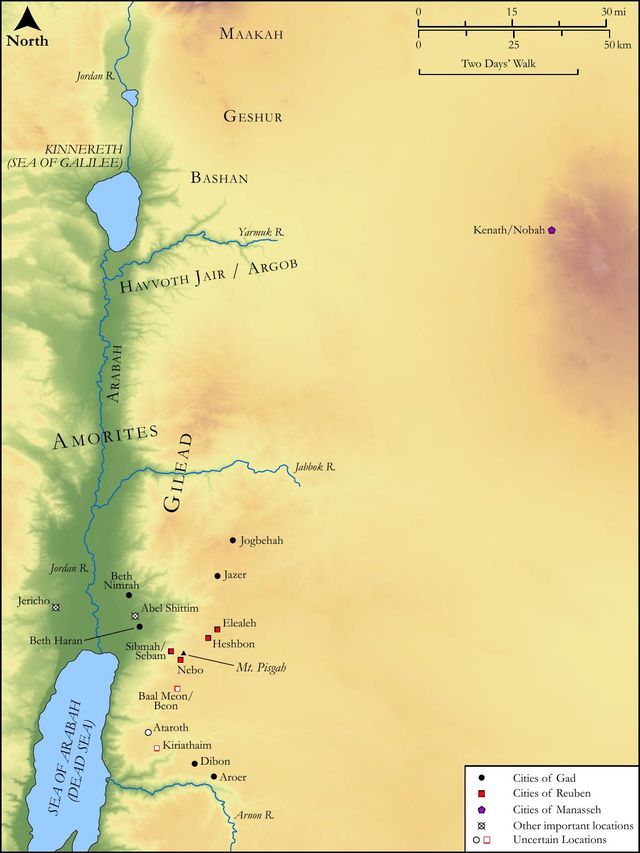
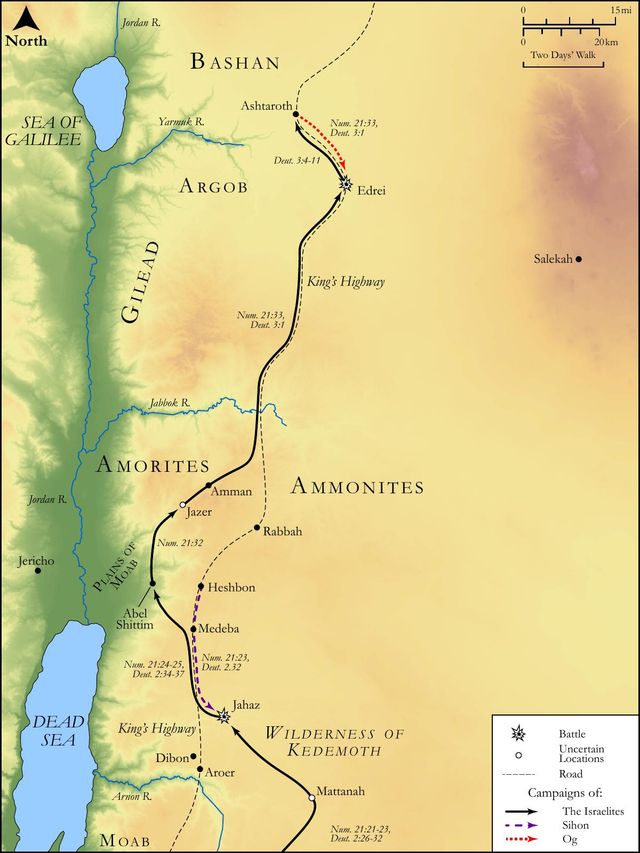
Study this verse
Public-domain commentary
Matthew Henry
From his Commentary on the Whole Bible. Henry comments on passages, not single verses — this entry covers Deuteronomy 3:1–11. His two-level outline is real structure in the source text, so it is rendered as structure.
We have here another brave country delivered into the hand of Israel, that of Bashan; the conquest of Sihon is often mentioned together with that of Og, to the praise of God, the rather because in these Israel's triumphs began, Psa 135:11; Psa 136:19, Psa 136:20. See,
I.How they got the mastery of Og, a very formidable prince,
1.Very strong, for he was of the remnant of the giants (Deu 3:11); his personal strength was extraordinary, a monument of which was preserved by the Ammonites in his bedstead, which was shown as a rarity in their chief city. You might guess at his weight by the materials of his bedstead; it was iron, as if a bedstead of wood were too weak for him to trust to: and you might guess at his stature by the dimensions of it; it was nine cubits long and four cubits broad, which, supposing a cubit to be but half a yard (and some learned men have made it appear to be somewhat more), was four yards and a half long, and two yards broad; and if we allow his bedstead to be two cubits longer than himself, and that is as much as we need allow, he was three yards and a half high, double the stature of an ordinary man, and every way proportionable, yet they smote him, Deu 3:3. Note, when God pleads his people's cause he can deal with giants as with grasshoppers. No man's might can secure him against the Almighty. The army of Og was very powerful, for he had the command of sixty fortified cities, besides the unwalled towns, Deu 3:5. Yet all this was nothing before God's Israel, when they came with commission to destroy him.
2.He was very bold and daring: He came out against Israel to battle, Deu 3:1. It was wonderful that he did not take warning by the ruin of Sihon, and send to desire conditions of peace; but he trusted to his own strength, and so was hardened to his destruction. Note, Those that are not awakened by the judgments of God upon others, but persist in their defiance of heaven, are ripening apace for the like judgments upon themselves, Jer 3:8. God bade Moses not fear him, Deu 3:2. If Moses himself was so strong in faith as not to need the caution, yet it is probable that the people needed it, and for them these fresh assurances are designed; "I will deliver him into thy hand; not only deliver thee out of his hand, that he shall not be thy ruin, but deliver him into thy hand, that thou shalt be his ruin, and make him pay dearly for his attempt." He adds, Thou shalt do to him as thou didst to Sihon, intimating that they ought to be encouraged by their former victory to trust in God for another victory, for he is God, and changeth not.
II.How they got possession of Bashan, a very desirable country.
They took all the cities (Deu 3:4), and all the spoil of them, Deu 3:7. They made them all their own, Deu 3:10. So that now they had in their hands all that fruitful country which lay east of Jordan, from the river Arnon unto Hermon, Deu 3:8. Their conquering and possessing these countries was intended, not only for the encouragement of Israel in the wars of Canaan, but for the satisfaction of Moses before his death. Since he must not live to see the completing of their victory and settlement, God thus gives him a specimen of it. Thus the Spirit is given to those that believe as the earnest of their inheritance, until the redemption of the purchased possession.
Continue studying Deuteronomy 3:9 across the web’s major study libraries — every link below opens this exact verse, chapter, or book on the destination site.
Read & Compare
 BibleGatewayThis verse in more than 200 translations and 70 languages.
 Bible.comThe YouVersion reader — hundreds of translations, reading plans, and highlights.
 ESV.orgCrossway's official English Standard Version reader.
 NET BibleThe NET translation with 60,000+ translators' notes on every rendering decision.
 STEP BibleTyndale House's free study tool — original text, vocabulary, and scholarly resources.
 BibliaLogos Bible Software's free web reader.
 USCCBThe New American Bible (Revised Edition) with the U.S. bishops' study notes.
Commentaries
 BibleHub CommentariesDozens of classic commentaries on this verse, gathered on one page.
 StudyLightMore than 100 commentary sets — the largest collection on the web.
 BibleRefPlain-English commentary on what this verse means, verse by verse.
 Enduring WordDavid Guzik's free commentary on this chapter, widely used by Bible teachers.
 Bible Study ToolsVerse commentary alongside Greek and Hebrew study aids.
Original Language & Research
- BibleHub InterlinearThe verse word by word — original language, transliteration, and English.
- BibleHub LexiconEvery word's original-language definition and Strong's entry.
 Blue Letter BibleDeep-study tools — Strong's numbers, concordance, and word studies.
 SefariaThe Hebrew text with Rashi and centuries of Jewish commentary.
Sermons, Hymns & Audio


TrulyRandomVerse is not affiliated with these sites and doesn’t control their content. They’re linked because they’re genuinely useful.
Summary
Deuteronomy 3:9 functions as a crucial parenthetical clarification within Moses' historical recounting of Israel's conquest of the Transjordan region, specifically the defeat of Og, king of Bashan. This verse provides essential geographical detail by identifying Mount Hermon, a significant landmark, by its alternative names used by neighboring peoples—Sirion by the Sidonians and Shenir by the Amorites. This meticulous detail serves to anchor the biblical narrative in verifiable geographical and cultural reality, thereby underscoring the historical accuracy of the account and the precise fulfillment of God's covenant promises regarding the land given to Israel.
Context
ShowHideLiterary Context
This verse is strategically placed within Moses' comprehensive recapitulation of Israel's wilderness journey and their initial conquests east of the Jordan, a foundational sermon delivered to the new generation poised to enter the Promised Land (Deuteronomy 1:1-4:43). Specifically, it appears as an explanatory note in the detailed account of the defeat of Og, king of Bashan (Deuteronomy 3:1-7), which immediately follows the conquest of Sihon, king of Heshbon (Deuteronomy 2:26-37). Moses is meticulously describing the extent of the land east of the Jordan that the Lord had delivered into Israel's hands, with Mount Hermon serving as the prominent northernmost boundary of Og's former kingdom. The parenthetical nature of the verse, indicated by the KJV's use of brackets, signifies an editorial insertion designed to provide clarity and precision for readers who might be more familiar with the mountain by its regional appellations, thus ensuring no ambiguity regarding the precise geographical scope of Israel's divinely granted victory.
Historical & Cultural Context
The historical backdrop for Deuteronomy is the plains of Moab, as the Israelites conclude their forty-year wilderness wandering and prepare for the invasion of Canaan. The Transjordanian region was a mosaic of diverse peoples and powerful city-states. The Amorites, a prominent Semitic group, had established formidable kingdoms, including those ruled by Sihon and Og. To the northwest, along the Mediterranean coast, flourished the Sidonians, a leading Phoenician people renowned for their extensive maritime trade networks, sophisticated craftsmanship, and significant cultural influence throughout the Levant. Mount Hermon itself, a majestic and often snow-capped peak, stands as a towering natural landmark, serving as a significant geographical boundary and a vital source of water for the entire region through its snowmelt. The biblical author's inclusion of multiple names for this singular geographical feature vividly reflects the linguistic and cultural diversity inherent among the peoples round about Canaan, where various peoples would naturally name prominent landmarks according to their own languages, cultural perspectives, and historical traditions. This detail demonstrates the biblical writer's profound and intimate knowledge of the region's diverse inhabitants and their customs.
Key Themes
ShowHideDeuteronomy 3:9, though seemingly a minor geographical clarification, significantly contributes to several overarching themes foundational to Deuteronomy and the broader Pentateuch. Firstly, it powerfully reinforces the theme of Geographical Precision and Historical Reliability. The meticulous detail in identifying landmarks by multiple regional names grounds the narrative in a tangible, verifiable reality, thereby affirming the historical veracity of God's actions and promises. This is presented not as a mythical tale but as a faithful record of real events unfolding in a real world. Secondly, the verse subtly highlights Cultural and Linguistic Diversity, acknowledging the various peoples inhabiting the land and their unique terminologies, yet simultaneously demonstrating God's overarching sovereignty over all nations and their territories. Finally, and most profoundly, it reinforces the central theme of Divine Faithfulness and the Fulfillment of God's Promises. The detailed description of the conquered territory, extending to the prominent Mount Hermon, serves as irrefutable, tangible proof that God was indeed delivering on His covenant promise to give Israel the land, first articulated to Abraham in Genesis 15:18. The successful conquest of these powerful kings and the subsequent possession of their lands, including the northern reaches defined by Hermon, unequivocally demonstrate God's immense power and His unwavering commitment to His people, as consistently portrayed throughout Deuteronomy 2 and Deuteronomy 3.
Exposition and Analysis
ShowHideKey Word Analysis
ShowHideFrom the root חָרַם, meaning "abrupt," this name refers to the prominent, towering mount of Palestine, which marks the northernmost boundary of the land described in the biblical narrative. Its imposing presence and often snow-capped peaks made it a significant geographical and perhaps even sacred landmark to the peoples who dwelt near it, establishing a clear marker for the extent of Israel's divinely granted conquest.
This is the name given to Mount Hermon by the Sidonians, a leading Phoenician people inhabiting the coastal regions to the northwest. The name "Sirion" is understood to be related to "sheeted with snow," likely referring to the mountain's perpetually snow-covered peak. Its inclusion demonstrates the biblical author's precise awareness of the diverse linguistic landscape and the perspectives of the neighboring peoples, the Sidonians and the Amorites, further solidifying the geographical accuracy of the account.
From an unused root meaning "to be pointed," this name refers to the "peak" or "summit" of Mount Hermon, as it was known by the Amorites. The Amorites were a powerful Semitic people who had established significant kingdoms throughout the Levant, including the Transjordanian territories recently conquered by Israel. The mention of "Shenir" further illustrates the multi-ethnic and multi-linguistic context of the region and underscores the comprehensive geographical and cultural awareness of the biblical writer.
Verse Breakdown
ShowHide"(Which) Hermon"
This introductory phrase serves as a parenthetical clarification, immediately linking the subsequent information back to the majestic mountain previously mentioned as the northern boundary of Og's kingdom in Deuteronomy 3:8. It identifies the primary, Israelite name for the mountain, setting the stage for the presentation of its alternative regional names.
"the Sidonians call Sirion;"
This clause provides the first alternative name for Mount Hermon, explicitly attributing its usage to the Sidonians. This detail not only highlights the linguistic influence and presence of the Phoenician people in the broader region but also demonstrates the biblical author's profound and precise knowledge of the local cultures and their specific naming conventions for significant geographical features.
"and the Amorites call it Shenir;)"
This second clause offers yet another alternative name for the same mountain, specifying that it was used by the Amorites, who were the dominant inhabitants of the Transjordanian territory that Israel had recently conquered. The deliberate inclusion of both Sidonian and Amorite names powerfully underscores the rich, diverse linguistic tapestry of the peoples round about Israel and unequivocally confirms the extensive geographical and cultural awareness possessed by the biblical writer.
Literary Devices
ShowHideDeuteronomy 3:9 masterfully employs several subtle yet significant literary devices that enhance its depth and credibility. The most prominent is Parenthesis, clearly indicated by the KJV's use of brackets, which allows the inspired author to insert a vital explanatory note without disrupting the primary flow of Moses' historical narrative. This technique provides crucial supplemental geographical information to the audience, ensuring absolute clarity regarding the precise territorial scope of the conquest. The verse also powerfully exemplifies Geographical Realism, firmly grounding the divinely inspired narrative in concrete, verifiable locations known to Israel and her neighbors. By meticulously providing multiple names for the same mountain, the text achieves a remarkable degree of Historical Authentication, demonstrating an intimate and precise familiarity with the region's diverse inhabitants and their unique linguistic customs. This meticulous precision lends undeniable credibility and trustworthiness to the entire historical account, profoundly suggesting that the events described are not abstract tales or myths but real occurrences in a real, identifiable world.
Theological and Thematic Connections
ShowHideWhile seemingly a mere geographical detail, Deuteronomy 3:9 holds profound theological significance. It underscores the meticulous nature of God's Word and His providential oversight of human history. The precise identification of Mount Hermon by its various regional names serves as a powerful affirmation of the historical veracity of the biblical narrative, demonstrating that God's promises and actions unfold within a real, tangible world, not a mythical one. This level of detail reinforces the utter reliability and trustworthiness of Scripture, assuring readers that the God who orchestrates vast historical movements also attends to the smallest, seemingly insignificant details, ensuring the absolute accuracy of His revealed truth. It speaks volumes about God's comprehensive knowledge of all creation and His sovereign control over nations and their territories, as He meticulously orchestrated Israel's inheritance of the Promised Land according to His divine plan.
Reflection and Application
ShowHideDeuteronomy 3:9, though concise, extends a profound invitation to trust implicitly in the detailed faithfulness of God. In an era often characterized by skepticism regarding historical claims, this verse, with its meticulous geographical and cultural precision, stands as an enduring testament to the Bible's unwavering grounding in historical reality. It serves as a powerful reminder that God's Word is not a collection of vague, abstract stories but a divinely inspired, historically accurate record of His active interaction with humanity within specific times, places, and cultures. This extraordinary level of detail should profoundly bolster our confidence in the entire biblical narrative, assuring us that even the seemingly small, parenthetical pieces contribute purposefully to a larger, accurate, and coherent picture of God's overarching redemptive plan. If God is so utterly precise in detailing geographical landmarks and the linguistic habits of ancient peoples, how much more precise, reliable, and trustworthy is He in His grand promises concerning our salvation, our eternal future, and His ongoing, sovereign work in our individual lives? This verse profoundly encourages us to delve deeper into the sacred Scriptures, trusting with unwavering conviction that every single word is purposeful, divinely inspired, and revelatory of His unchanging character and His eternal truth.
Questions for Reflection
ShowHideFAQ
ShowHideWhy does the Bible include such specific geographical and linguistic details?
ShowHideThe inclusion of specific geographical and linguistic details, as vividly demonstrated in Deuteronomy 3:9, serves several crucial and interconnected purposes. Firstly, it powerfully authenticates the historical claims of the biblical narrative, demonstrating unequivocally that the events described occurred in a real, tangible world with identifiable landmarks and diverse human populations. This grounds the divine story in concrete reality, sharply distinguishing it from mere myth or legend. Secondly, such details showcase the biblical authors' intimate and profound knowledge of the land and its inhabitants, lending immense credibility and authority to their accounts. Thirdly, it subtly underscores the meticulousness of God's providential hand in history, revealing that His divine plan unfolds with absolute precision, even down to the names of mountains given by different cultures. Finally, it provides essential context for ancient readers and helps modern readers grasp the full scope and reality of God's covenant promises, particularly concerning the land He sovereignly gave to Israel.
What is the significance of different names for the same mountain?
ShowHideThe mention of different names for Mount Hermon (Hermon, Sirion, Shenir) profoundly signifies the multicultural and multilingual environment of the peoples dwelling about the land of Canaan. It vividly illustrates how various ethnic groups—Israelites, Sidonians (Phoenicians), and Amorites—perceived, named, and related to significant landmarks based on their own distinct languages, cultural traditions, and perhaps even their specific relationship to the mountain. For the biblical text, this detail immeasurably enhances its historical accuracy and realism, demonstrating that the inspired author possessed a deep awareness of the broader regional context. It also subtly highlights God's overarching sovereignty over all peoples and lands, as His redemptive plan unfolds amidst the rich tapestry of diverse human cultures and languages.
Does this verse have any direct prophetic significance for the future?
ShowHideWhile Deuteronomy 3:9 is primarily a historical and geographical clarification, it does not carry direct prophetic significance in the sense of foretelling specific future events. Its profound importance lies in its contribution to the historical reliability and factual grounding of the Old Testament narrative, which in turn provides a robust foundation for the entire biblical revelation. The precise and verifiable fulfillment of God's promises regarding the land in the past (Deuteronomy 2 and Deuteronomy 3) provides an unshakable basis of trust for His future promises, including those related to the coming of the Messiah and the ultimate establishment of His eternal kingdom.
Christ-Centered Fulfillment
ShowHideWhile Deuteronomy 3:9 is a specific geographical detail, its inclusion within the broader narrative of Israel's inheritance of the Promised Land powerfully points to the ultimate fulfillment found exclusively in Jesus Christ. The earthly land, with its meticulously defined boundaries and diverse inhabitants, served as a tangible, physical expression of God's unwavering covenant faithfulness to Abraham and his descendants. This earthly inheritance, described with such precision, profoundly foreshadows the spiritual inheritance and eternal rest that all believers receive in Christ. Just as God meticulously prepared a physical place for His chosen people, He has meticulously prepared an eternal dwelling for those who are united to Him in Christ, as Jesus Himself promised in John 14:2-3. The conquest of formidable kings like Og and the subsequent possession of their territories, extending to the northern reach of Hermon, powerfully prefigure Christ's ultimate and decisive victory over sin, death, and all spiritual powers and authorities, as triumphantly declared in Colossians 2:15. He is the true and eternal King who establishes an everlasting kingdom, a kingdom not bound by earthly borders or geographical limitations but encompassing all who believe and confess Him as Lord (Revelation 11:15). The precise details of the Old Testament, including seemingly minor geographical notes, serve to authenticate the historical reality of God's grand redemptive plan, a plan that finds its glorious culmination and perfect fulfillment in the person and redemptive work of Jesus Christ, who is Himself the true inheritance and eternal rest for His people (Hebrews 4:9-10).