


Joshua 11:14
- וְכֹלVe·kholand allH3605Conj-w ¦ N-mscNoun Singular Masculine Constructוְandכֹלall
- שְׁלַלshe·Lal[the] booty ofH7998N-mscNoun Singular Masculine Construct
- הֶעָרִיםhe·'a·Rimthe citiesH5892Art ¦ N-mpNoun Plural Masculine Absoluteהֶtheעָרִיםcities
- הָאֵלֶּהha·'E·leh<the> theseH428Art ¦ PrtParticle Demonstrativeהָ<the>אֵלֶּהthese
- וְהַבְּהֵמָהve·ha·be·he·Mahand the cattleH929Conj-w ¦ Art ¦ N-fsNoun Singular Feminine Absoluteוְandהַtheבְּהֵמָהcattle
- בָּזְזוּba·ze·Zuthey plunderedH962V-Qal-Perf-3cpVerb Qal Perfect 3rd Plural common gender
- לָהֶםla·Hemfor <the> themselvesPrep-l ¦ 3mpSuffix Personal 3rd Plural Masculineלָfor <the>הֶםthemselves
- בְּנֵיbe·Nei[the] people ofH1121N-mpcNoun Plural Masculine Construct
- יִשְׂרָאֵלYis·ra·'ElIsraelH3478N-properNoun Proper Location
- רַקrakonlyH7535AdvAdverb
- אֶת'et<obj.>H853DirObjMParticle Object Indicator
- כָּלkoleveryH3605N-mscNoun Singular Masculine Construct
- הָאָדָםha·'a·Dam<the> manH120Art ¦ N-msNoun Singular Masculine Absoluteהָ<the>אָדָםman
- הִכּוּhi·Kuthey struckH5221V-Hiphil-Perf-3cpVerb Hiphil Perfect 3rd Plural common gender
- לְפִיle·fito [the] mouth ofH6310Prep-l ¦ N-mscNoun Singular Masculine Constructלְtoפִי[the] mouth of
- חֶרֶבChe·rev[the] swordH2719N-fsNoun Singular Feminine Absolute
- עַד'aduntilH5704PrepPreposition
- הִשְׁמִדָםhish·mi·Damthey had destroyedH8045V-Hiphil-Inf ¦ 3mpVerb Hiphil Infinitive Constructהִשְׁמִדָhad destroyedםthey
- אוֹתָם'o·Tam<obj.> themH853DirObjM ¦ 3mpParticle Object Indicatorאוֹתָ<obj.>םthem
- לֹאlo'notH3808NegParticle Negative
- הִשְׁאִירוּhish·'I·ruthey leftH7604V-Hiphil-Perf-3cpVerb Hiphil Perfect 3rd Plural common gender
- כָּלkolanyH3605N-mscNoun Singular Masculine Construct
- נְשָׁמָהne·sha·Mahbreathing thingH5397N-fsNoun Singular Feminine Absolute
English is a literal word-by-word gloss of the Hebrew, not the KJV's wording. Why?
This is the original text the KJV's translators worked from — each Hebrew word with its own literal English meaning in this verse, prepared by scholars at Tyndale House, Cambridge. The KJV translates whole sentences, not word by word, so its wording differs: one Hebrew word can become several English words, and the KJV may choose “the LORD” where the gloss reads “Yahweh”. Both are faithful — they answer different questions. For the KJV's own rendering, switch to the KJV text.
Details
See on the biblical-era map
Study this verse
Public-domain commentary
Matthew Henry
From his Commentary on the Whole Bible. Henry comments on passages, not single verses — this entry covers Joshua 11:10–14.
We have here the same improvement made of this victory as was made of that in the foregoing chapter. 1. The destruction of Hazor is particularly recorded, because in it, and by the king thereof, this daring design against Israel was laid, Jos 11:10, Jos 11:11. The king of Hazor, it seems, escaped with his life out of the battle, and thought himself safe when he had got back into his own city, and Joshua had gone in pursuit of the scattered troops another way. But it proved that that which he thought would be for his welfare was his trap; in it he was taken as in an evil net; there he was slain, and his city, for his sake, burned. Yet we find that the remains of it being not well looked after by Israel the Canaanites rebuilt it, and settled there under another king of the same name, Jdg 4:2. 2. The rest of the cities of that part of the country are spoken of only in general, that Joshua got them all into his hands, but did not burn them as he did Hazor, for Israel was to dwell in great and goodly cities which they builded not (Deu 6:10) and in these among the rest. And here we find Israel rolling in blood and treasure. (1.) In the blood of their enemies; they smote all the souls (Jos 11:1), neither left they any to breathe (Jos 11:14), that there might be none to infect them with the abominations of Canaan, and none to disturb them in the possession of it. The children were cut off, lest they should afterwards lay claim to any part of this land in the right of their parents. (2.) In the wealth of their enemies. The spoil, and the cattle, they took for a prey to themselves, Jos 11:14. As they were enriched with the spoil of their oppressors when they came out of Egypt, wherewith to defray the charges of their apprenticeship in the wilderness, so they were now enriched with the spoil of their enemies for a stock wherewith to set up in the land of Canaan. Thus is the wealth of the sinner laid up for the just.
Historical interpretation
Historical reception
1 surviving comment on this verse from the historical church.
One should not at all think it a horrible cruelty that Joshua did not leave anyone alive in those cities that fell to him, for God himself had ordered this. However, whoever for this reason thinks that God himself must be cruel and does not wish to believe then that the true God was the author of the Old Testament judges as perversely about the works of God as he does about the sins of human beings. Such people do not know what each person ought to suffer. Consequently, they think it a great evil when that which is about to fall is thrown down and when mortals die.
Continue studying Joshua 11:14 across the web’s major study libraries — every link below opens this exact verse, chapter, or book on the destination site.
Read & Compare
 BibleGatewayThis verse in more than 200 translations and 70 languages.
 Bible.comThe YouVersion reader — hundreds of translations, reading plans, and highlights.
 ESV.orgCrossway's official English Standard Version reader.
 NET BibleThe NET translation with 60,000+ translators' notes on every rendering decision.
 STEP BibleTyndale House's free study tool — original text, vocabulary, and scholarly resources.
 BibliaLogos Bible Software's free web reader.
 USCCBThe New American Bible (Revised Edition) with the U.S. bishops' study notes.
Commentaries
 BibleHub CommentariesDozens of classic commentaries on this verse, gathered on one page.
 StudyLightMore than 100 commentary sets — the largest collection on the web.
 BibleRefPlain-English commentary on what this verse means, verse by verse.
 Enduring WordDavid Guzik's free commentary on this chapter, widely used by Bible teachers.
 Bible Study ToolsVerse commentary alongside Greek and Hebrew study aids.
Original Language & Research
- BibleHub InterlinearThe verse word by word — original language, transliteration, and English.
- BibleHub LexiconEvery word's original-language definition and Strong's entry.
 Blue Letter BibleDeep-study tools — Strong's numbers, concordance, and word studies.
 SefariaThe Hebrew text with Rashi and centuries of Jewish commentary.
Sermons, Hymns & Audio


TrulyRandomVerse is not affiliated with these sites and doesn’t control their content. They’re linked because they’re genuinely useful.
Summary
Joshua 11:14 provides a concise yet profound summary of the outcomes of Israel's northern campaign under Joshua, delineating the distinct fates of the material possessions and the human inhabitants of the conquered Canaanite cities. While the Israelites were permitted to appropriate the spoil and livestock for their own use, the divine command of herem (utter destruction) was meticulously executed upon the indigenous population, ensuring no individual was left alive. This action served to fulfill God's righteous judgment against the pervasive wickedness of the Canaanites and to ritually cleanse the land for Israel's habitation.
Context
ShowHideLiterary Context
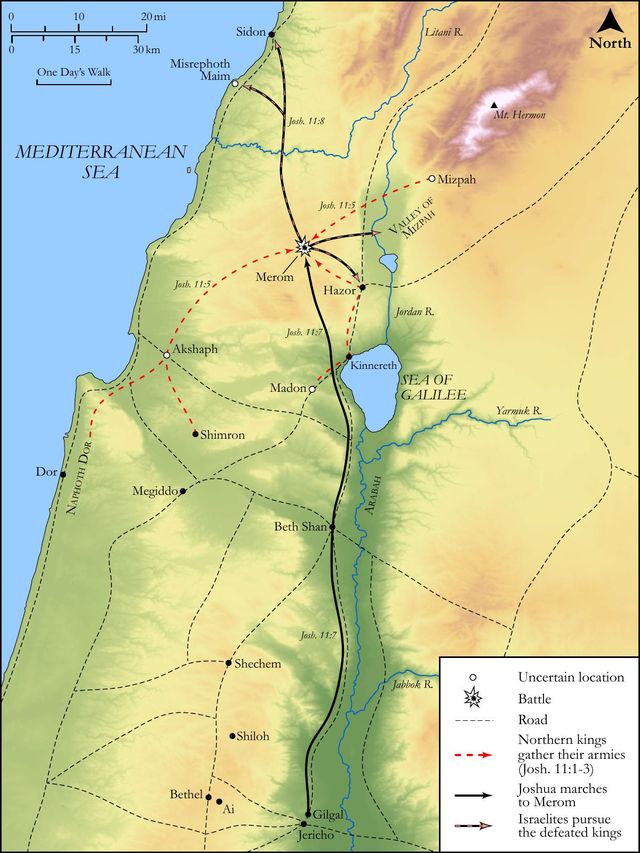
This verse serves as a pivotal summary statement, concluding the detailed account of Joshua's northern military campaign. It follows the decisive victory over the formidable coalition of kings led by Jabin of Hazor at the waters of Merom, as vividly described in Joshua 11:1-9. The preceding verses, Joshua 11:10-13, elaborate on the specific actions taken against Hazor, which was burned, and other northern cities, which were taken but not burned, indicating their intended future habitation by Israel. Verse 14 generalizes these specific instances into a comprehensive policy applied across all conquered northern territories, clearly distinguishing between the appropriation of material wealth and the complete eradication of the human population. This distinction provides a holistic overview of the campaign's conclusion, setting the stage for the broader summary of the entire conquest found in Joshua 11:15-23.
Historical & Cultural Context
The conquest of Canaan is situated within the Late Bronze Age (approximately 15th-13th centuries BCE), a period characterized by frequent conflicts among city-states in the ancient Near East. The Canaanite inhabitants were deeply entrenched in polytheistic worship, which included abhorrent practices such as fertility cults, ritual prostitution, and child sacrifice. The biblical narrative consistently portrays these practices as an abomination to Yahweh. God's unique command to Israel for the utter destruction of the Canaanite inhabitants, often referred to as herem, as explicitly outlined in Deuteronomy 20:16-18, was not a standard ancient Near Eastern warfare practice but a divinely ordained judgment. This judgment was against their profound moral corruption and served as a prophylactic measure to prevent Israel from being defiled by their idolatry and immoral customs, ensuring the spiritual purity of the Promised Land. The differentiation in the spoil policy—allowing the taking of goods from distant cities but mandating herem for inhabitants within Canaan—underscores the specific theological rationale driving the conquest.
Key Themes
ShowHideThis verse powerfully encapsulates several central themes that permeate the book of Joshua and the broader Pentateuchal narrative. A primary theme is Divine Judgment, where God employs Israel as His instrument to execute righteous wrath upon the Canaanite nations, whose "iniquity was not yet full" in Abraham's time, as foretold in Genesis 15:16. It also profoundly highlights Israel's Obedience to God's difficult and specific commands concerning the herem, demonstrating their faithfulness to the covenant. Furthermore, the verse explicitly distinguishes between the appropriation of material spoil (cattle and goods) and the total eradication of human life. This distinction underscores the nuanced application of herem: it was primarily directed at the people and their idolatrous systems, rather than indiscriminately at all their possessions, unless specifically commanded otherwise (as exemplified in the case of Jericho). This emphasis reveals that the ultimate objective was the spiritual purity of the land and the prevention of Israel's defilement by the abominable practices of the Canaanites.
Exposition and Analysis
ShowHideKey Word Analysis
ShowHideDerived from a root meaning "to plunder," this term refers to booty, plunder, or goods taken from a defeated enemy. In the context of Joshua 11:14, it specifically denotes the material wealth—possessions, valuables, and non-living assets—of the conquered cities that the Israelites were explicitly permitted to appropriate. This contrasts sharply with the human inhabitants, who were subjected to the herem command.
A primitive root meaning "to strike" or "to hit," often with lethal force. Here, it describes the violent, decisive action taken by the Israelites in battle, specifically using "the edge of the sword" to signify a thorough and complete execution of the divine command. This term conveys the direct and fatal nature of the military action, leaving no survivors among the human population.
This word literally means "a puff," "wind," "angry or vital breath," or "spirit." The phrase "neither left they any to breathe" (וְכֹל נְשָׁמָה לֹא הִשְׁאִירוּ) is a powerful idiom emphasizing the absolute totality of the destruction of human life. It signifies that not a single living soul was spared, underscoring the completeness and uncompromising nature of the herem command as applied to the inhabitants.
Verse Breakdown
ShowHide"And all the spoil of these cities, and the cattle, the children of Israel took for a prey unto themselves;"
This initial clause details the material outcomes of Israel's military victories. "Spoil" refers to the valuable goods and possessions found within the conquered cities, while "cattle" specifies the livestock. The phrase "took for a prey unto themselves" indicates that these resources became the legitimate property of the Israelite warriors and their families, providing sustenance and enriching them after the arduous campaigns. This appropriation was in accordance with specific divine allowances for certain conquered cities, distinguishing it from instances of total herem where all possessions were also to be destroyed, as seen in the case of Jericho.
"but every man they smote with the edge of the sword, until they had destroyed them,"
This segment describes the stark and absolute fate of the human inhabitants. The phrase "every man" highlights the comprehensive nature of the divine command, applying to all individuals without exception. "Smote with the edge of the sword" emphasizes the method of execution, signifying a direct, lethal, and uncompromising military action. The concluding phrase "until they had destroyed them" underscores the objective: complete annihilation of the population, not merely defeat, subjugation, or displacement. This was a direct fulfillment of God's righteous judgment against the Canaanites' profound wickedness.
"neither left they any to breathe."
This final, chilling phrase powerfully reinforces the absolute totality of the destruction of human life. It means that absolutely no one, not even a single living soul, was spared. This hyperbolic yet contextually literal statement emphasizes the strict and unwavering adherence to the herem command, ensuring that the land was thoroughly cleansed of its idolatrous and morally corrupt inhabitants, thereby preventing their influence from contaminating the covenant people of Israel.
Literary Devices
ShowHideJoshua 11:14 employs several potent literary devices to convey its message with clarity and impact. Contrast is profoundly prominent, highlighting the stark difference between the Israelites' appropriation of material spoil and cattle for their own benefit, versus the utter destruction of every human inhabitant. This juxtaposition emphasizes the specific and nuanced nature of the divine command, distinguishing between material gain and the execution of judgment. The phrase "neither left they any to breathe" is a powerful use of Hyperbole, serving to emphasize the absolute and exhaustive nature of the eradication of life. While literally fulfilled in the context of herem, its strong language underscores the completeness of the action. This powerful expression contributes to a pervasive sense of Finality and Totality, leaving no ambiguity about the comprehensive outcome of the divine judgment. Furthermore, the verse functions as a Summary Statement, encapsulating the consistent policy applied throughout the northern campaign, thereby reinforcing the overarching theme of Israel's unwavering Obedience to God's difficult and uncompromising commands.
Theological and Thematic Connections
ShowHideJoshua 11:14 stands as a profound theological declaration concerning divine judgment, God's absolute holiness, and the nature of His covenant relationship with Israel. The herem (utter destruction) was not an act of arbitrary cruelty but a divinely mandated cleansing of the land from the pervasive evil, idolatry, and moral depravity of the Canaanites, whose sin had reached its full measure over centuries. Israel acted as the instrument of God's righteous wrath, fulfilling a long-prophesied judgment that began with the promise to Abraham that his descendants would inherit the land only after the iniquity of the Amorites was complete. This passage underscores God's absolute intolerance for sin and His unwavering commitment to maintaining the purity of His people and the land He designated for them. It serves as a stark reminder that God's holiness demands a radical separation from all that is defiling and rebellious against Him, demonstrating His justice even in severe judgment.
Reflection and Application
ShowHideJoshua 11:14 presents a challenging but essential truth about the profound seriousness of sin and the uncompromising nature of God's holiness. While the literal application of herem was specific to Israel's historical conquest of Canaan, its underlying principles resonate deeply for believers today. It calls us to recognize the profound gravity of any sin that takes root in our lives, our families, or our communities. Just as God commanded the Israelites to utterly destroy the corrupting influences of Canaan, we are called to wage spiritual warfare against the "flesh" and the "world" within ourselves, leaving "no breath" for sin, idolatry, or compromise to survive and corrupt our walk with God. This requires radical obedience, a willingness to confront and cut off anything that hinders our devotion to Christ, and an unwavering commitment to spiritual purity. It reminds us that our God is a consuming fire, holy and just, who desires His people to be set apart for Him, free from the defilement of the world.
Questions for Reflection
ShowHideFAQ
ShowHideWas the command to utterly destroy the Canaanites an act of genocide, and how does it align with God's character of love?
ShowHideThe command to utterly destroy the Canaanites, known as herem, is one of the most challenging and debated passages in the Old Testament. It is crucial to understand it within its specific theological and historical context. This was not a general command for all times or all peoples, nor was it an act of ethnic cleansing based on race. Instead, it was a unique, divinely mandated act of judgment against specific nations whose moral depravity and idolatry had reached an unbearable level over centuries, as indicated in Genesis 15:16. The Canaanites practiced child sacrifice, ritual prostitution, and other abominable acts that profoundly defiled the land and corrupted human society. God, as the righteous Judge of all the earth (Genesis 18:25), had patiently waited for their repentance, but their iniquity was full. Israel acted as the instrument of this divine judgment, not out of their own malice, but in obedience to God's command, which also served to protect Israel from the pervasive spiritual corruption of these nations (Deuteronomy 20:16-18). While difficult to reconcile with modern sensibilities, it reveals God's absolute holiness, His commitment to justice, and His intolerance for persistent, defiant rebellion against His moral order, even when it involves severe consequences.
Christ-Centered Fulfillment
ShowHideWhile Joshua 11:14 describes a literal military conquest and the physical destruction of enemies, its ultimate fulfillment and profound spiritual resonance are found in the person and redemptive work of Jesus Christ. The herem command, with its emphasis on utterly destroying all that is defiling and corrupting, powerfully foreshadows Christ's decisive victory over sin, death, and the principalities and powers of darkness. Just as Israel cleansed the land of Canaanite wickedness, Jesus, through His sacrificial death on the cross, utterly destroyed the power of sin that held humanity captive, leaving "no breath" for its dominion over those who believe in Him (Hebrews 2:14). He is the ultimate Divine Warrior who conquers not with the sword of steel, but with the "sword of the Spirit, which is the word of God" (Ephesians 6:17). The spoil taken by Israel can be seen as a shadow of the spiritual blessings and freedom that believers "take for a prey unto themselves" through Christ's victory—redemption, righteousness, peace, and eternal life (Colossians 2:15). Ultimately, the cleansing of Canaan points to the new creation in Christ, where the old, sinful nature is "put to death" (Colossians 3:5) and believers are called to live in purity and holiness, having been delivered from the dominion of darkness and graciously transferred into the glorious kingdom of His beloved Son (Colossians 1:13).