


Numbers 31:9
Bible text: King James Version (1769 Blayney text) · Public domain
Bible text: King James Version with Strong's numbers · Public domain
Bible text: Berean Standard Bible · Public domain
Bible text: American Standard Version (1901) · Public domain
Bible text: World English Bible, Messianic edition · Public domain
Bible text: Geneva Bible (1599) · Public domain
Bible text: Young's Literal Translation · Public domain
- וַיִּשְׁבּוּvai·yish·Buand they took captiveH7617Conj-w ¦ V-Qal-ConsecImperf-3mpVerb Qal Consecutive Imperfect 3rd Plural Masculineוַandיִּשְׁבּוּthey took captive
- בְנֵיve·nei[the] people ofH1121N-mpcNoun Plural Masculine Construct
- יִשְׂרָאֵלYis·ra·'ElIsraelH3478N-properNoun Proper Location
- אֶת'et<obj.>H853DirObjMParticle Object Indicator
- נְשֵׁיne·Shei[the] women ofH802N-mpcNoun Plural Masculine Construct
- מִדְיָןmid·YanMidianH4080N-properNoun Proper Location
- וְאֶתve·'Etand <obj.>H853Conj-w ¦ DirObjMParticle Object Indicatorוְandאֶת<obj.>
- טַפָּםta·Pamtheir little one[s]H2945N-msc ¦ 3mpNoun Singular Masculine Constructטַפָּlittle one[s]םtheir
- וְאֵתve·'Etand <obj.>H853Conj-w ¦ DirObjMParticle Object Indicatorוְandאֵת<obj.>
- כָּלkolallH3605N-mscNoun Singular Masculine Construct
- בְּהֶמְתָּםbe·hem·Tamtheir cattleH929N-fsc ¦ 3mpNoun Singular Feminine Constructבְּהֶמְתָּcattleםtheir
- וְאֶתve·'Etand <obj.>H853Conj-w ¦ DirObjMParticle Object Indicatorוְandאֶת<obj.>
- כָּלkolallH3605N-mscNoun Singular Masculine Construct
- מִקְנֵהֶםmik·ne·Hemtheir livestockH4735N-msc ¦ 3mpNoun Singular Masculine Constructמִקְנֵlivestockהֶםtheir
- וְאֶתve·'Etand <obj.>H853Conj-w ¦ DirObjMParticle Object Indicatorוְandאֶת<obj.>
- כָּלkolallH3605N-mscNoun Singular Masculine Construct
- חֵילָםchei·Lamtheir wealthH2428N-msc ¦ 3mpNoun Singular Masculine Constructחֵילָwealthםtheir
- בָּזָזוּba·Za·zuthey plunderedH962V-Qal-Perf-3cpVerb Qal Perfect 3rd Plural common gender
English is a literal word-by-word gloss of the Hebrew, not the KJV's wording. Why?
This is the original text the KJV's translators worked from — each Hebrew word with its own literal English meaning in this verse, prepared by scholars at Tyndale House, Cambridge. The KJV translates whole sentences, not word by word, so its wording differs: one Hebrew word can become several English words, and the KJV may choose “the LORD” where the gloss reads “Yahweh”. Both are faithful — they answer different questions. For the KJV's own rendering, switch to the KJV text.
Details
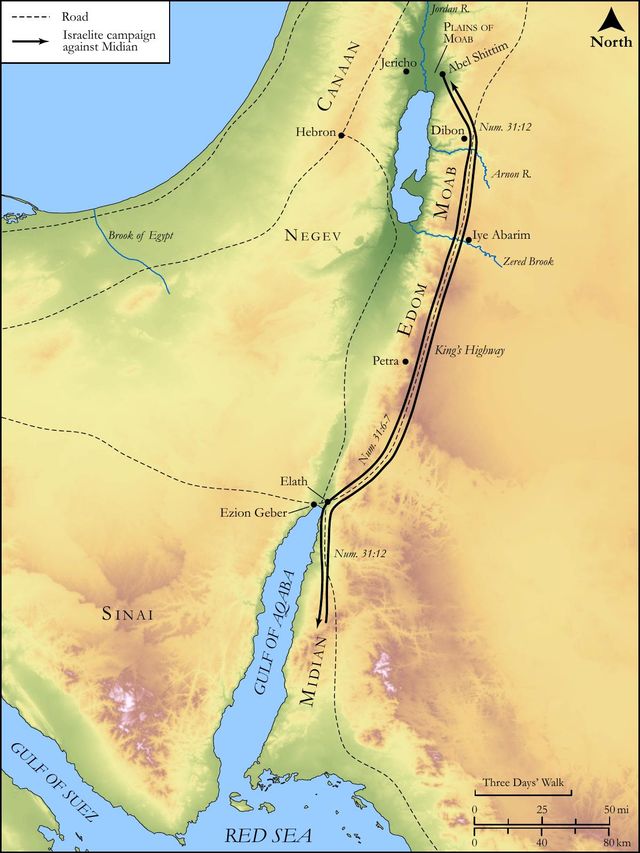
See on the biblical-era map
Study this verse
Continue studying Numbers 31:9 across the web’s major study libraries — every link below opens this exact verse, chapter, or book on the destination site.
Read & Compare
 BibleGatewayThis verse in more than 200 translations and 70 languages.
 Bible.comThe YouVersion reader — hundreds of translations, reading plans, and highlights.
 ESV.orgCrossway's official English Standard Version reader.
 NET BibleThe NET translation with 60,000+ translators' notes on every rendering decision.
 STEP BibleTyndale House's free study tool — original text, vocabulary, and scholarly resources.
 BibliaLogos Bible Software's free web reader.
 USCCBThe New American Bible (Revised Edition) with the U.S. bishops' study notes.
Commentaries
 BibleHub CommentariesDozens of classic commentaries on this verse, gathered on one page.
 StudyLightMore than 100 commentary sets — the largest collection on the web.
 BibleRefPlain-English commentary on what this verse means, verse by verse.
 Enduring WordDavid Guzik's free commentary on this chapter, widely used by Bible teachers.
 Bible Study ToolsVerse commentary alongside Greek and Hebrew study aids.
Original Language & Research
- BibleHub InterlinearThe verse word by word — original language, transliteration, and English.
- BibleHub LexiconEvery word's original-language definition and Strong's entry.
 Blue Letter BibleDeep-study tools — Strong's numbers, concordance, and word studies.
 SefariaThe Hebrew text with Rashi and centuries of Jewish commentary.
Sermons, Hymns & Audio


TrulyRandomVerse is not affiliated with these sites and doesn’t control their content. They’re linked because they’re genuinely useful.
Summary
Numbers 31:9 meticulously records a pivotal outcome of Israel's divinely commanded punitive war against the Midianites: the comprehensive capture of human lives, specifically women and children, and the extensive plunder of material wealth. This verse serves as a stark, factual report of the immediate spoils of victory, highlighting the severe consequences of Midian's actions against God's people and setting the stage for subsequent divine instructions regarding the disposition of these captives and goods.
Context
ShowHideLiterary Context
Numbers 31:9 is situated within the broader narrative of Israel's journey through the wilderness, specifically following the devastating incident at Baal-Peor in Numbers 25, where Midianite women enticed Israelite men into idolatry and sexual immorality. The war against Midian, detailed in Numbers 31, is presented as a direct divine command from Yahweh to Moses, a retribution for Midian's role in leading Israel astray. Verse 9 specifically describes the initial phase of the military victory: the taking of captives and spoil. It functions as a concise, factual report of the immediate outcome of the battle, preceding the more complex and challenging divine directives concerning the disposition of the captured population and the distribution of the plunder, which are given in later verses of the chapter, particularly Numbers 31:14-24. This sequential presentation builds narrative tension, moving from the act of conquest to the ethical and theological complexities of its aftermath.
Historical & Cultural Context
Warfare among the nations frequently involved the taking of captives and the seizure of plunder as standard practice. This was not merely for economic gain but also as a demonstration of dominance, a means of weakening the enemy's future capacity, and a reward for the victorious army. The Midianites were a semi-nomadic people, often adversaries of Israel, whose influence, particularly their religious practices, posed a significant threat to Israel's covenant fidelity. The war described in Numbers 31 was not for territorial expansion but a specific act of divine judgment, akin to a holy war, where the enemy was deemed an existential spiritual threat due to their role in the Baal-Peor apostasy. While the concept of herem (devotion to destruction) was applied in some conquests (e.g., Deuteronomy 20:16-18), the Midianite war had unique parameters, as evidenced by the subsequent instructions regarding the disposition of the captives and spoil, which differed from a total herem.
Key Themes
ShowHideThis verse contributes significantly to several overarching themes within Numbers and the Pentateuch. Firstly, it powerfully underscores the theme of Divine Judgment and the severe consequences of sin, particularly idolatry and spiritual apostasy, as seen in Midian's role at Baal-Peor (Numbers 25:1-9). God's holiness demands a response to such egregious sin that threatens the purity of His covenant people. Secondly, it highlights the Harsh Realities of Ancient Warfare, depicting the common practices of the era, even when divinely sanctioned. This provides a stark contrast to modern sensibilities, forcing the reader to grapple with the historical context of God's dealings with nations. Finally, the verse implicitly demonstrates Israel's Obedience to a challenging divine command, even though the full implications of dealing with the captives would later require further, difficult instructions from Moses, as detailed in Numbers 31:17-18.
Exposition and Analysis
ShowHideKey Word Analysis
ShowHideThis Hebrew verb (H7617) means "to transport into captivity," "to take as prisoner," or "to lead away." Its use here specifically denotes the capture of human beings—women and children—as war booty. This was a common practice in ancient warfare, where the defeated population could be enslaved, assimilated, or otherwise disposed of by the victors. The term emphasizes the forced removal and subjugation of the individuals, highlighting the complete victory of the Israelite forces over the Midianites.
Derived from the primitive root (H962) meaning "to plunder" or "to seize booty," this noun refers to the material possessions taken from the enemy during warfare. In this context, it encompasses "cattle," "flocks," and "goods," indicating a comprehensive appropriation of Midian's economic resources. The act of taking spoil was both a reward for the victorious army and a means of crippling the enemy's future capacity, ensuring their inability to pose a threat.
This proper noun (H4080) refers to a people descended from Abraham through Keturah (Genesis 25:2), who became a significant, often adversarial, presence in Israel's history. Their specific role in enticing Israel to idolatry at Baal-Peor (Numbers 25:6-9) is the direct catalyst for this punitive war, marking them as a spiritual enemy whose corrupting influence warranted severe divine judgment.
Verse Breakdown
ShowHide"And the children of Israel took [all] the women of Midian captives, and their little ones"
This clause describes the capture of the human element of the Midianite population. The inclusion of "all" (though sometimes debated in its absolute sense, it conveys comprehensiveness) and specifically "their little ones" (children) is crucial. It highlights the devastating scope of ancient warfare and sets the stage for the challenging divine instructions that follow concerning the disposition of these captives, distinguishing between those who were involved in the sin at Baal-Peor and those who were not. This captures the immediate, tangible human cost of the conflict.
"and took the spoil of all their cattle, and all their flocks, and all their goods"
This second clause details the material plunder. "Cattle" and "flocks" refer to their livestock, which was a primary form of wealth in an agrarian and pastoral society, representing their economic foundation. "All their goods" is a comprehensive term encompassing any other movable property or possessions, from household items to valuables. The repetition of "all" underscores the thoroughness of the plunder, reflecting a complete appropriation of Midian's material resources as part of the punitive judgment, effectively dismantling their societal and economic infrastructure.
Literary Devices
ShowHideNumbers 31:9 employs several literary devices to convey its message with clarity and impact. Enumeration is evident in the precise listing of the spoils: "women," "little ones," "cattle," "flocks," and "goods," which provides a clear, comprehensive account of the victory's immediate yield and emphasizes the totality of the conquest. The verse functions as a factual Reportage, presenting the outcome of the military action in a direct, unembellished manner, characteristic of historical narrative in the Pentateuch, lending an air of objective truth to the events. There is a strong sense of Consequence or Result, as the taking of captives and spoil is presented as the direct, inevitable outcome of the divinely commanded war against Midian's egregious sin. Furthermore, the verse serves as a subtle Foreshadowing, as the very act of taking these specific categories of spoil (women and children) immediately raises complex ethical and practical questions that are addressed in the subsequent, intricate divine instructions in Numbers 31:14-24, thus building narrative tension and anticipation for further revelation.
Theological and Thematic Connections
ShowHideNumbers 31:9, while describing a difficult historical event, serves as a powerful testament to God's unwavering holiness and justice. The severity of the judgment against Midian, manifested in the taking of their people and possessions, underscores the profound seriousness of sin, particularly idolatry and spiritual compromise, which threatened to corrupt God's covenant people. This passage reminds us that God is not indifferent to evil; His righteous character demands a response to sin that seeks to undermine His covenant and lead His people astray. While the methods of divine judgment in the Old Testament can be challenging to reconcile with contemporary ethics, they consistently reveal a God who acts decisively to preserve the purity and distinctiveness of His chosen people, through whom His redemptive plan for humanity would unfold. This act of judgment, therefore, is ultimately rooted in God's faithfulness to His covenant and His commitment to His people's spiritual well-being, ensuring the lineage and context for the coming Messiah.
Reflection and Application
ShowHideNumbers 31:9 presents a stark reality of ancient warfare and divine judgment that can be challenging for modern readers. While we do not engage in physical wars of conquest or punitive judgment in the same manner as ancient Israel, the underlying principles remain profoundly relevant. This passage calls us to reflect on the absolute holiness of God and the gravity of sin, especially spiritual idolatry and compromise that can lead us away from Him. It reminds us that God takes seriously anything that threatens the purity of His relationship with His people and His purposes for them. For us today, the "Midianites" are not a physical nation but spiritual forces and influences that seek to entice us into unfaithfulness—whether through worldly values, false ideologies, moral laxity, or anything that competes for our ultimate allegiance. We are called to spiritual vigilance, to "wage war" against sin in our own lives and in the church, not with physical weapons, but with the armor of God (Ephesians 6:10-18) and the spiritual weapons of truth, righteousness, and the Word of God. This verse also prompts us to humbly acknowledge the complexities of God's dealings in history, trusting that His ways are always just, even when they are beyond our full comprehension, and to seek His wisdom in navigating the moral complexities of our own time.
Questions for Reflection
ShowHideFAQ
ShowHideWhy did God command such a harsh war against Midian, including the capture of women and children?
ShowHideThe war against Midian was not a typical territorial conquest but a specific, punitive act of divine judgment. Its primary catalyst was Midian's direct role in the Baal-Peor incident (Numbers 25:1-9), where Midianite women enticed Israelite men into idolatry and sexual immorality, leading to a plague that killed 24,000 Israelites. This was a direct assault on Israel's covenant relationship with God and a grievous sin that threatened the spiritual purity and very existence of God's chosen people. God's command was an act of righteous indignation against those who sought to corrupt His people and undermine His redemptive plan. While the capture of women and children is difficult for modern readers, it was a common practice in ancient warfare. Furthermore, later in Numbers 31:17-18, Moses, under divine instruction, makes a crucial distinction, commanding the killing of adult women who had known a man (i.e., those likely involved in the Baal-Peor seduction) and all male children, while sparing the virgin girls and female children. This indicates a specific, targeted judgment against those deemed responsible for the spiritual corruption, not a blanket annihilation, and highlights the unique, judicial nature of this particular conflict.
How do we reconcile the severity of this passage with God's character of love and mercy?
ShowHideReconciling such passages requires understanding the multifaceted nature of God's character, which includes both perfect love and perfect justice. In the Old Testament, God often used physical judgments to address severe sin and to preserve the holiness of His covenant people, through whom the Messiah would eventually come. The Midianite war demonstrates God's intolerance for idolatry and moral corruption that threatened to derail His redemptive plan for humanity. While God is merciful and slow to anger, His justice is also absolute, demanding a response to sin that is proportionate to its offense against His holy character. This passage reminds us that sin has real and devastating consequences. Ultimately, God's love and mercy are most fully revealed in Christ, who bore the full weight of God's judgment against sin on the cross (Romans 5:8). The Old Testament judgments, though harsh, served to highlight the seriousness of sin and the desperate need for a perfect sacrifice, foreshadowing the ultimate solution found in Jesus Christ, who perfectly embodies both God's unwavering justice and His boundless, redemptive love.
Christ-Centered Fulfillment
ShowHideNumbers 31:9, with its depiction of divine judgment and the taking of spoil from an enemy who sought to corrupt God's people, finds its ultimate fulfillment in the person and work of Jesus Christ. The war against Midian was a physical manifestation of God's battle against spiritual forces of evil that sought to lead Israel astray and compromise their covenant purity. In the New Testament, Christ wages a far greater spiritual war, not with swords and spears, but through His perfect life, atoning death, and glorious resurrection. He triumphs decisively over the true spiritual enemies of humanity—Satan, sin, and death. Just as the Israelites "took spoil" from Midian, Christ, by His victory on the cross, "disarmed the rulers and authorities and put them to open shame, by triumphing over them in him" (Colossians 2:15). He leads "captivity captive," distributing gifts to His people as the ultimate Victor who has conquered the powers of darkness (Ephesians 4:8). Furthermore, the cleansing rituals associated with the spoil in Numbers 31:21-24 also point to Christ, whose perfect sacrifice and precious blood purify us from all sin and make us holy before God, cleansing our consciences from dead works to serve the living God (Hebrews 9:14). Ultimately, the judgment against Midian, a people who caused Israel to stumble, foreshadows Christ's role as the Lamb of God who takes away the sin of the world, providing the ultimate and final solution to humanity's rebellion and spiritual corruption, not through destruction, but through redemption and reconciliation.