


Joshua 8:27
- רַקrakonlyH7535AdvAdverb
- הַבְּהֵמָהha·be·he·Mahthe livestockH929Art ¦ N-fsNoun Singular Feminine Absoluteהַtheבְּהֵמָהlivestock
- וּשְׁלַלu·she·Laland [the] booty ofH7998Conj-w ¦ N-mscNoun Singular Masculine Constructוּandשְׁלַל[the] booty of
- הָעִירha·'Irthe cityH5892Art ¦ N-fsNoun Singular Feminine Absoluteהָtheעִירcity
- הַהִיאha·Hi'<the> thatH1931Art ¦ Pro-3fsPronoun Personal 3rd Singular Feminineהַ<the>הִיאthat
- בָּזְזוּba·ze·Zuthey plunderedH962V-Qal-Perf-3cpVerb Qal Perfect 3rd Plural common gender
- לָהֶםla·Hemfor <the> themselvesPrep-l ¦ 3mpSuffix Personal 3rd Plural Masculineלָfor <the>הֶםthemselves
- יִשְׂרָאֵלYis·ra·'ElIsraelH3478N-properNoun Proper Location
- כִּדְבַרkid·Varaccording to [the] word ofH1697Prep-k ¦ N-mscNoun Singular Masculine Constructכִּaccording toדְבַר[the] word of
- יְהוָהYah·wehYahwehH3068N-properNoun Proper Title
- אֲשֶׁר'a·SherwhichH834RelParticle Relative
- צִוָּהtzi·Vahhe had commandedH6680V-Piel-Perf-3msVerb Piel Perfect 3rd Singular Masculine
- אֶת'et<obj.>H853DirObjMParticle Object Indicator
- יְהוֹשֻׁעַye·ho·Shu·a'JoshuaH3091N-proper-mNoun Proper Masculine
English is a literal word-by-word gloss of the Hebrew, not the KJV's wording. Why?
This is the original text the KJV's translators worked from — each Hebrew word with its own literal English meaning in this verse, prepared by scholars at Tyndale House, Cambridge. The KJV translates whole sentences, not word by word, so its wording differs: one Hebrew word can become several English words, and the KJV may choose “the LORD” where the gloss reads “Yahweh”. Both are faithful — they answer different questions. For the KJV's own rendering, switch to the KJV text.
Details
See on the biblical-era map
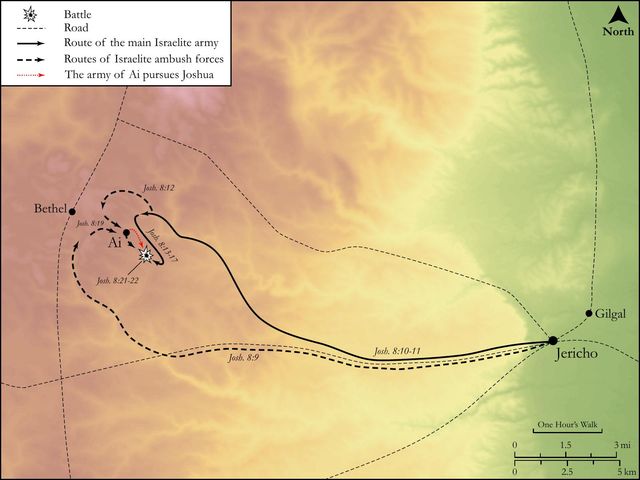
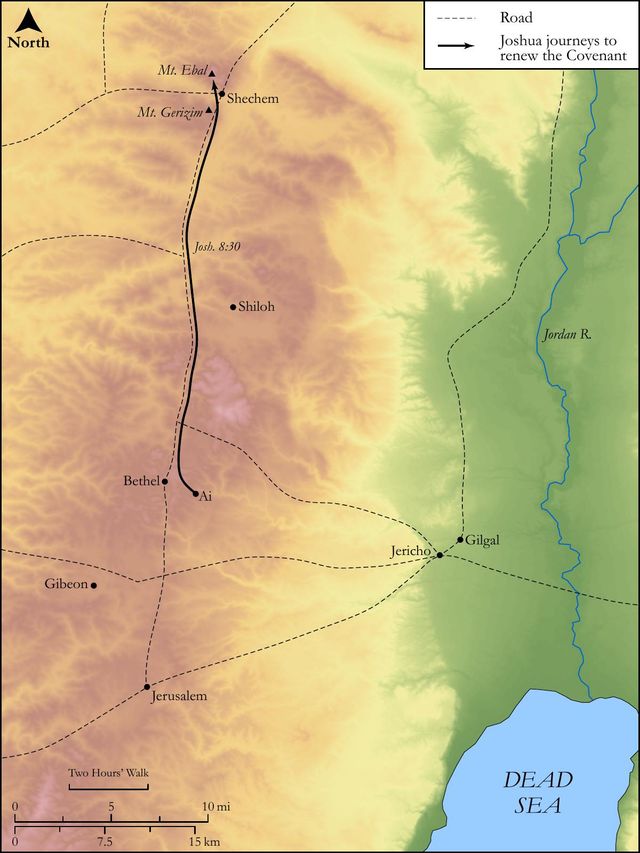
Study this verse
Public-domain commentary
Matthew Henry
From his Commentary on the Whole Bible. Henry comments on passages, not single verses — this entry covers Joshua 8:23–29.
We have here an account of the improvement which the Israelites made of their victory over Ai. 1. They put all to the sword, not only in the field, but in the city, man, woman, and child, none of them remained, Jos 8:24. God, the righteous Judge, had passed this sentence upon them for their wickedness, so that the Israelites were only the ministers of his justice and the executioners of his doom. Once in this story, and but once, mention is made of the men of Beth-el, as confederates with the men of Ai, Jos 8:17. Though they had a king of their own, and were not subjects to the king of Ai (for the king of Beth-el is reckoned among the thirty-one kings that Joshua destroyed, Jos 12:16), yet Ai being a stronger place they threw themselves into that, for their own safety, and the strengthening of their neighbours' hands, and so (we may presume) were all cut off with them; thus that by which they hoped to prevent their own ruin hastened it. The whole number of the slain, it seems, was but 12,000, and inconsiderable body to make head against all the thousands of Israel; but those whom God will destroy he infatuates. Here it is said (Jos 8:26) that Joshua drew not his hand back wherewith he stretched out the spear (Jos 8:18) till the slaughter was completed. Some think the spear he stretched out was not to slay the enemies, but to animate and encourage his own soldiers, some flag or ensign being hung out at the end of this spear; and they observe it as an instance of his self-denial that though the fire of courage wherewith his breast was filled would have pushed him forward, sword in hand, into the hottest of the action, yet, in obedience to God, he kept the inferior post of a standard-bearer, and did not quit it till the work was done. By the spear stretched out, he directed the people to expect their help from God, and to him to give the praise. 2. They plundered the city and took all the spoil to themselves, Jos 8:27. Thus the wealth of the sinner is laid up for the just; the spoil they brought out of Egypt, by borrowing of their neighbours, was much of it expended upon the tabernacle they had reared in the wilderness, for which they are now reimbursed with interest. The spoil here taken, it is probable, was all brought together, and distributed by Joshua in due proportions, as that of the Midianites was, Num 31:26, etc. It was not seized with irregularity or violence, for God is the God or order and equity, and not of confusion. 3. They laid the city in ashes, and left it to remain so, Jos 8:28. Israel must yet dwell in tents, and therefore this city, as well as Jericho, must be burnt. And, though there was no curse entailed upon him that should rebuild it, yet, it seems, it was not rebuilt unless it be the same with Aijah, which we read of, long after, Neh 11:31. Some think it was not rebuilt because Israel had received a defeat before it, the remembrance of which should be buried in the ruins of the city. 4. The king of Ai was taken prisoner and cut off, not by the sword of war as a soldier, but by the sword of justice as a malefactor. Joshua ordered him to be hanged, and his dead body thrown at the gate of his own city, under a heap of stone, Jos 8:23, Jos 8:29. Some particular reason, no doubt, there was for this severity against the king of Ai; it is likely he had been notoriously wicked and vile, and a blasphemer of the God of Israel, perhaps upon occasion of the repulse he had given to the forces of Israel in their first onset. Some observe that his dead body was thrown at the gate where he had been wont to sit in judgment that so much the greater contempt might thereby be poured upon the dignity he had been proud of, and he might be punished for the unrighteous decrees he had made in the very place where he had made them. Thus the Lord is known by the judgments which he executes.
Continue studying Joshua 8:27 across the web’s major study libraries — every link below opens this exact verse, chapter, or book on the destination site.
Read & Compare
 BibleGatewayThis verse in more than 200 translations and 70 languages.
 Bible.comThe YouVersion reader — hundreds of translations, reading plans, and highlights.
 ESV.orgCrossway's official English Standard Version reader.
 NET BibleThe NET translation with 60,000+ translators' notes on every rendering decision.
 STEP BibleTyndale House's free study tool — original text, vocabulary, and scholarly resources.
 BibliaLogos Bible Software's free web reader.
 USCCBThe New American Bible (Revised Edition) with the U.S. bishops' study notes.
Commentaries
 BibleHub CommentariesDozens of classic commentaries on this verse, gathered on one page.
 StudyLightMore than 100 commentary sets — the largest collection on the web.
 BibleRefPlain-English commentary on what this verse means, verse by verse.
 Enduring WordDavid Guzik's free commentary on this chapter, widely used by Bible teachers.
 Bible Study ToolsVerse commentary alongside Greek and Hebrew study aids.
Original Language & Research
- BibleHub InterlinearThe verse word by word — original language, transliteration, and English.
- BibleHub LexiconEvery word's original-language definition and Strong's entry.
 Blue Letter BibleDeep-study tools — Strong's numbers, concordance, and word studies.
 SefariaThe Hebrew text with Rashi and centuries of Jewish commentary.
Sermons, Hymns & Audio


TrulyRandomVerse is not affiliated with these sites and doesn’t control their content. They’re linked because they’re genuinely useful.
Summary
Joshua 8:27 succinctly describes the culmination of Israel's second, successful conquest of Ai, highlighting their specific actions regarding the spoils of war. Unlike the previous victory at Jericho, where all plunder was devoted to destruction or consecrated to the Lord, God explicitly permitted Israel to take the cattle and other valuable goods from Ai for themselves. This verse underscores Israel's meticulous obedience to this distinct divine instruction, emphasizing God's sovereign right to determine the terms of engagement and His generous provision for His people.
Context
ShowHideLiterary Context
Joshua 8:27 serves as a definitive concluding statement within the narrative of Israel's conquest of Ai. This victory immediately follows their humiliating defeat in Joshua 7, which was a direct consequence of Achan's disobedience regarding the devoted things from Jericho. After Achan's judgment and the subsequent purification of the camp, God graciously reinstates His favor and provides Joshua with a new, detailed strategy for taking Ai, involving an intricate ambush (Joshua 8:1-26). Crucially, Joshua 8:2 explicitly details God's command regarding the spoils: "Only its spoil and its cattle you shall take as plunder for yourselves." This stands in stark contrast to the instructions for Jericho, where everything was "devoted to the LORD" (Joshua 6:17-19). Verse 27, therefore, confirms the successful execution of God's specific command for Ai, affirming Israel's renewed obedience and the distinct nature of the spoils from this particular victory.
Historical & Cultural Context
The conquest of Canaan was understood by Israel as a divinely mandated holy war, a concept not uncommon in the ancient Near East, where deities were often believed to fight alongside their chosen people. However, Israel's holy war differed significantly due to the unique nature of Yahweh and His covenant with His people. The concept of cherem (Hebrew: חֵרֶם), meaning "devotion to destruction" or "dedication to God," was central to these wars, often involving the complete destruction of people and property to prevent the integration of pagan practices and to demonstrate God's absolute sovereignty. The variation in commands for Jericho (total cherem) and Ai (permission to take spoil) reflects God's specific, sovereign directives for each engagement, rather than a general, uniform rule of warfare. Ai was a strategically vital city, controlling access to the central highlands of Canaan, and its capture was essential for securing Israel's position in the promised land. The allowance of spoil from Ai likely served as a form of divine provision for the newly settling nation, demonstrating God's care and faithfulness after their period of wandering and the recent setback at Ai.
Key Themes
ShowHideJoshua 8:27 powerfully reinforces several overarching themes within the book of Joshua and the broader Pentateuchal narrative. First, it highlights Divine Sovereignty and Specificity of Command. God, not human strategy or desire, dictates the terms of war and the distribution of its gains. His commands are precise and context-dependent, requiring Israel's careful discernment and absolute obedience, as seen by the contrast between Jericho's instructions and those for Ai. Second, it speaks to God's Provision and Faithfulness. After the severe consequences of Achan's disobedience, God restores His blessing, allowing Israel to profit materially from the victory, thereby demonstrating His continued covenant faithfulness and care for His people's needs. Third, the verse illustrates the Importance of Obedience and Trust. Israel's success at Ai was directly tied to their meticulous adherence to God's instructions, a stark reminder of the principle that obedience brings blessing and victory, while disobedience, as painfully shown in Joshua 7, leads to defeat and judgment.
Exposition and Analysis
ShowHideKey Word Analysis
ShowHideThis noun refers to the plunder, booty, or spoils of war taken from an enemy. In the context of ancient Near Eastern warfare, shalal represented a significant material gain for the victors. Here, its use signifies the legitimate acquisition of goods and possessions from Ai, directly sanctioned by God. The allowance of shalal from Ai stands in deliberate contrast to the strict prohibition against taking anything from Jericho, underscoring the specific nature of God's command for each city.
This verb, used in the phrase "took for a prey," means "to plunder," "to seize," or "to take as spoil." While often used synonymously with shalal (the noun), bazaz emphasizes the active process of taking or seizing the enemy's possessions. The pairing of shalal (the object) and bazaz (the action) reinforces the idea that the cattle and goods of Ai were not merely found, but were actively and rightfully taken by Israel, not as an act of arbitrary looting, but as a divinely approved acquisition, distinguishing it from the illicit gains of Achan.
This verb means "to constitute," "to enjoin," or "to give a charge/command." It signifies a formal, authoritative directive. The use of this word is crucial, as it attributes Israel's actions not to their own initiative or desire for plunder, but to a direct, specific, and binding instruction from the LORD to Joshua. This highlights the theological bedrock of the verse: Israel's actions were an act of obedience to divine authority, making their acquisition of spoil righteous and legitimate.
Verse Breakdown
ShowHide"Only the cattle and the spoil of that city"
This opening phrase immediately establishes the precise parameters of what Israel was permitted to take. The word "only" (רַק, raq) is critical, indicating a specific limitation and exclusion of other actions, such as the total destruction of all property as was required at Jericho. "Cattle" (בְּהֵמָה, bᵉhêmâh) refers to livestock, a vital economic asset in the ancient world, while "spoil" (שָׁלָל, shâlâl) encompasses other valuable goods and possessions. This clause directly reflects God's command given to Joshua in Joshua 8:2, demonstrating Israel's meticulous adherence to the divine directive.
"Israel took for a prey unto themselves,"
This clause confirms the action carried out by the Israelites. "Took for a prey" (בָּזַז, bâzaz) signifies that they claimed these items as their own, for their personal use and benefit. This was a significant act of divine provision, allowing God's people to be enriched by the victory, standing in stark contrast to the absolute devotion of Jericho's spoils, which were either destroyed or dedicated to the Lord's treasury. It underscores God's care for His people's material needs and His willingness to bless them after their repentance and renewed obedience.
"according unto the word of the LORD which he commanded Joshua."
This concluding clause serves as the theological anchor of the entire verse, providing the ultimate justification and authority for Israel's actions. It explicitly attributes Israel's taking of the spoil not to their own initiative, greed, or desire for plunder, but to direct, precise obedience to God's specific instruction given to Joshua. The phrase "the word of the LORD" (דְּבַר יְהוָה, dâbâr Yᵉhôvâh) emphasizes divine revelation and absolute authority. This highlights the paramount importance of discerning and following God's precise commands, even when they differ from previous or expected patterns, reinforcing the themes of divine sovereignty, Israel's covenantal obligation to obey, and the direct link between obedience and blessing.
Literary Devices
ShowHideThe primary literary device at play in Joshua 8:27 is Contrast, specifically a Thematic Contrast. The verse intentionally draws a clear distinction between the rules governing the conquest of Ai and those previously established for Jericho in Joshua 6. While Jericho's spoils were under cherem (devoted entirely to destruction or to the Lord), Ai's spoils were explicitly permitted for Israel's personal use. This contrast powerfully highlights God's Sovereignty and the Specificity of His Commands, demonstrating that His will is not monolithic but is perfectly tailored to each unique situation and divine purpose. The careful repetition of terms like "spoil" and the phrase "took for a prey" also functions as a form of Emphasis, underscoring the legitimacy and divine sanction of Israel's acquisition, differentiating it from the forbidden gains of Achan in Joshua 7. The concluding phrase, "according unto the word of the LORD which he commanded Joshua," acts as a potent Theological Marker, clearly identifying divine authority as the ultimate source and justification for Israel's actions and their subsequent success.
Theological and Thematic Connections
ShowHideJoshua 8:27 serves as a profound theological statement regarding God's sovereign right to dictate the terms of His engagement with humanity and His people's absolute dependence on His specific commands. It teaches that divine guidance is not a one-size-fits-all principle but is often tailored to unique circumstances, requiring careful discernment and unwavering obedience. The striking contrast between the instructions for Jericho and Ai illustrates that even within a broader divine plan (the conquest of Canaan), God's methods and requirements can vary significantly. This demonstrates His faithfulness in providing for His people's needs while simultaneously upholding His holiness and justice. Furthermore, the verse underscores the restorative power of repentance and purification, as God's blessing and provision return to the nation after their purification from Achan's sin, highlighting His unwavering covenant faithfulness.
Reflection and Application
ShowHideJoshua 8:27 offers profound lessons for contemporary believers regarding the nature of divine guidance and the critical importance of contextual obedience. It challenges us to move beyond a simplistic or formulaic understanding of God's will, recognizing that what God commands in one season or situation may differ in another. This calls for a continuous, humble seeking of God's specific direction through prayer, diligent study of Scripture, and wise counsel, rather than relying on past experiences, assumptions, or generalized principles. Just as Israel's prosperity and success at Ai were directly tied to their meticulous obedience to the precise word of the Lord, so too are our blessings and spiritual victories often contingent on our willingness to discern and follow God's unique path for our lives. Furthermore, the verse powerfully reminds us of God's restorative grace; even after our failures and setbacks, genuine repentance opens the door for God's renewed provision and blessing, demonstrating His unwavering faithfulness to His covenant people.
Questions for Reflection
ShowHideFAQ
ShowHideWhy did God allow Israel to take spoil from Ai but not from Jericho?
ShowHideThe differing commands for Jericho and Ai highlight God's sovereign authority and the specific, contextual nature of His instructions for His people. Jericho was designated as cherem (devoted to destruction), signifying a unique, firstfruits offering to the Lord and a powerful demonstration of His absolute power and holiness. Everything in Jericho was to be destroyed or consecrated to God's treasury (Joshua 6:17-19). This was a stark lesson in obedience and the severe consequences of disobedience, as tragically seen with Achan's sin in Joshua 7. For Ai, however, God explicitly permitted Israel to take the spoil and cattle for themselves (Joshua 8:2). This was an act of divine provision for His people, demonstrating His care and blessing after their repentance and the restoration of their fellowship with Him. It teaches us that God's ways are not always uniform but are perfectly tailored to His specific purposes and the needs of His people in each unique situation.
Christ-Centered Fulfillment
ShowHideWhile Joshua 8:27 describes a specific historical event of conquest and provision in the Old Testament, its underlying principles find profound Christ-centered fulfillment. The ultimate "word of the LORD" is not merely a spoken command but is perfectly embodied in Jesus Christ, who is the Living Word (John 1:1-14). Just as God commanded Joshua with specific instructions for victory and provision for His people, so too does Christ lead His new covenant people in spiritual warfare, providing for them through His ultimate, decisive triumph over sin and death. The "spoil" and "prey" taken by Israel from Ai, though material, foreshadow the far greater spiritual riches and victory believers receive through Christ's perfect obedience and His triumph over all hostile powers. He is the one who "disarmed the rulers and authorities and put them to open shame, by triumphing over them in him" (Colossians 2:15). Furthermore, the principle of absolute obedience to God's specific word is perfectly exemplified in Christ's life, who was obedient "even to the point of death on a cross" (Philippians 2:8). Through His perfect obedience, we, who are united with Him, receive the ultimate "spoil" and "prey"—salvation, eternal life, reconciliation with God, and the glorious inheritance of the saints, not by our own merit or plunder, but as a boundless gift of grace (Ephesians 2:8-9). Thus, Joshua 8:27 points beyond the material gains of an earthly battle to the spiritual victory and abundant provision secured for us by the obedient Lamb of God, Jesus Christ, who makes us more than conquerors (Romans 8:37).