


Numbers 31:26
Bible text: King James Version (1769 Blayney text) · Public domain
Bible text: Berean Standard Bible · Public domain
Bible text: American Standard Version (1901) · Public domain
Bible text: World English Bible, Messianic edition · Public domain
Bible text: Geneva Bible (1599) · Public domain
Bible text: Young's Literal Translation · Public domain
- שָׂאSa'lift upH5375V-Qal-Imp-2msVerb Qal Imperative 2nd Singular Masculine
- אֵת'et<obj.>H853DirObjMParticle Object Indicator
- רֹאשׁrosh[the] head ofH7218N-mscNoun Singular Masculine Construct
- מַלְקוֹחַmal·Ko·ach[the] booty ofH4455N-mscNoun Singular Masculine Construct
- הַשְּׁבִיha·she·Vi<the> captivityH7628Art ¦ N-msNoun Singular Masculine Absoluteהַ<the>שְּׁבִיcaptivity
- בָּאָדָםba·'a·Damamong <the> humankindH120Prep-b ¦ N-msNoun Singular Masculine Absoluteבָּamong <the>אָדָםhumankind
- וּבַבְּהֵמָהu·va·be·he·Mahand among the livestockH929Conj-w ¦ Prep-b ¦ N-fsNoun Singular Feminine Absoluteוּandבַamong theבְּהֵמָהlivestock
- אַתָּה'a·TahyouH859Pro-2msPronoun Personal 2nd Singular Masculine
- וְאֶלְעָזָרve·'el·'a·Zarand EleazarH499Conj-w ¦ N-proper-mNoun Proper MasculineוְandאֶלְעָזָרEleazar
- הַכֹּהֵןha·ko·Henthe priestH3548Art ¦ N-msNoun Singular Masculine Absoluteהַtheכֹּהֵןpriest
- וְרָאשֵׁיve·ra·Sheiand [the] leaders ofH7218Conj-w ¦ N-mpcNoun Plural Masculine Constructוְandרָאשֵׁי[the] leaders of
- אֲבוֹת'a·Vot[the] fathers ofH1N-fpcNoun Plural Feminine Construct
- הָעֵדָהha·'e·Dahthe congregationH5712Art ¦ N-fsNoun Singular Feminine Absoluteהָtheעֵדָהcongregation
English is a literal word-by-word gloss of the Hebrew, not the KJV's wording. Why?
This is the original text the KJV's translators worked from — each Hebrew word with its own literal English meaning in this verse, prepared by scholars at Tyndale House, Cambridge. The KJV translates whole sentences, not word by word, so its wording differs: one Hebrew word can become several English words, and the KJV may choose “the LORD” where the gloss reads “Yahweh”. Both are faithful — they answer different questions. For the KJV's own rendering, switch to the KJV text.
Details
See on the biblical-era map
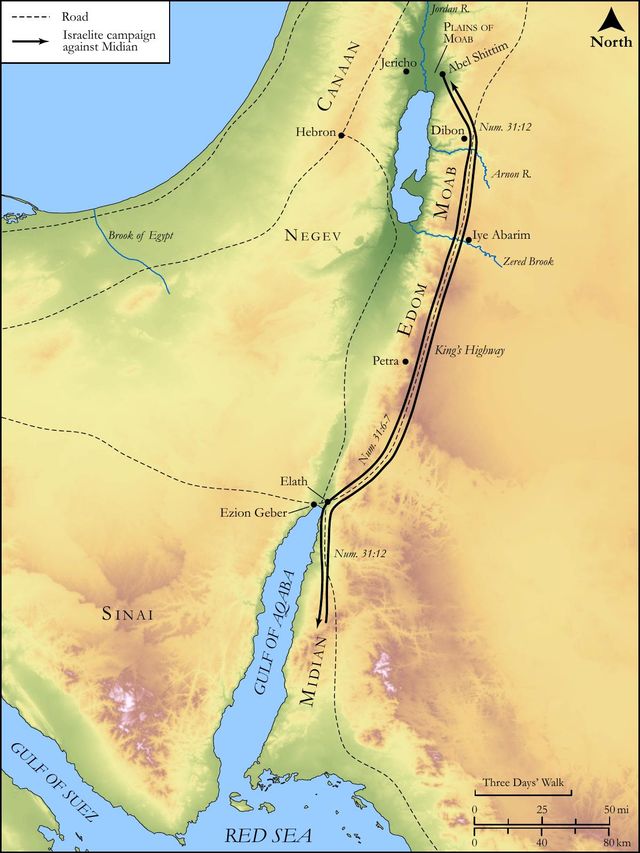
Study this verse
Continue studying Numbers 31:26 across the web’s major study libraries — every link below opens this exact verse, chapter, or book on the destination site.
Read & Compare
 BibleGatewayThis verse in more than 200 translations and 70 languages.
 Bible.comThe YouVersion reader — hundreds of translations, reading plans, and highlights.
 ESV.orgCrossway's official English Standard Version reader.
 NET BibleThe NET translation with 60,000+ translators' notes on every rendering decision.
 STEP BibleTyndale House's free study tool — original text, vocabulary, and scholarly resources.
 BibliaLogos Bible Software's free web reader.
 USCCBThe New American Bible (Revised Edition) with the U.S. bishops' study notes.
Commentaries
 BibleHub CommentariesDozens of classic commentaries on this verse, gathered on one page.
 StudyLightMore than 100 commentary sets — the largest collection on the web.
 BibleRefPlain-English commentary on what this verse means, verse by verse.
 Enduring WordDavid Guzik's free commentary on this chapter, widely used by Bible teachers.
 Bible Study ToolsVerse commentary alongside Greek and Hebrew study aids.
Original Language & Research
- BibleHub InterlinearThe verse word by word — original language, transliteration, and English.
- BibleHub LexiconEvery word's original-language definition and Strong's entry.
 Blue Letter BibleDeep-study tools — Strong's numbers, concordance, and word studies.
 SefariaThe Hebrew text with Rashi and centuries of Jewish commentary.
Sermons, Hymns & Audio


TrulyRandomVerse is not affiliated with these sites and doesn’t control their content. They’re linked because they’re genuinely useful.
Summary
Numbers 31:26 initiates the meticulous and divinely mandated process of inventorying the vast spoils, encompassing both people and livestock, taken from the Midianites following a punitive war. This crucial administrative task is explicitly delegated to Moses, Eleazar the priest, and the chief fathers of the Israelite congregation, underscoring God's unwavering demand for order, accountability, and collaborative leadership in all matters pertaining to His covenant people, even in the handling of war booty.
Context
ShowHideLiterary Context
Numbers 31:26 is situated within the detailed account of Israel's divinely commanded war against Midian, which spans the entirety of Numbers 31. The preceding verses (vv. 1-12) describe the swift and decisive military victory, where the Israelites executed God's vengeance upon Midian for their role in seducing Israel to idolatry and immorality at Baal-Peor, as recounted in Numbers 25:1-3. Following the initial capture of immense spoils, Moses expresses strong displeasure with the soldiers for sparing the women who had enticed Israel (vv. 13-18). Before any purification or distribution of the captives and plunder could occur, a series of precise instructions are issued by God through Moses. Verse 25 commands Moses, Eleazar, and the heads of the clans to "take the sum of the prey," setting the stage for the detailed inventory process that Numbers 31:26 explicitly commands and formalizes. This verse thus marks a critical transition from military action to administrative and cultic order, ensuring that all actions align with divine law.
Historical & Cultural Context
Among the nations round about, war spoils were typically considered the property of the conquering king or deity, often dedicated to temples or distributed according to the ruler's discretion. Israel's handling of the Midianite spoils, however, diverged significantly, operating under a unique system governed by divine law rather than human custom. The war itself was not merely for territorial expansion or material gain but was a punitive expedition, an act of divine judgment against Midian for their spiritual corruption of Israel. The meticulous inventory process reflects Israel's unique covenant relationship with Yahweh, where even the spoils of war were subject to divine oversight, purification, and prescribed distribution. The involvement of Moses (the civil and military leader), Eleazar (the high priest, representing the cultic realm), and the "chief fathers" (tribal heads, representing the community) highlights a system of checks and balances and shared responsibility, ensuring that the process was conducted with integrity, fairness, and adherence to both civil and sacred law.
Key Themes
ShowHideThis verse powerfully contributes to several overarching themes within Numbers and the Pentateuch. The command to "take the sum" highlights Divine Order and Accountability, emphasizing God's character as a God who values precision, transparency, and meticulous management, even in the aftermath of violent conflict. This divine mandate for precise accounting ensured justice and prevented chaos, reflecting the broader theme of God establishing order out of chaos (e.g., Genesis 1). Furthermore, the explicit naming of Moses, Eleazar, and the chief fathers underscores the theme of Collaborative and Unified Leadership. This joint responsibility demonstrates the necessity of civil, spiritual, and communal authorities working in concert to uphold God's law and administer His people effectively. Finally, Numbers 31:26 serves as a crucial step in the Preparation for Purification and Distribution of the spoils. This inventory was an indispensable precursor to the purification rites detailed in Numbers 31:23-24 and the subsequent division of the spoils among the soldiers, the congregation, and the Levites, as outlined in Numbers 31:27-47). It ensured that everything was properly categorized and handled according to God's commands before being brought into the camp or distributed, maintaining the sanctity of the Israelite community.
Exposition and Analysis
ShowHideKey Word Analysis
ShowHideThe verb נָשָׂא (nâsâʼ), Strong's H5375, literally means "to lift," "to carry," or "to take up." In contexts such as this, it carries the nuance of "to take a census," "to count," or "to take an inventory." The imperative form here ("Take the sum") conveys a direct, authoritative command, emphasizing the necessity of a precise and comprehensive accounting. It implies a systematic and deliberate process of counting every item, ensuring nothing is overlooked or improperly handled.
The noun רֹאשׁ (rôʼsh), Strong's H7218, primarily means "head," but it also carries the figurative sense of "chief," "principal," "beginning," or "sum." In this context, it refers to the total count or aggregate amount of the captured items. The combination with "take" (nâsâʼ) reinforces the idea of a complete and official reckoning, a head-count or total tally of all the spoils.
The noun מַלְקוֹחַ (malqôwach), Strong's H4455, refers specifically to that which is "taken," "captured," "plundered," or "spoiled" in war. It is a comprehensive term encompassing all the material gains from a military victory, including both human captives and livestock, as explicitly stated in the verse. Its use here highlights the tangible results of the punitive expedition against the Midianites and the substantial wealth acquired, all of which must now be meticulously accounted for under divine instruction.
Verse Breakdown
ShowHide"Take the sum of the prey that was taken, [both] of man and of beast"
This opening clause is a direct divine imperative, relayed through Moses, commanding a meticulous and comprehensive inventory. The phrase "prey that was taken" (literally, "the taking of the taking") emphasizes the totality and completeness of what was captured, leaving no ambiguity about what needed to be counted. The explicit inclusion of "man and of beast" underscores the breadth of the inventory, encompassing all living spoils of war, both human captives and all categories of livestock. This command highlights God's demand for order and accountability in even the most chaotic circumstances of war, ensuring that resources are managed according to His precise will.
"thou, and Eleazar the priest, and the chief fathers of the congregation"
This specifies the three distinct yet complementary leadership groups responsible for executing the inventory. "Thou" refers to Moses, the supreme civil and military leader of Israel, who serves as God's primary agent. "Eleazar the priest" represents the spiritual and cultic authority, ensuring that the process adheres to divine law and cultic purity, as the spoils would eventually need purification before being brought into the camp. "The chief fathers of the congregation" refers to the heads of the tribal clans, who represent the people and ensure fairness, transparency, and communal acceptance of the distribution process. This tripartite leadership structure demonstrates the importance of shared responsibility, checks and balances, and the integration of civil, spiritual, and communal authority in the administration of God's people.
Literary Devices
ShowHideThe verse employs several literary devices to convey its significant message. The most prominent is Imperative Mood, as seen in the opening command "Take the sum." This direct instruction highlights the divine authority behind the task and the non-negotiable nature of God's will for order and accountability. Enumeration is also evident in the explicit listing of the three distinct leadership roles—Moses, Eleazar the priest, and the chief fathers of the congregation. This precise enumeration underscores the collaborative nature of the task and the comprehensive oversight required, ensuring that civil, religious, and communal aspects are all represented. Furthermore, the phrase "both of man and of beast" serves as a form of Merism, a literary device where two contrasting parts represent a whole, emphasizing the exhaustive and all-encompassing nature of the inventory. This ensures that every single item of the spoils, from the largest animal to every human captive, is included in the meticulous count, leaving nothing uncounted or unaccounted for.
Theological and Thematic Connections
ShowHideNumbers 31:26 offers profound theological insights into God's character and His expectations for His people. It reveals a God who is not only powerful in judgment and victory but also meticulously concerned with order, accountability, and just administration. The command to take a precise inventory of war spoils, even down to "man and of beast," demonstrates that God's sovereignty extends over all aspects of life, including the seemingly mundane or chaotic. This passage underscores the principle of stewardship, where all possessions and even people are ultimately God's, and their handling must align with His divine will. The collaborative leadership model presented also speaks to the importance of diverse gifts and roles working in unity for the common good and God's glory, reflecting a divine design for governance that prioritizes integrity and shared responsibility.
Reflection and Application
ShowHideNumbers 31:26, though set in the context of ancient warfare, offers timeless principles for contemporary believers. It challenges us to consider the meticulousness with which God desires us to manage all that He entrusts to us—our resources, our time, our gifts, and even our relationships. The emphasis on taking a "sum" and the explicit involvement of multiple leaders calls us to embrace radical accountability and transparency in our personal lives, our families, and our communities of faith. Are we diligent stewards of the blessings and responsibilities God has given us? Do we seek counsel and collaborate with others in leadership, recognizing that diverse perspectives can lead to more robust and righteous decisions? This verse reminds us that divine order is not merely an abstract concept but a practical imperative for a flourishing life and a faithful church. It encourages us to approach all tasks, big or small, with integrity, precision, and a deep awareness that we are ultimately accountable to God, who sees and knows all.
Questions for Reflection
ShowHideFAQ
ShowHideWhy was such a meticulous inventory commanded for the spoils of war?
ShowHideThe meticulous inventory commanded in Numbers 31:26 served several crucial purposes. Firstly, it underscored God's demand for order and accountability within His covenant people, even in the chaotic aftermath of war. It ensured that all captured assets, both human and animal, were properly recognized and managed according to divine law, preventing arbitrary handling or misappropriation. Secondly, this precise accounting was a necessary precursor to the purification rites detailed in Numbers 31:23-24 and the subsequent, divinely ordained distribution of the spoils among the soldiers, the congregation, and the Levites (e.g., Numbers 31:27-47). It ensured fairness, prevented disputes, and maintained the sanctity of the camp by ensuring that only purified items were brought in and distributed according to God's specific instructions.
What does the involvement of Moses, Eleazar, and the chief fathers signify about leadership in ancient Israel?
ShowHideThe explicit mention of Moses, Eleazar the priest, and the chief fathers of the congregation highlights a critical aspect of leadership in ancient Israel: it was collaborative, multi-faceted, and divinely ordained. Moses represented the supreme civil and military authority, responsible for executing God's commands and governing the people. Eleazar, as the high priest, embodied the spiritual and cultic authority, ensuring that all actions adhered to the laws of purity and worship. The "chief fathers" were the heads of the tribal clans, representing the communal and administrative interests of the entire congregation. This tripartite leadership structure ensured checks and balances, collective wisdom, and comprehensive oversight. It demonstrated that important decisions and administrative tasks required the unified effort of civil, spiritual, and communal leaders to uphold both secular and sacred law, ensuring integrity, justice, and adherence to God's will for the entire nation.
Christ-Centered Fulfillment
ShowHideWhile Numbers 31:26 details a physical inventory of war spoils, its underlying principles find profound Christ-centered fulfillment. The meticulous order and accountability demanded by God in this passage foreshadow the perfect order and divine precision of God's redemptive plan, culminating in Christ. Just as the Israelites took "the sum of the prey," Christ, through His ultimate victory on the cross, took captive the spiritual "prey" of sin, death, and the powers of darkness. Colossians 2:15 declares that He "disarmed the principalities and powers and made a public spectacle of them, triumphing over them by the cross." This spiritual "spoils of war" is not material wealth but the liberation of humanity, offered as gifts to His redeemed people, as Ephesians 4:8 proclaims, "He led captivity captive, and gave gifts unto men." Moreover, the collaborative leadership of Moses, Eleazar, and the chief fathers points to Christ as the ultimate, unified Leader—our Prophet, Priest, and King—who perfectly fulfills all these roles. He possesses "all authority in heaven and on earth" (Matthew 28:18), bringing divine order to a chaotic world and meticulously administering the "spoils" of His victory, which are the souls of His people and the establishment of His eternal kingdom. Believers, as stewards of this new covenant inheritance, are called to live with the same meticulous accountability and order that God demanded in Numbers 31:26, now in response to the immeasurable grace and victory secured by Christ.