


Joshua 11:13
- רַקrakonlyH7535AdvAdverb
- כָּלkolallH3605N-mscNoun Singular Masculine Construct
- הֶעָרִיםhe·'a·Rimthe citiesH5892Art ¦ N-mpNoun Plural Masculine Absoluteהֶtheעָרִיםcities
- הָעֹמְדוֹתha·'o·me·dOtwhich were standingH5975Art ¦ V-Qal-Prtcpl-fpVerb Qal Participle Plural Feminine Absoluteהָwhichעֹמְדוֹתwere standing
- עַל'alonH5921PrepPreposition
- תִּלָּםti·Lamtheir moundsH8510N-msc ¦ 3mpNoun Singular Masculine Constructתִּלָּmoundsםtheir
- לֹאlo'notH3808NegParticle Negative
- שְׂרָפָםse·ra·Famit burned themH8313V-Qal-Perf-3ms ¦ 3mpVerb Qal Perfect 3rd Singular Masculineשְׂרָפָit burnedםthem
- יִשְׂרָאֵלYis·ra·'ElIsraelH3478N-properNoun Proper Location
- זוּלָתִיzu·la·TiexceptH2108N-fscNoun Singular Feminine Construct
- אֶת'et<obj.>H853DirObjMParticle Object Indicator
- חָצוֹרcha·TzorHazorH2674N-properNoun Proper Location
- לְבַדָּהּle·va·Dahto alone itH905Prep-l ¦ N-msc ¦ 3fsNoun Singular Masculine Constructלְtoבַדָּaloneהּit
- שָׂרַףsa·Rafhe burnedH8313V-Qal-Perf-3msVerb Qal Perfect 3rd Singular Masculine
- יְהוֹשֻׁעַye·ho·Shu·a'JoshuaH3091N-proper-mNoun Proper Masculine
English is a literal word-by-word gloss of the Hebrew, not the KJV's wording. Why?
This is the original text the KJV's translators worked from — each Hebrew word with its own literal English meaning in this verse, prepared by scholars at Tyndale House, Cambridge. The KJV translates whole sentences, not word by word, so its wording differs: one Hebrew word can become several English words, and the KJV may choose “the LORD” where the gloss reads “Yahweh”. Both are faithful — they answer different questions. For the KJV's own rendering, switch to the KJV text.
Details
See on the biblical-era map
Study this verse
Public-domain commentary
Matthew Henry
From his Commentary on the Whole Bible. Henry comments on passages, not single verses — this entry covers Joshua 11:10–14.
We have here the same improvement made of this victory as was made of that in the foregoing chapter. 1. The destruction of Hazor is particularly recorded, because in it, and by the king thereof, this daring design against Israel was laid, Jos 11:10, Jos 11:11. The king of Hazor, it seems, escaped with his life out of the battle, and thought himself safe when he had got back into his own city, and Joshua had gone in pursuit of the scattered troops another way. But it proved that that which he thought would be for his welfare was his trap; in it he was taken as in an evil net; there he was slain, and his city, for his sake, burned. Yet we find that the remains of it being not well looked after by Israel the Canaanites rebuilt it, and settled there under another king of the same name, Jdg 4:2. 2. The rest of the cities of that part of the country are spoken of only in general, that Joshua got them all into his hands, but did not burn them as he did Hazor, for Israel was to dwell in great and goodly cities which they builded not (Deu 6:10) and in these among the rest. And here we find Israel rolling in blood and treasure. (1.) In the blood of their enemies; they smote all the souls (Jos 11:1), neither left they any to breathe (Jos 11:14), that there might be none to infect them with the abominations of Canaan, and none to disturb them in the possession of it. The children were cut off, lest they should afterwards lay claim to any part of this land in the right of their parents. (2.) In the wealth of their enemies. The spoil, and the cattle, they took for a prey to themselves, Jos 11:14. As they were enriched with the spoil of their oppressors when they came out of Egypt, wherewith to defray the charges of their apprenticeship in the wilderness, so they were now enriched with the spoil of their enemies for a stock wherewith to set up in the land of Canaan. Thus is the wealth of the sinner laid up for the just.
Continue studying Joshua 11:13 across the web’s major study libraries — every link below opens this exact verse, chapter, or book on the destination site.
Read & Compare
 BibleGatewayThis verse in more than 200 translations and 70 languages.
 Bible.comThe YouVersion reader — hundreds of translations, reading plans, and highlights.
 ESV.orgCrossway's official English Standard Version reader.
 NET BibleThe NET translation with 60,000+ translators' notes on every rendering decision.
 STEP BibleTyndale House's free study tool — original text, vocabulary, and scholarly resources.
 BibliaLogos Bible Software's free web reader.
 USCCBThe New American Bible (Revised Edition) with the U.S. bishops' study notes.
Commentaries
 BibleHub CommentariesDozens of classic commentaries on this verse, gathered on one page.
 StudyLightMore than 100 commentary sets — the largest collection on the web.
 BibleRefPlain-English commentary on what this verse means, verse by verse.
 Enduring WordDavid Guzik's free commentary on this chapter, widely used by Bible teachers.
 Bible Study ToolsVerse commentary alongside Greek and Hebrew study aids.
Original Language & Research
- BibleHub InterlinearThe verse word by word — original language, transliteration, and English.
- BibleHub LexiconEvery word's original-language definition and Strong's entry.
 Blue Letter BibleDeep-study tools — Strong's numbers, concordance, and word studies.
 SefariaThe Hebrew text with Rashi and centuries of Jewish commentary.
Sermons, Hymns & Audio


TrulyRandomVerse is not affiliated with these sites and doesn’t control their content. They’re linked because they’re genuinely useful.
Summary
Joshua 11:13 provides a precise detail regarding Israel's strategic conduct during the conquest of the northern Canaanite kingdoms, highlighting a singular exception to their general policy of preserving captured cities. While most fortified urban centers were left structurally intact for Israelite occupation, Hazor, the preeminent and most powerful city of the northern coalition, was specifically singled out for complete destruction by fire. This act underscored its unique strategic significance, the totality of God's judgment against its wickedness, and Joshua's meticulous obedience to divine command.
Context
ShowHideLiterary Context
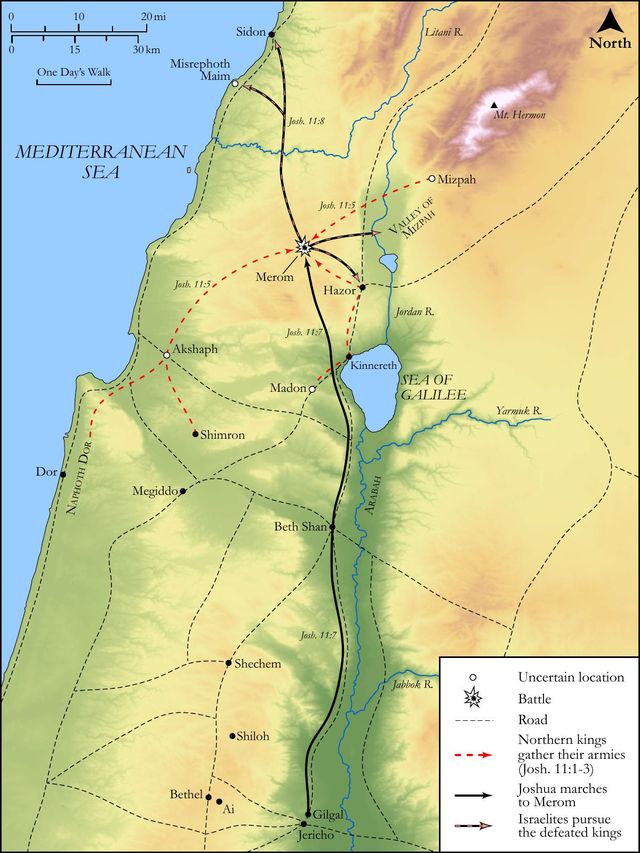
This verse is strategically placed at the culmination of Joshua's northern campaign, immediately following the decisive victory at the Waters of Merom. Here, Joshua comprehensively routed a formidable coalition of Canaanite kings led by Jabin, the king of Hazor, as detailed in Joshua 11:1-9. The preceding narrative vividly describes the swift and overwhelming defeat of these allied forces, with Joshua meticulously carrying out God's commands to hamstring their horses and burn their chariots. Verse 13 then offers a crucial post-battle detail, differentiating the treatment of Hazor from that of other conquered cities. It serves as a specific illustration of the broader summary of the entire conquest that follows in Joshua 11:15-23, emphasizing Joshua's unwavering and precise obedience to the divine instructions given through Moses.
Historical & Cultural Context
The conquest of Canaan unfolded during the Late Bronze Age (approximately 1550-1200 BC), a period characterized by numerous independent city-states, each typically fortified with formidable walls and often built upon elevated "tells." A "tell" is an artificial mound formed over centuries by the accumulation of debris from successive layers of human habitation, signifying a city's ancient origins, strategic defensive position, and enduring importance. Hazor, in particular, was an exceptionally large and powerful city in the ancient Near East, functioning as a vital trade hub and military stronghold, explicitly identified as "the head of all those kingdoms" in Joshua 11:10. The practice of utterly destroying enemy cities by fire was a severe, yet common, act of warfare in the ancient world, often signifying total subjugation, the eradication of a threat, or divine judgment. Conversely, the preservation of other cities for habitation was a pragmatic strategy, allowing the conquerors to immediately inherit and utilize existing infrastructure, thereby fulfilling God's promise to provide Israel with a land containing cities they did not build, as articulated in Deuteronomy 6:10-11.
Key Themes
ShowHideJoshua 11:13 contributes significantly to several overarching themes within the book of Joshua and the broader Pentateuch. Firstly, it powerfully underscores the theme of Divine Judgment against the inhabitants of Canaan, whose pervasive wickedness and idolatry had reached a point necessitating their expulsion and destruction, as commanded in Deuteronomy 20:16-18. The selective and severe destruction of Hazor highlights the precision and totality of this judgment against a central hub of Canaanite resistance. Secondly, the verse exemplifies Obedience to God's Commands, showcasing Joshua's unwavering faithfulness in executing the divine instructions, even when they involved such drastic and specific measures. This theme of meticulous obedience is a recurring motif throughout Joshua, culminating in the affirmation of his complete adherence to God's will in Joshua 11:15. Thirdly, the verse subtly points to God's Strategic Providence and Provision, as He not only guides Israel's military actions to achieve victory but also thoughtfully orchestrates the preservation of cities, providing His people with ready-made infrastructure to inhabit, demonstrating His meticulous care for their welfare and future settlement.
Exposition and Analysis
ShowHideKey Word Analysis
ShowHideThe KJV's "stood still in their strength" translates the Hebrew phrase עַל־תִּלָּם (ʿal-tillam), which literally means "on their mound" or "on their tell." têl refers to a "mound" or "heap," often implying a fortified position. A "tell" is an artificial mound created over centuries by successive layers of human habitation, indicating a city's ancient origins, strategic location, and often, its strong fortifications. The phrase therefore refers to cities that remained structurally intact, built upon their ancient, fortified foundations, making them resilient to easy destruction. This highlights the pragmatic decision to preserve these robust structures for Israel's use.
Châtsôwr is a collective form of ḥāṣēr, meaning "village," but here it refers to "Chatsor," a specific, prominent city in Palestine. In the context of Joshua, Hazor was identified as "the head of all those kingdoms" (Joshua 11:10), signifying its unparalleled power, influence, and strategic importance among the northern Canaanite city-states. Its specific mention and unique treatment underscore its pivotal role in the northern campaign and the severity of God's judgment against it.
The Hebrew verb שָׂרַף (sâraph) means "to be (causatively, set) on fire" or "to burn (up) kindle, utterly." It signifies a thorough and complete destruction by fire. Unlike merely capturing or dismantling, "burning" implies the total obliteration of a city's structures, rendering it uninhabitable. This term is used specifically for Hazor, emphasizing the unique and absolute nature of its destruction, setting it apart from other conquered cities. This act served as a powerful symbol of the complete dismantling of the northern coalition's power and the finality of God's judgment upon its capital.
Verse Breakdown
ShowHide"But [as for] the cities that stood still in their strength,"
This opening clause establishes a general category of cities. These were fortified urban centers, likely built on ancient tells, whose substantial construction allowed them to remain structurally sound even after their inhabitants were defeated. The implication is that these cities presented viable infrastructure for Israel to occupy and inhabit.
"Israel burned none of them,"
This statement reveals Israel's general policy regarding the conquered cities in the northern campaign. Rather than destroying the physical structures, they preserved them. This was a pragmatic and providentially guided decision, allowing the Israelites to inherit ready-made homes and fortifications, thereby fulfilling God's promise to provide them with a land of cities they did not build.
"save Hazor only;"
This crucial phrase introduces the singular and significant exception to the general policy. Hazor, identified in Joshua 11:10 as "the head of all those kingdoms," was treated differently. Its unique status as the leading city of the northern coalition, perhaps due to its immense power, its role as the center of resistance, or its particularly egregious idolatry, necessitated a distinct and more severe judgment.
"[that] did Joshua burn."
This concluding clause confirms the specific action taken against Hazor. The repetition of "burn" (implicitly in "Israel burned none of them" and explicitly in "did Joshua burn") emphasizes the deliberate, thorough, and complete destruction of Hazor by fire, carried out by Joshua himself. This act symbolized the utter annihilation of its power and influence, signifying the finality of God's judgment upon this key stronghold.
Literary Devices
ShowHideJoshua 11:13 employs several potent literary devices to convey its message with clarity and impact. Contrast is the most prominent, establishing a stark distinction between the treatment of the majority of conquered cities ("Israel burned none of them") and the singular, exceptional fate of Hazor ("save Hazor only; [that] did Joshua burn"). This sharp contrast immediately draws the reader's attention to Hazor's unique significance and the severity of its judgment. The use of Exception ("save Hazor only") serves to highlight this particular city, underscoring its pivotal role as the strategic and spiritual head of the northern coalition. Furthermore, the strategic repetition of the verb "burn" (implied in the general statement about other cities and explicitly stated for Hazor) creates powerful Emphasis, reinforcing the decisive and complete nature of Hazor's destruction. This deliberate linguistic choice elevates Hazor's fate beyond a mere military act, portraying it as a profound and symbolic act of divine judgment and the complete dismantling of a major stronghold of opposition.
Theological and Thematic Connections
ShowHideJoshua 11:13 powerfully illustrates the dual nature of God's dealings with humanity: His righteous judgment against pervasive sin and His gracious provision for His covenant people. The selective and utter destruction of Hazor, the strategic capital of the northern Canaanite resistance, was not an arbitrary act but a precise and necessary execution of divine judgment against a system deeply entrenched in idolatry, moral depravity, and opposition to God's redemptive plan. This act directly fulfilled the explicit commands given in Deuteronomy 20:16-18 regarding the total destruction of the inhabitants of the promised land. Simultaneously, the preservation of other cities demonstrates God's practical and benevolent care for Israel, providing them with established infrastructure and resources. This act of provision fulfilled His ancient promises to give them a land flowing with milk and honey, complete with cities they did not build and vineyards they did not plant, as seen in Deuteronomy 6:10-11. This profound balance reflects God's absolute sovereignty over both the acts of judgment and the acts of gracious provision in the unfolding of His redemptive purposes.
Reflection and Application
ShowHideJoshua 11:13 offers profound lessons for believers today, primarily concerning the nature of spiritual warfare, the wisdom of discerning God's specific commands, and the necessity of radical obedience. Just as Israel faced formidable strongholds in Canaan, believers encounter spiritual "Hazors"—deeply entrenched sins, destructive habits, strongholds of unbelief, or even cultural idols that hinder their walk with God and His kingdom. While some spiritual battles may involve "preserving" and sanctifying aspects of our lives (e.g., wisely stewarding our gifts, talents, or resources for God's glory), others demand a decisive, uncompromising "burning"—a complete eradication and separation from anything that stands in direct opposition to God's holy will. This requires profound spiritual discernment, guided by the Holy Spirit and God's Word, to know when to integrate and redeem, and when to utterly destroy or separate. Our obedience, like Joshua's, must be precise, unwavering, and rooted in trust that God's strategy, whether it involves preservation or destruction, is always for our ultimate good, His glory, and the advancement of His eternal kingdom. This verse reminds us that true spiritual victory often necessitates radical measures against the most formidable obstacles in our lives and in the world around us.
Questions for Reflection
ShowHideFAQ
ShowHideWhy was Hazor singled out for complete destruction by fire, unlike other conquered cities?
ShowHideHazor was uniquely targeted for complete destruction because it was explicitly identified as "the head of all those kingdoms" in Joshua 11:10, meaning it was the most powerful, influential, and strategically significant city in the northern Canaanite coalition. Its utter destruction by fire served multiple crucial purposes: it was a definitive and symbolic act of divine judgment against the spiritual and political center of resistance to God's people; it prevented its future re-emergence as a military or idolatrous threat; and it powerfully symbolized the complete dismantling of the Canaanite power structure in the north. While other cities were preserved for Israel's habitation, Hazor's unparalleled prominence and defiance demanded a more severe and symbolic judgment, demonstrating the totality of God's victory and the finality of His decree against the land's wicked inhabitants.
Christ-Centered Fulfillment
ShowHideJoshua 11:13, in its depiction of a conquering leader bringing decisive judgment and establishing an inheritance for his people, powerfully foreshadows the ultimate and redemptive work of Jesus Christ. Just as Joshua led Israel to conquer the physical strongholds of Canaan, Jesus, the greater Joshua (whose name is the Greek equivalent of Joshua), leads His people in a spiritual conquest, overcoming the far more formidable strongholds of sin, death, and the devil. Through His atoning sacrifice on the cross and His glorious resurrection, Christ decisively triumphed over "the principalities and powers," disarming them and making a public spectacle of them, leading them in triumph (as described in Colossians 2:15). While Joshua's conquest involved physical destruction, Christ's victory "burns" away the power of sin in the lives of believers, not by physical fire, but by the consuming fire of His holiness, justice, and purifying grace (as alluded to in Hebrews 12:29). He utterly destroys the spiritual "Hazors"—the dominion of darkness that once held humanity captive—and establishes His eternal kingdom, providing His followers with an inheritance not of earthly cities, but of heavenly dwellings and eternal life (as promised in John 14:2-3 and 1 Peter 1:3-5). Thus, Joshua's act of judgment and provision points forward to Christ's ultimate work of redemption, where He decisively defeats all spiritual enemies and secures an eternal, imperishable inheritance for all who place their faith in Him.