


Deuteronomy 2:35
- רַקrakonlyH7535AdvAdverb
- הַבְּהֵמָהha·be·he·Mahthe livestockH929Art ¦ N-fsNoun Singular Feminine Absoluteהַtheבְּהֵמָהlivestock
- בָּזַזְנוּba·Zaz·nuwe plunderedH962V-Qal-Perf-1cpVerb Qal Perfect 1st Plural common gender
- לָנוּLa·nufor ourselvesPrep-l ¦ 1cpSuffix Personal 1st Plural common genderלָforנוּourselves
- וּשְׁלַלu·she·Laland [the] booty ofH7998Conj-w ¦ N-mscNoun Singular Masculine Constructוּandשְׁלַל[the] booty of
- הֶעָרִיםhe·'a·Rimthe citiesH5892Art ¦ N-mpNoun Plural Masculine Absoluteהֶtheעָרִיםcities
- אֲשֶׁר'a·SherwhichH834RelParticle Relative
- לָכָדְנוּla·Kha·de·nuwe had capturedH3920V-Qal-Perf-1cpVerb Qal Perfect 1st Plural common gender
English is a literal word-by-word gloss of the Hebrew, not the KJV's wording. Why?
This is the original text the KJV's translators worked from — each Hebrew word with its own literal English meaning in this verse, prepared by scholars at Tyndale House, Cambridge. The KJV translates whole sentences, not word by word, so its wording differs: one Hebrew word can become several English words, and the KJV may choose “the LORD” where the gloss reads “Yahweh”. Both are faithful — they answer different questions. For the KJV's own rendering, switch to the KJV text.
Details
See on the biblical-era maps
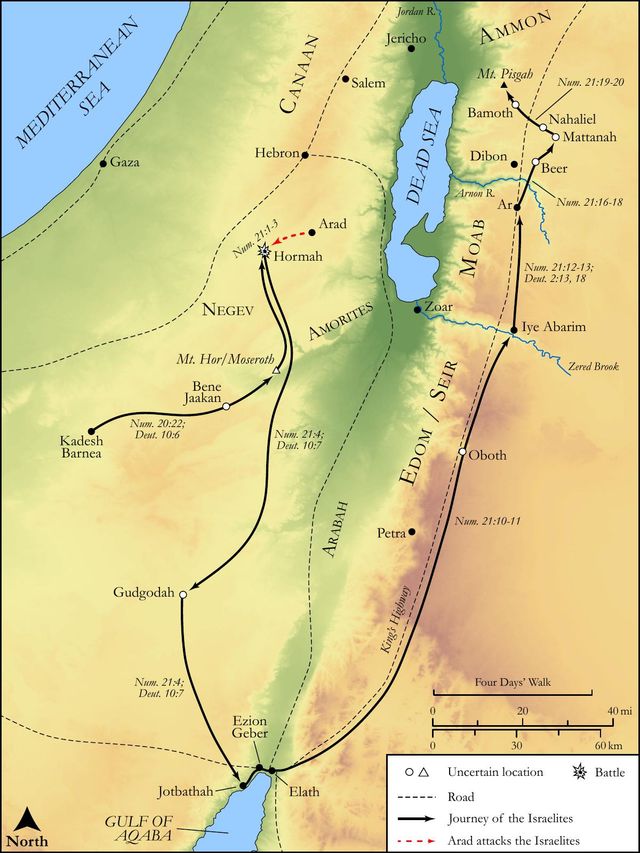
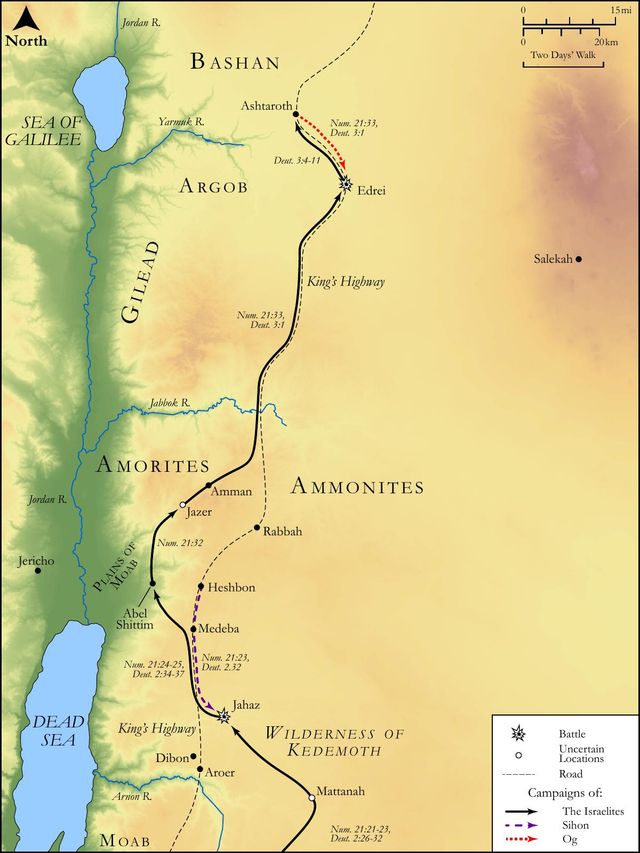
Study this verse
Public-domain commentary
Matthew Henry
From his Commentary on the Whole Bible. Henry comments on passages, not single verses — this entry covers Deuteronomy 2:24–37. His two-level outline is real structure in the source text, so it is rendered as structure.
God having tried the self-denial of his people in forbidding them to meddle with the Moabites and Ammonites, and they having quietly passed by those rich countries, and, though superior in number, not made any attack upon them, here he recompenses them for their obedience by giving them possession of the country of Sihon king of the Amorites. If we forbear what God forbids, we shall receive what he promises, and shall be no losers at last by our obedience, though it may seem for the present to be to our loss. Wrong not others, and God shall right thee.
I.God gives them commission to seize upon the country of Sihon king of Heshbon, Deu 2:24, Deu 2:25.
This was then God's way of disposing of kingdoms, but such particular grants are not now either to be expected or pretended. In this commission observe,
1.Though God assured them that the land should be their own, yet they must bestir themselves, and contend in battle with the enemy. What God gives we must endeavour to get.
2.God promises that when they fight he will fight for them. Do you begin to possess it, and I will begin to put the dread of you upon them. God would dispirit the enemy and so destroy them, would magnify Israel and so terrify all those against whom they were commissioned. See Exo 15:14.
II.Moses sends to Sihon a message of peace, and only begs a passage through his land, with a promise to give his country no disturbance, but the advantage of trading for ready money with so great a body, Deu 2:26-29. Moses herein did neither disobey God, who bade him contend with Sihon, nor dissemble with Sihon; but doubtless it was by divine direction that he did it, that Sihon might be left inexcusable, though God hardened his heart. This may illustrate the method of God's dealing with those to whom he gives his gospel, but does not give grace to believe it.
III.Sihon began the war (Deu 2:32), God having made his heart obstinate, and hidden from his eyes the thing that belonged to his peace (Deu 2:30), that he might deliver him into the hand of Israel. Those that meddle with the people of God meddle to their own hurt; and God sometimes ruins his enemies by their own resolves. See Mic 4:11-13; Rev 16:14.
IV.Israel was victorious.
1.They put all the Amorites to the sword, men, women, and children (Deu 2:33, Deu 2:34); this they did as the executioners of God's wrath; now the measure of the Amorites' iniquity was full (Gen 15:16), and the longer it was in the filling the sorer was the reckoning at last. This was one of the devoted nations. They died, not as Israel's enemies, but as sacrifices to divine justice, in the offering of which sacrifices Israel was employed, as a kingdom of priests. The case being therefore extraordinary, it ought not to be drawn into a precedent for military executions, which make no distinction and give no quarter: those will have judgment without mercy that show no mercy.
2.They took possession of all they had; their cities (Deu 2:34), their goods (Deu 2:35), and their land, Deu 2:36. The wealth of the sinner is laid up for the just. What a new world did Israel now come into! Most of them were born, and had lived all their days, in a vast howling wilderness, where they knew not what either fields or cities were, had no houses to dwell in, and neither sowed nor reaped; and now of a sudden to become masters of a country so well built, so well husbanded, this made them amends for their long waiting, and yet it was but the earnest of a great deal more. Much more joyful will the change be which holy souls will experience when they remove out of the wilderness of this world to the better country, that is, the heavenly, to the city that has foundations.
Continue studying Deuteronomy 2:35 across the web’s major study libraries — every link below opens this exact verse, chapter, or book on the destination site.
Read & Compare
 BibleGatewayThis verse in more than 200 translations and 70 languages.
 Bible.comThe YouVersion reader — hundreds of translations, reading plans, and highlights.
 ESV.orgCrossway's official English Standard Version reader.
 NET BibleThe NET translation with 60,000+ translators' notes on every rendering decision.
 STEP BibleTyndale House's free study tool — original text, vocabulary, and scholarly resources.
 BibliaLogos Bible Software's free web reader.
 USCCBThe New American Bible (Revised Edition) with the U.S. bishops' study notes.
Commentaries
 BibleHub CommentariesDozens of classic commentaries on this verse, gathered on one page.
 StudyLightMore than 100 commentary sets — the largest collection on the web.
 BibleRefPlain-English commentary on what this verse means, verse by verse.
 Enduring WordDavid Guzik's free commentary on this chapter, widely used by Bible teachers.
 Bible Study ToolsVerse commentary alongside Greek and Hebrew study aids.
Original Language & Research
- BibleHub InterlinearThe verse word by word — original language, transliteration, and English.
- BibleHub LexiconEvery word's original-language definition and Strong's entry.
 Blue Letter BibleDeep-study tools — Strong's numbers, concordance, and word studies.
 SefariaThe Hebrew text with Rashi and centuries of Jewish commentary.
Sermons, Hymns & Audio


TrulyRandomVerse is not affiliated with these sites and doesn’t control their content. They’re linked because they’re genuinely useful.
Summary
Deuteronomy 2:35 concludes Moses' detailed account of Israel's decisive victory over Sihon, king of Heshbon, a pivotal moment in their journey towards the Promised Land. This verse highlights a crucial distinction in God's command for this conquest: while the inhabitants of the cities were utterly destroyed, Israel was explicitly permitted to take the livestock and material goods as plunder for themselves. This act underscored God's specific instructions for this particular engagement, differentiating it from earlier directives regarding nations like Edom, Moab, and Ammon, and demonstrating His sovereign judgment and faithful provision for His people as they advanced towards their inheritance.
Context
ShowHideLiterary Context
Deuteronomy 2:35 serves as the concluding statement in Moses' retrospective account of Israel's victory over Sihon, king of Heshbon, which spans from Deuteronomy 2:26 to Deuteronomy 2:37. This victory is presented as a direct fulfillment of God's promise to give Israel the land east of the Jordan. The verse immediately follows the grim declaration in Deuteronomy 2:34, which states that every city was utterly destroyed, including men, women, and children. Verse 35 then provides the exception to this destruction, clarifying what Israel was permitted to take. This detail is crucial for understanding the nuanced nature of "holy war" as commanded by God, distinguishing this specific conquest from the total herem (devotion to destruction) that would be applied to other cities, such as Jericho later on (Joshua 6:17-19). The broader narrative of Deuteronomy 2 emphasizes God's guidance and provision throughout Israel's forty years in the wilderness, culminating in their initial territorial acquisitions.
Historical & Cultural Context
The conquest of Sihon's kingdom occurred as Israel was transitioning from their wilderness wanderings to the threshold of the Promised Land, specifically the Transjordan region. This area was strategically important, controlling major trade routes like the King's Highway. The nations encountered—Edom, Moab, Ammon, and the Amorites (Sihon's people)—were distinct entities with varying relationships to Israel, often involving ancestral ties (e.g., Edom from Esau, Moab and Ammon from Lot). Culturally, warfare in the ancient Near East often involved the taking of spoil as a primary objective, signifying victory and enriching the conquering nation. However, Israel's warfare was unique, often dictated by divine command, which sometimes included the concept of herem—the complete devotion of enemies and their possessions to God, usually through destruction. The allowance to take "cattle" and "spoil" in this instance marked a departure from a total herem and provided practical resources for the nascent nation as they prepared for settlement, reflecting God's direct involvement in their economic well-being and military strategy.
Key Themes
ShowHideThe verse significantly contributes to several key themes within Deuteronomy and the broader Pentateuch. Firstly, it underscores Divine Sovereignty and Command, illustrating that Israel's actions were not based on human ambition but on precise divine directives. God orchestrated the encounter with Sihon, hardened his heart (Deuteronomy 2:30), and delivered him into Israel's hand. Secondly, it highlights God's Judgment and Provision. The destruction of Sihon's people served as God's righteous judgment against the wickedness of these Amorite nations, while the permission to take spoil demonstrated God's faithful provision for His people's needs as they prepared to inherit the land. This dual aspect reveals God as both a righteous judge and a benevolent provider. Lastly, the passage emphasizes the Distinction in Holy War, showcasing that God's commands regarding warfare were highly specific and varied. Unlike the peaceful passage commanded through Edom, Moab, and Ammon (Deuteronomy 2:4-6, Deuteronomy 2:9, Deuteronomy 2:19), the conquest of Sihon's kingdom was a divinely mandated act of judgment and territorial acquisition, with specific rules for the distribution of spoils.
Exposition and Analysis
ShowHideKey Word Analysis
ShowHideFrom an unused root probably meaning "to be mute," this term properly denotes a dumb beast, especially any large quadruped or animal, often used collectively. In the context of ancient Israel, livestock represented significant wealth, sustenance, and a primary form of capital. Its inclusion as permissible spoil indicates God's practical provision for the Israelites' immediate needs and their future economic stability as they transitioned from nomadic life to settled agriculture. Taking "cattle" was a tangible benefit of conquest, directly contributing to the nation's well-being.
This word is derived from a primitive root meaning "to plunder." While the KJV translates it as "prey" (a noun), the underlying Hebrew root emphasizes the act of seizing or taking for plunder or booty. It signifies movable property and livestock acquired through military victory. The use of "prey" here highlights that these items were legitimately acquired through a divinely sanctioned conquest, serving as a reward or benefit to the victorious Israelites.
Derived from a root meaning "to strip off" or "to plunder," this noun refers to booty, plunder, or spoil taken in war. Similar to "prey," "spoil" encompasses the general material possessions, goods, valuables, and other movable assets obtained from the captured cities. The pairing of "cattle" (bᵉhêmâh) with "prey" (bâzaz) and "spoil" (shâlâl) ensures a comprehensive description of all the material wealth Israel was permitted to appropriate from Sihon's kingdom, underscoring the completeness of their allowed acquisition.
Verse Breakdown
ShowHide"Only the cattle we took for a prey unto ourselves"
This clause establishes a clear and significant exception to the preceding command for the utter destruction (herem) of the cities' inhabitants. While the people were destroyed, the livestock was explicitly spared for Israel's benefit. This highlights God's practical provision for His people, allowing them to gain tangible resources from the conquest. The phrase "unto ourselves" underscores that these resources were for Israel's direct use and sustenance, not for dedication to the tabernacle or for complete destruction, as was sometimes the case in other instances of holy war.
"and the spoil of the cities which we took"
This second clause broadens the scope of what was permissible to take beyond just livestock. "Spoil" would include other valuable possessions, goods, and movable assets found within the captured cities of Sihon's kingdom. This reinforces the idea of comprehensive material gain for Israel resulting from this divinely sanctioned victory, further emphasizing God's provision and the legitimate acquisition of wealth through conquest. It signifies that the entire material wealth of the conquered cities, apart from the inhabitants, became Israel's possession.
Literary Devices
ShowHideDeuteronomy 2:35 employs Contrast and Emphasis to convey its message with precision. The verse stands in stark Contrast to the total destruction of life detailed in Deuteronomy 2:34, highlighting the specific and nuanced nature of God's commands in warfare. While the human inhabitants were subject to herem, the material possessions were not. This also contrasts with God's earlier directives concerning Edom, Moab, and Ammon, where Israel was forbidden from taking any possessions (Deuteronomy 2:6). The use of "Only" at the beginning of the verse serves as a strong Emphasis, drawing the reader's attention to this specific allowance and differentiating it from the general rule of destruction. Furthermore, the pairing of "cattle" with "prey" and "spoil" creates a form of Merism or Comprehensive Language, indicating that all forms of movable wealth were included in the permissible plunder, thus emphasizing the totality of the material gain for Israel.
Theological and Thematic Connections
ShowHideDeuteronomy 2:35 is a powerful testament to God's multifaceted character, revealing Him as both a righteous judge and a benevolent provider. The conquest of Sihon's kingdom was not merely a territorial expansion but an act of divine judgment against the Amorites, whose wickedness had reached its full measure (Genesis 15:16). Yet, amidst this judgment, God's faithfulness to His covenant people is evident in His provision. The allowance to take spoil directly addressed Israel's practical needs as they prepared to settle the land, demonstrating that God's commands, even those involving severe judgment, always operate within the framework of His care and provision for His chosen ones. This selective application of herem underscores the principle that God's justice is precise, and His blessings are tailored to His purposes, ensuring that His people are equipped for the mission He has set before them.
Reflection and Application
ShowHideDeuteronomy 2:35, while rooted in the ancient context of holy war, offers profound lessons for contemporary believers. It reminds us that God is sovereign over all nations and circumstances, and His plans, though sometimes beyond our full comprehension, are always just and purposeful. Just as God provided for Israel's physical needs through the spoil of conquest, He continues to provide for His people today, often in unexpected ways, even amidst spiritual battles. This verse encourages us to trust in God's specific guidance for our lives, recognizing that His commands are not arbitrary but are designed for our good and His glory. It challenges us to discern God's will carefully, understanding that His methods and directives may vary depending on the situation, and to obey Him wholeheartedly, knowing that His provision will accompany His call. Ultimately, it calls us to acknowledge God as the source of all our blessings and to live in grateful submission to His divine authority, recognizing that His wisdom far surpasses our own.
Questions for Reflection
ShowHideFAQ
ShowHideWhy was Israel allowed to take spoil from Sihon but not from Edom, Moab, or Ammon?
ShowHideThe distinction lies in God's specific commands and His sovereign purposes for each nation. For Edom, Moab, and Ammon, God explicitly instructed Israel not to provoke war or take their land and possessions because He had already allotted those territories to them as an inheritance (Deuteronomy 2:4-6, Deuteronomy 2:9, Deuteronomy 2:19). Their lands were not part of the inheritance promised to Abraham's descendants. In contrast, Sihon, king of Heshbon, was an Amorite, whose land was part of the territory God intended for Israel. God hardened Sihon's heart to resist Israel (Deuteronomy 2:30) specifically so that Israel could defeat him and take his land as a possession, including his cities and their spoil. This demonstrates that God's instructions for "holy war" were not uniform but were precisely tailored to His overarching redemptive plan and specific judgments against particular nations, distinguishing between those to be conquered and those to be passed through peacefully.
Christ-Centered Fulfillment
ShowHideDeuteronomy 2:35, detailing Israel's acquisition of spoil from Sihon's defeated kingdom, finds its ultimate Christ-centered fulfillment in the victory of Jesus over sin, death, and the powers of darkness. Just as Israel, God's chosen people, took the spoils of war as a sign of their triumph and God's provision, so too does Christ, the true Israel, conquer His enemies and distribute the spoils of His victory to His church. His death on the cross was not a defeat but a decisive triumph, disarming the spiritual rulers and authorities and making a public spectacle of them, triumphing over them by the cross (Colossians 2:15). The "spoil" for believers is not material wealth from earthly conquest, but the infinitely greater spiritual blessings of salvation: forgiveness of sins, righteousness, eternal life, the indwelling Holy Spirit, and the promise of an eternal inheritance (Ephesians 1:3-14). Christ's victory over the "strong man" (Satan) enables Him to plunder his house and set the captives free (Mark 3:27). Thus, the ancient narrative of Israel taking "cattle" and "spoil" foreshadows the spiritual riches and freedom that Christ secures for all who believe, demonstrating God's ultimate provision for His new covenant people through the Lamb who was slain and has conquered (Revelation 5:9-10).