


Deuteronomy 2:9
Bible text: King James Version (1769 Blayney text) · Public domain
Bible text: King James Version with Strong's numbers · Public domain
Bible text: Berean Standard Bible · Public domain
Bible text: American Standard Version (1901) · Public domain
Bible text: World English Bible, Messianic edition · Public domain
Bible text: Geneva Bible (1599) · Public domain
Bible text: Young's Literal Translation · Public domain
- וַיֹּאמֶרvai·Yo·merand he saidH559Conj-w ¦ V-Qal-ConsecImperf-3msVerb Qal Consecutive Imperfect 3rd Singular Masculineוַandיֹּאמֶרhe said
- יְהוָהYah·wehYahwehH3068N-properNoun Proper Title
- אֵלַי'e·Laito meH413Prep ¦ 1csPrepositionאֵלַtoיme
- אֶל'eltoH413PrepPreposition
- תָּצַרta·tzaryou may provokeH6696V-Qal-Imperf-2msVerb Qal Imperfect 2nd Singular Masculine
- אֶת'et<obj.>H853DirObjMParticle Object Indicator
- מוֹאָבmo·'AvMoabH4124N-properNoun Proper Location
- וְאַלve·'aland may notH408Conj-w ¦ NegParticle Negativeוְandאַלmay not
- תִּתְגָּרtit·Garyou engage in strifeH1624V-Hithpael-Imperf-2msVerb Hithpael Imperfect 2nd Singular Masculine
- בָּםbamwith themPrep-b ¦ 3mpSuffix Personal 3rd Plural Masculineבָּwithםthem
- מִלְחָמָהmil·cha·MahbattleH4421N-fsNoun Singular Feminine Absolute
- כִּיkiforH3588PrtParticle Conditional
- לֹאlo'notH3808NegParticle Negative
- אֶתֵּן'e·TenI will giveH5414V-Qal-Imperf-1csVerb Qal Imperfect 1st Singular common gender
- לְךָle·Khato youPrep-l ¦ 2msSuffix Personal 2nd Singular Masculineלְtoךָyou
- מֵאַרְצוֹme·'ar·Tzoany of his landH776Prep-m ¦ N-fsc ¦ 3msNoun Singular Feminine Constructמֵany ofאַרְצlandוֹhis
- יְרֻשָּׁהye·ru·Shaha possessionH3425N-fsNoun Singular Feminine Absolute
- כִּיkiforH3588PrtParticle Conditional
- לִבְנֵיliv·neito [the] descendants ofH1121Prep-l ¦ N-mpcNoun Plural Masculine Constructלִtoבְנֵי[the] descendants of
- לוֹטLotLotH3876N-proper-mNoun Proper Masculine
- נָתַתִּיna·Ta·tiI have givenH5414V-Qal-Perf-1csVerb Qal Perfect 1st Singular common gender
- אֶת'et<obj.>H853DirObjMParticle Object Indicator
- עָר'arArH6144N-properNoun Proper Location
- יְרֻשָּׁהye·ru·shaha possessionH3425N-fsNoun Singular Feminine Absolute
English is a literal word-by-word gloss of the Hebrew, not the KJV's wording. Why?
This is the original text the KJV's translators worked from — each Hebrew word with its own literal English meaning in this verse, prepared by scholars at Tyndale House, Cambridge. The KJV translates whole sentences, not word by word, so its wording differs: one Hebrew word can become several English words, and the KJV may choose “the LORD” where the gloss reads “Yahweh”. Both are faithful — they answer different questions. For the KJV's own rendering, switch to the KJV text.
Details
See on the biblical-era maps
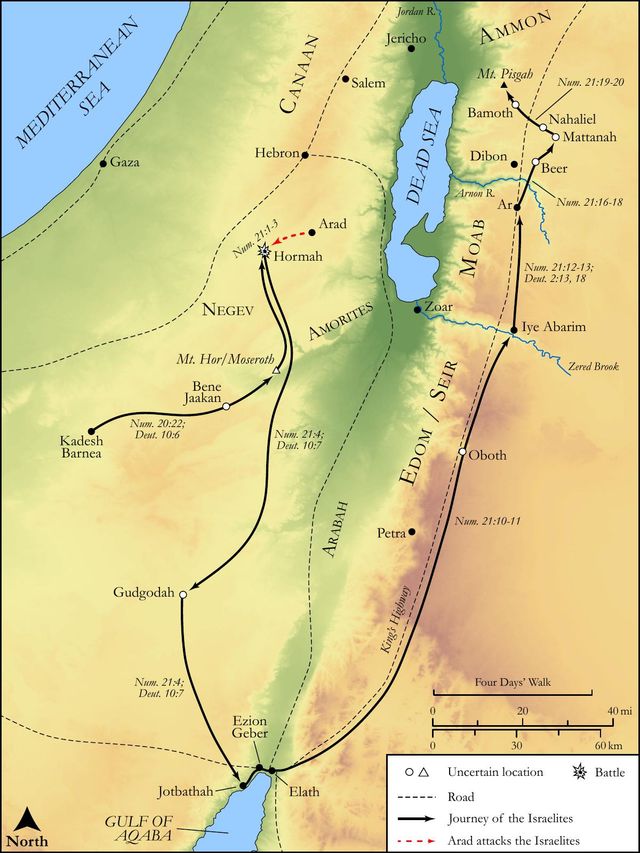
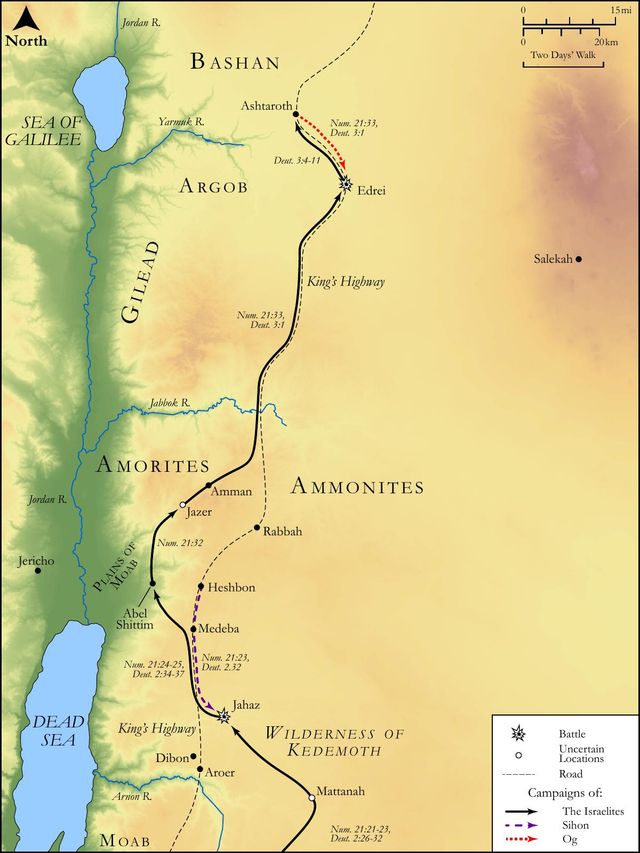
Study this verse
Public-domain commentary
Matthew Henry
From his Commentary on the Whole Bible. Henry comments on passages, not single verses — this entry covers Deuteronomy 2:8–23. His three-level outline is real structure in the source text, so it is rendered as structure.
It is observable here that Moses, speaking of the Edomites (Deu 2:8), calls them, "our brethren, the children of Esau." Though they had been unkind to Israel, in refusing them a peaceable passage through their country, yet he calls them brethren. For, though our relations fail in their duty to us, we must retain a sense of the relation, and not be wanting in our duty to them, as there is occasion. Now in these verses we have,
I.The account which Moses gives of the origin of the nations of which he had here occasion to speak, the Moabites, Edomites, and Ammonites.
We know very well, from other parts of his history, whose posterity they were; but here he tells us how they came to those countries in which Israel found them; they were not the aborigines, or first planters. But,
1.The Moabites dwelt in a country which had belonged to a numerous race of giants, called Emim (that is, terrible ones), as tall as the Anakim, and perhaps more fierce, Deu 2:10, Deu 2:11.
2.The Edomites in like manner dispossessed the Horim from Mount Seir, and took their country (Deu 2:12. and again Deu 2:22), of which we read, Gen 36:20.
3.The Ammonites likewise got possession of a country that had formerly been inhabited by giants, called Zamzummim, crafty men, or wicked men (Deu 2:20, Deu 2:21), probably the same that are called Zuzim, Gen 14:5. He illustrates these remarks by an instance older than any of these; the Caphtorim (who were akin to the Philistines, Gen 10:14) drove the Avim out of their country, and took possession of it, Deu 2:23. The learned bishop Patrick supposes these Avites, being expelled hence, to have settled in Assyria, and to be the same people we read of under that name, Kg2 17:31. Now these revolutions are recorded,
(1.)To show how soon the world was peopled after the flood, so well peopled that, when a family grew numerous, they could not find a place to settle in, at least in that part of the world, but they must drive out those that were already settled.
(2.)To show that the race is not to the swift, nor the battle to the strong. Giants were expelled by those of ordinary stature; for probably these giants, like those before the flood (Gen 6:4), were notorious for impiety and oppression, which brought the judgments of God upon them, against which their great strength would be on defence.
(3.)To show what uncertain things worldly possessions are, and how often they change their owners; it was so of old, and ever will be so. Families decline, and from them estates are transferred to families that increase; so little constancy or continuance is there in these things.
(4.)To encourage the children of Israel, who were now going to take possession of Canaan, against the difficulties they would meet with, and to show the unbelief of those that were afraid of the sons of Anak, to whom the giants, here said to be conquered, are compared, Deu 2:11, Deu 2:21. If the providence of God had done this for the Moabites and Ammonites, much more would his promise do it for Israel his peculiar people.
II.The advances which Israel made towards Canaan.
They passed by the way of the wilderness of Moab (Deu 2:8), and then went over the brook or vale of Zered (Deu 2:13), and there Moses takes notice of the fulfilling of the word which God had spoken concerning them, that none of those that were numbered at Mount Sinai should see the land that God had promised, Num 14:23. According to that sentence, now that they began to set their faces towards Canaan, and to have it in their eye, notice is taken of their being all destroyed and consumed, and not a man of them left, Deu 2:14. Common providence, we may observe, in about thirty-eight years, ordinarily raises a new generation, so that in that time few remain of the old one; but here it was entirely new, and none at all remained but Caleb and Joshua: for indeed the hand of the Lord was against them, v. 15. Those cannot but waste, until they were consumed, who have the hand of God against them. Observe, Israel is not called to engage with the Canaanites till all the men of war, the veteran regiments, that had been used to hardship, and had learned the art of war from the Egyptians, were consumed and dead from among the people (v. 16), that the conquest of Canaan, being effected by a host of new-raised men, trained up in a wilderness, the excellency of the power might the more plainly appear to be of God and not of men.
III.The caution given them not to meddle with the Moabites or Ammonites, whom they must not disseize, nor so much as disturb in their possessions: Distress them not, nor contend with them, v. 9. Though the Moabites aimed to ruin Israel (Num 22:6), yet Israel must not aim to ruin them. If others design us a mischief, this will not justify us in designing them a mischief. But why must not the Moabites and Ammonites be meddled with? 1. Because they were the children of Lot (v. 9, 19), righteous Lot, who kept his integrity in Sodom. Note, Children often fare the better in this world for the piety of their ancestors: the seed of the upright, though they degenerate, yet are blessed with temporal good things. 2. Because the land they were possessed of was what God had given them, and he did not design it for Israel. Even wicked men have a right to their worldly possessions, and must not be wronged. The tares are allowed their place in the field, and must not be rooted out until the harvest. God gives and preserves outward blessings to wicked men, to show that these are not the best things, but he has better in store for his own children.
Continue studying Deuteronomy 2:9 across the web’s major study libraries — every link below opens this exact verse, chapter, or book on the destination site.
Read & Compare
 BibleGatewayThis verse in more than 200 translations and 70 languages.
 Bible.comThe YouVersion reader — hundreds of translations, reading plans, and highlights.
 ESV.orgCrossway's official English Standard Version reader.
 NET BibleThe NET translation with 60,000+ translators' notes on every rendering decision.
 STEP BibleTyndale House's free study tool — original text, vocabulary, and scholarly resources.
 BibliaLogos Bible Software's free web reader.
 USCCBThe New American Bible (Revised Edition) with the U.S. bishops' study notes.
Commentaries
 BibleHub CommentariesDozens of classic commentaries on this verse, gathered on one page.
 StudyLightMore than 100 commentary sets — the largest collection on the web.
 BibleRefPlain-English commentary on what this verse means, verse by verse.
 Enduring WordDavid Guzik's free commentary on this chapter, widely used by Bible teachers.
 Bible Study ToolsVerse commentary alongside Greek and Hebrew study aids.
Original Language & Research
- BibleHub InterlinearThe verse word by word — original language, transliteration, and English.
- BibleHub LexiconEvery word's original-language definition and Strong's entry.
 Blue Letter BibleDeep-study tools — Strong's numbers, concordance, and word studies.
 SefariaThe Hebrew text with Rashi and centuries of Jewish commentary.
Sermons, Hymns & Audio


TrulyRandomVerse is not affiliated with these sites and doesn’t control their content. They’re linked because they’re genuinely useful.
Summary
Deuteronomy 2:9 records a pivotal divine command from the Lord to Moses, instructing Israel not to engage in hostilities or attempt to dispossess the Moabites of their territory. This directive profoundly illustrates God's sovereign authority over the allocation of land to all nations, not exclusively to Israel. Specifically, the Lord declares that He has already granted the region of Ar to the descendants of Lot as an enduring possession, thereby establishing clear, divinely ordained boundaries that Israel must respect, even amidst their divinely mandated conquest of Canaan.
Context
ShowHideLiterary Context
Deuteronomy 2 is part of Moses' extensive historical prologue, which recounts Israel's journey from Kadesh-barnea towards the Promised Land, highlighting their obedience or disobedience to God's commands during their wilderness wanderings. Chapters 1-3 serve as a vital review of Israel's recent past, particularly the events of the last 38 years, setting the theological and historical stage for the renewed covenant instructions that follow. Immediately preceding this verse, God had issued a remarkably similar command concerning the Edomites, descendants of Esau, explicitly stating that their territory was also a divine grant and not for Israel to seize or provoke (Deuteronomy 2:4-5). This parallel instruction regarding Moab in Deuteronomy 2:9 reinforces a consistent and profound divine principle: God, not human ambition or military might, ultimately determines national boundaries and possessions. The narrative then proceeds to detail Israel's peaceful passage through Moabite territory, followed by an analogous command regarding the Ammonites (Deuteronomy 2:19), solidifying this theme of divine territorial sovereignty.
Historical & Cultural Context
The Moabites were an ancient Semitic people, tracing their lineage back to Lot, Abraham's nephew, through his elder daughter (Genesis 19:37). Their territory was situated east of the Dead Sea, forming a significant border with Israel's eventual eastern frontier. At this juncture, Israel represented a formidable, divinely-backed military force on the very cusp of conquering the land of Canaan. The divine command to bypass Moab (along with Edom and Ammon) was strikingly counter-cultural in a day when conquest among the nations was often driven by opportunity, perceived weakness, and the desire for territorial expansion. This directive powerfully demonstrated that Israel's warfare was not for indiscriminate expansion but was precisely directed by God's specific commands and purposes. While the nations believed their gods granted them territory, as Jephthah would later say of Chemosh, "that which Chemosh thy god giveth thee to possess," here, Yahweh's sovereignty is explicitly shown to extend even to nations outside the immediate Abrahamic covenant, highlighting His universal dominion.
Key Themes
ShowHideThis verse contributes profoundly to several overarching theological and narrative themes within Deuteronomy and the broader Pentateuch. Foremost is the theme of Divine Sovereignty Over Land and Nations. God's explicit declaration, "I will not give thee of their land... because I have given Ar unto the children of Lot," unequivocally asserts His ultimate authority over the earth's territories and the destinies of all peoples, not merely Israel. This highlights that Israel's inheritance of Canaan was not a matter of human strength or conquest but a direct divine gift, paralleling God's prior allocations to other nations. Secondly, it underscores the critical theme of Obedience to God's Specific Commands. Israel was called to trust God's wisdom and restraint, even when it meant bypassing seemingly conquerable territory. This demonstrated that their success and security depended entirely on faithful adherence to His word, not on their strategic prowess. Lastly, it subtly introduces the theme of God's Broader Providence, revealing that God's care, established order, and just dealings extend beyond His covenant people to all humanity, even those who might later become adversaries. This resonates with the universal scope of God's redemptive plan, as seen in passages like God's blessing to all families of the earth through Abraham (Genesis 12:3).
Exposition and Analysis
ShowHideKey Word Analysis
ShowHideThis verb carries a strong connotation of hostility, vexation, or acting as an adversary. It means "to cramp," "confine," "besiege," or "be in a narrow place." In this context, it signifies a comprehensive prohibition against any form of harassment, oppression, or aggressive action that would cause difficulty or anguish for the Moabites. It extends beyond mere military engagement to encompass any act of antagonism or creating distress.
The Hebrew verb means "to grate," "to anger," "to stir up strife," "provoke," "quarrel," or "contend in battle." While tsûwr implies the act of causing distress or besieging, gârâh focuses more on initiating the conflict or provoking a fight. Together, "distress not" and "neither contend" form a powerful hendiadys, emphasizing a complete and absolute prohibition against any hostile engagement, whether direct combat or general antagonism, with the Moabites.
This noun refers to an inherited property, a conquest, or a patrimony. Its repetition ("I will not give thee of their land for a possession; because I have given Ar unto the children of Lot for a possession") highlights the divine nature of land ownership. It is not merely conquered territory but a divinely allotted inheritance. This term emphasizes the permanence and legitimacy of the Moabites' claim to Ar, as it was a gift from God Himself, just as Canaan was to be Israel's yᵉrushshâh.
Verse Breakdown
ShowHide"And the LORD said unto me"
This opening clause establishes the divine origin and absolute authority of the command. Moses is presented as the direct recipient and faithful conveyor of Yahweh's specific instruction, underscoring its non-negotiable nature for Israel.
"Distress not the Moabites, neither contend with them in battle"
This is the direct, two-fold prohibition. It is a comprehensive command against any form of hostile action, ranging from subtle harassment and vexation to full-scale military engagement. It sets a clear, divinely mandated boundary for Israel's conduct towards a specific nation.
"for I will not give thee of their land [for] a possession"
This provides the immediate, pragmatic divine rationale for the command. God explicitly states that the Moabite territory is not part of Israel's destined inheritance or the land promised to them. It is not for Israel to conquer or claim as their own.
"because I have given Ar unto the children of Lot [for] a possession"
This final clause offers the ultimate theological justification and reveals God's broader providential plan. God Himself, in His sovereign wisdom and prior allocation, had already granted the region of Ar (a significant part of Moabite territory) to the descendants of Lot, Abraham's nephew. This demonstrates God's universal governance, extending His care and territorial grants beyond Israel to other nations, even those not directly in the Abrahamic covenant.
Literary Devices
ShowHideDeuteronomy 2:9 employs several effective literary devices that enhance its message. The most prominent is Divine Command, expressed through the direct speech of the Lord to Moses, which lends absolute authority and gravity to the instruction. This command is reinforced by Repetition of the word "possession" (yᵉrushshâh), which appears twice in quick succession. This repetition emphasizes the divine nature of land allocation—both for Israel's future inheritance and for Moab's current territory. There is also a clear Contrast established: while Israel is divinely commissioned to conquer Canaan, they are explicitly forbidden from conquering Moab. This highlights the specificity and selectivity of God's plans and the precise nature of His commands. This contrast subtly Foreshadows the broader principle that God's sovereignty extends over all nations and their boundaries, a theme that will be developed throughout biblical history, culminating in the universal scope of His redemptive plan.
Theological and Thematic Connections
ShowHideDeuteronomy 2:9 stands as a profound theological statement on God's universal sovereignty and His meticulous ordering of the world. It reveals that Yahweh is not merely the God of Israel, but the God of all nations, determining their boundaries and allotting their territories according to His divine will. This demonstrates a broader providence that extends beyond the covenant people, showcasing His justice, order, and care even among those not directly in covenant relationship with Him. For Israel, it was a crucial lesson in obedience and trust, teaching them that their success and inheritance were entirely dependent on God's specific commands, not on their military might or perceived opportunities for expansion. It also established a precedent for respecting divinely ordained boundaries, even when dealing with nations that might later become adversaries. This principle of God's universal dominion resonates throughout Scripture, reminding believers that His purposes encompass all of creation and that He is the ultimate arbiter of human affairs.
Reflection and Application
ShowHideDeuteronomy 2:9 calls us to a profound recognition of God's ultimate authority over all aspects of life, including geopolitical boundaries and the destinies of nations. It challenges any human tendency to assume that our desires or perceived rights override God's established order. For believers today, this verse encourages a posture of humility and trust, knowing that God's plans are far-reaching and encompass even those outside our immediate sphere of concern. It teaches us to respect the legitimate claims and possessions of others, whether individuals, communities, or nations, understanding that God has a purpose for everyone and that His justice extends to all. Furthermore, it underscores the importance of discerning God's specific will for our lives and endeavors, rather than pursuing opportunities based solely on human logic, ambition, or perceived advantage. Just as Israel's success depended on their obedience to God's precise commands, our spiritual flourishing is tied to our willingness to align with His sovereign directives, even when they seem counter-intuitive or limit our immediate desires. This verse ultimately fosters a worldview where God's wisdom and justice are paramount, guiding our interactions with the world around us and cultivating a spirit of peace rather than contention.
Questions for Reflection
ShowHideFAQ
ShowHideWhy did God protect the Moabites, who were not part of Israel, but command Israel to destroy other nations like the Canaanites?
ShowHideThis question highlights a crucial distinction in God's dealings with nations, demonstrating His perfect justice and varied purposes. God's command to protect the Moabites (and Edomites and Ammonites) was based on His prior, sovereign allocation of their land to the descendants of Lot and Esau, respectively. These nations, while not part of the Abrahamic covenant, were not yet ripe for judgment in the same way the Canaanites were. The Canaanites, on the other hand, were targeted for judgment due to their extreme wickedness, pervasive idolatry, and abhorrent practices (including child sacrifice), which had reached a point where God's patience had run out and their iniquity was "complete" (Genesis 15:16; Leviticus 18:24-25). God's actions are always just, purposeful, and executed according to His perfect timing, demonstrating His right to judge and His prerogative to grant or withhold territory based on His wisdom and moral standards. The protection of Moab, therefore, emphasizes God's universal governance and His varied dealings with humanity, not a contradiction in His character.
Did Israel always obey this command regarding the Moabites?
ShowHideWhile Israel was commanded to bypass the Moabites peacefully during their wilderness journey, their relationship with Moab was not always peaceful in subsequent history. Later, during the period of the Judges, the Moabites, under King Eglon, oppressed Israel for eighteen years, leading to a period of servitude (Judges 3:12-14). Despite this, the book of Ruth, set during the same period, beautifully illustrates a peaceful and redemptive interaction between Israel and Moab through Ruth, a Moabitess who became an ancestress of King David and ultimately, Jesus Christ. This demonstrates that while the initial command in Deuteronomy 2:9 was about territorial respect and non-aggression, the historical relationship evolved, highlighting both human disobedience and God's overarching redemptive plan that could even incorporate individuals from nations initially set apart.
Christ-Centered Fulfillment
ShowHideDeuteronomy 2:9, with its emphasis on God's sovereign allocation of land and His protection of the Moabites as descendants of Lot, profoundly foreshadows the universal scope of God's redemptive plan in Christ. Just as God meticulously ordered the physical territories and destinies of nations in the Old Testament, so too does He sovereignly orchestrate the spiritual inheritance of humanity in the New Covenant. Christ is the ultimate "possession" and "inheritance" for believers, far surpassing any earthly land or territory. He is the true heir of all things (Hebrews 1:2), and through Him, we receive an inheritance that is imperishable, undefiled, and unfading, kept in heaven for us (1 Peter 1:4). The command to "distress not" and "contend not" with Moab, a nation outside the Abrahamic covenant, subtly points to God's broader heart for all peoples, culminating in the Great Commission where believers are sent to make disciples of all nations (Matthew 28:19). In Christ, the dividing walls of hostility between Jew and Gentile are broken down (Ephesians 2:14), and people from every tribe, tongue, people, and nation are brought into God's spiritual kingdom, inheriting eternal life through faith in the Lamb of God (Revelation 7:9-10). This divine principle of sovereign allocation, seen in the land of Ar for Moab, finds its ultimate and most glorious fulfillment in the spiritual inheritance of salvation freely given to all who believe in Jesus Christ, the Prince of Peace, who reconciles all things to Himself (Colossians 1:20).