


Deuteronomy 2:10
Bible text: King James Version (1769 Blayney text) · Public domain
Bible text: Berean Standard Bible · Public domain
Bible text: American Standard Version (1901) · Public domain
Bible text: World English Bible, Messianic edition · Public domain
Bible text: Geneva Bible (1599) · Public domain
Bible text: Young's Literal Translation · Public domain
- הָאֵמִיםha·'e·Mimthe EmitesH368Art ¦ N-properNoun Proper LocationהָtheאֵמִיםEmites
- לְפָנִיםle·fa·Nim<to> beforeH6440Prep-l ¦ N-mpNoun Plural Masculine Absoluteלְ<to>פָנִיםbefore
- יָשְׁבוּYa·she·vuthey dweltH3427V-Qal-Perf-3cpVerb Qal Perfect 3rd Plural common gender
- בָהּVahin itPrep-b ¦ 3fsSuffix Personal 3rd Singular Feminineבָinהּit
- עַם'ama peopleH5971N-msNoun Singular Masculine Absolute
- גָּדוֹלga·DolgreatH1419Adj-msAdjective Singular Masculine Absolute
- וְרַבve·Ravand numerousH7227Conj-w ¦ Adj-msAdjective Singular Masculine Absoluteוְandרַבnumerous
- וָרָםva·Ramand loftyH7311Conj-w ¦ V-Qal-Prtcpl-msVerb Qal Participle Singular Masculine Absoluteוָandרָםlofty
- כָּעֲנָקִיםka·'a·na·Kimlike the AnakitesH6062Prep-k ¦ N-mpNoun Gentilic Plural Masculine Absoluteכָּlike theעֲנָקִיםAnakites
English is a literal word-by-word gloss of the Hebrew, not the KJV's wording. Why?
This is the original text the KJV's translators worked from — each Hebrew word with its own literal English meaning in this verse, prepared by scholars at Tyndale House, Cambridge. The KJV translates whole sentences, not word by word, so its wording differs: one Hebrew word can become several English words, and the KJV may choose “the LORD” where the gloss reads “Yahweh”. Both are faithful — they answer different questions. For the KJV's own rendering, switch to the KJV text.
Details
See on the biblical-era maps
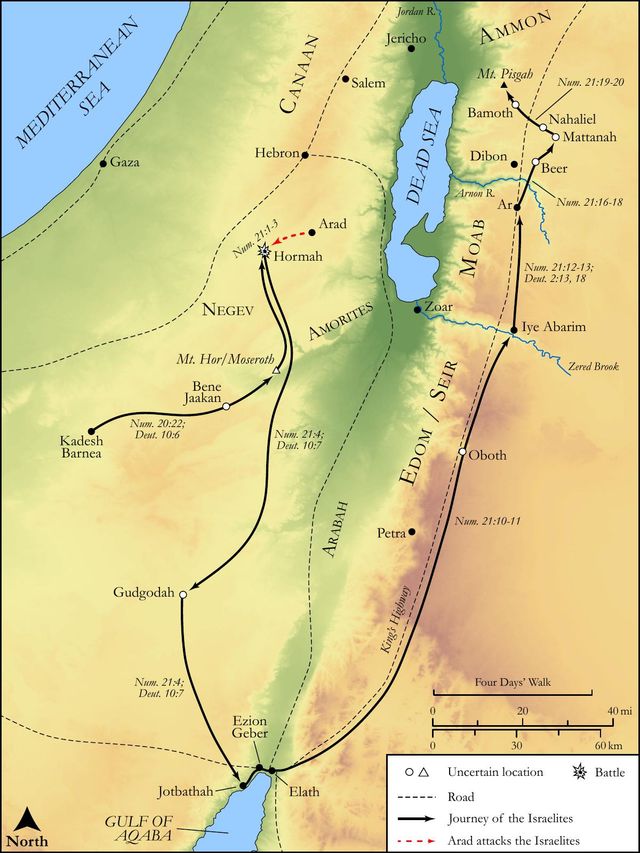
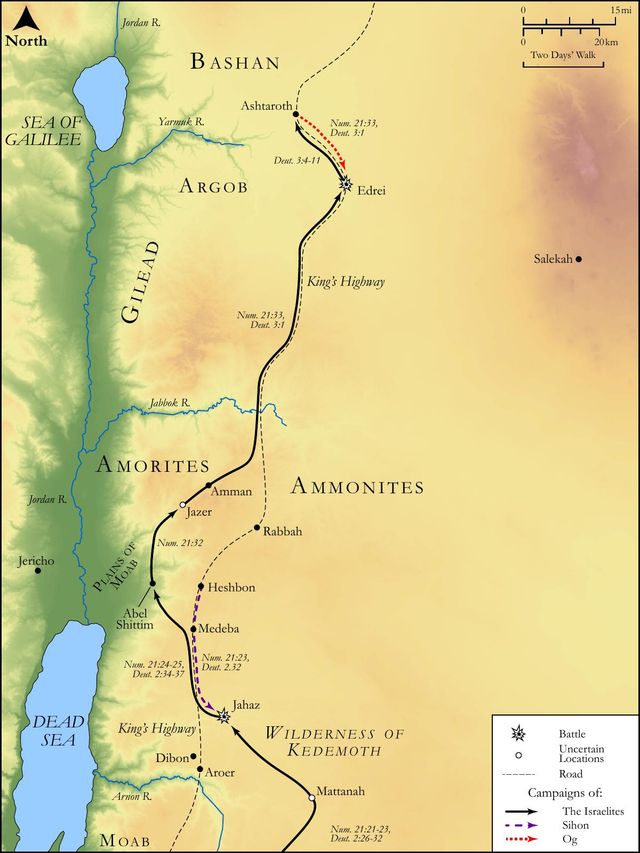
Study this verse
Public-domain commentary
Matthew Henry
From his Commentary on the Whole Bible. Henry comments on passages, not single verses — this entry covers Deuteronomy 2:8–23. His three-level outline is real structure in the source text, so it is rendered as structure.
It is observable here that Moses, speaking of the Edomites (Deu 2:8), calls them, "our brethren, the children of Esau." Though they had been unkind to Israel, in refusing them a peaceable passage through their country, yet he calls them brethren. For, though our relations fail in their duty to us, we must retain a sense of the relation, and not be wanting in our duty to them, as there is occasion. Now in these verses we have,
I.The account which Moses gives of the origin of the nations of which he had here occasion to speak, the Moabites, Edomites, and Ammonites.
We know very well, from other parts of his history, whose posterity they were; but here he tells us how they came to those countries in which Israel found them; they were not the aborigines, or first planters. But,
1.The Moabites dwelt in a country which had belonged to a numerous race of giants, called Emim (that is, terrible ones), as tall as the Anakim, and perhaps more fierce, Deu 2:10, Deu 2:11.
2.The Edomites in like manner dispossessed the Horim from Mount Seir, and took their country (Deu 2:12. and again Deu 2:22), of which we read, Gen 36:20.
3.The Ammonites likewise got possession of a country that had formerly been inhabited by giants, called Zamzummim, crafty men, or wicked men (Deu 2:20, Deu 2:21), probably the same that are called Zuzim, Gen 14:5. He illustrates these remarks by an instance older than any of these; the Caphtorim (who were akin to the Philistines, Gen 10:14) drove the Avim out of their country, and took possession of it, Deu 2:23. The learned bishop Patrick supposes these Avites, being expelled hence, to have settled in Assyria, and to be the same people we read of under that name, Kg2 17:31. Now these revolutions are recorded,
(1.)To show how soon the world was peopled after the flood, so well peopled that, when a family grew numerous, they could not find a place to settle in, at least in that part of the world, but they must drive out those that were already settled.
(2.)To show that the race is not to the swift, nor the battle to the strong. Giants were expelled by those of ordinary stature; for probably these giants, like those before the flood (Gen 6:4), were notorious for impiety and oppression, which brought the judgments of God upon them, against which their great strength would be on defence.
(3.)To show what uncertain things worldly possessions are, and how often they change their owners; it was so of old, and ever will be so. Families decline, and from them estates are transferred to families that increase; so little constancy or continuance is there in these things.
(4.)To encourage the children of Israel, who were now going to take possession of Canaan, against the difficulties they would meet with, and to show the unbelief of those that were afraid of the sons of Anak, to whom the giants, here said to be conquered, are compared, Deu 2:11, Deu 2:21. If the providence of God had done this for the Moabites and Ammonites, much more would his promise do it for Israel his peculiar people.
II.The advances which Israel made towards Canaan.
They passed by the way of the wilderness of Moab (Deu 2:8), and then went over the brook or vale of Zered (Deu 2:13), and there Moses takes notice of the fulfilling of the word which God had spoken concerning them, that none of those that were numbered at Mount Sinai should see the land that God had promised, Num 14:23. According to that sentence, now that they began to set their faces towards Canaan, and to have it in their eye, notice is taken of their being all destroyed and consumed, and not a man of them left, Deu 2:14. Common providence, we may observe, in about thirty-eight years, ordinarily raises a new generation, so that in that time few remain of the old one; but here it was entirely new, and none at all remained but Caleb and Joshua: for indeed the hand of the Lord was against them, v. 15. Those cannot but waste, until they were consumed, who have the hand of God against them. Observe, Israel is not called to engage with the Canaanites till all the men of war, the veteran regiments, that had been used to hardship, and had learned the art of war from the Egyptians, were consumed and dead from among the people (v. 16), that the conquest of Canaan, being effected by a host of new-raised men, trained up in a wilderness, the excellency of the power might the more plainly appear to be of God and not of men.
III.The caution given them not to meddle with the Moabites or Ammonites, whom they must not disseize, nor so much as disturb in their possessions: Distress them not, nor contend with them, v. 9. Though the Moabites aimed to ruin Israel (Num 22:6), yet Israel must not aim to ruin them. If others design us a mischief, this will not justify us in designing them a mischief. But why must not the Moabites and Ammonites be meddled with? 1. Because they were the children of Lot (v. 9, 19), righteous Lot, who kept his integrity in Sodom. Note, Children often fare the better in this world for the piety of their ancestors: the seed of the upright, though they degenerate, yet are blessed with temporal good things. 2. Because the land they were possessed of was what God had given them, and he did not design it for Israel. Even wicked men have a right to their worldly possessions, and must not be wronged. The tares are allowed their place in the field, and must not be rooted out until the harvest. God gives and preserves outward blessings to wicked men, to show that these are not the best things, but he has better in store for his own children.
Continue studying Deuteronomy 2:10 across the web’s major study libraries — every link below opens this exact verse, chapter, or book on the destination site.
Read & Compare
 BibleGatewayThis verse in more than 200 translations and 70 languages.
 Bible.comThe YouVersion reader — hundreds of translations, reading plans, and highlights.
 ESV.orgCrossway's official English Standard Version reader.
 NET BibleThe NET translation with 60,000+ translators' notes on every rendering decision.
 STEP BibleTyndale House's free study tool — original text, vocabulary, and scholarly resources.
 BibliaLogos Bible Software's free web reader.
 USCCBThe New American Bible (Revised Edition) with the U.S. bishops' study notes.
Commentaries
 BibleHub CommentariesDozens of classic commentaries on this verse, gathered on one page.
 StudyLightMore than 100 commentary sets — the largest collection on the web.
 BibleRefPlain-English commentary on what this verse means, verse by verse.
 Enduring WordDavid Guzik's free commentary on this chapter, widely used by Bible teachers.
 Bible Study ToolsVerse commentary alongside Greek and Hebrew study aids.
Original Language & Research
- BibleHub InterlinearThe verse word by word — original language, transliteration, and English.
- BibleHub LexiconEvery word's original-language definition and Strong's entry.
 Blue Letter BibleDeep-study tools — Strong's numbers, concordance, and word studies.
 SefariaThe Hebrew text with Rashi and centuries of Jewish commentary.
Sermons, Hymns & Audio


TrulyRandomVerse is not affiliated with these sites and doesn’t control their content. They’re linked because they’re genuinely useful.
Summary
Deuteronomy 2:10 serves as a crucial historical interjection within Moses' retrospective address, illuminating God's sovereign hand in dispossessing the formidable Emims from the land of Moab in times past. This verse vividly describes the Emims as "a people great, and many, and tall," drawing a direct and impactful comparison to the well-known and feared Anakims. This detail not only provides background on the region's ancient inhabitants but also powerfully underscores God's ability to clear the way for His chosen people, setting a divine precedent for Israel's own impending conquest of Canaan against seemingly insurmountable odds.
Context
ShowHideLiterary Context
Deuteronomy 2:10 functions as a parenthetical historical note embedded within Moses' extended address to the new generation of Israelites on the plains of Moab. In the verses immediately preceding (Deuteronomy 2:1-9), Moses recounts God's specific commands for Israel to bypass the territories of Edom and Moab, as these lands had already been divinely allotted to the descendants of Esau and Lot, respectively. Verse 10, along with subsequent interjections (e.g., Deuteronomy 2:11-12 and Deuteronomy 2:20-23), provides crucial background on the prior inhabitants of these lands. By highlighting that God had previously dispossessed powerful, giant-like peoples (like the Emims and Zamzumims) to make way for the current occupants, Moses reinforces the theological truth that God is sovereign over all nations and their territories. This historical precedent serves to bolster Israel's confidence for their own divinely ordained conquest of Canaan, where they would face similar formidable adversaries.
Historical & Cultural Context
The Transjordan region, encompassing areas like Moab, was known to have been inhabited by various indigenous groups often referred to as Rephaim, a term broadly denoting "giants" or "mighty ones." The Emims, specifically mentioned in this verse, were one such group, associated with the territory east of the Jordan River. The comparison of the Emims to the Anakims is highly significant within the Israelite cultural context. The Anakims were a notoriously feared group of giants dwelling in Canaan, whose formidable stature had instilled terror in the Israelite spies, leading to their faithless report in Numbers 13:33. This cultural understanding of "giants" as symbols of overwhelming, insurmountable opposition would have immediately resonated with Moses' audience. By categorizing the Emims alongside the Anakims, the verse effectively communicates the immense scale of the challenge these early inhabitants posed and, by extension, magnifies the power of the God who dispossessed them, setting a powerful example for Israel's future conquests.
Key Themes
ShowHideDeuteronomy 2:10 contributes significantly to several foundational themes within Deuteronomy and the broader Pentateuch. Firstly, it powerfully illustrates Divine Sovereignty over Nations and Land Allocation. God's active role in determining the boundaries and destinies of peoples is central; He dispossessed the Emims for the Moabites, demonstrating His ultimate authority over all earthly powers. This sets a clear precedent for His intention to dispossess the Canaanites for Israel. Secondly, the verse underscores the theme of Overcoming Formidable Obstacles. The vivid description of the Emims as "great, and many, and tall," coupled with their comparison to the Anakims, serves to magnify God's power. It reminds the Israelites that no adversary, however imposing, is too great for God to overcome, providing assurance for their own impending conquest of Canaan, where they would encounter similar "giants" (as referenced in Deuteronomy 9:1-2). Thirdly, this historical detail establishes a Historical Precedent for God's Faithfulness. By recalling how God enabled the Moabites to displace such powerful inhabitants, Moses builds a compelling case for Israel's trust in God's promise to deliver the Promised Land into their hands, reinforcing the reliability of God's covenant promises despite the formidable nations they would encounter.
Exposition and Analysis
ShowHideKey Word Analysis
ShowHideThis plural noun, derived from a root meaning "terrors" or "dread," aptly describes an early Canaanitish (or Moabite) tribe known for their fearsome reputation. As a branch of the Rephaim, they were an ancient race associated with imposing stature and strength. Their historical presence in Moabite territory before the Moabites signifies a pre-Israelite history of the land and God's prior acts of dispossession, setting the stage for His future actions on behalf of Israel.
This primitive root signifies "to sit down," but broadly implies "to dwell," "to remain," or "to inhabit." In this context, it confirms the Emims' established presence and long-term habitation in the land before their displacement. It highlights that they were not merely passing through but had settled and made the territory their home, underscoring the magnitude of their dispossession by divine decree.
This adjective denotes greatness in various senses, including size, power, or importance. Applied to the Emims, it emphasizes their formidable nature, not only in physical stature ("tall") but also in their overall might, influence, or perhaps their large population ("many"). This descriptor contributes to the portrayal of the Emims as a significant and challenging force, further magnifying the power of God who dispossessed them.
Verse Breakdown
ShowHide"The Emims dwelt therein in times past,"
This opening clause establishes the historical setting, indicating that the Emims were the former, long-term inhabitants of the land now occupied by the Moabites. The phrase "in times past" points to a period preceding the current narrative of Israel's journey, emphasizing God's enduring sovereignty over the land and its peoples throughout history. The "therein" implicitly refers to the territory of Moab, as contextually established in Deuteronomy 2:9.
"a people great, and many, and tall,"
This descriptive phrase provides a vivid portrayal of the Emims, emphasizing their formidable characteristics. "Great" suggests their power, influence, or overall significance. "Many" indicates a substantial population, implying a numerous and formidable force. "Tall" directly refers to their immense physical stature, explicitly marking them as giants. Collectively, these descriptors paint a picture of a truly imposing, numerous, and intimidating people.
"as the Anakims;"
This concluding clause provides a direct and powerful comparison, leveraging the Israelites' existing knowledge and fear. By likening the Emims to the Anakims, Moses immediately conveys the immense stature and formidable nature of the Emims. The Anakims were a well-known race of giants whose formidable presence had previously terrified the Israelite spies (as recounted in Numbers 13:33). This simile serves as a powerful shorthand, instantly communicating that the Emims were likewise a race of intimidating giants, reinforcing the magnitude of God's power in their dispossession.
Literary Devices
ShowHideDeuteronomy 2:10 skillfully employs several literary devices to convey its message with impact. The most prominent is Comparison, specifically a Simile, evident in the phrase "as the Anakims." This direct comparison to a widely known and feared group of giants immediately communicates the formidable nature of the Emims to the Israelite audience, leveraging their existing understanding and apprehension. The descriptive triad "great, and many, and tall" utilizes Amplification to emphasize the Emims' imposing presence, aiming to impress upon the listeners the sheer magnitude of the people God dispossessed. Furthermore, the verse functions as a Historical Aside or Parenthetical Remark within Moses' broader speech. It briefly interrupts the narrative flow of Israel's wilderness journey to provide crucial background information, reinforcing the theological point about God's sovereign control over the land and its inhabitants, thereby building confidence for Israel's own impending conquest.
Theological and Thematic Connections
ShowHideDeuteronomy 2:10, though a brief historical note, is profoundly significant in its theological implications. It fundamentally reinforces the theme of God's absolute sovereignty over all creation, including the allocation of land and the destiny of nations. The fact that God dispossessed the "great, and many, and tall" Emims for the Moabites serves as a powerful precedent for His intention to dispossess the even mightier nations of Canaan for Israel. This demonstrates that no human power, no matter how formidable, can thwart God's divine plan. It underscores His unwavering faithfulness to His covenant promises, showing that He actively prepares the way for His people, even if it means overcoming "giants" that seem insurmountable to human eyes. This historical detail is strategically placed to instill courage and faith in the new generation of Israelites, reminding them that the God who cleared the way for Moab will surely clear the way for them into the Promised Land.
Reflection and Application
ShowHideDeuteronomy 2:10, while rooted in ancient history, offers a profound and enduring message for believers today. It serves as a powerful reminder that our God is a God who overcomes "giants." Just as He sovereignly dispossessed the formidable Emims and Anakims, paving the way for His people, He is equally capable of confronting and conquering the "giants" in our own lives. These "giants" may not be physical beings, but they manifest as daunting challenges, overwhelming fears, seemingly insurmountable obstacles, deeply entrenched sins, or persistent anxieties. The verse encourages us to remember that no problem, no adversary, and no personal struggle is too "great, and many, and tall" for God's boundless power and unwavering sovereignty. It calls us to place our trust not in our own limited strength or resources, but in the God who has a proven track record of clearing the way and delivering His people. As we face our own "giants," we can draw immense courage and unwavering faith from this ancient account, knowing that the same God who acted then is actively at work now, orchestrating circumstances and empowering us to lead us into His promised blessings and victories.
Questions for Reflection
ShowHideFAQ
ShowHideWere the Emims and Anakims literally giants, or is this a metaphorical description?
ShowHideThe biblical text consistently portrays the Emims, Anakims, and other related groups (such as the Rephaim) as literally being people of exceptionally great stature and strength. The descriptions "great, and many, and tall" for the Emims in Deuteronomy 2:10, along with the Israelite spies' report of the Anakims making them feel like "grasshoppers" in Numbers 13:33, strongly suggest literal physical gigantism. While the language can be evocative, the consistent portrayal across different biblical books (e.g., Deuteronomy 3:11 describing Og's massive iron bedstead, or 1 Samuel 17:4 detailing Goliath's height as "six cubits and a span") indicates that these were indeed exceptionally large individuals or groups of people. Their formidable size was a key reason for the fear they inspired and served to magnify God's power in dispossessing them.
Christ-Centered Fulfillment
ShowHideDeuteronomy 2:10, with its depiction of God dispossessing formidable physical "giants" like the Emims, finds its ultimate and profound fulfillment in the person and redemptive work of Jesus Christ. While the Old Testament narrative focuses on literal, imposing adversaries that stood in the way of Israel's inheritance, these "giants" serve as powerful types and shadows of the spiritual enemies that humanity truly faces: sin, death, and the devil. Just as God cleared the land of the "great, and many, and tall" Emims for His people Israel, Christ, through His perfect life, atoning death, and glorious resurrection, has decisively conquered the ultimate spiritual giants that held all humanity captive. The cross is where the true "Anakims" of our existence were defeated; Christ disarmed the powers and authorities, triumphing over them by it (Colossians 2:15). His resurrection is the definitive proof that the "giant" of death has been swallowed up in victory, and its sting removed (1 Corinthians 15:54-57). Therefore, the historical account in Deuteronomy points forward to the greater reality that in Christ, believers are empowered to overcome all spiritual opposition, knowing that the decisive battle has already been won by the true King of kings and Lord of lords. We are no longer to fear the "giants" of this fallen world, for "He who is in you is greater than he who is in the world" (1 John 4:4).