


Numbers 21:15
- וְאֶשֶׁדve·'E·shedand [the] slope ofH793Conj-w ¦ N-fscNoun Singular Feminine Constructוְandאֶשֶׁד[the] slope of
- הַנְּחָלִיםha·ne·cha·Limthe wadisH5158Art ¦ N-mpNoun Plural Masculine Absoluteהַtheנְּחָלִיםwadis
- אֲשֶׁר'a·SherwhichH834RelParticle Relative
- נָטָהna·Tahit extendsH5186V-Qal-Perf-3msVerb Qal Perfect 3rd Singular Masculine
- לְשֶׁבֶתle·She·vetto [the] dwelling ofH3427Prep-l ¦ V-Qal-InfVerb Qal Infinitive Constructלְtoשֶׁבֶת[the] dwelling of
- עָר'ArArH6144N-properNoun Proper Location
- וְנִשְׁעַןve·nish·'Anand it leansH8172Conj-w ¦ V-Niphal-ConsecPerf-3msVerb Niphal Consecutive Perfect 3rd Singular Masculineוְandנִשְׁעַןit leans
- לִגְבוּלlig·Vulto [the] border ofH1366Prep-l ¦ N-mscNoun Singular Masculine Constructלִtoגְבוּל[the] border of
- מוֹאָבmo·'AvMoabH4124N-properNoun Proper Location
English is a literal word-by-word gloss of the Hebrew, not the KJV's wording. Why?
This is the original text the KJV's translators worked from — each Hebrew word with its own literal English meaning in this verse, prepared by scholars at Tyndale House, Cambridge. The KJV translates whole sentences, not word by word, so its wording differs: one Hebrew word can become several English words, and the KJV may choose “the LORD” where the gloss reads “Yahweh”. Both are faithful — they answer different questions. For the KJV's own rendering, switch to the KJV text.
Details
See on the biblical-era maps
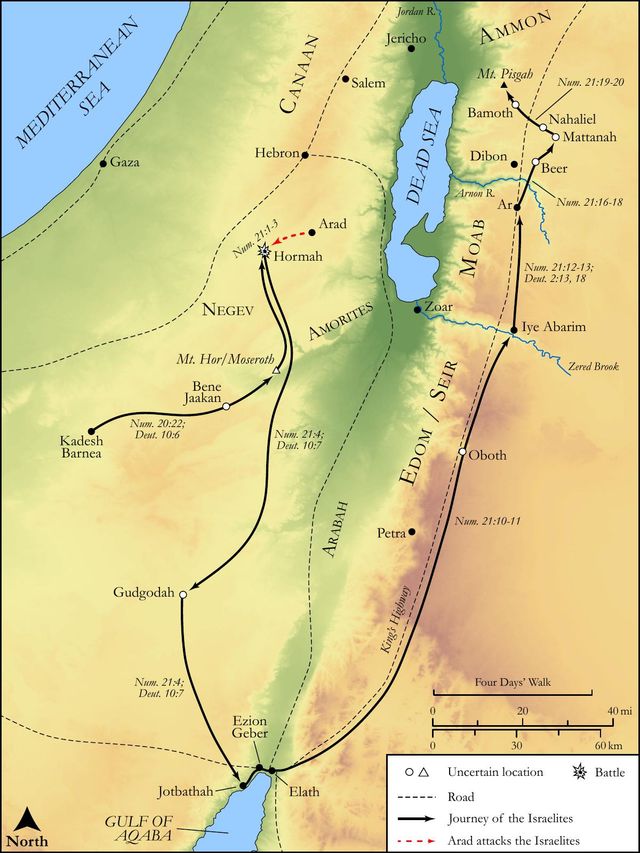
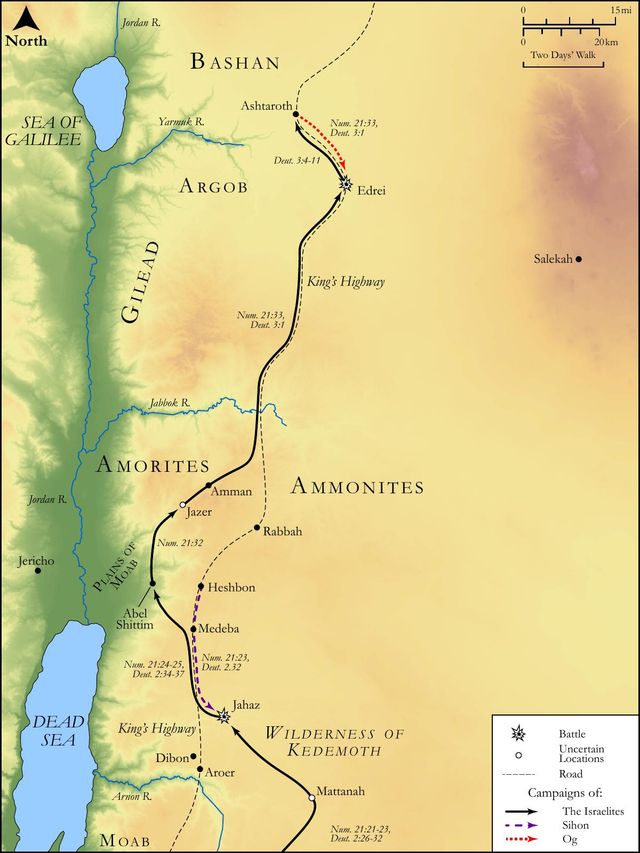
Study this verse
Public-domain commentary
Matthew Henry
From his Commentary on the Whole Bible. Henry comments on passages, not single verses — this entry covers Numbers 21:10–20. His four-level outline is real structure in the source text, so it is rendered as structure.
We have here an account of the several stages and removals of the children of Israel, till they came into the plains of Moab, out of which they at length passed over Jordan into Canaan, as we read in the beginning of Joshua. Natural motions are quicker the nearer they are to their centre. The Israelites were now drawing near to the promised rest, and now they set forward, as the expression is, Num 21:10. It were well if we would do thus in our way to heaven, rid ground in the latter end of our journey, and the nearer we come to heaven be so much the more active and abundant in the work of the Lord. Two things especially are observable in the brief account here given of these removals: -
1.The wonderful success which God blessed his people with, near the brooks of Arnon, Num 21:13-15. They had now compassed the land of Edom (which they were not to invade, nor so much as to disturb, Deu 2:4, Deu 2:5), and had come to the border of Moab. It is well that there are more ways than one to Canaan. The enemies of God's people may retard their passage, but cannot prevent their entrance into the promised rest. Care is taken to let us know that the Israelites in their march religiously observed the orders which God gave them to use no hostility against the Moabites (Deu 2:9), because they were the posterity of righteous Lot; therefore they pitched on the other side of Arnon (Num 21:13), that side which was now in the possession of the Amorites, one of the devoted nations, though formerly it had belonged to Moab, as appears here, Num 21:26, Num 21:27. This care of theirs not to offer violence to the Moabites is pleaded by Jephtha long afterwards, in his remonstrance against the Ammonites (Jdg 11:15, etc.), and turned to them for a testimony. What their achievements were, now that they pitched on the banks of the river Arnon, we are not particularly told, but are referred to the book of the wars of the Lord, perhaps that book which was begun with the history of the war with the Amalekites, Exo 17:14. Write it (said God) for a memorial in a book, to which were added all the other battles which Israel fought, in order, and, among the rest, their actions on the river Arnon, at Vaheb in Suphah (as our margin reads it) and other places on that river. Or, it shall be said (as some read it) in the rehearsal, or commemoration, of the wars of the Lord, what he did in the Red Sea, when he brought Israel out of Egypt, and what he did in the brooks of Arnon, just before he brought them into Canaan. Note, In celebrating the memorials of God's favours to us, it is good to observe the series of them, and how divine goodness and mercy have constantly followed us, even from the Red Sea to the brooks of Arnon. In every stage of our lives, nay, in every step, we should take notice of what God has wrought for us; what he did at such a time, and what in such a place, ought to be distinctly remembered.
2.The wonderful supply which God blessed his people with at Beer (Num 21:16), which signifies the well or fountain. It is said (Num 21:10) they pitched in Oboth, which signifies bottles, so called perhaps because there they filled their bottles with water, which should last them for some time; but by this time, we may suppose, it was with them as it was with Hagar (Gen 21:15), The water was spent in the bottle; yet we do not find that they murmured, and therefore God, in compassion to them, brought them to a well of water, to encourage them to wait on him in humble silence and expectation and to believe that he would graciously take cognizance of their wants, though they did not complain of them. In this world, we do at the best but pitch in Oboth, where our comforts lie in close and scanty vessels; when we come to heaven we shall remove to Beer, the well of life, the fountain of living waters. Hitherto we have found, when they were supplied with water, they asked it in unjust discontent, and God gave it in just displeasure; but here we find,
(1.)That God gave it in love (Num 21:16): Gather the people together, to be witnesses of the wonder, and joint-sharers in the favour, and I will give them water. Before they prayed, God granted, and anticipated them with the blessings of his goodness.
(2.)That they received it with joy and thankfulness, which made the mercy doubly sweet to them, Num 21:17. Then they sang this song, to the glory of God and the encouragement of one another, Spring up, O well! Thus they pray that it may spring up, for promised mercies must be fetched in by prayer; they triumph that it does spring up, and meet it with their joyful acclamations. With joy must we draw water out of the wells of salvation, Isa 11:3. As the brazen serpent was a figure of Christ, who is lifted up for our cure, so is this well a figure of the Spirit, who is poured forth for our comfort, and from whom flow to us rivers of living waters, Joh 7:38. Does this well spring up in our souls? We should sing to it; take the comfort to ourselves, and give the glory to God; stir up this gift, sing to it, Spring up, O well! thou fountain of gardens, to water my soul (Sol 4:15), plead the promise, which perhaps alludes to this story (Isa 41:17, Isa 41:18), I will make the wilderness wells of water.
(3.)That whereas before the remembrance of the miracle was perpetuated in the names given to the places, which signified the people's strife and murmuring, now it was perpetuated in a song of praise, which preserved on record the manner in which it was done (Num 21:18): The princes digged the well, the seventy elders, it is probable, by direction of the lawgiver (that is, Moses, under God) with their staves; that is, with their staves they made holes in the soft and sandy ground, and God caused the water miraculously to spring up in the holes which they made. Thus the pious Israelites long afterwards, passing through the valley of Baca, a dry and thirsty place, made wells, and God by rain from heaven filled the pools, Psa 84:6. Observe,
[1.]God promised to give them water, but the must open the ground to receive it, and give it vent. God's favours must be expected in the use of such means as lie within our power, but still the excellency of the power is of God.
[2.]The nobles of Israel were forward to set their hands to this work, and used their staves, probable those that were the ensigns of their honour and power, for the public service, and it is upon record to their honour. And we may suppose that it was a great confirmation to them in their offices, and a great comfort to the people, that they were made use of by the divine power as instruments to this miraculous supply. By this it appeared that the spirit of Moses, who must shortly die, rested in some measure upon the nobles of Israel. Moses did not strike the ground himself, as formerly the rock, but gave them direction to do it, that their staves might share in the honour of his rod, and they might comfortably hope that when he should leave them yet God would not, but that they also in their generation should be public blessings, and might expect the divine presence with them as long as they acted by the direction of the lawgiver. For comfort must be looked for only in the way of duty; and, if we would share in divine joys, we must carefully follow the divine direction.
Continue studying Numbers 21:15 across the web’s major study libraries — every link below opens this exact verse, chapter, or book on the destination site.
Read & Compare
 BibleGatewayThis verse in more than 200 translations and 70 languages.
 Bible.comThe YouVersion reader — hundreds of translations, reading plans, and highlights.
 ESV.orgCrossway's official English Standard Version reader.
 NET BibleThe NET translation with 60,000+ translators' notes on every rendering decision.
 STEP BibleTyndale House's free study tool — original text, vocabulary, and scholarly resources.
 BibliaLogos Bible Software's free web reader.
 USCCBThe New American Bible (Revised Edition) with the U.S. bishops' study notes.
Commentaries
 BibleHub CommentariesDozens of classic commentaries on this verse, gathered on one page.
 StudyLightMore than 100 commentary sets — the largest collection on the web.
 BibleRefPlain-English commentary on what this verse means, verse by verse.
 Enduring WordDavid Guzik's free commentary on this chapter, widely used by Bible teachers.
 Bible Study ToolsVerse commentary alongside Greek and Hebrew study aids.
Original Language & Research
- BibleHub InterlinearThe verse word by word — original language, transliteration, and English.
- BibleHub LexiconEvery word's original-language definition and Strong's entry.
 Blue Letter BibleDeep-study tools — Strong's numbers, concordance, and word studies.
 SefariaThe Hebrew text with Rashi and centuries of Jewish commentary.
Sermons, Hymns & Audio


TrulyRandomVerse is not affiliated with these sites and doesn’t control their content. They’re linked because they’re genuinely useful.
Summary
Numbers 21:15 serves as a precise geographical waypoint in the Israelites' wilderness journey, detailing their approach to the Promised Land. This verse, following a reference to "the book of the wars of the LORD," meticulously pinpoints a specific location: "the stream of the brooks" that descends towards Ar, an ancient Moabite city, and lies directly upon the border of Moab. It underscores the meticulous nature of God's guidance and the historical veracity of Israel's divinely directed itinerary through the ancient Near East, affirming His sovereign oversight of their every step.
Context
ShowHideLiterary Context
Numbers 21:15 is deeply embedded within a crucial itinerary section (Numbers 21:10-20) that meticulously chronicles Israel's journey from Mount Hor towards the plains of Moab, on the eastern side of the Jordan. This particular verse, along with Numbers 21:14, functions as a geographical interlude, possibly quoting or referencing a historical source known as "the book of the wars of the LORD" (Numbers 21:14). Immediately preceding this geographical detail, the narrative describes Israel's significant victory over Arad (Numbers 21:1-3) and the pivotal incident of the fiery serpents and the bronze serpent (Numbers 21:4-9), highlighting themes of judgment, repentance, and divine provision. The verses following Numbers 21:15 continue the detailed route, leading to the pivotal confrontation with Sihon, king of the Amorites, whose territory Israel was commanded to conquer, unlike Edom and Moab (Numbers 21:21-32). The precise geographical details, including this verse, emphasize the reality and historical nature of their divinely guided journey.
Historical & Cultural Context
The setting for Numbers 21:15 is the late Bronze Age, as the Israelites, having wandered for nearly forty years, are on the cusp of entering Canaan. The region described in this verse is Transjordan, specifically the area bordering Moab. Moab was an ancient kingdom east of the Dead Sea, often in conflict with Israel but also related through Lot, Abraham's nephew (Genesis 19:37). The "dwelling of Ar" (Ar-Moab) was a significant Moabite city, likely located on or near the Arnon River. The "stream of the brooks" most likely refers to the wadi system of the Arnon River, a major geographical feature that formed a natural and well-known border between Moab to the south and the Amorite kingdom to the north (Numbers 21:13). Understanding these ancient national boundaries and the topography of deep wadis (seasonal riverbeds) is crucial for appreciating the strategic and divinely ordained path Israel took, respecting God's command not to provoke or take land from the Moabites, as explicitly stated in Deuteronomy 2:9.
Key Themes
ShowHideNumbers 21:15 contributes to several overarching themes within the book of Numbers and the Pentateuch. Firstly, it highlights Divine Guidance and Providence, demonstrating God's meticulous and precise leading of His people through a complex and often hostile wilderness. Their journey was not random but carefully directed, with God establishing their path and boundaries, as seen in His instructions concerning Moab and Edom (compare Deuteronomy 2:4-9). Secondly, the verse underscores the theme of Borders and Sovereignty, illustrating the reality of national territories in the ancient world and God's ultimate sovereignty over them, even as He respects and utilizes these established boundaries for His purposes. The mention of "the border of Moab" emphasizes the distinctness of nations and the divine mandate regarding their lands. Finally, the inclusion of such detailed geographical markers reinforces the Historical Veracity of the Exodus and wilderness narrative, presenting it not as myth but as a tangible, verifiable account of God's interaction with His people in real time and space, a reality further supported by the extensive itinerary in Numbers 33.
Exposition and Analysis
ShowHideKey Word Analysis
ShowHideThis word, derived from a root meaning "to pour," refers to an outpouring of water, a stream, or a torrent. In the context of Numbers 21:15, it points to a specific, identifiable watercourse, likely a part of the wadi system that defines the region's topography. Its presence indicates a significant geographical feature, often serving as a natural boundary.
Often translated as "wadi" or "torrent-valley," this term describes a watercourse that may be dry for much of the year but becomes a rushing torrent during the rainy season. These wadis frequently form deep gorges, serving as natural barriers and pathways. The combination with "stream" (ʼeshed) emphasizes the nature of this watercourse as a significant, perhaps seasonally flowing, geographical landmark.
While the KJV translates it as "dwelling," the underlying Hebrew root primarily means "to sit down" or "to dwell." In this context, "the dwelling of Ar" refers to the inhabited place or city of Ar. It signifies a settled location, a populated center, rather than a temporary encampment, reinforcing Ar's status as a significant Moabite city.
This is the proper name of an ancient and prominent city in Moab, often referred to as Ar-Moab. Its mention here provides a precise geographical anchor, indicating the proximity of the Israelite encampment or passage to a major Moabite urban center and its associated territory.
Derived from a root meaning "to twist" or "to cord," this term refers to a boundary, limit, or territory enclosed by such a boundary. It signifies a clearly delineated line, whether natural or artificial, that separates one region or nation from another. The phrase "border of Moab" explicitly defines the territorial frontier of the Moabite kingdom, which Israel was divinely commanded to respect.
Verse Breakdown
ShowHide"And at the stream of the brooks"
This opening phrase immediately establishes the geographical setting, pinpointing a specific watercourse or wadi system as the location of Israel's journey or encampment. It suggests a point of natural significance, likely a valley or gorge carved by water.
"that goeth down to the dwelling of Ar"
This clause further refines the location of the "stream of the brooks" by specifying its relationship to the city of Ar. It implies that the wadi descends in the direction of, or leads towards, this significant Moabite settlement, providing a directional marker for the Israelite journey and indicating their proximity to a major urban center.
"and lieth upon the border of Moab"
This final and most crucial clause identifies the "stream of the brooks" as a definitive boundary marker. It confirms that the Israelites were at a point directly on the frontier of Moabite territory, highlighting their adherence to God's command to respect the established borders of their kinsmen, the Moabites. This detail underscores both divine instruction and Israelite obedience.
Literary Devices
ShowHideNumbers 21:15 primarily employs Topographical Description and Itinerary, which are characteristic of the book of Numbers' meticulous recording of the Israelites' journey. The precise naming of geographical features like "the stream of the brooks" and "the dwelling of Ar," along with the clear identification of "the border of Moab," serves to ground the narrative in a verifiable physical reality. This detailed mapping of their route lends Verisimilitude to the account, affirming its historical authenticity and demonstrating that these events were not mythical but occurred in real space and time. The inclusion of such specific, seemingly mundane details also functions as a subtle form of Divine Affirmation, implicitly demonstrating God's meticulous guidance and providential control over every aspect of Israel's journey, even down to the precise geographical points of their encampments and passages. This level of detail underscores God's active involvement in the unfolding history of His people.
Theological and Thematic Connections
ShowHideNumbers 21:15, though a seemingly minor geographical detail, contributes significantly to the broader theological narrative of God's faithfulness and sovereignty. It underscores the meticulous nature of divine guidance, demonstrating that God's plans for His people are precise and purposeful, even in the wilderness. The mention of "the border of Moab" highlights God's sovereignty over all nations and His establishment of boundaries, which even His chosen people must respect. This verse serves as a testament to the historical reality of the Exodus and wilderness wanderings, grounding the spiritual lessons in tangible, verifiable events. It reinforces the idea that God is actively involved in the specific details of His people's lives and journeys, both corporately as a nation and individually, orchestrating their path with divine wisdom and care.
Reflection and Application
ShowHideNumbers 21:15, a seemingly small geographical detail, offers profound lessons for contemporary believers. It reminds us that God's providence is not merely a grand, sweeping concept but extends to the minute particulars of our lives. Just as He meticulously guided Israel through specific wadis and along precise national borders, He orchestrates the details of our own journeys, leading us through particular circumstances, around certain obstacles, and towards His intended destination. This verse encourages a deep trust in God's sovereign hand, even when our path seems circuitous or involves navigating complex "borders" in our personal or professional lives. It calls us to recognize that God's guidance is always purposeful, even when the purpose isn't immediately clear, and that His faithfulness is demonstrated in His constant presence and direction. It challenges us to look for God's hand in the seemingly mundane details, finding reassurance that He is intimately involved in our individual stories, just as He was in the grand narrative of Israel.
Questions for Reflection
ShowHideFAQ
ShowHideWhy is such a specific geographical detail included in the Bible?
ShowHideThe inclusion of precise geographical details like Numbers 21:15 serves multiple crucial purposes. Firstly, it underscores the historical veracity of the biblical narrative, grounding the events of the Exodus and wilderness wanderings in real, identifiable locations. This demonstrates that these were not mythical tales but actual historical movements of a people led by God. Secondly, it highlights God's meticulous guidance and providence. Every step of Israel's journey was divinely orchestrated, including their precise route and the boundaries they were to respect (e.g., Deuteronomy 2:9). These details affirm God's active involvement in the lives of His people. Finally, geographical markers often carry theological significance, defining territories, establishing boundaries, and illustrating God's sovereignty over all lands and nations, even those outside of Israel, reinforcing the idea that His plan encompasses all of creation.
Christ-Centered Fulfillment
ShowHideNumbers 21:15, with its emphasis on precise divine guidance through specific geographical markers and national borders, finds profound Christ-centered fulfillment in the person and work of Jesus. Just as God meticulously led Israel through the wilderness, so too was Christ's earthly journey, from His humble birth in Bethlehem (Micah 5:2) to His crucifixion outside Jerusalem, a divinely ordained and precisely executed itinerary. Jesus Himself declared, "I am the way, the truth, and the life" (John 14:6), embodying the ultimate divine guidance for humanity. He navigated the "borders" of human sin and divine holiness, perfectly fulfilling the Law and establishing a new covenant that transcends earthly boundaries, inviting all nations into God's kingdom through the Great Commission (Matthew 28:19). The wilderness journey of Israel, marked by specific geographical points and divine provisions, serves as a type for the spiritual journey of believers, where Christ is our ultimate guide and the one who leads us through the "wilderness" of this world to the true promised land of eternal rest (Hebrews 4:9-11). Through His perfect obedience and sacrificial death, Jesus opened a "new and living way" (Hebrews 10:20) for all who trust in Him, fulfilling the precise, purposeful, and boundary-respecting guidance of God foreshadowed in Numbers 21:15 by bringing us into an eternal relationship with the Father.