


Deuteronomy 2:29
Bible text: King James Version (1769 Blayney text) · Public domain
Bible text: King James Version with Strong's numbers · Public domain
Bible text: Berean Standard Bible · Public domain
Bible text: American Standard Version (1901) · Public domain
Bible text: World English Bible, Messianic edition · Public domain
Bible text: Geneva Bible (1599) · Public domain
Bible text: Young's Literal Translation · Public domain
- כַּאֲשֶׁרka·'a·Sherjust asH834Prep-k ¦ RelParticle Relativeכַּjustאֲשֶׁרas
- עָשׂוּ'a·suthey didH6213V-Qal-Perf-3cpVerb Qal Perfect 3rd Plural common gender
- לִיlifor mePrep-l ¦ 1csSuffix Personal 1st Singular common genderלִforיme
- בְּנֵיbe·Nei[the] descendants ofH1121N-mpcNoun Plural Masculine Construct
- עֵשָׂו'e·SavEsauH6215N-proper-mNoun Proper Masculine
- הַיֹּשְׁבִיםhai·yo·she·Vimwho dwellH3427Art ¦ V-Qal-Prtcpl-mpVerb Qal Participle Plural Masculine Absoluteהַwhoיֹּשְׁבִיםdwell
- בְּשֵׂעִירbe·se·'Irin SeirH8165Prep-b ¦ N-properNoun Proper LocationבְּinשֵׂעִירSeir
- וְהַמּוֹאָבִיםve·ha·Mo·'a·Vimand the MoabitesH4125Conj-w ¦ Art ¦ N-mpNoun Gentilic Plural Masculine AbsoluteוְandהַtheמּוֹאָבִיםMoabites
- הַיֹּשְׁבִיםhai·yo·she·Vimwho dwellH3427Art ¦ V-Qal-Prtcpl-mpVerb Qal Participle Plural Masculine Absoluteהַwhoיֹּשְׁבִיםdwell
- בְּעָרbe·'Arin ArH6144Prep-b ¦ N-properNoun Proper LocationבְּinעָרAr
- עַד'aduntilH5704PrepPreposition
- אֲשֶׁר'a·SherthatH834RelParticle Relative
- אֶעֱבֹר'e·'e·VorI will pass overH5674V-Qal-Imperf-1csVerb Qal Imperfect 1st Singular common gender
- אֶת'et<obj.>H853DirObjMParticle Object Indicator
- הַיַּרְדֵּןhai·yar·Denthe JordanH3383Art ¦ N-properNoun Proper LocationהַtheיַּרְדֵּןJordan
- אֶל'elintoH413PrepPreposition
- הָאָרֶץha·'A·retzthe landH776Art ¦ N-fsNoun Singular Feminine Absoluteהָtheאָרֶץland
- אֲשֶׁר'a·SherwhichH834RelParticle Relative
- יְהוָהYah·wehYahwehH3068N-properNoun Proper Title
- אֱלֹהֵינוּ'e·lo·Hei·nuour GodH430N-mpc ¦ 1cpNoun Plural Masculine ConstructאֱלֹהֵיGodנוּour
- נֹתֵןno·Ten[is] about to giveH5414V-Qal-Prtcpl-msVerb Qal Participle Singular Masculine Absolute
- לָנוּLa·nuto usPrep-l ¦ 1cpSuffix Personal 1st Plural common genderלָtoנוּus
English is a literal word-by-word gloss of the Hebrew, not the KJV's wording. Why?
This is the original text the KJV's translators worked from — each Hebrew word with its own literal English meaning in this verse, prepared by scholars at Tyndale House, Cambridge. The KJV translates whole sentences, not word by word, so its wording differs: one Hebrew word can become several English words, and the KJV may choose “the LORD” where the gloss reads “Yahweh”. Both are faithful — they answer different questions. For the KJV's own rendering, switch to the KJV text.
Details
See on the biblical-era maps
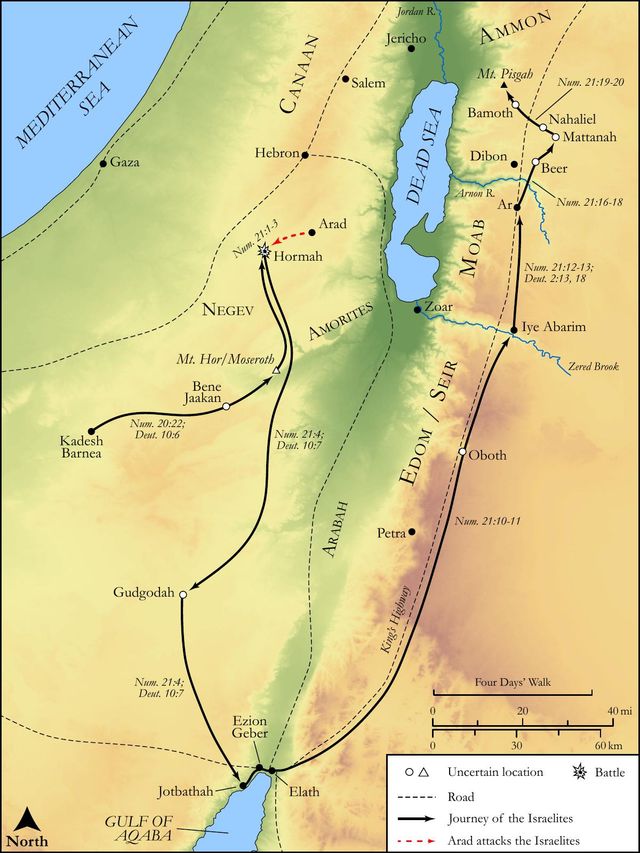
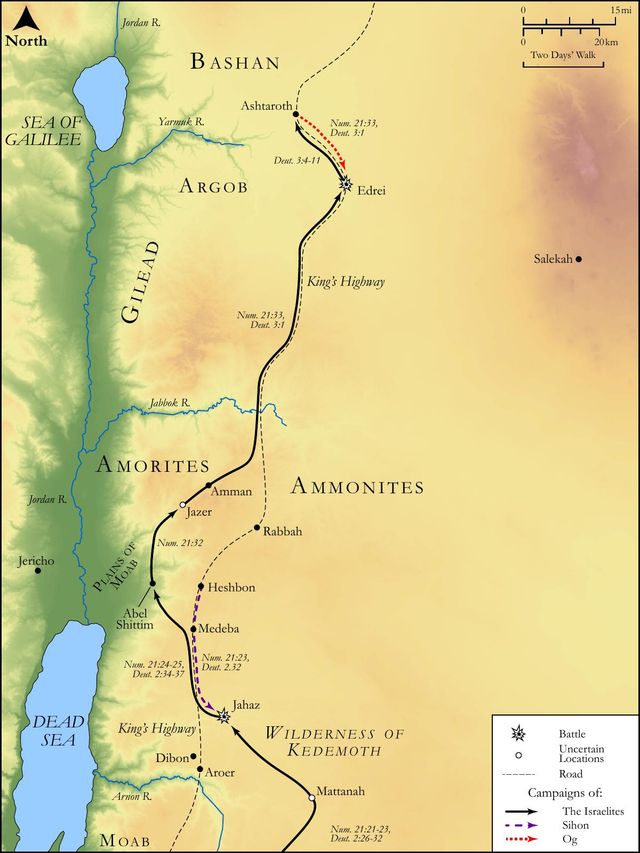
Study this verse
Public-domain commentary
Matthew Henry
From his Commentary on the Whole Bible. Henry comments on passages, not single verses — this entry covers Deuteronomy 2:24–37. His two-level outline is real structure in the source text, so it is rendered as structure.
God having tried the self-denial of his people in forbidding them to meddle with the Moabites and Ammonites, and they having quietly passed by those rich countries, and, though superior in number, not made any attack upon them, here he recompenses them for their obedience by giving them possession of the country of Sihon king of the Amorites. If we forbear what God forbids, we shall receive what he promises, and shall be no losers at last by our obedience, though it may seem for the present to be to our loss. Wrong not others, and God shall right thee.
I.God gives them commission to seize upon the country of Sihon king of Heshbon, Deu 2:24, Deu 2:25.
This was then God's way of disposing of kingdoms, but such particular grants are not now either to be expected or pretended. In this commission observe,
1.Though God assured them that the land should be their own, yet they must bestir themselves, and contend in battle with the enemy. What God gives we must endeavour to get.
2.God promises that when they fight he will fight for them. Do you begin to possess it, and I will begin to put the dread of you upon them. God would dispirit the enemy and so destroy them, would magnify Israel and so terrify all those against whom they were commissioned. See Exo 15:14.
II.Moses sends to Sihon a message of peace, and only begs a passage through his land, with a promise to give his country no disturbance, but the advantage of trading for ready money with so great a body, Deu 2:26-29. Moses herein did neither disobey God, who bade him contend with Sihon, nor dissemble with Sihon; but doubtless it was by divine direction that he did it, that Sihon might be left inexcusable, though God hardened his heart. This may illustrate the method of God's dealing with those to whom he gives his gospel, but does not give grace to believe it.
III.Sihon began the war (Deu 2:32), God having made his heart obstinate, and hidden from his eyes the thing that belonged to his peace (Deu 2:30), that he might deliver him into the hand of Israel. Those that meddle with the people of God meddle to their own hurt; and God sometimes ruins his enemies by their own resolves. See Mic 4:11-13; Rev 16:14.
IV.Israel was victorious.
1.They put all the Amorites to the sword, men, women, and children (Deu 2:33, Deu 2:34); this they did as the executioners of God's wrath; now the measure of the Amorites' iniquity was full (Gen 15:16), and the longer it was in the filling the sorer was the reckoning at last. This was one of the devoted nations. They died, not as Israel's enemies, but as sacrifices to divine justice, in the offering of which sacrifices Israel was employed, as a kingdom of priests. The case being therefore extraordinary, it ought not to be drawn into a precedent for military executions, which make no distinction and give no quarter: those will have judgment without mercy that show no mercy.
2.They took possession of all they had; their cities (Deu 2:34), their goods (Deu 2:35), and their land, Deu 2:36. The wealth of the sinner is laid up for the just. What a new world did Israel now come into! Most of them were born, and had lived all their days, in a vast howling wilderness, where they knew not what either fields or cities were, had no houses to dwell in, and neither sowed nor reaped; and now of a sudden to become masters of a country so well built, so well husbanded, this made them amends for their long waiting, and yet it was but the earnest of a great deal more. Much more joyful will the change be which holy souls will experience when they remove out of the wilderness of this world to the better country, that is, the heavenly, to the city that has foundations.
Continue studying Deuteronomy 2:29 across the web’s major study libraries — every link below opens this exact verse, chapter, or book on the destination site.
Read & Compare
 BibleGatewayThis verse in more than 200 translations and 70 languages.
 Bible.comThe YouVersion reader — hundreds of translations, reading plans, and highlights.
 ESV.orgCrossway's official English Standard Version reader.
 NET BibleThe NET translation with 60,000+ translators' notes on every rendering decision.
 STEP BibleTyndale House's free study tool — original text, vocabulary, and scholarly resources.
 BibliaLogos Bible Software's free web reader.
 USCCBThe New American Bible (Revised Edition) with the U.S. bishops' study notes.
Commentaries
 BibleHub CommentariesDozens of classic commentaries on this verse, gathered on one page.
 StudyLightMore than 100 commentary sets — the largest collection on the web.
 BibleRefPlain-English commentary on what this verse means, verse by verse.
 Enduring WordDavid Guzik's free commentary on this chapter, widely used by Bible teachers.
 Bible Study ToolsVerse commentary alongside Greek and Hebrew study aids.
Original Language & Research
- BibleHub InterlinearThe verse word by word — original language, transliteration, and English.
- BibleHub LexiconEvery word's original-language definition and Strong's entry.
 Blue Letter BibleDeep-study tools — Strong's numbers, concordance, and word studies.
 SefariaThe Hebrew text with Rashi and centuries of Jewish commentary.
Sermons, Hymns & Audio


TrulyRandomVerse is not affiliated with these sites and doesn’t control their content. They’re linked because they’re genuinely useful.
Summary
Deuteronomy 2:29 captures a pivotal moment in Israel's wilderness journey, as Moses recounts the peaceful passage granted by the Edomites and Moabites, contrasting with later adversarial encounters. This verse underscores God's meticulous providence in clearing the path for His people, emphasizing their unwavering focus on the divinely promised inheritance across the Jordan River, a land freely bestowed by the LORD. It highlights God's sovereignty over all nations and His faithfulness in guiding Israel towards the fulfillment of His ancient covenant promises.
Context
ShowHideLiterary Context
Deuteronomy 2:29 is situated within Moses' second major discourse to the new generation of Israelites, delivered on the plains of Moab just prior to their entry into Canaan. Chapters 1-3 serve as a historical prologue, recounting key events of the wilderness wandering, particularly focusing on the journey from Kadesh-Barnea to the plains of Moab. This verse specifically concludes Moses' recollection of Israel's interactions with the Edomites and Moabites (Deuteronomy 2:1-23), highlighting God's explicit command to respect their territorial integrity, as these lands had been divinely allotted to Esau's descendants and Lot's descendants, respectively. The phrase "did unto me" directly refers back to the peaceful transactions and permissions granted by these nations, as detailed in Deuteronomy 2:6 and Deuteronomy 2:28. This narrative sets a precedent for God's sovereign control over all nations and His specific instructions for Israel's conduct, even with non-covenant peoples, before introducing the impending conflict with the Amorites in Deuteronomy 2:24-37.
Historical & Cultural Context
The setting is the end of Israel's 40-year wilderness sojourn, around 1406 BC, as they stand on the eastern side of the Jordan River, poised to enter Canaan. Edom (descendants of Esau) inhabited the mountainous region of Seir, south of the Dead Sea, while Moab (descendants of Lot) occupied the Transjordanian plateau east of the Dead Sea, north of Edom. Both were related ethnically to Israel, though not part of the Abrahamic covenant. Travel through these territories was crucial for Israel to avoid the more difficult southern route through the Arabah. The "peaceful passage" mentioned in the verse, where food and water were purchased rather than taken by force, reflects a practice common among the nations for large groups traversing foreign lands, as Israel had asked of Edom, often requiring prior negotiation or tribute. This act of cooperation, facilitated by divine influence, contrasts sharply with the later hostility encountered from the Amorites (Deuteronomy 2:24-37) and the Amalekites (Deuteronomy 25:17-19), underscoring God's specific commands and provisions for each stage of Israel's journey.
Key Themes
ShowHideDeuteronomy 2:29 powerfully contributes to several overarching themes within Deuteronomy and the broader Pentateuch. Firstly, it reinforces the theme of Divine Providence and Guidance, demonstrating God's meticulous care for Israel, not only in miraculous provision but also in orchestrating diplomatic relations with neighboring nations to ensure their progress toward the Promised Land. Secondly, it highlights the theme of Covenant Faithfulness and Fulfillment, as the journey's ultimate objective—crossing the Jordan into the land "which the LORD our God giveth us"—is the culmination of God's ancient promises to Abraham (e.g., Genesis 12:7) and his descendants. Thirdly, the verse subtly introduces the theme of Respect for Established Boundaries and Justice, even for non-Israelite peoples, as God explicitly commanded Israel not to dispossess Edom or Moab (Deuteronomy 2:4-5; Deuteronomy 2:9), demonstrating a universal principle of divine justice that extends beyond the covenant community. This stands in stark contrast to the impending conquest of Canaan, which is framed as a divine judgment against its inhabitants.
Exposition and Analysis
ShowHideKey Word Analysis
ShowHideFormed like שָׂעִיר; rough; Seir, a mountain of Idumaea and its aboriginal occupants, also one in Palestine. This refers to the mountainous region inhabited by the Edomites, descendants of Esau. Its mention here grounds the historical account in a specific, recognizable geographical location, emphasizing the literal journey Israel undertook and the distinct territory they respected.
The same as עִיר; a city; Ar, a place in Moab. This is the capital city of Moab, located on the Arnon River. Its inclusion, alongside Seir, precisely delineates the territories through which Israel passed. The specificity of these place names lends authenticity to Moses' historical recounting and underscores the distinct identities of the nations involved.
From יָרַד; a descender; Jarden, the principal river of Palestine. The principal river of the Levant, forming the eastern boundary of the Promised Land. The phrase "pass over Jordan" (עָבַר יַרְדֵּן, 'avar Yarden') is a recurring motif in the Pentateuch and Joshua, signifying the transition from the wilderness journey to the inheritance of the land. It represents a threshold, a critical point of no return, and the imminent fulfillment of God's promises.
Verse Breakdown
ShowHide"(As the children of Esau which dwell in Seir, and the Moabites which dwell in Ar, did unto me;)"
This parenthetical clause serves as a comparative statement, drawing a parallel between Israel's current request to the Amorites (implied by the preceding verses) and the past, successful, and peaceful interactions with Edom and Moab. "Did unto me" refers to the permission granted for passage and the provision of food and water for purchase, as detailed in Deuteronomy 2:6 and Deuteronomy 2:28. It highlights God's prior orchestration of favorable circumstances for His people, demonstrating His power to influence even non-covenant nations for His purposes.
"until I shall pass over Jordan"
This phrase articulates the immediate and ultimate goal of Israel's present journey. The Jordan River represents the final geographical barrier before entering the land of promise. The use of "until" indicates that the peaceful passage through these territories was a necessary prerequisite and a direct means to achieve this divinely appointed destination. It signifies the culmination of their arduous wilderness trek, marking the transition from wandering to inheritance.
"into the land which the LORD our God giveth us."
This concluding clause emphatically declares the divine origin and nature of the Promised Land. It is not a land to be conquered by Israel's might alone, but a gift, an inheritance freely bestowed by the sovereign LORD (H3068, Yᵉhôvâh). The possessive "our God" (H430, ʼĕlôhîym) reinforces the covenant relationship between Yahweh and Israel, highlighting His faithfulness to His promises and His active role in securing their future. This phrase reiterates a foundational theological truth throughout Deuteronomy: the land is a gracious endowment from God, a demonstration of His covenant fidelity.
Literary Devices
ShowHideThe verse employs several significant literary devices that enrich its meaning and impact. Parenthesis is evident in the opening clause, "(As the children of Esau which dwell in Seir, and the Moabites which dwell in Ar, did unto me;)", which provides crucial contextual information and a comparative framework for understanding Israel's current situation. This allows Moses to interject a past success story to bolster the narrative, highlighting God's consistent provision. Repetition of the concept of "the land which the LORD our God giveth us" is a pervasive theme throughout Deuteronomy, serving as a constant reminder of God's covenant faithfulness and the ultimate purpose of their journey. This repetition acts as a leitmotif, reinforcing the theological significance of the land as a divine gift and the central promise of the covenant. Furthermore, the mention of specific geographical locations like Seir, Ar, and the Jordan River provides a strong sense of verisimilitude, grounding the historical account in tangible reality and emphasizing the literal journey of the Israelites. The entire verse functions as a synecdoche for God's overarching providence, where the specific instances of peaceful passage illustrate His broader control over nations and His unwavering commitment to His people's destiny.
Theological and Thematic Connections
ShowHideDeuteronomy 2:29 serves as a profound testament to God's meticulous care and sovereign orchestration of events for His covenant people. It demonstrates that God's providence extends beyond miraculous interventions to include influencing the hearts and actions of non-covenant nations for His purposes. The peaceful passage through Edom and Moab, contrasted with the impending conflict with the Amorites, illustrates that God's commands and methods are tailored to specific circumstances and His broader redemptive plan. The verse also underscores the unwavering focus on the Promised Land as a divine gift, not a human achievement, reinforcing the theme of grace that permeates Israel's history. This journey, marked by both divine command and human obedience, ultimately points to a greater spiritual journey of faith and the ultimate inheritance promised to believers.
Reflection and Application
ShowHideDeuteronomy 2:29 offers powerful lessons for contemporary believers, reminding us that God's providential hand is at work even in seemingly ordinary circumstances. Just as God cleared the path for Israel through the territories of Edom and Moab, He often orchestrates unexpected favor, opens doors, or provides resources when we are faithfully pursuing His will. This verse encourages us to trust in God's timing and methods, recognizing that His ways are higher than ours, and He may use unlikely means or individuals to accomplish His purposes. It also serves as a poignant reminder to maintain our focus on the ultimate spiritual inheritance and calling God has given us, symbolized by the Promised Land. Our "Jordan" may be a significant life transition, a challenging spiritual growth period, or the ultimate hope of eternal fellowship with Christ. We are called to navigate our journey with both faith and wisdom, seeking peace where possible, yet always pressing forward towards the divine destination, confident in the Giver of all good things.
Questions for Reflection
ShowHideFAQ
ShowHideDid Edom and Moab always allow Israel peaceful passage?
ShowHideNo, not always. While Deuteronomy 2:29 and the preceding verses (Deuteronomy 2:6, Deuteronomy 2:28) describe a peaceful, transactional passage where Israel purchased food and water, earlier in the wilderness journey, Edom had explicitly refused Israel passage through their territory (Numbers 20:14-21). This earlier refusal forced Israel to take a longer route around Edom. The account in Deuteronomy 2:29, therefore, refers to a specific, later instance of cooperation, perhaps influenced by God's direct command not to provoke them, or a change in Edomite policy. It highlights God's sovereign ability to influence circumstances and nations differently at various points in His people's journey, always for the ultimate good and progress of His redemptive plan.
What is the significance of "the land which the LORD our God giveth us"?
ShowHideThis phrase is profoundly significant throughout Deuteronomy and the Pentateuch. It emphasizes that the Promised Land is not a conquest earned by Israel's military might or moral superiority, but a gracious, sovereign gift from God (Deuteronomy 9:4-6). It underscores God's faithfulness to His covenant promises made to Abraham, Isaac, and Jacob (Genesis 12:7; Genesis 15:18-21; Genesis 26:3; Genesis 28:13). The land is an inheritance, a tangible expression of God's love, provision, and commitment to His people, serving as the physical locus for their covenant relationship with Him and the fulfillment of His redemptive purposes. It is a constant reminder that their dwelling in the land is contingent upon their obedience to the Giver, not their own merit.
How does this verse relate to God's command to conquer Canaan?
ShowHideThis verse provides a crucial contrast and clarification regarding God's commands for Israel. While God commanded Israel to utterly dispossess the inhabitants of Canaan due to their extreme wickedness and idolatry (Deuteronomy 7:1-6; Deuteronomy 9:4-5), He explicitly forbade them from provoking or taking the land of Edom (Deuteronomy 2:4-5) and Moab (Deuteronomy 2:9). This distinction reveals that God's judgments and territorial allotments are specific and righteous. It demonstrates that God is not capricious; His commands regarding conquest were not a blanket permission for aggression but precise instructions for specific nations and lands, rooted in His divine justice and His plan for Israel's unique role as a holy nation. The peaceful passage through Edom and Moab underscores the principle that Israel's actions were always to be governed by God's explicit word, not by their own desires or perceived opportunities.
Christ-Centered Fulfillment
ShowHideDeuteronomy 2:29, though rooted in Israel's historical journey, finds profound Christ-centered fulfillment in several ways. The peaceful passage granted to Israel, leading them to the Promised Land, foreshadows the ultimate "way" opened for humanity through Jesus Christ. Just as God cleared the path for Israel through the wilderness and across the Jordan, so Christ, by His atoning work, has cleared the way for believers to enter into the true spiritual inheritance—eternal life and fellowship with God. He is the Lamb of God who takes away the sin of the world, removing the ultimate barrier between humanity and God. Furthermore, the concept of "the land which the LORD our God giveth us" finds its ultimate reality not in a geographical territory, but in the spiritual blessings and heavenly inheritance secured by Christ. Believers are now heirs with Christ, receiving an inheritance that is imperishable, undefiled, and unfading, kept in heaven for you. Jesus Himself declares, "I am the way, the truth, and the life; no one comes to the Father except through Me", embodying the ultimate passage into God's presence. The journey of Israel, marked by divine guidance and the promise of a land, thus serves as a powerful type for the believer's journey of faith, led by the Spirit, towards the spiritual blessings and eternal rest found in Christ, our true Sabbath rest.