


Numbers 20:18
Bible text: King James Version (1769 Blayney text) · Public domain
Bible text: Berean Standard Bible · Public domain
Bible text: American Standard Version (1901) · Public domain
Bible text: World English Bible, Messianic edition · Public domain
Bible text: Geneva Bible (1599) · Public domain
Bible text: Young's Literal Translation · Public domain
- וַיֹּאמֶרvai·Yo·merand it saidH559Conj-w ¦ V-Qal-ConsecImperf-3msVerb Qal Consecutive Imperfect 3rd Singular Masculineוַandיֹּאמֶרit said
- אֵלָיו'e·Lavto himH413Prep ¦ 3msPreposition Definiteאֵלָיtoוhim
- אֱדוֹם'e·DomEdomH123N-proper-mNoun Proper Masculine
- לֹאlo'notH3808NegParticle Negative
- תַעֲבֹרta·'a·Voryou will passH5674V-Qal-Imperf-2msVerb Qal Imperfect 2nd Singular Masculine
- בִּיBiin <the> mePrep-b ¦ 1csSuffix Personal 1st Singular common genderבִּin <the>יme
- פֶּןpenlestH6435PrtParticle Conditional
- בַּחֶרֶבba·Che·revwith the swordH2719Prep-b ¦ N-fsNoun Singular Feminine Absoluteבַּwith theחֶרֶבsword
- אֵצֵא'e·Tze'I should come outH3318V-Qal-Imperf-1csVerb Qal Imperfect 1st Singular common gender
- לִקְרָאתֶךָlik·ra·Te·chato meet youH7122Prep-l ¦ V-Qal-Inf ¦ 2msVerb Qal Infinitive Constructלִtoקְרָאתֶmeetךָyou
English is a literal word-by-word gloss of the Hebrew, not the KJV's wording. Why?
This is the original text the KJV's translators worked from — each Hebrew word with its own literal English meaning in this verse, prepared by scholars at Tyndale House, Cambridge. The KJV translates whole sentences, not word by word, so its wording differs: one Hebrew word can become several English words, and the KJV may choose “the LORD” where the gloss reads “Yahweh”. Both are faithful — they answer different questions. For the KJV's own rendering, switch to the KJV text.
Details
See on the biblical-era maps
Study this verse
Public-domain commentary
Matthew Henry
From his Commentary on the Whole Bible. Henry comments on passages, not single verses — this entry covers Numbers 20:14–21. His two-level outline is real structure in the source text, so it is rendered as structure.
We have here the application made by Israel to the Edomites. The nearest way to Canaan from the place where Israel now lay encamped was through the country of Edom. Now,
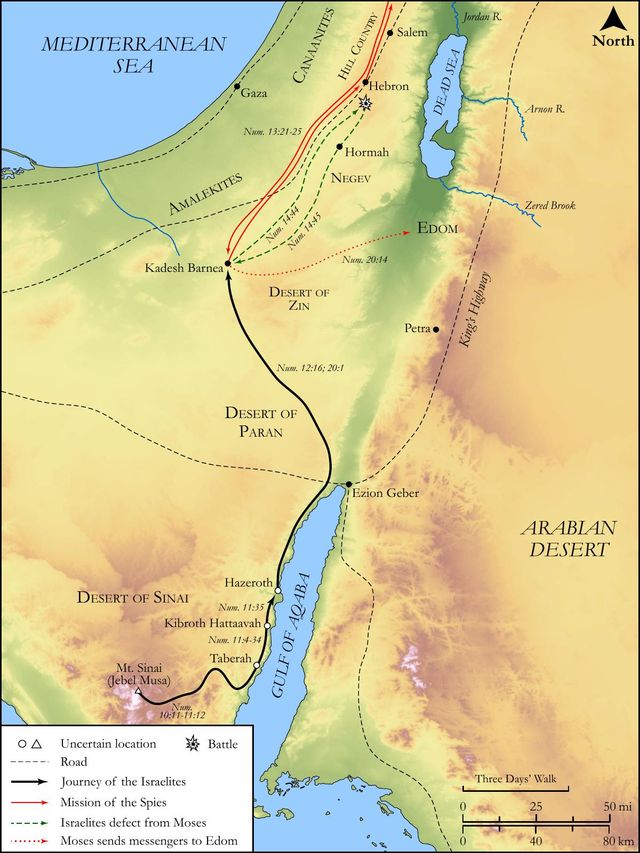
I.Moses sends ambassadors to treat with the king of Edom for leave to pass through his country, and gives them instructions what to say, Num 20:14-17.
1.They are to claim kindred with the Edomites: Thus saith thy brother Israel. Both nations descended from Abraham and Isaac, their common ancestors; Esau and Jacob, the two fathers of their respective nations, were twin-brothers; and therefore, for relation-sake, they might reasonably expect this kindness from them; nor needed the Edomites to fear that their brother Israel had any ill design upon them, or would take any advantages against them.
2.They are to give a short account of the history and present state of Israel, which, they take it for granted, the Edomites were no strangers to. And in this there was a double plea: - (1.) Israel had been abused by the Egyptians, and therefore ought to be pitied and succoured by their relations: "The Egyptians vexed us and our fathers, but we may hope our brethren the Edomites will not be so vexatious." (2.) Israel had been wonderfully saved by the Lord, and therefore ought to be countenanced and favoured (Num 20:16): "We cried unto the Lord, and he sent an angel, the angel of his presence, the angel of the covenant, the eternal Word, who had brought us forth out of Egypt, and led us hither." It was therefore the interest of the Edomites to ingratiate themselves with a people that had so great an interest in heaven and were so much its favourites, and it was at their peril if they offered them any injury. It is our wisdom and duty to be kind to those whom God is pleased to own, and to take his people for our people. Come in, thou blessed of the Lord.
3.They are humbly to beg a passport through their country. Though God himself, in the pillar of cloud and fire, was Israel's guide, in following which they might have justified their passing through any man's ground against all the world, yet God would have this respect paid to the Edomites, to show that no man's property ought to be invaded under colour of religion. Dominion is founded in providence, not in grace. Thus when Christ was to pass through a village of the Samaritans, to whom his coming was likely to be offensive, he sent messengers before his face to ask leave, Luk 9:52. Those that would receive kindness must not disdain to request it.
4.They are to give security for the good behaviour of the Israelites in this march, that they would keep in the king's high road, that they would commit no trespass upon any man's property, either in ground or water, that they would not so much as make use of a well without paying for it, and that they would make all convenient speed, as fast as they could well go on their feet, Num 20:17, Num 20:19. Nothing could be offered more fair and neighbourly.
II.The ambassadors returned with a denial, Num 20:18.
Edom, that is, the king of Edom, as protector of his country, said, Thou shalt not pass by me; and, when the ambassadors urged it further, he repeated the denial (Num 20:20) and threatened, if they offered to enter his country, it should be at their peril; he raised his trained bands to oppose them. Thus Edom refused to give Israel passage. This was owing,
1.To their jealousy of the Israelites; they feared they should receive promises. And truly, had this numerous army been under any other discipline and command than that of the righteous God himself, who would no more suffer them to do wrong than to take wrong, there might have been cause for this jealousy; but what could they fear from a nation that had statutes and judgments so righteous?
2.It was owing to the old enmity which Esau bore to Israel. If they had no reason to fear damage by them, yet they were not willing to show so much kindness to them. Esau hated Jacob because of the blessing, and now the hatred revived, when the blessing was ready to be inherited. God would hereby discover the ill-nature of the Edomites to their shame, and try the good-nature of the Israelites to their honour: they turned away from him, and did not take this occasion to quarrel with him. Note, We must not think it strange if the most reasonable requests be denied by unreasonable men, and if those be affronted by men whom God favours. I as a deaf man heard not. After this indignity which the Edomites offered to Israel God gave them a particular caution not to abhor an Edomite (Deu 23:7), though the Edomites had shown such an abhorrence of them, to teach us in such cases not to meditate revenge.
Continue studying Numbers 20:18 across the web’s major study libraries — every link below opens this exact verse, chapter, or book on the destination site.
Read & Compare
 BibleGatewayThis verse in more than 200 translations and 70 languages.
 Bible.comThe YouVersion reader — hundreds of translations, reading plans, and highlights.
 ESV.orgCrossway's official English Standard Version reader.
 NET BibleThe NET translation with 60,000+ translators' notes on every rendering decision.
 STEP BibleTyndale House's free study tool — original text, vocabulary, and scholarly resources.
 BibliaLogos Bible Software's free web reader.
 USCCBThe New American Bible (Revised Edition) with the U.S. bishops' study notes.
Commentaries
 BibleHub CommentariesDozens of classic commentaries on this verse, gathered on one page.
 StudyLightMore than 100 commentary sets — the largest collection on the web.
 BibleRefPlain-English commentary on what this verse means, verse by verse.
 Enduring WordDavid Guzik's free commentary on this chapter, widely used by Bible teachers.
 Bible Study ToolsVerse commentary alongside Greek and Hebrew study aids.
Original Language & Research
- BibleHub InterlinearThe verse word by word — original language, transliteration, and English.
- BibleHub LexiconEvery word's original-language definition and Strong's entry.
 Blue Letter BibleDeep-study tools — Strong's numbers, concordance, and word studies.
 SefariaThe Hebrew text with Rashi and centuries of Jewish commentary.
Sermons, Hymns & Audio


TrulyRandomVerse is not affiliated with these sites and doesn’t control their content. They’re linked because they’re genuinely useful.
Summary
Numbers 20:18 records the decisive and hostile refusal of the Edomites to grant the Israelites peaceful passage through their ancestral territory during their wilderness journey, explicitly threatening military confrontation should Israel attempt to proceed. This verse marks a significant turning point, forcing Israel to alter their divinely directed route and highlighting the persistent challenges and human opposition encountered on the path to the Promised Land.
Context
ShowHideLiterary Context
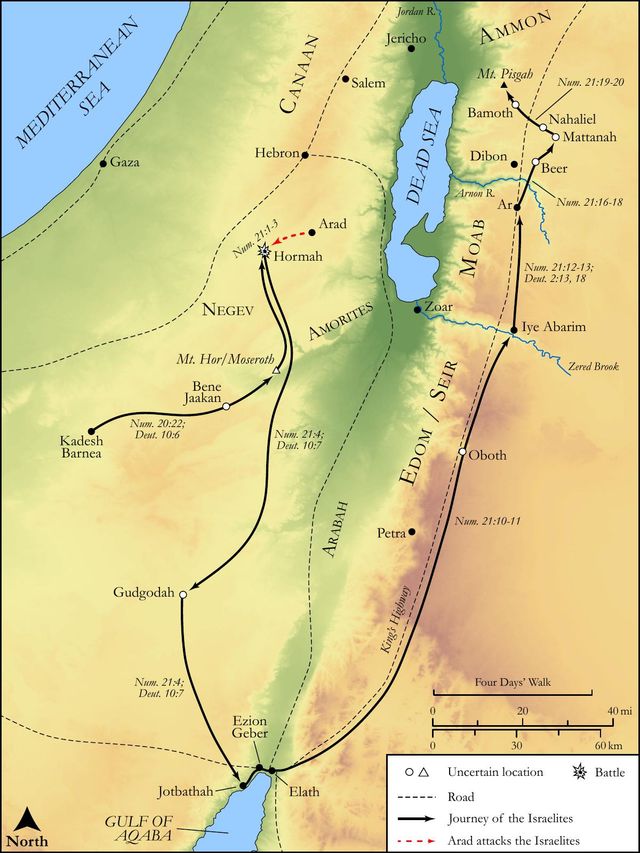
This verse is situated at a critical juncture in the book of Numbers, following the tragic events at Meribah where Moses disobeys God and is barred from entering the Promised Land, and preceding the death of Aaron. Israel, having spent nearly forty years in the wilderness, is now approaching the borders of Canaan from the southeast. Moses sends a diplomatic embassy to the King of Edom, appealing to their shared ancestry through Jacob and Esau, and promising peaceful transit along the "King's Highway" without disturbing their land or water, even offering to pay for any resources consumed, as detailed in Numbers 20:17. Numbers 20:18 delivers Edom's terse, uncompromising, and militarily backed rejection, directly setting the stage for Israel's forced detour around Edomite territory, as detailed in Numbers 20:21. This immediate sequence of events underscores the practical difficulties of the wilderness journey and the complex geopolitical landscape Israel had to navigate.
Historical & Cultural Context
Edom was a powerful kingdom located south and east of the Dead Sea, occupying a strategically important region that controlled major trade routes, including the "King's Highway." This ancient route was vital for commerce and communication, connecting Egypt to Mesopotamia. The Edomites were descendants of Esau, Jacob's twin brother, establishing a deep-seated, often contentious, familial relationship with Israel. While Israel sought peaceful passage based on this kinship, the Edomites harbored a long-standing animosity rooted in the patriarchal narratives of sibling rivalry and Esau's enduring resentment towards Jacob, as seen in Genesis 27:41. Culturally, nations guarded their borders fiercely, and the passage of a large, nomadic group like Israel would have been viewed with suspicion, regardless of peaceful overtures. The threat of "the sword" was a standard declaration of intent to defend national sovereignty with military force, a common practice among the kings of that day.
Key Themes
ShowHideNumbers 20:18 contributes significantly to several overarching themes within the book of Numbers and the broader Pentateuch. Firstly, it highlights the theme of Divine Guidance Amidst Human Obstacles. Despite God explicitly leading Israel towards the Promised Land, their path is not without significant human resistance and geopolitical challenges. Secondly, the verse powerfully illustrates Sibling Rivalry and Enduring Animosity, demonstrating how ancient grudges, even between related peoples, can persist for generations and manifest in open hostility, impacting the divine plan. Thirdly, it underscores the theme of God's Sovereignty and Israel's Obedience. Rather than engaging in a potentially devastating conflict with a related nation—a conflict God had previously instructed them to avoid, as recorded in Deuteronomy 2:4—Israel wisely chooses to obey God's implicit will by seeking an alternative route, demonstrating their reliance on divine direction even when it means a longer, more arduous journey.
Exposition and Analysis
ShowHideKey Word Analysis
ShowHideThe name "Edom" means "red," a direct reference to Esau, Jacob's twin brother, who was born red and sold his birthright for a bowl of red lentil stew (Genesis 25:30). This etymological connection underscores the deep historical and familial ties between Israel and Edom, making Edom's hostile refusal particularly poignant. The name itself serves as a constant reminder of the ancient rivalry and the Edomites' distinct, often antagonistic, identity.
This primitive root signifies "to cross over" or "to go through," encompassing a wide range of transitions, both literal and figurative. In this context, it refers specifically to Israel's desire for physical transit through Edomite territory. Edom's absolute prohibition against Israel "passing by" them highlights their assertion of sovereign control over their land and their unwavering resolve to prevent any unauthorized movement, demonstrating a complete denial of Israel's peaceful request for passage.
This term refers to a cutting instrument, primarily a sword, and symbolizes military might, violence, and the intent to engage in armed conflict. Its inclusion in Edom's response elevates their refusal from a mere denial of passage to an explicit declaration of war if Israel attempts to proceed. The "sword" here represents the ultimate deterrent and the willingness to shed blood to enforce national sovereignty, leaving no room for misinterpretation of Edom's hostile stance.
Verse Breakdown
ShowHide"And Edom said unto him"
This phrase indicates a direct, official communication from the Edomite leadership (likely the king, as per Numbers 20:14) to Moses, representing Israel. The brevity and directness of the statement convey an unyielding and firm decision, leaving no room for negotiation or reconsideration of Israel's peaceful request.
"Thou shalt not pass by me"
This is an absolute prohibition, a categorical denial of Israel's request for transit through Edomite territory. It asserts Edom's sovereign control over their land and their right to refuse passage to any party, regardless of kinship or peaceful intentions. The bluntness of the refusal emphasizes Edom's unyielding stance and deep-seated suspicion or animosity towards Israel.
"lest I come out against thee with the sword"
This clause provides the explicit consequence of Israel disregarding the prohibition: military action. It is a clear and unambiguous threat of war, indicating Edom's readiness to deploy its armed forces to prevent Israel's passage. The phrase "with the sword" highlights the seriousness of the threat, signaling that Edom is prepared to use deadly force, forcing Israel to choose between conflict and a detour.
Literary Devices
ShowHideNumbers 20:18 effectively employs several literary devices to convey its meaning and impact. The most prominent is Antagonism, as Edom's response directly opposes Israel's peaceful overture, establishing a clear adversarial relationship. This immediate declaration of hostility, despite kinship, sets a tone of conflict. There is also an element of Foreshadowing, as this initial refusal and threat of war anticipate the long and often bloody history of conflict between Israel and Edom that would continue for centuries (e.g., 2 Kings 8:20-22). The "sword" itself functions as Symbolism, representing not just a physical weapon but also the Edomites' hostile intent, their national power, and their willingness to defend their territory violently. The stark contrast between Israel's humble, kinship-based request and Edom's aggressive, military-backed refusal also creates a subtle Irony, highlighting the tragic breakdown of familial ties into national animosity.
Theological and Thematic Connections
ShowHideNumbers 20:18 serves as a stark reminder that even when God's people are clearly following His divine leading, their path may be met with unexpected and unprovoked hostility from others. It underscores the reality that the journey of faith is not always smooth or direct; obstacles, even from those with whom one shares a common heritage, are part of the landscape. The Edomites' refusal, rooted in ancient animosity, illustrates how deep-seated grudges can persist and impede progress, forcing God's people to exercise wisdom and discernment rather than engaging in unnecessary conflict. Ultimately, the verse affirms God's sovereignty, as He faithfully guides Israel to their destination, even if the path requires detours and greater endurance, demonstrating that His purposes will prevail despite human opposition.
Reflection and Application
ShowHideNumbers 20:18 offers profound lessons for believers navigating their spiritual journey today. Just as Israel, under divine guidance, faced unexpected opposition, we too may encounter resistance, hostility, or closed doors even when we believe we are walking in God's will. This verse challenges us to consider our response to such obstacles: do we insist on our perceived right, or do we seek God's wisdom for an alternative path? It reminds us that not every confrontation is necessary or divinely ordained; sometimes, a peaceful detour, though longer or more challenging, is the wiser and more obedient course. Furthermore, the Edomite animosity, rooted in ancient history, serves as a cautionary tale about the enduring power of unresolved conflict and bitterness, even within families or related communities. We are called to release grudges and seek reconciliation where possible, but also to recognize when others' hearts are hardened, and to trust God to redirect our steps. Ultimately, this passage reinforces faith in God's faithfulness: He will lead His people to their destination, even if the journey is not as we initially planned, demonstrating His sovereign control over all circumstances.
Questions for Reflection
ShowHideFAQ
ShowHideWhy was Edom so hostile towards Israel, despite their shared ancestry?
ShowHideEdom's hostility stemmed from a deep-seated, long-standing animosity rooted in the ancient rivalry between Jacob (Israel's progenitor) and Esau (Edom's progenitor). Esau harbored a bitter resentment towards Jacob for taking his birthright and blessing (Genesis 27:41). Over centuries, this personal grudge evolved into national enmity. Additionally, Edom, as a sovereign kingdom, likely viewed the passage of a large, potentially disruptive, nomadic group like Israel with suspicion and fear, regardless of their peaceful overtures. They prioritized their national security and control over their strategic trade routes, such as the King's Highway, over any familial ties.
What was the "King's Highway" and why was it important?
ShowHideThe "King's Highway" (Hebrew: Derekh HaMelekh) was an ancient and vital north-south trade route that ran through the Transjordan plateau, connecting Egypt and the Arabian Peninsula in the south to Syria and Mesopotamia in the north. It was strategically crucial for commerce, military movements, and communication east of the Jordan. For Israel, it offered the most direct and convenient path to the Promised Land from their position. Edom's control over a significant portion of this highway gave them considerable power and allowed them to dictate terms of passage, making their refusal to Israel particularly impactful.
Why did Israel not fight Edom, especially given God's promise to give them the land?
ShowHideIsrael did not fight Edom primarily because God had explicitly instructed them not to provoke the Edomites, Moabites, or Ammonites, as these nations had been given their territories by God and were not part of Israel's promised inheritance (Deuteronomy 2:4-6). Moses, leading Israel, sought peace and demonstrated a commitment to obeying God's specific commands regarding these nations. Engaging in conflict with a related people would have been a deviation from God's plan and an unnecessary expenditure of resources and lives. Israel's focus was on reaching the Promised Land, not on conquering every nation in their path. Their decision to detour rather than fight showcased their trust in God's ultimate guidance and their adherence to His specific instructions.
Christ-Centered Fulfillment
ShowHideThe Edomites' hostile refusal to grant Israel passage, despite shared lineage and peaceful overtures, powerfully foreshadows the experience of Christ and His followers. Just as Israel, the chosen people, faced rejection from their "brothers" on their journey to the Promised Land, so too did Jesus, the ultimate Israelite, experience profound rejection from His own people, as John 1:11 laments, "He came to His own, and His own received Him not." Jesus' path to fulfilling God's redemptive plan was not a direct, unopposed route, but one marked by constant opposition, culminating in the ultimate "detour" of the cross. Yet, through this very "detour"—His crucifixion and resurrection—He forged the true "King's Highway," the path to eternal life, declaring Himself to be the Way, the Truth, and the Life. For believers, our journey to the heavenly Promised Land is similarly marked by spiritual opposition, but Christ, our greater Moses, has already overcome the world's hostility (John 16:33). He leads us not by force, but by grace, ensuring that despite all obstacles, we will ultimately enter into the rest prepared for the people of God (Hebrews 4:9-11). The Edomite refusal highlights that the true journey to God's promised inheritance is achieved not through human might or forced passage, but through divine guidance and the ultimate sacrifice of the Lamb of God.