


Numbers 20:21
Bible text: King James Version (1769 Blayney text) · Public domain
Bible text: Berean Standard Bible · Public domain
Bible text: American Standard Version (1901) · Public domain
Bible text: World English Bible, Messianic edition · Public domain
Bible text: Geneva Bible (1599) · Public domain
Bible text: Young's Literal Translation · Public domain
- וַיְמָאֵןvay·ma·'Enand it refusedH3985Conj-w ¦ V-Piel-ConsecImperf-3msVerb Piel Consecutive Imperfect 3rd Singular Masculineוַandיְמָאֵןit refused
- אֱדוֹם'e·DomEdomH123N-proper-mNoun Proper Masculine
- נְתֹןne·Tonto permitH5414V-Qal-InfVerb Qal Infinitive Construct
- אֶת'et<obj.>H853DirObjMParticle Object Indicator
- יִשְׂרָאֵלYis·ra·'ElIsraelH3478N-properNoun Proper Location
- עֲבֹר'a·Vorto passH5674V-Qal-InfVerb Qal Infinitive Construct
- בִּגְבֻלוֹbig·vu·Loin its territoryH1366Prep-b ¦ N-msc ¦ 3msNoun Singular Masculine Constructבִּinגְבֻלterritoryוֹits
- וַיֵּטvai·Yetand it turned asideH5186Conj-w ¦ V-Qal-ConsecImperf-3msVerb Qal Consecutive Imperfect 3rd Singular Masculineוַandיֵּטit turned aside
- יִשְׂרָאֵלYis·ra·'ElIsraelH3478N-properNoun Proper Location
- מֵעָלָיוme·'a·Lavfrom on <the> itH5921Prep-m ¦ Prep ¦ 3msPreposition Definiteמֵfromעָלָיon <the>וit
English is a literal word-by-word gloss of the Hebrew, not the KJV's wording. Why?
This is the original text the KJV's translators worked from — each Hebrew word with its own literal English meaning in this verse, prepared by scholars at Tyndale House, Cambridge. The KJV translates whole sentences, not word by word, so its wording differs: one Hebrew word can become several English words, and the KJV may choose “the LORD” where the gloss reads “Yahweh”. Both are faithful — they answer different questions. For the KJV's own rendering, switch to the KJV text.
Details
See on the biblical-era maps
Study this verse
Public-domain commentary
Matthew Henry
From his Commentary on the Whole Bible. Henry comments on passages, not single verses — this entry covers Numbers 20:14–21. His two-level outline is real structure in the source text, so it is rendered as structure.
We have here the application made by Israel to the Edomites. The nearest way to Canaan from the place where Israel now lay encamped was through the country of Edom. Now,
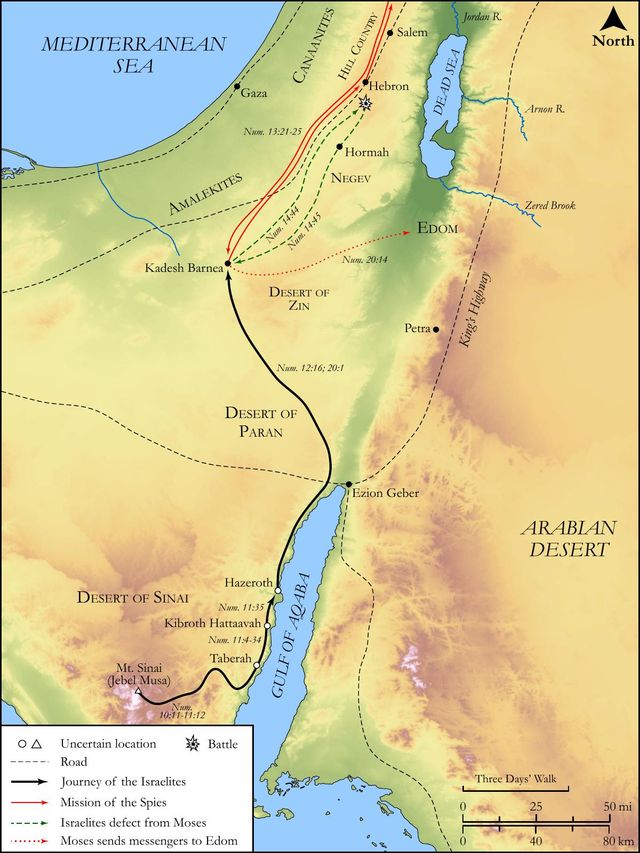
I.Moses sends ambassadors to treat with the king of Edom for leave to pass through his country, and gives them instructions what to say, Num 20:14-17.
1.They are to claim kindred with the Edomites: Thus saith thy brother Israel. Both nations descended from Abraham and Isaac, their common ancestors; Esau and Jacob, the two fathers of their respective nations, were twin-brothers; and therefore, for relation-sake, they might reasonably expect this kindness from them; nor needed the Edomites to fear that their brother Israel had any ill design upon them, or would take any advantages against them.
2.They are to give a short account of the history and present state of Israel, which, they take it for granted, the Edomites were no strangers to. And in this there was a double plea: - (1.) Israel had been abused by the Egyptians, and therefore ought to be pitied and succoured by their relations: "The Egyptians vexed us and our fathers, but we may hope our brethren the Edomites will not be so vexatious." (2.) Israel had been wonderfully saved by the Lord, and therefore ought to be countenanced and favoured (Num 20:16): "We cried unto the Lord, and he sent an angel, the angel of his presence, the angel of the covenant, the eternal Word, who had brought us forth out of Egypt, and led us hither." It was therefore the interest of the Edomites to ingratiate themselves with a people that had so great an interest in heaven and were so much its favourites, and it was at their peril if they offered them any injury. It is our wisdom and duty to be kind to those whom God is pleased to own, and to take his people for our people. Come in, thou blessed of the Lord.
3.They are humbly to beg a passport through their country. Though God himself, in the pillar of cloud and fire, was Israel's guide, in following which they might have justified their passing through any man's ground against all the world, yet God would have this respect paid to the Edomites, to show that no man's property ought to be invaded under colour of religion. Dominion is founded in providence, not in grace. Thus when Christ was to pass through a village of the Samaritans, to whom his coming was likely to be offensive, he sent messengers before his face to ask leave, Luk 9:52. Those that would receive kindness must not disdain to request it.
4.They are to give security for the good behaviour of the Israelites in this march, that they would keep in the king's high road, that they would commit no trespass upon any man's property, either in ground or water, that they would not so much as make use of a well without paying for it, and that they would make all convenient speed, as fast as they could well go on their feet, Num 20:17, Num 20:19. Nothing could be offered more fair and neighbourly.
II.The ambassadors returned with a denial, Num 20:18.
Edom, that is, the king of Edom, as protector of his country, said, Thou shalt not pass by me; and, when the ambassadors urged it further, he repeated the denial (Num 20:20) and threatened, if they offered to enter his country, it should be at their peril; he raised his trained bands to oppose them. Thus Edom refused to give Israel passage. This was owing,
1.To their jealousy of the Israelites; they feared they should receive promises. And truly, had this numerous army been under any other discipline and command than that of the righteous God himself, who would no more suffer them to do wrong than to take wrong, there might have been cause for this jealousy; but what could they fear from a nation that had statutes and judgments so righteous?
2.It was owing to the old enmity which Esau bore to Israel. If they had no reason to fear damage by them, yet they were not willing to show so much kindness to them. Esau hated Jacob because of the blessing, and now the hatred revived, when the blessing was ready to be inherited. God would hereby discover the ill-nature of the Edomites to their shame, and try the good-nature of the Israelites to their honour: they turned away from him, and did not take this occasion to quarrel with him. Note, We must not think it strange if the most reasonable requests be denied by unreasonable men, and if those be affronted by men whom God favours. I as a deaf man heard not. After this indignity which the Edomites offered to Israel God gave them a particular caution not to abhor an Edomite (Deu 23:7), though the Edomites had shown such an abhorrence of them, to teach us in such cases not to meditate revenge.
Continue studying Numbers 20:21 across the web’s major study libraries — every link below opens this exact verse, chapter, or book on the destination site.
Read & Compare
 BibleGatewayThis verse in more than 200 translations and 70 languages.
 Bible.comThe YouVersion reader — hundreds of translations, reading plans, and highlights.
 ESV.orgCrossway's official English Standard Version reader.
 NET BibleThe NET translation with 60,000+ translators' notes on every rendering decision.
 STEP BibleTyndale House's free study tool — original text, vocabulary, and scholarly resources.
 BibliaLogos Bible Software's free web reader.
 USCCBThe New American Bible (Revised Edition) with the U.S. bishops' study notes.
Commentaries
 BibleHub CommentariesDozens of classic commentaries on this verse, gathered on one page.
 StudyLightMore than 100 commentary sets — the largest collection on the web.
 BibleRefPlain-English commentary on what this verse means, verse by verse.
 Enduring WordDavid Guzik's free commentary on this chapter, widely used by Bible teachers.
 Bible Study ToolsVerse commentary alongside Greek and Hebrew study aids.
Original Language & Research
- BibleHub InterlinearThe verse word by word — original language, transliteration, and English.
- BibleHub LexiconEvery word's original-language definition and Strong's entry.
 Blue Letter BibleDeep-study tools — Strong's numbers, concordance, and word studies.
 SefariaThe Hebrew text with Rashi and centuries of Jewish commentary.
Sermons, Hymns & Audio


TrulyRandomVerse is not affiliated with these sites and doesn’t control their content. They’re linked because they’re genuinely useful.
Summary
Numbers 20:21 marks a pivotal moment in Israel's wilderness journey, succinctly detailing Edom's resolute refusal to grant them peaceful passage through their territory, despite Israel's diplomatic request and shared ancestral ties. This act of overt hostility forced Israel to alter their direct route to the Promised Land, highlighting the unforeseen obstacles and divine redirection inherent in their pilgrimage. The verse powerfully underscores Israel's commitment to obedience, choosing to "turn away" from conflict and trust in God's sovereign guidance rather than forcing a confrontation with their kinsmen.
Context
ShowHideLiterary Context
Numbers 20:21 is situated within the latter half of Israel's forty-year wilderness wandering, a period marked by the passing of the Exodus generation and preparations for entering the Promised Land. The immediate preceding narrative in Numbers 20 recounts the death of Miriam, the contentious incident at Meribah where Moses disobediently struck the rock, resulting in both he and Aaron being barred from entering Canaan. Following these events, Israel, encamped at Kadesh, dispatched messengers to the king of Edom (verses 14-17), requesting peaceful transit through their land, specifically via the ancient King's Highway, with assurances of strict adherence to the path and payment for any water consumed. Edom's outright refusal and subsequent threat of military confrontation, detailed in Numbers 20:18-20, directly precipitate the "turning away" described in verse 21. This forced detour then sets the stage for the subsequent journey around Edom and the significant event of Aaron's death on Mount Hor, as narrated in Numbers 20:22-29.
Historical & Cultural Context
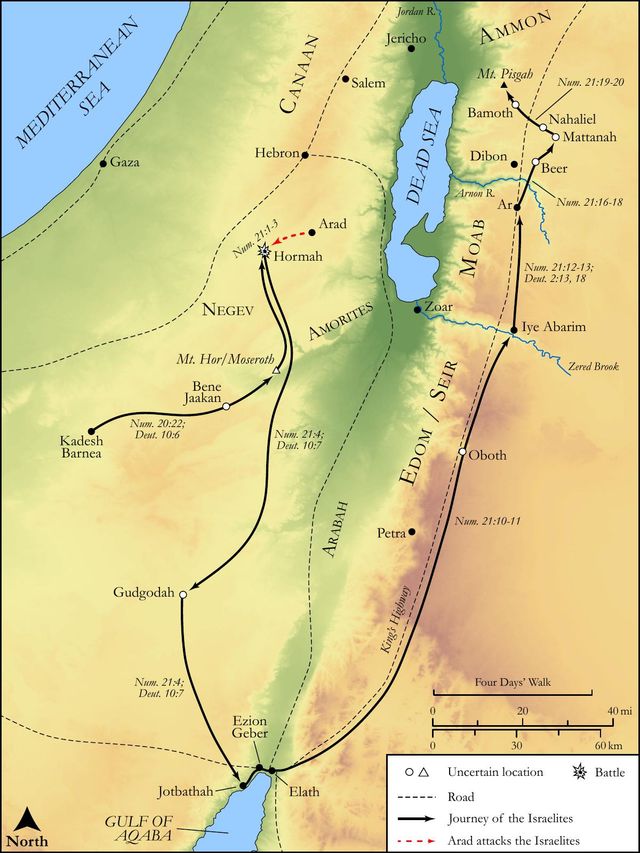
Edom was a nation descended from Esau, Jacob's twin brother, as meticulously detailed in Genesis 36:1. Despite this deep familial connection, a persistent and often hostile animosity characterized the relationship between Edom and Israel, rooted in the ancient rivalry between Jacob and Esau, vividly captured in Genesis 27:41. Geographically, Edom controlled the vital King's Highway, a crucial north-south trade route extending from the Gulf of Aqaba. Passage through this territory represented the most direct and logical route for Israel to reach Canaan from their encampment at Kadesh. Edom's refusal was not merely an inconvenience; it was a deliberate act of unbrotherly hostility from a kindred nation, contravening the customs of hospitality towards travelers and pilgrims, such as Abraham showed to the three men at Mamre. This forced Israel to undertake a lengthy and arduous detour through the Arabah, east of Edomite territory, a journey that would exact a significant toll in terms of time, resources, and morale.
Key Themes
ShowHideNumbers 20:21 contributes significantly to several overarching theological and narrative themes within the book of Numbers and the broader Pentateuch. Firstly, it powerfully illustrates the theme of Divine Guidance and Obedience. Rather than resorting to conflict, Israel adheres to God's earlier command to avoid provoking the Edomites, as explicitly stated in Deuteronomy 2:4-5. Their "turning away" demonstrates a profound submission to God's will, even when it necessitates a more challenging and circuitous path. Secondly, the incident underscores the pervasive theme of Obstruction and Hostility faced by God's people on their journey towards the Promised Land. Edom's unbrotherly act serves as a stark reminder that the path of faith is frequently met with opposition, often from unexpected sources. Lastly, this verse reinforces the theme of God's Sovereignty over Human Plans. Despite Israel's logical and peaceful diplomatic overtures, God's ultimate plan for their journey was not contingent on human cooperation or the absence of obstacles. Instead, such impediments are often integral to God's sovereign design, serving to lead His people by His chosen route, fostering deeper dependence and unwavering trust in His providence.
Exposition and Analysis
ShowHideKey Word Analysis
ShowHideThis proper noun, derived from the Hebrew word for "red," directly references Esau's reddish complexion at birth (Genesis 25:25) and the red lentil stew for which he infamously sold his birthright (Genesis 25:30). In this context, "Edom" represents the nation descended from Esau, embodying a long-standing familial rivalry and a spirit of antagonism towards Israel. The name itself serves as a constant reminder of their origins and their character, which here manifests as unbrotherly hostility.
The Hebrew verb מָאֵן ( mâʼên ) denotes a strong, deliberate, and unyielding unwillingness or rejection. It is not a mere polite decline but an emphatic, decisive "no" that carries the weight of stubborn opposition. This emphasizes the firmness and finality of Edom's stance, indicating a deep-seated animosity that transcended simple territorial protection and directly forced Israel's subsequent action. The word implies a complete and utter denial.
This is the Qal imperfect consecutive of the verb נָטָה ( nâṭâh ), meaning "to stretch or spread out," and by implication, "to bend away" or "incline." In this context, it describes Israel's action of strategically departing from Edom's border. It signifies a deliberate choice to avoid confrontation and to take an alternative route, demonstrating obedience to God's command not to engage in battle with Edom (Deuteronomy 2:4). This turning away is an act of submission and trust, prioritizing peace and God's leading over immediate convenience or retaliation.
Verse Breakdown
ShowHide"Thus Edom refused to give Israel passage through his border:"
This initial clause concisely articulates the core conflict and the central act of hostility. Edom, the "brother" nation, actively and emphatically denied Israel's peaceful and reasonable request to traverse their territory. This refusal was a direct act of aggression, effectively blocking Israel's most direct route to the Promised Land. It highlights the unbrotherly and unhospitable nature of Edom's response, establishing a formidable obstacle that was both geographical and relational.
"wherefore Israel turned away from him."
This second clause describes Israel's immediate, measured, and obedient response to Edom's refusal. Rather than forcing the issue through military might, engaging in conflict, or retaliating against their kinsmen, Israel chose to "turn away." This action demonstrates their reliance on God's guidance and their commitment to peace, even when it meant enduring a longer, more arduous journey. It signifies a strategic withdrawal, an act of faith that God would provide an alternative path and ultimately fulfill His promises regardless of human obstruction.
Literary Devices
ShowHideNumbers 20:21 employs several effective literary devices to convey its profound message. The most prominent is Antithesis, which starkly contrasts Edom's hostile and unyielding "refusal" with Israel's obedient and peaceful "turning away." This highlights Israel's commitment to divine instruction and their preference for peace in the face of blatant provocation. There is also a strong element of Narrative Irony, as the nation descended from Esau, Jacob's twin brother, acts with such profound unbrotherly animosity, betraying any expectation of kinship or hospitality. Furthermore, Edom's refusal and the subsequent forced detour can be seen as Foreshadowing the ongoing adversarial relationship between the descendants of Esau and Jacob throughout biblical history, culminating in numerous prophetic pronouncements against Edom (e.g., Obadiah 1:10-14). The "border" itself functions as a potent Symbol of both physical and relational barriers, representing the challenges, divisions, and tests of faith that God's people inevitably encounter on their journey towards His promised blessings.
Theological and Thematic Connections
ShowHideNumbers 20:21 serves as a powerful illustration of divine sovereignty navigating human opposition. Edom's refusal, while a significant setback for Israel's immediate plans and a display of profound unbrotherly hostility, ultimately served God's larger, often inscrutable, purpose. It demonstrates that the progress of His people is not contingent on human cooperation or the absence of obstacles, but on His unfailing guidance and providential hand. This incident underscores the profound principle that God often leads His people through unexpected detours and around formidable barriers, teaching them patience, dependence, and the paramount importance of obedience over immediate convenience or retaliatory conflict. It also highlights the persistent reality of opposition in the spiritual journey, even from those who might be expected to be allies, reminding believers that the path to God's promises is rarely without challenges and often requires a trusting surrender to His alternative routes.
Reflection and Application
ShowHideNumbers 20:21 offers profound and enduring lessons for contemporary believers navigating the complexities of life's journey. When our well-intentioned plans are unexpectedly thwarted, when doors close that we earnestly prayed would open, or when we face unprovoked hostility from others, this passage calls us to respond with wisdom, patience, and unwavering trust in God's sovereign leading. Instead of attempting to force our way, engaging in conflict, or succumbing to anger and frustration, we are invited to "turn away" in obedience, prayerfully seeking God's alternative path, however circuitous or inconvenient it may initially appear. This often involves a humble surrender of our preferred timeline or method, recognizing that God's detours are not diversions from His ultimate plan but integral parts of it, meticulously designed to refine our character, deepen our faith, and ultimately lead us to His intended destination. It powerfully reminds us that our primary call is to obedience and peace, trusting that God will indeed make a way where there seems to be no way, and that His divine purposes will prevail regardless of human opposition or the challenges we encounter.
Questions for Reflection
ShowHideFAQ
ShowHideWhy did Edom refuse Israel passage, especially given their familial connection?
ShowHideEdom's refusal stemmed from a complex interplay of factors, primarily a deep-seated, historical animosity rooted in the ancient rivalry between their patriarchs, Esau and Jacob (Genesis 27:41). Despite Israel's diplomatic emphasis on their peaceful intentions, their commitment to staying on the King's Highway, and their willingness to pay for any consumed resources (Numbers 20:17), Edom likely viewed the massive Israelite multitude as a potential threat to their sovereignty, their precious water sources, and their control over vital strategic trade routes like the King's Highway. Their response was not merely a lack of hospitality but an act of overt hostility, driven by fear, suspicion, and an ancient grudge, even though God had explicitly commanded Israel not to provoke them (Deuteronomy 2:4).
Christ-Centered Fulfillment
ShowHideThe narrative of Edom's stubborn refusal and Israel's subsequent detour, while appearing to be a significant setback, profoundly foreshadows the journey of God's people through this fallen world and, more importantly, the ultimate "passage" opened by Jesus Christ. Just as ancient Israel sought passage to a tangible promised land, humanity universally longs for a true homeland, a heavenly city, which the author of Hebrews describes as the ultimate desire of the faithful throughout history (Hebrews 11:13-16). While earthly powers, human sin, and formidable obstacles may "refuse" us passage or present seemingly insurmountable barriers to God's presence, the ultimate "way" to God's very presence and eternal life is not found through human negotiation, military might, or self-effort. Instead, it is through the singular, unhindered path sovereignly provided by Jesus Christ Himself. He unequivocally declared, "I am the way, and the truth, and the life. No one comes to the Father except through me" (John 14:6). Edom's closed border powerfully illustrates humanity's inherent inability to enter God's presence on its own terms or by its own strength. However, Christ, the Lamb of God, has, through His perfect sacrifice on the cross, opened a new and living way into the Holy of Holies (Hebrews 10:19-20). He is the one who holds the "key of David, who opens and no one will shut, and who shuts and no one opens" (Revelation 3:7), guaranteeing secure passage for all who place their trust in Him, leading them not around the ultimate obstacle of sin, but directly through it, to the ultimate promised inheritance and eternal communion with God.