


Numbers 20:20
Bible text: King James Version (1769 Blayney text) · Public domain
Bible text: Berean Standard Bible · Public domain
Bible text: American Standard Version (1901) · Public domain
Bible text: World English Bible, Messianic edition · Public domain
Bible text: Geneva Bible (1599) · Public domain
Bible text: Young's Literal Translation · Public domain
- וַיֹּאמֶרvai·Yo·merand it saidH559Conj-w ¦ V-Qal-ConsecImperf-3msVerb Qal Consecutive Imperfect 3rd Singular Masculineוַandיֹּאמֶרit said
- לֹאlo'notH3808NegParticle Negative
- תַעֲבֹרta·'a·Voryou will pass throughH5674V-Qal-Imperf-2msVerb Qal Imperfect 2nd Singular Masculine
- וַיֵּצֵאvai·ye·Tze'and it came outH3318Conj-w ¦ V-Qal-ConsecImperf-3msVerb Qal Consecutive Imperfect 3rd Singular Masculineוַandיֵּצֵאit came out
- אֱדוֹם'e·dOmEdomH123N-proper-mNoun Proper Masculine
- לִקְרָאתוֹlik·ra·Toto meet himH7122Prep-l ¦ V-Qal-Inf ¦ 3msVerb Qal Infinitive Constructלִtoקְרָאתmeetוֹhim
- בְּעַםbe·'Amwith a peopleH5971Prep-b ¦ N-msNoun Singular Masculine Absoluteבְּwithעַםa people
- כָּבֵדka·VedmassiveH3515Adj-msAdjective Singular Masculine Absolute
- וּבְיָדu·ve·Yadand with a handH3027Conj-w ¦ Prep-b ¦ N-csNoun Singular common gender Absoluteוּandבְwithיָדa hand
- חֲזָקָהcha·za·KahstrongH2389Adj-fsAdjective Singular Feminine Absolute
English is a literal word-by-word gloss of the Hebrew, not the KJV's wording. Why?
This is the original text the KJV's translators worked from — each Hebrew word with its own literal English meaning in this verse, prepared by scholars at Tyndale House, Cambridge. The KJV translates whole sentences, not word by word, so its wording differs: one Hebrew word can become several English words, and the KJV may choose “the LORD” where the gloss reads “Yahweh”. Both are faithful — they answer different questions. For the KJV's own rendering, switch to the KJV text.
Details
See on the biblical-era maps
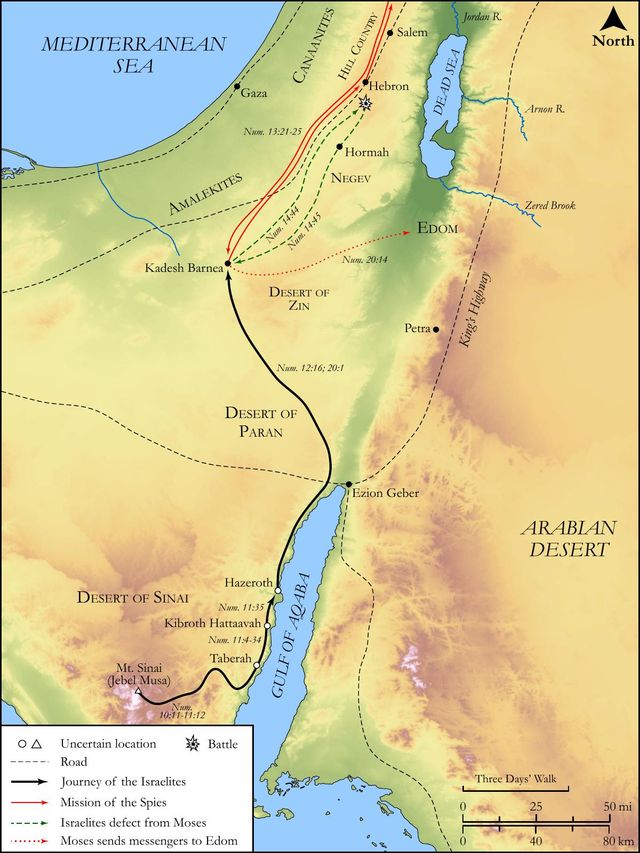
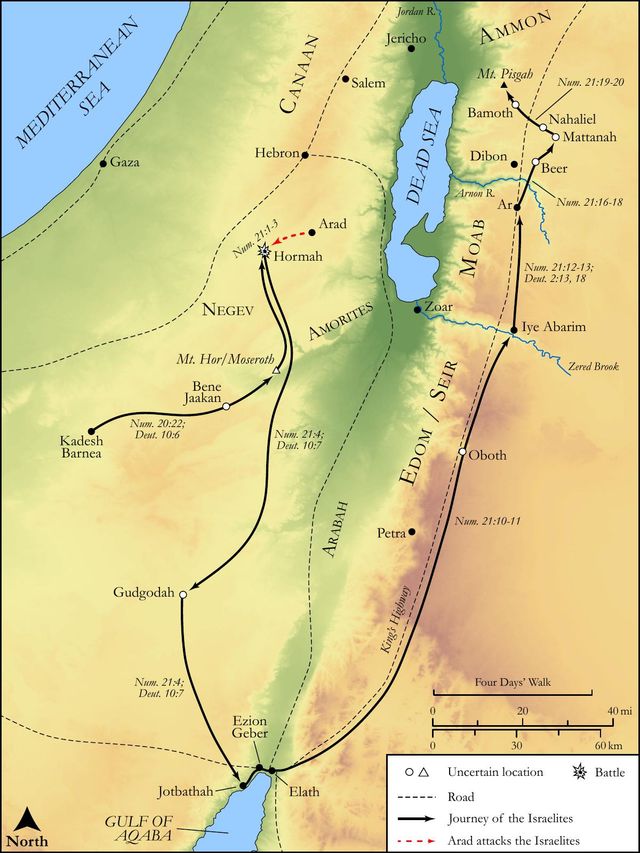
Study this verse
Public-domain commentary
Matthew Henry
From his Commentary on the Whole Bible. Henry comments on passages, not single verses — this entry covers Numbers 20:14–21. His two-level outline is real structure in the source text, so it is rendered as structure.
We have here the application made by Israel to the Edomites. The nearest way to Canaan from the place where Israel now lay encamped was through the country of Edom. Now,
I.Moses sends ambassadors to treat with the king of Edom for leave to pass through his country, and gives them instructions what to say, Num 20:14-17.
1.They are to claim kindred with the Edomites: Thus saith thy brother Israel. Both nations descended from Abraham and Isaac, their common ancestors; Esau and Jacob, the two fathers of their respective nations, were twin-brothers; and therefore, for relation-sake, they might reasonably expect this kindness from them; nor needed the Edomites to fear that their brother Israel had any ill design upon them, or would take any advantages against them.
2.They are to give a short account of the history and present state of Israel, which, they take it for granted, the Edomites were no strangers to. And in this there was a double plea: - (1.) Israel had been abused by the Egyptians, and therefore ought to be pitied and succoured by their relations: "The Egyptians vexed us and our fathers, but we may hope our brethren the Edomites will not be so vexatious." (2.) Israel had been wonderfully saved by the Lord, and therefore ought to be countenanced and favoured (Num 20:16): "We cried unto the Lord, and he sent an angel, the angel of his presence, the angel of the covenant, the eternal Word, who had brought us forth out of Egypt, and led us hither." It was therefore the interest of the Edomites to ingratiate themselves with a people that had so great an interest in heaven and were so much its favourites, and it was at their peril if they offered them any injury. It is our wisdom and duty to be kind to those whom God is pleased to own, and to take his people for our people. Come in, thou blessed of the Lord.
3.They are humbly to beg a passport through their country. Though God himself, in the pillar of cloud and fire, was Israel's guide, in following which they might have justified their passing through any man's ground against all the world, yet God would have this respect paid to the Edomites, to show that no man's property ought to be invaded under colour of religion. Dominion is founded in providence, not in grace. Thus when Christ was to pass through a village of the Samaritans, to whom his coming was likely to be offensive, he sent messengers before his face to ask leave, Luk 9:52. Those that would receive kindness must not disdain to request it.
4.They are to give security for the good behaviour of the Israelites in this march, that they would keep in the king's high road, that they would commit no trespass upon any man's property, either in ground or water, that they would not so much as make use of a well without paying for it, and that they would make all convenient speed, as fast as they could well go on their feet, Num 20:17, Num 20:19. Nothing could be offered more fair and neighbourly.
II.The ambassadors returned with a denial, Num 20:18.
Edom, that is, the king of Edom, as protector of his country, said, Thou shalt not pass by me; and, when the ambassadors urged it further, he repeated the denial (Num 20:20) and threatened, if they offered to enter his country, it should be at their peril; he raised his trained bands to oppose them. Thus Edom refused to give Israel passage. This was owing,
1.To their jealousy of the Israelites; they feared they should receive promises. And truly, had this numerous army been under any other discipline and command than that of the righteous God himself, who would no more suffer them to do wrong than to take wrong, there might have been cause for this jealousy; but what could they fear from a nation that had statutes and judgments so righteous?
2.It was owing to the old enmity which Esau bore to Israel. If they had no reason to fear damage by them, yet they were not willing to show so much kindness to them. Esau hated Jacob because of the blessing, and now the hatred revived, when the blessing was ready to be inherited. God would hereby discover the ill-nature of the Edomites to their shame, and try the good-nature of the Israelites to their honour: they turned away from him, and did not take this occasion to quarrel with him. Note, We must not think it strange if the most reasonable requests be denied by unreasonable men, and if those be affronted by men whom God favours. I as a deaf man heard not. After this indignity which the Edomites offered to Israel God gave them a particular caution not to abhor an Edomite (Deu 23:7), though the Edomites had shown such an abhorrence of them, to teach us in such cases not to meditate revenge.
Continue studying Numbers 20:20 across the web’s major study libraries — every link below opens this exact verse, chapter, or book on the destination site.
Read & Compare
 BibleGatewayThis verse in more than 200 translations and 70 languages.
 Bible.comThe YouVersion reader — hundreds of translations, reading plans, and highlights.
 ESV.orgCrossway's official English Standard Version reader.
 NET BibleThe NET translation with 60,000+ translators' notes on every rendering decision.
 STEP BibleTyndale House's free study tool — original text, vocabulary, and scholarly resources.
 BibliaLogos Bible Software's free web reader.
 USCCBThe New American Bible (Revised Edition) with the U.S. bishops' study notes.
Commentaries
 BibleHub CommentariesDozens of classic commentaries on this verse, gathered on one page.
 StudyLightMore than 100 commentary sets — the largest collection on the web.
 BibleRefPlain-English commentary on what this verse means, verse by verse.
 Enduring WordDavid Guzik's free commentary on this chapter, widely used by Bible teachers.
 Bible Study ToolsVerse commentary alongside Greek and Hebrew study aids.
Original Language & Research
- BibleHub InterlinearThe verse word by word — original language, transliteration, and English.
- BibleHub LexiconEvery word's original-language definition and Strong's entry.
 Blue Letter BibleDeep-study tools — Strong's numbers, concordance, and word studies.
 SefariaThe Hebrew text with Rashi and centuries of Jewish commentary.
Sermons, Hymns & Audio


TrulyRandomVerse is not affiliated with these sites and doesn’t control their content. They’re linked because they’re genuinely useful.
Summary
Numbers 20:20 vividly recounts the Edomite king's unyielding refusal to grant Israel passage through his territory, a direct route essential for their progress toward the Promised Land. This outright rejection was not merely a verbal decree but was immediately reinforced by a formidable military mobilization, as Edom deployed a large populace with a "strong hand" to physically block Israel's advance. This hostile act compelled the Israelites to undertake a lengthy and arduous detour, underscoring the deep-seated animosity between these kindred nations and highlighting the persistent challenges Israel faced on its divinely orchestrated wilderness journey.
Context
ShowHideLiterary Context
This pivotal verse is strategically placed within the latter stages of Israel's wilderness wanderings, nearly four decades after their exodus from Egypt, as they approach the borders of Canaan. It directly follows the tragic incident at Meribah, where Moses and Aaron's disobedience resulted in their exclusion from entering the Promised Land, a somber prelude to the challenges ahead, as detailed in Numbers 20:1-13. Immediately prior to Edom's refusal, Israel had dispatched a diplomatic delegation to the King of Edom, humbly requesting peaceful transit through his land via the ancient "King's Highway," offering assurances of non-interference with resources and strict adherence to the path, as recorded in Numbers 20:14-19. Edom's harsh and immediate rejection in verse 20 directly necessitates Israel's circuitous route, which soon leads to the significant event of Aaron's death on Mount Hor, a testament to the ongoing trials and divine redirection experienced by the Israelites before their ultimate entry into the land of promise, recounted in Numbers 20:22-29.
Historical & Cultural Context
The Edomites were the direct descendants of Esau, Jacob's elder twin brother, as established in Genesis 36:1. This familial relationship, however, was overshadowed by a long-standing history of rivalry and tension between the two peoples, tracing back to the patriarchal narratives themselves. Edom occupied a strategically vital mountainous region south of the Dead Sea, controlling the "King's Highway," a crucial ancient trade route that facilitated commerce between Egypt, Mesopotamia, and Syria. From Edom's perspective, granting unhindered passage to a vast, migrating nation like Israel, numbering potentially millions, would have been perceived as an immense security risk. Concerns over resource depletion (water and pasture), potential military threat, or even the establishment of a permanent presence, regardless of Israel's sincere assurances, would have been paramount. Their aggressive and unyielding posture in this verse reflects the common practice of the nations to fiercely protect their territorial sovereignty and strategic assets against perceived threats.
Key Themes
ShowHideNumbers 20:20 significantly contributes to several profound themes woven throughout the book of Numbers and the broader Pentateuch. Firstly, it powerfully illustrates the persistent hostility and obstruction Israel encountered on its journey, not only from traditional enemies but also, strikingly, from "kindred" nations, underscoring the pervasive challenges of the wilderness. Secondly, this incident serves as a profound demonstration of divine sovereignty and guidance. It reveals that even human opposition and forced detours are intricately incorporated into God's overarching plan for His people. Despite the direct path being denied, God's ultimate purpose for Israel's arrival in the Promised Land remained unthwarted, simply rerouted by His hand, as seen in Numbers 21:4. Finally, Edom's unbrotherly and aggressive conduct here serves as a potent foreshadowing of their consistent antagonism toward Israel throughout biblical history, culminating in severe prophetic judgments against them, most notably and comprehensively articulated in the book of Obadiah.
Exposition and Analysis
ShowHideKey Word Analysis
ShowHideFrom the root H5674, this verb signifies to "cross over" or "pass through." In the context of "Thou shalt not go through," it conveys an absolute and unequivocal prohibition. The Hebrew negative particle combined with the imperfect verb form emphasizes a definitive command, leaving no room for negotiation or reconsideration. It signals a complete and final rejection of Israel's request for transit.
Derived from H3515, this adjective means "heavy" but is frequently used figuratively to mean "numerous," "great," or "abundant." When applied to "people" (Hebrew, ʻam, H5971), as in "much people," it emphasizes the substantial size and numerical strength of the Edomite forces mobilized against Israel. It indicates that Edom's threat was not a mere bluff but a genuine, large-scale military deployment, making any attempt by Israel to force passage highly dangerous.
This adjective means "strong," "firm," or "mighty." When paired with "hand" (Hebrew, yâd, H3027), as in "strong hand," it forms a significant idiom in the Old Testament. While most frequently used to describe God's powerful acts of deliverance, particularly His mighty hand in bringing Israel out of Egypt (Exodus 13:3), here it is strikingly applied to Edom's military might. This usage highlights the formidable nature of Edom's opposition and their resolute determination to prevent Israel's passage, backed by a tangible, armed threat. It creates an ironic contrast, as a phrase typically associated with divine power is now used to describe human hostility against God's people.
Verse Breakdown
ShowHide"And he said, Thou shalt not go through."
This opening clause delivers the direct, blunt, and absolute refusal from the King of Edom. The brevity and directness of the statement underscore the Edomite king's unwavering resolve and his complete unwillingness to compromise or engage in further dialogue. It immediately extinguishes any hope Israel had for peaceful passage.
"And Edom came out against him with much people,"
This clause describes the immediate and aggressive response of Edom following the verbal prohibition. The phrase "came out against him" indicates a hostile military deployment, signifying not merely a defensive posture but a confrontational movement. The mobilization of "much people" signifies a large, organized military force, demonstrating Edom's serious intent to physically enforce their prohibition and deter any attempt by Israel to proceed.
"and with a strong hand."
This concluding phrase powerfully reinforces the nature of Edom's opposition. The "strong hand" signifies not just numerical superiority but also military power, determination, and a readiness for immediate conflict. It conveys the clear message that Edom was prepared to use overwhelming force to prevent Israel's passage, making it evident that Israel would face a full-scale battle if they attempted to push through. This detail underscores the gravity of the situation and the wisdom of Israel's subsequent decision to turn away.
Literary Devices
ShowHideNumbers 20:20 masterfully employs several literary devices to convey its profound message. The most striking is Irony, particularly in the application of the phrase "strong hand." Throughout the Pentateuch, this idiom is consistently used to describe God's mighty power in delivering Israel from bondage and establishing His covenant. Here, it is strikingly and ironically applied to Edom's hostile military might, highlighting the stark contrast between human opposition and divine power, even as God's true "strong hand" continues to guide Israel. The passage also utilizes Foreshadowing, as Edom's aggressive stance in this encounter sets the stage for future conflicts and prophetic judgments against them in later biblical books (e.g., Obadiah), emphasizing a recurring pattern of animosity between the descendants of Jacob and Esau. Finally, the direct, declarative statements of refusal and immediate military action create a palpable sense of immediate Conflict and tension, vividly portraying the abrupt confrontation between the two nations and the sudden halt to Israel's desired path.
Theological and Thematic Connections
ShowHideThe Edomite refusal in Numbers 20:20 serves as a powerful reminder that God's people often encounter resistance and hostility, even from those with whom they share a common heritage. This incident highlights the reality that the path of faith is rarely without obstacles, and divine purposes may unfold through unexpected detours rather than direct routes. It underscores the sovereignty of God, who, even when human opposition seems insurmountable, orchestrates events to fulfill His ultimate plan, guiding His people along alternative paths that serve His higher purposes. The unbrotherly conduct of Edom also foreshadows the broader biblical theme of the world's antagonism towards God's chosen people, a hostility that necessitates divine protection and wisdom in navigating difficult circumstances, ultimately demonstrating that God's will cannot be thwarted by human defiance.
Reflection and Application
ShowHideLife's journey, much like Israel's wilderness trek, is rarely a straight line. Numbers 20:20 speaks profoundly to the experience of encountering "Edoms"—unforeseen obstacles, hostile rejections, or uncooperative individuals that block our desired and seemingly logical paths. This verse reminds us that not every door we knock on will open, even when our intentions are pure and our approach is humble. Sometimes, despite our best efforts, we will face outright opposition and threats, backed by a "strong hand" of resistance. In such moments, the wisdom of Israel's response is instructive: rather than forcing a confrontation that could lead to devastating conflict, they chose to trust in God's alternative routes. This teaches us the importance of discernment in avoiding unnecessary battles and cultivating a spirit of adaptability, recognizing that a blocked path might be God's way of redirecting us toward a safer, more beneficial, or divinely appointed alternative. Our ultimate trust must rest in God's sovereign guidance, knowing that His plan for us will prevail, even if it requires unexpected detours and a willingness to surrender our preferred route for His perfect one.
Questions for Reflection
ShowHideFAQ
ShowHideWhy didn't Israel simply fight Edom and force their way through their territory?
ShowHideIsrael did not fight Edom for several compelling reasons, primarily stemming from divine command and strategic wisdom. Firstly, God had explicitly instructed Israel not to provoke the Edomites, as they were descendants of Esau, and their land was given to them by God as an inheritance (Deuteronomy 2:4-6). Israel's divine mission was to inherit the land of Canaan, not to conquer every nation in their path. Secondly, engaging in a battle with a formidable, well-prepared force like Edom, as described in Numbers 20:20, would have been costly in terms of lives and resources, potentially jeopardizing their overall journey and delaying their entry into the Promised Land. Israel was a nomadic people, not a standing army equipped for prolonged siege warfare against fortified cities. Opting for a detour, though longer and more arduous, was a demonstration of obedience to God's command and strategic wisdom, choosing to avoid unnecessary conflict when a peaceful, albeit circuitous, alternative existed under God's sovereign direction.
Christ-Centered Fulfillment
ShowHideThe Edomite refusal in Numbers 20:20, where a direct path is blocked by hostility and a "strong hand," powerfully foreshadows the opposition faced by Christ and His church. Just as Israel sought passage to their promised inheritance, humanity seeks true life and access to God, which is found only through Jesus, who declares, "I am the way, the truth, and the life. No one comes to the Father except through Me" (John 14:6). Yet, His path to establish this way was met with profound hostility from the "strong hand" of human and spiritual powers, culminating in His crucifixion. This was a "detour" through suffering, a path of apparent defeat that ultimately led to the greatest victory. The world's "Edom-like" resistance to the gospel and to believers is a recurring theme, as followers of Christ are promised tribulation (John 16:33) and persecution (2 Timothy 3:12). However, just as God sovereignly guided Israel around Edom to their inheritance, so too does He guide His church through all opposition. The "strong hand" that rose against Israel is ultimately overcome by the true "strong hand" of God, manifested in Christ's resurrection from the dead (Acts 2:24), ensuring that the gates of hell will not prevail against His church (Matthew 16:18) and that His people will reach their eternal inheritance.