


Amos 1:11
- כֹּהkohthusH3541AdvAdverb
- אָמַר'a·Marhe saysH559V-Qal-Perf-3msVerb Qal Perfect 3rd Singular Masculine
- יְהוָהYah·wehYahwehH3068N-properNoun Proper Title
- עַל'alonH5921PrepPreposition
- שְׁלֹשָׁהshe·lo·ShahthreeH7969N-csNoun Singular common gender Absolute
- פִּשְׁעֵיpish·'Ei<the> transgressions ofH6588N-mpcNoun Plural Masculine Construct
- אֱדוֹם'e·DomEdomH123N-proper-mNoun Proper Masculine
- וְעַלve·'aland onH5921Conj-w ¦ PrepPrepositionוְandעַלon
- אַרְבָּעָה'ar·ba·'AhfourH702N-csNoun Singular common gender Absolute
- לֹאlo'notH3808NegParticle Negative
- אֲשִׁיבֶנּוּ'a·shi·Ve·nuI will revoke itH7725V-Hiphil-Imperf-1cs ¦ 3msVerb Hiphil Imperfect 1st Singular common genderאֲשִׁיבֶI will revokeנּוּit
- עַל'albecauseH5921PrepPreposition
- רָדְפוֹra·de·Fohe pursuedH7291V-Qal-Inf ¦ 3msVerb Qal Infinitive Constructרָדְפpursuedוֹhe
- בַחֶרֶבva·Che·revwith the swordH2719Prep-b ¦ N-fsNoun Singular Feminine Absoluteבַwith theחֶרֶבsword
- אָחִיו'a·Chivhis brotherH251N-msc ¦ 3msNoun Singular Masculine Constructאָחִיbrotherוhis
- וְשִׁחֵתve·shi·Chetand he spoiledH7843Conj-w ¦ V-Piel-ConsecPerf-3msVerb Piel Consecutive Perfect 3rd Singular Masculineוְandשִׁחֵתhe spoiled
- רַחֲמָיוra·cha·Mavhis compassion<s>H7356N-mpc ¦ 3msNoun Plural Masculine Constructרַחֲמָיcompassion<s>וhis
- וַיִּטְרֹףvai·yit·Rofand it toreH2963Conj-w ¦ V-Qal-ConsecImperf-3msVerb Qal Consecutive Imperfect 3rd Singular Masculineוַandיִּטְרֹףit tore
- לָעַדla·'Adfor everH5703Prep-l ¦ N-msNoun Singular Masculine Absoluteלָforעַדever
- אַפּוֹ'a·Pohis angerH639N-msc ¦ 3msNoun Singular Masculine Constructאַפּangerוֹhis
- וְעֶבְרָתוֹve·'ev·ra·Toand his furyH5678Conj-w ¦ N-fsc ¦ 3msNoun Singular Feminine Constructוְandעֶבְרָתfuryוֹhis
- שְׁמָרָהshe·Ma·rahhe kept itH8104V-Qal-Perf-3ms ¦ 3fsVerb Qal Perfect 3rd Singular Masculineשְׁמָרָhe keptהit
- נֶצַחNe·tzachperpetuityH5331N-msNoun Singular Masculine Absolute
English is a literal word-by-word gloss of the Hebrew, not the KJV's wording. Why?
This is the original text the KJV's translators worked from — each Hebrew word with its own literal English meaning in this verse, prepared by scholars at Tyndale House, Cambridge. The KJV translates whole sentences, not word by word, so its wording differs: one Hebrew word can become several English words, and the KJV may choose “the LORD” where the gloss reads “Yahweh”. Both are faithful — they answer different questions. For the KJV's own rendering, switch to the KJV text.
Details
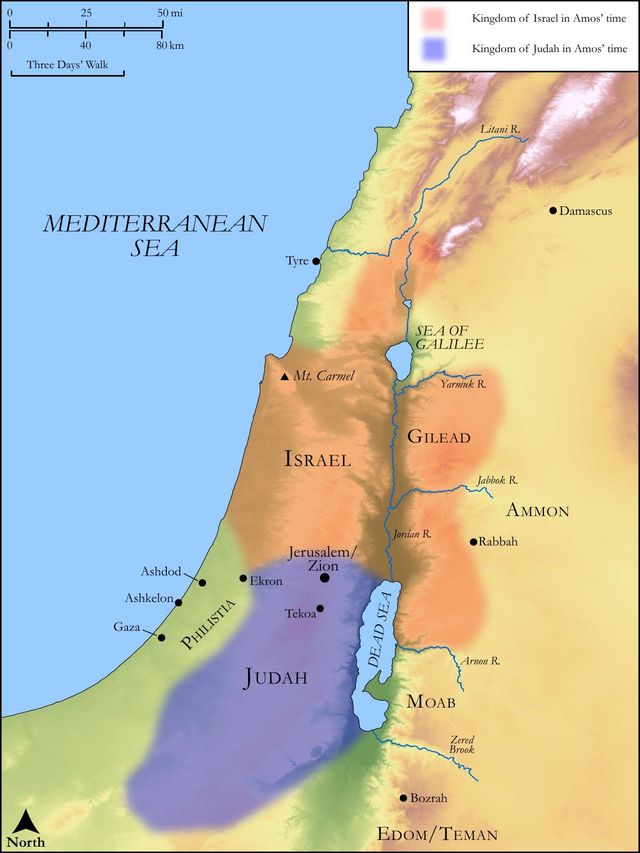
See on the biblical-era map
Study this verse
Public-domain commentary
Matthew Henry
From his Commentary on the Whole Bible. Henry comments on passages, not single verses — this entry covers Amos 1:3–15. His three-level outline is real structure in the source text, so it is rendered as structure.
What the Lord says here may be explained by what he says Jer 12:14, Thus said the Lord, against all my evil neighbours that touch the inheritance of my people Israel, Behold, I will pluck them out. Damascus was a near neighbour to Israel on the north, Tyre and Gaza on the west, Edom on the south, Ammon and (in the next chapter) Moab on the east; and all of them had been, one time, one way, or other, pricking briers and grieving thorns to Israel, evil neighbours to them; and, because God espouses his people's cause, he there calls them his evil neighbours, and here comes forth to reckon with them. The method is taken in dealing with each of them is, in part, the same, and therefore we put them together, and yet in each there is something peculiar.
I.Let us see what is repeated, both by way of charge and by way of sentence, concerning them all.
The controversy God has with each of them is prefaced with, Thus said the Lord, Jehovah the God of Israel. Though those nations will not worship him as their God, yet they shall be made to know that they are accountable to him as their Judge. The God of Israel is the God of the whole earth, and has something to say to them that shall make them tremble. Against them the Lord roars out of Zion. And before God, by the prophet, threatens Israel and Judah, he denounces judgments against those nations whom he made use of as scourges to them for their being so, which might serve for a check to their pride and insolence and a relief to his people under their dejections; for hereby they might see that God had not quitted his interest in them, and therefore might hope they had not lost their interest in him. Now as to all these nations here arraigned,
1.The indictment drawn up against them all is thus far the same,
(1.)That they are charged in general with three transgressions, and with four, that is, with many transgressions (as by one or two we mean a few, so by three or four we mean many, as in Latin a man that is very happy is said to be terque quarterque beatus - three and four times happy); or with three and four, that is, with seven transgressions, a number of perfection, intimating that they have filled up the measure of their iniquities, and are ripe for ruin; or with three (that is, a variety of sins) and with a fourth especially, which is specified concerning each of them, though the other three are not, as Pro 30:15, Pro 30:18, Pro 30:21, Pro 30:29, where we read of three things, yea, four, generally one seems to be more especially intended.
(2.)That the particular sin which is fastened upon as the fourth, and which alone is specified, is the sin of persecution: it is some mischief or other done to the people of God that is particularly charged upon every one of them, for persecution is the measure-filling sin of any people, and it is this sin that will be particularly reckoned for - I was hungry, and you gave me no meat; much more if it may be said, I was hungry, and you took my meat from me.
2.The judgment given against them all is thus far the same,
(1.)That, their sin having risen to such a height, God will not turn away the punishment thereof. Though he has granted them a long reprieve, and has often turned away their punishment, yet now he will turn it away no longer, but justice shall take its course. "I will not revoke it (so some read it); I will not recall the voice which has gone forth from Zion to Jerusalem (Amo 1:2), speaking death and terror to the sinful nations." It is an irrevocable sentence. God has spoken it, and he will not call it back. Note, Though God bear long, he will not bear always, with those that provoke him; and, when the decree brings forth, it will bring up.
(2.)That God will kindle a fire among them; this is said concerning all these evil neighbours, Amo 1:4, Amo 1:7, Amo 1:10, Amo 1:12, Amo 1:14. God will send a fire into their cities. When fires are kindled that lay cities, towns, and houses in ashes, whether designedly or casually, God must be acknowledged in it; they are of his sending. Sin stirs up the fire of his jealousy, and that kindles other fires.
II.Let us see what is mentioned, both by way of charge and by way of sentence, that is peculiar to each of them, that every one may take his portion.
1.Concerning Damascus, the head-city of Syria, a kingdom that was often vexatious to Israel.
(1.)The peculiar sin of Damascus was using the Gileadites barbarously: They threshed Gilead with threshing-instruments of iron (Amo 1:3), which may be understood literally of their putting to the torture, or to cruel deaths, the inhabitants of Gilead whom they got into their hands, as David put the Ammonites under saws and harrows Sa2 12:31. We read with what inhumanity Hazael king of Syria prosecuted his wars with Israel (Kg2 8:12); he dashed their children, and ripped up their women with child; and see what desolations he made in their land, Kg2 10:32, Kg2 10:33. Or it may be taken figuratively, for his laying the country waste, and this very similitude is used in the history of it. Kg2 13:7, He destroyed them, and made them like the dust by threshing. Note, Men often do that unjustly and wickedly, and shall be severely reckoned with for it, which yet God just permits them to do. The church is called God's threshing, and the corn of his floor (Isa 21:10); but if men make it their threshing, and the chaff of their floor, they shall be sure to hear of it.
(2.)The peculiar punishment of Damascus is [1.] That the fire which shall be sent shall fasten upon the court in the first place, not on the chief city, nor the country towns, but on the house of Hazael, which he built; and it shall devour the palaces of Ben-hadad, the royal palaces inhabited by the kings of Syria, many of whom were of that name. Note, Even royal palaces are no defence against the judgments of God, though ever so richly furnished, though ever so strongly fortified. [2.] That the enemy shall force his way into the city (Amo 1:5): I will break the bar of Damascus, and then the gate flies open. Or it may be understood figuratively: all that which is depended upon as the strength and safety of that great city shall fail, and prove insufficient. When God's judgments come with commission it is in vain to think of turning them out. [3.] That the people shall be destroyed with the sword: I will cut off the inhabitant from the plain of Aven, the valley of idolatry, for the gods of the Syrians were gods of the valleys (Kg1 20:23), were worshipped in valleys; as the idols of Israel were worshipped on the hills; him also that holdeth the sceptre of power, some petty king or other that used to boast of the sceptre he held from Beth-Eden, the house of pleasure. Both those that were given to idolatry and those that were given to sensuality should be cut off together. [4.] That the body of the nation shall be carried off. The people shall go into captivity unto Kir, which was in the country of the Medes. We find this fulfilled (Kg2 16:9) about fifty years after this, when the king of Assyria went up against Damascus, and took it, and carried the people of it captive to Kir, and slew Rezin, at the instigation of Ahaz king of Judah.
2.Concerning Gaza, a city of the Philistines, and now the metropolis of that country.
(1.)The peculiar sin of the Philistines was carrying away captive the whole captivity, either of Israel or Judah, which some think refers to that inroad made upon Jehoram when they took away all the king's sons and all his substance (Ch2 21:17), or, perhaps, it refers to their seizing those that fled to them for shelter when Sennacherib invaded Judah, and selling them to the Grecians (Joe 3:4-6), or (as here) to the Edomites, who were always sworn enemies to the people of God. They spared none, but carried off all they could lay their hands on, designing, if possible, to cut off the name of Israel, Psa 83:4-7.
(2.)The peculiar punishment of the Philistines is that the fire which God will send shall devour the palaces of Gaza, and that the inhabitants of the other cities of the Philistines, Ashdod (or Azotus), Ashkelon, and Ekron, shall all be cut off, and God will make as thorough work with them in their ruin as they would have made with God's people when they carried away the whole captivity; for even the remnant of them shall perish, Amo 1:8. Note, God will make a full end of those that think to make a full end of his church and people.
3.Concerning Tyre, that famous city of wealth and strength, that was itself a kingdom, Amo 1:9.
(1.)The peculiar sin of Tyre is delivering up the whole captivity to Edom, that is, selling to the Edomites those of Israel that fled to them for shelter, or in any way fell into their hands; not caring what hardships they put upon them, so that they could but make gain of them to themselves. Herein they forgot the brotherly covenant, the league that was between Solomon and Hiram king of Tyre (Kg1 5:12), which was intimate that Hiram called Solomon his brother, Kg1 9:13. Note, It is a great aggravation of enmity and malice when it is the violation of friendship and of a brotherly covenant.
(2.)Here is nothing peculiar in the punishment of Tyrus but that the palaces thereof shall be devoured, which was done when Nebuchadnezzar took it after thirteen years' siege. Their merchants were all princes, and their private houses were as palaces; but the fire shall make no more of them than of cottages.
4.Concerning Edom, the posterity of Esau.
(1.)Their peculiar sin was an unmerciful, unwearied, pursuit of the people of God, and their taking all advantages against them to do them a mischief, Amo 1:11. He did pursue his brother with the sword, not only of old, when the king of Edom took up arms to oppose the children of Israel's passage through his border (Num 20:18), but ever since upon all occasions; they had not strength and courage enough to face them in the field of battle, but, whenever any other enemy had put Judah or Israel to flight, then the Edomites set in with the pursuers, fell upon the rear, slew those that were half dead already, and (as is usual with cowards when they have an enemy at an advantage) they did cast off all pity. Those that are least courageous are commonly most cruel. Edom was so; his malice destroyed his compassion (so the word is); he stripped himself of the tenderness of a man, and put on the fierceness of a beast of prey; and, as such a one, he did tear, his anger did tear perpetually. His cruelty was insatiable, and he never knew when he had sucked enough of the blood of Israel, but, like the horse-leech, still cried, Give, give. Nay, he kept his wrath for ever; when he wanted objects of his wrath, and opportunity to show it, yet he kept it in reserve (it rested in his bosom), he rolled it under his tongue as a sweet morsel, and had it ready to spit in the face of Israel upon the next occasion. Cursed be such cruel wrath, and anger so fierce, so outrageous, which makes men like the devil, who continually seeks to devour, and unlike to God, who keeps not his anger for ever. Edom's malice was unnatural, for thus he pursued his brother, whom he ought to have protected: it was hereditary, as if it had been entailed upon the family ever since Esau hated Jacob, and time itself could not wear it out, no, nor the brotherly conduct of Israel towards them (Deu 2:4), and the express law given to Israel (Deu 23:7), Thou shalt not abhor an Edomite, for he is thy brother.
(2.)Here is nothing peculiar in their punishment; but (Amo 1:12) a fire shall be sent to devour their palaces. Note, The fire of our anger against our brethren kindles the fire of God's anger against us.
5.Concerning the Ammonites, Amo 1:13-15.
(1.)See how violently the fire of their anger turned against the people of God; they not only triumphed in their calamities (as we find, Eze 25:2, Eze 25:6), but they did themselves use them barbarously; they ripped up the women with child of Gilead, a piece of cruelty the very mention of which strikes a horror upon one's mind; one would think it is not possible that any of the human race should be so inhuman. Hazael was guilty of it, Kg2 8:12. It was done not only in a brutish rage, which falls without consideration upon all that comes before it, but with a devilish design to extirpate the race of Israel by killing not only all that were born, but all that were to be born, worse than Egyptian cruelty. It was that they might enlarge their border, that they might make the land of Gilead their own, and there might be none to lay claim to it or given them any disturbance in the possession of it. We find (Jer 49:1) that the Ammonites inherited Gad (that is, Gilead) under pretence that Israel had no sons, no heirs. We know how heavy the doom of those was, and how heinous their crime, who said, This is the heir; come, let us kill him, and the inheritance shall be ours by occupancy. See what cruelty covetousness is the cause of, and what horrid practices those are often put upon that are greedy to enlarge their own border.
(2.)See how violently the fire of God's anger burned against them; shall not God visit for these things done to any of mankind, especially when they are done to his own people? Shall not his soul be avenged on such a nation as this? No doubt, it shall. The fire shall be kindled with shouting in the day of battle, that is, war shall kindle the fire; it shall be a fire accompanied with the sword, or a roaring fire, which shall make a noise like that of soldiers ready to engage, and it shall be as a tempest in the day of the whirlwind, which comes swiftly, furiously, and bears down all before it. Or this tempest and whirlwind shall be as bellows to the fire, to make it burn the stronger, and spread the further. It is particularly threatened that their king and his princes shall go together into captivity, carried away by the king of Babylon, not long after Judah was. See what changes God's providence often makes with men, or rather their own sin; kings become captives, and princes prisoners. Milchom shall go into captivity; some understand it of the god of the Ammonites, whom they called Moloch - a king. He, and his princes, and his priests that attended him, shall to into captivity; their idol shall be so far from protecting them that it shall itself go into captivity with them. Note, Those who by violence and fraud seek to enlarge their own border will justly be expelled and excluded their own border; nor is it strange if those who make no conscience of invading the rights of others be able to make no resistance against those who invade theirs.
Historical interpretation
Historical reception
1 surviving comment on this verse from the historical church.
(Ver. 11 and following) Thus says the Lord: For three crimes of Edom, and for four, I will not revoke my judgment; Because he pursued his brother with the sword, and violated all pity, and his anger tore at them constantly, and he kept his wrath to the end. I will send fire into Teman, and it will consume the fortresses of Bozrah. LXX: Thus says the Lord: For three crimes of Edom, and for four, I will not turn away from them, because he pursued his brother with the sword and violated the womb above the earth, and seized his horror as a testimony, and kept his fury forever. And I will send fire into Teman, and it will consume the foundations of its walls. Edom himself is the same as Esau, so named because of the cooking of red lentils, whose birthright he lost with this nourishment: he is also called Seir, hairy and rough. Hence the mountains of the Edomites are called the mountains of Seir, and in Greek language Edom is called Idumea. This one pursued his brother with a sword, namely the sons of Jacob, concerning whom it is written more fully in the blessings of Isaac, to whom Jacob was blessed first, and afterwards Esau: so that the hatred of the brothers might be preserved in their descendants, and the Idumean people would persecute their brothers to such an extent that they would not even grant passage through the holy land to those leaving Egypt; and not only did he persecute his brother with a sword, but he violated mercy, or rather according to Symmachus' interpretation, his own womb: so that he would forget his kinship, and harden the bowels of mercy, and would not know that he was his brother, and would despise the womb of Rebekah, who had given birth to twin infants in one childbirth. And what follows: And he held on to his fury, and kept his indignation until the end, he shows his ancient hatred, which was never reconciled with peace. Therefore, he threatens punishment for sins, and he said: I will send fire into Theman, which is the region of the Edomites, and it extends to the southern part, which is called Theman: this province is called not only Theman, but also Daron and Nageb, because it faces the east, south, and the African wind. And when he says, 'He shall devour the houses of Bozrah,' it does not mean, as some suppose, another city, but Edom, fortified and well-fortified, according to what we read in Isaiah: 'Who is this that comes from Edom, with dyed garments from Bozrah? This one, beautiful in his robe, walking in the greatness of his strength' (Isaiah 63:2)? Whatever we have said about Esau and Jacob, let us apply it to the Jews and the Christian people. For they, who were earthly and bloodthirsty, persecuted the brother Jacob, who supplanted them, and took away their firstborn, and persecuted with the sword, so that they seized the possessions and wealth of believers, which we read about in the Acts of the Apostles (Acts 2:4): and they violated mercy and the laws of nature, forgetting their mother Rebecca, who is interpreted as patience, and at the same time they were born in Christ: holding onto their ancient fury and anger, to this day in their synagogues they blaspheme the Christian people under the name of Nazarenes: and as long as they kill us, they want to be burned with fire. But the Lord will send fire into Theman, into the dry and deserted parts of Judaea (that are not irrigated by the rains of the prophets), and it will consume all their fortifications, even the foundations of its walls, so that with the complete collapse of all literal sense, the Church of Christ the Lord may be built upon its foundations. For misericordia, they translated the Septuagint as vulva. And for furore, they used horrorem. And for indignatione, they chose impetum, led by the ambiguity of the words: because Rehem signifies both the womb and mercy; Aphpho signifies his rage and horror; and Ebrath is said to mean both indignation and impulse. Furthermore, Armanoth (), which we have interpreted as houses, Aquila and Symmachus βάρεις, that is, homes; Theodotius transferred the inhabitants: only seventy and here and above, they called foundations.
Continue studying Amos 1:11 across the web’s major study libraries — every link below opens this exact verse, chapter, or book on the destination site.
Read & Compare
 BibleGatewayThis verse in more than 200 translations and 70 languages.
 Bible.comThe YouVersion reader — hundreds of translations, reading plans, and highlights.
 ESV.orgCrossway's official English Standard Version reader.
 NET BibleThe NET translation with 60,000+ translators' notes on every rendering decision.
 STEP BibleTyndale House's free study tool — original text, vocabulary, and scholarly resources.
 BibliaLogos Bible Software's free web reader.
 USCCBThe New American Bible (Revised Edition) with the U.S. bishops' study notes.
Commentaries
 BibleHub CommentariesDozens of classic commentaries on this verse, gathered on one page.
 StudyLightMore than 100 commentary sets — the largest collection on the web.
 BibleRefPlain-English commentary on what this verse means, verse by verse.
 Enduring WordDavid Guzik's free commentary on this chapter, widely used by Bible teachers.
 Bible Study ToolsVerse commentary alongside Greek and Hebrew study aids.
Original Language & Research
- BibleHub InterlinearThe verse word by word — original language, transliteration, and English.
- BibleHub LexiconEvery word's original-language definition and Strong's entry.
 Blue Letter BibleDeep-study tools — Strong's numbers, concordance, and word studies.
 SefariaThe Hebrew text with Rashi and centuries of Jewish commentary.
Sermons, Hymns & Audio


TrulyRandomVerse is not affiliated with these sites and doesn’t control their content. They’re linked because they’re genuinely useful.
Summary
Amos 1:11 pronounces a severe divine judgment against the nation of Edom, declaring that their accumulated transgressions have reached an unforgivable peak. Specifically, the LORD condemns Edom for their relentless and merciless pursuit of their "brother" Israel with the sword, characterized by a complete abandonment of compassion, a perpetually tearing anger, and an enduring, unyielding wrath. This oracle underscores God's universal sovereignty and His righteous indignation against cruelty and unremitting hatred, particularly when directed against kin.
Context
ShowHideLiterary Context
Amos 1:11 is part of a series of oracles (Amos 1:3–2:16) where the prophet Amos delivers God's judgment against various nations surrounding Israel, culminating in judgments against Judah and Israel themselves. Each oracle follows a consistent rhetorical pattern: "For three transgressions of [nation], and for four, I will not turn away [the punishment] thereof." This formula signals that the sins of each nation have reached an overflowing measure, making divine intervention and judgment inevitable. Edom's oracle immediately follows those against Damascus, Gaza, Tyre, and precedes those against Ammon, Moab, Judah, and Israel, establishing a comprehensive scope of God's moral governance over all peoples. The specific nature of Edom's sin—fratricidal hatred—sets it apart, emphasizing the depth of their moral depravity.
Historical & Cultural Context
Edom was a nation located southeast of Judah, primarily in the mountainous region of Seir. Their historical identity was deeply intertwined with Israel's, as the Edomites were descendants of Esau, the elder twin brother of Jacob (Israel), as recorded in Genesis 25:23. Despite this familial bond, the relationship between Edom and Israel was marked by consistent hostility and conflict throughout their history, stemming from Esau's initial resentment (Genesis 27:41). Edom frequently exploited Israel's vulnerabilities, refused passage during the Exodus (Numbers 20:14-21), and often sided with Israel's enemies, notably participating in the Babylonian destruction of Jerusalem (Psalm 137:7 and Obadiah 1:10-14). Amos prophesied during the 8th century BCE, a period of relative peace and prosperity for both the Northern Kingdom of Israel and the Southern Kingdom of Judah, making the pronouncement of judgment against these powerful nations a stark reminder of God's ultimate authority.
Key Themes
ShowHideThis verse contributes to several overarching themes in Amos. Foremost is the theme of Divine Judgment on Nations, asserting God's universal sovereignty and His moral accountability over all peoples, not just His covenant nation. The specific nature of Edom's sin highlights the theme of Brotherly Hatred and Cruelty, demonstrating that God condemns not only overt acts of violence but also the underlying malice, lack of compassion, and unyielding wrath that fuel such actions. Edom's refusal to show "pity" and their "perpetual" anger underscore the theme of Moral Depravity and Unrepentance, indicating a deep-seated spiritual sickness that had permeated their national character and led to an overflowing measure of sin, making their judgment irreversible.
Exposition and Analysis
ShowHideKey Word Analysis
ShowHideMeaning "a revolt (national, moral or religious); rebellion, sin, transgression, trespass." Here, it signifies Edom's acts of rebellion against God's moral order and their severe breach of the natural law of kinship. It implies a deliberate and defiant stepping over boundaries, not merely an accidental error.
Meaning "compassion (in the plural); by extension, the womb (as cherishing the fetus); by implication, a maiden; bowels, compassion, damsel, tender love, (great, tender) mercy, pity, womb." This word carries a deep emotional weight, often referring to a profound, visceral, almost maternal compassion. Edom's "casting off" of all pity indicates a complete and utter abandonment of this fundamental human and divine quality, revealing a hardened heart devoid of empathy for their own kin.
Meaning "to pluck off or pull to pieces; causatively to supply with food (as in morsels); catch, [idiom] without doubt, feed, ravin, rend in pieces, [idiom] surely, tear (in pieces)." When applied to Edom's anger, it vividly portrays their rage as a destructive, predatory force that violently rips apart and devours, leaving devastation in its wake. It emphasizes the active, consuming nature of their malice.
Verse Breakdown
ShowHide"Thus saith the LORD;"
This opening phrase, a prophetic formula (Hebrew, koh 'amar YHWH'), establishes the divine authority and absolute certainty of the pronouncement. It signifies that the following words are not merely human opinion but the direct, infallible word of God, the self-Existent or Eternal One.
"For three transgressions of Edom, and for four, I will not turn away [the punishment] thereof;"
This numerical parallelism indicates that Edom's sins have reached a complete and overflowing measure, exceeding any possibility of divine forbearance or turning back of judgment. It signifies that their wickedness has accumulated to an unbearable point, necessitating an irreversible divine response.
"because he did pursue his brother with the sword,"
This clause identifies the primary and most egregious sin: the active, hostile, and violent pursuit of Israel, their "brother" (descended from Jacob), using military force. This refers to Edom's consistent aggression and exploitation of Israel's weaknesses, violating the sacred bond of kinship.
"and did cast off all pity,"
This emphasizes Edom's complete lack of compassion and mercy. The verb "cast off" (Hebrew, shachath') implies a deliberate act of discarding or destroying, indicating that Edom actively chose to abandon any tender feelings or empathy towards their kin, hardening their hearts against natural affection.
"and his anger did tear perpetually,"
Edom's anger is personified as a destructive force that "tears" or "rends" continually. This highlights the unceasing, violent, and consuming nature of their rage. It was not a momentary outburst but a sustained, characteristic disposition, reflecting a deep-seated, active malice.
"and he kept his wrath for ever:"
This final clause reiterates and intensifies the previous one, emphasizing the enduring and unyielding nature of Edom's animosity. Their "wrath" (Hebrew, 'ebrâh', a furious outburst) was not allowed to dissipate but was "kept" or "guarded" (Hebrew, shamar') and nurtured indefinitely, demonstrating a profound and unrepentant hatred that characterized their national identity.
Literary Devices
ShowHideAmos 1:11 employs several powerful literary devices to convey the gravity of Edom's sin and the certainty of divine judgment. The most prominent is Numerical Parallelism, specifically the "three transgressions... and for four" formula, which is a common Hebrew poetic device (a form of merism) used to indicate a full, complete, and overflowing measure of something, rather than a literal count. It emphasizes that Edom's culpability has reached its absolute limit, making judgment inevitable. Personification is evident in the description of Edom's "anger" (Hebrew, 'aph') as something that "did tear perpetually," giving an abstract emotion the active, destructive quality of a predatory beast. This vivid imagery underscores the violent and consuming nature of their rage. Furthermore, the phrases "perpetually" (Hebrew, 'ad' or netsach') and "for ever" (Hebrew, netsach') function as Hyperbole or Intensification, emphasizing the sustained, unyielding, and chronic nature of Edom's hatred, rather than a temporary lapse. This accumulation of devices paints a stark picture of Edom's deep-seated malice and the righteous basis for God's irreversible judgment.
Theological and Thematic Connections
ShowHideAmos 1:11 powerfully articulates God's profound concern for justice, even among nations outside His direct covenant. Edom's sin is not merely a political or military transgression but a deep moral and spiritual failure: the rejection of basic human compassion and the cultivation of unyielding hatred, particularly against those with whom one shares a familial bond. This passage reveals that God's moral law is universal, holding all humanity accountable for their actions and attitudes, especially regarding how they treat one another. The severity of the judgment underscores that persistent malice, lack of empathy, and unrepentant cruelty are an affront to the divine character, which is inherently merciful and just. Edom's refusal to "cast off all pity" and their choice to "keep their wrath for ever" demonstrates a hardened heart that has rejected the very possibility of reconciliation and compassion, sealing their fate.
Reflection and Application
ShowHideAmos 1:11 serves as a sobering mirror, challenging us to examine the state of our own hearts and relationships. The Edomites' sin of unyielding hatred and lack of pity towards their "brother" is a stark warning against allowing bitterness, anger, or resentment to take root and fester. In our own lives, whether within families, communities, or even on a global scale, unchecked anger and a refusal to extend compassion can lead to destructive outcomes, just as they did for Edom. This verse calls us to cultivate mercy, forgiveness, and reconciliation, actively seeking to "cast off" malice and to nurture love. It reminds us that our treatment of others, especially those with whom we have a close connection or a shared humanity, is not inconsequential to God. Instead, it is a reflection of our obedience to His moral law and the character we embody. We are called to resist the temptation to harbor perpetual wrath and instead to pursue peace and righteousness, knowing that God holds all people accountable for their actions and the attitudes of their hearts.
Questions for Reflection
ShowHideFAQ
ShowHideWhat is the significance of the phrase "For three transgressions... and for four"?
ShowHideThis is a common Hebrew literary device known as numerical parallelism or an ascending numerical sequence. It is not meant to be a literal count of specific sins. Instead, it signifies that the nation's transgressions have reached a complete, full, and overflowing measure. It communicates that Edom's wickedness has accumulated to an unbearable degree, exceeding God's patience and making divine judgment inevitable and irreversible. It emphasizes the totality and saturation of their sin.
Who were Edom and their "brother" in this context?
ShowHideEdom was a nation descended from Esau, the elder twin brother of Jacob, whose name was later changed to Israel (see Genesis 32:28). Therefore, Edom's "brother" refers to the nation of Israel, with whom they shared a common ancestry. Despite this familial bond, the relationship between the two nations was historically marked by deep-seated animosity, hostility, and conflict, stemming from the rivalry between their patriarchs (Genesis 27:41).
Why was Edom's sin considered so severe by God?
ShowHideEdom's sin was particularly egregious because it involved unyielding hatred and cruelty directed against their own kin, the Israelites. The text highlights several aspects of their sin: "pursuing his brother with the sword" (active aggression), "casting off all pity" (complete lack of compassion), and their anger that "did tear perpetually, and he kept his wrath for ever" (sustained, destructive malice). This was not a momentary lapse but a deep-seated, characteristic disposition of relentless animosity and a refusal to show mercy, which God found abhorrent, especially given the familial connection. Their actions violated fundamental principles of kinship and humanity, making their judgment just and severe.
Christ-Centered Fulfillment
ShowHideAmos 1:11, with its pronouncement of judgment against Edom for their unyielding hatred and lack of pity toward their brother, profoundly foreshadows the ultimate solution to humanity's brokenness found in Jesus Christ. Edom's sin of fratricidal malice, a deep-seated rejection of love and compassion, reflects the universal human condition of sin and rebellion against God and neighbor (Romans 3:23). While God's righteous judgment against such sin is certain, as seen in Edom's fate, Christ's coming offers a pathway to reconciliation and transformation. Jesus, the true "brother" who "did not come to be served, but to serve, and to give his life as a ransom for many" (Matthew 20:28), perfectly embodies the compassion and self-sacrificial love that Edom so tragically lacked. Through His atoning death on the cross, Christ bore the full wrath and judgment for humanity's transgressions, including the very hatred and lack of pity condemned in Amos 1:11. His resurrection offers the power to break the perpetual cycle of anger and wrath, enabling believers to "put off their old self, which is being corrupted by its deceitful desires" and to "put on the new self, created to be like God in true righteousness and holiness" (Ephesians 4:22-24). Ultimately, Christ's work establishes a new covenant of love and reconciliation, inviting all people, regardless of their past enmity, to become "brothers and sisters" in Him, living out the very compassion and forgiveness that Edom rejected (John 13:34-35).