


2 Kings 16:9
Bible text: King James Version (1769 Blayney text) · Public domain
Bible text: King James Version with Strong's numbers · Public domain
Bible text: Berean Standard Bible · Public domain
Bible text: American Standard Version (1901) · Public domain
Bible text: World English Bible, Messianic edition · Public domain
Bible text: Geneva Bible (1599) · Public domain
Bible text: Young's Literal Translation · Public domain
- וַיִּשְׁמַעvai·yish·Ma'and he listenedH8085Conj-w ¦ V-Qal-ConsecImperf-3msVerb Qal Consecutive Imperfect 3rd Singular Masculineוַandיִּשְׁמַעhe listened
- אֵלָיו'e·Lavto himH413Prep ¦ 3msPrepositionאֵלָיtoוhim
- מֶלֶךְMe·lekh[the] king ofH4428N-mscNoun Singular Masculine Construct
- אַשּׁוּר'a·ShurAssyriaH804N-properNoun Proper Location
- וַיַּעַלvai·ya·'Aland he came upH5927Conj-w ¦ V-Qal-ConsecImperf-3msVerb Qal Consecutive Imperfect 3rd Singular Masculineוַandיַּעַלhe came up
- מֶלֶךְMe·lekh[the] king ofH4428N-mscNoun Singular Masculine Construct
- אַשּׁוּר'a·ShurAssyriaH804N-properNoun Proper Location
- אֶל'eltoH413PrepPreposition
- דַּמֶּשֶׂקda·Me·sekDamascusH1834N-properNoun Proper Location
- וַיִּתְפְּשֶׂהָvai·yit·pe·Se·haand he seized itH8610Conj-w ¦ V-Qal-ConsecImperf-3ms ¦ 3fsVerb Qal Consecutive Imperfect 3rd Singular Masculineוַandיִּתְפְּשֶׂhe seizedהָit
- וַיַּגְלֶהָvai·yag·Le·haand he took into exile itH1540Conj-w ¦ V-Hiphil-ConsecImperf-3ms ¦ 3fsVerb Hiphil Consecutive Imperfect 3rd Singular Masculineוַandיַּגְלֶhe took into exileהָit
- קִירָהKi·rahKir towardsH7024N-proper ¦ SfxNoun Proper LocationקִירָKirהtowards
- וְאֶתve·'Etand <obj.>H853Conj-w ¦ DirObjMParticle Object Indicatorוְandאֶת<obj.>
- רְצִיןre·TzinRezinH7526N-proper-mNoun Proper Masculine
- הֵמִיתhe·Mithe put to deathH4191V-Hiphil-Perf-3msVerb Hiphil Perfect 3rd Singular Masculine
English is a literal word-by-word gloss of the Hebrew, not the KJV's wording. Why?
This is the original text the KJV's translators worked from — each Hebrew word with its own literal English meaning in this verse, prepared by scholars at Tyndale House, Cambridge. The KJV translates whole sentences, not word by word, so its wording differs: one Hebrew word can become several English words, and the KJV may choose “the LORD” where the gloss reads “Yahweh”. Both are faithful — they answer different questions. For the KJV's own rendering, switch to the KJV text.
Details
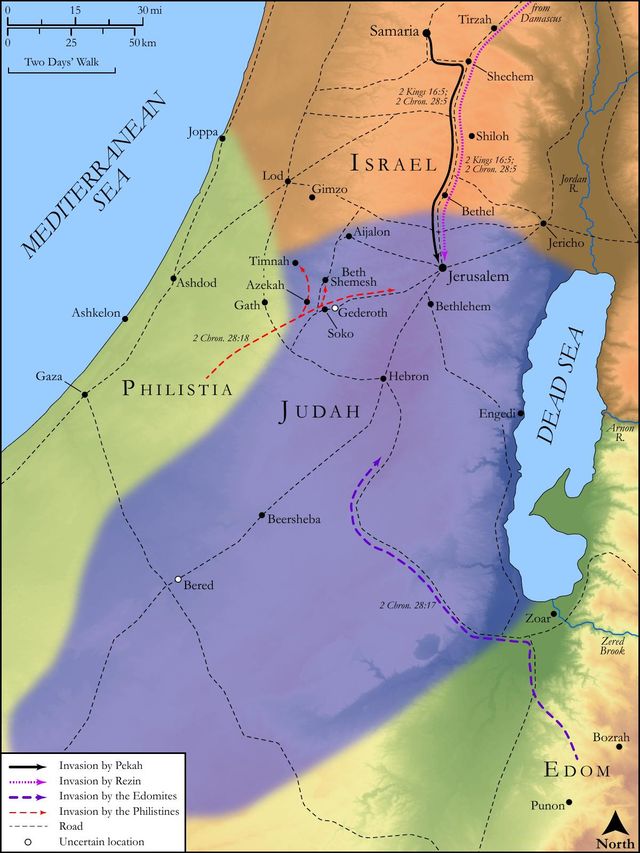
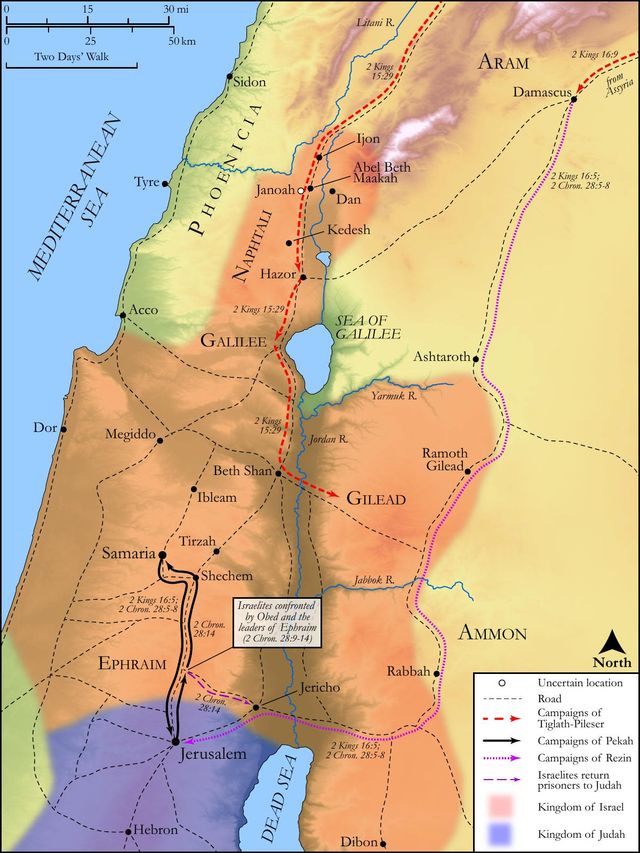
See on the biblical-era maps
Study this verse
Public-domain commentary
Matthew Henry
From his Commentary on the Whole Bible. Henry comments on passages, not single verses — this entry covers 2 Kings 16:5–9.
Here is, 1. The attempt of his confederate neighbours, the kings of Syria and Israel, upon him. They thought to make themselves masters of Jerusalem, and to set a king of their own in it, Isa 7:6. In this they fell short, but the king of Syria recovered Elath, a considerable port upon the Red Sea, which Amaziah had taken from the Syrians, Kg2 14:22. What can those keep that have lost their religion? Let them expect, thenceforward, to be always on the losing hand. 2. His project to get clear of them. Having forsaken God, he had neither courage nor strength to make head against his enemies, nor could he, with any boldness, ask help of God; but he made his court to the king of Assyria, and got him to come in for his relief. Those whose hearts condemn them will go any where in a day of distress rather than to God. Was it because there was not a God in Israel that he sent to the Assyrian for help? Was the rock of ages removed out of its place, that he stayed himself on this broken reed? The sin itself was its own punishment; for, though it is true that he gained his point (the king of Assyria hearkened to him, and, to serve his own turn, made a descent upon Damascus, whereby he gave a powerful diversion to the king of Syria, Kg2 16:9, and obliged him to let fall his design against Ahaz, carrying the Syrians captive to Kir, as Amos had expressly foretold, Amo 1:5), yet, considering all, he made but a bad bargain; for, to compass this, (1.) He enslaved himself (Kg2 16:7): I am thy servant and thy son, that is, "I will be as dutiful and obedient to thee as to a master or father, if thou wilt but do me this good turn." Had he thus humbled himself to God, and implored his favour, he might have been delivered upon easier terms; he might have saved his money, and needed only to have parted with his sins. But, if the prodigal forsake his father's house, he soon becomes a slave to the worst of masters, Luk 15:15. (2.) He impoverished himself; for he took the silver and gold that were laid up in the treasury both of the temple and of the kingdom, and sent it to the king of Assyria, Kg2 16:8. Both church and state must be squeezed and exhausted, to gratify this his new patron and guardian. I know not what authority he had thus to dispose of the public stock; but it is common for those that have brought themselves into straits by one sin to help themselves out by another; and those that have alienated themselves from God will make no difficulty of alienating any of his rights.
Continue studying 2 Kings 16:9 across the web’s major study libraries — every link below opens this exact verse, chapter, or book on the destination site.
Read & Compare
 BibleGatewayThis verse in more than 200 translations and 70 languages.
 Bible.comThe YouVersion reader — hundreds of translations, reading plans, and highlights.
 ESV.orgCrossway's official English Standard Version reader.
 NET BibleThe NET translation with 60,000+ translators' notes on every rendering decision.
 STEP BibleTyndale House's free study tool — original text, vocabulary, and scholarly resources.
 BibliaLogos Bible Software's free web reader.
 USCCBThe New American Bible (Revised Edition) with the U.S. bishops' study notes.
Commentaries
 BibleHub CommentariesDozens of classic commentaries on this verse, gathered on one page.
 StudyLightMore than 100 commentary sets — the largest collection on the web.
 BibleRefPlain-English commentary on what this verse means, verse by verse.
 Enduring WordDavid Guzik's free commentary on this chapter, widely used by Bible teachers.
 Bible Study ToolsVerse commentary alongside Greek and Hebrew study aids.
Original Language & Research
- BibleHub InterlinearThe verse word by word — original language, transliteration, and English.
- BibleHub LexiconEvery word's original-language definition and Strong's entry.
 Blue Letter BibleDeep-study tools — Strong's numbers, concordance, and word studies.
 SefariaThe Hebrew text with Rashi and centuries of Jewish commentary.
Sermons, Hymns & Audio


TrulyRandomVerse is not affiliated with these sites and doesn’t control their content. They’re linked because they’re genuinely useful.
Summary
Second Kings 16:9 records the decisive fulfillment of King Ahaz's desperate plea to Assyria, detailing the swift and brutal conquest of Damascus by Tiglath-Pileser III. This verse marks a critical turning point in Judah's history, demonstrating Assyria's growing dominance among the nations and serving as a stark testament to the consequences of Judah's unfaithful alliances, while simultaneously highlighting God's sovereign hand in orchestrating the rise and fall of nations to accomplish His divine purposes and fulfill His prophetic word.
Context
ShowHideLiterary Context
This verse serves as the climax of the narrative arc initiated by King Ahaz's crisis in 2 Kings 16. Faced with the existential threat of the Syro-Ephraimite War—a formidable alliance between King Rezin of Aram (Damascus) and King Pekah of Israel—Ahaz, king of Judah, chose to disregard the prophet Isaiah's counsel to trust solely in the Lord (Isaiah 7:4-9). Instead, he sent lavish tribute from the temple and royal treasuries to Tiglath-Pileser III, the powerful king of Assyria, seeking military intervention (2 Kings 16:7-8). Verse 9 directly reports Assyria's immediate and decisive response, confirming that Tiglath-Pileser "hearkened unto him," signifying his acceptance of Ahaz's terms and his subsequent military campaign against Damascus, which was the immediate threat to Judah. This action not only resolved Ahaz's immediate predicament but also drew Judah deeper into the Assyrian sphere of influence, setting the stage for future subjugation.
Historical & Cultural Context
The mid-8th century BCE was dominated by the meteoric rise of the Neo-Assyrian Empire under Tiglath-Pileser III (745-727 BCE), a highly aggressive and effective military leader. His reign was characterized by systematic campaigns of conquest, consolidation of power, and the implementation of brutal policies, most notably mass deportation. The Syro-Ephraimite War (c. 735-732 BCE) was a regional conflict that Assyria skillfully exploited to expand its control westward. Damascus, as the capital of Aram, was a strategic and powerful city-state that had historically posed a significant challenge to both Israel and Judah. Its fall to Assyria was a monumental event, signaling the definitive end of Aramean independence and demonstrating Assyria's overwhelming military might. The practice of carrying populations "captive to Kir" was a standard Assyrian tactic designed to break national identity, prevent rebellion, and integrate conquered territories into their vast imperial system. Kir, though its exact location remains debated (possibly in Mesopotamia or Elam), represents a distant, foreign land of exile, signifying the complete uprooting and dissolution of the Aramean kingdom.
Key Themes
ShowHideThis verse powerfully illustrates several overarching themes within 2 Kings:
Divine Sovereignty and Judgment
Despite Ahaz's faithless act of seeking a pagan alliance, God remained sovereign over the nations. Assyria, though a ruthless empire, was ultimately an instrument in God's hands to execute judgment upon Aram and, eventually, Israel, for their idolatry and rebellion. The fall of Damascus and the death of Rezin were not random geopolitical events but part of God's larger, unfolding plan, demonstrating His control over the course of human history (Isaiah 10:5-7).
Consequences of Ungodly Alliances
Ahaz's decision to rely on Assyria rather than the Lord provided immediate relief but plunged Judah into a long-term, dangerous dependency on a foreign power. This highlights the spiritual peril of seeking human solutions over divine trust, as such alliances often lead to compromise, idolatry, and eventual subjugation, as seen in Judah's later history under Assyrian and Babylonian dominance (Deuteronomy 28:49-50).
Fulfillment of Prophecy
The capture of Damascus and the death of Rezin directly fulfilled specific prophecies given earlier by prophets. Isaiah had prophesied that within 65 years, Ephraim (Israel) would be shattered, and Damascus would cease to be a kingdom (Isaiah 7:8). The prophet Amos had also foretold the destruction of Damascus, the breaking of its gates, and the exile of its people to Kir (Amos 1:3-5). This immediate fulfillment underscores God's foreknowledge and the absolute certainty of His word.
Exposition and Analysis
ShowHideKey Word Analysis
ShowHide(shâmaʻ), a primitive root meaning "to hear intelligently (often with implication of attention, obedience, etc.; causatively, to tell, etc.)." In this context, it signifies more than just hearing Ahaz's plea; it implies that Tiglath-Pileser III not only received the message and the tribute but also acted decisively in accordance with Ahaz's request. It conveys a sense of active response and agreement, indicating that the Assyrian king found the offer beneficial and chose to intervene.
(tâphas), a primitive root meaning "to manipulate, i.e. seize; chiefly to capture, wield, specifically, to overlay; figuratively, to use unwarrantably." This is a strong military term indicating a successful conquest. The use of "took it" (referring to Damascus) emphasizes the city's complete fall and subjugation, not merely a siege or a temporary occupation, but a definitive capture that ended its independent status.
(Qîyr), meaning "fortress." This is an obscure geographical location, mentioned also in Amos 1:5 and Amos 9:7. While its precise location is debated among scholars (some suggest a region in Mesopotamia, others in Elam or near the Persian Gulf), its significance here lies in its representation of a distant, foreign land. It symbolizes the complete uprooting and displacement of the Aramean people, a hallmark of Assyrian deportation policy designed to break national identity and prevent future rebellion.
Verse Breakdown
ShowHide"And the king of Assyria hearkened unto him"
This clause confirms the success of Ahaz's desperate diplomatic and financial overture to Tiglath-Pileser III. It indicates that the Assyrian king accepted the tribute and agreed to intervene on Judah's behalf, demonstrating the immediate effectiveness of Ahaz's strategy, albeit one rooted in unfaithfulness to God.
"for the king of Assyria went up against Damascus, and took it"
This explains how the Assyrian king "hearkened." It describes the swift and decisive military action taken by Tiglath-Pileser III. "Went up against Damascus" signifies a full-scale military campaign, and "took it" confirms the successful conquest and capture of the Aramean capital, a major geopolitical event that ended the Syro-Ephraimite threat to Judah.
"and carried [the people of] it captive to Kir"
This details the brutal aftermath of the conquest. The Assyrian policy of mass deportation is clearly illustrated, where the conquered population of Damascus was forcibly removed from their homeland and exiled to a distant, foreign land. This act was designed to dismantle the Aramean nation and integrate its territory into the Assyrian Empire, ensuring no future resistance.
"and slew Rezin"
This final, stark statement confirms the death of King Rezin of Aram. His execution signifies the complete demise of the Aramean kingdom and the definitive end of the Syro-Ephraimite alliance. It is the ultimate act of Assyrian dominance and a direct fulfillment of prophecy, leaving no doubt about the finality of Damascus's defeat.
Literary Devices
ShowHideThe narrative in 2 Kings 16:9 employs several potent literary devices. There is significant Irony present, as Ahaz's act of faithlessness—seeking help from a pagan king instead of trusting Yahweh—results in an outcome that, paradoxically, fulfills God's own prophetic word and serves His sovereign purposes. God uses the very instrument of Ahaz's disobedience (Assyria) to bring about His judgment on Aram and Israel. This highlights the theme of Divine Sovereignty, where God remains in ultimate control, orchestrating even the actions of ungodly rulers and nations to achieve His will. The swiftness and brutality of Assyria's actions, particularly the deportation to Kir and the slaying of Rezin, serve as a Foreshadowing of Judah's own future exile and the consequences of its continued unfaithfulness, as seen in the later Babylonian captivity. The narrative also uses Conciseness to deliver momentous historical events with stark efficiency, making the impact of Damascus's fall and Rezin's death all the more powerful.
Theological and Thematic Connections
ShowHideThe events of 2 Kings 16:9 profoundly underscore God's absolute sovereignty over human history and the nations. Even when His people act in faithlessness, as King Ahaz did, God remains in control, using even pagan empires like Assyria as instruments of His divine judgment and to fulfill His prophetic word. This demonstrates that no human plan or alliance, whether faithful or faithless, can thwart God's ultimate purposes. The fall of Damascus and the death of Rezin were not merely geopolitical shifts but divinely orchestrated acts of justice against nations that had opposed God's people and indulged in idolatry. This serves as a powerful reminder that God is the true King, ruling over all earthly kings and kingdoms, bringing low the proud and exalting the humble according to His perfect will.
Reflection and Application
ShowHideThe account in 2 Kings 16:9 offers profound lessons for believers today. King Ahaz's decision to rely on the formidable power of Assyria rather than the omnipotent God of Israel stands as a cautionary tale. In our own lives, when faced with overwhelming challenges, fears, or threats, we are often tempted to seek immediate, human-devised solutions, whether it be through worldly alliances, financial schemes, or compromising our integrity. This passage reminds us that while God can indeed use any means to accomplish His purposes, our primary responsibility is to trust in Him alone, to walk in faith and obedience, and to wait on His perfect timing and intervention. True security and lasting peace are found not in the strength of human institutions or the wisdom of the world, but in unwavering reliance on the Lord. Furthermore, the fulfillment of prophecy in this verse should bolster our confidence in God's faithfulness to His word and His ultimate control over all world events, assuring us that His promises will always come to pass.
Questions for Reflection
ShowHideFAQ
ShowHideWhat was the Syro-Ephraimite War, and how did 2 Kings 16:9 resolve it?
ShowHideThe Syro-Ephraimite War (c. 735-732 BCE) was a conflict where King Rezin of Aram (Damascus) and King Pekah of Israel formed an alliance to pressure King Ahaz of Judah into joining their coalition against the rising power of Assyria. When Ahaz refused, they attacked Judah, intending to depose him and install a puppet king. Instead of trusting in the Lord, as advised by the prophet Isaiah (Isaiah 7:4-9), Ahaz appealed to Tiglath-Pileser III of Assyria for help, sending him rich tribute (2 Kings 16:7-8). 2 Kings 16:9 describes Assyria's response: Tiglath-Pileser "hearkened unto him," meaning he accepted Ahaz's plea and payment. He then "went up against Damascus, and took it, and carried [the people of] it captive to Kir, and slew Rezin." This decisive military action by Assyria effectively ended the Syro-Ephraimite threat to Judah by destroying one of its primary antagonists and its capital.
Why was the "carrying captive to Kir" significant?
ShowHideThe act of "carrying captive to Kir" was a crucial aspect of Assyrian imperial policy, known as mass deportation. It was not merely a punitive measure but a strategic tool designed to achieve several objectives. By forcibly relocating conquered populations, the Assyrians aimed to break down national and ethnic identities, thereby preventing future rebellions. It also served to integrate new territories and their resources into the vast Assyrian Empire, often by resettling people in areas where their labor was needed. Kir, though its exact location is debated, represents a distant and foreign land, emphasizing the complete uprooting and dismemberment of the Aramean kingdom. This policy was a hallmark of Assyrian brutality and effective control, and it foreshadowed similar exiles that would later befall the northern kingdom of Israel (2 Kings 17:6) and eventually Judah (2 Kings 25:11).
Christ-Centered Fulfillment
ShowHideWhile 2 Kings 16:9 details a moment of earthly political maneuvering and divine judgment, it ultimately points to the supreme sovereignty of Jesus Christ. Just as God used the Assyrian king, a pagan ruler, as an instrument to fulfill His purposes and bring judgment upon unfaithful nations, so too does Christ hold all authority in heaven and on earth (Matthew 28:18). He is the one through whom and for whom all things were created, and in Him, all things hold together (Colossians 1:16-17). The temporary relief Ahaz found in an earthly alliance contrasts sharply with the eternal peace and security found only in Christ, who is our true refuge and strength (Psalm 46:1). The judgment meted out to Damascus and Rezin foreshadows the ultimate and righteous judgment that Christ will execute upon all unrighteousness and rebellion at His second coming, when He will truly "take" the nations and rule with a rod of iron (Revelation 19:11-16). Unlike the physical exile to Kir, Christ offers spiritual deliverance from the captivity of sin and death, bringing His people into His glorious kingdom, where there is true rest and an eternal home (Hebrews 4:9-11; John 14:2-3). Thus, the historical events of 2 Kings 16:9, though grim, ultimately magnify the Lordship of Christ, who is the ultimate fulfiller of God's purposes and the true deliverer of His people.