


Isaiah 7:8
- כִּיkiforH3588PrtParticle Conditional
- רֹאשׁrosh[is] [the] head ofH7218N-mscNoun Singular Masculine Construct
- אֲרָם'a·RamAramH758N-properNoun Proper Location
- דַּמֶּשֶׂקda·Me·sekDamascusH1834N-properNoun Proper Location
- וְרֹאשׁve·Roshand [is] [the] head ofH7218Conj-w ¦ N-mscNoun Singular Masculine Constructוְandרֹאשׁ[is] [the] head of
- דַּמֶּשֶׂקda·Me·sekDamascusH1834N-properNoun Proper Location
- רְצִיןre·TzinRezinH7526N-proper-mNoun Proper Masculine
- וּבְעוֹדu·ve·'odand in yetH5750Conj-w ¦ Prep-b ¦ Adj-msAdjective Numerical Singular Masculine Absoluteוּandבְinעוֹדyet
- שִׁשִּׁיםshi·ShimsixtyH8346Adj-mpAdjective Numerical Plural Masculine Absolute
- וְחָמֵשׁve·cha·Meshand fiveH2568Conj-w ¦ Adj-csAdjective Numerical Singular common gender Absoluteוְandחָמֵשׁfive
- שָׁנָהsha·Nahyear[s]H8141N-fsNoun Singular Feminine Absolute
- יֵחַתye·Chatit will be shatteredH2865V-Niphal-Imperf-3msVerb Niphal Imperfect 3rd Singular Masculine
- אֶפְרַיִם'ef·Ra·yimEphraimH669N-proper-mNoun Proper Masculine
- מֵעָםme·'Amfrom a peopleH5971Prep-m ¦ N-msNoun Singular Masculine Absoluteמֵfromעָםa people
English is a literal word-by-word gloss of the Hebrew, not the KJV's wording. Why?
This is the original text the KJV's translators worked from — each Hebrew word with its own literal English meaning in this verse, prepared by scholars at Tyndale House, Cambridge. The KJV translates whole sentences, not word by word, so its wording differs: one Hebrew word can become several English words, and the KJV may choose “the LORD” where the gloss reads “Yahweh”. Both are faithful — they answer different questions. For the KJV's own rendering, switch to the KJV text.
Details
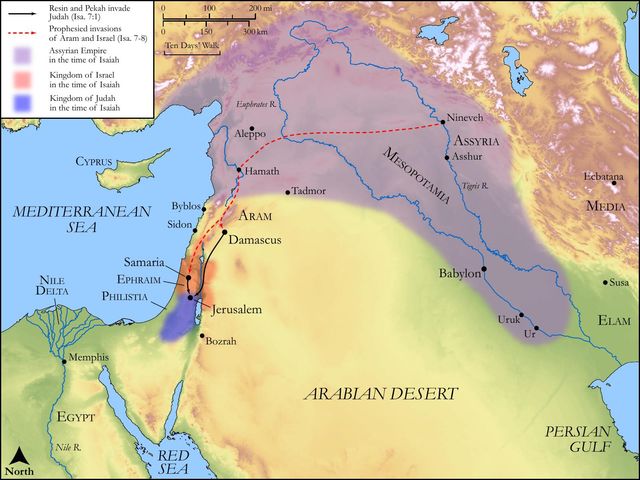
See on the biblical-era map
Study this verse
Public-domain commentary
Matthew Henry
From his Commentary on the Whole Bible. Henry comments on passages, not single verses — this entry covers Isaiah 7:1–9. His four-level outline is real structure in the source text, so it is rendered as structure.
The prophet Isaiah had his commission renewed in the year that king Uzziah died, Isa 6:1. Jotham his son reigned, and reigned well, sixteen years. All that time, no doubt, Isaiah prophesied as he was commanded, and yet we have not in this book any of his prophecies dated in the reign of Jotham; but this, which is put first, was in the days of Ahaz the son of Jotham. Many excellent useful sermons he preached which were not published and left upon record; for, if all that was memorable had been written, the world could not have contained the books, Joh 21:25. Perhaps in the reign of Ahaz, a wicked king, he had not opportunity to preach so much at court as in Jotham's time, and therefore then he wrote the more, for a testimony against them. Here is,
I.A very formidable design laid against Jerusalem by Rezin king of Syria and Pekah king of Israel, two neighbouring potentates, who had of late made descents upon Judah severally. At the end of the reign of Jotham, the Lord began to send against Judah Rezin and Pekah, Kg2 15:37. But now, in the second or third year of the reign of Ahaz, encouraged by their former successes, they entered into an alliance against Judah. Because Ahaz, though he found the sword over his head, began his reign with idolatry, God delivered him into the hand of the king of Syria and of the king of Israel (Ch2 28:5), and a great slaughter they made in his kingdom, Isa 7:6, Isa 7:7. Flushed with this victory, they went up towards Jerusalem, the royal city, to war against it, to besiege it, and make themselves masters of it; but it proved in the issue that they could not gain their point. Note, The sin of a land brings foreign invasions upon it and betrays the most advantageous posts and passes to the enemy; and God sometimes makes one wicked nation a scourge to another; but judgment, ordinarily, begins at the house of God.
II.The great distress that Ahaz and his court were in when they received advice of this design:
It was told the house of David that Syria and Ephraim had signed a league against Judah, Isa 7:2. This degenerate royal family is called the house of David, to put us in mind of that article of God's covenant with David (Psa 89:30-33), If his children forsake my law, I will chasten their transgression with the rod; but my loving-kindness will I not utterly take away, which is remarkably fulfilled in this chapter. News being brought that the two armies of Syria and Israel were joined, and had taken the field, the court, the city, and the country, were thrown into consternation; The heart of Ahaz was moved with fear, and then no wonder that the heart of his people was so, as the trees of the wood are moved with the wind. They were tossed and shaken, and put into a great disorder and confusion, were wavering and uncertain in their counsels, hurried hither and thither, and could not fix in any steady resolution. They yielded to the storm, and gave up all for gone, concluding it in vain to make any resistance. Now that which caused this fright was the sense of guilt and the weakness of their faith. They had made God their enemy, and knew not how to make him their friend, and therefore their fears tyrannised over them; while those whose consciences are kept void of offence, and whose hearts are fixed, trusting in God, need not be afraid of evil tidings; though the earth be removed, yet will not they fear; but the wicked flee at the shaking of a leaf, Lev 26:36.
III.The orders and directions given to Isaiah to go and encourage Ahaz in his distress; not for his own sake (he deserved to hear nothing from God but words of terror, which might add affliction to his grief), but because he was a son of David and king of Judah. God had kindness for him for his father's sake, who must not be forgotten, and for his people's sake, who must not be abandoned, but would be encouraged if Ahaz were. Observe,
1.God appointed the prophet to meet Ahaz, though he did not send to the prophet to speak with him, nor desire him to enquire of the Lord for him (Isa 7:3): Go to meet Ahaz. Note, God is often found of those who seek him not, much more will he be found of those who seek him diligently. He speaks comfort to many who not only are not worthy of it, but do not so much as enquire after it.
3.He ordered him to take his little son with him, because he carried a sermon in his name, Shear-jashub - A remnant shall return. The prophets sometimes recorded what they preached in the significant names of their children (as Hos 1:4, Hos 1:6, Hos 1:9); therefore Isaiah's children are said to be for signs, Isa 8:18. This son was so called for the encouragement of those of God's people who were carried captive, assuring them that they should return, at least a remnant of them, which was more than they could pretend to merit; yet at this time God was better than his word; for he took care not only that a remnant should return, but the whole number of those whom the confederate forces of Syria and Israel had taken prisoners, Ch2 28:15.
3.He directed him where he should find Ahaz. He was to meet with him not in the temple, or the synagogue, or royal chapel, but at the end of the conduit of the upper pool, where he was, probably with many of his servants about him, contriving how to order the water-works, so as to secure them to the city, or deprive the enemy of the benefits of them (Isa 22:9-11; Ch2 32:3, Ch2 32:4), or giving some necessary directions for the fortifying of the city as well as they could; and perhaps finding every thing in a bad posture or defence, the conduit out of repair, as well as other things gone to decay, his fears increased, and he was now in greater perplexity than ever; therefore, Go, meet him there. Note, God sometimes sends comforts to his people very seasonably, and, what time they are most afraid, encourages them to trust in him.
4.He put words in his mouth, else the prophet would not have known how to bring a message of good to such a bad man, a sinner in Zion, that ought to be afraid; but God intended it for the support of faithful Israelites.
(1.)The prophet must rebuke their fears, and advise them by no means to yield to them, but keep their temper, and preserve the possession of their own souls (Isa 7:4): Take heed, and be quiet. Note, In order to comfort there is need of caution; that we may be quiet, it is necessary that we take heed and watch against those things that threaten to disquiet us. "Fear not with this amazement, this fear, that weakens, and has torment; neither let thy heart be tender, so as to melt and fail within thee; but pluck up thy spirits, have a good heart on it, and be courageous; let not fear betray the succours which reason and religion offer for thy support." Note, Those who expect God should help them must help themselves, Psa 27:14.
(2.)He must teach them to despise their enemies, not in pride, or security, or incogitancy (nothing more dangerous than so to despise an enemy), but in faith and dependence upon God. Ahaz's fear called them two powerful politic princes, for either of whom he was an unequal match, but, if united, he durst not look them in the face, nor make head against them. "No," says the prophet, "they are two tails of smoking firebrands; they are angry, they are fierce, they are furious, as firebrands, as fireballs; and they make one another worse by being in a confederacy, as sticks of fire put together burn the more violently. But they are only smoking firebrands: and where there is smoke there is some fire, but it may be not so much as was feared. Their threatenings will vanish into smoke. Pharaoh king of Egypt is but a noise (Jer 46:17), and Rezin king of Syria but a smoke; and such are all the enemies of God's church, smoking flax, that will soon be quenched. Nay, they are but tails of smoking firebrands, in a manner burnt out already; their force is spent; they have consumed themselves with the heat of their own anger; you may put your foot on them, and tread them out." The two kingdoms of Syria and Israel were now near expiring. Note, The more we have an eye to God as a consuming fire the less reason we shall have to fear men, though they are ever so furious, nay, we shall be able to despise them as smoking firebrands.
(3.)He must assure them that the present design of these high allies (so they thought themselves) against Jerusalem should certainly be defeated and come to nothing, Isa 7:5-7.
[1.]That very thing which Ahaz thought most formidable is made the ground of their defeat - and that was the depth of their designs and the height of their hopes: "Therefore they shall be baffled and sent back with shame, because they have taken evil counsel against thee, which is an offence to God. These firebrands are a smoke in his nose (Isa 65:5), and therefore must be extinguished." First, They are very spiteful and malicious, and, therefore they shall not prosper. Judah had done them no wrong; they had no pretence to quarrel with Ahaz; but, without any reason, they said, Let us go up against Judah, and vex it. Note, Those that are vexatious cannot expect to be prosperous, those that love to do mischief cannot expect to do well. Secondly, They are very secure, and confident of success. They will vex Judah by going up against it; yet that is not all: they do not doubt but to make a breach in the wall of Jerusalem wide enough for them to march their army in at; or they count upon dissecting or dividing the kingdom into two parts, one for the king of Israel, the other for the king of Syria, who had agreed in one viceroy - a king to be set in the midst of it, even the son of Tabeal, some obscure person, it is uncertain whether a Syrian or an Israelite. So sure were they of gaining their point that they divided the prey before they had caught it. Note, Those that are most scornful are commonly least successful, for surely God scorns the scorners.
[2.]God himself gives them his word that the attempt should not take effect (Isa 7:7): "Thus saith the Lord God, the sovereign Lord of all, who brings the counsel of the heathen to naught (Psa 33:10), It shall not stand, neither shall it come to pass; their measures shall all be broken, and they shall not be able to bring to pass their enterprise." Note, Whatever stands against God, or thinks to stand without him, cannot stand long. Man purposes, but God disposes; and who is he that saith and it cometh to pass if the Lord commands it not or countermands it? Lam 3:37. See Pro 19:21.
(4.)He must give them a prospect of the destruction of these enemies, at last, that were now such a terror to them.
[1.]They should neither of them enlarge their dominions, nor push their conquests any further; The head city of Syria is Damascus, and the head man of Damascus is Rezin; this he glories in, and this let him be content with, Isa 7:8. The head city of Ephraim has long been Samaria, and the head man in Samaria is now Pekah the son of Remaliah. These shall be made to know their own, their bounds are fixed, and they shall not pass them, to make themselves masters of the cities of Judah, much less to make Jerusalem their prey. Note, As God has appointed men the bounds of their habitation (Act 17:26), so he has appointed princes the bounds of their dominion, within which they ought to confine themselves, and not encroach upon their neighbours' rights.
[2.]Ephraim, which perhaps was the more malicious and forward enemy of the two, should shortly be quite rooted out, and should be so far from seizing other people's lands that they should not be able to hold their own. Interpreters are much at a loss how to compute the sixty-five years within which Ephraim shall cease to be a people; for the captivity of the ten tribes was but eleven years after this: and some make it a mistake of the transcriber, and think it should be read within six and five years, just eleven. But it is hard to allow that. Others make it to be sixty-five years from the time that the prophet Amos first foretold the ruin of the kingdom of the ten tribes; and some late interpreters make it to look as far forward as the last desolation of that country by Esarhaddon, which was about sixty-five years after this; then Ephraim was so broken that it was no more a people. Now it was the greatest folly in the world for those to be ruining their neighbours who were themselves marked for ruin, and so near to it. See what a prophet told them at this time, when they were triumphing over Judah, Ch2 28:10. Are there not with you, even with you, sins against the Lord your God?
(5.)He must urge them to mix faith with those assurances which he had given them (Isa 7:9): "If you will not believe what is said to you, surely you shall not be established; your shaken and disordered state shall not be established, your unquiet unsettled spirit shall not; though the things told you are very encouraging, yet they will not be so to you, unless you believe them, and be willing to take God's word." Note, The grace of faith is absolutely necessary to the quieting and composing of the mind in the midst of all the tosses of this present time, Ch2 20:20.
Historical interpretation
Historical reception
1 surviving comment on this verse from the historical church.
(Verse 3, 4 and following) And the Lord said to Isaiah: Go out to meet Ahaz, you and your son Shear-Jashub, at the end of the conduit of the upper pool on the highway to the Fuller's Field. And say to him: Take heed, be quiet, do not fear, and do not let your heart be faint because of these two smoldering stumps of firebrands, at the fierce anger of Rezin and Syria, and the son of Remaliah. Because Syria, Ephraim, and the son of Remaliah have plotted evil against you, saying: Let us go up against Judah and trouble it, and let us make a gap in its wall for ourselves, and set a king over it, the son of Tabeel. Thus says the Lord God, this will not stand, and this will not be, but the head of Syria is Damascus and the head of Damascus is Rezin, and yet sixty-five years, and Ephraim will cease to be a people. And the head of Ephraim is Samaria, and the head of Samaria is the son of Romelia. If you do not believe, you will not endure. Jasub, the son of Isaiah, who is interpreted as the remnant and turning back, in the likeness of the people of Judah, who was to be saved from the hands of the two kings, is commanded to go out with his parent and meet Ahaz, the king of Judah, by the upper pool of the aqueduct, on the road of the fuller's field, where later we will read, in the time of King Hezekiah, Rabshakeh stood to blaspheme the people of God by order of Sennacherib, the king of Assyria. The place they went out to was the one where the leaders of the city, sent by Hezekiah, were mentioned in the book of Kings. And it is commanded to Ahaz (2 Kings 18), even though he is a wicked king, by the mercy of the Lord, to be silent and not be terrified or afraid in his heart, thinking that he will suffer similar things that he had suffered before. However, he calls the two tails of burning wood, that is, the smoke towers, Rezin the king of Syria and Pekah the son of Remaliah king of Samaria, because the kingdom of Syria, that is, Damascus, and the kingdom of Samaria, that is, the ten tribes, which were called Ephraim by another name, end in them. For it is written (2 Kings 16) that Theglathphalassar, king of the Assyrians, ascended to Damascus under King Ahaz and laid it waste, and carried away its inhabitants to Cyrene, and killed Rasin, and that he plotted against Pekah son of Remaliah, and killed him, and reigned in Israel for nine years in his place, and that Salmanasar, king of Assyria, came and besieged Samaria, which is now called Sebaste, for three years, and in the ninth year of the reign of Hoshea he captured it, and he imprisoned Hoshea and carried Israel away to the Assyrians, and placed them in Halah and in Habor by the River Gozan and in the cities of Media, or as the Septuagint translated, in the mountains of Media (2 Kings 17). For although the wicked kings have devised a plan today to ascend to Judah, whose region is situated in the mountains, and to rouse him from his rest, and in a way, to subdue him to their authority; and to set over him the son of Tabeel, who is interpreted as 'good God', in order to show either a man with this name, or an idol. Nevertheless, thus says the Lord God: This plan shall not stand, but for the time being the head of Syria's cities shall be Damascus, and in that very metropolis, Rasin shall reign. Furthermore, in Ephraim because of Jeroboam the son of Nabath, who was the first ruler of Ephraim, there will be the head of Samaria, that is, the royal house in the city of Samaria, and the head of Samaria will be the son of Romelia, that is, Phacee: however, the kingdom of the ten tribes, that is, the people of Ephraim, will cease to exist after sixty-five years. If we do not pay closer attention, it will not be able to stand. For in the twelfth year of Achaz the son of Joatham in the tribe of Judah, Hoshia ruled over Samaria, and in the ninth year, he was captured by the Assyrian empire (2 Kings 17). However, Achaz reigned over Judah for sixteen years (2 Kings 16), after whose death in the seventh year of his reign, Hoshea was captured and Samaria was destroyed, and the entire people were transported to Media. Thus, if we were to add sixteen years for Achaz and seven for Hoshea, there would be a total of twenty-three years, or at most, twenty-four. So where are the sixty-five years in which the kingdom of Israel is said to be ended? Therefore, the Hebrews explained this passage as follows: Amos, who began prophesying during the reign of Uzziah, also known as Azariah, and Isaiah, who began his prophecy, was the first to prophesy against Israel, saying: But Israel shall be taken captive out of his own land (Amos 7:11, 17). The title of his prophecy against Samaria is: And he began to prophesy in the days of Uzziah, king of Judah, two years before the earthquake, which is said to have occurred at the time when Uzziah entered the temple of God and usurped the priesthood for himself, and the earth shook, and the ashes of the altar were poured out, and the king himself was struck with leprosy (II Chronicles 26). But Ozias wanted there to be twenty-five years when these things happened, of which there remain twenty-seven more years. For Ozias reigned for fifty-two years (2 Kings 15), after him his son Joatham reigned for sixteen years, and his son Achaz for another sixteen years. After him reigned Ezechias, and in the sixth year of his reign, Samaria was captured, making a total of sixty-five years (2 Kings 16). This, the Lord predicting through the prophet, Achaz and the people did not believe the future. Hence it is added: If you do not believe, you will not remain, as Symmachus translated, that is, you will not remain in your kingdom, but you will be led into captivity, enduring the punishment of those whose faithlessness you imitated. Or certainly according to the Septuagint, you will not understand. And the meaning is: because you do not believe what the Lord says will happen, you will not have understanding. These things we have spoken according to history. However, according to the intended symbolism, it should be considered that the prophet Isaiah is commanded to meet the impious king, going out from his place, not at the beginning of the aqueduct, but at the farthest ends of the upper pool, which was in the field of the clothiers, where impurities and stains were cleansed. Although Ahaz reigned over Judah, because he was impious, he dwelled at the farthest ends of the upper pool. Therefore, God does not have such pity on a king whom he regarded as unworthy of salvation as he has for his own people. However, the two tails of smoking torches, as we have previously mentioned, are called secular wisdom and heretical discourse, the end of which is destruction. Those who foolishly devised a plan to rise up against Judah, in order to capture him as if he were careless and asleep, and to associate him with their own errors, and to place the son of Tabeel, that is, a false god, on him. For both adversaries consider the truth to be with themselves, and they estimate that their own doctrine is the best. In the end, the heretic Marcion believes that Christ is the son of the good God, that is, of another, and not of the just one whose prophets he is. He calls him bloody, cruel, and a judge. While they are saying these things, the Lord threatens that their plan will not stand, but for the time being, as long as this world stands, and as long as the things of this world rule in their boundaries and cities. But when the time of the consummation comes, that is, sixty-five years, and both the things of the world that were made in six days, and all that pertains to the five senses, come to an end, then everything will be dissolved, which the gentiles and heretics do not believe will happen, and because of their disbelief, they do not understand what is being said.
Continue studying Isaiah 7:8 across the web’s major study libraries — every link below opens this exact verse, chapter, or book on the destination site.
Read & Compare
 BibleGatewayThis verse in more than 200 translations and 70 languages.
 Bible.comThe YouVersion reader — hundreds of translations, reading plans, and highlights.
 ESV.orgCrossway's official English Standard Version reader.
 NET BibleThe NET translation with 60,000+ translators' notes on every rendering decision.
 STEP BibleTyndale House's free study tool — original text, vocabulary, and scholarly resources.
 BibliaLogos Bible Software's free web reader.
 USCCBThe New American Bible (Revised Edition) with the U.S. bishops' study notes.
Commentaries
 BibleHub CommentariesDozens of classic commentaries on this verse, gathered on one page.
 StudyLightMore than 100 commentary sets — the largest collection on the web.
 BibleRefPlain-English commentary on what this verse means, verse by verse.
 Enduring WordDavid Guzik's free commentary on this chapter, widely used by Bible teachers.
 Bible Study ToolsVerse commentary alongside Greek and Hebrew study aids.
Original Language & Research
- BibleHub InterlinearThe verse word by word — original language, transliteration, and English.
- BibleHub LexiconEvery word's original-language definition and Strong's entry.
 Blue Letter BibleDeep-study tools — Strong's numbers, concordance, and word studies.
 SefariaThe Hebrew text with Rashi and centuries of Jewish commentary.
Sermons, Hymns & Audio


TrulyRandomVerse is not affiliated with these sites and doesn’t control their content. They’re linked because they’re genuinely useful.
Summary
Isaiah 7:8 delivers a precise prophetic declaration from God through the prophet Isaiah to King Ahaz of Judah, who was gripped by fear during the Syro-Ephraimite War. This verse specifically foretells the impending demise of Judah's northern adversaries, stating that Damascus, the capital of Syria, would lose its king, Rezin, and more significantly, that within sixty-five years, the Northern Kingdom of Israel, referred to as Ephraim, would be utterly shattered and cease to exist as a distinct people. This prophecy served as a powerful reassurance of God's absolute sovereignty over nations and His unwavering commitment to His covenant purposes, even in the face of human unbelief.
Context
ShowHideLiterary Context
Isaiah 7:8 is strategically placed within the "Book of Immanuel" (Isaiah 7-12), a pivotal section of Isaiah's prophetic ministry. It immediately follows God's direct message to King Ahaz, who was paralyzed by fear due to the hostile alliance of King Rezin of Syria and King Pekah of Israel (Ephraim). These allied kings sought to overthrow Jerusalem and install a puppet ruler, the "son of Tabeel" (Isaiah 7:1-7). The preceding verses meticulously set the stage for Ahaz's panic and God's gracious offer of a sign, which Ahaz famously refused in a display of feigned piety. Verse 8, therefore, provides concrete details regarding the temporal limits and ultimate failure of the very threat that was causing Ahaz such distress, reinforcing the divine assurance that their plans would not stand. This declaration of the enemies' certain downfall serves as the immediate backdrop and logical precursor to the profound prophecy of Immanuel in Isaiah 7:14, a sign of God's continued presence and faithfulness despite the immediate crisis and Ahaz's profound lack of faith.
Historical & Cultural Context
The historical backdrop for Isaiah 7:8 is the Syro-Ephraimite War, which unfolded around 735-734 BC. During this period, the Northern Kingdom of Israel (Ephraim) under King Pekah and Aram (Syria) under King Rezin formed an anti-Assyrian coalition. Their objective was to coerce Judah into joining their alliance by attacking Jerusalem and threatening to replace King Ahaz with a more compliant ruler (Isaiah 7:6). Judah, a smaller kingdom, found itself precariously positioned between these two hostile neighbors and the rapidly expanding superpower of Assyria, which was aggressively extending its empire westward. Culturally, the people of Judah, like other ancient Near Eastern nations, would have readily understood the "head" of a kingdom to signify its capital city and its reigning monarch. Thus, the prophecy's explicit focus on Damascus and Rezin, followed by Ephraim's dissolution, would have carried immense significance in terms of national identity, political power, and the ultimate fate of empires in a region dominated by imperial ambitions.
Key Themes
ShowHideThis verse powerfully underscores several major themes prevalent in the book of Isaiah and broader biblical theology. Firstly, it highlights Divine Sovereignty Over Nations, demonstrating unequivocally that God, not earthly kings or military alliances, ultimately controls the destiny of kingdoms. Despite the formidable threat posed by Syria and Ephraim, God declares their predetermined end, showcasing His absolute authority over all human affairs and political powers, a theme profoundly echoed in passages like Daniel 2:21. Secondly, it emphasizes Prophetic Precision and Fulfillment. The specific timeframe of "within threescore and five years" for Ephraim's destruction, while initially perplexing given Samaria's fall in 722 BC (around 13 years after this prophecy, as recorded in 2 Kings 17:6), points to a more complete and irreversible dispersion and loss of national identity. This deeper fulfillment likely refers to later Assyrian policies, such as Esarhaddon's resettlement of foreign peoples into Samaria around 670 BC (735 BC - 65 years = 670 BC), which effectively erased Ephraim as a distinct political entity and people group within the land. Lastly, the verse reinforces The Certainty of God's Word, serving as a strong assurance to Ahaz and Judah that God's plan would prevail, regardless of the immediate circumstances or the perceived strength of their enemies, a truth foundational to the entire book of Isaiah.
Exposition and Analysis
ShowHideKey Word Analysis
ShowHideThis term (H7218) literally refers to the physical head, but figuratively, as used here, it denotes the chief, beginning, principal, or ruler. In the context of a nation, it signifies the capital city or the supreme authority. Thus, "the head of Syria is Damascus" means Damascus is the capital and seat of power for Syria, and "the head of Damascus is Rezin" identifies Rezin as the supreme ruler of that capital and, by extension, the entire Syrian kingdom. This emphasizes the source of the threat Ahaz faced, identifying the key figures and places whose power God was about to dismantle.
This proper noun (H1834) refers to the ancient city of Damascus, the capital of Syria (Aram). Its inclusion here highlights the specific geopolitical entity that was a primary aggressor against Judah. The prophecy's declaration concerning Damascus and its king, Rezin, directly addresses the immediate threat perceived by King Ahaz, underscoring God's direct intervention in the affairs of these powerful nations.
This proper noun (H669) refers to the dominant tribe of the Northern Kingdom of Israel, often used as a metonym for the entire kingdom itself. The prophecy's focus on Ephraim signifies the comprehensive judgment awaiting the rebellious Northern Kingdom, which had continually turned away from God. This specific mention emphasizes that the judgment is not merely on a city or a king, but on an entire people group that had forsaken its covenant relationship with Yahweh.
The Hebrew verb (H2865) means "to prostrate," "to break down," or "to dismay." It conveys a sense of being shattered, terrified, or utterly destroyed. In this context, it implies more than just military defeat; it signifies a complete collapse leading to the loss of national identity and cohesion for Ephraim. This is not merely a setback but a comprehensive and irreversible judgment that would dismantle their societal and political structure, rendering them incapable of functioning as a distinct entity.
This noun (H5971) refers to a people as a congregated unit, a tribe, or a nation. When the prophecy states that Ephraim would be "broken, that it be not a people," it means that Ephraim would lose its distinct national identity, its cohesion as a united ethnic and political entity. This goes beyond mere conquest; it speaks to a profound and permanent dissolution, where the very concept of "Ephraim" as a self-governing, identifiable nation would cease to exist within the land.
Verse Breakdown
ShowHide"For the head of Syria [is] Damascus, and the head of Damascus [is] Rezin;"
This initial clause precisely identifies the political and military leadership of Judah's immediate adversaries. Syria (Aram) is personified by its capital, Damascus, and Damascus is personified by its king, Rezin. This establishes the clear targets of the divine pronouncement, highlighting the specific powers that Ahaz feared and whose plans God was about to nullify. It sets the stage by acknowledging the perceived strength and organization of the enemy, only to then declare their certain downfall.
"and within threescore and five years shall Ephraim be broken, that it be not a people."
This is the core prophetic declaration concerning the Northern Kingdom of Israel, referred to here by its dominant tribe, Ephraim. The phrase "threescore and five years" (65 years) provides a remarkably precise, long-term timeline for Ephraim's ultimate demise. While Samaria, Ephraim's capital, fell to Assyria in 722 BC (only about 13 years after this prophecy in 735 BC), the "broken, that it be not a people" aspect points to a more thorough and permanent dispersion and loss of national identity. This was fulfilled around 670 BC, when Esarhaddon, the Assyrian king, enacted policies of mass deportation and resettlement of foreign peoples into Samaria, effectively dissolving Ephraim's distinct socio-political and ethnic identity within the land. This demonstrates God's long-range foresight and the comprehensive nature of His judgment, which extended beyond mere military defeat to the complete eradication of a national entity.
Literary Devices
ShowHideIsaiah 7:8 employs several potent Literary Devices to convey its message of divine judgment and sovereignty. The primary device is Prophecy, a direct, declarative statement of future events, demonstrating God's foreknowledge and absolute control over history. The specific mention of "threescore and five years" adds a layer of remarkable Precision to this prophecy, emphasizing the certainty and measured nature of God's predetermined plan, even if its full fulfillment extended beyond immediate events. The phrase "the head of Syria [is] Damascus, and the head of Damascus [is] Rezin" utilizes Synecdoche (a part representing the whole) or Metonymy, where the capital city stands for the entire nation, and the king for the capital, establishing the clear and identifiable targets of the divine decree. Finally, the declaration that Ephraim "shall be broken, that it be not a people" employs Hyperbole or Intensification to underscore the completeness and finality of the judgment. It's not merely a defeat but an utter obliteration of national identity, a state of non-existence as a distinct political and ethnic entity, highlighting the severity and comprehensive nature of God's impending judgment on a rebellious people.
Theological and Thematic Connections
ShowHideIsaiah 7:8 stands as a profound testament to God's absolute sovereignty over human history and the destiny of nations. It reveals that no earthly power, no matter how formidable or threatening, can ultimately thwart the divine will. God's prophetic word is not merely a prediction but a declaration of His predetermined plan, which will inevitably come to pass. This verse assures us that even in times of national crisis or personal fear, God remains enthroned, actively orchestrating events to fulfill His purposes, whether those purposes involve judgment on rebellious nations or the preservation of His covenant people. It underscores the reliability of divine promises and warnings, reminding believers that trust in God's word is the only true source of security and stability in a world of constant flux.
Reflection and Application
ShowHideIsaiah 7:8 offers a powerful anchor for our faith in a world often characterized by political turmoil, national anxieties, and personal fears. Just as King Ahaz was paralyzed by the perceived strength of his enemies, we too can become overwhelmed by daunting circumstances, whether they are global crises, national challenges, or deeply personal struggles. This verse reminds us that God is not a passive observer but the ultimate orchestrator of history, holding the reins of power over all nations and their leaders. Our security is not found in human alliances, military might, or political strategies, but in humble reliance upon the unchanging character and infallible word of God. When facing overwhelming odds, we are called to remember that God's purposes will prevail, and His promises are certain. This should inspire a deep sense of peace and courageous trust, knowing that the God who foretold the end of mighty kingdoms with such precision is the same God who sovereignly cares for every detail of our lives, calling us to respond in faith, not fear.
Questions for Reflection
ShowHideFAQ
ShowHideWhat is the significance of the "threescore and five years" prophecy in Isaiah 7:8, given that Samaria fell much sooner?
ShowHideThe "threescore and five years" (65 years) prophecy refers to a more complete and irreversible dissolution of Ephraim's national identity, extending beyond just the initial military defeat. While the capital of the Northern Kingdom, Samaria, fell to the Assyrians in 722 BC (approximately 13 years after Isaiah's prophecy in 735 BC, as recorded in 2 Kings 17:6), the 65-year timeline points to a later, more thorough depopulation and resettlement policy. This was likely fulfilled around 670 BC (735 BC - 65 years = 670 BC), when the Assyrian king Esarhaddon enacted policies of mass deportation and the resettlement of foreign peoples into the territory of Samaria. This strategic move effectively erased Ephraim as a distinct political and ethnic entity within the land, fulfilling the prophecy that it would "be broken, that it be not a people." This demonstrates the long-term scope and precision of God's prophetic word, which often encompasses multiple stages of fulfillment, culminating in a comprehensive and permanent change.
How does Isaiah 7:8 relate to the broader "Immanuel prophecy" in Isaiah 7?
ShowHideIsaiah 7:8 provides the immediate and crucial context for the "Immanuel prophecy" that follows in Isaiah 7:14. King Ahaz was terrified by the Syro-Ephraimite alliance, whose leaders, Rezin and Pekah, are explicitly mentioned in verse 8. God, through Isaiah, first reassures Ahaz that the plans of these two kings will not stand (Isaiah 7:7), and then, in verse 8, gives a specific timeline for their ultimate demise and the complete dissolution of Ephraim. This declaration of the enemies' certain downfall is the very foundation upon which the sign of Immanuel is offered. The promise of "God with us" (Immanuel) is given precisely because Ahaz is afraid of these specific adversaries whose fate has just been sealed by divine decree. Thus, Isaiah 7:8 highlights the immediate crisis that the Immanuel prophecy addresses, underscoring God's active presence and faithfulness in the midst of national threat and human unbelief, demonstrating that His presence is the ultimate security.
Christ-Centered Fulfillment
ShowHideThe divine sovereignty over nations declared in Isaiah 7:8 finds its ultimate and most profound fulfillment in the person and work of Jesus Christ. While earthly kingdoms rise and fall, and their "heads" are broken, Christ is the eternal "Head" over all creation and every authority. As Colossians 1:16-17 proclaims, "For by him all things were created, in heaven and on earth, visible and invisible, whether thrones or dominions or rulers or authorities—all things were created through him and for him. And he is before all things, and in him all things hold together." The breaking of Ephraim, signifying the end of a distinct earthly people group, foreshadows the spiritual reality that in Christ, national and ethnic distinctions are transcended for those who believe. As Galatians 3:28 states, "There is neither Jew nor Gentile, neither slave nor free, nor is there male and female, for you are all one in Christ Jesus." Though His kingdom is "not of this world" (John 18:36), Christ ultimately reigns supreme, and the day will come when "the kingdom of the world has become the kingdom of our Lord and of his Christ, and he shall reign forever and ever" (Revelation 11:15). Thus, the precise judgment on Ephraim serves as a microcosm of God's ultimate control over all history, culminating in the universal reign of the Messiah, who alone is the true and everlasting Head, the Immanuel promised to a fearful world.