


Jeremiah 46:17
Bible text: King James Version (1769 Blayney text) · Public domain
Bible text: Berean Standard Bible · Public domain
Bible text: American Standard Version (1901) · Public domain
Bible text: World English Bible, Messianic edition · Public domain
Bible text: Geneva Bible (1599) · Public domain
Bible text: Young's Literal Translation · Public domain
- קָרְאוּka·re·'Upeople will call outH7121V-Qal-Perf-3cpVerb Qal Perfect 3rd Plural common gender
- שָׁםShamthereH8033AdvAdverb
- פַּרְעֹהpar·'OhPharaohH6547N-msNoun Title Singular Masculine Absolute
- מֶלֶךְMe·lekh[the] king ofH4428N-mscNoun Singular Masculine Construct
- מִצְרַיִםmitz·Ra·yimEgyptH4714N-properNoun Proper Location
- שָׁאוֹןsha·'on[is] a noiseH7588N-msNoun Singular Masculine Absolute
- הֶעֱבִירhe·'e·Virhe has let pass byH5674V-Hiphil-Perf-3msVerb Hiphil Perfect 3rd Singular Masculine
- הַמּוֹעֵדha·mo·'Edthe appointed timeH4150Art ¦ N-msNoun Singular Masculine Absoluteהַtheמּוֹעֵדappointed time
English is a literal word-by-word gloss of the Hebrew, not the KJV's wording. Why?
This is the original text the KJV's translators worked from — each Hebrew word with its own literal English meaning in this verse, prepared by scholars at Tyndale House, Cambridge. The KJV translates whole sentences, not word by word, so its wording differs: one Hebrew word can become several English words, and the KJV may choose “the LORD” where the gloss reads “Yahweh”. Both are faithful — they answer different questions. For the KJV's own rendering, switch to the KJV text.
Details
See on the biblical-era map
Study this verse
Public-domain commentary
Matthew Henry
From his Commentary on the Whole Bible. Henry comments on passages, not single verses — this entry covers Jeremiah 46:13–28. His three-level outline is real structure in the source text, so it is rendered as structure.
In these verses we have,
I.Confusion and terror spoken to Egypt.
The accomplishment of the prediction in the former part of the chapter disabled the Egyptians from making any attempts upon other nations; for what could they do when their army was routed? But still they remained strong at home, and none of their neighbours durst make any attempts upon them. Though the kings of Egypt came no more out of their land (Kg2 24:7), yet they kept safe and easy in their land; and what would they desire more than peaceably to enjoy their own? One would think all men should be content to do this, and not covet to invade their neighbours. But the measure of Egypt's iniquity is full, and now they shall not long enjoy their own; those that encroached on others shall not be themselves encroached on. The scope of the prophecy here is to show how the king of Babylon should shortly come and smite the land of Egypt, and bring the war into their own bosoms which they had formerly carried into his borders, Jer 46:13. This was fulfilled by the same hand with the former, even Nebuchadnezzar's, but many years after, twenty at least, and probably the prediction of it was long after the former prediction, and perhaps much about the same time with that other prediction of the same event which we had Jer 43:10.
1.Here is the alarm of war sounded in Egypt, to their great amazement (Jer 46:14), notice given to the country that the enemy is approaching, the sword is devouring round about in the neighbouring countries, and therefore it is time for the Egyptians to put themselves in a posture of defence, to prepare for war, that they may give the enemy a warm reception. This must be proclaimed in all parts of Egypt, particularly in Migdol, Noph, and Tahpanhes, because in these places especially the Jewish refugees, or fugitives rather, had planted themselves, in contempt of God's command (Jer 44:1), and let them hear what a sorry shelter Egypt is likely to be to them.
2.The retreat hereupon of the forces of other nations which the Egyptians had in their pay is here foretold. Some considerable number of those troops, it is probable, were posted upon the frontiers to guard them, where they were beaten off by the invaders and put to flights. Then were the valiant men swept away (Jer 46:15) as with a sweeping rain (it is the word that is used Pro 28:3); they can none of them stand their ground, because the Lord drives them from their respective posts; he drives them by his terrors; he drives them by enabling the Chaldeans to drive them. It is not possible that those should fix whom the wrath of God chases. He it was (Jer 46:16) that made many to fall, yea, when their day shall come to fall, the enemy needs not throw them down, they shall fall one upon another, every man shall be a stumbling-block to his fellow, to his follower; nay, if God please, they shall be made to fall upon one another, they shall be made to fall upon one another, every man's sword shall be against his fellow. Her hired men, the troops Egypt has in he service, are indeed in the midst of her like fatted bullocks, lusty men, able bodied and high spirited, who were likely for action and promised to make their part good against the enemy; but they are turned back; their hearts failed them, and, instead of fighting, they have fled away together. How could they withstand their fate when the day of their calamity had come, the day in which God will visit them in wrath? Some think they are compared to fatted bullocks for their luxury; they had wantoned in pleasures, so that they were very unfit for hardships, and therefore turned back and could not stand. In this consternation,
(1.)They all made homeward towards their own country (Jer 46:16): They said, "Arise, and let us go again to our own people, where we may be safe from the oppressing sword of the Chaldeans, that bears down all before it." In times of exigence little confidence is to be put in mercenary troops, that fight purely for pay, and have no interest in theirs whom they fight for.
(2.)They exclaimed vehemently against Pharaoh, to whose cowardice or bad management, it is probably, their defeat was owing. When he posted them there upon the borders of his country it is probably that he told them he would within such a time come himself with a gallant army of his own subjects to support them; but he failed them, and, when the enemy advanced, they found they had none to back them, so that they were perfectly abandoned to the fury of the invaders. No marvel then that they quitted their post and deserted the service, crying out, Pharaoh king of Egypt is but a noise (Jer 46:17); he can hector, and talk big of the mighty things he would do, but that is all; he brings nothing to pass. All his promises to those in alliance with him, or that are employed for him, vanish into smoke. He brings not the succours he engaged to bring, or not till it is too late: He has passed the time appointed; he did not keep his word, nor keep his day, and therefore they bid him farewell, they will never serve under him any more. Note, Those that make most noise in any business are frequently but a noise. Great talkers are little doers.
3.The formidable power of the Chaldean army is here described as bearing down all before it. The King of kings, whose name is the Lord of hosts, and before whom the mightiest kings on earth, though gods to us, are but as grasshoppers, he hath said it, he hath sworn it, As I live, saith this king, as Tabor overtops the mountains and Carmel overlooks the sea, so shall the king of Babylon overpower all the force of Egypt, such a command shall he have, such a sway shall he bear, Jer 46:18. He and his army shall come against Egypt with axes, as hewers of wood (Jer 46:22), and the Egyptians shall be no more able to resist them than the tree is to resist the man that comes with an axe to cut it down; so that Egypt shall be felled as a forest is by the hewers of wood, which (if there by many of them, and those well provided with instruments for the purpose) will be done in a little time. Egypt is very populous, full of towns and cities, like a forest, the trees of which cannot be searched or numbered, and very rich, full of hidden treasures, many of which will escape the searching eye of the Chaldean soldiers; but they shall make a great spoil in the country, for they are more than the locusts, that come in vast swarms and overrun a country, devouring every green thing (Joe 1:6, Joe 1:7), so shall the Chaldeans do, for they are innumerable. Note, The Lord of hosts hath numberless hosts at his command.
4.The desolation of Egypt hereby is foretold, and the waste that should be made of that rich country. Egypt is now like a very fair heifer, or calf (Jer 46:20), fat and shining, and not accustomed to the yoke of subjection, wanton as a heifer that is well fed, and very sportful. Some think here is an allusion to Apis, the bull or calf which the Egyptians worshipped, from whom the children of Israel learned to worship the golden calf. Egypt is as fair as a goddess, and adores herself, but destruction comes; cutting up comes (so some read it); it comes out of the north; thence the Chaldean soldiers shall come, as so many butchers or sacrificers, to kill and cut up this fair heifer.
(1.)The Egyptians shall be brought down, shall be tamed, and their tune changed: The daughters of Egypt shall be confounded (Jer 46:24), shall be filled with astonishment. Their voice shall go like a serpent, that is, it shall be very low and submissive; they shall not low like a fair heifer, that makes a great noise, but hiss out of their holes like serpents. They shall not dare to make loud complaints of the cruelty of the conquerors, but vent their griefs in silent murmurs. They shall not now, as they used to do, answer roughly, but, with the poor, use entreaties and beg for their lives.
(2.)They shall be carried away prisoners into their enemy's land (Jer 46:19): "O thou daughter! dwelling securely and delicately in Egypt, that fruitful pleasant country, do not think this will last always, but furnish thyself to go into captivity; instead of rich clothes, which will but tempt the enemy to strip thee, get plain and warm clothes; instead of fine shoes, provide strong ones; and inure thyself to hardship, that thou mayest bear it the better." Note, It concerns us, among all our preparations, to prepare for trouble. We provide for the entertainment of our friends, let us not neglect to provide for the entertainment of our enemies, nor among all our furniture omit furniture for captivity. The Egyptians must prepare to flee; for their cities shall be evacuated. Noph particularly shall be desolate, without an inhabitant, so general shall the slaughter and the captivity be. There are some penalties which, we say, the king and the multitude are exempted from, but here even these are obnoxious: The multitude of No shall be punished: it is called populous No, Nah 3:8. Though hand join in hand, yet they shall not escape; nor can any think to go off in the crowd. Be they ever so many, they shall find God will be too many for them. Their kings and all their petty princes shall fall; and their gods too (Jer 43:12, Jer 43:13), their idols and their great men. Those which they call their tutelar deities shall be no protection to them. Pharaoh shall be brought down, and all those that trust in him (Jer 46:25), particularly the Jews that came to sojourn in his country, trusting in him rather than in God. All these shall be delivered into the hands of the northern nations (Jer 46:24), into the hand not only of Nebuchadnezzar that mighty potentate, but into the hands of his servants, according to the curse on Ham's posterity, of which the Egyptians were, that they should be the servants of servants. These seek their lives, and into their hands they shall be delivered.
5.An intimation is given that in process of time Egypt shall recover itself again (Jer 46:26): Afterwards it shall be inhabited, shall be peopled again, whereas by this destruction it was almost dispeopled. Ezekiel foretels that this should be at the end of forty years, Eze 29:13. See what changes the nations of the earth are subject to, how they are emptied and increased again; and let not nations that prosper be secure, nor those that for the present are in thraldom despair.
II.Comfort and peace are here spoken to the Israel of God, Jer 46:27, Jer 46:28.
Some understand it of those whom the king of Egypt had carried into captivity with Jehoahaz, but we read not of any that were carried away captives with him; it may therefore rather refer to the captives in Babylon, whom God had mercy in store for, or, more generally, to all the people of God, designed for their encouragement in the most difficult times, when the judgments of God are abroad among the nations. We had these words of comfort before, Jer 30:10, Jer 30:11.
1.Let the wicked of the earth tremble, they have cause for it; but fear not thou, O my servant Jacob! and be not dismayed, O Israel! and again, Fear thou not, O Jacob! God would not have his people to be a timorous people.
2.The wicked of the earth shall be put away like dross, not be looked after any more; but God's people, in order to their being saved, shall be found out and gathered though they be far off, shall be redeemed though they be held fast in captivity, and shall return.
3.The wicked is like the troubled sea when it cannot rest; they flee when none pursues. But Jacob, being at home in God, shall be at rest and at ease, and none shall make him afraid; for what time he is afraid he has a God to trust to.
4.The wicked God beholds afar off; but, wherever thou art, O Jacob! I am with thee, a very present help.
5.A full end shall be made of the nations that oppressed God's Israel, as Egypt and Babylon; but mercy shall be kept in store for the Israel of God: they shall be corrected, but not cast off; the correction shall be in measure, in respect of degree and continuance. Nations have their periods; the Jewish nation itself has come to an end as a nation; but the gospel church, God's spiritual Israel, still continues, and will to the end of time; in that this promise is to have its full accomplishment, that, though God correct it, he will never make a full end of it.
Continue studying Jeremiah 46:17 across the web’s major study libraries — every link below opens this exact verse, chapter, or book on the destination site.
Read & Compare
 BibleGatewayThis verse in more than 200 translations and 70 languages.
 Bible.comThe YouVersion reader — hundreds of translations, reading plans, and highlights.
 ESV.orgCrossway's official English Standard Version reader.
 NET BibleThe NET translation with 60,000+ translators' notes on every rendering decision.
 STEP BibleTyndale House's free study tool — original text, vocabulary, and scholarly resources.
 BibliaLogos Bible Software's free web reader.
 USCCBThe New American Bible (Revised Edition) with the U.S. bishops' study notes.
Commentaries
 BibleHub CommentariesDozens of classic commentaries on this verse, gathered on one page.
 StudyLightMore than 100 commentary sets — the largest collection on the web.
 BibleRefPlain-English commentary on what this verse means, verse by verse.
 Enduring WordDavid Guzik's free commentary on this chapter, widely used by Bible teachers.
 Bible Study ToolsVerse commentary alongside Greek and Hebrew study aids.
Original Language & Research
- BibleHub InterlinearThe verse word by word — original language, transliteration, and English.
- BibleHub LexiconEvery word's original-language definition and Strong's entry.
 Blue Letter BibleDeep-study tools — Strong's numbers, concordance, and word studies.
 SefariaThe Hebrew text with Rashi and centuries of Jewish commentary.
Sermons, Hymns & Audio


TrulyRandomVerse is not affiliated with these sites and doesn’t control their content. They’re linked because they’re genuinely useful.
Summary
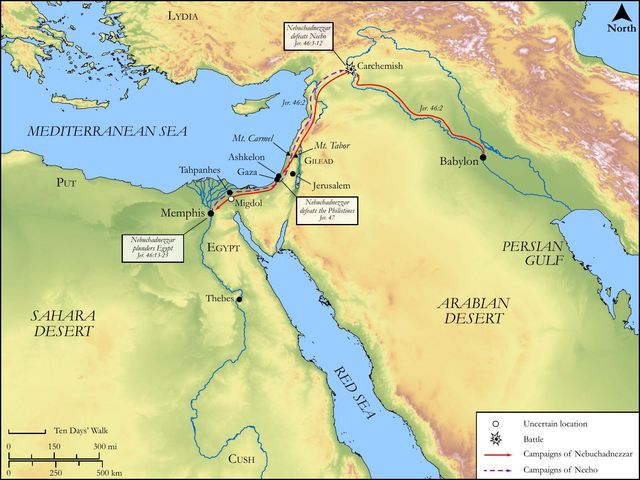
Jeremiah 46:17 delivers a scathing prophetic indictment against Egypt and its formidable king, Pharaoh Necho II, following their devastating defeat by Babylon at the pivotal Battle of Carchemish. The verse vividly portrays the once-mighty Egyptian monarch as reduced to a mere "noise," signifying his utter loss of power and influence, whose divinely appointed season of dominance has irrevocably passed. It stands as a stark declaration of the transient nature of all earthly power and a powerful affirmation of God's ultimate sovereignty over the rise and fall of nations.
Context
ShowHideLiterary Context
Jeremiah 46 marks the beginning of a significant prophetic section within the book (chapters 46-51), which contains oracles against various foreign nations. This particular chapter is dedicated entirely to Egypt, commencing with a detailed prophecy concerning Pharaoh Necho's army and its ignominious defeat at the Battle of Carchemish (Jeremiah 46:2-12). Following this initial declaration of military failure, Jeremiah broadens his scope to a comprehensive prophecy of Nebuchadnezzar's subsequent invasion and conquest of Egypt itself (Jeremiah 46:13-26). Within this broader context, verse 17 functions as a poignant, derisive epitaph for Pharaoh's diminished status. It is a public taunt, likely uttered by those who witnessed or heard of Egypt's downfall, reinforcing the divine judgment articulated throughout the chapter and highlighting the stark contrast between Egypt's former pride and its profound humiliation.
Historical & Cultural Context
The historical setting for Jeremiah 46:17 is the turbulent geopolitical landscape of the late 7th and early 6th centuries BC. Egypt, under the leadership of Pharaoh Necho II, was a dominant regional power, frequently contending for influence with the ascendant Babylonian empire and the declining Assyrian empire. The critical event referenced is the Battle of Carchemish in 605 BC, where Nebuchadnezzar of Babylon decisively routed the combined Egyptian and Assyrian forces. This battle was a watershed moment, effectively ending Egyptian hegemony in the Levant and ushering in an era of Babylonian supremacy. Culturally, pharaohs were revered as divine or semi-divine rulers, their authority considered absolute and their armies seemingly invincible. The public declaration that "Pharaoh king of Egypt is but a noise" would have been an extraordinarily shocking and profoundly humiliating statement, dismantling the very foundations of Egyptian imperial pride, religious claims, and military reputation.
Key Themes
ShowHideThis verse powerfully contributes to several overarching themes evident within the book of Jeremiah and the broader prophetic corpus. Firstly, it underscores the Futility of Human Power, demonstrating unequivocally that even the most formidable earthly rulers and empires are ultimately transient and subject to the will of the Almighty. Pharaoh, once a symbol of unassailable strength, is reduced to an empty "noise," illustrating the ephemeral nature of worldly might and the danger of trusting in human strength (compare with Isaiah 2:22). Secondly, it highlights Divine Sovereignty Over Nations, asserting that God actively orchestrates the rise and fall of kingdoms according to His predetermined purposes. Pharaoh's "time appointed" was divinely determined, and its expiration signifies God's active involvement in human history, a truth powerfully echoed in passages like Daniel 2:21. Finally, the phrase "he hath passed the time appointed" introduces the theme of Lost Opportunity and Inevitable Judgment, implying that there was a set period for Egypt's dominance, and once that period expired, its downfall was assured, reflecting a broader biblical principle of divine timing and accountability for nations (Amos 1-2).
Exposition and Analysis
ShowHideKey Word Analysis
ShowHideThis primitive root means "to call out to," "address by name," "proclaim," or "publish." In the context of Jeremiah 46:17, it does not denote a cry of lamentation from the Egyptians, but rather a public, perhaps mocking or derisive, declaration made by those observing or commenting on Egypt's downfall. It suggests a widely disseminated pronouncement of Pharaoh's diminished status.
Derived from a root meaning "to rush," this noun signifies "uproar," "tumult," "din," and by implication, "destruction" or "pomp." Here, it is used with profound derision to describe Pharaoh's once-feared presence, his boasts, and the clamor of his mighty army as nothing more than empty sound, devoid of substance or effective power after his crushing defeat. His former "pomp" and formidable reputation have become mere "noise."
These two words, H5674 and H4150, combine to form a crucial theological statement. ʻâbar (H5674) means "to cross over," "pass by," or "transgress," denoting any transition. môwʻêd (H4150) refers to "an appointment," "a fixed time or season," "a festival," or "a place of meeting." Together, "passed the time appointed" signifies that Pharaoh's divinely allotted period of power, influence, or opportunity has expired. It implies a divinely set deadline or a missed opportunity for action or repentance, leading to inevitable decline and judgment.
Verse Breakdown
ShowHide"They did cry there"
This opening clause establishes the public nature of the pronouncement. "They" refers to those who are witnessing or commenting on Egypt's humiliation, likely the people of Judah or other nations affected by the geopolitical shift. "There" points to the place where this news was heard and disseminated, perhaps Judah or the broader Levant, signifying that the downfall of Pharaoh was a widely recognized and declared truth. It sets a tone of public derision and proclamation.
"Pharaoh king of Egypt [is but] a noise"
This is the heart of the prophetic taunt. Pharaoh, the very embodiment of Egyptian power, pride, and perceived divinity, is stripped of all dignity and reduced to an empty "noise" or "uproar." This powerful metaphor signifies that his once-feared boasts, his military might, and his reputation for invincibility are now revealed as hollow, ineffective, and utterly without substance. His empire's formidable presence has evaporated, leaving behind only the echo of what once was.
"he hath passed the time appointed"
This concluding clause provides the profound theological explanation for Pharaoh's downfall. His period of dominance, his divinely allotted season of power and influence, has definitively come to an end. This is not merely a military defeat but a fulfillment of a predetermined divine schedule. It implies that God had set a limit to Pharaoh's authority and that limit has now been reached and surpassed, leading to his inevitable decline and the rise of a new, divinely sanctioned power.
Literary Devices
ShowHideJeremiah 46:17 masterfully employs several potent literary devices to convey its message of divine judgment and the transience of earthly power. The most prominent is Metaphor, where Pharaoh, a mighty and revered king, is directly equated with "a noise" (shâʼôwn). This direct identification, rather than a simile, powerfully conveys his utter loss of substance, authority, and effective power. His former pomp and military might are now reduced to an empty sound, a mere echo of past glory. This reduction also borders on Hyperbole, as it exaggerates his diminished state to emphasize the completeness of his humiliation. Furthermore, there is a strong element of Irony: the king who once commanded a vast army and was considered a god-like figure is now mocked as insignificant and ineffectual. The phrase "passed the time appointed" functions as a form of Euphemism for divine judgment or the end of a divinely ordained era, subtly hinting at God's sovereign control over historical events without explicitly stating "God judged him." The overall tone of the verse is one of profound Derision and Triumph, reflecting the prophetic perspective on the downfall of an oppressor and the vindication of God's sovereign word.
Theological and Thematic Connections
ShowHideJeremiah 46:17 serves as a powerful theological statement on the absolute transience of human power and the unassailable sovereignty of God over all nations and their rulers. It decisively debunks the myth of invincible earthly empires, demonstrating that even the most formidable kingdoms and their leaders operate strictly within divinely appointed boundaries and seasons. Pharaoh's reduction from a mighty, god-like king to a mere "noise" profoundly underscores that true authority and enduring power reside solely with the Lord, who orchestrates the rise and fall of kingdoms according to His eternal purposes and perfect timing. This verse is a profound testament to God's active and meticulous control over the unfolding of human history, reminding us that no human boast, military might, or political prowess can ultimately thwart His will or extend beyond His ordained season.
Reflection and Application
ShowHideJeremiah 46:17 offers profound and enduring insights for contemporary life, compelling us to critically re-evaluate where we place our ultimate trust and how we perceive and pursue power. In a world often captivated by human achievement, political might, economic prowess, and personal influence, this verse serves as a sobering and necessary reminder that all earthly glory is fleeting, temporal, and ultimately subject to the sovereign hand of God. It challenges us to cultivate a deep sense of humility, recognizing that our own "appointed times" for influence, success, or even life itself, are finite and divinely ordained. This profound truth should inspire us to steward our time, talents, and resources with wisdom and intentionality, focusing on eternal values and God's kingdom rather than on accumulating temporal gains or fleeting accolades. Moreover, this verse provides immense comfort and reassurance to those who feel overwhelmed or intimidated by powerful earthly forces, assuring us that God remains immutably on His throne, orchestrating history and holding all rulers and systems accountable. Our ultimate hope, security, and allegiance must therefore rest in Him alone, not in the passing "noise" of human endeavors or the transient promises of this world.
Questions for Reflection
ShowHideFAQ
ShowHideWhat was the "time appointed" that Pharaoh passed?
ShowHideThe "time appointed" (Hebrew: môwʻêd) refers to the divinely ordained period of Pharaoh's (and by extension, Egypt's) dominance and influence in the region. It was a set season or opportunity that God had allowed for Egypt's power and regional supremacy. Pharaoh Necho II "passed" or "missed" this appointed time, meaning his era of supremacy had expired, particularly after the decisive defeat at the Battle of Carchemish in 605 BC. This marked the end of Egypt's significant control over the Levant and ushered in the Babylonian Empire's rise, demonstrating God's sovereign control over the rise and fall of nations, as seen in Daniel 2:21.
Why is Pharaoh referred to as "but a noise"?
ShowHideCalling Pharaoh "but a noise" (Hebrew: shâʼôwn) is a powerful, derisive metaphor used to convey his utter humiliation and the complete collapse of his power. It signifies that his former boasts, his formidable military reputation, and his perceived invincibility have become hollow, empty, and ineffective. The "noise" represents the clamor and pomp of his once-great army and empire, now reduced to an ineffective din or an empty echo. It highlights the stark contrast between his former glory and his current humiliation, emphasizing that his power has vanished, leaving only an insignificant sound. This prophetic taunt underscores the futility of human pride and strength when confronted with divine judgment, a theme echoed in Isaiah 2:22.
Christ-Centered Fulfillment
ShowHideJeremiah 46:17, with its stark declaration of the futility of human power and the absolute sovereignty of God over all nations, finds its ultimate fulfillment and most profound meaning in the person and redemptive work of Jesus Christ. While earthly kings like Pharaoh rise and fall, their "appointed times" coming to an inevitable end, Jesus is the eternal King, whose kingdom "shall never be destroyed" (Daniel 2:44). The fleeting "noise" of Pharaoh's boastful power and transient empire contrasts sharply with the quiet, humble, yet infinitely powerful authority of Christ, who did not come to be served but to serve and to give His life as a ransom for many (Mark 10:45). All human empires, with their pomp, their military might, and their perceived invincibility, are but fleeting shadows compared to the everlasting reign of the "King of kings and Lord of lords" (Revelation 19:16). The "time appointed" for Pharaoh passed, leading to his downfall, but Christ's redemptive work at the cross marked the "fullness of time" (Galatians 4:4), inaugurating an eternal kingdom where sin and death are decisively defeated, and God's sovereign plan culminates in the exaltation of His Son. Unlike Pharaoh, whose power diminished into a mere noise, Jesus' authority and victory are everlasting, drawing all creation into His perfect and unending reign (Philippians 2:9-11).