


1 Kings 20:10
- וַיִּשְׁלַחvai·yish·Lachand he sentH7971Conj-w ¦ V-Qal-ConsecImperf-3msVerb Qal Consecutive Imperfect 3rd Singular Masculineוַandיִּשְׁלַחhe sent
- אֵלָיו'e·Lavto himH413Prep ¦ 3msPrepositionאֵלָיtoוhim
- בֶּןbenBenH1130N-proper-mNoun Proper Masculine
- הֲדַדha·DadHadadH1130N-proper-mNoun Proper Masculine
- וַיֹּאמֶרvai·Yo·merand he saidH559Conj-w ¦ V-Qal-ConsecImperf-3msVerb Qal Consecutive Imperfect 3rd Singular Masculineוַandיֹּאמֶרhe said
- כֹּהkohthusH3541AdvAdverb
- יַעֲשׂוּןya·'a·Sunmay they do !H6213V-Qal-Imperf-3mp ¦ SfxVerb Qal Imperfect 3rd Plural Masculineיַעֲשׂוּmay they doן!
- לִיlito mePrep-l ¦ 1csSuffix Personal 1st Singular common genderלִtoיme
- אֱלֹהִים'E·lo·Him[the] godsH430N-mpNoun Plural Masculine Absolute
- וְכֹהve·Khohand thusH3541Conj-w ¦ AdvAdverbוְandכֹהthus
- יוֹסִפוּyo·Si·fumay they addH3254V-Hiphil-Imperf-3mpVerb Hiphil Imperfect 3rd Plural Masculine
- אִם'imifH518PrtParticle Conditional
- יִשְׂפֹּקyis·Pokit will sufficeH5606V-Qal-Imperf-3msVerb Qal Imperfect 3rd Singular Masculine
- עֲפַר'a·Far[the] dust ofH6083N-mscNoun Singular Masculine Construct
- שֹׁמְרוֹןsho·me·RonSamariaH8111N-properNoun Proper Location
- לִשְׁעָלִיםlish·'a·Limfor handfulsH8168Prep-l ¦ N-mpNoun Plural Masculine Absoluteלִforשְׁעָלִיםhandfuls
- לְכָלle·kholfor allH3605Prep-l ¦ N-mscNoun Singular Masculine Constructלְforכָלall
- הָעָםha·'Amthe peopleH5971Art ¦ N-msNoun Singular Masculine Absoluteהָtheעָםpeople
- אֲשֶׁר'a·SherwhichH834RelParticle Relative
- בְּרַגְלָיbe·rag·Lai[is] at my feetH7272Prep-b ¦ N-fdc ¦ 1csNoun Dual Feminine Constructבְּ[is] atרַגְלָfeetיmy
English is a literal word-by-word gloss of the Hebrew, not the KJV's wording. Why?
This is the original text the KJV's translators worked from — each Hebrew word with its own literal English meaning in this verse, prepared by scholars at Tyndale House, Cambridge. The KJV translates whole sentences, not word by word, so its wording differs: one Hebrew word can become several English words, and the KJV may choose “the LORD” where the gloss reads “Yahweh”. Both are faithful — they answer different questions. For the KJV's own rendering, switch to the KJV text.
Details
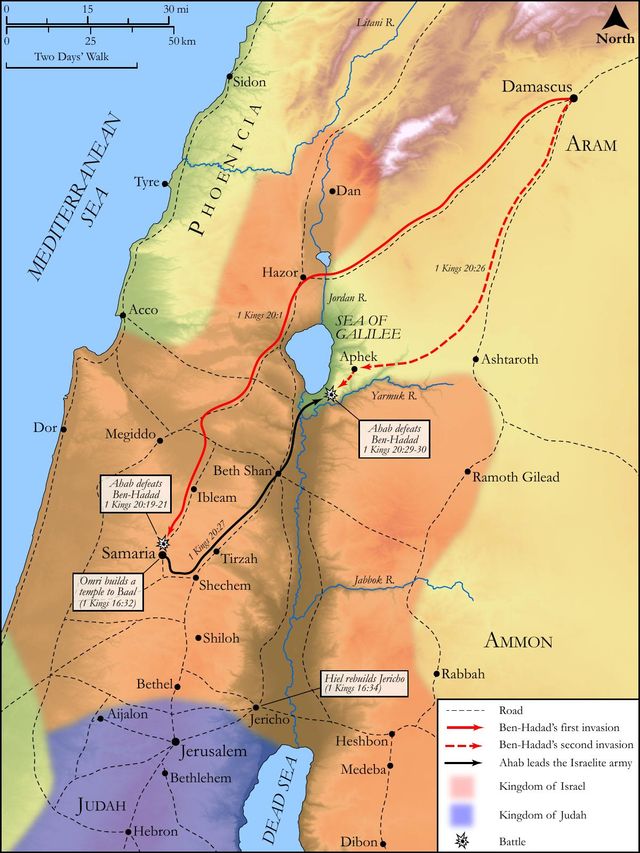
See on the biblical-era map

Study this verse
Public-domain commentary
Matthew Henry
From his Commentary on the Whole Bible. Henry comments on passages, not single verses — this entry covers 1 Kings 20:1–11. His three-level outline is real structure in the source text, so it is rendered as structure.
Here is, I. The threatening descent which Ben-hadad made upon Ahab's kingdom, and the siege he laid to Samaria, his royal city, Kg1 20:1. What the ground of the quarrel was we are not told; covetousness and ambition were the principle, which would never want some pretence or other. David in his time had quite subdued the Syrians and made them tributaries to Israel, but Israel's apostasy from God makes them formidable again. Asa had tempted the Syrians to invade Israel once (Kg1 15:18-20), and now they did it of their own accord. It is dangerous bringing a foreign force into the country: posterity may pay dearly for it. Ben-hadad had with him thirty-two kings, who were either tributaries to him, and bound in duty to attend him, or confederates with him, and bound in interest to assist him. How little did the title of king look when all these poor petty governors pretended to it!
II.The treaty between these two kings.
Surely Israel's defence had departed from them, or else the Syrians could not have marched so readily, and with so little opposition, to Samaria, the head and heart of the country, a city lately built, and therefore, we may suppose, not well fortified, but likely to fall quickly into the hands of the invaders; both sides are aware of this, and therefore,
1.Ben-hadad's proud spirit sends Ahab a very insolent demand, Kg1 20:2, Kg1 20:3. A parley is sounded, and a trumpeter (we may suppose) is sent into the city, to let Ahab know that he will raise the siege upon condition that Ahab become his vassal (Nay, his villain), and not only pay him a tribute out of what he has, but make over his title to Ben-hadad, and hold all at his will, even his wives and children, the godliest of them. The manner of expression is designed to gall them; "All shall be mine, without exception."
2.Ahab's poor spirit sends Ben-hadad a very disgraceful submission. It is general indeed (he cannot mention particulars in his surrender with so much pleasure as Ben-hadad did in his demand), but it is effectual: I am thine, and all that I have, Kg1 20:4. See the effect of sin.
(1.)If he had not by sin provoked God to depart from him, Ben-hadad could not have made such a demand. Sin brings men into such straits, by putting them out of divine protection. If God may not rule us, our enemies shall. A rebel to God is a slave to all besides. Ahab had prepared his silver and gold for Baal, Hos 2:8. Justly therefore is it taken from him; such an alienating amounts to a forfeiture.
(2.)If he had not by sin wronged his own conscience, and set that against him, he could not have made such a mean surrender. Guilt dispirits men, and makes them cowards. He knew Baal could not help, and had no reason to think that God would, and therefore was content to buy his life upon any terms. Skin for skin, and all that is dear to him, he will give for it; he will rather live a beggar than not die a prince.
3.Ben-hadad's proud spirit rises upon his submission, and becomes yet more insolent and imperious, Kg1 20:5, Kg1 20:6. Ahab had laid his all at his feet, at his mercy, expecting that one king would use another generously, that this acknowledgment of Ben-hadad's sovereignty would content him, the honour was sufficient for the present, and he might hereafter make use of it if he saw cause (Satis est prostrasse leoni - It suffices the lion to have laid his victim prostrate); but this will not serve.
(1.)Ben-hadad is as covetous as he is proud, and cannot go away unless he have the possession as well as the dominion. He thinks it not enough to call it his, unless he have it in his hands. He will not so much as lend Ahab the use of his own goods above a day longer.
(2.)He is as spiteful as he is haughty. Had he come himself to select what he had a mind for, it would have shown some respect to a crowned head; but he will send his servants to insult the prince, and hector over him, to rifle the palace, and strip it of all its ornaments; nay, to give Ahab the more vexation, they shall be ordered, not only to take what they please, but, if they can learn which are the persons or things that Ahab is in a particular manner fond of, to take those: Whatsoever is pleasant in thy eyes they shall take away. We are often crossed in that which we most dote upon; and that proves least safe which is most dear.
(3.)He is as unreasonable as he is unjust, and will construe the surrender Ahab made for himself as made for all his subjects too, and will have them also to lie at his mercy: "They shall search, not only thy house, but the houses of thy servants too, and plunder them at discretion." Blessed be God for peace and property, and that what we have we can call our own.
4.Ahab's poor spirit begins to rise too, upon this growing insolence; and, if it becomes not bold, yet it becomes desperate, and he will rather hazard his life than give up all thus.
(1.)How he takes advice of his privy-council, who encourage him to stand it out. He speaks but poorly (Kg1 20:7), appeals to them whether Ben-hadad be not an unreasonable enemy, and do not seek mischief. What else could he expect from one who, without any provocation given him, had invaded his country and besieged his capital city? He owns to them how he had truckled to him before, and will have them advise him what he should do in this strait; and they speak bravely (Hearken not to him, nor consent, Kg1 20:8), promising no doubt to stand by him in the refusal.
(2.)Yet he expresses himself very modestly in his denial, Kg1 20:9. He owns Ben-hadad's dominion over him: "Tell my lord the king I have no design to affront him, nor to receded from the surrender I have already made; what I offered at first I will stand to, but this thing I may not do; I must not give what is none of my own." It was a mortification to Ben-hadad that even such an abject spirit as Ahab's durst deny him; yet it should seem, by his manner of expressing himself, that he durst not have done it if his people had not animated him.
5.Ben-hadad proudly swears the ruin of Samaria. The threatening waves of his wrath, meeting with this check, rage and foam, and make a noise. In his fury, he imprecates the impotent revenge of his gods, if the dust of Samaria serve for handfuls for his army (Kg1 20:10), so numerous, so resolute, an army will be bring into the field against Samaria, and so confident is he of their success; it will be done as easily as the taking up of a handful of dust; all shall be carried away, even the ground on which the city stands. Thus confident is his pride, thus cruel is his malice; this prepares him to be ruined, though such a prince and such a people are unworthy of the satisfaction of seeing him ruined.
6.Ahab sends him a decent rebuke to his assurance, dares not defy his menaces, only reminds him of the uncertain turns of war (Kg1 20:11): "Let not him that begins a war, and is girding on his sword, his armour, his harness, boast of victory, or think himself sure of it, as if he had put it off, and had come home a conqueror." This was one of the wisest words that ever Ahab spoke, and is a good item or momento to us all; it is folly to boast beforehand of any day, since we know not what it may bring forth (Pro 27:1), but especially to boast of a day of battle, which may prove as much against us as we promise ourselves it will be for us. It is impolitic to despise an enemy, and to be too sure of victory is the way to be beaten. Apply it to our spiritual conflicts. Peter fell by his confidence. While we are here we are but girding on the harness, and therefore must never boast as though we had put it off. Happy is the man that feareth always, and is never off his watch.
Historical interpretation
Historical reception
1 surviving comment on this verse from the historical church.
"May the gods do so to me, and more also, etc." [1 Kings 20:10] What Benhadad king of Syria, besieging and beginning to assault Samaria said: 'May the gods do so to me, and more also, if the dust of Samaria will be enough to fill the hands of all the people who follow me,' has this sense: Samaria, like other cities, had earth inside near the walls, almost equal to the walls, lest the walls standing without the support of the adjacent earth, should be frequently struck down by the assaulting hand with the battering ram." From the outside, the height of the walls far exceeded the surface of the ground, especially since, as Scripture relates, the city itself had been set on the summit of a mountain. Therefore, the haughty king, threatening the besieged city, said that he had such a multitude of troops with him that even if each of his soldiers brought only one stone, or clod, or log to construct a rampart against the city, such a high rampart could rise from it that the surface of the city itself, which was within the walls, would seem equal, so that they might fight on an equal footing against the city, sending missiles or torches. The king of Israel, restraining the king of Syria's arrogance with a modest utterance, said, "Say to him: Let not him who girds on his armor boast as he who takes it off." There is a difference between a man who is girded, a man who is ungirded, and a man who is not girded. A man who is girded is one who walks about with a belt; an ungirded man is one who recently took off his belt, for example, to enter a bath, or to get into bed, or perhaps to put on another tunic; a man who is not girded is one who, having recently put on a tunic, has not yet fortified himself with the addition of a belt. Thus, one who is in a military expedition can rightly be called girded, that is, armed. One who has returned home victoriously from a battle, having laid down his arms, is rightly called ungirded, because he wields the repose of peace longed for. One who has not yet begun to fight, nor begun to prepare for the contest, is rightly called not girded. Therefore, the king of Israel said to the king of Syria, boasting that he had already captured Samaria, which he had begun to besiege, "Let not him who girds on his armor boast as he who takes it off." As if to say plainly: Do not boast as if you were already the victor of war's peril, who, still set in the field, do not yet know whom victory will favor. And indeed he spoke the truth. For soon after the battle commenced, Benadab, not triumphing over the conquered adversaries, but with his army defeated, fled home.
Continue studying 1 Kings 20:10 across the web’s major study libraries — every link below opens this exact verse, chapter, or book on the destination site.
Read & Compare
 BibleGatewayThis verse in more than 200 translations and 70 languages.
 Bible.comThe YouVersion reader — hundreds of translations, reading plans, and highlights.
 ESV.orgCrossway's official English Standard Version reader.
 NET BibleThe NET translation with 60,000+ translators' notes on every rendering decision.
 STEP BibleTyndale House's free study tool — original text, vocabulary, and scholarly resources.
 BibliaLogos Bible Software's free web reader.
 USCCBThe New American Bible (Revised Edition) with the U.S. bishops' study notes.
Commentaries
 BibleHub CommentariesDozens of classic commentaries on this verse, gathered on one page.
 StudyLightMore than 100 commentary sets — the largest collection on the web.
 BibleRefPlain-English commentary on what this verse means, verse by verse.
 Enduring WordDavid Guzik's free commentary on this chapter, widely used by Bible teachers.
 Bible Study ToolsVerse commentary alongside Greek and Hebrew study aids.
Original Language & Research
- BibleHub InterlinearThe verse word by word — original language, transliteration, and English.
- BibleHub LexiconEvery word's original-language definition and Strong's entry.
 Blue Letter BibleDeep-study tools — Strong's numbers, concordance, and word studies.
 SefariaThe Hebrew text with Rashi and centuries of Jewish commentary.
Sermons, Hymns & Audio


TrulyRandomVerse is not affiliated with these sites and doesn’t control their content. They’re linked because they’re genuinely useful.
Summary
Ben-Hadad, the arrogant King of Aram, sends a bombastic and intimidating message to King Ahab of Israel during the siege of Samaria. His declaration, framed as a self-imprecatory oath, boasts of an army so vast that if each soldier were to take a mere handful of dust from Samaria, there would not be enough dust in the entire city to satisfy them all. This extreme hyperbole underscores Ben-Hadad's immense overconfidence in his military might and his absolute certainty of Samaria's utter destruction, setting the stage for a dramatic confrontation that will ultimately reveal the sovereignty of Yahweh over human pride and power.
Context
ShowHideLiterary Context
This verse is a pivotal moment in the narrative of 1 Kings 20, which details two significant conflicts between Aram (Syria) and Israel. The chapter opens with Ben-Hadad besieging Samaria, demanding tribute from Ahab. Ahab initially capitulates to the demands for silver, gold, wives, and children, as recorded in 1 Kings 20:1-4. However, Ben-Hadad escalates his demands, insisting that his servants be allowed to freely plunder Samaria (1 Kings 20:5-6). Ahab, after consulting with the elders of Israel, refuses this second, more humiliating demand (1 Kings 20:7-9). It is in direct response to this refusal that Ben-Hadad sends the boastful message of 1 Kings 20:10, which immediately precedes the divine intervention where a prophet announces God's plan to deliver Israel and humble Ben-Hadad (1 Kings 20:13-14). The subsequent narrative details Israel's surprising victory, orchestrated by God, despite their numerical inferiority.
Historical & Cultural Context
The conflict between Aram and Israel was a recurring feature of the geopolitical landscape in the ancient Near East during the ninth century BCE. Ben-Hadad II (or Hadadezer) was a powerful Aramean king, often identified with the figure who led a coalition against Shalmaneser III of Assyria. Samaria, the capital of the Northern Kingdom of Israel, was strategically important and well-fortified. The practice of demanding tribute and threatening total destruction of a besieged city was common in ancient warfare. Self-imprecatory oaths, like the one uttered by Ben-Hadad, were a solemn and binding form of vow in ancient Near Eastern cultures, invoking divine judgment upon oneself if the oath was not fulfilled. Ben-Hadad's reference to "the gods" reflects the polytheistic worldview prevalent in Aram, contrasting sharply with Israel's monotheistic worship of Yahweh.
Key Themes
ShowHideThe overarching theme of 1 Kings 20 and indeed much of the Deuteronomistic History is the sovereignty of God over all nations and human endeavors. Ben-Hadad's boast in 1 Kings 20:10 serves as a dramatic setup for God to demonstrate His power, often through unexpected means, to humble the proud and deliver His people, not based on their strength but on His own will. This highlights the theme of divine deliverance and the contrast between human arrogance and divine humility. It also touches on the theme of oaths and their implications, showing how even pagan oaths can be used by God to set the stage for His intervention, underscoring that no human boast or military might can stand against the Lord. The narrative also subtly explores the character of Ahab, who, despite his unfaithfulness, is still the king of God's people and receives divine aid.
Exposition and Analysis
ShowHideKey Word Analysis
ShowHideThis term (H430) refers to gods in the ordinary sense, often used in the plural. In this context, it signifies the polytheistic deities worshipped by Ben-Hadad and the Arameans, contrasting with Israel's singular God, Yahweh. Ben-Hadad's invocation of "the gods" in his oath underscores his pagan worldview and the cultural practice of swearing by one's deities to lend solemnity and binding power to a vow.
This word (H6083) denotes powdered earth or fine particles. In the context of Ben-Hadad's boast, "dust of Samaria" vividly illustrates the complete reduction and desolation of the city. It suggests that Samaria will be so utterly destroyed and pulverized that its very substance will be transformed into dust, emphasizing the totality of the impending destruction as envisioned by the Aramean king.
This verb (H5606) means "to be enough" or "to be sufficient." In Ben-Hadad's hyperbolic statement, his claim that the dust of Samaria will not suffice for handfuls for his innumerable army highlights the extreme numerical superiority he believes his forces possess. It is a declaration of overwhelming abundance on his side, contrasted with the utter inadequacy of Samaria's resources to even provide a symbolic handful for each of his soldiers.
Verse Breakdown
ShowHide"And Benhadad sent unto him, and said,"
This clause establishes the direct and formal nature of the communication. Ben-Hadad, the powerful Aramean king, is not merely making a general boast but is specifically addressing Ahab, the King of Israel, through a messenger. This personal delivery elevates the intensity and gravity of the challenge, making it a direct confrontation between the two monarchs and their respective kingdoms.
"The gods do so unto me, and more also,"
This is the solemn, self-imprecatory oath, a common and potent formula in the ancient Near East. Ben-Hadad pledges his own well-being, invoking divine retribution upon himself if his boast is not fulfilled. The phrase "and more also" intensifies the oath, indicating that he is willing to accept even greater punishment if he fails. This reveals his absolute confidence and commitment to his stated intention of utterly destroying Samaria.
"if the dust of Samaria shall suffice for handfuls for all the people that follow me."
This is the core of Ben-Hadad's boast, expressing the overwhelming size of his army and the impending desolation of Samaria. The imagery implies that his forces are so numerous that Samaria will be reduced to mere dust, and even that dust will be insufficient for each soldier to take a symbolic handful. It is a declaration of total annihilation and humiliation, leaving no doubt about his intent to completely overwhelm and plunder the city.
Literary Devices
ShowHideThe verse is rich with literary techniques that amplify Ben-Hadad's arrogance and the dramatic tension. The most prominent device is Hyperbole, where Ben-Hadad exaggerates the size of his army to an absurd degree, claiming that the dust of Samaria would not suffice for each soldier to take a handful. This overstatement is intended to instill fear and convey the futility of resistance. Closely related is the use of vivid Imagery, particularly "the dust of Samaria" and "handfuls," which creates a powerful mental picture of an innumerable army poised to utterly pulverize the city. Furthermore, the verse employs a formal Oath/Imprecation ("The gods do so unto me, and more also"), which is a common ancient Near Eastern literary and cultural convention. This solemn declaration, invoking divine judgment, underscores Ben-Hadad's absolute conviction and commitment to his threat. Finally, there is a strong element of Dramatic Irony, as the reader, knowing the subsequent events of the chapter, understands that Ben-Hadad's boast will ultimately lead to his humiliation, not Samaria's destruction, setting up God's intervention as the true display of power.
Theological and Thematic Connections
ShowHideBen-Hadad's arrogant boast in 1 Kings 20:10 serves as a profound theological statement on the nature of human pride versus divine sovereignty. It vividly illustrates the human tendency to rely on perceived strength, numbers, and material resources, rather than acknowledging a higher power. This self-exaltation directly sets the stage for God to demonstrate His ability to humble the proud and deliver His people, not through their own might, but through His miraculous intervention. The narrative that follows showcases God's power to overturn seemingly insurmountable odds, emphasizing that true victory and security come from Him alone, irrespective of human military prowess or strategic advantage. This principle is a recurring theme throughout Scripture, where God consistently opposes the proud and gives grace to the humble.
Reflection and Application
ShowHideBen-Hadad's bombastic declaration in 1 Kings 20:10 offers a timeless warning against the dangers of unchecked pride and self-reliance. In our own lives, whether as individuals, communities, or nations, it is easy to fall into the trap of overestimating our capabilities, resources, or wisdom, and underestimating the challenges or the need for divine assistance. This verse reminds us that such arrogance often precedes a fall, as God consistently resists the proud. True strength and lasting security are found not in human boasting or overwhelming numbers, but in humility and a steadfast reliance on God's power and provision. It calls us to examine our own hearts: do we trust in our own "armies" (talents, wealth, connections) or in the Lord? The narrative encourages us to approach life's battles with humility, recognizing that God alone is the source of ultimate victory and deliverance, often working in ways that defy human expectations to demonstrate His glory.
Questions for Reflection
ShowHideFAQ
ShowHideWhat does Ben-Hadad's oath "The gods do so unto me, and more also" signify?
ShowHideThis phrase is a common self-imprecatory oath in ancient Near Eastern cultures, meaning "May the gods inflict such and such a punishment upon me, and even worse, if I do not fulfill my promise or boast." It signifies an absolute and unwavering commitment to the stated intention. In 1 Kings 20:10, Ben-Hadad uses it to underscore his certainty that his vast army will utterly destroy Samaria, invoking divine wrath upon himself if he fails. It highlights his extreme confidence and the solemnity of his threat.
Why does Ben-Hadad refer to "the gods" instead of "the Lord" or "Yahweh"?
ShowHideBen-Hadad was the King of Aram (Syria), a polytheistic nation that worshipped various deities, including Hadad, the storm god. His reference to "the gods" (plural) reflects his pagan worldview and religious practices, which stood in stark contrast to the monotheistic worship of Yahweh by the Israelites. This distinction is important because the subsequent narrative in 1 Kings 20 demonstrates that it is Yahweh, the God of Israel, who ultimately holds sovereignty over all nations and their gods, humbling Ben-Hadad despite his invocation of his own deities.
How does Ben-Hadad's boast about the "dust of Samaria" relate to his army's size?
ShowHideThe imagery of "the dust of Samaria" not sufficing "for handfuls for all the people that follow me" is a powerful hyperbole. It means that Ben-Hadad's army is so incredibly vast and numerous that if each soldier were to take just a small handful of dust from the city as a symbolic gesture of conquest or plunder, there wouldn't be enough dust in the entire city of Samaria to provide a handful for every single one of his soldiers. It's a dramatic way of conveying an overwhelming numerical superiority and the impending, complete desolation of the city.
Christ-Centered Fulfillment
ShowHideBen-Hadad's arrogant boast in 1 Kings 20:10, rooted in human pride and reliance on earthly power, stands in stark contrast to the person and work of Jesus Christ. While Ben-Hadad sought to conquer and destroy through overwhelming force, Christ came not to be served, but to serve, and to give His life as a ransom for many (Mark 10:45). The victory over Ben-Hadad, orchestrated by God against human expectations, foreshadows a greater spiritual victory achieved through seemingly weak means: the cross. The "armies" of sin, death, and Satan, which once held humanity captive, were far more formidable than Ben-Hadad's forces, yet Christ, through His humility and obedience unto death (Philippians 2:8), disarmed these spiritual powers and triumphed over them (Colossians 2:15). Unlike Ben-Hadad, whose pride led to his humiliation, Christ's humility led to His exaltation, where every knee will one day bow to Him (Philippians 2:9-11). Thus, Ben-Hadad's boast serves as a powerful Old Testament shadow, highlighting the futility of human pride and setting the stage for the ultimate display of divine power and humble victory found in the person and redemptive work of Jesus, the true King whose kingdom is not of this world, yet triumphs over all.