


1 Kings 20:7
Bible text: King James Version (1769 Blayney text) · Public domain
Bible text: King James Version with Strong's numbers · Public domain
Bible text: Berean Standard Bible · Public domain
Bible text: American Standard Version (1901) · Public domain
Bible text: World English Bible, Messianic edition · Public domain
Bible text: Geneva Bible (1599) · Public domain
Bible text: Young's Literal Translation · Public domain
- וַיִּקְרָאvai·yik·Ra'and he summonedH7121Conj-w ¦ V-Qal-ConsecImperf-3msVerb Qal Consecutive Imperfect 3rd Singular Masculineוַandיִּקְרָאhe summoned
- מֶלֶךְMe·lekh[the] king ofH4428N-mscNoun Singular Masculine Construct
- יִשְׂרָאֵלYis·ra·'ElIsraelH3478N-properNoun Proper Location
- לְכָלle·khol<to> allH3605Prep-l ¦ N-mscNoun Singular Masculine Constructלְ<to>כָלall
- זִקְנֵיzik·Nei[the] elders ofH2205Adj-mpcAdjective Plural Masculine Construct
- הָאָרֶץha·'A·retzthe landH776Art ¦ N-fsNoun Singular Feminine Absoluteהָtheאָרֶץland
- וַיֹּאמֶרvai·Yo·merand he saidH559Conj-w ¦ V-Qal-ConsecImperf-3msVerb Qal Consecutive Imperfect 3rd Singular Masculineוַandיֹּאמֶרhe said
- דְּעוּde·'uknowH3045V-Qal-Imp-2mpVerb Qal Imperative 2nd Plural Masculine
- נָאna'pleaseH4994PrtParticle Interjection
- וּרְאוּu·re·'Uand seeH7200Conj-w ¦ V-Qal-Imp-2mpVerb Qal Imperative 2nd Plural Masculineוּandרְאוּsee
- כִּיkithatH3588PrtParticle Conditional
- רָעָהra·'AhtroubleH7451N-fsNoun Singular Feminine Absolute
- זֶהzehthis [man]H2088PrtParticle Demonstrative
- מְבַקֵּשׁme·va·Kesh[is] seekingH1245V-Piel-Prtcpl-msVerb Piel Participle Singular Masculine Absolute
- כִּיkiforH3588PrtParticle Conditional
- שָׁלַחsha·Lachhe sentH7971V-Qal-Perf-3msVerb Qal Perfect 3rd Singular Masculine
- אֵלַי'e·Laito meH413Prep ¦ 1csPrepositionאֵלַtoיme
- לְנָשַׁיle·na·Shaifor my wivesH802Prep-l ¦ N-mpc ¦ 1csNoun Plural Masculine Constructלְforנָשַׁwivesיmy
- וּלְבָנַיu·le·va·Naiand for my childrenH1121Conj-w ¦ Prep-l ¦ N-mpc ¦ 1csNoun Plural Masculine Constructוּandלְforבָנַchildrenיmy
- וּלְכַסְפִּיu·le·khas·Piand for my silverH3701Conj-w ¦ Prep-l ¦ N-msc ¦ 1csNoun Singular Masculine Constructוּandלְforכַסְפִּsilverיmy
- וְלִזְהָבִיve·liz·ha·Viand for my goldH2091Conj-w ¦ Prep-l ¦ N-msc ¦ 1csNoun Singular Masculine Constructוְandלִforזְהָבִgoldיmy
- וְלֹאve·Lo'and notH3808Conj-w ¦ NegParticle Negativeוְandלֹאnot
- מָנַעְתִּיma·Na'·tiI withheld [them]H4513V-Qal-Perf-1csVerb Qal Perfect 1st Singular common gender
- מִמֶּנּוּmi·Me·nufrom himH4480Prep ¦ 3msPrepositionמִמֶּfromנּוּhim
English is a literal word-by-word gloss of the Hebrew, not the KJV's wording. Why?
This is the original text the KJV's translators worked from — each Hebrew word with its own literal English meaning in this verse, prepared by scholars at Tyndale House, Cambridge. The KJV translates whole sentences, not word by word, so its wording differs: one Hebrew word can become several English words, and the KJV may choose “the LORD” where the gloss reads “Yahweh”. Both are faithful — they answer different questions. For the KJV's own rendering, switch to the KJV text.
Details
See on the biblical-era maps

Study this verse
Public-domain commentary
Matthew Henry
From his Commentary on the Whole Bible. Henry comments on passages, not single verses — this entry covers 1 Kings 20:1–11. His three-level outline is real structure in the source text, so it is rendered as structure.
Here is, I. The threatening descent which Ben-hadad made upon Ahab's kingdom, and the siege he laid to Samaria, his royal city, Kg1 20:1. What the ground of the quarrel was we are not told; covetousness and ambition were the principle, which would never want some pretence or other. David in his time had quite subdued the Syrians and made them tributaries to Israel, but Israel's apostasy from God makes them formidable again. Asa had tempted the Syrians to invade Israel once (Kg1 15:18-20), and now they did it of their own accord. It is dangerous bringing a foreign force into the country: posterity may pay dearly for it. Ben-hadad had with him thirty-two kings, who were either tributaries to him, and bound in duty to attend him, or confederates with him, and bound in interest to assist him. How little did the title of king look when all these poor petty governors pretended to it!
II.The treaty between these two kings.
Surely Israel's defence had departed from them, or else the Syrians could not have marched so readily, and with so little opposition, to Samaria, the head and heart of the country, a city lately built, and therefore, we may suppose, not well fortified, but likely to fall quickly into the hands of the invaders; both sides are aware of this, and therefore,
1.Ben-hadad's proud spirit sends Ahab a very insolent demand, Kg1 20:2, Kg1 20:3. A parley is sounded, and a trumpeter (we may suppose) is sent into the city, to let Ahab know that he will raise the siege upon condition that Ahab become his vassal (Nay, his villain), and not only pay him a tribute out of what he has, but make over his title to Ben-hadad, and hold all at his will, even his wives and children, the godliest of them. The manner of expression is designed to gall them; "All shall be mine, without exception."
2.Ahab's poor spirit sends Ben-hadad a very disgraceful submission. It is general indeed (he cannot mention particulars in his surrender with so much pleasure as Ben-hadad did in his demand), but it is effectual: I am thine, and all that I have, Kg1 20:4. See the effect of sin.
(1.)If he had not by sin provoked God to depart from him, Ben-hadad could not have made such a demand. Sin brings men into such straits, by putting them out of divine protection. If God may not rule us, our enemies shall. A rebel to God is a slave to all besides. Ahab had prepared his silver and gold for Baal, Hos 2:8. Justly therefore is it taken from him; such an alienating amounts to a forfeiture.
(2.)If he had not by sin wronged his own conscience, and set that against him, he could not have made such a mean surrender. Guilt dispirits men, and makes them cowards. He knew Baal could not help, and had no reason to think that God would, and therefore was content to buy his life upon any terms. Skin for skin, and all that is dear to him, he will give for it; he will rather live a beggar than not die a prince.
3.Ben-hadad's proud spirit rises upon his submission, and becomes yet more insolent and imperious, Kg1 20:5, Kg1 20:6. Ahab had laid his all at his feet, at his mercy, expecting that one king would use another generously, that this acknowledgment of Ben-hadad's sovereignty would content him, the honour was sufficient for the present, and he might hereafter make use of it if he saw cause (Satis est prostrasse leoni - It suffices the lion to have laid his victim prostrate); but this will not serve.
(1.)Ben-hadad is as covetous as he is proud, and cannot go away unless he have the possession as well as the dominion. He thinks it not enough to call it his, unless he have it in his hands. He will not so much as lend Ahab the use of his own goods above a day longer.
(2.)He is as spiteful as he is haughty. Had he come himself to select what he had a mind for, it would have shown some respect to a crowned head; but he will send his servants to insult the prince, and hector over him, to rifle the palace, and strip it of all its ornaments; nay, to give Ahab the more vexation, they shall be ordered, not only to take what they please, but, if they can learn which are the persons or things that Ahab is in a particular manner fond of, to take those: Whatsoever is pleasant in thy eyes they shall take away. We are often crossed in that which we most dote upon; and that proves least safe which is most dear.
(3.)He is as unreasonable as he is unjust, and will construe the surrender Ahab made for himself as made for all his subjects too, and will have them also to lie at his mercy: "They shall search, not only thy house, but the houses of thy servants too, and plunder them at discretion." Blessed be God for peace and property, and that what we have we can call our own.
4.Ahab's poor spirit begins to rise too, upon this growing insolence; and, if it becomes not bold, yet it becomes desperate, and he will rather hazard his life than give up all thus.
(1.)How he takes advice of his privy-council, who encourage him to stand it out. He speaks but poorly (Kg1 20:7), appeals to them whether Ben-hadad be not an unreasonable enemy, and do not seek mischief. What else could he expect from one who, without any provocation given him, had invaded his country and besieged his capital city? He owns to them how he had truckled to him before, and will have them advise him what he should do in this strait; and they speak bravely (Hearken not to him, nor consent, Kg1 20:8), promising no doubt to stand by him in the refusal.
(2.)Yet he expresses himself very modestly in his denial, Kg1 20:9. He owns Ben-hadad's dominion over him: "Tell my lord the king I have no design to affront him, nor to receded from the surrender I have already made; what I offered at first I will stand to, but this thing I may not do; I must not give what is none of my own." It was a mortification to Ben-hadad that even such an abject spirit as Ahab's durst deny him; yet it should seem, by his manner of expressing himself, that he durst not have done it if his people had not animated him.
5.Ben-hadad proudly swears the ruin of Samaria. The threatening waves of his wrath, meeting with this check, rage and foam, and make a noise. In his fury, he imprecates the impotent revenge of his gods, if the dust of Samaria serve for handfuls for his army (Kg1 20:10), so numerous, so resolute, an army will be bring into the field against Samaria, and so confident is he of their success; it will be done as easily as the taking up of a handful of dust; all shall be carried away, even the ground on which the city stands. Thus confident is his pride, thus cruel is his malice; this prepares him to be ruined, though such a prince and such a people are unworthy of the satisfaction of seeing him ruined.
6.Ahab sends him a decent rebuke to his assurance, dares not defy his menaces, only reminds him of the uncertain turns of war (Kg1 20:11): "Let not him that begins a war, and is girding on his sword, his armour, his harness, boast of victory, or think himself sure of it, as if he had put it off, and had come home a conqueror." This was one of the wisest words that ever Ahab spoke, and is a good item or momento to us all; it is folly to boast beforehand of any day, since we know not what it may bring forth (Pro 27:1), but especially to boast of a day of battle, which may prove as much against us as we promise ourselves it will be for us. It is impolitic to despise an enemy, and to be too sure of victory is the way to be beaten. Apply it to our spiritual conflicts. Peter fell by his confidence. While we are here we are but girding on the harness, and therefore must never boast as though we had put it off. Happy is the man that feareth always, and is never off his watch.
Continue studying 1 Kings 20:7 across the web’s major study libraries — every link below opens this exact verse, chapter, or book on the destination site.
Read & Compare
 BibleGatewayThis verse in more than 200 translations and 70 languages.
 Bible.comThe YouVersion reader — hundreds of translations, reading plans, and highlights.
 ESV.orgCrossway's official English Standard Version reader.
 NET BibleThe NET translation with 60,000+ translators' notes on every rendering decision.
 STEP BibleTyndale House's free study tool — original text, vocabulary, and scholarly resources.
 BibliaLogos Bible Software's free web reader.
 USCCBThe New American Bible (Revised Edition) with the U.S. bishops' study notes.
Commentaries
 BibleHub CommentariesDozens of classic commentaries on this verse, gathered on one page.
 StudyLightMore than 100 commentary sets — the largest collection on the web.
 BibleRefPlain-English commentary on what this verse means, verse by verse.
 Enduring WordDavid Guzik's free commentary on this chapter, widely used by Bible teachers.
 Bible Study ToolsVerse commentary alongside Greek and Hebrew study aids.
Original Language & Research
- BibleHub InterlinearThe verse word by word — original language, transliteration, and English.
- BibleHub LexiconEvery word's original-language definition and Strong's entry.
 Blue Letter BibleDeep-study tools — Strong's numbers, concordance, and word studies.
 SefariaThe Hebrew text with Rashi and centuries of Jewish commentary.
Sermons, Hymns & Audio


TrulyRandomVerse is not affiliated with these sites and doesn’t control their content. They’re linked because they’re genuinely useful.
Summary
In 1 Kings 20:7, King Ahab of Israel, facing increasingly outrageous and malicious demands from Ben-Hadad of Aram, convenes the elders of the land. This verse marks a critical turning point where Ahab, having initially conceded to Ben-Hadad's tribute demands, recognizes the Syrian king's true intent to inflict harm and plunder. He appeals to his council for their discernment and support, signaling a shift from appeasement to a resolve for resistance against an aggressor whose aims extend beyond mere tribute to total subjugation and humiliation.
Context
ShowHideLiterary Context
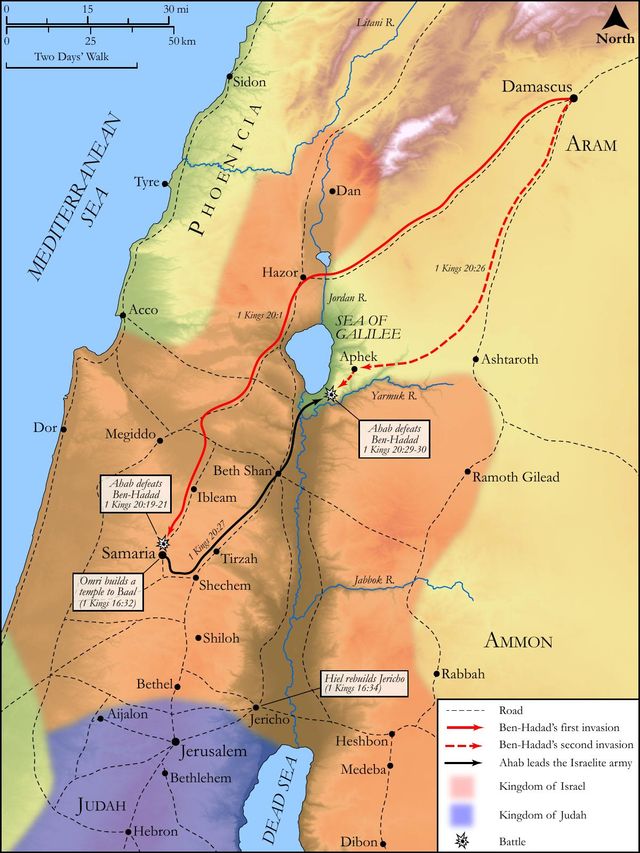
This verse is a pivotal moment within the larger narrative of 1 Kings 20. The chapter opens with Ben-Hadad besieging Samaria and sending an initial demand for Ahab's silver, gold, wives, and children. Surprisingly, Ahab, in an attempt to avert bloodshed, concedes, declaring, "My lord, O king, I am thine, and all that I have" (1 Kings 20:4). However, Ben-Hadad, emboldened by Ahab's submission, immediately escalates his demands. He sends a second message, declaring that his servants would search Samaria the following day and seize whatever they pleased from Ahab's house and his officials' homes (1 Kings 20:5-6). It is this blatant disregard for the initial agreement and the clear intent for total plunder and humiliation that prompts Ahab to call the elders, realizing that Ben-Hadad "seeketh mischief" and cannot be appeased. This sets the stage for the miraculous deliverance God grants Israel, despite Ahab's unfaithfulness.
Historical & Cultural Context
The setting is Samaria, the capital of the Northern Kingdom of Israel, under siege by the Aramean (Syrian) army led by Ben-Hadad. Conflicts between Israel and Aram were frequent during this period, often involving border disputes, trade routes, and tribute payments. Siege warfare was a common tactic, aiming to starve out or demoralize a city into surrender. In Israel, "elders of the land" (Hebrew: ziqnê hāʾāreṣ) held significant political, judicial, and advisory roles. They represented the people, provided counsel to the king, and their consensus often legitimized royal decisions, especially in matters of war and peace. Ahab's act of consulting them was not a sign of weakness but a strategic move to rally national support and demonstrate that the decision to resist was a collective one, based on a clear understanding of the enemy's malicious intentions, rather than merely a personal affront to the king.
Key Themes
ShowHideThe verse powerfully illustrates the Escalation of Conflict when dealing with an aggressor; initial appeasement, rather than satisfying, often emboldens the oppressor to make even more unreasonable and tyrannical demands, moving beyond tribute to outright subjugation and plunder. It highlights the importance of Seeking Wise Counsel, as Ahab, despite his generally negative portrayal in Scripture (1 Kings 16:30), recognized the gravity of the situation and wisely sought the advice and solidarity of the elders, a principle echoed in wisdom literature (Proverbs 11:14). Most significantly, it marks Ahab's Recognition of Malicious Intent. His statement, "see how this [man] seeketh mischief," signifies a crucial discernment that Ben-Hadad's true aim was not merely tribute but complete humiliation and destruction, even after initial concessions. This discernment of evil intent is a critical turning point, leading to a necessary shift from passive acceptance to active resistance.
Exposition and Analysis
ShowHideKey Word Analysis
ShowHideThe Hebrew word רָע (H7451, raʻ) is a broad term that can mean "evil," "harm," "calamity," "adversity," or "wickedness." When combined with "seeketh" (H1245, bâqash), it vividly describes Ben-Hadad's deliberate, premeditated, and malevolent intention to inflict harm and bring disaster upon Israel. It goes beyond simple tribute or conquest to imply a desire for utter devastation and humiliation, revealing a moral depravity in his actions.
The Hebrew word זָקֵן (H2205, zâqên) refers to an "old" or "aged" person, and by extension, a respected, experienced, and authoritative leader of the community or nation. In ancient Israel, elders served as local judges, administrators, and advisors to the king. Calling them together signifies Ahab's need for their collective wisdom, their endorsement, and their ability to rally the people's support. It indicates that the crisis was not merely a personal affront to the king but a threat to the entire nation, requiring a unified response.
The Hebrew verb מָנַע (H4513, mânaʻ) means "to debar," "to keep back," "to refrain," or "to withhold." In the context of "I denied him not," it underscores Ahab's initial, full compliance with Ben-Hadad's first set of demands. It highlights the extent of Ahab's appeasement and sets up a stark contrast with Ben-Hadad's subsequent, insatiable greed. Ahab's willingness to give up his wives, children, silver, and gold demonstrates his desire to avoid conflict, making Ben-Hadad's escalating demands appear all the more unreasonable and malicious.
Verse Breakdown
ShowHide"Then the king of Israel called all the elders of the land"
This opening clause signifies a formal and urgent summons by King Ahab. Facing a national crisis, he recognizes the need for counsel and legitimacy beyond his own authority. The "elders of the land" represent the collective wisdom and will of the people, and their involvement would be crucial for any subsequent military action or diplomatic stance, ensuring national unity in response to the threat.
"and said, Mark, I pray you, and see how this [man] seeketh mischief"
Ahab's address to the elders is an earnest appeal for their discerning judgment. The phrase "Mark, I pray you, and see" is an urgent call to observe and understand the true, malevolent nature of Ben-Hadad's intentions. Ahab explicitly accuses Ben-Hadad of "seeking mischief," which implies a deliberate and malicious desire to inflict harm and bring disaster, not merely to gain tribute. This marks Ahab's crucial realization that Ben-Hadad's actions are driven by malice and a desire for total subjugation, not just material gain.
"for he sent unto me for my wives, and for my children, and for my silver, and for my gold; and I denied him not"
This final clause serves as Ahab's compelling justification for his accusation of "mischief." He reminds the elders of Ben-Hadad's initial, extravagant demands (his wives, children, and all his wealth) and, crucially, emphasizes his own full compliance ("and I denied him not"). This highlights the treacherous and insatiable nature of Ben-Hadad, who, despite receiving everything he initially asked for, immediately escalated his demands, proving his true intent was not satisfaction but total plunder and humiliation.
Literary Devices
ShowHideThe verse employs several significant literary devices that enrich its meaning. Contrast is powerfully evident in the juxtaposition of Ahab's initial, complete compliance ("I denied him not") with Ben-Hadad's escalating, insatiable demands, which ultimately reveal his true malicious intent. This highlights the futility and danger of appeasing an aggressor. An implicit Rhetorical Question is present in Ahab's plea, "Mark, I pray you, and see how this [man] seeketh mischief," which is not a genuine inquiry but an urgent, persuasive call for the elders to recognize the obvious treacherous nature of Ben-Hadad's actions. This serves to unify the council against a common, clearly defined enemy. Furthermore, the narrative uses Foreshadowing by exposing Ben-Hadad's character early on, setting the stage for his eventual defeat and the divine intervention that will protect Israel despite Ahab's own failings. The entire scene also carries a subtle Irony, as Ahab, often depicted as a wicked king, here demonstrates a moment of shrewd discernment and wise leadership by seeking counsel and recognizing the true nature of evil.
Theological and Thematic Connections
ShowHideThis pivotal moment in 1 Kings 20:7 offers profound theological and thematic insights. It underscores the biblical principle that evil, when appeased, often grows bolder and more destructive. Ben-Hadad's escalating demands reveal a heart bent on mischief, highlighting the insatiable nature of sin and unchecked greed. Theologically, it speaks to the importance of discernment – the ability to perceive the true intentions behind actions, especially those that appear manipulative or exploitative. Ahab's recognition of Ben-Hadad's "mischief" is a vital step towards resisting oppression. Furthermore, the act of seeking counsel from the elders reflects a divine wisdom principle: that in a multitude of counselors there is safety and strength, and that collective wisdom can provide clarity and legitimacy in times of national or personal crisis. This decision to stand firm, born out of discernment and collective wisdom, ultimately opens the door for God's intervention and deliverance for His people.
Reflection and Application
ShowHideThe narrative of 1 Kings 20:7 offers timeless lessons for believers today. It challenges us to cultivate spiritual discernment, recognizing that not all overtures are genuine and that some individuals or ideologies are truly bent on "mischief" or harm. Just as Ahab learned that appeasement only emboldened Ben-Hadad, we are reminded that compromising with evil or neglecting to confront malicious intent can lead to greater detriment. This verse calls us to be wise as serpents and innocent as doves, understanding that while we are to be peacemakers, we must also be discerning about the true nature of threats, whether they arise in personal relationships, societal challenges, or spiritual warfare. The act of calling the elders emphasizes the invaluable role of wise counsel and community in navigating difficult decisions. We are called to seek guidance from trusted, godly advisors, to lean on the collective wisdom of the church, and to stand united against forces that seek to undermine truth, justice, or peace. Understanding the true nature of a threat is the first step toward effectively addressing it, relying not on our own strength, but on God's wisdom and power.
Questions for Reflection
ShowHideFAQ
ShowHideWhy did King Ahab initially concede to Ben-Hadad's demands, even though they were so extreme?
ShowHideAhab's initial concession, as seen in 1 Kings 20:4, was likely a desperate attempt to avoid bloodshed and a full-scale siege of Samaria. He may have genuinely believed that by giving Ben-Hadad what he asked for—even his wives, children, silver, and gold—he could satisfy the Aramean king and avert further conflict. This reveals a misjudgment of Ben-Hadad's true character, which was not merely greedy but malicious and intent on total subjugation and humiliation, as evidenced by his escalated demands in 1 Kings 20:5-6.
What was the significance of Ahab calling "all the elders of the land"?
ShowHideIn ancient Israel, the elders were respected community leaders who held significant political, judicial, and advisory authority. By calling them, Ahab was not just seeking personal advice; he was seeking national consensus and legitimization for any future action. Their presence and agreement would signify that the decision to resist Ben-Hadad was not merely the king's personal choice but a unified stand by the entire nation. This move was crucial for rallying popular support and demonstrating that the threat was to all of Israel, not just to the royal household.
How does this verse reveal Ben-Hadad's character?
ShowHideThis verse powerfully exposes Ben-Hadad's treacherous and insatiable character. His initial demands, though extreme, were met by Ahab. Yet, Ben-Hadad immediately escalated, demanding the right for his servants to plunder anything they desired from Samaria. Ahab's statement, "this [man] seeketh mischief," encapsulates Ben-Hadad's true intent: not merely tribute or conquest, but deliberate harm, humiliation, and destruction. He is revealed as a deceitful and malicious aggressor who cannot be appeased and whose word cannot be trusted.
Christ-Centered Fulfillment
ShowHideWhile 1 Kings 20:7 depicts an earthly king discerning and confronting an earthly aggressor, it subtly points to the ultimate King, Jesus Christ, who perfectly embodies discernment and decisively confronts the true "mischief-seeker"—Satan and the forces of evil. Ahab's limited wisdom in recognizing Ben-Hadad's malicious intent foreshadows Christ, who perfectly knows the hearts and intentions of all men (Matthew 9:4) and discerns the schemes of the enemy (John 8:44). Unlike Ahab, who initially appeased, Christ never compromised with evil, directly confronting temptation in the wilderness (Matthew 4:1-11) and rebuking those who sought to undermine God's truth (Matthew 23). The ultimate "mischief" wrought by sin and death, which no human king could overcome, was decisively defeated by Christ through His atoning sacrifice on the cross. He disarmed the spiritual rulers and authorities who sought to enslave humanity (Colossians 2:15), and through His resurrection, He destroyed the one who had the power of death (Hebrews 2:14-15). Thus, Christ is the ultimate wisdom and the victorious King who has secured our triumph over all spiritual mischief.