


2 Kings 5:7
Bible text: King James Version (1769 Blayney text) · Public domain
Bible text: King James Version with Strong's numbers · Public domain
Bible text: Berean Standard Bible · Public domain
Bible text: American Standard Version (1901) · Public domain
Bible text: World English Bible, Messianic edition · Public domain
Bible text: Geneva Bible (1599) · Public domain
Bible text: Young's Literal Translation · Public domain
- וַיְהִיvay·Hiand it wasH1961Conj-w ¦ V-Qal-ConsecImperf-3msVerb Qal Consecutive Imperfect 3rd Singular Masculineוַandיְהִיit was
- כִּקְרֹאkik·Ro'when read aloudH7121Prep-k ¦ V-Qal-InfVerb Qal Infinitive Constructכִּwhenקְרֹאread aloud
- מֶלֶךְMe·lekh[the] king ofH4428N-mscNoun Singular Masculine Construct
- יִשְׂרָאֵלYis·ra·'ElIsraelH3478N-properNoun Proper Location
- אֶת'et<obj.>H853DirObjMParticle Object Indicator
- הַסֵּפֶרha·Se·ferthe letterH5612Art ¦ N-msNoun Singular Masculine Absoluteהַtheסֵּפֶרletter
- וַיִּקְרַעvai·yik·Ra'and he toreH7167Conj-w ¦ V-Qal-ConsecImperf-3msVerb Qal Consecutive Imperfect 3rd Singular Masculineוַandיִּקְרַעhe tore
- בְּגָדָיוbe·ga·Davhis clothesH899N-mpc ¦ 3msNoun Plural Masculine Constructבְּגָדָיclothesוhis
- וַיֹּאמֶרvai·Yo·merand he saidH559Conj-w ¦ V-Qal-ConsecImperf-3msVerb Qal Consecutive Imperfect 3rd Singular Masculineוַandיֹּאמֶרhe said
- הַאֱלֹהִיםha·'E·lo·Him¿ GodH430Interrog ¦ N-mpNoun Plural Masculine Absoluteהַ¿אֱלֹהִיםGod
- אָנִי'a·ni[am] IH589Pro-1csPronoun Personal 1st Singular common gender
- לְהָמִיתle·ha·Mitto killH4191Prep-l ¦ V-Hiphil-InfVerb Hiphil Infinitive Constructלְtoהָמִיתkill
- וּלְהַחֲיוֹתu·le·ha·cha·Yotand to restore to lifeH2421Conj-w ¦ Prep-l ¦ V-Hiphil-InfVerb Hiphil Infinitive Constructוּandלְtoהַחֲיוֹתrestore to life
- כִּיkithatH3588PrtParticle Conditional
- זֶהzehthis [man]H2088PrtParticle Demonstrative
- שֹׁלֵחַsho·Le·ach[is] sendingH7971V-Qal-Prtcpl-msVerb Qal Participle Singular Masculine Absolute
- אֵלַי'e·Laito meH413Prep ¦ 1csPrepositionאֵלַtoיme
- לֶאֱסֹףle·'e·Softo deliverH622Prep-l ¦ V-Qal-InfVerb Qal Infinitive Constructלֶtoאֱסֹףdeliver
- אִישׁ'isha manH376N-msNoun Singular Masculine Absolute
- מִצָּרַעְתּוֹmi·tza·ra'·Tofrom his skin diseaseH6883Prep-m ¦ N-fsc ¦ 3msNoun Singular Feminine Constructמִfromצָּרַעְתּskin diseaseוֹhis
- כִּיkithatH3588PrtParticle Conditional
- אַךְ'akhonlyH389AdvAdverb
- דְּעוּde·'uconsiderH3045V-Qal-Imp-2mpVerb Qal Imperative 2nd Plural Masculine
- נָאna'pleaseH4994PrtParticle Interjection
- וּרְאוּu·re·'Uand seeH7200Conj-w ¦ V-Qal-Imp-2mpVerb Qal Imperative 2nd Plural Masculineוּandרְאוּsee
- כִּיkithatH3588PrtParticle Conditional
- מִתְאַנֶּהmit·'a·Neh[is] seeking an opportunityH579V-Hithpael-Prtcpl-msVerb Hithpael Participle Singular Masculine Absolute
- הוּאhu'heH1931Pro-3msPronoun Personal 3rd Singular Masculine
- לִיLito mePrep-l ¦ 1csSuffix Personal 1st Singular common genderלִtoיme
English is a literal word-by-word gloss of the Hebrew, not the KJV's wording. Why?
This is the original text the KJV's translators worked from — each Hebrew word with its own literal English meaning in this verse, prepared by scholars at Tyndale House, Cambridge. The KJV translates whole sentences, not word by word, so its wording differs: one Hebrew word can become several English words, and the KJV may choose “the LORD” where the gloss reads “Yahweh”. Both are faithful — they answer different questions. For the KJV's own rendering, switch to the KJV text.
Details
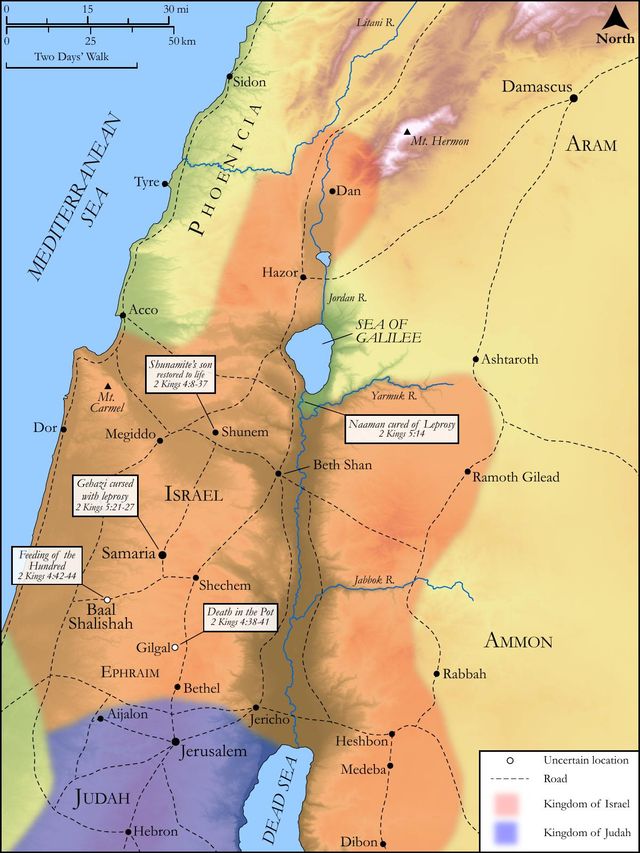
See on the biblical-era map
Study this verse
Public-domain commentary
Matthew Henry
From his Commentary on the Whole Bible. Henry comments on passages, not single verses — this entry covers 2 Kings 5:1–8. His two-level outline is real structure in the source text, so it is rendered as structure.
Our saviour's miracles were intended for the lost sheep of the house of Israel, yet one, like a crumb, fell from the table to a woman of Canaan; so this one miracle Elisha wrought for Naaman, a Syrian; for God does good to all, and will have all men to be saved. Here is,
I.The great affliction Naaman was under, in the midst of all his honours, Kg2 5:1.
He was a great man, in a great place; not only rich and raised, but particularly happy for two things: - 1. That he had been very serviceable to his country. God made him so: By him the Lord had often given deliverance to Syria, success in their wars even with Israel. The preservation and prosperity even of those that do not know God and serve him must be ascribed to him, for he is the Saviour of all men, but especially of those that believe. Let Israel know that when the Syrians prevailed it was from the Lord. 2. That he was very acceptable to his prince, was his favourite, and prime-minister of state; so great was he, so high, so honourable, and a mighty man of valour; but he was a leper, was under that loathsome disease, which made him a burden to himself. Note, (1.) No man's greatness, or honour, or interest, or valour, or victory, can set him out of the reach of the sorest calamities of human life; there is many a sickly crazy body under rich and gay clothing. (2.) Every man has some but or other in his character, something that blemishes and diminishes him, some allay to his grandeur, some damp to his joy; he may be very happy, very good, yet, in something or other, not so good as he should be nor so happy as he would be. Naaman was a great as the world could make him, and yet (as bishop Hall expresses it) the basest slave in Syria would not change skins with him.
II.The notice that was given him of Elisha's power, by a little maid that waited on his lady, Kg2 5:2, Kg2 5:3.
This maid was, by birth, an Israelite, providentially carried captive into Syria, and there preferred into Naaman's family, where she published Elisha's fame to the honour of Israel and Israel's God. The unhappy dispersing of the people of God has sometimes proved the happy occasion of the diffusion of the knowledge of God, Act 8:4. This little maid,
1.As became a true-born Israelite, consulted the honour of her country, and could give an account, though but a girl, of the famous prophet they had among them. Children should betimes acquaint themselves with the wondrous works of God, that, wherever they go, they may have them to talk of. See Psa 8:2.
2.As became a good servant, she desired the health and welfare of her master, though she was a captive, a servant by force; much more should servants of choice seek their masters' good. The Jews in Babylon were to seek the peace of the land of their captivity. Jer 29:7. Elisha had not cleansed any leper in Israel (Luk 4:27), yet this little maid, from the other miracles he had wrought, inferred that he could cure her master, and from his common beneficence inferred that he would do it, though he was a Syrian. Servants may be blessings to the families where they are, by telling what they know of the glory of God and the honour of his prophets.
III.The application which the king of Syria hereupon made to the king of Israel on Naaman's behalf.
Naaman took notice of the intelligence, though given by a simple maid, and did not despise it for the sake of her meanness, when it tended to his bodily health. he did not say, "The girl talks like a fool; how can any prophet of Israel do that for me which all the physicians of Syria have attempted in vain?" Though he neither loved nor honoured the Jewish nation, yet, if one of that nation can but cure him of his leprosy, he will thankfully acknowledge the obligation. O that those who are spiritually diseased would hearken thus readily to the tidings brought them of the great Physician! See what Naaman did upon this little hint.
1.He would not send for the prophet to come to him, but such honour would he pay to one that had so much of a divine power with him as to be able to cure diseases that he would go to him himself, though he himself was sickly, unfit for society, the journey long, and the country an enemy's; princes, he thinks, must stoop to prophets when they need them.
2.He would not go incognito - in disguise, though his errand proclaimed his loathsome disease, but went in state, and with a great retinue, to do the more honour to the prophet.
3.He would not go empty-handed, but took with him gold, silver, and raiment, to present to his physician. Those that have wealth, and want health show which they reckon the more valuable blessing; what will they not give for ease, and strength, and soundness of body?
4.He would not go without a letter to the king of Israel from the king his master, who did himself earnestly desire his recovery. He knows not where in Samaria to find this wonder-working prophet, but takes it for granted the king knows where to find him; and, to engage the prophet to do his utmost for Naaman, he will go to him supported with the interest of two kings. If the king of Syria must entreat his help, he hopes the king of Israel, being his liege-lord, may command it. The gifts of the subject must all be (he thinks) for the service and honour of the prince, and therefore he desires the king that he would recover the leper (Kg2 5:6), taking it for granted that there was a greater intimacy between the king and the prophet than really there was.
IV.The alarm this gave to the king of Israel, Kg2 5:7. He apprehended there was in this letter,
1.A great affront upon God, and therefore he rent his clothes, according to the custom of the Jews when they heard or read that which they thought blasphemous; and what less could it be than to attribute to him a divine power? "Am I a God, to kill whom I will, and make alive whom I will? No, I pretend not to such an authority." Nebuchadnezzar did, as we find, Dan 5:19. "Am I a God, to kill with a word, and make alive with a word? No, I pretend not to such a power;" thus this great man, this bad man, is made to own that he is but a man. Why did he not, with this consideration, correct himself for his idolatry, and reason thus: - Shall I worship those as gods that can neither kill nor make alive, can do neither good nor evil?
2.A bad design upon himself. He appeals to those about him for this: "See how he seeketh a quarrel against me; he requires me to recover the leper, and if I do not, though I cannot, he will make that a pretence to wage war with me," which he suspects the rather because Naaman is his general. had he rightly understood the meaning of the letter, that when the king wrote to him to recover the leper he meant that he would take care he might be recovered, he would not have been in this fright. Note, We often create a great deal of uneasiness to ourselves by misinterpreting the words and actions of others that are well intended: it is charity to ourselves to think no evil. If he had bethought himself of Elisha, and his power, he would easily have understood the letter, and have known what he had to do; but he is put into this confusion by making himself a stranger to the prophet: the captive maid had him more in her thoughts than the king had.
V.The proffer which Elisha made of his services.
He was willing to do any thing to make his prince easy, though he was neglected and his former good services were forgotten by him. Hearing on which occasion the king had rent his clothes, he sent to him to let him know that if his patient would come to him he should not lose his labour (Kg2 5:8): He shall know that there is a prophet in Israel (and it were sad with Israel if there were not), that there is a prophet in Israel who can do that which the king of Israel dares not attempt, which the prophets of Syria cannot pretend to. It was not for his own honour, but for the honour of God, that he coveted to make them all know that there was a prophet in Israel, though obscure and overlooked.
Continue studying 2 Kings 5:7 across the web’s major study libraries — every link below opens this exact verse, chapter, or book on the destination site.
Read & Compare
 BibleGatewayThis verse in more than 200 translations and 70 languages.
 Bible.comThe YouVersion reader — hundreds of translations, reading plans, and highlights.
 ESV.orgCrossway's official English Standard Version reader.
 NET BibleThe NET translation with 60,000+ translators' notes on every rendering decision.
 STEP BibleTyndale House's free study tool — original text, vocabulary, and scholarly resources.
 BibliaLogos Bible Software's free web reader.
 USCCBThe New American Bible (Revised Edition) with the U.S. bishops' study notes.
Commentaries
 BibleHub CommentariesDozens of classic commentaries on this verse, gathered on one page.
 StudyLightMore than 100 commentary sets — the largest collection on the web.
 BibleRefPlain-English commentary on what this verse means, verse by verse.
 Enduring WordDavid Guzik's free commentary on this chapter, widely used by Bible teachers.
 Bible Study ToolsVerse commentary alongside Greek and Hebrew study aids.
Original Language & Research
- BibleHub InterlinearThe verse word by word — original language, transliteration, and English.
- BibleHub LexiconEvery word's original-language definition and Strong's entry.
 Blue Letter BibleDeep-study tools — Strong's numbers, concordance, and word studies.
 SefariaThe Hebrew text with Rashi and centuries of Jewish commentary.
Sermons, Hymns & Audio


TrulyRandomVerse is not affiliated with these sites and doesn’t control their content. They’re linked because they’re genuinely useful.
Summary
Second Kings 5:7 vividly portrays the desperate reaction of the King of Israel, Jehoram, upon receiving a letter from the King of Syria requesting the healing of Naaman from leprosy. His act of tearing his clothes and his rhetorical outburst—"Am I God, to kill and to make alive?"—underscore his profound distress, his acute awareness of human limitations in the face of a divinely inflicted disease, and his immediate suspicion that the request is a calculated political maneuver designed to provoke conflict. The verse captures a moment of royal panic and theological insight, setting the stage for God's miraculous intervention through His prophet.
Context
ShowHideLiterary Context
This verse is a pivotal moment in the narrative of Naaman's healing. The story begins with Naaman, a highly esteemed Syrian commander, afflicted with leprosy, a condition that rendered him ritually unclean and socially ostracized in Israelite society, often seen as a divine judgment. A young Israelite slave girl in Naaman's household, demonstrating remarkable faith and compassion, suggests that Naaman seek healing from "the prophet in Samaria" (2 Kings 5:3). Naaman, with the full endorsement of his king, travels to Israel, bearing a significant sum of silver and gold, and a letter addressed to the King of Israel. The king's dramatic reaction in 2 Kings 5:7 is born from his misapprehension that the request is directed at him personally, rather than at God's prophet. His despair is quickly followed by the intervention of Elisha, who hears of the king's distress and sends word, "Let him come to me, and he shall know that there is a prophet in Israel" (2 Kings 5:8). This sets up the miraculous healing that follows, highlighting God's power and the efficacy of His prophet.
Historical & Cultural Context
The period of the Divided Monarchy was marked by frequent political instability and conflict, particularly between Israel and its powerful northern neighbor, Aram-Damascus (Syria). The kings of Israel often found themselves in a precarious position, navigating alliances and hostilities. Leprosy (Hebrew: tzara'at) in ancient Israel was a severe and often incurable skin disease, carrying immense social and religious stigma. It was frequently associated with divine judgment (e.g., Numbers 12:10; 2 Chronicles 26:19-21). Healing from leprosy was considered a miracle comparable to resurrection, a power reserved for God alone. The act of tearing one's clothes was a deeply ingrained cultural expression of extreme grief, shock, horror, or indignation, signifying profound emotional distress and often a sense of helplessness or a plea for divine intervention. The king's immediate assumption of a "quarrel" reflects the tense geopolitical climate and the constant threat of war.
Key Themes
ShowHideThe episode in 2 Kings 5 and specifically the king's reaction in 2 Kings 5:7 powerfully underscores several core biblical themes. Firstly, it highlights the stark contrast between human limitations and divine omnipotence. The king correctly perceives that healing leprosy is beyond any human capability, recognizing it as a power belonging solely to God, who "kills and makes alive." Secondly, it reveals the theme of God's sovereignty working through unexpected channels. The king, an earthly ruler, is powerless, while God chooses to work through a humble slave girl and His prophet, Elisha, demonstrating that divine power is not confined to human hierarchies or expectations. Thirdly, the king's paranoia about a "quarrel" emphasizes the pervasive political tension and mistrust between nations, yet it also subtly sets the stage for God to demonstrate His power even to a foreign nation, challenging human assumptions about where true power lies.
Exposition and Analysis
ShowHideKey Word Analysis
ShowHideThis primitive root signifies "to die" literally or figuratively, and causatively, "to kill." In the king's rhetorical question, it refers to the divine prerogative of determining life's end, a power that no human possesses. The king recognizes that only God can inflict or remove such a severe, life-threatening condition as leprosy, which was often seen as a living death.
This primitive root means "to live" or, causatively, "to revive," "keep alive," "quicken," "recover," or "restore to life." Paired with "kill," it forms a comprehensive statement about God's absolute sovereignty over all aspects of existence. The king's use of this term acknowledges that the power to heal leprosy, effectively bringing someone back from a state akin to death, belongs exclusively to the divine realm.
This plural noun, often used with the article to refer to the supreme God (Yahweh), denotes divine authority and power. The king's desperate question, "Am I God?", underscores his understanding that the request from the Syrian king demands a power that is inherently divine, not human. It highlights the vast chasm between human capability and the omnipotence of the one true God.
Verse Breakdown
ShowHide"And it came to pass, when the king of Israel had read the letter,"
This opening clause sets the scene, indicating a direct and immediate reaction to the content of the letter from the King of Syria. The act of reading the letter is the catalyst for the king's dramatic response, implying that the request contained within was shocking and deeply unsettling to him.
"that he rent his clothes,"
This action is a vivid, non-verbal expression of the king's extreme distress. It signifies his profound grief, shock, and indignation. In the cultural context, it communicates a sense of utter helplessness and the perception of an insurmountable crisis, publicly displaying his inner turmoil and the perceived gravity of the situation.
"and said, [Am] I God, to kill and to make alive,"
This is a rhetorical question, laden with sarcasm and despair. The king understands that healing leprosy, a condition often seen as a divine judgment and incurable by human means, requires the power of God over life and death. By asking if he is God, he highlights the absurdity and impossibility of the request from his human vantage point, acknowledging that such power belongs solely to the divine.
"that this man doth send unto me to recover a man of his leprosy?"
This clause articulates the specific, impossible demand that triggered the king's outburst. The king interprets the request for healing as a direct challenge to his authority and capabilities, failing to grasp that the Syrian king's intention was to seek a prophet, not a monarch, for divine intervention.
"wherefore consider, I pray you, and see how he seeketh a quarrel against me."
This final clause reveals the king's immediate and overriding interpretation of the Syrian king's motive. Given the tense political climate between Israel and Syria, the King of Israel perceives the impossible request as a deliberate provocation, a pretext for war, or an attempt to find a casus belli (an act or event that provokes a war). His paranoia underscores the precariousness of his position and his inability to see beyond the political implications to the divine hand at work.
Literary Devices
ShowHideThe verse employs several potent literary devices to convey the king's emotional state and the theological implications. A prominent device is the Rhetorical Question ("Am I God, to kill and to make alive?"). This question is not posed to elicit an answer, but to emphasize the obvious truth: only God possesses such power. It highlights the king's recognition of human limitation and divine omnipotence. The king's immediate leap to the conclusion that Syria "seeketh a quarrel against me" demonstrates Paranoia and Dramatic Irony, as the reader knows the true, benevolent intent behind Naaman's visit, making the king's misinterpretation all the more poignant. The act of tearing his clothes serves as powerful Symbolism, visually representing his profound distress, vulnerability, and sense of being overwhelmed by circumstances beyond his control.
Theological and Thematic Connections
ShowHideThe King of Israel's despairing cry, "Am I God, to kill and to make alive?", resonates deeply with the biblical understanding of divine sovereignty. It articulates a fundamental truth: ultimate power over life, death, and miraculous healing resides exclusively with Yahweh. The king, though spiritually dim in many respects, correctly identifies that healing leprosy is not within the purview of human kings or political power, but is a divine prerogative. This moment serves as a powerful theological anchor, reminding both the characters in the narrative and the reader that God's power transcends human limitations, political machinations, and even the most dire human conditions. It sets the stage for God to demonstrate His unique ability to intervene in human affairs, often through unexpected means and for His own glory, even among those who do not yet know Him.
Reflection and Application
ShowHideThe King of Israel's panicked reaction in 2 Kings 5:7 offers a profound lesson for believers today. We often face "leprosies" in our lives—situations that seem incurable, problems that are utterly beyond our human capacity to fix, or circumstances that feel like a "quarrel" against us. Like the king, we can easily fall into despair, believing that if we, in our limited human power, cannot solve it, then it is unsolvable. This verse challenges us to acknowledge our human limitations and, more importantly, to remember that what is impossible with man is possible with God. It calls us to look beyond our immediate political or personal anxieties and recognize that God alone possesses the power to "kill and to make alive"—to bring life out of death, healing out of sickness, and order out of chaos. Our faith should not be placed in human institutions, political power, or even our own ingenuity, but in the sovereign God who works in ways far beyond our comprehension, often through humble and unexpected channels.
Questions for Reflection
ShowHideFAQ
ShowHideWhy was the King of Israel so distressed by the letter?
ShowHideThe King of Israel (Jehoram) was distressed for a combination of reasons. Firstly, the request to heal Naaman from leprosy was an impossible demand for any human, as healing leprosy was considered a divine act, often associated with God's power over life and death. He correctly perceived that he did not possess such power. Secondly, he interpreted the request as a political trap. Given the frequent conflicts between Israel and Syria, he believed the Syrian king was deliberately sending an impossible request to create a pretext for war, or to find a "quarrel" against him, thereby justifying a future invasion or conflict (2 Kings 5:7). His reaction was one of panic and suspicion, not spiritual insight.
Why didn't the King of Israel know about Elisha's ability to heal?
ShowHideWhile Elisha was a prominent prophet in Israel during this period, the king's relationship with him was often strained and adversarial. Kings frequently sought prophets for political or military advice, but Jehoram, like many kings of Israel, was not necessarily a devout follower of Yahweh and may have viewed Elisha with suspicion or simply as a nuisance. Furthermore, the king's focus was on political survival and military strategy, not necessarily on the miraculous works of God's prophets. The slave girl knew about Elisha because of her personal experience and faith, while the king, despite being in the same land, was spiritually disconnected and politically preoccupied, leading to his ignorance of God's active presence through His prophet (2 Kings 5:8).
What was the significance of leprosy in the Old Testament, and why was its healing so miraculous?
ShowHideIn the Old Testament, "leprosy" (Hebrew: tzara'at) referred to a range of severe skin conditions, not just modern Hansen's disease. It was highly contagious and often incurable, leading to social isolation and ritual impurity. More significantly, it was frequently associated with divine judgment for sin (e.g., Numbers 12:10; 2 Chronicles 26:19-21). Because of its perceived divine origin and its incurability by human means, the healing of leprosy was considered a miracle on par with raising the dead, a power belonging solely to God. This is why the King of Israel exclaimed, "Am I God, to kill and to make alive?" when asked to "recover a man of his leprosy" (2 Kings 5:7).
Christ-Centered Fulfillment
ShowHideThe King of Israel's desperate cry, "Am I God, to kill and to make alive?", while uttered in a moment of human despair and political paranoia, inadvertently points to the ultimate reality found in Jesus Christ. The power to "kill and to make alive," which the king rightly recognized as belonging exclusively to God, is fully embodied in Jesus. He is not merely a prophet or a king, but God incarnate, possessing inherent authority over life and death. Jesus demonstrated this divine power through His numerous healing miracles, including cleansing lepers, a feat considered impossible for humans (Matthew 8:2-3). More profoundly, Jesus's own death and resurrection are the ultimate fulfillment of this divine prerogative; He laid down His life and took it up again (John 10:18), conquering sin and death for all who believe. Through Him, spiritual death is overcome by eternal life (John 5:24), and He promises to raise the dead on the last day (John 6:40). Thus, the king's rhetorical question finds its perfect and redemptive answer in the person and work of Jesus, the true God who not only has the power to kill and make alive, but who uses that power to bring salvation and new life to humanity.