


Isaiah 37:25
Bible text: King James Version (1769 Blayney text) · Public domain
Bible text: Berean Standard Bible · Public domain
Bible text: American Standard Version (1901) · Public domain
Bible text: World English Bible, Messianic edition · Public domain
Bible text: Geneva Bible (1599) · Public domain
Bible text: Young's Literal Translation · Public domain
- אֲנִי'a·NiIH589Pro-1csPronoun Personal 1st Singular common gender
- קַרְתִּיKar·tiI have dugH6979V-Qal-Perf-1csVerb Qal Perfect 1st Singular common gender
- וְשָׁתִיתִיve·sha·Ti·tiand I have drunkH8354Conj-w ¦ V-Qal-Perf-1csVerb Qal Perfect 1st Singular common genderוְandשָׁתִיתִיI have drunk
- מָיִםMa·yimwaterH4325N-mpNoun Plural Masculine Absolute
- וְאַחְרִבve·'ach·Rivso I may dry upH2717Conj-w ¦ V-Hiphil-ConjImperf-1csVerb Hiphil Conjunction+Imperfect 1st Singular common genderוְsoאַחְרִבI may dry up
- בְּכַףbe·khafwith [the] sole ofH3709Prep-b ¦ N-fscNoun Singular Feminine Constructבְּwithכַף[the] sole of
- פְּעָמַיpe·'a·Maimy feetH6471N-mpc ¦ 1csNoun Plural Masculine Constructפְּעָמַfeetיmy
- כֹּלkolallH3605N-mscNoun Singular Masculine Construct
- יְאֹרֵיye·'o·Rei[the] canals ofH2975N-mpcNoun Plural Masculine Construct
- מָצוֹרma·TzorEgyptH4693N-properNoun Proper Location
English is a literal word-by-word gloss of the Hebrew, not the KJV's wording. Why?
This is the original text the KJV's translators worked from — each Hebrew word with its own literal English meaning in this verse, prepared by scholars at Tyndale House, Cambridge. The KJV translates whole sentences, not word by word, so its wording differs: one Hebrew word can become several English words, and the KJV may choose “the LORD” where the gloss reads “Yahweh”. Both are faithful — they answer different questions. For the KJV's own rendering, switch to the KJV text.
Details
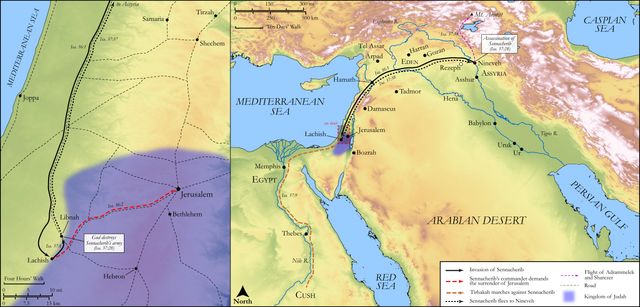
See on the biblical-era map
Study this verse
Public-domain commentary
Matthew Henry
From his Commentary on the Whole Bible. Henry comments on passages, not single verses — this entry covers Isaiah 37:21–38.
We may here observe, 1. That those who receive messages of terror from men with patience, and send messages of faith to God by prayer, may expect messages of grace and peace from God for their comfort, even when they are most cast down. Isaiah sent a long answer to Hezekiah's prayer in God's name, sent it in writing (for it was too long to be sent by word of mouth), and sent it by way of return to his prayer, relation being thereunto had: "Whereas thou hast prayed to me, know, for thy comfort, that thy prayer is heard." Isaiah might have referred him to the prophecies he had delivered (particularly that ch. 10) and bid him pick out an answer from thence; but, that he might have abundant consolation, a message is sent him on purpose. The correspondence between earth and heaven is never let fall on God's side. 2. Those who magnify themselves, especially who magnify themselves against God and his people, do really vilify themselves, and made themselves contemptible, in the eyes of all wise men: "The virgin, the daughter of Zion, has despised Sennacherib, and all his impotent malice and menaces; she knows that, while she preserves her integrity, she is sure of the divine protection, and that though the enemy may bark he cannot bite. All his threats are a jest; it is all but brutum fulmen - a mere flash," 3. Those who abuse the people of God affront God himself; and he takes what is said and done against them as said and done against himself: "Whom hast thou reproached? Even the Holy One of Israel, whom thou hast therefore reproached because he is a Holy One." And it aggravated the indignity Sennacherib did to God that he not only reproached him himself, but set his servants on to do the same: By thy servants, the abjects, thou hast reproached me. 4. Those who boast of themselves and their own achievements reflect upon God and his providence: "Thou hast said, I have digged, and drunk water; I have done mighty feats, and will do more; and wilt not own that I have done it," Isa 37:24-26. The most active men are no more than God makes them, and God makes them no more than of old he designed to make them: "What I have formed of ancient times, in an eternal counsel, now have I brought to pass" (for God does all according to the counsel of his will), "that thou shouldst be to lay waste defenced cities; it is therefore intolerable arrogance to make it thy own doing." 5. All the malice, and all the motions and projects, of the church's enemies, are under the cognizance and check of the church's God. Sennacherib was active and quick, here, and there, and every where, but God knew his going out and coming in, and had always an eye upon him, Isa 37:28. And that was not all; he had a hand upon him too, a strict hand, a strong hand, a hook in his nose and a bridle in his lips, with which, though he was very headstrong and unruly, he could and would turn him back by the way which he came, Isa 37:29. Hitherto he shall come and no further. God had signed Sennacherib's commission against Judah (Isa 10:6); here he supersedes it. He has frightened them, but he must not hurt them, and therefore is discharged from going any further; nay, his commitment is here signed, by which he is clapped up, to answer for what he had done beyond his commission. 6. God is his people's bountiful benefactor, as well as their powerful protector, both a sun and a shield to those that trust in him. Jerusalem shall be defended (Isa 37:35), the besiegers shall not come into it, no, nor come before it with any regular attack, but they shall be routed before they begin the siege, Isa 37:33. But this is not all; God will return in mercy to his people, and will do them good. Their land shall be more than ordinarily fruitful, so that their losses shall be abundantly repaired; they shall not feel any of the ill effects either of the enemies' wasting the country or of their own being taken off from husbandry. But the earth, as at first, shall bring forth of itself, and they shall live and live plentifully upon its spontaneous productions. The blessing of the Lord can, when he pleases, make rich without the hand of the diligent. And let them not think that the desolations of their country would excuse them from observing the sabbatical year, which happened (as it should seem) the year after, and when they were not to plough or sow; no, though they had not now their usual stock beforehand for that year, yet they must religiously observe it, and depend upon God to provide for them. God must be trusted in the way of duty. 7. There is no standing before the judgments of God when they come with commission. (1.) The greatest numbers cannot stand before them: one angel shall, in one night, lay a vast army of men dead upon the spot, when God commissions him so to do, Isa 37:36. Here are 185,000 brave soldiers in an instant turned into so many dead corpses. Many think the 76th Psalm was penned upon occasion of this defeat, where from the spoiling of the stout-hearted, and sending them to sleep their long sleep (Isa 37:5), it is inferred that God is more glorious and excellent than the mountains of prey (Isa 37:4), and that he, even he, is to be feared, Isa 37:7. Angels are employed, more than we are aware of, as ministers of God's justice, to punish the pride and break the power of wicked men. (2.) The greatest men cannot stand before them: The great king, the king of Assyria, looks very little when he is forced to return, not only with shame, because he cannot accomplish what he had projected with so much assurance, but with terror and fear, lest the angel that had destroyed his army should destroy him; yet he is made to look less when his own sons, who should have guarded him, sacrificed him to his idol, whose protection he sought, Isa 37:37, Isa 37:38. God can quickly stop their breath who breathe out threatenings and slaughter against his people, and will do it when they have filled up the measure of their iniquity; and the Lord is known by these judgments which he executes, known to be a God that resists the proud. Many prophecies were fulfilled in this providence, which should encourage us, as far as they look further, and are designed as common and general assurances of the safety of the church and of all that trust in God, to depend upon God for the accomplishment of them. He that has delivered does and will deliver. Lord, forgive our enemies; but, so let all thy enemies perish, O Lord!
Historical interpretation
Historical reception
2 surviving comments on this verse. Each one is dated, so this reads as a timeline rather than a list.
(v. 21 seqq.) However, Isaiah (also known as Josiah), the son of Amos, sent to Hezekiah saying: Thus says the Lord God of Israel: concerning what you asked me about Sennacherib, the king of Assyria, this is the word that the Lord spoke about him: He has despised you and mocked you, O virgin daughter of Zion. After you, the daughter of Jerusalem has shaken her head. Whom did you reproach and blaspheme? Against whom did you raise your voice and lift your eyes in pride, to the Holy One of Israel? You reproached the Lord in the hand of your servants and said: In the multitude of my chariots I have ascended (Al. I will ascend) the height of the mountains, the peaks of Lebanon, and I will cut down its lofty cedars, and its chosen fir trees, and I will enter the height of its summit, the Carmel of its cliff. I dug and drank water, and I dried up with the sole of my foot all the rivers of the banks. Because Hezekiah prayed to the Lord so boldly, and did not send to Isaiah, as he had sent before, the Prophet himself does not go to him, but sends messengers to him, who would say to him in the words of God: concerning Sennacherib, against whom you pray, this is the Lord's sentence: The virgin of Zion and the daughter of Jerusalem (who is called virgin and daughter because, while all the nations worship the idols of dead men, she alone preserves the purity of the religion of God and the worship of the one divinity) has derided you and despised you; and in order not to incite greater blasphemy against you, she did not respond immediately, but after you departed, she moved her head, certain of vengeance and secure in punishment. And she spoke these words: You have not sinned against me, but against the Lord; and it is not for your own sake, but for the sake of your servants, that the pride of the blasphemer becomes greater. For you have said that you would ascend to the heights of the mountains and the peaks of Mount Lebanon in your chariots, and cut down its tall cedars and its firs. This we can take either metaphorically of all nations and their rulers, or of Jerusalem, which is interpreted as Lebanon, so that its cedars and firs refer to the powerful and the nobles; but the height of its summit and the leap of Carmel refer to the Temple. For he had said above: Have you not heard what the kings of Assyria have done to all the lands that they have destroyed? Therefore, you will not be able to be saved. And what he infers: I dug and drank water, and I dried up with the sole of my foot all the streams of the ramparts, according to the story, this can be understood that, due to the multitude of the army, he has dried up all the rivers so that he is compelled to dig wells for himself. According to the translation: he has devastated all the peoples who are sometimes described by the names of waters with his own army. For whom alone they translated the Seventy, and I made the bridge (i.e. the powerful one, or the power), and I made the waters deserted, and all the congregation of waters: so that no nation might have any unpassable way for itself, but that it might trample the waters underfoot above all the peoples.
Because Hezekiah prayed to the Lord so boldly and did not send for Isaiah, as he had done previously, the prophet did not visit him in person but sent messengers who spoke to him the words of God: “This is the sentence of the Lord on Sennacherib, against whom you prayed: the virgin of Zion and daughter of Jerusalem”—who is called virgin and daughter because, with all the other nations worshiping the idols of dead men, she alone preserved the purity of the religion of God and the worship of one divinity—“has mocked and despised you. And lest she provoke you to greater blasphemy, she did not respond in your presence, but wagged her head behind you, immune from vengeance, secure from punishment. She also said this: ‘It is not against me that you have rebelled but against the Lord. Nor did you do it yourself, but through your servants, that the arrogance of your blasphemy might be greater. For you said that with the multitude of your chariots you would ascend the heights of the mountains and the yokes of Lebanon, and that you would fell the highest of its cedars and firs.’ ” We should read this metaphorically as concerning all the Gentiles and their princes, or as concerning Jerusalem, which Lebanon represents, such that we would refer her cedars and firs to the rulers and aristocrats but the height of her summit and the forest of her Carmel to the temple. For he had said above: “Have you not heard what the kings of Assyria did to all the earth, destroying it? Therefore, neither can you be liberated.” And because he adds: “I dug a well and drank water and dried up with my footsteps all the rivers of Egypt,” it can be understood in accordance with history that all the streams ran dry before the multitude of the army, thus making it necessary to dig wells. This means that by means of his army he destroyed all the peoples, who are sometimes known under the name of “waters,” as only the Seventy translated: “And I made a bridge and I turned the desert into waters and all the congregations of the waters.” None of the nations were impassable to themselves, of course, but he trampled with his foot on all the waters of the people.
Continue studying Isaiah 37:25 across the web’s major study libraries — every link below opens this exact verse, chapter, or book on the destination site.
Read & Compare
 BibleGatewayThis verse in more than 200 translations and 70 languages.
 Bible.comThe YouVersion reader — hundreds of translations, reading plans, and highlights.
 ESV.orgCrossway's official English Standard Version reader.
 NET BibleThe NET translation with 60,000+ translators' notes on every rendering decision.
 STEP BibleTyndale House's free study tool — original text, vocabulary, and scholarly resources.
 BibliaLogos Bible Software's free web reader.
 USCCBThe New American Bible (Revised Edition) with the U.S. bishops' study notes.
Commentaries
 BibleHub CommentariesDozens of classic commentaries on this verse, gathered on one page.
 StudyLightMore than 100 commentary sets — the largest collection on the web.
 BibleRefPlain-English commentary on what this verse means, verse by verse.
 Enduring WordDavid Guzik's free commentary on this chapter, widely used by Bible teachers.
 Bible Study ToolsVerse commentary alongside Greek and Hebrew study aids.
Original Language & Research
- BibleHub InterlinearThe verse word by word — original language, transliteration, and English.
- BibleHub LexiconEvery word's original-language definition and Strong's entry.
 Blue Letter BibleDeep-study tools — Strong's numbers, concordance, and word studies.
 SefariaThe Hebrew text with Rashi and centuries of Jewish commentary.
Sermons, Hymns & Audio


TrulyRandomVerse is not affiliated with these sites and doesn’t control their content. They’re linked because they’re genuinely useful.
Summary
Isaiah 37:25 records the audacious boast of Sennacherib, King of Assyria, delivered through his messengers to King Hezekiah and the people of Judah. In this declaration, Sennacherib asserts his unparalleled power and dominion, claiming his army's ability to overcome any natural obstacle or fortified defense. His boast of being able to "dig and drink water" in arid lands and to "dry up all the rivers of the besieged places" simply by marching through them serves as a potent psychological weapon. This rhetoric is designed to erode the morale of Jerusalem's inhabitants and undermine their faith in the Lord, setting the stage for a dramatic confrontation between human arrogance and divine sovereignty.
Context
ShowHideLiterary Context
This verse is deeply embedded within the crucial narrative of Isaiah 36-39, which chronicles the Assyrian siege of Jerusalem during the reign of King Hezekiah. Specifically, Isaiah 37 details Sennacherib's second, more direct, and overtly blasphemous message to Hezekiah, following the initial intimidation tactics described in Isaiah 36. The boast in Isaiah 37:25 is part of a longer speech (verses 23-25) where Sennacherib directly challenges the God of Israel, Yahweh, claiming that his overwhelming conquests are solely attributable to his own might, rather than any divine permission or oversight. This hubris directly precipitates the dramatic divine response and miraculous deliverance that follows, particularly highlighted in Isaiah 37:33-36, where God explicitly declares His intention to turn Sennacherib back and defend Jerusalem for His own name's sake.
Historical & Cultural Context
The events depicted in this passage occurred around 701 BC, a period when the Neo-Assyrian Empire, under the formidable leadership of Sennacherib, stood as the preeminent superpower of that day. Assyria had systematically conquered numerous kingdoms, including a significant portion of Judah, before turning its attention to Jerusalem. The Assyrians were infamous for their brutal military strategies, which encompassed devastating sieges, forced mass deportations, and sophisticated psychological warfare. Sennacherib's boastful rhetoric mirrors the typical pronouncements of the kings of that day, who frequently attributed their military successes to their own unparalleled strength and the perceived superiority of their patron deities. By claiming the ability to "dry up rivers" and conquer "besieged places," Sennacherib not only asserts his military dominance but also expresses profound contempt for the local deities, implying that even the natural defenses supposedly protected by these gods are utterly powerless against the might of the Assyrian war machine. This cultural context underscores the profound theological challenge inherent in Sennacherib's words.
Key Themes
ShowHideIsaiah 37:25 vividly illuminates several central themes within the book of Isaiah and broader biblical theology. Foremost among these is the arrogance of human power and the futility of trusting in human strength over divine sovereignty. Sennacherib's boast serves as a quintessential example of hubris, where a mortal king arrogantly attributes absolute power and unwavering success to himself, completely disregarding the Lord's ultimate control over history and nations. This human self-exaltation stands in stark contrast to the consistent message of Isaiah, which repeatedly emphasizes God's absolute control over all nations and His unwavering commitment to His covenant people, as powerfully articulated in passages such as Isaiah 40:15 and Isaiah 45:7. The narrative strategically employs Sennacherib's pride as a dramatic foil to magnify God's glory and His unparalleled ability to deliver His people against seemingly insurmountable odds, thereby reinforcing the profound theological truth that true security and salvation are found solely in trusting in the Lord, not in military might or human boasting.
Exposition and Analysis
ShowHideKey Word Analysis
ShowHideA primitive root meaning "to trench" or "to throw forth"; by implication, "to wall up" or "to build a wall." In this context, it signifies the Assyrian army's extraordinary capacity for engineering and resourcefulness. It suggests their ability to construct channels, dig wells, or otherwise secure vital water supplies even in hostile, arid, or previously unconquered territories. This demonstrates their self-sufficiency and mastery over the environment, implying a thorough and successful effort to overcome natural limitations and sustain their military campaigns indefinitely.
A primitive root meaning "to parch (through drought)," or by analogy, "to desolate, destroy, kill." Here, it is employed hyperbolically to convey the idea of complete subjugation, devastation, and the rendering of defenses useless. Sennacherib claims his forces are so overwhelmingly powerful that they can literally deplete water sources or render rivers impassable, effectively laying waste to the natural defenses of any land they conquer. This verb emphasizes the destructive and overwhelming nature of his military advance.
Of Egyptian origin, referring to "a channel," "a fosse," or "canal." While often specifically denoting the Nile, it also refers to other major rivers like the Tigris, or even general canals and streams. In this verse, "rivers" represent significant natural barriers, vital water sources, and strategic defensive elements for cities and regions. Sennacherib's audacious claim to dry them up underscores the perceived magnitude of his power and his asserted ability to overcome even the most formidable natural obstacles, rendering them utterly ineffective as defenses.
Verse Breakdown
ShowHide"I have digged, and drunk water"
This clause highlights Sennacherib's self-proclaimed ingenuity, logistical prowess, and military self-sufficiency. It suggests that his army is not merely dependent on existing water sources but possesses the capability to create or access their own, even in the most challenging or arid conquered territories. This boast speaks to their advanced engineering, discipline, and independence from natural limitations, further emphasizing their perceived invincibility and ability to sustain prolonged campaigns anywhere.
"and with the sole of my feet have I dried up"
This is a profoundly powerful and hyperbolic assertion of absolute dominance. The phrase "with the sole of my feet" implies the sheer physical presence, overwhelming numbers, and effortless advance of his vast army. The act of "drying up" by merely marching signifies a complete and effortless conquest, as if the very presence of his forces causes natural elements to yield to his will. It conveys an image of unstoppable might, where even the ground itself is subject to his command.
"all the rivers of the besieged places"
This phrase specifies the comprehensive extent of Sennacherib's claimed power and conquest. "Rivers" represent not only vital lifelines but also crucial natural defenses for cities and regions. By claiming to dry up all of them, he is asserting absolute and total control over the resources and defensive capabilities of any city he chooses to conquer, thereby rendering their resistance utterly futile. This is a direct and chilling challenge to the security of Jerusalem, which relied heavily on its water supply and fortifications.
Literary Devices
ShowHideThe primary literary device employed in Isaiah 37:25 is Hyperbole. Sennacherib's claims to have "dried up all the rivers of the besieged places" with the "sole of my feet" are a deliberate and extreme exaggeration. These statements are not meant to be taken literally but are designed to convey an overwhelming sense of military might, an unstoppable force, and absolute dominion. This overstatement is strategically crafted to instill profound fear and despair in the hearts of the besieged, aiming to break their will to resist. Additionally, there is a clear element of Metonymy, where "the sole of my feet" stands in for the entire Assyrian army and its overwhelming, relentless advance. The boast also contains a profound degree of Dramatic Irony, as the very power Sennacherib boasts of will soon be dramatically and divinely curtailed by the Lord, demonstrating the ultimate futility of human pride and self-exaltation when confronted with divine sovereignty.
Theological and Thematic Connections
ShowHideSennacherib's boast in Isaiah 37:25 stands as a quintessential demonstration of human pride and self-exaltation, a recurring and critical theme throughout biblical theology. It represents a direct challenge to the sovereignty of God, implying that human might and ingenuity can overcome any obstacle, even those ordained or protected by the divine. This profound arrogance sets the stage for God's dramatic and decisive intervention, underscoring the timeless truth that ultimate power and authority belong to the Lord alone, and that those who exalt themselves will inevitably be humbled. The narrative serves as a profound and enduring lesson on the inherent dangers of trusting in human strength, military prowess, or material resources rather than placing unwavering faith in the living God, who holds all creation and history firmly within His sovereign control.
Reflection and Application
ShowHideIsaiah 37:25 offers profound and timeless insights for contemporary believers. Sennacherib's audacious boast serves as a powerful mirror reflecting the persistent human tendency to rely primarily on our own strength, intellect, or material resources, especially when confronted with daunting challenges or seemingly insurmountable obstacles. We often fall into the subtle trap of self-sufficiency, mistakenly believing that our achievements, capabilities, or even our very existence are solely a result of our own efforts, thereby forgetting the profound truth that "every good gift and every perfect gift is from above, coming down from the Father of lights" (James 1:17). This verse calls us to a posture of profound humility, reminding us that true power, ultimate authority, and lasting victory belong exclusively to God. When confronted with overwhelming circumstances, whether they manifest as personal struggles, societal pressures, spiritual attacks, or global crises, we are often tempted to despair or to place our trust in worldly solutions and human ingenuity. However, the dramatic narrative of Isaiah 37 powerfully demonstrates that God is utterly sovereign over all creation and all history, capable of delivering His people even when human odds appear utterly impossible. Our true security, profound peace, and ultimate hope are found not in our own ability to "dry up rivers" or conquer "besieged places" through our own might, but in our unwavering trust in the Lord, who faithfully defends and delivers His own.
Questions for Reflection
ShowHideFAQ
ShowHideWho is speaking in Isaiah 37:25, and what is the purpose of this boast?
ShowHideThe speaker in Isaiah 37:25 is Sennacherib, the formidable King of Assyria. Although the words are attributed to him, they are delivered through his high-ranking messengers, most notably the Rabshakeh, who acted as his chief spokesman. The primary purpose of this audacious boast is to engage in a sophisticated form of psychological warfare against King Hezekiah and the people of Jerusalem. Sennacherib's strategic aim was to instill paralyzing fear, demoralize the city's inhabitants, and fundamentally undermine their trust in the Lord, thereby coercing them into surrendering without the need for a prolonged and costly siege. He claims absolute power and dominion over all obstacles, both natural and man-made, to demonstrate his perceived invincibility and the utter futility of any resistance against his might.
What does Sennacherib mean by "drying up all the rivers of the besieged places with the sole of my feet"?
ShowHideThis statement is a profound and deliberate hyperbole, not intended to be interpreted literally, but rather to convey the overwhelming might, logistical ingenuity, and destructive capability of the Assyrian army. "Drying up rivers" signifies their total ability to overcome any natural barriers, whether by diverting water, consuming vast quantities of it, or simply marching through it with such a massive and relentless force that it renders the water source utterly useless as a defense. The phrase "with the sole of my feet" emphasizes the sheer physical presence, the effortless dominance, and the relentless advance of his countless troops. It is a boast that his army is so numerous and powerful that their mere forward movement can neutralize any natural or fortified defense, thereby making surrender the only logical and inevitable option for those under siege.
How does God respond to Sennacherib's arrogance and boastful claims?
ShowHideGod responds directly, powerfully, and decisively to Sennacherib's profound arrogance and blasphemous claims. Through the prophet Isaiah, the Lord sends a reassuring message to Hezekiah, affirming that He has heard every word of Sennacherib's defiance and will absolutely not allow Jerusalem to fall. God declares that He will put a hook in Sennacherib's nose and turn him back the way he came, a vivid metaphor for divine control and humiliation (Isaiah 37:29). True to His divine word, that very night, an angel of the Lord miraculously strikes down 185,000 Assyrian soldiers, forcing Sennacherib to retreat in utter shame and return to Nineveh. There, he is later assassinated by his own sons while worshipping in the temple of his god, Nisroch (Isaiah 37:36-38). This dramatic and miraculous divine intervention powerfully demonstrates the ultimate futility of human pride and the absolute sovereignty of God over all earthly powers.
Christ-Centered Fulfillment
ShowHideSennacherib's boast in Isaiah 37:25, a stark declaration of human power and self-sufficiency arrayed against divine authority, finds its ultimate contrast, subversion, and profound fulfillment in the person and redemptive work of Jesus Christ. While Sennacherib claimed to "dry up rivers" and conquer "besieged places" through brute military force and destructive conquest, Christ demonstrates true, ultimate authority not through earthly might but through creative power, humble obedience, and redemptive sacrifice. The boast of Sennacherib, representing the ephemeral pride of earthly kingdoms and the inherent futility of relying on human strength, is utterly subverted by the profound humility and ultimate triumph of the Lamb of God. Jesus, through His sacrificial death on the cross and His glorious resurrection, truly "dried up" the rivers of sin, death, and spiritual bondage, not with the sole of His feet in a military march, but by the shedding of His own precious blood, thereby conquering the ultimate "besieged place"—the human heart held captive by sin and the dominion of darkness (Colossians 2:13-15). He is the true Lord who possesses inherent authority over all creation, calming raging storms with a mere word (Mark 4:39) and offering living water that truly satisfies the deepest thirst of the human soul (John 4:10-14). Unlike Sennacherib, whose arrogant boast led to his humiliating defeat and ignominious end, Christ's humble obedience unto death led to His supreme exaltation by God (Philippians 2:8-11). Through Him, believers find definitive deliverance from the true, eternal enemies—sin, death, and the devil—enemies far more formidable and pervasive than any earthly army (Hebrews 2:14-15). He is the true King who delivers His people, not by the might of human armies or the force of conquest, but by the transformative power of His cross and resurrection, establishing an eternal kingdom that will never be destroyed or overthrown (Daniel 2:44).