


Isaiah 37:33
Bible text: King James Version (1769 Blayney text) · Public domain
Bible text: King James Version with Strong's numbers · Public domain
Bible text: Berean Standard Bible · Public domain
Bible text: American Standard Version (1901) · Public domain
Bible text: World English Bible, Messianic edition · Public domain
Bible text: Geneva Bible (1599) · Public domain
Bible text: Young's Literal Translation · Public domain
- לָכֵןla·Khen<to> thereforeH3651Prep-l ¦ AdvAdverbלָ<to>כֵןtherefore
- כֹּהkohthusH3541AdvAdverb
- אָמַר'a·Marhe saysH559V-Qal-Perf-3msVerb Qal Perfect 3rd Singular Masculine
- יְהוָהYah·wehYahwehH3068N-properNoun Proper Title
- אֶל'elconcerningH413PrepPreposition
- מֶלֶךְMe·lekh[the] king ofH4428N-mscNoun Singular Masculine Construct
- אַשּׁוּר'a·ShurAssyriaH804N-properNoun Proper Location
- לֹאlo'notH3808NegParticle Negative
- יָבוֹאya·Vo'he will comeH935V-Qal-Imperf-3msVerb Qal Imperfect 3rd Singular Masculine
- אֶל'elintoH413PrepPreposition
- הָעִירha·'Irthe cityH5892Art ¦ N-fsNoun Singular Feminine Absoluteהָtheעִירcity
- הַזֹּאתha·Zot<the> thisH2063Art ¦ PrtParticle Demonstrativeהַ<the>זֹּאתthis
- וְלֹאve·lo'and notH3808Conj-w ¦ NegParticle Negativeוְandלֹאnot
- יוֹרֶהyo·Rehhe will shootH3384V-Hiphil-Imperf-3msVerb Hiphil Imperfect 3rd Singular Masculine
- שָׁםshamthereH8033AdvAdverb
- חֵץChetzan arrowH2671N-msNoun Singular Masculine Absolute
- וְלֹאve·lo'and notH3808Conj-w ¦ NegParticle Negativeוְandלֹאnot
- יְקַדְּמֶנָּהye·kad·de·Me·nahhe will confront itH6923V-Piel-Imperf-3ms ¦ 3fsVerb Piel Imperfect 3rd Singular Masculineיְקַדְּמֶhe will confrontנָּהit
- מָגֵןma·Gena shieldH4043N-msNoun Singular Masculine Absolute
- וְלֹאve·lo'and notH3808Conj-w ¦ NegParticle Negativeוְandלֹאnot
- יִשְׁפֹּךְyish·Pokhhe will pour outH8210V-Qal-Imperf-3msVerb Qal Imperfect 3rd Singular Masculine
- עֳלֶיהָ'o·Lei·haon itH5921Prep ¦ 3fsPrepositionעֳלֶיonהָit
- סֹלְלָהso·le·Laha moundH5550N-fsNoun Singular Feminine Absolute
English is a literal word-by-word gloss of the Hebrew, not the KJV's wording. Why?
This is the original text the KJV's translators worked from — each Hebrew word with its own literal English meaning in this verse, prepared by scholars at Tyndale House, Cambridge. The KJV translates whole sentences, not word by word, so its wording differs: one Hebrew word can become several English words, and the KJV may choose “the LORD” where the gloss reads “Yahweh”. Both are faithful — they answer different questions. For the KJV's own rendering, switch to the KJV text.
Details
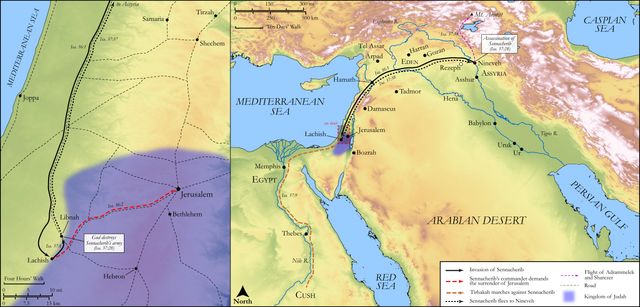
See on the biblical-era map
Study this verse
Public-domain commentary
Matthew Henry
From his Commentary on the Whole Bible. Henry comments on passages, not single verses — this entry covers Isaiah 37:21–38.
We may here observe, 1. That those who receive messages of terror from men with patience, and send messages of faith to God by prayer, may expect messages of grace and peace from God for their comfort, even when they are most cast down. Isaiah sent a long answer to Hezekiah's prayer in God's name, sent it in writing (for it was too long to be sent by word of mouth), and sent it by way of return to his prayer, relation being thereunto had: "Whereas thou hast prayed to me, know, for thy comfort, that thy prayer is heard." Isaiah might have referred him to the prophecies he had delivered (particularly that ch. 10) and bid him pick out an answer from thence; but, that he might have abundant consolation, a message is sent him on purpose. The correspondence between earth and heaven is never let fall on God's side. 2. Those who magnify themselves, especially who magnify themselves against God and his people, do really vilify themselves, and made themselves contemptible, in the eyes of all wise men: "The virgin, the daughter of Zion, has despised Sennacherib, and all his impotent malice and menaces; she knows that, while she preserves her integrity, she is sure of the divine protection, and that though the enemy may bark he cannot bite. All his threats are a jest; it is all but brutum fulmen - a mere flash," 3. Those who abuse the people of God affront God himself; and he takes what is said and done against them as said and done against himself: "Whom hast thou reproached? Even the Holy One of Israel, whom thou hast therefore reproached because he is a Holy One." And it aggravated the indignity Sennacherib did to God that he not only reproached him himself, but set his servants on to do the same: By thy servants, the abjects, thou hast reproached me. 4. Those who boast of themselves and their own achievements reflect upon God and his providence: "Thou hast said, I have digged, and drunk water; I have done mighty feats, and will do more; and wilt not own that I have done it," Isa 37:24-26. The most active men are no more than God makes them, and God makes them no more than of old he designed to make them: "What I have formed of ancient times, in an eternal counsel, now have I brought to pass" (for God does all according to the counsel of his will), "that thou shouldst be to lay waste defenced cities; it is therefore intolerable arrogance to make it thy own doing." 5. All the malice, and all the motions and projects, of the church's enemies, are under the cognizance and check of the church's God. Sennacherib was active and quick, here, and there, and every where, but God knew his going out and coming in, and had always an eye upon him, Isa 37:28. And that was not all; he had a hand upon him too, a strict hand, a strong hand, a hook in his nose and a bridle in his lips, with which, though he was very headstrong and unruly, he could and would turn him back by the way which he came, Isa 37:29. Hitherto he shall come and no further. God had signed Sennacherib's commission against Judah (Isa 10:6); here he supersedes it. He has frightened them, but he must not hurt them, and therefore is discharged from going any further; nay, his commitment is here signed, by which he is clapped up, to answer for what he had done beyond his commission. 6. God is his people's bountiful benefactor, as well as their powerful protector, both a sun and a shield to those that trust in him. Jerusalem shall be defended (Isa 37:35), the besiegers shall not come into it, no, nor come before it with any regular attack, but they shall be routed before they begin the siege, Isa 37:33. But this is not all; God will return in mercy to his people, and will do them good. Their land shall be more than ordinarily fruitful, so that their losses shall be abundantly repaired; they shall not feel any of the ill effects either of the enemies' wasting the country or of their own being taken off from husbandry. But the earth, as at first, shall bring forth of itself, and they shall live and live plentifully upon its spontaneous productions. The blessing of the Lord can, when he pleases, make rich without the hand of the diligent. And let them not think that the desolations of their country would excuse them from observing the sabbatical year, which happened (as it should seem) the year after, and when they were not to plough or sow; no, though they had not now their usual stock beforehand for that year, yet they must religiously observe it, and depend upon God to provide for them. God must be trusted in the way of duty. 7. There is no standing before the judgments of God when they come with commission. (1.) The greatest numbers cannot stand before them: one angel shall, in one night, lay a vast army of men dead upon the spot, when God commissions him so to do, Isa 37:36. Here are 185,000 brave soldiers in an instant turned into so many dead corpses. Many think the 76th Psalm was penned upon occasion of this defeat, where from the spoiling of the stout-hearted, and sending them to sleep their long sleep (Isa 37:5), it is inferred that God is more glorious and excellent than the mountains of prey (Isa 37:4), and that he, even he, is to be feared, Isa 37:7. Angels are employed, more than we are aware of, as ministers of God's justice, to punish the pride and break the power of wicked men. (2.) The greatest men cannot stand before them: The great king, the king of Assyria, looks very little when he is forced to return, not only with shame, because he cannot accomplish what he had projected with so much assurance, but with terror and fear, lest the angel that had destroyed his army should destroy him; yet he is made to look less when his own sons, who should have guarded him, sacrificed him to his idol, whose protection he sought, Isa 37:37, Isa 37:38. God can quickly stop their breath who breathe out threatenings and slaughter against his people, and will do it when they have filled up the measure of their iniquity; and the Lord is known by these judgments which he executes, known to be a God that resists the proud. Many prophecies were fulfilled in this providence, which should encourage us, as far as they look further, and are designed as common and general assurances of the safety of the church and of all that trust in God, to depend upon God for the accomplishment of them. He that has delivered does and will deliver. Lord, forgive our enemies; but, so let all thy enemies perish, O Lord!
Historical interpretation
Historical reception
1 surviving comment on this verse from the historical church.
(Verse 33, 34.) Therefore, thus says the Lord about the king of Assyria: He shall not enter this city, nor shoot an arrow there, nor come before it with a shield, nor build siege works against it. By the way that he came, by the same he shall return, and he shall not enter this city, says the Lord. I will defend this city and save it for my own sake and for the sake of my servant David. It turns back to its purpose and dispels present fear after the hope of future things. For there was not so much joy upon the things which she had promised would come after a long time, as there was care for the impending. But what she says about Assyria returning and not lifting up a shield against Jerusalem, not shooting arrows, nor that the city should be fortified with walls and a rampart, and that the enemy would return by the way he had come, and that the city should be freed from the present siege, and finally she brings forth: for my sake and for the sake of my servant David, this signifies that they are preserved not by their own merit, but by the clemency of God, indeed by the memory of their father David. In which both his own negligence and that person's trustworthiness and justice are admonished, because God loves justice to such an extent that he protects even the descendants of holy men, not by their own merit, but by the virtue of their ancestors.
Continue studying Isaiah 37:33 across the web’s major study libraries — every link below opens this exact verse, chapter, or book on the destination site.
Read & Compare
 BibleGatewayThis verse in more than 200 translations and 70 languages.
 Bible.comThe YouVersion reader — hundreds of translations, reading plans, and highlights.
 ESV.orgCrossway's official English Standard Version reader.
 NET BibleThe NET translation with 60,000+ translators' notes on every rendering decision.
 STEP BibleTyndale House's free study tool — original text, vocabulary, and scholarly resources.
 BibliaLogos Bible Software's free web reader.
 USCCBThe New American Bible (Revised Edition) with the U.S. bishops' study notes.
Commentaries
 BibleHub CommentariesDozens of classic commentaries on this verse, gathered on one page.
 StudyLightMore than 100 commentary sets — the largest collection on the web.
 BibleRefPlain-English commentary on what this verse means, verse by verse.
 Enduring WordDavid Guzik's free commentary on this chapter, widely used by Bible teachers.
 Bible Study ToolsVerse commentary alongside Greek and Hebrew study aids.
Original Language & Research
- BibleHub InterlinearThe verse word by word — original language, transliteration, and English.
- BibleHub LexiconEvery word's original-language definition and Strong's entry.
 Blue Letter BibleDeep-study tools — Strong's numbers, concordance, and word studies.
 SefariaThe Hebrew text with Rashi and centuries of Jewish commentary.
Sermons, Hymns & Audio


TrulyRandomVerse is not affiliated with these sites and doesn’t control their content. They’re linked because they’re genuinely useful.
Summary
Isaiah 37:33 delivers a definitive divine pronouncement from the LORD, directly addressing the formidable Assyrian king Sennacherib and his impending siege of Jerusalem. This prophetic utterance serves as an unwavering assurance to King Hezekiah and the beleaguered inhabitants of the city that, despite the overwhelming military might and advanced siege tactics of the Assyrians, Jerusalem would remain inviolable. It stands as a profound testament to God's absolute sovereignty and His protective hand over His chosen people and city, declaring with divine authority that no arrow would be shot, no shield would approach, and no siege ramp would be cast against it.
Context
ShowHideLiterary Context
This verse is a pivotal moment within a larger narrative of profound national crisis and miraculous divine intervention in Judah's history. It immediately follows King Hezekiah's desperate and humble prayer to the LORD, recorded in Isaiah 37:15-20, offered after receiving blasphemous and intimidating messages from Sennacherib's field commander, Rabshakeh, which are detailed extensively in Isaiah 36. Hezekiah, having already demonstrated his reliance on God by tearing his clothes, covering himself with sackcloth, and sending messengers to Isaiah the prophet for divine counsel (Isaiah 37:1-4), receives this specific and detailed prophecy through Isaiah. The verse functions as God's direct, unwavering, and comprehensive answer to Hezekiah's plea, providing concrete assurance of Jerusalem's imminent deliverance and setting the stage for the dramatic and miraculous fulfillment that immediately follows in Isaiah 37:36-38.
Historical & Cultural Context
The events described in Isaiah 37 unfold around 701 BC, a period profoundly shaped by the dominance of the Neo-Assyrian Empire. This empire was renowned for its unparalleled military prowess, brutal conquest strategies, and highly advanced siege warfare. King Sennacherib was one of Assyria's most powerful and feared rulers, having already subjugated numerous nations and fortified cities, including many within Judah, before turning his attention to Jerusalem. Assyrian siege tactics were highly effective and meticulously executed, involving the strategic deployment of archers, shield-bearers to protect advancing troops, and the construction of massive earthen ramps (known as siege banks or mounds) to breach city walls or allow siege engines to approach. The cultural backdrop also includes the Assyrians' polytheistic worldview, where they frequently boasted of their gods' superiority over the deities of conquered peoples, directly challenging the unique power and authority of the God of Israel. Jerusalem, though a fortified city, was militarily outmatched and isolated, making the divine intervention described in this passage all the more miraculous and significant in demonstrating the LORD's unique and sovereign power over all earthly forces.
Key Themes
ShowHideIsaiah 37:33 powerfully contributes to and exemplifies several overarching themes within the book of Isaiah and broader biblical theology. Foremost is the theme of Divine Sovereignty and Protection, demonstrating God's absolute control over all earthly powers, even the most formidable empires and their seemingly unstoppable military might. Despite Sennacherib's strategic brilliance and overwhelming forces, God declares Jerusalem to be off-limits, highlighting His role as the ultimate defender of His people and His holy city. This passage also profoundly underscores God's Faithfulness to His Promises and Covenant, particularly His covenant with David concerning an eternal dynasty and the inviolability of Jerusalem as His chosen dwelling place (2 Samuel 7:12-16). The verse further illustrates The Futility of Human Power and Arrogance when it opposes God's sovereign will; all of Sennacherib's renowned siege tactics are rendered utterly useless by a single, authoritative divine decree. Finally, it highlights the Efficacy of Prayer and the Prophetic Word, as God's swift and decisive response to Hezekiah's humble and faithful prayer comes through the prophet Isaiah, demonstrating that true security and deliverance lie not in military strength or political maneuvering but in trusting in the LORD.
Exposition and Analysis
ShowHideKey Word Analysis
ShowHideDenoting "the self-Existent or Eternal; Jehovah, Jewish national name of God." This word emphasizes the speaker's identity as the covenant-keeping God of Israel, the one true and living God, whose character is eternal, self-existent, and unchanging. His declaration in this verse is not a mere prediction but a sovereign decree from the ultimate, unchallengeable authority, ensuring its absolute fulfillment.
Meaning "properly, a piercer, i.e. an arrow; by implication, a wound; figuratively, (of God) thunderbolt; the shaft of a spear." This term refers to a primary projectile weapon used extensively in ancient warfare, often deployed in massive volleys to inflict casualties, suppress defenders on city walls, and create chaos. The divine promise that no arrow would be shot signifies a complete cessation of even the most basic offensive action against the city, indicating total protection.
Referring to "a military mound, i.e. rampart of besiegers." This describes a siege ramp or mound, a crucial and often massive piece of siege engineering employed by ancient armies like the Assyrians. Such a structure would allow besiegers to gain elevated access to or position heavy siege engines against fortified city walls. The declaration that no bank would be cast against Jerusalem means that the most effective and destructive siege tactic would be divinely prevented, ensuring the city's physical integrity.
Verse Breakdown
ShowHide"Therefore thus saith the LORD concerning the king of Assyria,"
This opening clause powerfully establishes the divine authority and the specific target of the prophecy. "Thus saith the LORD" is a classic prophetic formula, unequivocally signaling that the following words are not human conjecture or political analysis but a direct, infallible utterance from God Himself. The explicit mention of "the king of Assyria" (Sennacherib) highlights the direct confrontation between the omnipotent God of Israel and the arrogant, seemingly unstoppable earthly monarch who had defied Him.
"He shall not come into this city,"
This is the overarching, absolute prohibition that encapsulates the divine protection. Despite Sennacherib's successful conquests of numerous other cities in Judah and his formidable presence at Jerusalem's gates, God declares an absolute barrier: the Assyrian king will not achieve his ultimate objective of entering and conquering Jerusalem. This statement serves as the definitive assurance of the city's inviolability.
"nor shoot an arrow there,"
This specifies the first of several common siege tactics that would be rendered futile. Assyrian archers were renowned for their skill and were a primary offensive force, with volleys of arrows used to suppress defenders on the walls and inflict casualties. The divine decree prevents even this initial, fundamental act of aggression from succeeding within the city's immediate vicinity, indicating a complete halt to offensive operations.
"nor come before it with shields,"
This refers to the disciplined advance of infantry, often in protective formations, using large shields (such as the Assyrian "gerrhon" or "tortoise" formation) to approach the city walls for direct assault or to position siege engines. The prohibition means that the Assyrian army would not even be able to execute their standard close-quarter assault tactics against Jerusalem's defenses, signifying a complete frustration of their ground offensive.
"nor cast a bank against it."
This final prohibition addresses the most significant and often decisive siege tactic: the construction of an earthen ramp or mound. Such a "bank" or "mount" would allow besiegers to bring battering rams or siege towers directly to the city walls, or to provide an elevated platform for archers and slingers to fire down into the city. God's declaration that this most effective and destructive method would not be employed against Jerusalem underscores the completeness of the divine protection and the utter frustration of Sennacherib's military efforts.
Literary Devices
ShowHideIsaiah 37:33 is profoundly shaped by Divine Oracle/Prophecy, serving as a direct, authoritative declaration from God that foretells future events with absolute certainty and power. The repetitive use of the negative conjunction "nor" (Anaphora and Repetition) across the clauses ("nor shoot an arrow there," "nor come before it with shields," "nor cast a bank against it") creates a powerful cumulative effect, emphasizing the absolute and comprehensive nature of God's protective decree. This Enumeration of specific siege tactics highlights the futility of human military might when confronted by divine will, creating a stark Antithesis between the overwhelming power of the Assyrian army and the unyielding sovereignty of the LORD. The city of Jerusalem itself functions as a profound Symbolism of God's chosen dwelling place and His covenant faithfulness, whose miraculous inviolability is a tangible testament to His protective character and the reliability of His promises.
Theological and Thematic Connections
ShowHideIsaiah 37:33 profoundly illustrates God's active and immediate involvement in human history, demonstrating His absolute sovereignty over nations and their rulers. It reveals that no earthly power, no matter how vast, technologically advanced, or seemingly unstoppable, can thwart the divine will or overcome God's protective hand over His people and His chosen city. This passage serves as a powerful reminder of God's covenant faithfulness, showing that He is not merely a distant, detached deity but a present, engaged deliverer who responds to the humble prayers of His servants. The miraculous deliverance of Jerusalem underscores that true security and ultimate victory come not from human strength, strategic brilliance, or military might, but from trusting in the omnipotence and unwavering promises of the LORD.
Reflection and Application
ShowHideThe divine promise in Isaiah 37:33 offers profound encouragement and a timeless, practical lesson for believers navigating the complexities and challenges of life. When faced with seemingly insurmountable obstacles, overwhelming opposition, or situations that feel utterly beyond human control, this verse powerfully reminds us that our ultimate security and hope rest in the unwavering sovereignty of God. Just as He declared Jerusalem off-limits to the mighty and ruthless Assyrian army, so too can we trust that God sets clear boundaries for the forces that threaten us, whether they be spiritual attacks, personal crises, professional pressures, or societal anxieties. Our appropriate response, like Hezekiah's, should be one of humble, persistent prayer and confident trust, knowing that the LORD is our ever-present defender and deliverer. This passage calls us to shift our gaze from the perceived magnitude of our problems to the infinite power and faithfulness of God, finding deep peace and courage in His unfailing protection and providential care.
Questions for Reflection
ShowHideFAQ
ShowHideWhat happened immediately after this prophecy was given?
ShowHideImmediately following this prophecy, the LORD sent an angel who struck down 185,000 Assyrian soldiers in a single night. This devastating and miraculous blow forced King Sennacherib to withdraw his army from Jerusalem and return to Nineveh in shame. The account of this incredible deliverance is recorded in Isaiah 37:36 and corroborated in 2 Kings 19:35. Furthermore, Sennacherib was later assassinated by his own sons while worshipping in the temple of his god, Nisroch, fulfilling another part of Isaiah's prophecy concerning his fate (Isaiah 37:37-38).
What does "cast a bank against it" mean in ancient siege warfare?
ShowHideIn ancient siege warfare, "casting a bank" (Hebrew: çôlᵉlâh) refers to the construction of a massive earthen ramp or mound against the walls of a besieged city. This was a common and highly effective tactic, particularly for powerful and technologically advanced armies like the Assyrians. The primary purpose of these ramps was multi-faceted: they allowed besiegers to elevate their archers and slingers to fire down into the city with greater accuracy and force, provided a stable platform for moving heavy siege engines (such as battering rams or siege towers) directly to the city walls for breaching, and could even serve as a direct assault route for troops to scale or breach the fortifications. The LORD's declaration that no such bank would be cast against Jerusalem signifies a complete and supernatural frustration of the Assyrian's most potent and destructive siege strategy, ensuring the city's physical integrity and demonstrating divine protection.
Christ-Centered Fulfillment
ShowHideWhile Isaiah 37:33 describes a literal, physical deliverance of Jerusalem from a military threat, its deeper Christ-centered fulfillment points to the ultimate spiritual deliverance and protection found in Jesus Christ. Just as God declared ancient Jerusalem inviolable by the Assyrian king, so too does Christ establish an eternal, spiritual kingdom—His Church—that the very gates of hell cannot prevail against (Matthew 16:18). The formidable Assyrian army, with its arrows, shields, and siege banks, serves as a powerful type or shadow of the spiritual enemies—sin, death, and Satan—that relentlessly besiege humanity. Yet, through Christ's sacrificial death on the cross and His triumphant resurrection, these spiritual foes are decisively defeated and disarmed. He is the true Lamb of God who takes away the sin of the world (John 1:29), and through His victory, He has triumphed over the powers and authorities, making a public spectacle of them (Colossians 2:15). The divine promise of protection to Jerusalem finds its ultimate reality in the new covenant, where believers are citizens of a heavenly Jerusalem (Hebrews 12:22) and are eternally secure in Christ, shielded from condemnation and eternal separation from God (Romans 8:1). This passage, therefore, foreshadows Christ's ultimate victory, ensuring that no spiritual "arrow" of accusation, no "shield" of worldly power, and no "bank" of sin's entrenchment can ultimately conquer those who are found in Him.