


Isaiah 37:32
Bible text: King James Version (1769 Blayney text) · Public domain
Bible text: Berean Standard Bible · Public domain
Bible text: American Standard Version (1901) · Public domain
Bible text: World English Bible, Messianic edition · Public domain
Bible text: Geneva Bible (1599) · Public domain
Bible text: Young's Literal Translation · Public domain
- כִּיkiforH3588PrtParticle Conditional
- מִירוּשָׁלִַםmi·ru·sha·Limfrom JerusalemH3389Prep-m ¦ N-properNoun Proper LocationמִfromירוּשָׁלִַםJerusalem
- תֵּצֵאte·Tze'it will go outH3318V-Qal-Imperf-3fsVerb Qal Imperfect 3rd Singular Feminine
- שְׁאֵרִיתshe·'e·Rita remnantH7611N-fsNoun Singular Feminine Absolute
- וּפְלֵיטָהu·fe·lei·Tahand an escaped remnantH6413Conj-w ¦ N-fsNoun Singular Feminine Absoluteוּandפְלֵיטָהan escaped remnant
- מֵהַרme·Harfrom [the] mountain ofH2022Prep-m ¦ N-mscNoun Singular Masculine Constructמֵfromהַר[the] mountain of
- צִיּוֹןtzi·YonZionH6726N-properNoun Proper Location
- קִנְאַתkin·'At[the] zeal ofH7068N-fscNoun Singular Feminine Construct
- יְהוָהYah·wehYahwehH3068N-properNoun Proper Title
- צְבָאוֹתtze·va·'otof hostsH6635N-fpNoun Plural Feminine Absolute
- תַּעֲשֶׂהta·'a·sehit will accomplishH6213V-Qal-Imperf-3fsVerb Qal Imperfect 3rd Singular Feminine
- זֹּאתZotthisH2063PrtParticle Demonstrative
English is a literal word-by-word gloss of the Hebrew, not the KJV's wording. Why?
This is the original text the KJV's translators worked from — each Hebrew word with its own literal English meaning in this verse, prepared by scholars at Tyndale House, Cambridge. The KJV translates whole sentences, not word by word, so its wording differs: one Hebrew word can become several English words, and the KJV may choose “the LORD” where the gloss reads “Yahweh”. Both are faithful — they answer different questions. For the KJV's own rendering, switch to the KJV text.
Details
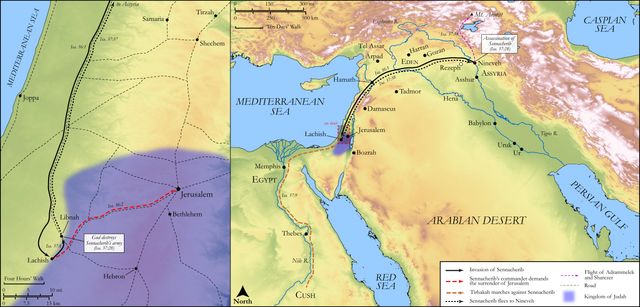
See on the biblical-era map
Study this verse
Public-domain commentary
Matthew Henry
From his Commentary on the Whole Bible. Henry comments on passages, not single verses — this entry covers Isaiah 37:21–38.
We may here observe, 1. That those who receive messages of terror from men with patience, and send messages of faith to God by prayer, may expect messages of grace and peace from God for their comfort, even when they are most cast down. Isaiah sent a long answer to Hezekiah's prayer in God's name, sent it in writing (for it was too long to be sent by word of mouth), and sent it by way of return to his prayer, relation being thereunto had: "Whereas thou hast prayed to me, know, for thy comfort, that thy prayer is heard." Isaiah might have referred him to the prophecies he had delivered (particularly that ch. 10) and bid him pick out an answer from thence; but, that he might have abundant consolation, a message is sent him on purpose. The correspondence between earth and heaven is never let fall on God's side. 2. Those who magnify themselves, especially who magnify themselves against God and his people, do really vilify themselves, and made themselves contemptible, in the eyes of all wise men: "The virgin, the daughter of Zion, has despised Sennacherib, and all his impotent malice and menaces; she knows that, while she preserves her integrity, she is sure of the divine protection, and that though the enemy may bark he cannot bite. All his threats are a jest; it is all but brutum fulmen - a mere flash," 3. Those who abuse the people of God affront God himself; and he takes what is said and done against them as said and done against himself: "Whom hast thou reproached? Even the Holy One of Israel, whom thou hast therefore reproached because he is a Holy One." And it aggravated the indignity Sennacherib did to God that he not only reproached him himself, but set his servants on to do the same: By thy servants, the abjects, thou hast reproached me. 4. Those who boast of themselves and their own achievements reflect upon God and his providence: "Thou hast said, I have digged, and drunk water; I have done mighty feats, and will do more; and wilt not own that I have done it," Isa 37:24-26. The most active men are no more than God makes them, and God makes them no more than of old he designed to make them: "What I have formed of ancient times, in an eternal counsel, now have I brought to pass" (for God does all according to the counsel of his will), "that thou shouldst be to lay waste defenced cities; it is therefore intolerable arrogance to make it thy own doing." 5. All the malice, and all the motions and projects, of the church's enemies, are under the cognizance and check of the church's God. Sennacherib was active and quick, here, and there, and every where, but God knew his going out and coming in, and had always an eye upon him, Isa 37:28. And that was not all; he had a hand upon him too, a strict hand, a strong hand, a hook in his nose and a bridle in his lips, with which, though he was very headstrong and unruly, he could and would turn him back by the way which he came, Isa 37:29. Hitherto he shall come and no further. God had signed Sennacherib's commission against Judah (Isa 10:6); here he supersedes it. He has frightened them, but he must not hurt them, and therefore is discharged from going any further; nay, his commitment is here signed, by which he is clapped up, to answer for what he had done beyond his commission. 6. God is his people's bountiful benefactor, as well as their powerful protector, both a sun and a shield to those that trust in him. Jerusalem shall be defended (Isa 37:35), the besiegers shall not come into it, no, nor come before it with any regular attack, but they shall be routed before they begin the siege, Isa 37:33. But this is not all; God will return in mercy to his people, and will do them good. Their land shall be more than ordinarily fruitful, so that their losses shall be abundantly repaired; they shall not feel any of the ill effects either of the enemies' wasting the country or of their own being taken off from husbandry. But the earth, as at first, shall bring forth of itself, and they shall live and live plentifully upon its spontaneous productions. The blessing of the Lord can, when he pleases, make rich without the hand of the diligent. And let them not think that the desolations of their country would excuse them from observing the sabbatical year, which happened (as it should seem) the year after, and when they were not to plough or sow; no, though they had not now their usual stock beforehand for that year, yet they must religiously observe it, and depend upon God to provide for them. God must be trusted in the way of duty. 7. There is no standing before the judgments of God when they come with commission. (1.) The greatest numbers cannot stand before them: one angel shall, in one night, lay a vast army of men dead upon the spot, when God commissions him so to do, Isa 37:36. Here are 185,000 brave soldiers in an instant turned into so many dead corpses. Many think the 76th Psalm was penned upon occasion of this defeat, where from the spoiling of the stout-hearted, and sending them to sleep their long sleep (Isa 37:5), it is inferred that God is more glorious and excellent than the mountains of prey (Isa 37:4), and that he, even he, is to be feared, Isa 37:7. Angels are employed, more than we are aware of, as ministers of God's justice, to punish the pride and break the power of wicked men. (2.) The greatest men cannot stand before them: The great king, the king of Assyria, looks very little when he is forced to return, not only with shame, because he cannot accomplish what he had projected with so much assurance, but with terror and fear, lest the angel that had destroyed his army should destroy him; yet he is made to look less when his own sons, who should have guarded him, sacrificed him to his idol, whose protection he sought, Isa 37:37, Isa 37:38. God can quickly stop their breath who breathe out threatenings and slaughter against his people, and will do it when they have filled up the measure of their iniquity; and the Lord is known by these judgments which he executes, known to be a God that resists the proud. Many prophecies were fulfilled in this providence, which should encourage us, as far as they look further, and are designed as common and general assurances of the safety of the church and of all that trust in God, to depend upon God for the accomplishment of them. He that has delivered does and will deliver. Lord, forgive our enemies; but, so let all thy enemies perish, O Lord!
Historical interpretation
Historical reception
1 surviving comment on this verse from the historical church.
(Vers. 30 seqq.) But this will be a sign for you: Eat in this year what grows of itself, and in the second year what springs from that; then in the third year sow, reap, plant vineyards, and eat their fruit. The remaining survivors of the house of Judah shall take root downward and bear fruit upward; for out of Jerusalem shall come a remnant, and out of Mount Zion a band of survivors. The zeal of the LORD of hosts will do this. All these things the Prophet speaks through messengers to Hezekiah, what Sennacherib said, what the Lord answered him: now he speaks to him directly, so that he may not doubt the things that were said to come. And for this reason, especially, the words of the prophets had credibility among the people: because they not only remembered things that would happen many centuries in the future, but also things that would happen immediately, and would be fulfilled after a short period of time: and that within two years, the Assyrian king would perish and security would be restored to the city of Jerusalem. This will be, he says, a sign of what I predict will happen, that in this year you will eat what grows naturally. Or according to the Seventy, those things which you harvest first. But in the second year, according to Symmachus, eat from the fruits: or according to the same people, those things which have sprouted from the past crops and fallen to the ground as seed. But in the third year, after the Assyrians have been driven away and the siege has been lifted, sow, reap, and plant vineyards, and eat the fruits of them. Indeed, the remaining fragments of this small city, which are now being surrounded by hostile armies, do not believe that they will escape. They will receive such an abundance and happiness of all things that they will be filled, like a tree firmly rooted in a high mountain, with the thickest of fruits. For the remnants will come forth from Jerusalem and from Mount Zion, and they will fill the land of Judaea, not by their own merit, but by the mercy of God, indeed by the zeal that He has shown towards His wicked people.
Continue studying Isaiah 37:32 across the web’s major study libraries — every link below opens this exact verse, chapter, or book on the destination site.
Read & Compare
 BibleGatewayThis verse in more than 200 translations and 70 languages.
 Bible.comThe YouVersion reader — hundreds of translations, reading plans, and highlights.
 ESV.orgCrossway's official English Standard Version reader.
 NET BibleThe NET translation with 60,000+ translators' notes on every rendering decision.
 STEP BibleTyndale House's free study tool — original text, vocabulary, and scholarly resources.
 BibliaLogos Bible Software's free web reader.
 USCCBThe New American Bible (Revised Edition) with the U.S. bishops' study notes.
Commentaries
 BibleHub CommentariesDozens of classic commentaries on this verse, gathered on one page.
 StudyLightMore than 100 commentary sets — the largest collection on the web.
 BibleRefPlain-English commentary on what this verse means, verse by verse.
 Enduring WordDavid Guzik's free commentary on this chapter, widely used by Bible teachers.
 Bible Study ToolsVerse commentary alongside Greek and Hebrew study aids.
Original Language & Research
- BibleHub InterlinearThe verse word by word — original language, transliteration, and English.
- BibleHub LexiconEvery word's original-language definition and Strong's entry.
 Blue Letter BibleDeep-study tools — Strong's numbers, concordance, and word studies.
 SefariaThe Hebrew text with Rashi and centuries of Jewish commentary.
Sermons, Hymns & Audio


TrulyRandomVerse is not affiliated with these sites and doesn’t control their content. They’re linked because they’re genuinely useful.
Summary
Isaiah 37:32 delivers a profound divine assurance to King Hezekiah and the beleaguered inhabitants of Jerusalem, promising their miraculous preservation from the overwhelming Assyrian invasion. It unequivocally declares that a surviving remnant will emerge from the city, not through human might or strategic defense, but solely by the intense, protective commitment—the "zeal"—of the LORD of hosts, thereby powerfully demonstrating God's unwavering sovereignty and faithfulness to His covenant and His chosen dwelling place.
Context
ShowHideLiterary Context
Isaiah 37 is centrally positioned within a critical historical and prophetic section of Isaiah (chapters 36-39), which meticulously chronicles the Assyrian invasion led by King Sennacherib and God's spectacular deliverance of Jerusalem. The preceding chapter, Isaiah 36, vividly describes Sennacherib's arrogant messages and Rabshakeh's blasphemous challenge to Judah's God, Yahweh. As chapter 37 unfolds, King Hezekiah responds with profound distress, genuine repentance, and an earnest prayer to the LORD. Isaiah, acting as God's prophet, then delivers a direct divine oracle, assuring Hezekiah that Sennacherib will not enter the city and will be compelled to return to his own land. Verse 32 serves as the theological bedrock for this audacious promise, articulating why such an impossible deliverance will transpire: it is driven by the very character and passionate commitment of God Himself. The immediate fulfillment of this prophecy is dramatically narrated in the subsequent verses, Isaiah 37:36-38, where the angel of the LORD strikes down 185,000 Assyrian soldiers.
Historical & Cultural Context
The events depicted in Isaiah 37 transpired around 701 BC, a period dominated by the formidable Neo-Assyrian Empire, renowned for its brutal military campaigns, efficient siege warfare, and policy of mass deportation. King Sennacherib's invasion of Judah was part of Assyria's broader strategy to consolidate control over the vital Levant region. Jerusalem, despite its fortifications, faced an existential threat, as numerous surrounding cities and fortified towns had already succumbed to the Assyrian onslaught. Among the nations, military victories were routinely attributed to the superior power of the conquering nation's deities. Consequently, Sennacherib's taunts were not merely political intimidation but direct theological challenges against Yahweh, the God of Judah. The concept of a "remnant" held particular poignancy during this era of widespread destruction and exile, reflecting God's consistent promise to preserve a faithful core of His people despite their national sins and the surrounding geopolitical chaos. The explicit mention of "Mount Zion" underscores Jerusalem's unique and sacred status as God's chosen city and dwelling place, serving as a powerful theological anchor for the people's hope and trust.
Key Themes
ShowHideThis verse profoundly encapsulates several foundational theological and narrative themes prevalent throughout the book of Isaiah and the broader Old Testament. Firstly, it emphatically highlights Divine Deliverance, asserting that the salvation of Jerusalem is not a product of human strategy, military prowess, or political maneuvering, but rather the direct, sovereign intervention of the LORD. This theme underscores God's absolute control over history and the destinies of nations, as powerfully illustrated in passages such as Isaiah 10:5-19. Secondly, the verse emphasizes the Preservation of a Remnant, a recurring and crucial motif in Isaiah, signifying God's unwavering faithfulness to His covenant by preserving a surviving, faithful core of His people, even amidst severe judgment and widespread devastation. This concept is fundamental to understanding God's overarching redemptive plan, as further elaborated in Isaiah 10:21-22. Thirdly, The Zeal of the LORD is presented as the ultimate driving force behind this miraculous deliverance. This "zeal" (Hebrew: qin'ah) denotes God's intense, passionate, and protective commitment to His own name, His covenant promises, and His chosen people, compelling Him to act decisively to uphold His honor and fulfill His word. This profound divine attribute is also famously invoked in the Messianic prophecy of Isaiah 9:7. Finally, the verse powerfully reinforces the Significance of Zion/Jerusalem as God's chosen dwelling place and the pivotal center of His redemptive purposes, making its defense a matter of profound divine honor and commitment, a truth celebrated in numerous psalms, such as Psalm 46:4-5.
Exposition and Analysis
ShowHideKey Word Analysis
ShowHideMeaning "a remainder or residual (surviving, final) portion." In the context of Isaiah, this term carries profound theological weight, referring to those who survive divine judgment or foreign invasion. It signifies God's preservation of a people for His purposes, even when the majority may fall away or be destroyed, ensuring the continuity of His covenant promises.
Referring to "a mountain of Jerusalem." Often used synonymously with Jerusalem itself, particularly in its theological sense as the holy city, the dwelling place of God, and the center of His kingdom. Its mention here alongside "Jerusalem" emphasizes the sacred and protected status of the city in God's eyes, highlighting it as the focal point of God's redemptive activity.
Meaning "jealousy or envy." However, in the divine context, it denotes God's intense, passionate, and protective commitment to His own honor, His covenant, and His people. It is a holy and righteous passion that compels Him to act decisively against anything that threatens His glory or His promises, ensuring His purposes are fulfilled.
Verse Breakdown
ShowHide"For out of Jerusalem shall go forth a remnant"
This opening clause declares a seemingly impossible outcome: despite the overwhelming siege and the imminent threat of total annihilation, a group of survivors will indeed emerge from Jerusalem. The phrase "go forth" implies not merely survival within the city walls, but a demonstrable, active preservation, a living testament to God's direct intervention. This "remnant" (Hebrew: shᵉʼêrîyth) is a key theological concept, emphasizing God's selective and gracious preservation of a portion of His people.
"and they that escape out of mount Zion"
This phrase functions as a powerful parallel to the first, reinforcing the certainty of survival and specifically emphasizing the sacred location. "Mount Zion" is often used interchangeably with Jerusalem, particularly highlighting its spiritual and holy aspect as the dwelling place of God. The parallelism underscores the absolute certainty of the preservation and the specific, divinely chosen site of God's miraculous work. "They that escape" further accentuates the direness of the situation from which they are delivered, making their survival all the more miraculous and clearly attributable to divine power.
"the zeal of the LORD of hosts shall do this."
This is the climactic and explanatory clause, revealing the ultimate power and motivation behind the promised deliverance. It unequivocally states that the preservation is not due to human strength, military strategy, or political maneuvering, but solely to the "zeal" (Hebrew: qin'ah – God's passionate, protective commitment) of "the LORD of hosts" (Hebrew: YHWH tsva'ot – Yahweh, the God of armies, both earthly and heavenly). This phrase attributes the entire miraculous event directly to God's inherent character, sovereign will, and irresistible power, ensuring its accomplishment.
Literary Devices
ShowHideIsaiah 37:32 masterfully employs several potent literary devices to convey its message of divine assurance. Parallelism is prominently featured, particularly in the pairing of "Jerusalem" with "mount Zion" and "a remnant" with "they that escape." This Synonymous Parallelism serves to reinforce the message of preservation and to emphasize the specific, divinely chosen location of God's action, highlighting both the physical city and its sacred, symbolic identity. The phrase "the zeal of the LORD of hosts" utilizes Personification, attributing an active, causative force to an abstract quality of God. God's "zeal" is presented not merely as an attribute but as the very agent that "shall do this," making His divine passion the dynamic engine of history and the guarantor of His promises. Furthermore, the declarative and definitive nature of the statement, "shall do this," functions as a Divine Fiat, a powerful pronouncement of God's sovereign will that inherently ensures its fulfillment, leaving no room for doubt about the inevitable outcome. The entire verse, by declaring a future event rooted in God's character and power, serves as a profound Prophecy.
Theological and Thematic Connections
ShowHideIsaiah 37:32 stands as a profound testament to God's active sovereignty and unwavering covenant faithfulness. It teaches that God's passionate commitment to His people and His own glory is the ultimate guarantee of their security, even when faced with overwhelming human power and seemingly insurmountable odds. The concept of the "remnant" is central, illustrating God's consistent method of preserving a faithful core through judgment, thereby ensuring the continuity of His redemptive plan. This preservation is not based on human merit or performance but solely on God's own passionate nature—His "zeal"—which compels Him to act decisively to uphold His promises and defend His name. This divine zeal ensures that His purposes will be accomplished, regardless of the apparent impossibility of the circumstances. The verse also powerfully underscores the unique theological significance of Jerusalem/Zion as the place of God's dwelling and the focal point of His redemptive history, making its defense a matter of divine honor and commitment.
Reflection and Application
ShowHideIsaiah 37:32 offers profound encouragement and a vital call to trust for believers today. In a world often characterized by overwhelming threats, pervasive anxieties, and seemingly insurmountable challenges, this verse serves as a powerful reminder that our ultimate security and hope rest not in human strength, political solutions, or economic stability, but in the "zeal of the LORD of hosts." God's passionate, protective commitment to His promises and His people is the ultimate driving force behind His interventions in history and in our personal lives. Just as He miraculously preserved a physical remnant in ancient Jerusalem, He continues to preserve His spiritual remnant, the Church, through all trials and tribulations. This truth should inspire us to bring our "impossible" situations—whether personal, communal, or global—before Him in earnest prayer, knowing with certainty that His zeal will accomplish what is humanly impossible. It also calls us to live faithfully as members of that preserved remnant, trusting implicitly in His power, participating actively in His redemptive purposes, and remaining confident that His divine passion will ultimately prevail against all opposition.
Questions for Reflection
ShowHideFAQ
ShowHideWhat is the significance of "the zeal of the LORD of hosts"?
ShowHide"The zeal of the LORD of hosts" (Hebrew: qin'ah YHWH tsva'ot) is a profound theological statement indicating God's intense, passionate, and protective commitment to His own honor, His covenant, and His people. It is not a human emotion of envy, but a divine attribute that compels Him to act decisively to defend His name and fulfill His promises. In Isaiah 37:32, it signifies that God's miraculous intervention to save Jerusalem is not arbitrary but flows directly from His very character—His holy passion for His own glory and for the well-being of those He has chosen. This same zeal is described as establishing the Messiah's kingdom in Isaiah 9:7, and God Himself declares His "jealousy" for His people in Exodus 34:14.
How does this verse relate to the broader biblical concept of the "remnant"?
ShowHideThe concept of the "remnant" is a recurring and crucial theme throughout the Bible, particularly prominent in the prophetic books. It refers to a surviving portion of God's people who are preserved through judgment or tribulation, not because of their own merit, but solely by God's grace and sovereign choice. In Isaiah 37:32, the "remnant" from Jerusalem and Zion refers to the physical survivors of the Assyrian siege, whom God miraculously preserved from annihilation. Theologically, this concept extends to those who remain faithful to God amidst widespread apostasy or intense persecution, and ultimately, to the spiritual remnant chosen by grace in the New Testament (e.g., Isaiah 1:9 and Romans 11:5). It underscores God's unwavering faithfulness to His covenant, ensuring that He will always preserve a people through whom His redemptive purposes will be carried out across generations.
Christ-Centered Fulfillment
ShowHideIsaiah 37:32, with its powerful declaration of divine protection for a remnant emerging from Zion, finds its ultimate and most profound fulfillment in the person and work of Jesus Christ and the establishment of His church. While historically realized in Jerusalem's miraculous deliverance from Assyria, the prophecy points to a greater spiritual reality. Jesus Himself is the perfect embodiment and manifestation of God's "zeal," profoundly demonstrated in His passionate commitment to His Father's house and glory, as vividly seen when He cleansed the temple (e.g., John 2:17). He is the ultimate "escape" and the one through whom the true spiritual "remnant" is gathered—those chosen by grace from every nation, tribe, and tongue. The "Jerusalem" and "Mount Zion" of this Old Testament prophecy foreshadow the heavenly Jerusalem, the New Covenant community, which is the Church. Christ famously promised that the gates of hell would not prevail against His Church (e.g., Matthew 16:18), echoing the divine and unbreakable protection promised to ancient Zion. Through His atoning sacrifice on the cross and His glorious resurrection, Jesus accomplished the ultimate deliverance, not merely from physical enemies, but from the far more formidable foes of sin, death, and the power of the devil. Believers are now citizens of this heavenly Jerusalem, built upon the sure foundation of the apostles and prophets, with Christ Jesus Himself as the cornerstone (e.g., Hebrews 12:22 and Ephesians 2:19-22). Thus, the zeal of the LORD, fully manifested in the redemptive work of Christ, ensures the eternal security and preservation of His redeemed people.