


Isaiah 37:29
Bible text: King James Version (1769 Blayney text) · Public domain
Bible text: King James Version with Strong's numbers · Public domain
Bible text: Berean Standard Bible · Public domain
Bible text: American Standard Version (1901) · Public domain
Bible text: World English Bible, Messianic edition · Public domain
Bible text: Geneva Bible (1599) · Public domain
Bible text: Young's Literal Translation · Public domain
- יַעַןYa·'anbecauseH3282ConjConjunction
- הִתְרַגֶּזְךָhit·ra·gez·Kharaging youH7264V-Hithpael-Inf ¦ 2msVerb Hithpael Infinitive Constructהִתְרַגֶּזְragingךָyou
- אֵלַי'e·Laiagainst meH413Prep ¦ 1csPrepositionאֵלַagainstיme
- וְשַׁאֲנַנְךָve·sha·'a·nan·Khaand your arroganceH7600Conj-w ¦ Adj-msc ¦ 2msAdjective Singular Masculine Constructוְandשַׁאֲנַנְarroganceךָyour
- עָלָה'a·Lahit has come upH5927V-Qal-Perf-3msVerb Qal Perfect 3rd Singular Masculine
- בְאָזְנָיve·'a·ze·Naiin my earsH241Prep-b ¦ N-fdc ¦ 1csNoun Dual Feminine Constructבְinאָזְנָearsיmy
- וְשַׂמְתִּיve·sam·Tiand I will putH7760Conj-w ¦ V-Qal-ConsecPerf-1csVerb Qal Consecutive Perfect 1st Singular common genderוְandשַׂמְתִּיI will put
- חַחִיcha·Chimy hookH2397N-msc ¦ 1csNoun Singular Masculine Constructחַחִhookיmy
- בְּאַפֶּךָbe·'a·Pe·khain your noseH639Prep-b ¦ N-msc ¦ 2msNoun Singular Masculine Constructבְּinאַפֶּnoseךָyour
- וּמִתְגִּיu·mit·Giand my bridleH4964Conj-w ¦ N-msc ¦ 1csNoun Singular Masculine Constructוּandמִתְגִּbridleיmy
- בִּשְׂפָתֶיךָbis·fa·Tei·khaon your lipsH8193Prep-b ¦ N-fdc ¦ 2msNoun Dual Feminine Constructבִּonשְׂפָתֶיlipsךָyour
- וַהֲשִׁיבֹתִיךָva·ha·Shi·vo·Ti·khaand I will turn back youH7725Conj-w ¦ V-Hiphil-ConsecPerf-1cs ¦ 2msVerb Hiphil Consecutive Perfect 1st Singular common genderוַandהֲשִׁיבֹתִיI will turn backךָyou
- בַּדֶּרֶךְba·De·rekhby the wayH1870Prep-b ¦ N-csNoun Singular common gender Absoluteבַּby theדֶּרֶךְway
- אֲשֶׁר'a·SherwhichH834RelParticle Relative
- בָּאתָBa·tayou cameH935V-Qal-Perf-2msVerb Qal Perfect 2nd Singular Masculine
- בָּהּBahby itPrep-b ¦ 3fsSuffix Personal 3rd Singular Feminineבָּbyהּit
English is a literal word-by-word gloss of the Hebrew, not the KJV's wording. Why?
This is the original text the KJV's translators worked from — each Hebrew word with its own literal English meaning in this verse, prepared by scholars at Tyndale House, Cambridge. The KJV translates whole sentences, not word by word, so its wording differs: one Hebrew word can become several English words, and the KJV may choose “the LORD” where the gloss reads “Yahweh”. Both are faithful — they answer different questions. For the KJV's own rendering, switch to the KJV text.
Details
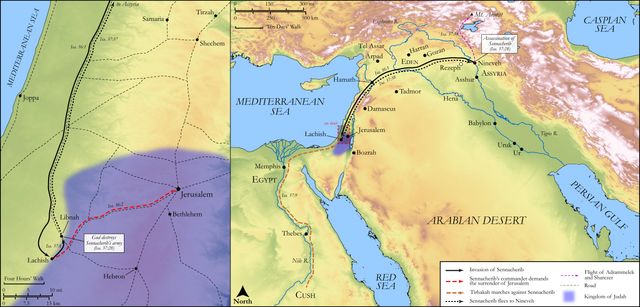
See on the biblical-era map
Study this verse
Public-domain commentary
Matthew Henry
From his Commentary on the Whole Bible. Henry comments on passages, not single verses — this entry covers Isaiah 37:21–38.
We may here observe, 1. That those who receive messages of terror from men with patience, and send messages of faith to God by prayer, may expect messages of grace and peace from God for their comfort, even when they are most cast down. Isaiah sent a long answer to Hezekiah's prayer in God's name, sent it in writing (for it was too long to be sent by word of mouth), and sent it by way of return to his prayer, relation being thereunto had: "Whereas thou hast prayed to me, know, for thy comfort, that thy prayer is heard." Isaiah might have referred him to the prophecies he had delivered (particularly that ch. 10) and bid him pick out an answer from thence; but, that he might have abundant consolation, a message is sent him on purpose. The correspondence between earth and heaven is never let fall on God's side. 2. Those who magnify themselves, especially who magnify themselves against God and his people, do really vilify themselves, and made themselves contemptible, in the eyes of all wise men: "The virgin, the daughter of Zion, has despised Sennacherib, and all his impotent malice and menaces; she knows that, while she preserves her integrity, she is sure of the divine protection, and that though the enemy may bark he cannot bite. All his threats are a jest; it is all but brutum fulmen - a mere flash," 3. Those who abuse the people of God affront God himself; and he takes what is said and done against them as said and done against himself: "Whom hast thou reproached? Even the Holy One of Israel, whom thou hast therefore reproached because he is a Holy One." And it aggravated the indignity Sennacherib did to God that he not only reproached him himself, but set his servants on to do the same: By thy servants, the abjects, thou hast reproached me. 4. Those who boast of themselves and their own achievements reflect upon God and his providence: "Thou hast said, I have digged, and drunk water; I have done mighty feats, and will do more; and wilt not own that I have done it," Isa 37:24-26. The most active men are no more than God makes them, and God makes them no more than of old he designed to make them: "What I have formed of ancient times, in an eternal counsel, now have I brought to pass" (for God does all according to the counsel of his will), "that thou shouldst be to lay waste defenced cities; it is therefore intolerable arrogance to make it thy own doing." 5. All the malice, and all the motions and projects, of the church's enemies, are under the cognizance and check of the church's God. Sennacherib was active and quick, here, and there, and every where, but God knew his going out and coming in, and had always an eye upon him, Isa 37:28. And that was not all; he had a hand upon him too, a strict hand, a strong hand, a hook in his nose and a bridle in his lips, with which, though he was very headstrong and unruly, he could and would turn him back by the way which he came, Isa 37:29. Hitherto he shall come and no further. God had signed Sennacherib's commission against Judah (Isa 10:6); here he supersedes it. He has frightened them, but he must not hurt them, and therefore is discharged from going any further; nay, his commitment is here signed, by which he is clapped up, to answer for what he had done beyond his commission. 6. God is his people's bountiful benefactor, as well as their powerful protector, both a sun and a shield to those that trust in him. Jerusalem shall be defended (Isa 37:35), the besiegers shall not come into it, no, nor come before it with any regular attack, but they shall be routed before they begin the siege, Isa 37:33. But this is not all; God will return in mercy to his people, and will do them good. Their land shall be more than ordinarily fruitful, so that their losses shall be abundantly repaired; they shall not feel any of the ill effects either of the enemies' wasting the country or of their own being taken off from husbandry. But the earth, as at first, shall bring forth of itself, and they shall live and live plentifully upon its spontaneous productions. The blessing of the Lord can, when he pleases, make rich without the hand of the diligent. And let them not think that the desolations of their country would excuse them from observing the sabbatical year, which happened (as it should seem) the year after, and when they were not to plough or sow; no, though they had not now their usual stock beforehand for that year, yet they must religiously observe it, and depend upon God to provide for them. God must be trusted in the way of duty. 7. There is no standing before the judgments of God when they come with commission. (1.) The greatest numbers cannot stand before them: one angel shall, in one night, lay a vast army of men dead upon the spot, when God commissions him so to do, Isa 37:36. Here are 185,000 brave soldiers in an instant turned into so many dead corpses. Many think the 76th Psalm was penned upon occasion of this defeat, where from the spoiling of the stout-hearted, and sending them to sleep their long sleep (Isa 37:5), it is inferred that God is more glorious and excellent than the mountains of prey (Isa 37:4), and that he, even he, is to be feared, Isa 37:7. Angels are employed, more than we are aware of, as ministers of God's justice, to punish the pride and break the power of wicked men. (2.) The greatest men cannot stand before them: The great king, the king of Assyria, looks very little when he is forced to return, not only with shame, because he cannot accomplish what he had projected with so much assurance, but with terror and fear, lest the angel that had destroyed his army should destroy him; yet he is made to look less when his own sons, who should have guarded him, sacrificed him to his idol, whose protection he sought, Isa 37:37, Isa 37:38. God can quickly stop their breath who breathe out threatenings and slaughter against his people, and will do it when they have filled up the measure of their iniquity; and the Lord is known by these judgments which he executes, known to be a God that resists the proud. Many prophecies were fulfilled in this providence, which should encourage us, as far as they look further, and are designed as common and general assurances of the safety of the church and of all that trust in God, to depend upon God for the accomplishment of them. He that has delivered does and will deliver. Lord, forgive our enemies; but, so let all thy enemies perish, O Lord!
Historical interpretation
Historical reception
2 surviving comments on this verse. Each one is dated, so this reads as a timeline rather than a list.
(Verse 26 and following) Have you not heard what I did to him in the past? From ancient times I formed it, and now I have brought it forth, and it has become a ruin of the hills that fight against me, and of fortified cities. The inhabitants of those cities were brought low, they trembled and were confused. They became like the grass of the field, and the green herb, and the roof grass that withered before it could mature. I have seen your dwelling place, your going out and your coming in, and your rage against me, when you raged against me. Your pride reaches my ears, so I will put a hoop in your nostrils and a bit in your lips, and I will bring you back on the path from which you came. These words are to be understood from the perspective of God in response to the blasphemy of the Assyrians: Do you not know that what you have done, you have done by my will, and that I have foretold these things, and commanded you to do them through you? Therefore, what I decreed long ago has been fulfilled in its time, that the hills, that is, the rulers who were previously fighting among themselves, and the heavily fortified cities, by my strengthening of my hand and without providing assistance as usual, would be uprooted and tremble and perish, and instead of olives and vineyards, and fruitful trees, there would be grass and weeds, and plants that are beaten down by hay and wither before reaching maturity. Therefore, I have known both your sitting down and your going out and your coming in beforehand, and the madness with which you were about to rage against me, as prophesied by the prophets. I spoke through them, knowing that you alone would declare, 'I will ascend into heaven, I will set my throne above the stars of heaven, and I will be like the Most High.' Therefore, your fury and your pride have reached my ears, and I will no longer bear you so that you may understand that you were able to act not by your own power, but by my will. For impious nations and unfruitful trees were deserving that they be cut down and fall by you, like my axe and saw. Therefore, I will place a circle or a bridle in your nostrils, so that I may restrain blasphemy from your mouth, and you may not dare to speak such things again; and I will apply a bridle to your lips, which will tame your ferocity and bring you back to the Assyrians. With this translation, the Scripture also uses it in the Psalms against the wicked: Put a bridle and a halter on their jaws, who do not come near you (Ps. 31:12).
This is directed from the person of God against the words of Assyria, to whose blasphemy the Lord responds thus: “Do you not know that you did this with my permission? Do you not know that I predict the future and command that certain things be done through you? Hence, what I decreed long ago is being fulfilled at this time: that the hills (that is, princes who fight among themselves) and the fortified cities will be shaken and eradicated, and will perish when I withdraw my hand and offer them none of the assistance to which they have grown accustomed. They were also compared not to olive groves and vineyards and fruitful trees but to straw and turf, to roof grass, all of which impede fruitfulness and wither before they reach maturity. In this way I have also foreknown your sitting down and your going out and your coming in, and I predicted through the prophets the insanity with which you would rage against me. Through these I knew long ago that you would say, ‘I will ascend to heaven; I will set my throne above the stars of heaven, and I will be like the Most High.’ Thus, your anger and your pride have reached my ears, and I will bear you no longer, that you may understand that you are not capable by your own strength but by my will. For the impious Gentiles and the unfruitful trees deserved to be cut down and felled through you, as though you were my axe and saw. Hence, I put a ring or a bit in your nostrils to restrain your verbal blasphemy, that you would dare to speak such things no more. I will also place a bridle on your lips to tame your ferocity and to lead you back to Egypt.” Scripture employs the same imagery in the Psalms against the impious: “Constrain their jaws with a bit and bridle, that they not approach you.”
Continue studying Isaiah 37:29 across the web’s major study libraries — every link below opens this exact verse, chapter, or book on the destination site.
Read & Compare
 BibleGatewayThis verse in more than 200 translations and 70 languages.
 Bible.comThe YouVersion reader — hundreds of translations, reading plans, and highlights.
 ESV.orgCrossway's official English Standard Version reader.
 NET BibleThe NET translation with 60,000+ translators' notes on every rendering decision.
 STEP BibleTyndale House's free study tool — original text, vocabulary, and scholarly resources.
 BibliaLogos Bible Software's free web reader.
 USCCBThe New American Bible (Revised Edition) with the U.S. bishops' study notes.
Commentaries
 BibleHub CommentariesDozens of classic commentaries on this verse, gathered on one page.
 StudyLightMore than 100 commentary sets — the largest collection on the web.
 BibleRefPlain-English commentary on what this verse means, verse by verse.
 Enduring WordDavid Guzik's free commentary on this chapter, widely used by Bible teachers.
 Bible Study ToolsVerse commentary alongside Greek and Hebrew study aids.
Original Language & Research
- BibleHub InterlinearThe verse word by word — original language, transliteration, and English.
- BibleHub LexiconEvery word's original-language definition and Strong's entry.
 Blue Letter BibleDeep-study tools — Strong's numbers, concordance, and word studies.
 SefariaThe Hebrew text with Rashi and centuries of Jewish commentary.
Sermons, Hymns & Audio


TrulyRandomVerse is not affiliated with these sites and doesn’t control their content. They’re linked because they’re genuinely useful.
Summary
Isaiah 37:29 serves as a profound divine declaration to Sennacherib, the arrogant King of Assyria, unequivocally asserting God's absolute sovereignty over all earthly powers. In direct response to Sennacherib's defiant rage and tumultuous boasts against the Lord, God pledges to exert complete and humiliating control over the king, likening him to a subdued animal. This verse promises a forced and ignominious retreat for Sennacherib, thereby ensuring the deliverance of Jerusalem and powerfully underscoring the ultimate futility of human pride when set against the omnipotent will of the Almighty.
Context
ShowHideLiterary Context
This verse is strategically placed within the pivotal historical narrative of Isaiah 36-39, which recounts the Assyrian siege of Jerusalem during the reign of King Hezekiah. Sennacherib, having already devastated numerous fortified cities in Judah, dispatched his field commander, Rabshakeh, to Jerusalem with a message of psychological warfare and blatant blasphemy, directly challenging King Hezekiah and, more significantly, the Lord God of Israel. Hezekiah's exemplary response, detailed in Isaiah 37:15-20, involved spreading Sennacherib's threatening letter before the Lord in fervent prayer. Isaiah 37:29 constitutes a crucial part of God's immediate prophetic answer to Hezekiah, delivered through the prophet Isaiah, assuring divine intervention and the decisive defeat of Sennacherib. This divine promise culminates in the miraculous deliverance of Jerusalem, fulfilling God's unwavering commitment to defend His city and people, as explicitly affirmed in Isaiah 37:35.
Historical & Cultural Context
The Assyrian Empire, particularly under Sennacherib (705-681 BCE), represented the preeminent military and political force of that day, notorious for its ruthless efficiency and sophisticated psychological warfare tactics. Sennacherib's campaign against Judah in 701 BCE is extensively corroborated by both biblical accounts and Assyrian annals, such as the famous Sennacherib Prism. The vivid imagery of "putting my hook in thy nose, and my bridle in thy lips" directly references a common and deeply humiliating ancient practice. Conquerors would frequently lead captive kings or control powerful, unruly animals (such as oxen, camels, or even warhorses) by inserting a hook or ring through their nose or lips, attaching a rope or bridle, and thereby forcing them to move in a desired direction. This potent metaphor would have been immediately understood by Isaiah's audience as a symbol of absolute subjugation, profound humiliation, and complete loss of agency, powerfully emphasizing God's undeniable and absolute power over even the most formidable earthly rulers.
Key Themes
ShowHideIsaiah 37:29 powerfully contributes to several overarching themes woven throughout the book of Isaiah and the broader biblical narrative. Foremost is the theme of Divine Sovereignty, illustrating God's absolute and unchallengeable control over all nations and their leaders, irrespective of their perceived might or arrogance. Sennacherib's boasts and military prowess are rendered utterly impotent before the Lord, echoing the timeless truth that the Most High rules the kingdom of mankind and gives it to whom he will. The verse also highlights Judgment on Arrogance and Blasphemy, as God explicitly states that Sennacherib's "rage against me, and thy tumult" is the direct catalyst for His intervention, serving as a stark and enduring warning against defying the Creator. Furthermore, it underscores God's unwavering Protection of His People, assuring Jerusalem of miraculous deliverance from an overwhelming threat, a promise entirely consistent with God's covenant faithfulness to Israel throughout their history, as powerfully articulated in passages like Psalm 46:1. Finally, the imagery vividly conveys the Humiliation of the Enemy, demonstrating that those who exalt themselves against God will ultimately be brought low, stripped of their pride, power, and perceived invincibility.
Exposition and Analysis
ShowHideKey Word Analysis
ShowHideThis primitive root signifies to quiver with any violent emotion, particularly intense anger or profound fear. In this specific context, it describes Sennacherib's seething, agitated fury and defiant indignation directed unequivocally "against me" (God). It implies a restless, tumultuous hostility that has reached a peak, thereby provoking a decisive divine response.
This word refers to a ring designed for the nose or lips, commonly used to control animals or even human captives. It denotes an instrument of absolute control and severe subjugation, implying a painful and deeply humiliating restraint. The imagery here is not merely symbolic but points to a physical, tangible means of forced guidance, emphasizing God's complete and undeniable mastery over Sennacherib.
A primitive root meaning to turn back, turn away, or retreat, applicable transitively or intransitively. It signifies a decisive reversal of direction, a forced withdrawal, and a complete failure to achieve one's objective. In this context, it highlights the divine reversal of Sennacherib's triumphant advance, compelling him to return in utter disgrace by the very path he had envisioned for conquest.
Verse Breakdown
ShowHide"Because thy rage against me, and thy tumult, is come up into mine ears"
This foundational clause explicitly establishes the divine rationale for God's impending and decisive action. Sennacherib's "rage" (intense, violent anger and defiant opposition) and "tumult" (his noisy, boastful, and arrogant clamor, likely referring to Rabshakeh's public taunts and the general uproar of his invading army) have not gone unnoticed by the Almighty. The anthropomorphic expression "is come up into mine ears" signifies that God has not only fully heard and perceived but has also taken full account of Sennacherib's blasphemous pride and direct challenge to His supreme authority. This is not merely an observation but a profound declaration that the limit of divine patience has been reached, necessitating intervention.
"therefore will I put my hook in thy nose, and my bridle in thy lips"
This is the core of God's punitive and humiliating response, employing powerful, culturally resonant imagery. The "hook in thy nose" and "bridle in thy lips" serve as potent metaphors for total, inescapable, and humiliating control. Just as a powerful, unruly animal is subdued and led by such instruments, so too will Sennacherib, despite his immense military power, be completely controlled and directed by God. This signifies a forced cessation of his aggressive campaign and a complete loss of his own will, agency, and direction. The possessive "my" emphatically underscores that this is God's direct, personal, and sovereign intervention.
"and I will turn thee back by the way by which thou camest"
This final clause declares the inevitable and humiliating consequence of God's absolute control. Sennacherib will not achieve his objective of conquering Jerusalem. Instead, he will be compelled to retreat, returning along the very path he took to invade Judah. This signifies not just a military defeat but a profound and public humiliation, as the mighty king is sent back in disgrace, his grand plans utterly thwarted by an unseen, yet omnipotent, divine power. It underscores the absolute futility of human ambition and pride when it dares to oppose the sovereign will of God.
Literary Devices
ShowHideIsaiah 37:29 is profoundly enriched by its use of several powerful literary devices. The most prominent is Metaphor, vividly exemplified by God's declaration to place a "hook in thy nose, and my bridle in thy lips" of Sennacherib. This striking figure of speech powerfully portrays the mighty Assyrian king as a subdued, domesticated, and utterly helpless animal, completely under the control of a superior power. It effectively strips him of his human agency, military prowess, and regal dignity, reducing him to a mere beast led by its master. This Metaphor profoundly emphasizes God's absolute sovereignty and the utter helplessness of even the most formidable human foe when confronted by divine will. Additionally, the phrase "is come up into mine ears" employs Anthropomorphism, attributing human physical characteristics (ears) to God to convey His attentive awareness, active perception, and direct engagement with human affairs, specifically Sennacherib's defiance and blasphemy. There is also a strong element of Irony in the powerful, boastful king being treated like a mere animal, a stark and humiliating contrast to his self-proclaimed might and arrogant "tumult."
Theological and Thematic Connections
ShowHideIsaiah 37:29 profoundly illustrates God's absolute and unwavering sovereignty over all creation, including the most powerful human rulers and empires. It serves as a timeless reminder that no earthly power, however formidable or defiantly arrayed, can ultimately thwart God's divine purposes or escape His righteous judgment. The Lord hears the boasts and rage of those who oppose Him, and He possesses the ultimate means to humble the proud and protect His people. This verse underscores the foundational biblical truth that divine control is not merely over individuals but extends to the rise and fall of nations, demonstrating that human history is ultimately orchestrated by God for His glory and the faithful fulfillment of His covenant promises.
Reflection and Application
ShowHideIsaiah 37:29 offers profound spiritual nourishment and highly practical application for believers living in any age. In a world often characterized by overwhelming challenges, oppressive practices, or the seemingly unchecked arrogance of those in power, this verse provides immense comfort and unwavering assurance. It powerfully reminds us that God remains sovereign over all circumstances, actively hearing and responding to the defiance and tumult that rises against His people and His holy name. Just as He effortlessly "hooked" and "bridled" the mighty Sennacherib, He is fully capable of restraining, redirecting, or dismantling any force that seeks to oppose His will or harm His beloved. This profound truth calls us to cultivate a deep and abiding trust in God's ultimate control, even when situations appear dire, insurmountable, or beyond human remedy. It challenges us to relinquish our anxieties and fears, knowing with certainty that the Lord is our unfailing defender and ultimate deliverer. Furthermore, this passage serves as a sobering caution against pride and self-exaltation, reminding us that true power and authority reside solely with God, and those who defiantly set themselves against Him will inevitably face His just and humbling hand. Our appropriate response, therefore, should be one of humble submission, unwavering faith, and confident reliance on His unfailing strength and perfect protection.
Questions for Reflection
ShowHideFAQ
ShowHideWhat was the significance of the "hook in the nose" and "bridle in the lips" imagery in Isaiah's day?
ShowHideThis imagery was a powerful and widely understood metaphor among the nations, representing complete subjugation, humiliation, and absolute control. It directly referenced the common practice of controlling powerful, unruly animals (like oxen or camels) or leading captive kings by inserting a hook or ring through their nose or lips and attaching a rope or bridle. This method allowed the controller to dictate the direction and movement of the subject, regardless of its own will or strength. For a mighty king like Sennacherib, who boasted of his conquests and immense power, being threatened with such treatment was the ultimate insult, signifying his reduction to a mere beast under God's absolute command. It visually communicated God's intention to strip him of all agency and force his ignominious retreat.
What happened to Sennacherib after this prophecy was delivered?
ShowHideAccording to the biblical account in Isaiah 37:36-38, God miraculously intervened. That very night, the angel of the Lord struck down 185,000 Assyrian soldiers in their camp, causing Sennacherib to withdraw in disgrace and return to Nineveh. Later, while worshipping in the temple of his god Nisroch, Sennacherib was assassinated by his own sons, Adrammelech and Sharezer. This swift and ignominious end perfectly fulfilled God's prophecy in Isaiah 37:29, demonstrating His absolute control over the king's fate and his forced retreat "by the way by which thou camest."
Christ-Centered Fulfillment
ShowHideIsaiah 37:29, while directly addressing the historical defeat of Sennacherib, finds its ultimate and most profound Christ-centered fulfillment in the triumph of Jesus Christ over all spiritual enemies. Just as God put a "hook" and "bridle" on the raging Assyrian king, demonstrating His sovereignty over earthly powers, so too has Christ, through His perfect life, atoning death, and glorious resurrection, utterly disarmed and triumphed over the spiritual forces of darkness, sin, and death. The "rage" and "tumult" of Satan and his demonic hordes, which continually seek to oppose God and oppress humanity, have been decisively heard and judged by the Father. Christ's victory on the cross was the ultimate act of putting a "hook" in the nose of the "ruler of this world," leading him captive in triumph, as Colossians 2:15 powerfully declares that He "disarmed the rulers and authorities and put them to open shame, by triumphing over them in him." Furthermore, Christ's resurrection ensures that death, the last enemy, is also bridled and will ultimately be swallowed up in victory, as seen in 1 Corinthians 15:54-57. The "way by which thou camest" for the enemies of God is now a path of forced retreat and ultimate destruction, while for believers, Christ has opened a new and living way to the Father, leading us in His triumphant procession, as depicted in 2 Corinthians 2:14. Thus, Isaiah 37:29 powerfully foreshadows the complete and final dominion of Christ, the true King, over all powers that would rage against God and His people, ensuring His eternal reign and our ultimate deliverance.