


Isaiah 37:31
Bible text: King James Version (1769 Blayney text) · Public domain
Bible text: Berean Standard Bible · Public domain
Bible text: American Standard Version (1901) · Public domain
Bible text: World English Bible, Messianic edition · Public domain
Bible text: Geneva Bible (1599) · Public domain
Bible text: Young's Literal Translation · Public domain
- וְיָסְפָהve·Ya·se·Fahand it will addH3254Conj-w ¦ V-Qal-ConsecPerf-3fsVerb Qal Consecutive Perfect 3rd Singular Feminineוְandיָסְפָהit will add
- פְּלֵיטַתpe·lei·Tat[the] escaped remnant ofH6413N-fscNoun Singular Feminine Construct
- בֵּיתbeit[the] house ofH1004N-mscNoun Singular Masculine Construct
- יְהוּדָהye·hu·DahJudahH3063N-properNoun Proper Location
- הַנִּשְׁאָרָהha·nish·'a·Rahwhich remainsH7604Art ¦ V-Niphal-Prtcpl-fsVerb Niphal Participle Singular Feminine Absoluteהַwhichנִּשְׁאָרָהremains
- שֹׁרֶשׁSho·resha rootH8328N-msNoun Singular Masculine Absolute
- לְמָטָּהle·Ma·tah<to> downwardsH4295Prep-l ¦ Adj-msAdjective Numerical Singular Masculine Absoluteלְ<to>מָטָּהdownwards
- וְעָשָׂהve·'a·Sahand it will produceH6213Conj-w ¦ V-Qal-ConsecPerf-3msVerb Qal Consecutive Perfect 3rd Singular Masculineוְandעָשָׂהit will produce
- פְרִיfe·RifruitH6529N-msNoun Singular Masculine Absolute
- לְמָעְלָהle·Ma·'e·lah<to> upwards <towards>H4605Prep-l ¦ Adj-cs ¦ SfxAdjective Numerical Singular common gender Absoluteלְ<to>מָעְלָupwardsה<towards>
English is a literal word-by-word gloss of the Hebrew, not the KJV's wording. Why?
This is the original text the KJV's translators worked from — each Hebrew word with its own literal English meaning in this verse, prepared by scholars at Tyndale House, Cambridge. The KJV translates whole sentences, not word by word, so its wording differs: one Hebrew word can become several English words, and the KJV may choose “the LORD” where the gloss reads “Yahweh”. Both are faithful — they answer different questions. For the KJV's own rendering, switch to the KJV text.
Details
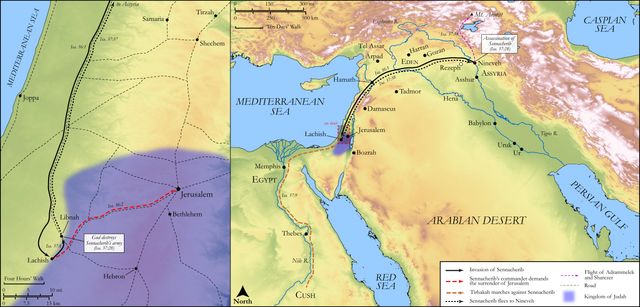
See on the biblical-era map
Study this verse
Public-domain commentary
Matthew Henry
From his Commentary on the Whole Bible. Henry comments on passages, not single verses — this entry covers Isaiah 37:21–38.
We may here observe, 1. That those who receive messages of terror from men with patience, and send messages of faith to God by prayer, may expect messages of grace and peace from God for their comfort, even when they are most cast down. Isaiah sent a long answer to Hezekiah's prayer in God's name, sent it in writing (for it was too long to be sent by word of mouth), and sent it by way of return to his prayer, relation being thereunto had: "Whereas thou hast prayed to me, know, for thy comfort, that thy prayer is heard." Isaiah might have referred him to the prophecies he had delivered (particularly that ch. 10) and bid him pick out an answer from thence; but, that he might have abundant consolation, a message is sent him on purpose. The correspondence between earth and heaven is never let fall on God's side. 2. Those who magnify themselves, especially who magnify themselves against God and his people, do really vilify themselves, and made themselves contemptible, in the eyes of all wise men: "The virgin, the daughter of Zion, has despised Sennacherib, and all his impotent malice and menaces; she knows that, while she preserves her integrity, she is sure of the divine protection, and that though the enemy may bark he cannot bite. All his threats are a jest; it is all but brutum fulmen - a mere flash," 3. Those who abuse the people of God affront God himself; and he takes what is said and done against them as said and done against himself: "Whom hast thou reproached? Even the Holy One of Israel, whom thou hast therefore reproached because he is a Holy One." And it aggravated the indignity Sennacherib did to God that he not only reproached him himself, but set his servants on to do the same: By thy servants, the abjects, thou hast reproached me. 4. Those who boast of themselves and their own achievements reflect upon God and his providence: "Thou hast said, I have digged, and drunk water; I have done mighty feats, and will do more; and wilt not own that I have done it," Isa 37:24-26. The most active men are no more than God makes them, and God makes them no more than of old he designed to make them: "What I have formed of ancient times, in an eternal counsel, now have I brought to pass" (for God does all according to the counsel of his will), "that thou shouldst be to lay waste defenced cities; it is therefore intolerable arrogance to make it thy own doing." 5. All the malice, and all the motions and projects, of the church's enemies, are under the cognizance and check of the church's God. Sennacherib was active and quick, here, and there, and every where, but God knew his going out and coming in, and had always an eye upon him, Isa 37:28. And that was not all; he had a hand upon him too, a strict hand, a strong hand, a hook in his nose and a bridle in his lips, with which, though he was very headstrong and unruly, he could and would turn him back by the way which he came, Isa 37:29. Hitherto he shall come and no further. God had signed Sennacherib's commission against Judah (Isa 10:6); here he supersedes it. He has frightened them, but he must not hurt them, and therefore is discharged from going any further; nay, his commitment is here signed, by which he is clapped up, to answer for what he had done beyond his commission. 6. God is his people's bountiful benefactor, as well as their powerful protector, both a sun and a shield to those that trust in him. Jerusalem shall be defended (Isa 37:35), the besiegers shall not come into it, no, nor come before it with any regular attack, but they shall be routed before they begin the siege, Isa 37:33. But this is not all; God will return in mercy to his people, and will do them good. Their land shall be more than ordinarily fruitful, so that their losses shall be abundantly repaired; they shall not feel any of the ill effects either of the enemies' wasting the country or of their own being taken off from husbandry. But the earth, as at first, shall bring forth of itself, and they shall live and live plentifully upon its spontaneous productions. The blessing of the Lord can, when he pleases, make rich without the hand of the diligent. And let them not think that the desolations of their country would excuse them from observing the sabbatical year, which happened (as it should seem) the year after, and when they were not to plough or sow; no, though they had not now their usual stock beforehand for that year, yet they must religiously observe it, and depend upon God to provide for them. God must be trusted in the way of duty. 7. There is no standing before the judgments of God when they come with commission. (1.) The greatest numbers cannot stand before them: one angel shall, in one night, lay a vast army of men dead upon the spot, when God commissions him so to do, Isa 37:36. Here are 185,000 brave soldiers in an instant turned into so many dead corpses. Many think the 76th Psalm was penned upon occasion of this defeat, where from the spoiling of the stout-hearted, and sending them to sleep their long sleep (Isa 37:5), it is inferred that God is more glorious and excellent than the mountains of prey (Isa 37:4), and that he, even he, is to be feared, Isa 37:7. Angels are employed, more than we are aware of, as ministers of God's justice, to punish the pride and break the power of wicked men. (2.) The greatest men cannot stand before them: The great king, the king of Assyria, looks very little when he is forced to return, not only with shame, because he cannot accomplish what he had projected with so much assurance, but with terror and fear, lest the angel that had destroyed his army should destroy him; yet he is made to look less when his own sons, who should have guarded him, sacrificed him to his idol, whose protection he sought, Isa 37:37, Isa 37:38. God can quickly stop their breath who breathe out threatenings and slaughter against his people, and will do it when they have filled up the measure of their iniquity; and the Lord is known by these judgments which he executes, known to be a God that resists the proud. Many prophecies were fulfilled in this providence, which should encourage us, as far as they look further, and are designed as common and general assurances of the safety of the church and of all that trust in God, to depend upon God for the accomplishment of them. He that has delivered does and will deliver. Lord, forgive our enemies; but, so let all thy enemies perish, O Lord!
Historical interpretation
Historical reception
1 surviving comment on this verse from the historical church.
(Vers. 30 seqq.) But this will be a sign for you: Eat in this year what grows of itself, and in the second year what springs from that; then in the third year sow, reap, plant vineyards, and eat their fruit. The remaining survivors of the house of Judah shall take root downward and bear fruit upward; for out of Jerusalem shall come a remnant, and out of Mount Zion a band of survivors. The zeal of the LORD of hosts will do this. All these things the Prophet speaks through messengers to Hezekiah, what Sennacherib said, what the Lord answered him: now he speaks to him directly, so that he may not doubt the things that were said to come. And for this reason, especially, the words of the prophets had credibility among the people: because they not only remembered things that would happen many centuries in the future, but also things that would happen immediately, and would be fulfilled after a short period of time: and that within two years, the Assyrian king would perish and security would be restored to the city of Jerusalem. This will be, he says, a sign of what I predict will happen, that in this year you will eat what grows naturally. Or according to the Seventy, those things which you harvest first. But in the second year, according to Symmachus, eat from the fruits: or according to the same people, those things which have sprouted from the past crops and fallen to the ground as seed. But in the third year, after the Assyrians have been driven away and the siege has been lifted, sow, reap, and plant vineyards, and eat the fruits of them. Indeed, the remaining fragments of this small city, which are now being surrounded by hostile armies, do not believe that they will escape. They will receive such an abundance and happiness of all things that they will be filled, like a tree firmly rooted in a high mountain, with the thickest of fruits. For the remnants will come forth from Jerusalem and from Mount Zion, and they will fill the land of Judaea, not by their own merit, but by the mercy of God, indeed by the zeal that He has shown towards His wicked people.
Continue studying Isaiah 37:31 across the web’s major study libraries — every link below opens this exact verse, chapter, or book on the destination site.
Read & Compare
 BibleGatewayThis verse in more than 200 translations and 70 languages.
 Bible.comThe YouVersion reader — hundreds of translations, reading plans, and highlights.
 ESV.orgCrossway's official English Standard Version reader.
 NET BibleThe NET translation with 60,000+ translators' notes on every rendering decision.
 STEP BibleTyndale House's free study tool — original text, vocabulary, and scholarly resources.
 BibliaLogos Bible Software's free web reader.
 USCCBThe New American Bible (Revised Edition) with the U.S. bishops' study notes.
Commentaries
 BibleHub CommentariesDozens of classic commentaries on this verse, gathered on one page.
 StudyLightMore than 100 commentary sets — the largest collection on the web.
 BibleRefPlain-English commentary on what this verse means, verse by verse.
 Enduring WordDavid Guzik's free commentary on this chapter, widely used by Bible teachers.
 Bible Study ToolsVerse commentary alongside Greek and Hebrew study aids.
Original Language & Research
- BibleHub InterlinearThe verse word by word — original language, transliteration, and English.
- BibleHub LexiconEvery word's original-language definition and Strong's entry.
 Blue Letter BibleDeep-study tools — Strong's numbers, concordance, and word studies.
 SefariaThe Hebrew text with Rashi and centuries of Jewish commentary.
Sermons, Hymns & Audio


TrulyRandomVerse is not affiliated with these sites and doesn’t control their content. They’re linked because they’re genuinely useful.
Summary
Isaiah 37:31 delivers a profound promise of restoration and resilience to the beleaguered house of Judah. Amidst the existential threat posed by the Assyrian Empire, this verse, spoken through the prophet Isaiah to King Hezekiah, assures that the surviving remnant will not only endure but will re-establish itself with deep spiritual and physical stability, flourishing and bearing abundant fruit. It is a powerful declaration of God's unwavering faithfulness to preserve and renew His people, transforming desolation into vibrant life.
Context
ShowHideLiterary Context
This verse is embedded within a critical narrative in Isaiah, detailing the Assyrian invasion of Judah during the reign of King Hezekiah. Following Sennacherib's arrogant taunts and blasphemous challenge to Yahweh, King Hezekiah turns to God in fervent prayer, laying the Assyrian letter before the Lord, as recounted in Isaiah 37:14-20. In response, God sends Isaiah with a message of assurance and deliverance. Verse 31 directly follows God's detailed prophecy of Sennacherib's defeat and withdrawal, promising that the Assyrian king will not even enter Jerusalem, a promise further elaborated in Isaiah 37:33-35. Thus, this verse serves as a declaration of the positive outcome for Judah, a promise of life and flourishing after the immediate threat is neutralized by divine intervention. It transitions from the immediate crisis to the long-term future of the preserved community.
Historical & Cultural Context
The late 8th century BCE was a period of immense geopolitical upheaval, with the Neo-Assyrian Empire dominating the nations. Assyria was renowned for its brutal military campaigns, including siege warfare, mass deportations, and psychological intimidation. Sennacherib's invasion of Judah in 701 BCE had already devastated many fortified cities, leaving Jerusalem as the last stronghold. The people of Judah faced overwhelming odds, with their very existence as a distinct nation hanging in the balance. In this context, the promise of "taking root downward, and bearing fruit upward" was not merely a metaphor for prosperity but a radical assurance of survival, stability, and renewed vitality against a backdrop of widespread destruction and displacement. It spoke to a people who understood agricultural cycles and the deep connection between a healthy root system and a productive harvest.
Key Themes
ShowHideIsaiah 37:31 powerfully articulates several core themes prevalent throughout Isaiah and the broader prophetic literature. The concept of the "remnant" is central, highlighting God's faithfulness to preserve a faithful core of His people even amidst judgment or severe trial, ensuring the continuity of His covenant promises, as seen in Isaiah 10:20-22. This verse also underscores Divine Preservation and Deliverance, demonstrating God's sovereign power to protect His chosen people from seemingly insurmountable threats and to bring life out of desolation. The vivid agricultural imagery signifies Restoration and Renewal, promising not just survival but a complete spiritual and physical recovery, where the surviving community would become deeply established and visibly productive. Finally, it offers profound Hope in Adversity, assuring a people on the brink of annihilation that their future is secure in God's hands, rooted in His enduring covenant and power to bring forth new life.
Exposition and Analysis
ShowHideKey Word Analysis
ShowHideDerived from H6413, this word signifies "deliverance" or "an escaped portion." In this context, it refers to the small group of survivors who have escaped the Assyrian onslaught. It emphasizes that their continued existence is not due to their own strength or numbers, but to divine preservation and a miraculous act of salvation. The "remnant" is a theological concept indicating God's preserving grace for a faithful core.
Meaning "a root" (literally or figuratively). In this verse, it's used as a verb, implying the action of developing a root system. This imagery speaks of stability, security, and a deep foundation. For a people uprooted and threatened with extinction, the promise to "take root downward" signifies a re-establishment of their identity, security, and connection to their land and, more importantly, to God. It implies a firm, unshakeable grounding.
A primitive root meaning "to do or make" in the broadest sense, including "to bring forth" or "yield." Here, it directly relates to the production of "fruit." This word conveys the active process of generating output and productivity. Coupled with "fruit," it promises that the re-established remnant will not just survive passively but will actively flourish and demonstrate visible signs of life, growth, and divine blessing.
Verse Breakdown
ShowHide"And the remnant that is escaped of the house of Judah"
This initial clause identifies the subject of the prophecy: the surviving portion of the Judean population. The term "remnant" (Hebrew: pᵉlêyṭâh) underscores their miraculous escape and implies that their preservation is a result of divine intervention, not human strength or strategy. "House of Judah" specifies the particular lineage and nation to whom this promise is directed, emphasizing God's covenant faithfulness to His chosen people.
"shall again take root downward"
This powerful agricultural metaphor speaks of re-establishment and deep stability. After being cut down, scattered, or threatened with uprooting by the Assyrians, the survivors are promised a renewed, firm foundation. "Taking root downward" signifies a secure grounding, drawing sustenance from the earth—or, spiritually, from God himself—implying resilience, deep spiritual renewal, and an unshakeable connection to their land and heritage.
"and bear fruit upward"
This second part of the agricultural metaphor completes the picture of restoration. Following the deep rooting, there will be visible, outward manifestation of life and productivity. "Bearing fruit upward" symbolizes flourishing, prosperity, growth, and blessing. It implies that the remnant will not merely survive but will thrive, demonstrating vitality and yielding tangible results, both physically (population growth, prosperity) and spiritually (righteous living, worship).
Literary Devices
ShowHideThe primary literary device employed in Isaiah 37:31 is Metaphor, specifically an extended agricultural metaphor. The people of Judah, reduced to a "remnant" and facing destruction, are likened to a plant or tree that has been severely pruned or threatened with uprooting. The promise that they "shall again take root downward, and bear fruit upward" vividly portrays their future. "Taking root downward" symbolizes stability, security, and a deep, firm foundation, suggesting spiritual grounding and re-establishment in their land and covenant with God. "Bearing fruit upward" symbolizes growth, flourishing, prosperity, and visible productivity, indicating that their restoration will be evident and abundant. This Imagery evokes a sense of organic, natural growth and vitality, reassuring the audience that God's work of restoration is as certain and powerful as the laws of nature. The use of Antithesis or contrast between the prior state of near annihilation and the promised future of deep rooting and abundant fruitfulness further amplifies the miraculous nature of God's preserving and restoring power.
Theological and Thematic Connections
ShowHideIsaiah 37:31 stands as a powerful testament to God's unwavering covenant faithfulness and His sovereign power to preserve and restore His people, even from the brink of extinction. The concept of the "remnant" is a recurring theological theme, emphasizing that God always maintains a faithful core through whom His purposes will be accomplished, ensuring the continuity of His redemptive plan despite human failure or external threats. This verse beautifully illustrates the principle that true stability and fruitfulness come from a deep, hidden connection—a "root downward" in God's promises and presence—which then enables visible, outward "fruit upward." It speaks to the divine capacity to bring life out of death, hope out of despair, and flourishing out of desolation, underscoring that God's ultimate intention for His people is not mere survival but vibrant, productive life in fellowship with Him.
Reflection and Application
ShowHideIsaiah 37:31 offers profound encouragement for believers navigating personal crises, periods of spiritual barrenness, or collective challenges. Just as Judah faced an overwhelming threat yet was promised divine preservation and renewal, we too can find hope in God's ability to restore and make us fruitful, even after devastating experiences. The imagery of "taking root downward" reminds us of the critical importance of spiritual depth and grounding. In times of trial, our focus should not be on outward appearances or immediate results, but on deepening our roots in God's Word, prayer, and community. This deep, hidden work of spiritual formation is what enables us to "bear fruit upward"—to manifest the character of Christ, serve others, and live a life that honors God, even when circumstances are difficult. It encourages us to trust in God's preserving power and His ability to bring renewal out of desolation, ensuring that even a "remnant" can thrive and be fruitful through His grace and strength.
Questions for Reflection
ShowHideFAQ
ShowHideWhat is the significance of the "remnant" in biblical prophecy?
ShowHideThe concept of the "remnant" is highly significant throughout biblical prophecy, particularly in the Old Testament. It refers to a faithful, surviving portion of God's people who are preserved by divine grace, often after a period of judgment, exile, or severe trial. This remnant is not merely a group that escaped destruction by chance, but one divinely chosen and protected to carry forward God's covenant promises and purposes. In Isaiah 37:31, the remnant of Judah is the seed for future blessing and continuity, demonstrating God's unwavering commitment to His covenant, even when the majority may have fallen away or been destroyed. This theme reappears in various forms, pointing to God's enduring faithfulness to His people and His ultimate plan of redemption through a preserved line, eventually culminating in Christ, as highlighted in Romans 9:27.
How does the agricultural imagery of "taking root downward" and "bearing fruit upward" apply to individual believers?
ShowHideThis vivid agricultural metaphor provides a powerful spiritual lesson for individual believers. "Taking root downward" symbolizes the essential need for a deep, hidden spiritual foundation. This involves cultivating a strong, intimate relationship with God through consistent prayer, diligent study of His Word, and active participation in Christian community. Just as a tree needs deep roots to withstand storms and draw nourishment, believers need deep spiritual roots to endure trials, resist temptation, and grow in faith. "Bearing fruit upward" then represents the outward manifestation of this inner spiritual vitality. This "fruit" refers to the character of Christ (e.g., the fruit of the Spirit in Galatians 5:22-23), good works, and a life that brings glory to God and blesses others. It signifies spiritual productivity and flourishing that naturally flows from a deeply rooted life in Christ.
Christ-Centered Fulfillment
ShowHideIsaiah 37:31, with its promise of a remnant taking root and bearing fruit, finds its ultimate and most profound fulfillment in Jesus Christ and the New Covenant. While initially a promise to the physical house of Judah, the spiritual reality it foreshadows is fully realized in the person and work of Christ. Jesus himself is the "root of Jesse" (Isaiah 11:10) and the "root and the offspring of David" (Revelation 22:16), the true source of life and stability for God's people. Through His death and resurrection, He established a new spiritual "remnant"—His church, composed of both Jew and Gentile—who are "rooted and built up in him" (Colossians 2:7). This new community, deeply connected to Christ as the true vine (John 15:5), is empowered by the Holy Spirit to "bear much fruit" for the glory of God. The promise of restoration and flourishing in Isaiah 37:31 is therefore not merely a temporal reprieve for Judah, but a prophetic glimpse into the spiritual vitality and eternal fruitfulness that believers experience through their union with Christ, the one who brings true life out of spiritual death and makes all things new (2 Corinthians 5:17).