


Romans 9:27
“Even if the number of people in Isra’el is as large
as the number of grains of sand by the sea,
only a remnant will be saved.
- ἨσαΐαςĒsaiasIsaiahG2268N-NSM-PNoun Nominative Singular Masculine Individual
- δὲdealsoG1161CONJConjunction
- κράζειkrazeicries outG2896V-PAI-3SVerb Present Active Indicative 3rd Singular
- ὑπὲρhuperconcerningG5228PREPPreposition
- τοῦtou<the>G3588T-GSMDefinite article Genitive Singular Masculine
- Ἰσραήλ·IsraēlIsraelG2474N-GSM-LNoun Genitive Singular Masculine Location
- ἐὰνeanThoughG1437CONDConjunction
- ᾖēshall beG1510V-PAS-3SVerb Present Active Subjunctive 3rd Singular
- ὁhotheG3588T-NSMDefinite article Nominative Singular Masculine
- ἀριθμὸςarithmosnumberG706N-NSMNoun Nominative Singular Masculine
- τῶνtōnof theG3588T-GPMDefinite article Genitive Plural Masculine
- υἱῶνhuiōnsonsG5207N-GPMNoun Genitive Plural Masculine
- ἸσραὴλIsraēlof IsraelG2474N-GSM-LNoun Genitive Singular Masculine Location
- ὡςhōsasG5613PRTParticle or Disjunctive
- ἡhētheG3588T-NSFDefinite article Nominative Singular Feminine
- ἄμμοςammossandG285N-NSFNoun Nominative Singular Feminine
- τῆςtēsof theG3588T-GSFDefinite article Genitive Singular Feminine
- θαλάσσηςthalassēsseaG2281N-GSFNoun Genitive Singular Feminine
- τὸto[only] theG3588T-NSNDefinite article Nominative Singular Neuter
- ὑπόλειμμαhupoleimmavestigeN-NSNNoun Nominative Singular Neuter
- σωθήσεται·sōthēsetaiwill be savedG4982V-FPI-3SVerb Future Passive Indicative 3rd Singular
English is a literal word-by-word gloss of the Greek, not the KJV's wording. Why?
This is the original text the KJV's translators worked from — each Greek word with its own literal English meaning in this verse, prepared by scholars at Tyndale House, Cambridge. The KJV translates whole sentences, not word by word, so its wording differs: one Greek word can become several English words, and the KJV may choose “charity” where the gloss reads “love”. Both are faithful — they answer different questions. For the KJV's own rendering, switch to the KJV text.
Details
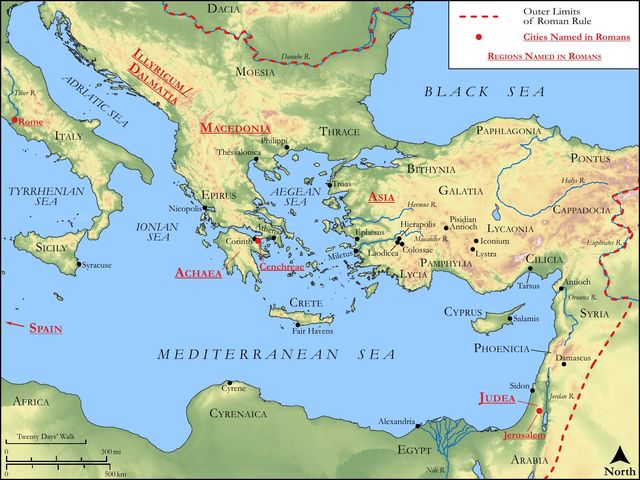
See on the biblical-era map

Study this verse
Public-domain commentary
Matthew Henry
From his Commentary on the Whole Bible. Henry comments on passages, not single verses — this entry covers Romans 9:25–29. His three-level outline is real structure in the source text, so it is rendered as structure.
Having explained the promise, and proved the divine sovereignty, the apostle here shows how the rejection of the Jews, and the taking in of the Gentiles, were foretold in the Old Testament, and therefore must needs be very well consistent with the promise made to the fathers under the Old Testament. It tends very much to the clearing of a truth to observe how the scripture is fulfilled in it. The Jews would, no doubt, willingly refer it to the Old Testament, the scriptures of which were committed to them. Now he shows how this, which was so uneasy to them, was there spoken of.
I.By the prophet Hosea, who speaks of the taking in of a great many of the Gentiles, Hos 2:23 and Hos 1:10.
The Gentiles had not been the people of God, not owning him, nor being owned by him in that relation: "But," says he, "I will call them my people, make them such and own them as such, notwithstanding all their unworthiness." A blessed change! Former badness is no bar to God's present grace and mercy. - And her beloved which was not beloved. Those whom God calls his people he calls beloved: he loves those that are his own. And lest it might be supposed that they should become God's people only by being proselyted to the Jewish religion, and made members of that nation, he adds, from Hos 1:10, In the place where it was said, etc., there shall they be called. They need not be embodied with the Jews, nor go up to Jerusalem to worship; but, wherever they are scattered over the face of the earth, there will God own them. Observe the great dignity and honour of the saints, that they are called the children of the living God; and his calling them so makes them so. Behold, what manner of love! This honour have all his saints.
II.By the prophet Isaiah, who speaks of the casting off of many of the Jews, in two places.
1.One is Isa 10:22, Isa 10:23, which speaks of the saving of a remnant, that is, but a remnant, which, though in the prophecy it seems to refer to the preservation of a remnant from the destruction and desolation that were coming upon them by Sennacherib and his army, yet is to be understood as looking further, and sufficiently proves that it is no strange thing for God to abandon to ruin a great many of the seed of Abraham, and yet maintain his word of promise to Abraham in full force and virtue. This is intimated in the supposition that the number of children of Israel was as the sand of the sea, which was part of the promise made to Abraham, Gen 22:17. And yet only a remnant shall be saved; for many are called, but few are chosen. In this salvation of the remnant we are told (Rom 9:28) from the prophet,
(1.)That he will complete the work: He will finish the work. When God begins he will make an end, whether in ways of judgment or of mercy. The rejection of the unbelieving Jews god would finish in their utter ruin by the Romans, who soon after this quite took away their place and nation. The assuming of Christian churches into the divine favour, and the spreading of the gospel in other nations, was a work which God would likewise finish, and be known by his name JEHOVAH. As for God, his work is perfect. Margin, He will finish the account. God, in his eternal counsels, has taken an account of the children of men, allotted them to such or such a condition, to such a share of privileges; and, as they come into being, his dealings with them are pursuant to these counsels: and he will finish the account, complete the mystical body, call in as many as belong to the election of grace, and then the account will be finished.
(2.)That he will contract it; not only finish it, but finish it quickly. Under the Old Testament he seemed to tarry, and to make a longer and more tedious work of it. The wheels moved but slowly towards the extent of the church; but now he will cut it short, and make a short work upon the earth. Gentile converts were now flying as a cloud. But he will cut it short in righteousness, both in wisdom and in justice. Men, when they cut short, do amiss; they do indeed despatch causes; but, when God cuts short, it is always in righteousness. So the fathers generally apply it. Some understand it of the evangelical law and covenant, which Christ has introduced and established in the world: he has in that finished the work, put an end to the types and ceremonies of the Old Testament. Christ said, It is finished, and then the veil was rent, echoing as it were to the word that Christ said upon the cross. And he will cut it short. The work (it is logos - the word, the law) was under the Old Testament very long; a long train of institutions, ceremonies, conditions: but now it is cut short. Our duty is now, under the gospel, summed up in much less room than it was under the law; the covenant was abridged and contracted; religion is brought into a less compass. And it is in righteousness, in favour to us, in justice to his own design and counsel. With us contractions are apt to darken things: -
- Brevis esse laboro, Obscurus fio -
I strive to be concise, but prove obscure.
but it is not so in this case. Though it be cut short, it is clear and plain; and, because short, the more easy.
2.Another is quoted from Isa 1:9, where the prophet is showing how in a time of general calamity and destruction God would preserve a seed. This is to the same purport with the former; and the scope of it is to show that it was no strange thing for God to leave the greatest part of the people of the Jews to ruin, and to reserve to himself only a small remnant: so he had done formerly, as appears by their own prophets; and they must not wonder if he did so now. Observe,
(1.)What God is. He is the Lord of sabaoth, that is, the Lord of hosts - a Hebrew word retained in the Greek, as Jam 5:4. All the host of heaven and earth are at his beck and disposal. When God secures a seed to himself out of a degenerate apostate world, he acts as Lord of sabaoth. It is an act of almighty power and infinite sovereignty.
(2.)What his people are; they are a seed, a small number. The corn reserved for next year's seedings is but little, compared with that which is spent and eaten. But they are a useful number - the seed, the substance, of the next generation, Isa 6:13. It is so far from being an impeachment of the justice and righteousness of God that so many perish and are destroyed, that it is a wonder of divine power and mercy that all are not destroyed, that there are any saved; for even those that are left to be a seed, if God had dealt with them according to their sins, had perished with the rest. This is the great truth which this scripture teacheth us.
Historical interpretation
Historical reception
5 surviving comments on this verse. Each one is dated, so this reads as a timeline rather than a list.
Select a marker to jump to its quote. Markers stagger vertically where authors wrote within a few decades of each other.
Paul says this because Isaiah was crying out for those who would believe in Christ. It is these who are the true Israel…. The others have gone away from the law because they have not believed in him whom the law promised would alone be sufficient for salvation. Therefore they became apostate, because by not accepting Christ they became lawbreakers. Therefore, of that great number only those who God foreknew would believe have been saved. Commentary on Paul’s Epistles.
"For Esaias," he says, "crieth concerning Israel." That is, speaks out boldly, and uses no dissimulation. Why then lay a charge against us, when they afore declared the same thing with more than trumpet's loudness? And what does Isaiah cry? "Though the number of the children of Israel be as the sand of the sea, a remnant shall be saved."
Do you see that he too does not say that all are to be saved, but that those that are worthy shall? For I regard not the multitude, he means, nor does a race diffused so far distress me, but those only do I save that yield themselves worthy of it. And he does not mention the "sand of the sea" without a reason, but to remind them of the ancient promise whereof they had made themselves unworthy. Why then are you troubled, as though the promise had failed, when all the Prophets show that it is not all that are to be saved?
Here Isaiah showed that only a few Jews would believe.
This shows that the Lord is the cornerstone, uniting both walls in himself. Hosea’s testimony is spoken of the Gentiles, but the Lord unites both Jews and Gentiles, according to what he said in the gospel about the latter: “I have other sheep that are not of this fold; I must bring them also and they will heed my voice. So there shall be one flock, one shepherd.”
If by remnant … we are to understand not election of the justified to eternal life but election of those who are to be justified, that kind of election is truly hidden and cannot be known by us, who must regard all men as parts of a single lump of clay. If some claim to be able to know it, I must confess my own weakness in this matter.
Continue studying Romans 9:27 across the web’s major study libraries — every link below opens this exact verse, chapter, or book on the destination site.
Read & Compare
 BibleGatewayThis verse in more than 200 translations and 70 languages.
 Bible.comThe YouVersion reader — hundreds of translations, reading plans, and highlights.
 ESV.orgCrossway's official English Standard Version reader.
 NET BibleThe NET translation with 60,000+ translators' notes on every rendering decision.
 STEP BibleTyndale House's free study tool — original text, vocabulary, and scholarly resources.
 BibliaLogos Bible Software's free web reader.
 USCCBThe New American Bible (Revised Edition) with the U.S. bishops' study notes.
Commentaries
 BibleHub CommentariesDozens of classic commentaries on this verse, gathered on one page.
 StudyLightMore than 100 commentary sets — the largest collection on the web.
 BibleRefPlain-English commentary on what this verse means, verse by verse.
 Enduring WordDavid Guzik's free commentary on this chapter, widely used by Bible teachers.
 Bible Study ToolsVerse commentary alongside Greek and Hebrew study aids.
Original Language & Research
- BibleHub InterlinearThe verse word by word — original language, transliteration, and English.
- BibleHub LexiconEvery word's original-language definition and Strong's entry.
 Blue Letter BibleDeep-study tools — Strong's numbers, concordance, and word studies.
 CNTR CollationThe earliest Greek manuscripts of this verse, collated letter by letter.
Sermons, Hymns & Audio


TrulyRandomVerse is not affiliated with these sites and doesn’t control their content. They’re linked because they’re genuinely useful.
Summary
Romans 9:27 presents a profound theological truth from the prophet Isaiah, quoted by Paul, asserting that despite the vast numerical promise made to Israel, God's salvific plan has always centered on a faithful remnant. This declaration is pivotal in Paul's argument concerning God's continuing faithfulness to His covenant people amidst their widespread rejection of Christ, demonstrating that salvation is not a matter of national or ethnic identity but of divine election and grace, fulfilled through a chosen few.
Context
ShowHideLiterary Context
This verse is situated within Paul's deeply theological and often challenging discourse in Romans chapters 9-11, where he wrestles with the complex question of Israel's unbelief and God's unwavering faithfulness. Having established the universal need for salvation by faith for both Jews and Gentiles in the preceding chapters, Paul now addresses the apparent paradox of God's chosen people largely rejecting their Messiah. He begins by expressing his profound sorrow for his kinsmen (Romans 9:1-5), then systematically argues that God's promises are not based on physical descent but on divine election, illustrating this with examples like Jacob and Esau (Romans 9:6-13). The quotation from Isaiah in verse 27, along with others, serves as prophetic evidence that God's intention was always to save a remnant, thereby explaining how His promises remain true despite the majority's unbelief.
Historical & Cultural Context
Paul is writing to a diverse church in Rome, comprising both Jewish and Gentile believers. The tension between these groups, particularly concerning the place of the Law and Israel's unique status, was significant. For Jewish believers, the idea that not all Israel would be saved, or that Gentiles could be co-heirs, was revolutionary and potentially scandalous. For Gentiles, there was a risk of triumphalism, believing they had replaced Israel. Paul's argument directly confronts these issues. The concept of "Israel" here refers primarily to the ethnic descendants of Jacob, God's covenant people. The "sand of the sea" idiom was a well-understood biblical metaphor for an immense, innumerable population, frequently used in God's promises to Abraham regarding his descendants (Genesis 22:17). Paul's reinterpretation of this promise through the lens of a "remnant" would have been a significant theological challenge to the prevailing understanding of national election.
Key Themes
ShowHideRomans 9:27 contributes significantly to several overarching themes in Romans and biblical theology. Firstly, it underscores God's Sovereign Choice and Faithfulness. Paul asserts that God's plan of salvation is not contingent on human numbers or national identity, but on His divine election, demonstrating that His purposes will prevail regardless of human response (Romans 9:16). Secondly, the verse is central to the Doctrine of the Remnant. This concept, prevalent throughout the Old Testament (e.g., Isaiah 1:9, Isaiah 11:11), signifies that even in times of widespread apostasy or judgment, God preserves a faithful core who remain true to Him. Paul explicitly reiterates this in Romans 11:5, emphasizing that this remnant is "according to the election of grace." Thirdly, it highlights the Fulfillment of Prophecy. Paul's strategic use of Isaiah demonstrates how Old Testament prophecies are being fulfilled in the present, even those that might seem to contradict earlier promises of vast numbers. The promise to Abraham is affirmed, but with the crucial clarification that spiritual salvation is for a remnant, not merely for all biological descendants.
Exposition and Analysis
ShowHideKey Word Analysis
ShowHideThis word (G2896) means to "croak" or scream, to call aloud, shriek, or intreat. In this context, it emphasizes the solemnity and urgency of Isaiah's prophetic declaration. It's not a mere statement but a passionate, emphatic proclamation, underscoring the gravity of the message concerning Israel's future.
This term (G285) refers to sand, typically as heaped on a beach. It is a common biblical idiom for an innumerable multitude, often used in God's promises of blessing and progeny, particularly to Abraham. Its inclusion here highlights the stark contrast between the vastness of God's original promise and the limited scope of actual salvation.
Derived from a word meaning "to leave behind," this term (G2640) signifies a remainder or a few. It is a crucial theological concept here, denoting a small, surviving group chosen by God out of a larger population. It contrasts sharply with the "sand of the sea," emphasizing that only a select portion of Israel will experience salvation, not the entire nation.
Verse Breakdown
ShowHide"Esaias also crieth concerning Israel,"
This opening clause establishes the authoritative source of Paul's subsequent statement. "Esaias" is the Greek transliteration of the prophet Isaiah, lending prophetic weight to Paul's argument. The verb "crieth" (G2896, krázō) suggests a strong, emphatic declaration, indicating the urgency and importance of the message Isaiah delivered concerning God's people, Israel. Paul is not merely citing a passage but invoking a profound prophetic oracle.
"Though the number of the children of Israel be as the sand of the sea,"
This phrase recalls God's covenant promises to Abraham, where his descendants were likened to the innumerable "sand of the sea" (Genesis 22:17) or the "stars of the heaven" (Genesis 15:5). It acknowledges the vastness of the nation of Israel, fulfilling the demographic aspect of God's promise. However, the introductory "Though" (G1437, eán) signals a significant qualification, preparing the reader for a contrast between this immense number and the actual scope of salvation.
"a remnant shall be saved:"
This is the crucial, climactic declaration of the verse. Despite the countless numbers, only a "remnant" (G2640, katáleimma) will experience salvation (G4982, sṓzō). This concept directly challenges the notion of automatic salvation based on ethnic identity alone. It underscores that God's ultimate plan for salvation is selective, based on His sovereign choice and grace, rather than on the numerical strength or lineage of the entire nation. This "remnant" represents those within Israel who respond to God's call in faith.
Literary Devices
ShowHidePaul's quotation of Isaiah in Romans 9:27 employs several potent literary devices. Foremost is Allusion, as Paul directly alludes to and quotes from Isaiah 10:22-23, grounding his New Testament theological argument in the prophetic tradition of the Old Testament. This serves to validate his claims by demonstrating their continuity with God's long-revealed purposes. The phrase "as the sand of the sea" is a clear example of Hyperbole, a deliberate exaggeration used to emphasize the immense, countless number of Israel's descendants, a common biblical idiom for God's promises of progeny. This hyperbole then sets up a powerful Contrast with the subsequent declaration that "a remnant shall be saved." The vast, innumerable quantity is placed in stark opposition to the small, chosen portion, highlighting the selective nature of God's salvation and challenging the assumption that all Israel would automatically be saved. This contrast underscores the theme of divine sovereignty over human numbers or lineage.
Theological and Thematic Connections
ShowHideRomans 9:27 profoundly shapes our understanding of God's redemptive plan, revealing that His faithfulness to His covenant promises is not negated by human unbelief, but rather reinterpreted and fulfilled through a sovereign act of preservation. The concept of the "remnant" is a recurring motif throughout biblical history, signifying that even in times of widespread apostasy or judgment, God always maintains a faithful core. This truth challenges any presumption of salvation based on ethnic identity or group affiliation, emphasizing instead God's free and electing grace. It demonstrates that God's ultimate purpose is to save a people for Himself, a purpose that transcends national boundaries and human expectations, ultimately pointing to a spiritual rather than merely physical lineage.
Reflection and Application
ShowHideThe profound truth of Romans 9:27 challenges us to examine the basis of our own assurance of salvation. It reminds us that belonging to a particular family, nation, or even a religious institution does not automatically guarantee a saving relationship with God. Salvation is always a work of God's sovereign grace, extended to those who respond in faith, whether Jew or Gentile. For believers, this verse offers immense comfort and encouragement, especially when we feel like a minority standing for truth in a world that increasingly rejects God. We are part of God's chosen remnant, a people preserved by His grace, and our hope is firmly rooted in His faithfulness, not in human numbers or strength. It calls us to embrace a deep humility, recognizing that our salvation is entirely His doing, and to live lives that reflect the transforming power of His electing love.
Questions for Reflection
ShowHideFAQ
ShowHideDoes this verse mean that God has rejected the Jewish people?
ShowHideNo, this verse does not mean God has rejected the Jewish people. Rather, it clarifies the nature of God's ongoing covenant with Israel. Paul addresses this very question explicitly in Romans 11:1, where he asks, "I say then, Hath God cast away his people? God forbid." He then proceeds to explain that God's promises are being fulfilled through a "remnant" within Israel, chosen by grace (Romans 11:5), and that ultimately, "all Israel shall be saved" (Romans 11:26) in a future eschatological sense. The verse in Romans 9:27 simply emphasizes that salvation is not automatic for every biological descendant of Abraham but is based on God's sovereign election and the response of faith, a truth that has always been present in God's dealings with Israel.
Christ-Centered Fulfillment
ShowHideRomans 9:27, by highlighting the principle of the "remnant," finds its ultimate fulfillment and clearest expression in Jesus Christ. He is the true Israelite, the faithful Son in whom God's promises find their "Yes" and "Amen" (2 Corinthians 1:20). The concept of a remnant, a chosen few, is perfectly embodied in the formation of the church, which is comprised of both believing Jews and Gentiles united in Christ, becoming the spiritual offspring of Abraham by faith (Galatians 3:29). Jesus Himself spoke of a narrow gate and few who find it (Matthew 7:13-14), echoing the remnant principle. Through His atoning work, Christ gathers to Himself a people, not based on ethnic lineage or numerical strength, but on the sovereign call of God and the individual's faith in Him. Thus, the "remnant" of Israel, and indeed the remnant of humanity, are "saved" only through their inclusion in Christ, the one through whom God's redemptive plan for all nations is realized (Ephesians 2:11-22).