


1 Kings 20:9
- וַיֹּאמֶרvai·Yo·merand he saidH559Conj-w ¦ V-Qal-ConsecImperf-3msVerb Qal Consecutive Imperfect 3rd Singular Masculineוַandיֹּאמֶרhe said
- לְמַלְאֲכֵיle·mal·'a·Kheito [the] messengers ofH4397Prep-l ¦ N-mpcNoun Plural Masculine Constructלְtoמַלְאֲכֵי[the] messengers of
- בֶןvenBenH1130N-proper-mNoun Proper Masculine
- הֲדַדha·DadHadadH1130N-proper-mNoun Proper Masculine
- אִמְרוּ'im·RusayH559V-Qal-Imp-2mpVerb Qal Imperative 2nd Plural Masculine
- לַאדֹנִיla·do·Nito my lordH113Prep-l ¦ N-msc ¦ 1csNoun Singular Masculine Constructלַtoאדֹנִlordיmy
- הַמֶּלֶךְha·Me·lekhthe kingH4428Art ¦ N-msNoun Singular Masculine Absoluteהַtheמֶּלֶךְking
- כֹּלkolallH3605N-msNoun Singular Masculine Absolute
- אֲשֶׁר'a·SherthatH834RelParticle Relative
- שָׁלַחְתָּsha·Lach·tayou sentH7971V-Qal-Perf-2msVerb Qal Perfect 2nd Singular Masculine
- אֶל'eltoH413PrepPreposition
- עַבְדְּךָ'av·de·Khayour servantH5650N-msc ¦ 2msNoun Singular Masculine Constructעַבְדְּservantךָyour
- בָרִאשֹׁנָהva·ri·sho·Nahat the firstH7223Prep-b ¦ Adj-fsAdjective Numerical Position Singular Feminine Absoluteבָat theרִאשֹׁנָהfirst
- אֶעֱשֶׂה'e·'e·SehI will doH6213V-Qal-Imperf-1csVerb Qal Imperfect 1st Singular common gender
- וְהַדָּבָרve·ha·da·Varand the thingH1697Conj-w ¦ Art ¦ N-msNoun Singular Masculine Absoluteוְandהַtheדָּבָרthing
- הַזֶּהha·Zeh<the> thisH2088Art ¦ PrtParticle Demonstrativeהַ<the>זֶּהthis
- לֹאlo'notH3808NegParticle Negative
- אוּכַל'u·KhalI am ableH3201V-Qal-Imperf-1csVerb Qal Imperfect 1st Singular common gender
- לַעֲשׂוֹתla·'a·Sotto doH6213Prep-l ¦ V-Qal-InfVerb Qal Infinitive Constructלַtoעֲשׂוֹתdo
- וַיֵּלְכוּvai·ye·le·Khuand they wentH1980Conj-w ¦ V-Qal-ConsecImperf-3mpVerb Qal Consecutive Imperfect 3rd Plural Masculineוַandיֵּלְכוּthey went
- הַמַּלְאָכִיםha·mal·'a·Khimthe messengersH4397Art ¦ N-mpNoun Plural Masculine Absoluteהַtheמַּלְאָכִיםmessengers
- וַיְשִׁבֻהוּvay·shi·Vu·huand they brought back himH7725Conj-w ¦ V-Hiphil-ConsecImperf-3mp ¦ 3msVerb Hiphil Consecutive Imperfect 3rd Plural Masculineוַandיְשִׁבֻthey brought backהוּhim
- דָּבָרda·VarwordH1697N-msNoun Singular Masculine Absolute
English is a literal word-by-word gloss of the Hebrew, not the KJV's wording. Why?
This is the original text the KJV's translators worked from — each Hebrew word with its own literal English meaning in this verse, prepared by scholars at Tyndale House, Cambridge. The KJV translates whole sentences, not word by word, so its wording differs: one Hebrew word can become several English words, and the KJV may choose “the LORD” where the gloss reads “Yahweh”. Both are faithful — they answer different questions. For the KJV's own rendering, switch to the KJV text.
Details
See on the biblical-era map
Study this verse
Public-domain commentary
Matthew Henry
From his Commentary on the Whole Bible. Henry comments on passages, not single verses — this entry covers 1 Kings 20:1–11. His three-level outline is real structure in the source text, so it is rendered as structure.
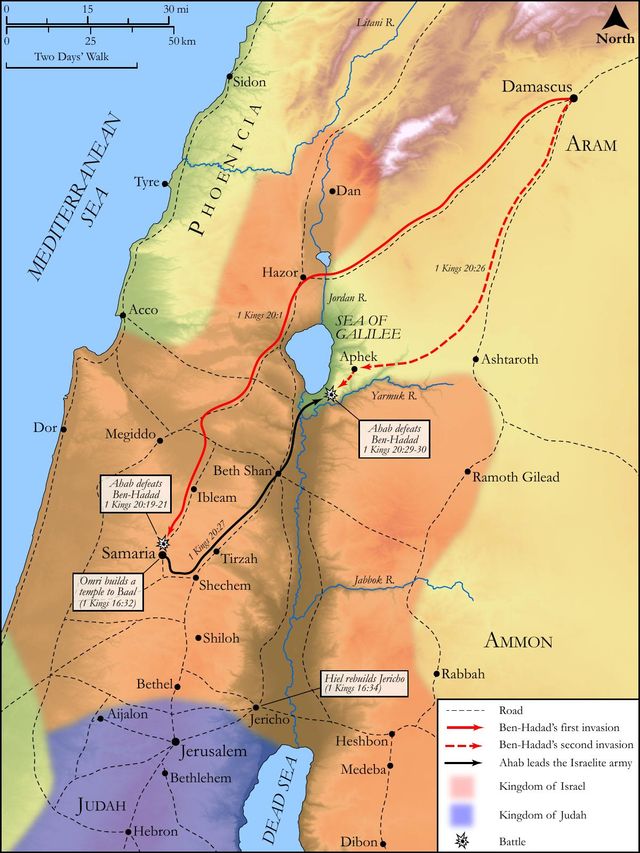
Here is, I. The threatening descent which Ben-hadad made upon Ahab's kingdom, and the siege he laid to Samaria, his royal city, Kg1 20:1. What the ground of the quarrel was we are not told; covetousness and ambition were the principle, which would never want some pretence or other. David in his time had quite subdued the Syrians and made them tributaries to Israel, but Israel's apostasy from God makes them formidable again. Asa had tempted the Syrians to invade Israel once (Kg1 15:18-20), and now they did it of their own accord. It is dangerous bringing a foreign force into the country: posterity may pay dearly for it. Ben-hadad had with him thirty-two kings, who were either tributaries to him, and bound in duty to attend him, or confederates with him, and bound in interest to assist him. How little did the title of king look when all these poor petty governors pretended to it!
II.The treaty between these two kings.
Surely Israel's defence had departed from them, or else the Syrians could not have marched so readily, and with so little opposition, to Samaria, the head and heart of the country, a city lately built, and therefore, we may suppose, not well fortified, but likely to fall quickly into the hands of the invaders; both sides are aware of this, and therefore,
1.Ben-hadad's proud spirit sends Ahab a very insolent demand, Kg1 20:2, Kg1 20:3. A parley is sounded, and a trumpeter (we may suppose) is sent into the city, to let Ahab know that he will raise the siege upon condition that Ahab become his vassal (Nay, his villain), and not only pay him a tribute out of what he has, but make over his title to Ben-hadad, and hold all at his will, even his wives and children, the godliest of them. The manner of expression is designed to gall them; "All shall be mine, without exception."
2.Ahab's poor spirit sends Ben-hadad a very disgraceful submission. It is general indeed (he cannot mention particulars in his surrender with so much pleasure as Ben-hadad did in his demand), but it is effectual: I am thine, and all that I have, Kg1 20:4. See the effect of sin.
(1.)If he had not by sin provoked God to depart from him, Ben-hadad could not have made such a demand. Sin brings men into such straits, by putting them out of divine protection. If God may not rule us, our enemies shall. A rebel to God is a slave to all besides. Ahab had prepared his silver and gold for Baal, Hos 2:8. Justly therefore is it taken from him; such an alienating amounts to a forfeiture.
(2.)If he had not by sin wronged his own conscience, and set that against him, he could not have made such a mean surrender. Guilt dispirits men, and makes them cowards. He knew Baal could not help, and had no reason to think that God would, and therefore was content to buy his life upon any terms. Skin for skin, and all that is dear to him, he will give for it; he will rather live a beggar than not die a prince.
3.Ben-hadad's proud spirit rises upon his submission, and becomes yet more insolent and imperious, Kg1 20:5, Kg1 20:6. Ahab had laid his all at his feet, at his mercy, expecting that one king would use another generously, that this acknowledgment of Ben-hadad's sovereignty would content him, the honour was sufficient for the present, and he might hereafter make use of it if he saw cause (Satis est prostrasse leoni - It suffices the lion to have laid his victim prostrate); but this will not serve.
(1.)Ben-hadad is as covetous as he is proud, and cannot go away unless he have the possession as well as the dominion. He thinks it not enough to call it his, unless he have it in his hands. He will not so much as lend Ahab the use of his own goods above a day longer.
(2.)He is as spiteful as he is haughty. Had he come himself to select what he had a mind for, it would have shown some respect to a crowned head; but he will send his servants to insult the prince, and hector over him, to rifle the palace, and strip it of all its ornaments; nay, to give Ahab the more vexation, they shall be ordered, not only to take what they please, but, if they can learn which are the persons or things that Ahab is in a particular manner fond of, to take those: Whatsoever is pleasant in thy eyes they shall take away. We are often crossed in that which we most dote upon; and that proves least safe which is most dear.
(3.)He is as unreasonable as he is unjust, and will construe the surrender Ahab made for himself as made for all his subjects too, and will have them also to lie at his mercy: "They shall search, not only thy house, but the houses of thy servants too, and plunder them at discretion." Blessed be God for peace and property, and that what we have we can call our own.
4.Ahab's poor spirit begins to rise too, upon this growing insolence; and, if it becomes not bold, yet it becomes desperate, and he will rather hazard his life than give up all thus.
(1.)How he takes advice of his privy-council, who encourage him to stand it out. He speaks but poorly (Kg1 20:7), appeals to them whether Ben-hadad be not an unreasonable enemy, and do not seek mischief. What else could he expect from one who, without any provocation given him, had invaded his country and besieged his capital city? He owns to them how he had truckled to him before, and will have them advise him what he should do in this strait; and they speak bravely (Hearken not to him, nor consent, Kg1 20:8), promising no doubt to stand by him in the refusal.
(2.)Yet he expresses himself very modestly in his denial, Kg1 20:9. He owns Ben-hadad's dominion over him: "Tell my lord the king I have no design to affront him, nor to receded from the surrender I have already made; what I offered at first I will stand to, but this thing I may not do; I must not give what is none of my own." It was a mortification to Ben-hadad that even such an abject spirit as Ahab's durst deny him; yet it should seem, by his manner of expressing himself, that he durst not have done it if his people had not animated him.
5.Ben-hadad proudly swears the ruin of Samaria. The threatening waves of his wrath, meeting with this check, rage and foam, and make a noise. In his fury, he imprecates the impotent revenge of his gods, if the dust of Samaria serve for handfuls for his army (Kg1 20:10), so numerous, so resolute, an army will be bring into the field against Samaria, and so confident is he of their success; it will be done as easily as the taking up of a handful of dust; all shall be carried away, even the ground on which the city stands. Thus confident is his pride, thus cruel is his malice; this prepares him to be ruined, though such a prince and such a people are unworthy of the satisfaction of seeing him ruined.
6.Ahab sends him a decent rebuke to his assurance, dares not defy his menaces, only reminds him of the uncertain turns of war (Kg1 20:11): "Let not him that begins a war, and is girding on his sword, his armour, his harness, boast of victory, or think himself sure of it, as if he had put it off, and had come home a conqueror." This was one of the wisest words that ever Ahab spoke, and is a good item or momento to us all; it is folly to boast beforehand of any day, since we know not what it may bring forth (Pro 27:1), but especially to boast of a day of battle, which may prove as much against us as we promise ourselves it will be for us. It is impolitic to despise an enemy, and to be too sure of victory is the way to be beaten. Apply it to our spiritual conflicts. Peter fell by his confidence. While we are here we are but girding on the harness, and therefore must never boast as though we had put it off. Happy is the man that feareth always, and is never off his watch.
Continue studying 1 Kings 20:9 across the web’s major study libraries — every link below opens this exact verse, chapter, or book on the destination site.
Read & Compare
 BibleGatewayThis verse in more than 200 translations and 70 languages.
 Bible.comThe YouVersion reader — hundreds of translations, reading plans, and highlights.
 ESV.orgCrossway's official English Standard Version reader.
 NET BibleThe NET translation with 60,000+ translators' notes on every rendering decision.
 STEP BibleTyndale House's free study tool — original text, vocabulary, and scholarly resources.
 BibliaLogos Bible Software's free web reader.
 USCCBThe New American Bible (Revised Edition) with the U.S. bishops' study notes.
Commentaries
 BibleHub CommentariesDozens of classic commentaries on this verse, gathered on one page.
 StudyLightMore than 100 commentary sets — the largest collection on the web.
 BibleRefPlain-English commentary on what this verse means, verse by verse.
 Enduring WordDavid Guzik's free commentary on this chapter, widely used by Bible teachers.
 Bible Study ToolsVerse commentary alongside Greek and Hebrew study aids.
Original Language & Research
- BibleHub InterlinearThe verse word by word — original language, transliteration, and English.
- BibleHub LexiconEvery word's original-language definition and Strong's entry.
 Blue Letter BibleDeep-study tools — Strong's numbers, concordance, and word studies.
 SefariaThe Hebrew text with Rashi and centuries of Jewish commentary.
Sermons, Hymns & Audio


TrulyRandomVerse is not affiliated with these sites and doesn’t control their content. They’re linked because they’re genuinely useful.
Summary
In 1 Kings 20:9, King Ahab of Israel delivers a pivotal and unexpected response to Ben-hadad, the King of Syria, who had besieged Samaria and made escalating demands. This verse marks Ahab's firm refusal of Ben-hadad's second, more egregious ultimatum—that Syrian servants would indiscriminately plunder his palace and the homes of his officials. Having initially conceded to the first set of demands concerning his personal wealth and family, Ahab's resolute declaration, "but this thing I may not do," signals a crucial turning point, drawing a definitive line against further humiliation and setting the stage for military confrontation rather than complete subjugation.
Context
ShowHideLiterary Context
This verse is deeply embedded within the dramatic narrative of Ben-hadad's siege of Samaria, meticulously detailed in 1 Kings 20. The chapter commences with Ben-hadad's formidable army encircling Samaria (1 Kings 20:1), leading to his initial, seemingly moderate demand for Ahab's silver, gold, wives, and children (1 Kings 20:3). Ahab, surprisingly, agrees to these terms, stating, "My lord, O king, according to thy saying, I am thine, and all that I have" (1 Kings 20:4). However, Ben-hadad's demands rapidly escalate. He then insists that his servants will search Ahab's house and the homes of his officials, taking whatever they please (1 Kings 20:5-6). This second, unprecedented demand crosses a critical line, prompting Ahab to consult with the elders of the land (1 Kings 20:7), who unanimously advise him to reject it (1 Kings 20:8). Ahab's response in verse 9 directly reflects this counsel, serving as the decisive moment that shifts the narrative from appeasement to confrontation, leading directly to the subsequent battle and divine intervention.
Historical & Cultural Context
The period of the Divided Kingdom witnessed frequent and often brutal conflicts between Israel and its powerful northern neighbor, Aram (Syria), with its capital at Damascus. Ben-hadad II was a formidable Aramean king, known for his military prowess and expansionist ambitions, who frequently clashed with Israel. Siege warfare was a common and devastating military tactic of the ancient Near East, designed to starve out or intimidate a city into surrender. The demands made by a conquering king typically involved tribute (silver, gold, livestock) and sometimes the surrender of royal family members as hostages. However, the demand to send servants to indiscriminately plunder private residences, including the king's palace and officials' homes, was an extreme act of humiliation and subjugation. It signified not merely a vassal relationship but a complete loss of sovereignty, dignity, and national honor, reducing the conquered king to a puppet and his people to subjects of arbitrary plunder. Ahab's initial capitulation, while seemingly weak, was a pragmatic strategy to avoid bloodshed and preserve some semblance of the kingdom, but the second demand was an unprecedented affront that even a king as compromised as Ahab could not accept without utterly forfeiting his kingdom's honor and his own authority.
Key Themes
ShowHideThis verse powerfully illustrates several enduring themes within 1 Kings. Firstly, it highlights the limits of appeasement. While Ahab was willing to surrender significant personal wealth and family members, the demand for unchecked plunder of his palace and officials' homes crossed a line of national honor and personal dignity that even he, often portrayed as a weak and idolatrous monarch, could not accept. This demonstrates that there are boundaries beyond which compromise becomes destructive. Secondly, it touches upon the theme of sovereignty and dignity. Ahab's refusal, though prompted by the elders' counsel, represents a stand for Israel's remaining autonomy and against utter humiliation, demonstrating that even in dire circumstances, there are boundaries beyond which national pride and self-respect must take precedence over fear. This resonates with the broader biblical emphasis on God's people maintaining their distinct identity. Thirdly, the verse underscores the consequences of escalation. Ben-hadad's overreach and insatiable demands ultimately led to Ahab's refusal, transforming a potential surrender into a military confrontation, which, surprisingly, God would use to demonstrate His power and sovereignty, as seen in 1 Kings 20:13-15. Finally, it subtly emphasizes the value of counsel, as Ahab's decision was not made in isolation but after consulting with the elders, echoing the wisdom found in passages like Proverbs 11:14, which states, "Where no counsel is, the people fall: but in the multitude of counsellors there is safety."
Exposition and Analysis
ShowHideKey Word Analysis
ShowHideMeaning "to do or make, in the broadest sense and widest application." In the phrase "I will do," it signifies Ahab's initial compliance and agreement to Ben-hadad's first set of demands. It conveys a sense of resignation and acceptance, indicating that Ahab was prepared to fulfill the terms of tribute, however onerous, to avoid conflict, reflecting a pragmatic decision to perform the requested actions.
A primitive root meaning "to be able, literally (can, could) or morally (may, might)." Used in the phrase "I may not do," this verb, combined with the negative particle, conveys not merely an inability but a resolute refusal. It signifies that the proposed action is beyond what Ahab is willing or morally able to concede, marking a critical boundary. It's a declaration of impossibility or unwillingness to comply.
Meaning "a word; by implication, a matter (as spoken of) or thing." In "this thing I may not do," dâbâr refers specifically to Ben-hadad's second, escalated demand for indiscriminate plunder. Its broad semantic range allows it to encompass the entire "matter" or "affair" of the second ultimatum, emphasizing the concrete and unacceptable nature of what Ben-hadad was requesting.
Verse Breakdown
ShowHide"Wherefore he said unto the messengers of Benhadad, Tell my lord the king"
This opening clause establishes the formal diplomatic protocol through which Ahab's response is conveyed. It underscores the gravity of the situation, as messages between monarchs were handled with utmost seriousness and formality, often dictating the course of peace or war. Ahab's address to "my lord the king" maintains a veneer of respect and acknowledges Ben-hadad's superior military position, even in his act of defiance.
"All that thou didst send for to thy servant at the first I will do"
This clause explicitly confirms Ahab's agreement to Ben-hadad's initial demands, which included his silver, gold, wives, and children. It highlights Ahab's willingness to make significant personal sacrifices to avert a full-scale war, demonstrating the immense pressure he was under and his initial inclination towards appeasement and preservation of his kingdom at almost any cost.
"but this thing I may not do"
This is the pivotal statement of the verse, marking a dramatic shift. "This thing" refers specifically to Ben-hadad's second, escalated demand—that his servants would enter Samaria and plunder Ahab's palace and the homes of his officials at will. Ahab's emphatic refusal, "I may not do," signifies a boundary that cannot be crossed. It represents a stand, however reluctant and pragmatic, against utter humiliation and the complete forfeiture of his kingdom's sovereignty and dignity. It is a declaration of non-compliance.
"And the messengers departed, and brought him word again"
This concluding phrase signifies the completion of the diplomatic exchange and the immediate consequence of Ahab's decision. The messengers' return with Ahab's refusal immediately sets the stage for the next phase of the conflict, confirming that negotiations have failed and that military confrontation is now inevitable. It underscores the direct and immediate impact of Ahab's unexpected act of defiance.
Literary Devices
ShowHideThe verse employs several significant literary devices that amplify its impact and narrative function. It serves as a crucial Turning Point in the narrative, dramatically shifting the dynamic from Ahab's capitulation to his unexpected resistance, thereby setting the stage for the subsequent military conflict and divine intervention. There is a clear Contrast established between Ahab's initial willingness to "do" Ben-hadad's first demands and his firm declaration, "this thing I may not do," regarding the second. This juxtaposition powerfully highlights the escalating nature of Ben-hadad's demands and the breaking point they represent for Ahab. The language used is characteristic of Diplomatic Language, formal and indirect, conveyed through messengers, emphasizing the gravity and official nature of the communication between two monarchs, and reflecting the high stakes involved in their exchange.
Theological and Thematic Connections
ShowHideAhab's decision in 1 Kings 20:9, though born of necessity and the counsel of his elders rather than deep spiritual conviction, illustrates a crucial theological principle: there are boundaries that must be maintained, even in the face of overwhelming pressure. While compromise can be a virtue in certain contexts, there are certain core values, dignities, and principles—whether personal, national, or spiritual—that cannot be surrendered without significant spiritual or existential cost. This moment, where a weak king draws a line, foreshadows God's unexpected intervention on behalf of Israel, demonstrating that even when human leaders are flawed, God can use their limited resolve to achieve His purposes and display His sovereignty. It reminds us that God often works through unexpected means and people, and that standing firm, even for pragmatic reasons, can open the door for divine deliverance and the manifestation of His power.
Reflection and Application
ShowHideThe narrative of Ahab's unexpected stand in 1 Kings 20:9 offers profound lessons for contemporary believers, challenging us to discern the crucial difference between healthy compromise and dangerous capitulation. In our personal lives, relationships, and spiritual walk, we often face escalating pressures that incrementally demand more of us, chipping away at our boundaries, integrity, or core convictions. This verse serves as a powerful reminder that there are moments when we must, with clear conviction, declare, "this thing I may not do." This might involve refusing to compromise on biblical truth, protecting personal or family integrity, resisting the subtle encroachments of worldly values that undermine our faith, or standing against injustice. Like Ahab, we are called to seek wise counsel, to pray for discernment, and to stand firm, trusting that God honors such resolve and is capable of intervening when we refuse to yield to what is unrighteous or destructive. Our "no" to certain demands can be a powerful "yes" to God's will and our own spiritual well-being, demonstrating a commitment to principles over expediency.
Questions for Reflection
ShowHideFAQ
ShowHideWhy did Ahab, who was often portrayed as weak, suddenly refuse Ben-hadad's demands?
ShowHideAhab's refusal in 1 Kings 20:9 was not a sudden burst of personal courage or spiritual conviction on his own initiative. The text clearly states that before responding, Ahab consulted with the elders of the land (1 Kings 20:7), who advised him that the second demand for indiscriminate plunder was intolerable and should be rejected (1 Kings 20:8). While Ahab was indeed often weak and susceptible to ungodly influences (e.g., Jezebel), this particular demand crossed a line of national honor, personal dignity, and practical governance that even the elders recognized as unacceptable. His refusal was therefore a pragmatic decision, influenced by wise counsel and the collective will of his leadership, rather than a display of newfound spiritual strength.
What was the significance of Ben-hadad's second demand for his servants to plunder?
ShowHideThe second demand, where Ben-hadad insisted that his servants would search and take whatever they pleased from Ahab's palace and the homes of his officials (1 Kings 20:5-6), was far more than just an additional tribute. It represented a complete and utter humiliation, a public display of Israel's total subjugation and loss of sovereignty. It meant that Ben-hadad would not just receive tribute but would personally send his men to ransack the capital, signifying that Israel was now his personal property, stripped of any remaining dignity or autonomy. This was an affront that even Ahab, advised by his elders, could not accept without completely demeaning his kingship and his nation. It was a demand for total, public degradation.
What happened immediately after Ahab's refusal?
ShowHideFollowing Ahab's refusal, Ben-hadad, enraged by the defiance, issued a boastful threat, vowing to utterly destroy Samaria (1 Kings 20:10). Ahab responded with a proverb about not boasting before the battle is won (1 Kings 20:11). Despite the overwhelming odds, a prophet of the Lord then appeared to Ahab, promising him victory over Ben-hadad's vast army, demonstrating God's sovereign power and His unexpected intervention on behalf of Israel, even through a flawed king like Ahab (1 Kings 20:13-15). This divine intervention led to a miraculous victory for Israel.
Christ-Centered Fulfillment
ShowHideWhile 1 Kings 20:9 describes a flawed king's pragmatic refusal, it ultimately points to a greater King who perfectly embodies unwavering resolve against evil and complete submission to divine will. Ahab's "I may not do" to Ben-hadad's overreach foreshadows Christ's perfect "no" to temptation in the wilderness (Matthew 4:1-11), where He resisted every attempt by Satan to compromise His mission or integrity, declaring, "Get thee hence, Satan" (Matthew 4:10). Unlike Ahab, who acted out of necessity and counsel, Jesus, the Son of God, stood firm by His own divine authority and perfect obedience to the Father. Furthermore, Christ's resolute "I will do" to the Father's will, even unto death on the cross, stands in stark contrast to Ahab's reluctant compliance. Jesus did not merely refuse what was wrong; He willingly embraced the ultimate sacrifice, becoming the Lamb of God who takes away the sin of the world, a "thing" He could and would do for the redemption of humanity, as prophesied in Isaiah 53:10. In Christ, we find the ultimate example of one who perfectly discerns and perfectly executes God's will, establishing an unshakeable kingdom where no enemy can plunder the souls of His redeemed, for He declares, "My sheep hear my voice... and no man is able to pluck them out of my Father's hand" (John 10:27-29). He is the true King who, through His victory over sin and death, ensures that His people will never be utterly humiliated or stripped of their eternal dignity.