


1 Kings 20:5
- וַיָּשֻׁבוּvai·ya·Shu·vuand they returnedH7725Conj-w ¦ V-Qal-ConsecImperf-3mpVerb Qal Consecutive Imperfect 3rd Plural Masculineוַandיָּשֻׁבוּthey returned
- הַמַּלְאָכִיםha·mal·'a·Khimthe messengersH4397Art ¦ N-mpNoun Plural Masculine Absoluteהַtheמַּלְאָכִיםmessengers
- וַיֹּאמְרוּvai·Yo·me·Ruand they saidH559Conj-w ¦ V-Qal-ConsecImperf-3mpVerb Qal Consecutive Imperfect 3rd Plural Masculineוַandיֹּאמְרוּthey said
- כֹּהkohthusH3541AdvAdverb
- אָמַר'a·Marhe saysH559V-Qal-Perf-3msVerb Qal Perfect 3rd Singular Masculine
- בֶּןbenBenH1130N-proper-mNoun Proper Masculine
- הֲדַדha·DadHadadH1130N-proper-mNoun Proper Masculine
- לֵאמֹרle·Mor<to> sayingH559Prep-l ¦ V-Qal-InfVerb Qal Infinitive Constructלֵ<to>אמֹרsaying
- כִּיkithatH3588PrtParticle Conditional
- שָׁלַחְתִּיsha·Lach·tiI sentH7971V-Qal-Perf-1csVerb Qal Perfect 1st Singular common gender
- אֵלֶיךָ'e·Lei·khato youH413Prep ¦ 2msPrepositionאֵלֶיtoךָyou
- לֵאמֹרle·Mor<to> sayingH559Prep-l ¦ V-Qal-InfVerb Qal Infinitive Constructלֵ<to>אמֹרsaying
- כַּסְפְּךָkas·pe·Khayour silverH3701N-msc ¦ 2msNoun Singular Masculine Constructכַּסְפְּsilverךָyour
- וּזְהָבְךָu·ze·ha·ve·Khaand your goldH2091Conj-w ¦ N-msc ¦ 2msNoun Singular Masculine Constructוּandזְהָבְgoldךָyour
- וְנָשֶׁיךָve·na·Shei·khaand your wivesH802Conj-w ¦ N-mpc ¦ 2msNoun Plural Masculine Constructוְandנָשֶׁיwivesךָyour
- וּבָנֶיךָu·va·Nei·khaand your childrenH1121Conj-w ¦ N-mpc ¦ 2msNoun Plural Masculine Constructוּandבָנֶיchildrenךָyour
- לִיlito mePrep-l ¦ 1csSuffix Personal 1st Singular common genderלִtoיme
- תִתֵּןti·Tenyou will giveH5414V-Qal-Imperf-2msVerb Qal Imperfect 2nd Singular Masculine
English is a literal word-by-word gloss of the Hebrew, not the KJV's wording. Why?
This is the original text the KJV's translators worked from — each Hebrew word with its own literal English meaning in this verse, prepared by scholars at Tyndale House, Cambridge. The KJV translates whole sentences, not word by word, so its wording differs: one Hebrew word can become several English words, and the KJV may choose “the LORD” where the gloss reads “Yahweh”. Both are faithful — they answer different questions. For the KJV's own rendering, switch to the KJV text.
Details
See on the biblical-era map
Study this verse
Public-domain commentary
Matthew Henry
From his Commentary on the Whole Bible. Henry comments on passages, not single verses — this entry covers 1 Kings 20:1–11. His three-level outline is real structure in the source text, so it is rendered as structure.
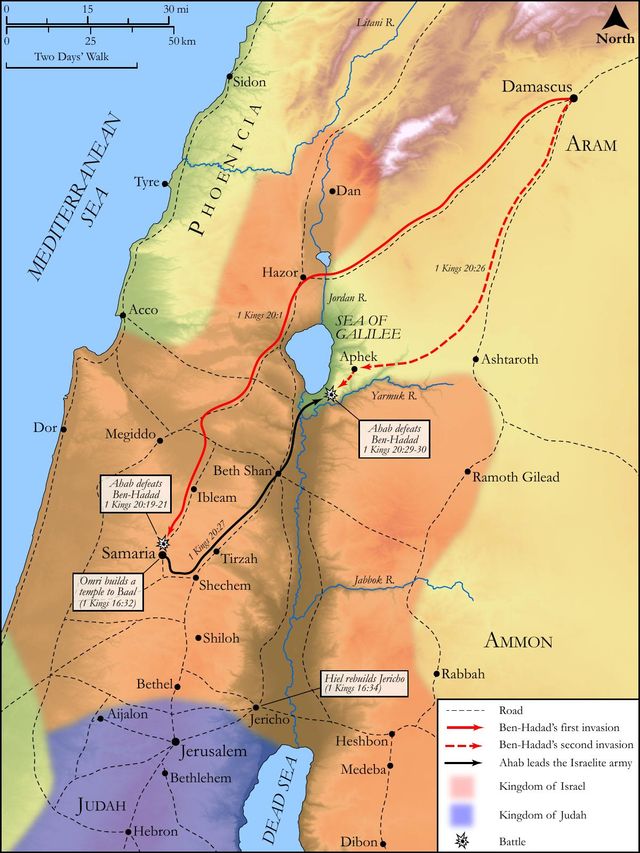
Here is, I. The threatening descent which Ben-hadad made upon Ahab's kingdom, and the siege he laid to Samaria, his royal city, Kg1 20:1. What the ground of the quarrel was we are not told; covetousness and ambition were the principle, which would never want some pretence or other. David in his time had quite subdued the Syrians and made them tributaries to Israel, but Israel's apostasy from God makes them formidable again. Asa had tempted the Syrians to invade Israel once (Kg1 15:18-20), and now they did it of their own accord. It is dangerous bringing a foreign force into the country: posterity may pay dearly for it. Ben-hadad had with him thirty-two kings, who were either tributaries to him, and bound in duty to attend him, or confederates with him, and bound in interest to assist him. How little did the title of king look when all these poor petty governors pretended to it!
II.The treaty between these two kings.
Surely Israel's defence had departed from them, or else the Syrians could not have marched so readily, and with so little opposition, to Samaria, the head and heart of the country, a city lately built, and therefore, we may suppose, not well fortified, but likely to fall quickly into the hands of the invaders; both sides are aware of this, and therefore,
1.Ben-hadad's proud spirit sends Ahab a very insolent demand, Kg1 20:2, Kg1 20:3. A parley is sounded, and a trumpeter (we may suppose) is sent into the city, to let Ahab know that he will raise the siege upon condition that Ahab become his vassal (Nay, his villain), and not only pay him a tribute out of what he has, but make over his title to Ben-hadad, and hold all at his will, even his wives and children, the godliest of them. The manner of expression is designed to gall them; "All shall be mine, without exception."
2.Ahab's poor spirit sends Ben-hadad a very disgraceful submission. It is general indeed (he cannot mention particulars in his surrender with so much pleasure as Ben-hadad did in his demand), but it is effectual: I am thine, and all that I have, Kg1 20:4. See the effect of sin.
(1.)If he had not by sin provoked God to depart from him, Ben-hadad could not have made such a demand. Sin brings men into such straits, by putting them out of divine protection. If God may not rule us, our enemies shall. A rebel to God is a slave to all besides. Ahab had prepared his silver and gold for Baal, Hos 2:8. Justly therefore is it taken from him; such an alienating amounts to a forfeiture.
(2.)If he had not by sin wronged his own conscience, and set that against him, he could not have made such a mean surrender. Guilt dispirits men, and makes them cowards. He knew Baal could not help, and had no reason to think that God would, and therefore was content to buy his life upon any terms. Skin for skin, and all that is dear to him, he will give for it; he will rather live a beggar than not die a prince.
3.Ben-hadad's proud spirit rises upon his submission, and becomes yet more insolent and imperious, Kg1 20:5, Kg1 20:6. Ahab had laid his all at his feet, at his mercy, expecting that one king would use another generously, that this acknowledgment of Ben-hadad's sovereignty would content him, the honour was sufficient for the present, and he might hereafter make use of it if he saw cause (Satis est prostrasse leoni - It suffices the lion to have laid his victim prostrate); but this will not serve.
(1.)Ben-hadad is as covetous as he is proud, and cannot go away unless he have the possession as well as the dominion. He thinks it not enough to call it his, unless he have it in his hands. He will not so much as lend Ahab the use of his own goods above a day longer.
(2.)He is as spiteful as he is haughty. Had he come himself to select what he had a mind for, it would have shown some respect to a crowned head; but he will send his servants to insult the prince, and hector over him, to rifle the palace, and strip it of all its ornaments; nay, to give Ahab the more vexation, they shall be ordered, not only to take what they please, but, if they can learn which are the persons or things that Ahab is in a particular manner fond of, to take those: Whatsoever is pleasant in thy eyes they shall take away. We are often crossed in that which we most dote upon; and that proves least safe which is most dear.
(3.)He is as unreasonable as he is unjust, and will construe the surrender Ahab made for himself as made for all his subjects too, and will have them also to lie at his mercy: "They shall search, not only thy house, but the houses of thy servants too, and plunder them at discretion." Blessed be God for peace and property, and that what we have we can call our own.
4.Ahab's poor spirit begins to rise too, upon this growing insolence; and, if it becomes not bold, yet it becomes desperate, and he will rather hazard his life than give up all thus.
(1.)How he takes advice of his privy-council, who encourage him to stand it out. He speaks but poorly (Kg1 20:7), appeals to them whether Ben-hadad be not an unreasonable enemy, and do not seek mischief. What else could he expect from one who, without any provocation given him, had invaded his country and besieged his capital city? He owns to them how he had truckled to him before, and will have them advise him what he should do in this strait; and they speak bravely (Hearken not to him, nor consent, Kg1 20:8), promising no doubt to stand by him in the refusal.
(2.)Yet he expresses himself very modestly in his denial, Kg1 20:9. He owns Ben-hadad's dominion over him: "Tell my lord the king I have no design to affront him, nor to receded from the surrender I have already made; what I offered at first I will stand to, but this thing I may not do; I must not give what is none of my own." It was a mortification to Ben-hadad that even such an abject spirit as Ahab's durst deny him; yet it should seem, by his manner of expressing himself, that he durst not have done it if his people had not animated him.
5.Ben-hadad proudly swears the ruin of Samaria. The threatening waves of his wrath, meeting with this check, rage and foam, and make a noise. In his fury, he imprecates the impotent revenge of his gods, if the dust of Samaria serve for handfuls for his army (Kg1 20:10), so numerous, so resolute, an army will be bring into the field against Samaria, and so confident is he of their success; it will be done as easily as the taking up of a handful of dust; all shall be carried away, even the ground on which the city stands. Thus confident is his pride, thus cruel is his malice; this prepares him to be ruined, though such a prince and such a people are unworthy of the satisfaction of seeing him ruined.
6.Ahab sends him a decent rebuke to his assurance, dares not defy his menaces, only reminds him of the uncertain turns of war (Kg1 20:11): "Let not him that begins a war, and is girding on his sword, his armour, his harness, boast of victory, or think himself sure of it, as if he had put it off, and had come home a conqueror." This was one of the wisest words that ever Ahab spoke, and is a good item or momento to us all; it is folly to boast beforehand of any day, since we know not what it may bring forth (Pro 27:1), but especially to boast of a day of battle, which may prove as much against us as we promise ourselves it will be for us. It is impolitic to despise an enemy, and to be too sure of victory is the way to be beaten. Apply it to our spiritual conflicts. Peter fell by his confidence. While we are here we are but girding on the harness, and therefore must never boast as though we had put it off. Happy is the man that feareth always, and is never off his watch.
Continue studying 1 Kings 20:5 across the web’s major study libraries — every link below opens this exact verse, chapter, or book on the destination site.
Read & Compare
 BibleGatewayThis verse in more than 200 translations and 70 languages.
 Bible.comThe YouVersion reader — hundreds of translations, reading plans, and highlights.
 ESV.orgCrossway's official English Standard Version reader.
 NET BibleThe NET translation with 60,000+ translators' notes on every rendering decision.
 STEP BibleTyndale House's free study tool — original text, vocabulary, and scholarly resources.
 BibliaLogos Bible Software's free web reader.
 USCCBThe New American Bible (Revised Edition) with the U.S. bishops' study notes.
Commentaries
 BibleHub CommentariesDozens of classic commentaries on this verse, gathered on one page.
 StudyLightMore than 100 commentary sets — the largest collection on the web.
 BibleRefPlain-English commentary on what this verse means, verse by verse.
 Enduring WordDavid Guzik's free commentary on this chapter, widely used by Bible teachers.
 Bible Study ToolsVerse commentary alongside Greek and Hebrew study aids.
Original Language & Research
- BibleHub InterlinearThe verse word by word — original language, transliteration, and English.
- BibleHub LexiconEvery word's original-language definition and Strong's entry.
 Blue Letter BibleDeep-study tools — Strong's numbers, concordance, and word studies.
 SefariaThe Hebrew text with Rashi and centuries of Jewish commentary.
Sermons, Hymns & Audio


TrulyRandomVerse is not affiliated with these sites and doesn’t control their content. They’re linked because they’re genuinely useful.
Summary
1 Kings 20:5 records a critical moment in the escalating confrontation between King Ben-hadad of Aram and King Ahab of Israel, as Ben-hadad's messengers return to reiterate the initial, seemingly "modest" demands for Ahab's silver, gold, wives, and children. This repetition is not a mere formality but a calculated strategic maneuver by the Syrian king, designed to confirm Ahab's prior submission and set the stage for an even more audacious and humiliating ultimatum that immediately follows in the narrative, revealing Ben-hadad's escalating arrogance and the increasingly desperate plight of Israel.
Context
ShowHideLiterary Context
This verse is strategically placed within the narrative of the Aramaean siege of Samaria, serving as a pivotal moment that bridges Ahab's initial, surprising submission and Ben-hadad's subsequent, truly outrageous demands. It directly follows Ahab's concession in 1 Kings 20:3-4, where he declared, "My lord, O king, according to thy saying, I am thine, and all that I have." The return of Ben-hadad's messengers, bearing the exact same demands, is not a negotiation but a confirmation of Ahab's perceived weakness and a psychological tactic. This reiteration builds narrative tension, setting up the shocking escalation in 1 Kings 20:6, where Ben-hadad asserts the right to send his servants to plunder Samaria at will. Thus, 1 Kings 20:5 functions as a crucial dramatic pause, solidifying the initial terms before the true, escalated ultimatum is delivered, highlighting the cunning and manipulative nature of Ben-hadad's strategy.
Historical & Cultural Context
The historical backdrop is the ongoing conflict between the Northern Kingdom of Israel and the powerful Aramean kingdom, with Samaria, Israel's capital, under siege. In the ancient Near East, sieges were common, and terms of surrender often included heavy tribute, encompassing precious metals, goods, and even members of the royal family as hostages, signifying submission and the avoidance of total destruction. Ben-hadad's initial demands, while severe, fell within these established norms. However, the subsequent escalation in 1 Kings 20:6 transcends typical tribute, aiming for total humiliation and unrestricted plunder, which was a clear violation of even the harsh conventions of the time. The specific demand for "wives and children" was particularly devastating, as it implied not only financial ruin but the potential destruction of the royal lineage and the profound dishonoring and subjugation of the entire household, a catastrophic blow to honor and sovereignty in ancient Semitic cultures. This context underscores the dire and humiliating circumstances confronting King Ahab.
Key Themes
ShowHideThis verse significantly contributes to several overarching themes within 1 Kings 20 and the broader narrative of 1 Kings. Firstly, it powerfully illustrates the escalation of pride and hubris in Ben-hadad, who, perceiving Ahab's complete submission, pushes his demands to an extreme. This unchecked arrogance frequently precedes a dramatic downfall, a recurring motif in biblical narratives (Proverbs 16:18). Secondly, the scene emphasizes the vulnerability and humiliation of Israel under Ahab's leadership, a consequence often linked to their spiritual apostasy and reliance on human power rather than divine guidance (1 Kings 18). Thirdly, the seemingly insurmountable odds against Israel set the stage for a profound demonstration of divine sovereignty and unexpected intervention. Despite Israel's unworthiness, God's prophetic word intervenes to deliver them, not for Ahab's merit, but for the glory of His own name and to reveal His supreme power over the nations, a foundational theme woven throughout the books of Kings.
Exposition and Analysis
ShowHideKey Word Analysis
ShowHideThis term, often translated as "angels" when referring to divine beings, here specifically denotes human emissaries, envoys, or deputies. The narrative's emphasis on their coming "again" (H7725, shûwb) highlights the deliberate and calculated nature of Ben-hadad's diplomatic strategy. Their return signifies not a reopening of negotiations, but a confirmation of terms and a prelude to further, more aggressive demands, underscoring the formal and non-negotiable nature of the communication from a superior power to a perceived subordinate.
This primitive root signifies "to say," "to declare," or "to command," used with broad latitude. The formal phrase "Thus speaketh Benhadad" is a standard formula in ancient Near Eastern diplomacy, imbuing the message with absolute authority and finality. In this context, it underscores Ben-hadad's perceived absolute power and his expectation of unquestioning obedience from Ahab, reflecting a king issuing a decree rather than proposing terms for discussion. It emphasizes the unilateral nature of the demands.
Derived from the root "to build," this term refers to a son, but in the widest sense, encompassing offspring, descendants, and even those born into a household. The demand for "thy children" (alongside wives, silver, and gold) was not merely about material wealth or hostages. It was a profound assault on Ahab's lineage, legacy, and the very continuity of his royal house. In ancient cultures, children were the future, and their seizure represented the ultimate humiliation and the symbolic destruction of a king's sovereignty and dynastic hopes.
Verse Breakdown
ShowHide"And the messengers came again"
This opening clause is critical, signaling a second, distinct diplomatic engagement from Ben-hadad. The word "again" (Hebrew, shûwb, H7725) indicates a return, implying a follow-up to Ahab's initial submission in 1 Kings 20:4. It suggests a deliberate re-engagement, not for further negotiation, but to solidify the previous agreement and, as the subsequent verses reveal, to set the stage for an escalation of demands based on Ahab's perceived vulnerability.
"and said, Thus speaketh Benhadad, saying"
This formal diplomatic formula emphasizes that the message conveyed is a direct, authoritative pronouncement from Ben-hadad himself, not merely a proposal from his envoys. It underscores the non-negotiable nature of the Syrian king's will, reinforcing his position of power and his contempt for Ahab's sovereignty. The repetition of "saying" (Hebrew, 'âmar, H559) further emphasizes the directness and weight of Ben-hadad's decree.
"Although I have sent unto thee, saying"
This clause highlights Ben-hadad's perspective and serves as a reminder to Ahab. The "Although" (Hebrew, veken, "and so" or "indeed") implies a confirmation or reiteration of what was already communicated and agreed upon. It functions to hold Ahab to his prior concession, establishing a baseline of submission from which Ben-hadad intends to launch his subsequent, more extreme demands. It's a subtle but sinister reminder of Ahab's earlier surrender.
"Thou shalt deliver me thy silver, and thy gold, and thy wives, and thy children;"
This is the core of the reiterated demand, identical to the initial one in 1 Kings 20:3. The specific items—silver, gold, wives, and children—represent the totality of a king's wealth, power, and legacy. The demand for wives and children, in particular, was a profound act of humiliation and a direct threat to the very continuity of Ahab's royal line, signifying complete subjugation and the loss of national sovereignty. The repetition here is crucial, as it sets up the shock and outrage of the next demand, which transcends even this severe initial tribute.
Literary Devices
ShowHideThe primary literary device at play in 1 Kings 20:5 is Repetition, specifically the verbatim reiteration of Ben-hadad's initial demands from 1 Kings 20:3. This repetition serves multiple strategic purposes: it underscores the initial, seemingly "final" terms to which Ahab had already agreed, thereby highlighting Ahab's prior submission and perceived weakness. More importantly, it functions as a deliberate dramatic pause, building intense narrative tension and acting as a powerful form of Foreshadowing for the truly outrageous and non-negotiable ultimatum that immediately follows in 1 Kings 20:6. The audience is led to believe these are the full demands, only for the narrative to reveal Ben-hadad's even greater arrogance and insatiable greed, creating a palpable sense of Escalation in the aggressor's demands and the victim's deepening predicament. This masterful use of repetition and subsequent escalation effectively portrays Ben-hadad's cunning and increasing hubris, alongside Ahab's desperate and worsening situation.
Theological and Thematic Connections
ShowHideThis verse, though seemingly a straightforward diplomatic exchange, profoundly illustrates the theological theme of unchecked human pride and its inevitable escalation. Ben-hadad's repeated demand, swiftly followed by his even more audacious ultimatum, reveals a heart consumed by arrogance, presuming himself utterly sovereign and beyond challenge. This human hubris invariably sets the stage for divine intervention, as God consistently humbles the proud and exalts the humble. The demands for Ahab's family and possessions are not merely political; they represent a direct assault on the very identity and sovereignty of God's chosen nation, albeit one currently led by a wicked king. This scenario implicitly raises profound questions about where true sovereignty ultimately resides and powerfully foreshadows God's ultimate demonstration of His power over the nations, often through unexpected and seemingly impossible means.
Reflection and Application
ShowHideThe scene depicted in 1 Kings 20:5 offers a profound and sobering lesson on the nature of spiritual and relational conflict, and the insidious progression of compromise. Just as Ben-hadad, perceiving King Ahab's initial concession, immediately pressed for more, so too can sin, temptation, or oppressive forces gain significant ground when we yield even a little. The "slippery slope" of compromise often begins with seemingly tolerable or minor demands, only to escalate inexorably to terms that are utterly destructive and soul-crushing. This passage challenges us to cultivate spiritual discernment and resolve, knowing when to stand firm, even against overwhelming odds, trusting in a power infinitely greater than our own. For Ahab, his initial submission emboldened his enemy, pushing him to a point of no return where divine intervention became the sole hope. Spiritually, it serves as a potent reminder that while humility before God is paramount, a lack of resolute resistance against the encroaching demands of the world, or our own sinful desires, can lead to profound spiritual subjugation. We are called to actively resist the devil, knowing that he will flee from us, and to stand firm in the glorious freedom Christ has decisively won for us.
Questions for Reflection
ShowHideFAQ
ShowHideWhy did Ben-hadad send messengers to reiterate demands that Ahab had already agreed to?
ShowHideBen-hadad's decision to send messengers again, reiterating the exact same demands, was a highly calculated psychological and strategic maneuver, not a mere formality. Firstly, it served to confirm Ahab's initial submission, ensuring there was no misunderstanding or attempt to retract his agreement, thereby solidifying Ben-hadad's perceived dominance. Secondly, and more importantly, it was a deliberate test of Ahab's resolve and a chilling prelude to an even more outrageous ultimatum. By repeating the initial terms, Ben-hadad was establishing a firm baseline, making Ahab's prior concession appear as a binding, non-negotiable agreement. This psychological pressure set the stage for the truly humiliating demands in 1 Kings 20:6, where Ben-hadad asserts his right to send his servants to plunder Samaria at will, without any further conditions. It was a powerful demonstration of his absolute power and an act of psychological warfare, designed to push Ahab to his absolute breaking point before delivering the final, crushing blow.
Christ-Centered Fulfillment
ShowHideThe escalating and ultimately tyrannical demands of Ben-hadad in 1 Kings 20:5 find profound Christ-centered fulfillment in the ultimate victory of Jesus Christ over the oppressive demands of sin, death, and the kingdom of darkness. Ben-hadad sought to strip Ahab of his wealth, family, and sovereignty, symbolizing the total subjugation and spiritual impoverishment that sin and Satan relentlessly seek to impose upon humanity. Just as King Ahab was utterly powerless to meet Ben-hadad's escalating demands and desperately required divine intervention, so too was humanity utterly incapable of satisfying the demands of God's righteous law or escaping the debilitating bondage of sin on its own (Romans 3:23 and Romans 6:23). However, unlike Ahab who initially conceded to the enemy's terms, Christ, the true and eternal King, never yielded to the demands of the spiritual adversary. He confronted sin and death head-on, not through concession or compromise, but through His ultimate, sacrificial death and triumphant resurrection. Through His atoning work on the cross, Jesus "disarmed the powers and authorities, he made a public spectacle of them, triumphing over them by the cross" (Colossians 2:15). He paid the ultimate price, not with perishable silver or gold, but with His own precious and sinless blood, to redeem us from the dominion of darkness and miraculously transfer us into His glorious kingdom (1 Peter 1:18-19; Colossians 1:13-14). Thus, what Ben-hadad demanded as tribute and a sign of subjugation, Christ freely gave as a ransom, securing our eternal freedom and restoring our true spiritual sovereignty and identity in Him (John 8:36).