


2 Chronicles 32:4
Bible text: King James Version (1769 Blayney text) · Public domain
Bible text: King James Version with Strong's numbers · Public domain
Bible text: Berean Standard Bible · Public domain
Bible text: American Standard Version (1901) · Public domain
Bible text: World English Bible, Messianic edition · Public domain
Bible text: Geneva Bible (1599) · Public domain
Bible text: Young's Literal Translation · Public domain
- וַיִּקָּבְצוּvai·yi·ka·ve·Tzuand they assembledH6908Conj-w ¦ V-Niphal-ConsecImperf-3mpVerb Niphal Consecutive Imperfect 3rd Plural Masculineוַandיִּקָּבְצוּthey assembled
- עַם'ampeopleH5971N-msNoun Singular Masculine Absolute
- רָבRavnumerousH7227Adj-msAdjective Singular Masculine Absolute
- וַיִּסְתְּמוּvai·yis·te·Muand they stopped upH5640Conj-w ¦ V-Qal-ConsecImperf-3mpVerb Qal Consecutive Imperfect 3rd Plural Masculineוַandיִּסְתְּמוּthey stopped up
- אֶת'et<obj.>H853DirObjMParticle Object Indicator
- כָּלkolallH3605N-mscNoun Singular Masculine Construct
- הַמַּעְיָנוֹתha·ma'·ya·Notthe springsH4599Art ¦ N-fpNoun Plural Feminine Absoluteהַtheמַּעְיָנוֹתsprings
- וְאֶתve·'Etand <obj.>H853Conj-w ¦ DirObjMParticle Object Indicatorוְandאֶת<obj.>
- הַנַּחַלha·Na·chalthe wadiH5158Art ¦ N-msNoun Singular Masculine Absoluteהַtheנַּחַלwadi
- הַשּׁוֹטֵףha·sho·Tefwhich flowedH7857Art ¦ V-Qal-Prtcpl-msVerb Qal Participle Singular Masculine Absoluteהַwhichשּׁוֹטֵףflowed
- בְּתוֹךְbe·tokhin [the] middle ofH8432Prep-b ¦ N-mscNoun Singular Masculine Constructבְּinתוֹךְ[the] middle of
- הָאָרֶץha·'A·retzthe landH776Art ¦ N-fsNoun Singular Feminine Absoluteהָtheאָרֶץland
- לֵאמֹרle·Mor<to> sayingH559Prep-l ¦ V-Qal-InfVerb Qal Infinitive Constructלֵ<to>אמֹרsaying
- לָמָּהLa·mah<to> why?H4100Prep-l ¦ InterrogPronoun Interrogativeלָ<to>מָּהwhy?
- יָבוֹאוּya·Vo·'uwill they comeH935V-Qal-Imperf-3mpVerb Qal Imperfect 3rd Plural Masculine
- מַלְכֵיmal·Khei[the] kings ofH4428N-mpcNoun Plural Masculine Construct
- אַשּׁוּר'a·ShurAssyriaH804N-properNoun Proper Location
- וּמָצְאוּu·ma·tze·'Uand they will findH4672Conj-w ¦ V-Qal-ConsecPerf-3cpVerb Qal Consecutive Perfect 3rd Plural common genderוּandמָצְאוּthey will find
- מַיִםMa·yimwatersH4325N-mpNoun Plural Masculine Absolute
- רַבִּיםra·BimmanyH7227Adj-mpAdjective Plural Masculine Absolute
English is a literal word-by-word gloss of the Hebrew, not the KJV's wording. Why?
This is the original text the KJV's translators worked from — each Hebrew word with its own literal English meaning in this verse, prepared by scholars at Tyndale House, Cambridge. The KJV translates whole sentences, not word by word, so its wording differs: one Hebrew word can become several English words, and the KJV may choose “the LORD” where the gloss reads “Yahweh”. Both are faithful — they answer different questions. For the KJV's own rendering, switch to the KJV text.
Details
See on the biblical-era maps
Study this verse
Public-domain commentary
Matthew Henry
From his Commentary on the Whole Bible. Henry comments on passages, not single verses — this entry covers 2 Chronicles 32:1–8. His two-level outline is real structure in the source text, so it is rendered as structure.
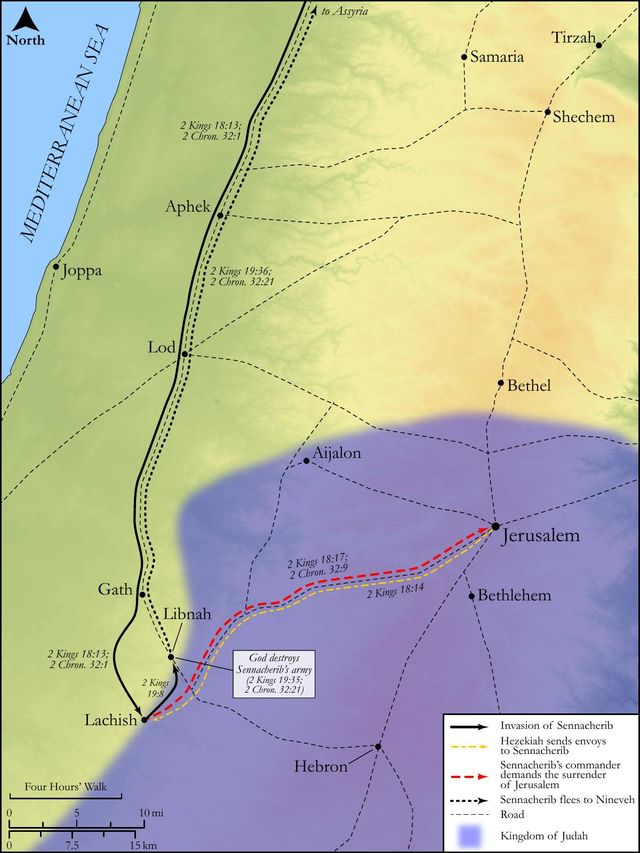
Here is, I. The formidable design of Sennacherib against Hezekiah's kingdom, and the vigorous attempt he made upon it. This Sennacherib was now, as Nebuchadnezzar was afterwards, the terror and scourge and great oppressor of that part of the world. He aimed to raise a boundless monarchy for himself upon the ruins of all his neighbours. His predecessor Shalmaneser had lately made himself master of the kingdom of Israel, and carried the ten tribes captives. Sennacherib thought, in like manner, to win Judah for himself. Pride and ambition put men upon grasping at universal dominion. It is observable that, just about this time, Rome, a city which afterwards came to reign more than any other had done over the kings of the earth, was built by Romulus. Sennacherib invaded Judah immediately after the reformation of it and the re-establishment of religion in it: After these things he entered into Judah, Ch2 32:1. 1. It was well ordered by the divine Providence that he did not give them this disturbance before the reformation was finished and established, as it might then have put a stop to it. 2. Perhaps he intended to chastise Hezekiah for destroying that idolatry to which he himself was devoted. He looked upon Hezekiah as profane in what he had done, and as having thrown himself out of the divine protection. He accordingly considered him as one who might easily be made a prey of. 3. God ordered it at this time that he might have an opportunity of showing himself strong on the behalf of this returning reforming people. He brought this trouble upon them that he might have the honour, and might put on them the honour, of their deliverance. After these things, and the establishment thereof, one would have expected to hear of nothing but perfect peace, and that none durst meddle with a people thus qualified for the divine favour; yet the next news we hear is that a threatening destroying army enters the country, and is ready to lay all waste. We may be in the way of our duty and yet meet with trouble and danger. God orders it so for the trial of our confidence in him and the manifestation of his care concerning us. The little opposition which Sennacherib met with in entering Judah induced him to imagine that all was his own. He thought to win all the fenced cities (Ch2 32:1), and purposed to fight against Jerusalem, Ch2 32:2. See Kg2 18:7, Kg2 18:13.
II.The preparation which Hezekiah prudently made against this storm that threatened him:
He took counsel with his princes what he should do, what measures he should take, Ch2 32:3. With their advice he provided,
1.That the country should give him a cold reception, for he took care that he should find no water in it (and then his army must perish for thirst), or at least that there should be a scarcity of water, by which his army would be weakened and unfitted for service. A powerful army, if it want water but a few days, will be but a heap of dry dust. All hands were set immediately to work to stop up the fountains, and the brook that ran through the midst of the land, turning that (it is probable) into the city by pipes under-ground. Such as this is the policy commonly practised now-a-days of destroying the forage before an invading army.
2.That the city should give him a warm reception. In order to this he repaired the wall, raised towers, and made darts (or, as it is in the margin, swords or weapons) and shields in abundance (Ch2 32:5), and appointed captains, Ch2 32:6. Note, Those that trust God with their safety must yet use proper means for their safety, otherwise they tempt him, and do not trust him. God will provide, but so must we also.
III.The encouragement which he gave to his people to depend upon God in this distress.
He gathered them together in a broad open street, and spoke comfortably to them, Ch2 32:6. He was himself undaunted, being confident the invasion would issue well. He was not like his father, who had much guilt to terrify him and no faith to encourage him, so that, in a time of public danger, his heart was moved, as the trees of the wood are moved with the wind, and then no marvel that the heart of his people was so too, Isa 7:2. With what he said he put life into his people, his captains especially, and spoke to their heart, as the word is.
1.He endeavoured to keep down their fears: "Be strong and courageous; do not think of surrendering the city or capitulating, but resolve to hold it out to the last man; do not think of losing the city, nor of falling into the enemy's hand; there is no danger. Let the soldiers be bold and brave, make good their posts, stand to their arms, and fight manfully, and let the citizens encourage them to do so: Be not afraid nor dismayed for the king of Assyria." The prophet had thus encouraged them from God (Isa 10:24): Be not afraid of the Assyrians; and here the king from him. Now it was that the sinners in Zion were afraid (Isa 33:14), but the righteous dwelt on high (Isa 33:15, Isa 33:16) and meditated on terror so as to conquer it. See Isa 33:18, which refers to what is recorded here.
2.He endeavoured to keep up their faith, in order to the silencing and suppressing of their fears. "Sennacherib has a multitude with him, and yet there are more with us than with him; for we have God with us, and how many do you reckon him for? With our enemy is an arm of flesh, which he trusts to; but with us is the Lord, whose power is irresistible, our God, whose promise is inviolable, a God in covenant with us, to help us, and to fight our battles, not only to help us to fight them, but to fight them for us if he please:" and so he did here. Note, A believing confidence in God will raise us above the prevailing fear of man. He that feareth the fury of the oppressor forgetteth the Lord his Maker, Isa 51:12, Isa 51:13. It is probable that Hezekiah said more to this purport, and that the people rested themselves upon what he said, not merely upon his word, but on the things he said concerning the presence of God with them and his power to relieve them, the belief of which made them easy. Let the good subjects and soldiers of Jesus Christ rest thus upon his word, and boldly say, Since God is for us, who can be against us?
Continue studying 2 Chronicles 32:4 across the web’s major study libraries — every link below opens this exact verse, chapter, or book on the destination site.
Read & Compare
 BibleGatewayThis verse in more than 200 translations and 70 languages.
 Bible.comThe YouVersion reader — hundreds of translations, reading plans, and highlights.
 ESV.orgCrossway's official English Standard Version reader.
 NET BibleThe NET translation with 60,000+ translators' notes on every rendering decision.
 STEP BibleTyndale House's free study tool — original text, vocabulary, and scholarly resources.
 BibliaLogos Bible Software's free web reader.
 USCCBThe New American Bible (Revised Edition) with the U.S. bishops' study notes.
Commentaries
 BibleHub CommentariesDozens of classic commentaries on this verse, gathered on one page.
 StudyLightMore than 100 commentary sets — the largest collection on the web.
 BibleRefPlain-English commentary on what this verse means, verse by verse.
 Enduring WordDavid Guzik's free commentary on this chapter, widely used by Bible teachers.
 Bible Study ToolsVerse commentary alongside Greek and Hebrew study aids.
Original Language & Research
- BibleHub InterlinearThe verse word by word — original language, transliteration, and English.
- BibleHub LexiconEvery word's original-language definition and Strong's entry.
 Blue Letter BibleDeep-study tools — Strong's numbers, concordance, and word studies.
 SefariaThe Hebrew text with Rashi and centuries of Jewish commentary.
Sermons, Hymns & Audio


TrulyRandomVerse is not affiliated with these sites and doesn’t control their content. They’re linked because they’re genuinely useful.
Summary
2 Chronicles 32:4 powerfully illustrates King Hezekiah's astute and decisive defensive measures in anticipation of the impending Assyrian invasion led by Sennacherib. Recognizing the critical logistical need for water for a large invading army, Hezekiah mobilized the people of Judah to collectively block or divert all accessible springs and streams outside Jerusalem. This strategic act was designed to deprive the formidable Assyrian forces of vital water resources, thereby weakening their siege capabilities and simultaneously safeguarding Jerusalem's own water supply, showcasing a remarkable blend of human foresight, unified national action, and strategic military wisdom in the face of an existential threat.
Context
ShowHideLiterary Context
This verse is strategically placed early in the Chronicler's account of Sennacherib's invasion of Judah, immediately following the Assyrian king's initial advances and capture of fortified cities in Judah, as detailed in 2 Chronicles 32:1-3. It serves as a crucial bridge, detailing Hezekiah's immediate and highly pragmatic response to the looming danger, thereby setting the stage for the dramatic siege of Jerusalem and the subsequent miraculous divine deliverance. The specific actions described here, particularly the stopping of external water sources, are intricately linked to Hezekiah's broader efforts to fortify Jerusalem, which notably included the construction of the famous Siloam Tunnel to bring the Gihon Spring's water inside the city walls, an engineering marvel later highlighted in 2 Chronicles 32:30. This verse, therefore, underscores the vital human element of preparation and strategic planning before the narrative shifts to emphasize God's ultimate intervention and the supernatural defeat of the Assyrians.
Historical & Cultural Context
The events of 2 Chronicles 32 are firmly rooted in the historical reality of the late 8th century BC, specifically around 701 BC, during the reign of King Hezekiah of Judah. This period was dominated by the immense power and expansionist ambitions of the Neo-Assyrian Empire. Sennacherib, the then-current Assyrian king, launched a major military campaign against Judah, aiming to subjugate the rebellious kingdom and its capital, Jerusalem. In siege warfare, control over water resources was absolutely paramount, especially for large armies undertaking prolonged sieges. Besieging armies relied heavily on local water supplies, while besieged cities depended on secure internal sources. Jerusalem, though naturally fortified by valleys on three sides, had its primary spring, the Gihon, located outside the city walls. Hezekiah's decisive action to "stop all the fountains, and the brook" (likely referring to the Gihon Spring and its overflow into the Kidron Valley) was a standard and highly effective military tactic, a "scorched earth" policy designed to deny the enemy sustenance, weaken their forces, and disrupt their logistical capabilities.
Key Themes
ShowHide2 Chronicles 32:4 contributes significantly to several overarching themes within the book of Chronicles and the broader biblical narrative. Firstly, it powerfully illustrates the theme of Prudent Preparation and Human Responsibility. Hezekiah, despite his profound faith and reliance on God, did not passively await divine intervention but actively engaged in strategic defense, demonstrating that genuine faith does not negate the need for practical wisdom, diligence, and human effort, a principle echoed in Proverbs 21:31. Secondly, the verse highlights Strategic Defense and Military Wisdom, showcasing an ingenious and vital tactic in ancient siege warfare that directly impacted the Assyrian campaign. Thirdly, the phrase "much people together" emphasizes Unified Effort and Community Action, illustrating the critical importance of collective cooperation and national solidarity under strong, godly leadership in times of severe crisis. These themes collectively reinforce the Chronicler's broader theological message that while God is ultimately sovereign and delivers His people, human obedience, diligence, and unity play a crucial and complementary role in the unfolding of His divine purposes.
Exposition and Analysis
ShowHideKey Word Analysis
ShowHideThis verb (H5640) means "to stop up," "to close," "to block," or "to conceal." In this context, it conveys a sense of thoroughness and decisiveness, indicating that the action was not merely to impede but to completely obstruct or render unusable the water sources. This deliberate act of blocking or concealing was crucial for the success of Hezekiah's defensive strategy, ensuring the Assyrians could not easily access these vital resources.
The term (H4599), though appearing in the plural in the KJV, refers to natural springs or wellsprings. Its use here indicates that Hezekiah's efforts were comprehensive, targeting all known natural water outlets in the vicinity of Jerusalem that could potentially supply the invading Assyrian army. The most significant "fountain" in question would have been the Gihon Spring, Jerusalem's primary external water source, which was subsequently diverted into the city.
This term (H5158) typically refers to a wadi or a seasonal stream bed, often a winter torrent. In this specific context, it most likely refers to the overflow or outflow of the Gihon Spring that ran through the Kidron Valley. By stopping both the springs and the brook, Hezekiah ensured that any surface water or easily accessible flowing water was also denied to the invaders, making the surrounding area barren and unsustainable for a large military force.
Verse Breakdown
ShowHide"So there was gathered much people together"
This opening phrase underscores the collective and unified effort of the people of Judah, mobilized under King Hezekiah's leadership. It was not a solitary act by the king but a massive communal undertaking, demonstrating the people's obedience, shared purpose, and unwavering commitment to the defense of their city and nation. This widespread unity was absolutely essential for the scale and effectiveness of the task at hand.
"who stopped all the fountains, and the brook that ran through the midst of the land"
This clause vividly describes the specific, strategic action taken by the gathered populace. "Stopping" involved either blocking the flow, diverting it, or covering the sources to make them unusable or undetectable to the enemy. "The midst of the land" refers to the area immediately surrounding Jerusalem, emphasizing that the defense encompassed the vital resources of the immediate region, particularly the Gihon Spring and its associated watercourses in the Kidron Valley, thereby creating a waterless zone for the invaders.
"saying, Why should the kings of Assyria come, and find much water?"
This concluding clause reveals the clear, logical, and highly pragmatic rationale behind this drastic defensive measure. It was a proactive and intelligent military tactic designed to create an inhospitable and unsustainable environment for the vast Assyrian army. By depriving them of their most fundamental need—water—Hezekiah aimed to severely weaken their forces, disrupt their siege capabilities, and potentially force their retreat, thereby protecting Jerusalem from a prolonged, devastating, and potentially successful siege.
Literary Devices
ShowHide2 Chronicles 32:4 effectively employs several literary devices to convey its profound message and highlight the strategic brilliance of Hezekiah. The most prominent is Practical Wisdom, as the verse meticulously describes a highly intelligent and pragmatic military strategy. Hezekiah's actions are presented as a model of foresight, resourcefulness, and effective leadership in the face of overwhelming odds. There is also a strong element of Foreshadowing, as this meticulous preparation sets the stage for the intense siege that follows, implicitly highlighting the crucial role of water in the upcoming conflict and the eventual divine intervention that will render human efforts complete. The act of denying water to the enemy can also be seen as a form of Symbolism, where water, typically a source of life and sustenance, is strategically withheld to bring about the enemy's potential demise, thus transforming a life-giving element into a potent weapon of defense. Furthermore, the collective action of "much people together" emphasizes Unity and Communal Effort, a recurring and significant theme in Chronicles, portraying a nation working together cohesively under godly leadership for a common, vital purpose.
Theological and Thematic Connections
ShowHideThis verse powerfully illustrates a profound biblical principle: while God is sovereign and ultimately delivers His people, He also expects and often works through human diligence, wisdom, and preparation. Hezekiah's actions are not presented as a lack of faith, but rather as a faithful steward's responsible and proactive use of the resources and intellect God provides. This strategic move, born of practical wisdom and foresight, demonstrates a deep, active trust in God that is expressed through diligent human effort. It teaches that genuine faith is not passive resignation or fatalism but active engagement, using all available and legitimate means to honor God and protect His people, understanding that the ultimate outcome and the final victory rest entirely with Him. This delicate yet powerful balance between divine sovereignty and human responsibility is a consistent theological thread woven throughout the tapestry of Scripture, calling believers to both pray fervently and work diligently.
Reflection and Application
ShowHide2 Chronicles 32:4 offers profound and enduring lessons for believers today, serving as a powerful reminder that our unwavering faith in God's ultimate provision and deliverance does not, in any way, negate the essential need for diligent human effort and wise, strategic preparation. Just as King Hezekiah and the people of Judah meticulously and strategically prepared for a formidable physical threat, we too are called to exercise prudence, foresight, and resourcefulness in facing the multifaceted challenges of life, whether they manifest as spiritual battles, relational complexities, professional demands, or personal trials. This involves careful planning, proactive measures, and a profound willingness to work together in unity, harnessing the collective wisdom, diverse gifts, and combined strength of our communities. It is a compelling call to be excellent stewards of the gifts, talents, and opportunities God has graciously entrusted to us, recognizing that our practical efforts are not a substitute for faith, but rather a tangible and vibrant expression of it—faith put into action. We are encouraged to pray as if everything depends entirely on God, and simultaneously to work with diligence and commitment as if everything depends on us, trusting implicitly that God will bless, direct, and ultimately bring to fruition our diligent efforts for His supreme glory and our ultimate good.
Questions for Reflection
ShowHideFAQ
ShowHideWas this act of stopping water sources ethical in ancient warfare?
ShowHideYes, within the established norms and practices of ancient warfare, denying an enemy access to vital resources like water was considered a standard, legitimate, and ethical military tactic. It was a crucial defensive measure aimed at weakening a besieging army and protecting one's own city and people from conquest or prolonged suffering. Hezekiah's action was not an act of wanton destruction or unprovoked aggression, but a strategic act of self-preservation in the face of a powerful invading force. It was a common and accepted practice to make the land inhospitable to an enemy army to force their retreat or surrender, thereby minimizing casualties on one's own side and preserving the integrity of the kingdom.
How effective was this strategy in contributing to Jerusalem's defense?
ShowHideThis strategy was highly effective and played a crucial, albeit complementary, role in Jerusalem's defense. By depriving the vast Assyrian army of readily available external water supplies, Hezekiah created a significant and debilitating logistical challenge for Sennacherib's forces. This action, combined with the successful diversion of the Gihon Spring's water into the city via the famous Siloam Tunnel (as referenced in 2 Kings 20:20 and 2 Chronicles 32:30), ensured Jerusalem's internal water supply was secured, while the besiegers faced increasing dehydration and logistical strain. While the ultimate deliverance of Jerusalem was a miraculous act of God, as clearly stated in 2 Chronicles 32:21-22, Hezekiah's prudent and strategic preparations significantly contributed to the city's ability to withstand the siege and provided the essential context for God's powerful intervention. Assyrian records, notably Sennacherib's own prism, attest to his besieging Hezekiah in Jerusalem but not conquering the city, indirectly confirming the effectiveness of Judah's defense.
Christ-Centered Fulfillment
ShowHideHezekiah's strategic act of securing life-sustaining water for Jerusalem while denying it to the invading enemy finds profound and multifaceted Christ-centered fulfillment in the person and redemptive work of Jesus Christ. Just as Hezekiah ensured the physical survival of his people by providing and protecting their access to vital water, Christ offers Himself as the ultimate and eternal source of spiritual "living water" that eternally sustains His people. In a world besieged by the spiritual forces of sin, death, and futility, Jesus declares with divine authority, "If anyone thirsts, let him come to me and drink" (John 7:37). He is the "spring of the water of life" (Revelation 21:6) that eternally quenches the deepest spiritual thirst of the human soul, offering an inexhaustible supply of grace, forgiveness, and eternal life, a stark contrast to the fleeting and unsatisfying provisions offered by the world. While Hezekiah's actions were a defensive measure against a physical foe, Christ's work is a decisive, offensive victory over all spiritual enemies—sin, death, and the devil—providing an inexhaustible supply of grace, forgiveness, and eternal life to all who believe. He, the true Lamb of God, is the one who leads His redeemed to "springs of living water" (Revelation 7:17), ensuring our eternal sustenance, security, and joy in Him.