


2 Kings 19:17
- אָמְנָם'a·me·NamtrulyH551AdvAdverb
- יְהוָהYah·wehO YahwehH3068N-properNoun Proper Title
- הֶחֱרִיבוּhe·che·Ri·vuthey have made desolateH2717V-Hiphil-Perf-3cpVerb Hiphil Perfect 3rd Plural common gender
- מַלְכֵיmal·Khei[the] kings ofH4428N-mpcNoun Plural Masculine Construct
- אַשּׁוּר'a·ShurAssyriaH804N-properNoun Proper Location
- אֶת'et<obj.>H853DirObjMParticle Object Indicator
- הַגּוֹיִםha·go·Yimthe nationsH1471Art ¦ N-mpNoun Plural Masculine Absoluteהַtheגּוֹיִםnations
- וְאֶתve·'Etand <obj.>H853Conj-w ¦ DirObjMParticle Object Indicatorוְandאֶת<obj.>
- אַרְצָם'ar·Tzamtheir landH776N-fsc ¦ 3mpNoun Singular Feminine Constructאַרְצָlandםtheir
English is a literal word-by-word gloss of the Hebrew, not the KJV's wording. Why?
This is the original text the KJV's translators worked from — each Hebrew word with its own literal English meaning in this verse, prepared by scholars at Tyndale House, Cambridge. The KJV translates whole sentences, not word by word, so its wording differs: one Hebrew word can become several English words, and the KJV may choose “the LORD” where the gloss reads “Yahweh”. Both are faithful — they answer different questions. For the KJV's own rendering, switch to the KJV text.
Details
See on the biblical-era map
Study this verse
Public-domain commentary
Matthew Henry
From his Commentary on the Whole Bible. Henry comments on passages, not single verses — this entry covers 2 Kings 19:8–19. His two-level outline is real structure in the source text, so it is rendered as structure.
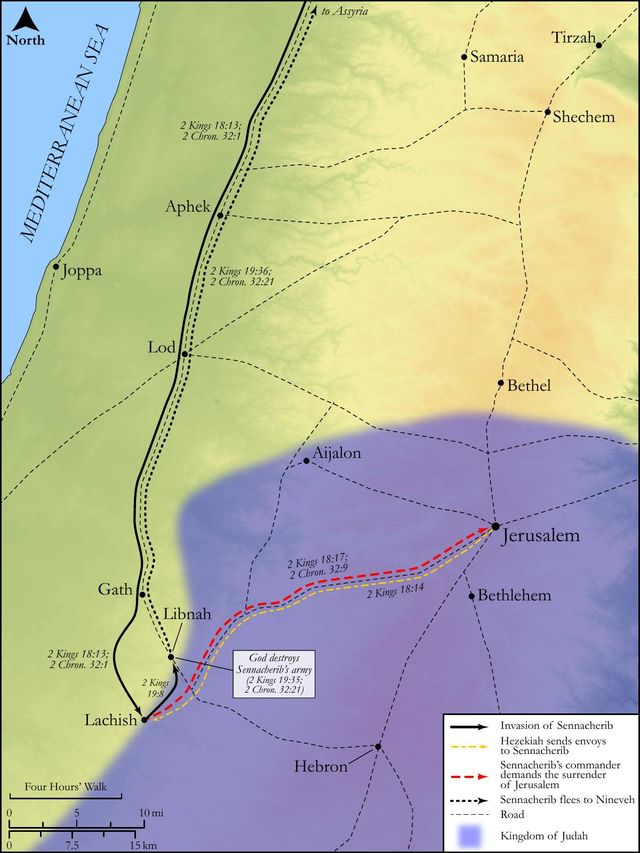
Rabshakeh, having delivered his message and received no answer (whether he took this silence for a consent or a slight does not appear), left his army before Jerusalem, under the command of the other generals, and went himself to attend the king his master for further orders. He found him besieging Libnah, a city that had revolted from Judah, Kg2 8:22. Whether he had taken Lachish or no is not certain; some think he departed from it because he found the taking of it impracticable, Kg2 19:8. However, he was now alarmed with the rumour that the king of the Cushites, who bordered upon the Arabians, was coming out against him with a great army, Kg2 19:9. This made him very desirous to gain Jerusalem with all speed. To take it by force would cost him more time and men than he could well spare, and therefore he renewed his attack upon Hezekiah to persuade him tamely to surrender it. Having found him an easy man once (Kg2 18:14), when he said, That which thou puttest on me I will bear, he hoped again to frighten him into a submission, but in vain. Here,
I.Sennacherib sent a letter to Hezekiah, a railing letter, a blaspheming letter, to persuade him to surrender Jerusalem, because it would be to no purpose for him to think of standing it out. His letter is to the same purport with Rabshakeh's speech; there is nothing new offered in it. Rabshakeh had said to the people, Let not Hezekiah deceive you, Kg2 18:29. Sennacherib writes to Hezekiah, Let not thy God deceive thee, Kg2 18:10. Those that have the God of Jacob for their help, and whose hope is in the Lord their God, need not fear being deceived by him, as the heathen were by their gods. To terrify Hezekiah, and drive him from his anchor, he magnifies himself and his own achievements. See how proudly he boasts,
1.Of the lands he had conquered (Kg2 18:11): All lands, and destroyed utterly! How are the mole-hills of his victories swelled to mountains! So far was he from destroying all lands that at this time the land of Cush, and Tirhakah its king, were a terror to him. What vast hyperboles may one expect in proud men's praises of themselves!
2.Of the gods he had conquered, Kg2 18:12. "Each vanquished nation and its gods, which were so far from being able to deliver them that they fell with them: and shall thy God deliver thee?" 3. Of the kings he had conquered (Kg2 18:13), the king of Hamath and the king of Arpad. Whether he means the prince or the idol, he means to make himself appear greater than either, and therefore very formidable, and the terror of the mighty in the land of the living.
II.Hezekiah encloses this in another letter, a praying letter, a believing letter, and sends it to the King of kings, who judges among the gods. Hezekiah was not so haughty as not to receive the letter, though we may suppose the superscription did not give him his due titles; when he had received it he was not so careless as not to read it; when he had read it he was not in such a passion as to write an answer to it in the same provoking language; but he immediately went up to the temple, presented himself, and then spread the letter before the Lord (Kg2 18:14), not as if God needed to have the letter shown to him (he knew what was in it before Hezekiah did), but hereby he signified that he acknowledged God in all his ways, - that he desired not to aggravate the injuries his enemies did him nor to make them appear worse than they were, but desired they might be set in a true light, - and that he referred himself to God, and his righteous judgment, upon the whole matter. Hereby likewise he would affect himself in the prayer he came to the temple to make; and we have need of all possible helps to quicken us in that duty. In the prayer which Hezekiah prayed over this letter, 1. He adores the God whom Sennacherib had blasphemed (Kg2 18:15), calls him the God of Israel, because Israel was his peculiar people, and the God that dwelt between the cherubim, because there was the peculiar residence of his glory upon earth; but he gives glory to him as the God of the whole earth, and not, as Sennacherib fancied him to be, the God of Israel only, and confined to the temple. "Let them say what they will, thou art sovereign Lord, for thou art the God, the God of gods, sole Lord, even thou alone, universal Lord of all the kingdoms of the earth, and rightful Lord, for thou hast made heaven and earth. Being Creator of all, by an incontestable title thou art owner and ruler of all." 2. He appeals to God concerning the insolence and profaneness of Sennacherib (Kg2 18:16): "Lord, hear; Lord, see. Here it is under his own hand; here it is in black and white." Had Hezekiah only been abused, he would have passed it by; but it is God, the living God, that is reproached, the jealous God. Lord, what wilt thou do for thy great name? 3. He owns Sennacherib's triumphs over the gods of the heathen, but distinguishes between them and the God of Israel (Kg2 18:17, Kg2 18:18): He has indeed cast their gods into the fire; for they were no gods, unable to help either themselves or their worshipers, and therefore no wonder that he has destroyed them; and, in destroying them, though he knew it not, he really served the justice and jealousy of the God of Israel, who has determined to extirpate all the gods of the heathen. But those are deceived who think they can therefore be too hard for him. He is none of the gods whom men's hands have made, but he has himself made all things, Psa 115:3, Psa 115:4. 4. He prays that God will now glorify himself in the defeat of Sennacherib and the deliverance of Jerusalem out of his hands (Kg2 19:19): "Now therefore save us; for if we be conquered, as other lands are, they will say that thou art conquered, as the gods of those lands were: but, Lord, distinguish thyself, by distinguishing us, and let all the world know, and be made to confess, that thou art the Lord God, the self-existent sovereign God, even thou only, and that all pretenders are vanity and a lie." Note, The best pleas in prayer are those which are taken from God's honour; and therefore the Lord's prayer begins with Hallowed be thy name, and concludes with Thine is the glory.
Historical interpretation
Historical reception
1 surviving comment on this verse from the historical church.
Prayer sometimes brings the dead back to life, but sometimes it may slay the living, as happened with the godly Peter: he brought Tabitha back to life by prayer, but he effected the death of Ananias and Sapphira. Elisha, that spiritual man, brought to life the young son of the Shunammite woman, but he brought to their end the wicked children, through the bears that he brought out against them with the course. The case of Hezekiah was also astonishing: through prayer he added to the days of his life as king and routed the mighty army of the Assyrians with the help of a spiritual being.
Continue studying 2 Kings 19:17 across the web’s major study libraries — every link below opens this exact verse, chapter, or book on the destination site.
Read & Compare
 BibleGatewayThis verse in more than 200 translations and 70 languages.
 Bible.comThe YouVersion reader — hundreds of translations, reading plans, and highlights.
 ESV.orgCrossway's official English Standard Version reader.
 NET BibleThe NET translation with 60,000+ translators' notes on every rendering decision.
 STEP BibleTyndale House's free study tool — original text, vocabulary, and scholarly resources.
 BibliaLogos Bible Software's free web reader.
 USCCBThe New American Bible (Revised Edition) with the U.S. bishops' study notes.
Commentaries
 BibleHub CommentariesDozens of classic commentaries on this verse, gathered on one page.
 StudyLightMore than 100 commentary sets — the largest collection on the web.
 BibleRefPlain-English commentary on what this verse means, verse by verse.
 Enduring WordDavid Guzik's free commentary on this chapter, widely used by Bible teachers.
 Bible Study ToolsVerse commentary alongside Greek and Hebrew study aids.
Original Language & Research
- BibleHub InterlinearThe verse word by word — original language, transliteration, and English.
- BibleHub LexiconEvery word's original-language definition and Strong's entry.
 Blue Letter BibleDeep-study tools — Strong's numbers, concordance, and word studies.
 SefariaThe Hebrew text with Rashi and centuries of Jewish commentary.
Sermons, Hymns & Audio


TrulyRandomVerse is not affiliated with these sites and doesn’t control their content. They’re linked because they’re genuinely useful.
Summary
King Hezekiah's raw and honest acknowledgment of the formidable power of the Assyrian Empire within his desperate prayer to the LORD. Facing an overwhelming siege by Sennacherib, Hezekiah lays bare the undeniable truth that Assyrian kings had indeed devastated numerous nations and their lands, thereby setting the stage for a plea that transcends human capability and relies solely on divine intervention. This verse underscores the reality of the crisis while implicitly affirming God's ultimate sovereignty over all earthly powers.
Context
ShowHideLiterary Context
This verse is situated within a critical narrative in 2 Kings 19, immediately following Hezekiah's receipt of a blasphemous and threatening letter from Sennacherib, the King of Assyria. Having spread the letter before the LORD in the temple (as described in 2 Kings 19:14), Hezekiah begins a fervent prayer that acknowledges the dire reality of Judah's situation. Verse 17 serves as the factual premise upon which his subsequent plea for divine deliverance is built, highlighting the overwhelming human odds against Judah and thus magnifying the need for God's miraculous intervention. It transitions from the external threat to Hezekiah's internal posture of humble yet confident supplication.
Historical & Cultural Context
The late 8th century BCE was dominated by the Neo-Assyrian Empire, a ruthless military power renowned for its efficiency, brutality, and policy of mass deportation. King Sennacherib (705-681 BCE) had already conquered numerous cities in Judah, including Lachish, and was now laying siege to Jerusalem. Assyrian propaganda, as seen in Sennacherib's letter, often boasted of their gods' superiority over conquered nations' deities and their kings' unparalleled might. The statement in 2 Kings 19:17 is not an exaggeration but a sober reflection of historical fact; Assyria had indeed "destroyed the nations and their lands" across the Near East, leaving a trail of devastation and fear. Judah, a small kingdom, was acutely aware of this historical precedent and their own precarious position.
Key Themes
ShowHide2 Kings 19:17 contributes to several overarching themes in the book of Kings and the broader biblical narrative. Firstly, it embodies the theme of Honest Acknowledgment of Reality in prayer, demonstrating that genuine faith does not deny the severity of a situation but brings it transparently before God. Secondly, it highlights the Reality of Human Destruction and the devastating impact of worldly power when unchecked by divine authority, contrasting human might with God's ultimate sovereignty. This sets the stage for the theme of Divine Intervention and Deliverance, as Hezekiah's prayer implicitly emphasizes that only God can overcome such an overwhelming force. Finally, it reinforces the theme of Trust in God Amidst Overwhelming Odds, showcasing Hezekiah's profound faith that even in the face of certain human defeat, God's power is sufficient to save. This aligns with the broader message of 2 Kings concerning the consequences of obedience and disobedience, and God's faithfulness to His covenant people.
Exposition and Analysis
ShowHideKey Word Analysis
ShowHideThis adverb (H551) functions as an emphatic declaration, underscoring the undeniable reality and certainty of Hezekiah's statement. It conveys "verily," "indeed," or "surely," indicating that Hezekiah is not expressing doubt or a mere opinion, but a firm affirmation of a widely known and observable historical fact. This honest admission sets a powerful precedent for prayer, demonstrating that genuine faith does not require minimizing the enemy's strength but bringing the unvarnished truth before the Almighty.
The verb (H2717) means "to parch," "to desolate," "to destroy," or "to lay waste." It vividly conveys the totality and finality of the Assyrian conquests, implying not just defeat but comprehensive ruin. This emphasizes the brutal and comprehensive nature of Assyrian warfare, leaving lands desolate and populations shattered, making their threat to Judah all the more terrifying and highlighting the immense power they wielded.
This term (H1471) refers to foreign peoples or ethnic groups, often used in contrast to Israel. In this context, it highlights the vast scope of Assyrian devastation, indicating that their destructive power was not limited to a single kingdom but had swept across numerous independent peoples and their territories. Hezekiah's use of "nations" underscores the widespread impact of Assyrian might, further emphasizing the existential threat facing Judah as just one more "nation" in their path.
Verse Breakdown
ShowHide"Of a truth, LORD"
This opening phrase establishes the tone of Hezekiah's prayer: a direct, honest address to God, acknowledging a grim reality. "Of a truth" (Hebrew: ʼomnâm') emphasizes the undeniable certainty of what follows. Hezekiah is not questioning or doubting but stating a known fact. The direct address "LORD" (Yahweh) signifies that this is a personal and covenantal appeal to the God of Israel, the one who has the power to intervene.
"the kings of Assyria have destroyed"
This clause directly names the perpetrators and their actions. "The kings of Assyria" refers to the succession of powerful monarchs who built the empire, collectively responsible for its devastating conquests. "Have destroyed" (Hebrew: chârab) points to a completed action with lasting consequences, highlighting the historical track record of Assyrian brutality and success. This is not a hypothetical threat but a proven pattern of devastation.
"the nations and their lands,"
This specifies the victims and the scope of the Assyrian destruction. "The nations" (Hebrew: gôyim) refers to the various peoples and kingdoms surrounding Judah, many of whom had already fallen to Assyrian might. "And their lands" indicates the complete subjugation and desolation of their territories, often involving the razing of cities, destruction of infrastructure, and deportation of populations. This paints a picture of comprehensive ruin, underscoring the existential threat facing Judah.
Literary Devices
ShowHideThe verse employs several impactful literary devices. Acknowledgment is central, as Hezekiah explicitly states a universally recognized truth, demonstrating his Realism in prayer. This realism is not despair but a foundation for faith, as it sets the stage for God to act against overwhelming odds. The statement also functions as a form of Foreshadowing, implicitly hinting at the unique nature of Judah's God, who is unlike the gods of the "nations" that Assyria had so easily "destroyed." The contrast between Assyria's past successes and the anticipated divine intervention for Judah creates a dramatic tension. Furthermore, the simplicity and directness of the language contribute to its Pathos, conveying the gravity of the situation and the sincerity of Hezekiah's desperate plea.
Theological and Thematic Connections
ShowHideHezekiah's honest acknowledgment in 2 Kings 19:17 is a profound theological statement. It demonstrates that true faith does not require a denial of reality or a minimization of the enemy's strength. Instead, it involves bringing the full weight of one's circumstances, no matter how dire, before a God who is sovereign over all earthly powers. By stating the undeniable truth of Assyria's destructive capability, Hezekiah implicitly magnifies God's power, setting the stage for a miraculous deliverance that would unequivocally demonstrate Yahweh's uniqueness among all gods. This act of transparent prayer, rooted in a clear-eyed view of both human power and divine omnipotence, becomes a model for believers facing seemingly insurmountable challenges. It underscores that our God is not intimidated by the giants we face, but rather, He is glorified when He acts in situations where human strength has utterly failed.
Reflection and Application
ShowHideHezekiah's prayer in 2 Kings 19:17 offers a powerful paradigm for our own spiritual lives. In a world often characterized by overwhelming challenges—be they personal struggles, societal injustices, or global crises—it is tempting to either deny the severity of our circumstances or to succumb to despair. Hezekiah demonstrates a third way: an honest, unvarnished acknowledgment of the "truth" of the situation, coupled with an unwavering turning to the LORD. This verse reminds us that God is not afraid of our fears, our doubts, or the stark realities we face. He invites us to bring our most terrifying truths before Him, knowing that His power is not diminished by the magnitude of our problems, but rather, it is often most clearly displayed when human solutions are exhausted. Our honesty in prayer is not a sign of weakness, but a profound act of faith, recognizing that only God possesses the ultimate power to overcome what seems insurmountable. It encourages us to lay out our "Assyrian threats" before the Lord, trusting that His sovereignty extends even over the most destructive forces in our lives.
Questions for Reflection
ShowHideFAQ
ShowHideWhy was it important for Hezekiah to state an obvious truth to God? Didn't God already know?
ShowHideWhile God is indeed omniscient and knows all things, Hezekiah's statement in 2 Kings 19:17 serves several crucial purposes for Hezekiah himself and for the narrative. Firstly, it demonstrates Hezekiah's humility and realism. He is not pretending the threat is small or that Judah has any human means of escape. He is laying bare the full, terrifying reality before God, showing that he understands the gravity of the situation. Secondly, it is an act of confession and dependence. By acknowledging the overwhelming power of Assyria, Hezekiah implicitly declares that only a power greater than Assyria—God's power—can save them. This sets the stage for God's miraculous intervention, emphasizing that the deliverance is purely divine and not due to any human strength or strategy. Thirdly, it is a foundational element of a genuine prayer. Just as a child brings their fears to a parent, Hezekiah brings his national fear to God, not to inform Him, but to express his trust and reliance on Him in the face of an undeniable, overwhelming threat. This honest engagement is a hallmark of biblical prayer.
Christ-Centered Fulfillment
ShowHideHezekiah's acknowledgment of the Assyrian kings' destructive power in 2 Kings 19:17 finds its ultimate fulfillment in Christ, who confronts and overcomes the true "destroyer" of humanity: sin and death. Just as Hezekiah faced an enemy whose track record of destruction was undeniable, humanity faces the pervasive reality of spiritual death and separation from God, a consequence of sin's reign (Romans 6:23). The kings of Assyria could destroy lands and nations, but they could not conquer death itself. Jesus, however, entered a world utterly ravaged by sin, acknowledging its devastating power over all humanity (John 1:29). Through His perfect life, atoning death, and glorious resurrection, Christ decisively defeated the spiritual "destroyer"—Satan and the power of death (Hebrews 2:14-15). Hezekiah's prayer for deliverance from a physical enemy foreshadows the ultimate deliverance Christ provides from spiritual bondage, offering true freedom and eternal life to all who believe (John 8:36). Thus, the historical reality of Assyrian destruction points forward to the greater spiritual reality of sin's devastation, and the miraculous intervention for Judah anticipates the infinitely greater salvation accomplished by the Lamb of God.