


2 Kings 19:16
- הַטֵּהha·TehinclineH5186V-Hiphil-Imp-2msVerb Hiphil Imperative 2nd Singular Masculine
- יְהוָהYah·wehO YahwehH3068N-properNoun Proper Title
- אָזְנְךָ'a·ze·ne·Khayour earH241N-fsc ¦ 2msNoun Singular Feminine Constructאָזְנְearךָyour
- וּשֲׁמָעu·sha·Ma'and hearH8085Conj-w ¦ V-Qal-Imp-2msVerb Qal Imperative 2nd Singular Masculineוּandשֲׁמָעhear
- פְּקַחpe·KachopenH6491V-Qal-Imp-2msVerb Qal Imperative 2nd Singular Masculine
- יְהוָהYah·wehO YahwehH3068N-properNoun Proper Title
- עֵינֶיךָ'ei·Nei·khayour eyesH5869N-fdc ¦ 2msNoun Dual Feminine Constructעֵינֶיeyesךָyour
- וּרְאֵהu·re·'Ehand seeH7200Conj-w ¦ V-Qal-Imp-2msVerb Qal Imperative 2nd Singular Masculineוּandרְאֵהsee
- וּשְׁמַעu·she·Ma'and hearH8085Conj-w ¦ V-Qal-Imp-2msVerb Qal Imperative 2nd Singular Masculineוּandשְׁמַעhear
- אֵת'et<obj.>H853DirObjMParticle Object Indicator
- דִּבְרֵיdiv·Rei[the] words ofH1697N-mpcNoun Plural Masculine Construct
- סַנְחֵרִיבsan·che·RivSennacheribH5576N-proper-mNoun Proper Masculine
- אֲשֶׁר'a·SherwhichH834RelParticle Relative
- שְׁלָחוֹshe·la·Chohe has sent itH7971V-Qal-Perf-3ms ¦ 3msVerb Qal Perfect 3rd Singular Masculineשְׁלָחhe has sentוֹit
- לְחָרֵףle·cha·Refto tauntH2778Prep-l ¦ V-Piel-InfVerb Piel Infinitive Constructלְtoחָרֵףtaunt
- אֱלֹהִים'E·lo·Him[the] GodH430N-mpNoun Plural Masculine Absolute
- חָיChailivingH2416Adj-msAdjective Singular Masculine Absolute
English is a literal word-by-word gloss of the Hebrew, not the KJV's wording. Why?
This is the original text the KJV's translators worked from — each Hebrew word with its own literal English meaning in this verse, prepared by scholars at Tyndale House, Cambridge. The KJV translates whole sentences, not word by word, so its wording differs: one Hebrew word can become several English words, and the KJV may choose “the LORD” where the gloss reads “Yahweh”. Both are faithful — they answer different questions. For the KJV's own rendering, switch to the KJV text.
Details
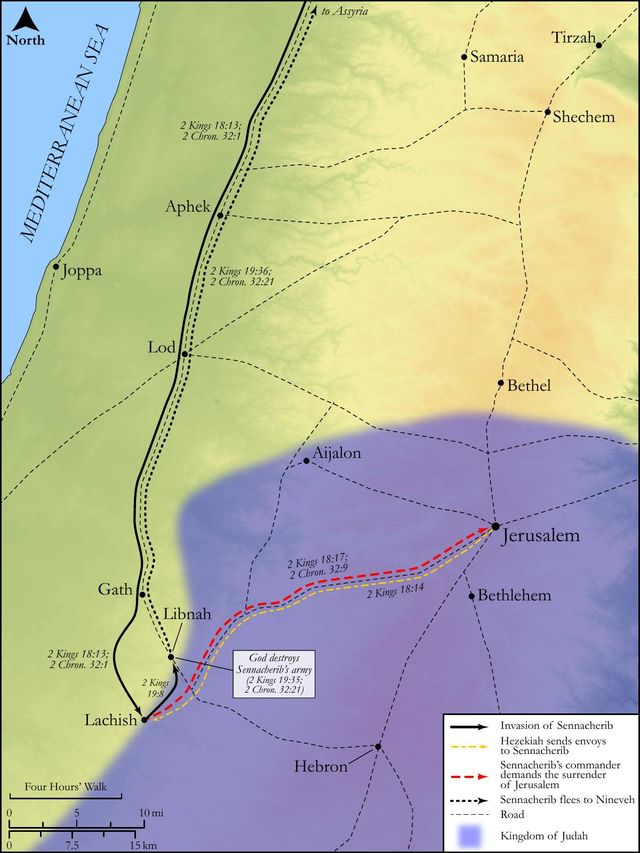
See on the biblical-era map
Study this verse
Public-domain commentary
Matthew Henry
From his Commentary on the Whole Bible. Henry comments on passages, not single verses — this entry covers 2 Kings 19:8–19. His two-level outline is real structure in the source text, so it is rendered as structure.
Rabshakeh, having delivered his message and received no answer (whether he took this silence for a consent or a slight does not appear), left his army before Jerusalem, under the command of the other generals, and went himself to attend the king his master for further orders. He found him besieging Libnah, a city that had revolted from Judah, Kg2 8:22. Whether he had taken Lachish or no is not certain; some think he departed from it because he found the taking of it impracticable, Kg2 19:8. However, he was now alarmed with the rumour that the king of the Cushites, who bordered upon the Arabians, was coming out against him with a great army, Kg2 19:9. This made him very desirous to gain Jerusalem with all speed. To take it by force would cost him more time and men than he could well spare, and therefore he renewed his attack upon Hezekiah to persuade him tamely to surrender it. Having found him an easy man once (Kg2 18:14), when he said, That which thou puttest on me I will bear, he hoped again to frighten him into a submission, but in vain. Here,
I.Sennacherib sent a letter to Hezekiah, a railing letter, a blaspheming letter, to persuade him to surrender Jerusalem, because it would be to no purpose for him to think of standing it out. His letter is to the same purport with Rabshakeh's speech; there is nothing new offered in it. Rabshakeh had said to the people, Let not Hezekiah deceive you, Kg2 18:29. Sennacherib writes to Hezekiah, Let not thy God deceive thee, Kg2 18:10. Those that have the God of Jacob for their help, and whose hope is in the Lord their God, need not fear being deceived by him, as the heathen were by their gods. To terrify Hezekiah, and drive him from his anchor, he magnifies himself and his own achievements. See how proudly he boasts,
1.Of the lands he had conquered (Kg2 18:11): All lands, and destroyed utterly! How are the mole-hills of his victories swelled to mountains! So far was he from destroying all lands that at this time the land of Cush, and Tirhakah its king, were a terror to him. What vast hyperboles may one expect in proud men's praises of themselves!
2.Of the gods he had conquered, Kg2 18:12. "Each vanquished nation and its gods, which were so far from being able to deliver them that they fell with them: and shall thy God deliver thee?" 3. Of the kings he had conquered (Kg2 18:13), the king of Hamath and the king of Arpad. Whether he means the prince or the idol, he means to make himself appear greater than either, and therefore very formidable, and the terror of the mighty in the land of the living.
II.Hezekiah encloses this in another letter, a praying letter, a believing letter, and sends it to the King of kings, who judges among the gods. Hezekiah was not so haughty as not to receive the letter, though we may suppose the superscription did not give him his due titles; when he had received it he was not so careless as not to read it; when he had read it he was not in such a passion as to write an answer to it in the same provoking language; but he immediately went up to the temple, presented himself, and then spread the letter before the Lord (Kg2 18:14), not as if God needed to have the letter shown to him (he knew what was in it before Hezekiah did), but hereby he signified that he acknowledged God in all his ways, - that he desired not to aggravate the injuries his enemies did him nor to make them appear worse than they were, but desired they might be set in a true light, - and that he referred himself to God, and his righteous judgment, upon the whole matter. Hereby likewise he would affect himself in the prayer he came to the temple to make; and we have need of all possible helps to quicken us in that duty. In the prayer which Hezekiah prayed over this letter, 1. He adores the God whom Sennacherib had blasphemed (Kg2 18:15), calls him the God of Israel, because Israel was his peculiar people, and the God that dwelt between the cherubim, because there was the peculiar residence of his glory upon earth; but he gives glory to him as the God of the whole earth, and not, as Sennacherib fancied him to be, the God of Israel only, and confined to the temple. "Let them say what they will, thou art sovereign Lord, for thou art the God, the God of gods, sole Lord, even thou alone, universal Lord of all the kingdoms of the earth, and rightful Lord, for thou hast made heaven and earth. Being Creator of all, by an incontestable title thou art owner and ruler of all." 2. He appeals to God concerning the insolence and profaneness of Sennacherib (Kg2 18:16): "Lord, hear; Lord, see. Here it is under his own hand; here it is in black and white." Had Hezekiah only been abused, he would have passed it by; but it is God, the living God, that is reproached, the jealous God. Lord, what wilt thou do for thy great name? 3. He owns Sennacherib's triumphs over the gods of the heathen, but distinguishes between them and the God of Israel (Kg2 18:17, Kg2 18:18): He has indeed cast their gods into the fire; for they were no gods, unable to help either themselves or their worshipers, and therefore no wonder that he has destroyed them; and, in destroying them, though he knew it not, he really served the justice and jealousy of the God of Israel, who has determined to extirpate all the gods of the heathen. But those are deceived who think they can therefore be too hard for him. He is none of the gods whom men's hands have made, but he has himself made all things, Psa 115:3, Psa 115:4. 4. He prays that God will now glorify himself in the defeat of Sennacherib and the deliverance of Jerusalem out of his hands (Kg2 19:19): "Now therefore save us; for if we be conquered, as other lands are, they will say that thou art conquered, as the gods of those lands were: but, Lord, distinguish thyself, by distinguishing us, and let all the world know, and be made to confess, that thou art the Lord God, the self-existent sovereign God, even thou only, and that all pretenders are vanity and a lie." Note, The best pleas in prayer are those which are taken from God's honour; and therefore the Lord's prayer begins with Hallowed be thy name, and concludes with Thine is the glory.
Historical interpretation
Historical reception
1 surviving comment on this verse from the historical church.
Prayer sometimes brings the dead back to life, but sometimes it may slay the living, as happened with the godly Peter: he brought Tabitha back to life by prayer, but he effected the death of Ananias and Sapphira. Elisha, that spiritual man, brought to life the young son of the Shunammite woman, but he brought to their end the wicked children, through the bears that he brought out against them with the course. The case of Hezekiah was also astonishing: through prayer he added to the days of his life as king and routed the mighty army of the Assyrians with the help of a spiritual being.
Continue studying 2 Kings 19:16 across the web’s major study libraries — every link below opens this exact verse, chapter, or book on the destination site.
Read & Compare
 BibleGatewayThis verse in more than 200 translations and 70 languages.
 Bible.comThe YouVersion reader — hundreds of translations, reading plans, and highlights.
 ESV.orgCrossway's official English Standard Version reader.
 NET BibleThe NET translation with 60,000+ translators' notes on every rendering decision.
 STEP BibleTyndale House's free study tool — original text, vocabulary, and scholarly resources.
 BibliaLogos Bible Software's free web reader.
 USCCBThe New American Bible (Revised Edition) with the U.S. bishops' study notes.
Commentaries
 BibleHub CommentariesDozens of classic commentaries on this verse, gathered on one page.
 StudyLightMore than 100 commentary sets — the largest collection on the web.
 BibleRefPlain-English commentary on what this verse means, verse by verse.
 Enduring WordDavid Guzik's free commentary on this chapter, widely used by Bible teachers.
 Bible Study ToolsVerse commentary alongside Greek and Hebrew study aids.
Original Language & Research
- BibleHub InterlinearThe verse word by word — original language, transliteration, and English.
- BibleHub LexiconEvery word's original-language definition and Strong's entry.
 Blue Letter BibleDeep-study tools — Strong's numbers, concordance, and word studies.
 SefariaThe Hebrew text with Rashi and centuries of Jewish commentary.
Sermons, Hymns & Audio


TrulyRandomVerse is not affiliated with these sites and doesn’t control their content. They’re linked because they’re genuinely useful.
Summary
In 2 Kings 19:16, King Hezekiah, facing the overwhelming military might and blasphemous taunts of the Assyrian King Sennacherib, pours out a fervent prayer to the LORD. He appeals to God's active perception and intervention, employing anthropomorphic language to implore Him to "bow down thine ear" and "open thine eyes." The profound core of his plea is for God to heed the words of Sennacherib, which directly "reproach the living God," thereby challenging God's very nature and sovereignty and calling for divine vindication of His holy name.
Context
ShowHideLiterary Context
This verse is a crucial part of King Hezekiah's impassioned and faith-filled prayer, recorded in 2 Kings 19:14-19. The immediate catalyst for this prayer is the receipt of a threatening and deeply blasphemous letter from King Sennacherib of Assyria, boasting of his conquests and, more critically, mocking the God of Judah. Hezekiah's response is not to mobilize his army or seek political alliances, but to go directly to the temple, spread the insolent letter before the LORD, and appeal to God's justice and power. This act of faith follows the prophet Isaiah's encouraging words in 2 Kings 19:6-7, promising divine intervention against Sennacherib. Hezekiah's prayer serves as a profound demonstration of his unwavering trust in God's sovereignty and a desperate plea for God to act for the sake of His own name and reputation, setting the stage for the miraculous and decisive deliverance that swiftly follows in 2 Kings 19:35-36.
Historical & Cultural Context
The events described in 2 Kings 19 unfold during the late 8th century BCE, a period profoundly shaped by the relentless expansion of the Neo-Assyrian Empire. Sennacherib, one of Assyria's most formidable and ruthless kings, had already devastated much of Judah and laid siege to Jerusalem around 701 BCE. The Assyrians were infamous for their brutal military tactics, their sophisticated psychological warfare, and their systematic deportation of conquered peoples, which aimed to break national and religious identity. Their imperial ideology asserted that their gods were superior deities who granted them unparalleled victory, and they expected the gods of conquered nations to be utterly subservient or impotent. Sennacherib's taunts, delivered by his field commander Rabshakeh in 2 Kings 18:28-35, were not merely insults but a calculated attempt to undermine the faith of Judah in their God, placing Him on par with the defeated and powerless idols of other nations. Hezekiah's prayer, therefore, transcends a mere personal plea; it is a profound theological confrontation with the prevailing imperial worldview that denied the uniqueness, power, and sovereignty of Israel's God, Yahweh.
Key Themes
ShowHideThe verse significantly contributes to several overarching themes pervasive throughout 2 Kings and the broader Old Testament narrative. Firstly, it powerfully highlights the theme of divine sovereignty and intervention, emphasizing God's ultimate and unchallenged control over human history and His readiness to act decisively on behalf of His people, especially when His honor is directly challenged. Secondly, it underscores the paramount importance of prayer as the primary and most potent response to crisis, illustrating a godly leader's humble dependence on divine power rather than human might or political maneuvering. Hezekiah's act of spreading the letter before the LORD demonstrates a profound trust in God's active engagement with human affairs, echoing similar acts of faith seen in figures like Moses and David. Thirdly, the pivotal phrase "the living God" introduces a crucial theme of God's unique nature and power in stark contrast to the lifeless, impotent idols of the nations. This distinction is central to Israelite theology, asserting that the LORD is not merely one god among many, but the only true, active, and powerful God, uniquely capable of hearing, seeing, and delivering, a truth further expounded in passages like Psalm 115. Finally, the verse articulates with great clarity the theme of God's honor and reputation, revealing Hezekiah's understanding that the Assyrian taunts constituted a direct and grievous affront to God's holy name, thereby making the ensuing conflict God's own battle to fight for His glory and vindication.
Exposition and Analysis
ShowHideKey Word Analysis
ShowHideThis verb literally means "to stretch or spread out" but also carries the implication "to bend away" or "to incline." In this context, when applied to God's "ear," it signifies an intense and deliberate act of inclining oneself to listen, paying close attention, or bending down to hear. Hezekiah is not just asking God to hear generally, but to adopt an attentive posture, as it were, to specifically and intimately attend to his desperate plea and the blasphemous words of Sennacherib. It conveys a sense of urgency and a profound desire for God's personal, focused engagement with the dire situation.
This verb means "to taunt, revile, insult, defy, or blaspheme." It carries a strong and visceral connotation of public shaming, contempt, and scorn. Sennacherib's words were far more than a mere military threat; they constituted a direct, scornful challenge to the very existence, power, and honor of the God of Israel. Hezekiah acutely recognizes that this is an attack on God's character and reputation, elevating the situation from a mere political or military crisis for Judah to a profound theological crisis for God's standing among the nations.
This is a profoundly significant theological declaration. It stands in stark contrast to the lifeless, impotent idols worshipped by other nations, which are described as having "mouths, but they speak not; eyes have they, but they see not" (Psalm 115:5). The phrase "living God" emphasizes God's active, dynamic, and eternally existing nature. He is not a distant, passive, or dead deity, but one who is intimately involved in creation and human affairs, uniquely capable of hearing, seeing, speaking, and acting decisively. Hezekiah's entire appeal hinges on this foundational truth: he is praying to the one true God who is truly alive and powerful enough to intervene and vindicate His name.
Verse Breakdown
ShowHide"LORD, bow down thine ear, and hear:"
Hezekiah initiates his prayer with a direct, deeply personal address to Yahweh, the covenant God of Israel. The request to "bow down thine ear" is a deeply intimate and urgent plea for God to incline Himself and listen intently to the specific, pressing crisis at hand. It is an appeal for divine attentiveness, recognizing that God's hearing is not passive but inherently leads to active and purposeful engagement.
"open, LORD, thine eyes, and see:"
This parallel plea reinforces and expands upon the previous one, extending the request for divine perception from hearing to seeing. Hezekiah implores God to actively observe the dire circumstances and the blasphemous actions of Sennacherib. It is a fervent call for God to be fully and intimately aware of the visual evidence of the overwhelming Assyrian threat and their defiant taunts, implying that such full awareness will inevitably lead to appropriate and decisive divine action.
"and hear the words of Sennacherib, which hath sent him to reproach the living God."
This final, climactic clause reveals the profound core and ultimate motivation for Hezekiah's urgent prayer. He is not merely asking God to save Judah from military defeat, but to respond directly and powerfully to the blatant insult and blasphemy against His own divine name and unique nature. Sennacherib's words are a "reproach"—a public taunt, defiance, and scorn—aimed directly at "the living God," thereby contrasting Him with the lifeless, impotent idols of the nations. Hezekiah understands that this is fundamentally God's battle to fight for His own honor, glory, and vindication in the eyes of all nations.
Literary Devices
ShowHideThe verse is exceptionally rich in Anthropomorphism, a literary device that attributes human physical characteristics and actions (such as ears, eyes, bowing, opening, hearing, and seeing) to God. This is not intended to limit God to human form but rather to make His active engagement, perception, and responsiveness comprehensible to human understanding, powerfully emphasizing His attentiveness and comprehensive awareness. The structure also employs sophisticated Parallelism, specifically synonymous parallelism, evident in the repeated and reinforcing structure of "bow down thine ear, and hear" and "open, LORD, thine eyes, and see." This repetition intensifies the plea, underscoring both the urgency and the comprehensive nature of Hezekiah's request for God's full and active perception. The prayer itself functions as a direct Apostrophe, a rhetorical device of direct address to God, creating an intimate and deeply personal tone despite the cosmic stakes involved. Finally, the entire verse functions as a powerful Rhetorical Appeal, not merely informing God of a situation (as if He were unaware) but appealing directly to His character, His honor, and His covenant faithfulness, compelling Him to act decisively on behalf of His own name and people.
Theological and Thematic Connections
ShowHideHezekiah's prayer in 2 Kings 19:16 is a profound theological statement on the very nature of God and the appropriate human response to overwhelming adversity. It powerfully affirms God's omniscience and omnipotence, asserting that He is not only intimately aware of all things but also supremely capable of acting decisively and miraculously in human history. The king's primary concern transcends mere Judah's survival; it is fundamentally about the vindication of God's holy name against the blasphemous taunts of a pagan king. This highlights the foundational biblical principle that God's glory is paramount, and He will indeed defend His honor when it is challenged. The stark contrast between "the living God" and the lifeless idols of the nations underscores the absolute uniqueness of Yahweh, who alone is active, powerful, and profoundly responsive to the cries of His people. This prayer serves as an enduring model for believers, demonstrating that in times of profound crisis, our ultimate appeal should always be to God's unchanging character and His unwavering commitment to His own glory, trusting that His active presence will inevitably lead to deliverance and vindication.
Reflection and Application
ShowHideHezekiah's prayer in 2 Kings 19:16 provides a timeless and deeply instructive blueprint for how believers should approach God in moments of profound and seemingly insurmountable crisis. When faced with situations that appear overwhelming, whether they are personal challenges, societal pressures, or direct attacks on our faith, our first and most potent response should be earnest, humble, and persistent prayer. Like Hezekiah, we are invited to lay our burdens, our fears, and even the blasphemies of the world directly before the LORD, confident that He is indeed the "living God" who truly sees, hears, and acts. This passage powerfully reminds us that our prayers are not merely requests for personal relief, but also profound appeals to God's unchanging character, His infinite power, and His unwavering commitment to His own glory. When the world mocks, challenges, or dismisses the truth of God, we can appeal to Him to act for the vindication of His name, trusting that He is fully capable of intervening and demonstrating His sovereign power. This shifts our focus from our own inherent weakness and limitations to God's infinite strength and faithfulness, transforming our anxiety into a profound opportunity for Him to magnificently display His divine faithfulness and power.
Questions for Reflection
ShowHideFAQ
ShowHideWhy does Hezekiah use anthropomorphic language ("bow down thine ear," "open thine eyes") when praying to God?
ShowHideHezekiah uses anthropomorphic language not because he believes God literally possesses physical ears and eyes, but to convey the profound intensity, intimacy, and urgency of his plea in terms that human beings can grasp and relate to. This imagery powerfully emphasizes God's active attentiveness, His comprehensive perception, and His personal engagement. When Hezekiah asks God to "bow down His ear" and "open His eyes," he is imploring God to actively and personally engage with the dire situation, to listen intently to the blasphemous words of Sennacherib, and to observe the overwhelming circumstances facing Judah. It's a deeply heartfelt plea for God to be fully aware and to respond with deliberate, decisive action, highlighting God's intimate involvement in human affairs, in stark contrast to the passive, unseeing, and unhearing idols of the nations (compare Psalm 115:4-7).
What is the profound significance of Hezekiah referring to God as "the living God"?
ShowHideThe phrase "the living God" is profoundly significant, especially within the immediate context of Sennacherib's taunts. It directly contrasts the LORD, Yahweh, with the lifeless, impotent idols of the nations that Assyria had conquered and whose gods had proven powerless. Sennacherib had explicitly mocked Hezekiah's trust in the LORD, suggesting that Judah's God was no more capable of delivering them than the defeated gods of Hamath or Arpad (2 Kings 18:33-34). By calling Yahweh "the living God," Hezekiah asserts that Israel's God is uniquely active, dynamic, truly existent, and eternally powerful, utterly unlike the inert, man-made deities. This declaration emphasizes God's unparalleled power to hear, see, speak, and intervene decisively in history, making Him fundamentally different from and infinitely superior to all other supposed gods. It is a foundational theological truth that underpins Hezekiah's unwavering faith and his fervent appeal for divine intervention (see also Jeremiah 10:10).
Christ-Centered Fulfillment
ShowHideHezekiah's desperate appeal to the "living God" who hears and sees finds its ultimate fulfillment and deepest meaning in the person and work of Jesus Christ. The very anthropomorphic language of God "bowing down His ear" and "opening His eyes" to human suffering and blasphemy is perfectly embodied in the Incarnation, where God Himself became flesh and dwelt among us, experiencing human pain, hearing human cries, and seeing human brokenness firsthand (John 1:14). Jesus is the ultimate "living God" who not only sees and hears with perfect understanding, but actively intervenes, perfectly fulfilling the Father's will and demonstrating divine power over sin, sickness, and death. Sennacherib's reproach against the living God powerfully foreshadows the ultimate reproach and blasphemy directed against God in the person of Christ, who was mocked, reviled, and crucified. Yet, it was precisely through this ultimate act of "reproach" that God's name was supremely and eternally vindicated. Christ, as the Lamb of God, truly took away the sin of the world (John 1:29), and through His glorious resurrection, He demonstrated decisively that He is indeed the "living One" who holds the keys of death and Hades (Revelation 1:18). Hezekiah's prayer for God to act for His own glory is answered in Christ's perfect obedience, atoning sacrifice, and triumphant resurrection, which brought ultimate glory to the Father and established His eternal kingdom, proving beyond all doubt that our God is truly alive, eternally sovereign, and perfectly faithful.