


2 Kings 19:19
- וְעַתָּהve·'a·Tahand nowH6258Conj-w ¦ AdvAdverbוְandעַתָּהnow
- יְהוָהYah·wehO YahwehH3068N-properNoun Proper Title
- אֱלֹהֵינוּ'e·lo·Hei·nuour GodH430N-mpc ¦ 1cpNoun Plural Masculine ConstructאֱלֹהֵיGodנוּour
- הוֹשִׁיעֵנוּho·shi·'E·nusave usH3467V-Hiphil-Imp-2ms ¦ 1cpVerb Hiphil Imperative 2nd Singular Masculineהוֹשִׁיעֵsaveנוּus
- נָאna'pleaseH4994PrtParticle Interjection
- מִיָּדוֹmi·ya·Dofrom his handH3027Prep-m ¦ N-csc ¦ 3msNoun Singular common gender Constructמִfromיָּדhandוֹhis
- וְיֵדְעוּve·ye·de·'Uso they may knowH3045Conj-w ¦ V-Qal-ConjImperf-3mpVerb Qal Conjunction+Imperfect 3rd Plural Masculineוְsoיֵדְעוּthey may know
- כָּלkolallH3605N-mscNoun Singular Masculine Construct
- מַמְלְכוֹתmam·le·Khot[the] kingdoms ofH4467N-fpcNoun Plural Feminine Construct
- הָאָרֶץha·'A·retzthe earthH776Art ¦ N-fsNoun Singular Feminine Absoluteהָtheאָרֶץearth
- כִּיkithatH3588PrtParticle Conditional
- אַתָּה'a·TahyouH859Pro-2msPronoun Personal 2nd Singular Masculine
- יְהוָהYah·wehO YahwehH3068N-properNoun Proper Title
- אֱלֹהִים'E·lo·Him[are] GodH430N-mpNoun Plural Masculine Absolute
- לְבַדֶּךָle·va·De·khato alone youH905Prep-l ¦ N-msc ¦ 2msNoun Singular Masculine Constructלְtoבַדֶּaloneךָyou
English is a literal word-by-word gloss of the Hebrew, not the KJV's wording. Why?
This is the original text the KJV's translators worked from — each Hebrew word with its own literal English meaning in this verse, prepared by scholars at Tyndale House, Cambridge. The KJV translates whole sentences, not word by word, so its wording differs: one Hebrew word can become several English words, and the KJV may choose “the LORD” where the gloss reads “Yahweh”. Both are faithful — they answer different questions. For the KJV's own rendering, switch to the KJV text.
Details
See on the biblical-era map
Study this verse
Public-domain commentary
Matthew Henry
From his Commentary on the Whole Bible. Henry comments on passages, not single verses — this entry covers 2 Kings 19:8–19. His two-level outline is real structure in the source text, so it is rendered as structure.
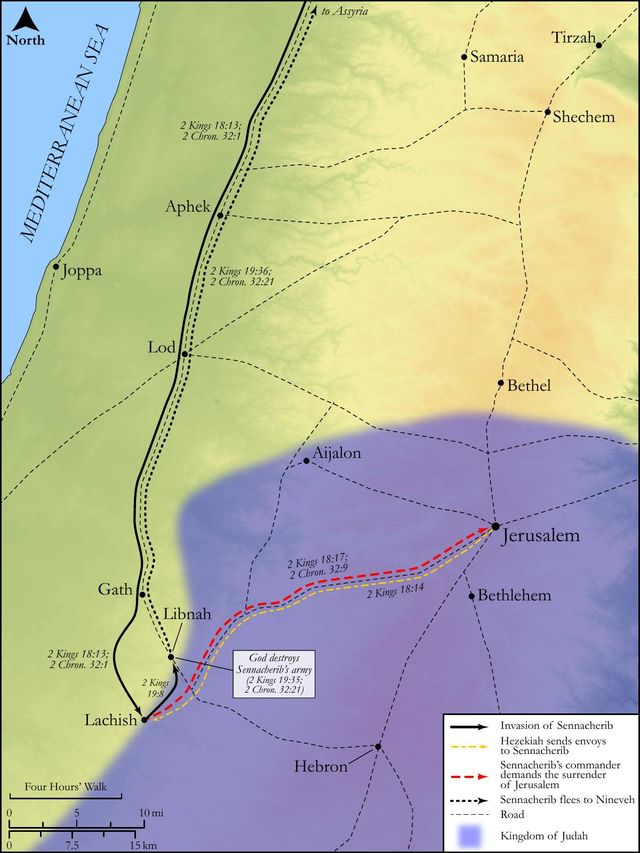
Rabshakeh, having delivered his message and received no answer (whether he took this silence for a consent or a slight does not appear), left his army before Jerusalem, under the command of the other generals, and went himself to attend the king his master for further orders. He found him besieging Libnah, a city that had revolted from Judah, Kg2 8:22. Whether he had taken Lachish or no is not certain; some think he departed from it because he found the taking of it impracticable, Kg2 19:8. However, he was now alarmed with the rumour that the king of the Cushites, who bordered upon the Arabians, was coming out against him with a great army, Kg2 19:9. This made him very desirous to gain Jerusalem with all speed. To take it by force would cost him more time and men than he could well spare, and therefore he renewed his attack upon Hezekiah to persuade him tamely to surrender it. Having found him an easy man once (Kg2 18:14), when he said, That which thou puttest on me I will bear, he hoped again to frighten him into a submission, but in vain. Here,
I.Sennacherib sent a letter to Hezekiah, a railing letter, a blaspheming letter, to persuade him to surrender Jerusalem, because it would be to no purpose for him to think of standing it out. His letter is to the same purport with Rabshakeh's speech; there is nothing new offered in it. Rabshakeh had said to the people, Let not Hezekiah deceive you, Kg2 18:29. Sennacherib writes to Hezekiah, Let not thy God deceive thee, Kg2 18:10. Those that have the God of Jacob for their help, and whose hope is in the Lord their God, need not fear being deceived by him, as the heathen were by their gods. To terrify Hezekiah, and drive him from his anchor, he magnifies himself and his own achievements. See how proudly he boasts,
1.Of the lands he had conquered (Kg2 18:11): All lands, and destroyed utterly! How are the mole-hills of his victories swelled to mountains! So far was he from destroying all lands that at this time the land of Cush, and Tirhakah its king, were a terror to him. What vast hyperboles may one expect in proud men's praises of themselves!
2.Of the gods he had conquered, Kg2 18:12. "Each vanquished nation and its gods, which were so far from being able to deliver them that they fell with them: and shall thy God deliver thee?" 3. Of the kings he had conquered (Kg2 18:13), the king of Hamath and the king of Arpad. Whether he means the prince or the idol, he means to make himself appear greater than either, and therefore very formidable, and the terror of the mighty in the land of the living.
II.Hezekiah encloses this in another letter, a praying letter, a believing letter, and sends it to the King of kings, who judges among the gods. Hezekiah was not so haughty as not to receive the letter, though we may suppose the superscription did not give him his due titles; when he had received it he was not so careless as not to read it; when he had read it he was not in such a passion as to write an answer to it in the same provoking language; but he immediately went up to the temple, presented himself, and then spread the letter before the Lord (Kg2 18:14), not as if God needed to have the letter shown to him (he knew what was in it before Hezekiah did), but hereby he signified that he acknowledged God in all his ways, - that he desired not to aggravate the injuries his enemies did him nor to make them appear worse than they were, but desired they might be set in a true light, - and that he referred himself to God, and his righteous judgment, upon the whole matter. Hereby likewise he would affect himself in the prayer he came to the temple to make; and we have need of all possible helps to quicken us in that duty. In the prayer which Hezekiah prayed over this letter, 1. He adores the God whom Sennacherib had blasphemed (Kg2 18:15), calls him the God of Israel, because Israel was his peculiar people, and the God that dwelt between the cherubim, because there was the peculiar residence of his glory upon earth; but he gives glory to him as the God of the whole earth, and not, as Sennacherib fancied him to be, the God of Israel only, and confined to the temple. "Let them say what they will, thou art sovereign Lord, for thou art the God, the God of gods, sole Lord, even thou alone, universal Lord of all the kingdoms of the earth, and rightful Lord, for thou hast made heaven and earth. Being Creator of all, by an incontestable title thou art owner and ruler of all." 2. He appeals to God concerning the insolence and profaneness of Sennacherib (Kg2 18:16): "Lord, hear; Lord, see. Here it is under his own hand; here it is in black and white." Had Hezekiah only been abused, he would have passed it by; but it is God, the living God, that is reproached, the jealous God. Lord, what wilt thou do for thy great name? 3. He owns Sennacherib's triumphs over the gods of the heathen, but distinguishes between them and the God of Israel (Kg2 18:17, Kg2 18:18): He has indeed cast their gods into the fire; for they were no gods, unable to help either themselves or their worshipers, and therefore no wonder that he has destroyed them; and, in destroying them, though he knew it not, he really served the justice and jealousy of the God of Israel, who has determined to extirpate all the gods of the heathen. But those are deceived who think they can therefore be too hard for him. He is none of the gods whom men's hands have made, but he has himself made all things, Psa 115:3, Psa 115:4. 4. He prays that God will now glorify himself in the defeat of Sennacherib and the deliverance of Jerusalem out of his hands (Kg2 19:19): "Now therefore save us; for if we be conquered, as other lands are, they will say that thou art conquered, as the gods of those lands were: but, Lord, distinguish thyself, by distinguishing us, and let all the world know, and be made to confess, that thou art the Lord God, the self-existent sovereign God, even thou only, and that all pretenders are vanity and a lie." Note, The best pleas in prayer are those which are taken from God's honour; and therefore the Lord's prayer begins with Hallowed be thy name, and concludes with Thine is the glory.
Continue studying 2 Kings 19:19 across the web’s major study libraries — every link below opens this exact verse, chapter, or book on the destination site.
Read & Compare
 BibleGatewayThis verse in more than 200 translations and 70 languages.
 Bible.comThe YouVersion reader — hundreds of translations, reading plans, and highlights.
 ESV.orgCrossway's official English Standard Version reader.
 NET BibleThe NET translation with 60,000+ translators' notes on every rendering decision.
 STEP BibleTyndale House's free study tool — original text, vocabulary, and scholarly resources.
 BibliaLogos Bible Software's free web reader.
 USCCBThe New American Bible (Revised Edition) with the U.S. bishops' study notes.
Commentaries
 BibleHub CommentariesDozens of classic commentaries on this verse, gathered on one page.
 StudyLightMore than 100 commentary sets — the largest collection on the web.
 BibleRefPlain-English commentary on what this verse means, verse by verse.
 Enduring WordDavid Guzik's free commentary on this chapter, widely used by Bible teachers.
 Bible Study ToolsVerse commentary alongside Greek and Hebrew study aids.
Original Language & Research
- BibleHub InterlinearThe verse word by word — original language, transliteration, and English.
- BibleHub LexiconEvery word's original-language definition and Strong's entry.
 Blue Letter BibleDeep-study tools — Strong's numbers, concordance, and word studies.
 SefariaThe Hebrew text with Rashi and centuries of Jewish commentary.
Sermons, Hymns & Audio


TrulyRandomVerse is not affiliated with these sites and doesn’t control their content. They’re linked because they’re genuinely useful.
Summary
2 Kings 19:19 records King Hezekiah's fervent and theocentric prayer during the existential crisis of the Assyrian siege of Jerusalem. Faced with Sennacherib's overwhelming military might and, more critically, his blasphemous taunts against Yahweh, Hezekiah appeals to God not merely for Judah's physical deliverance, but for a divine intervention so profound and undeniable that it would compel all the kingdoms of the earth to recognize Yahweh as the one true, sovereign God, thereby vindicating His unique name and unparalleled power.
Context
ShowHideLiterary Context
This verse is the climactic petition within Hezekiah's impassioned prayer, a pivotal moment recounted in both 2 Kings 19 and Isaiah 37. It directly follows the Assyrian King Sennacherib's audacious challenge to Jerusalem and, more significantly, his direct blasphemy against the God of Israel. Sennacherib's field commander, the Rabshakeh, had vociferously taunted the people of Judah, asserting that Yahweh was no more capable of saving them than the gods of the nations Assyria had already conquered (see 2 Kings 18:33-35). In response to this grave insult and imminent threat, Hezekiah demonstrated profound humility and faith: he tore his clothes, entered the temple, and sent messengers to the prophet Isaiah for divine counsel. Most critically, he spread Sennacherib's threatening letter before the Lord (as depicted in 2 Kings 19:14), symbolically laying the entire crisis—and the affront to God's honor—at the feet of the Almighty, setting the stage for this profound and purpose-driven petition.
Historical & Cultural Context
The late 8th century BCE marked the zenith of the Neo-Assyrian Empire's brutal dominance. Under Sennacherib, Assyria had systematically conquered and devastated numerous nations across the Near East, employing ruthless military tactics and psychological warfare. By the time of this narrative, Assyria had already swept through Judah, capturing many fortified cities (as recorded in 2 Kings 18:13), leaving Jerusalem as the last remaining stronghold. In this polytheistic ancient world, the military success or failure of a nation was often interpreted as a direct reflection of the power and efficacy of its national deity. Sennacherib's taunts were not merely a psychological tactic against Judah; they constituted a direct theological challenge and an assault on the reputation and power of Yahweh, implying He was just one more impotent deity among the many gods Assyria had already vanquished. Hezekiah's prayer, therefore, is a desperate plea for God to act in a way that would decisively refute this pagan worldview and uphold His unique supremacy.
Key Themes
ShowHideHezekiah's prayer powerfully encapsulates several foundational themes central to the book of 2 Kings and the broader Old Testament narrative. First, it highlights a desperate plea for divine deliverance in the face of overwhelming human impossibility. Hezekiah recognized that Judah's survival depended entirely on God's intervention, not on military might, political alliances, or strategic maneuvering. Second, the prayer profoundly underscores the theme of God's glory as the ultimate motivation for divine action. Hezekiah's primary concern was not merely Judah's preservation, but the vindication of God's name and reputation among all the kingdoms of the earth. He understood that Israel's fate was inextricably linked to God's honor, a principle consistently affirmed in God's subsequent response (e.g., 2 Kings 19:34). Third, the prayer is a bold assertion of monotheism in a world saturated with polytheism. The phrase "thou only" is a direct challenge to the pagan deities of Assyria and other nations, declaring Yahweh's absolute uniqueness and sole claim to divinity. This echoes the foundational truth of Israel's covenant faith, as articulated in the Shema in Deuteronomy 6:4, and anticipates the powerful prophetic declarations of God's singularity found in passages like Isaiah 45:5-6.
Exposition and Analysis
ShowHideKey Word Analysis
ShowHideThis is the sacred, personal, covenant name of God, often rendered as "Yahweh." Derived from the Hebrew verb "to be" (H1961, hayah), it signifies the self-existent, eternal, and unchanging God who is always present and faithful to His promises. By invoking "LORD," Hezekiah appeals to God based on His covenant relationship with Israel and His inherent, eternal nature as the sovereign over all creation.
This primitive root means "to be open, wide or free," and by implication, "to be safe." Causatively, it means "to free or succor," encompassing concepts like deliverance, help, preservation, and bringing salvation. Hezekiah's plea for God to "save" them is a cry for comprehensive liberation from the Assyrian threat, acknowledging God as the ultimate source of safety and rescue, capable of achieving victory where human effort is futile.
This verb signifies a deep, experiential, and relational knowledge, far beyond mere intellectual apprehension. It implies a recognition born of observation of God's mighty acts, leading to acknowledgment, understanding, and even worship. Hezekiah prays that all the kingdoms of the earth would "know" Yahweh in a way that demonstrates His active power and unique identity, not just hear about Him, but truly perceive His unparalleled deity through His decisive intervention.
Verse Breakdown
ShowHide"Now therefore, O LORD our God, I beseech thee, save thou us out of his hand"
Hezekiah initiates his prayer with an urgent and logical appeal. "Now therefore" underscores the immediate and dire circumstances, directly linking the petition to Sennacherib's blasphemous challenge. "O LORD our God" is a profound, personal invocation, appealing to the covenant-keeping, self-existent Yahweh, who is also the supreme and all-powerful Elohim. "I beseech thee" conveys the king's humility, earnestness, and desperate reliance on divine mercy. The core request, "save thou us out of his hand," is a desperate cry for rescue from the overwhelming power and dominion of the Assyrian king, acknowledging Judah's utter helplessness and God's sole capacity for deliverance.
"that all the kingdoms of the earth may know that thou [art] the LORD God, [even] thou only"
This clause reveals the profound, God-centered motivation and ultimate purpose behind Hezekiah's prayer. The conjunction "that" introduces the desired outcome. The ultimate goal is not merely Judah's survival, but the universal recognition of Yahweh's unique and supreme deity by all nations. Hezekiah desires that God's intervention would serve as an undeniable, global testimony, demonstrating that Yahweh is the sole, true, and living God, in stark contrast to the impotent idols of other peoples. The emphatic repetition and positioning of "thou only" powerfully reinforces this declaration of absolute monotheism, asserting God's exclusive claim to divinity and unrivaled power.
Literary Devices
ShowHideHezekiah's prayer in 2 Kings 19:19 is rich with profound literary and theological elements. It is primarily a Petition, a direct and earnest appeal to God for intervention and salvation. The structure of the prayer moves from a desperate plea for personal and national deliverance to a profound Theocentricity, where the ultimate purpose of the requested deliverance is God's glory and universal recognition. The phrase "thou only" functions as a powerful Emphasis through its repetition and strategic placement, underscoring the absolute singularity and uniqueness of God. Furthermore, the prayer implicitly employs Contrast by juxtaposing the true, living God of Israel with the false, impotent gods of the Assyrians, whose inability to save their worshippers was glaringly evident. The prayer also uses Hyperbole in "all the kingdoms of the earth," expressing a desire for a global, undeniable demonstration of God's power, reflecting the universal scope of God's sovereignty. This prayer stands as a masterful example of a leader's intercession rooted deeply in theological conviction and a passionate concern for God's honor.
Theological and Thematic Connections
ShowHideHezekiah's prayer stands as a profound theological statement, demonstrating that true faith seeks God's glory above all else, even in moments of existential crisis. It reminds us that God's reputation is intrinsically linked to His people's experience and that He often acts not merely for our sake, but for the vindication of His own name among the nations. This prayer elevates the concept of divine intervention from a simple act of rescue to a cosmic declaration of God's unrivaled sovereignty. It teaches us that our petitions should align with God's ultimate purposes, transforming personal needs into opportunities for His universal renown. God's ultimate desire is to be known as the one true God, and Hezekiah's prayer taps into this divine agenda, making his plea not just about Judah's survival, but about God's eternal glory.
Reflection and Application
ShowHideHezekiah's prayer offers a timeless and profoundly relevant model for believers facing overwhelming challenges in any era. In moments of personal despair, national crisis, or global uncertainty, when human solutions seem utterly futile, our first and most profound response should be to turn to God in humble yet confident prayer. Like Hezekiah, we are called to lay our burdens—our fears, our threats, our impossible situations—before the Lord, acknowledging our complete dependence on His power and sovereign will. Crucially, our prayers should transcend mere self-preservation, aspiring to the greater purpose of God's glory. When we pray that God would act in a way that makes His name known and exalted, we align our desires with His divine will, transforming our trials into platforms for His testimony. This perspective shifts our focus from our immediate predicament to the eternal truth of God's unrivaled power and unique deity, fostering a faith that trusts Him to demonstrate His supremacy to a watching world, ultimately deepening our worship and strengthening our resolve.
Questions for Reflection
ShowHideFAQ
ShowHideWhat was the significance of Sennacherib's letter that Hezekiah spread before the Lord?
ShowHideSennacherib's letter, as described in 2 Kings 19:14, was a direct and blasphemous challenge not only to Judah but, more significantly, to Yahweh Himself. It contained taunts comparing Yahweh to the defeated gods of other nations, asserting that He was powerless to save Jerusalem. By spreading the letter before the Lord in the temple, Hezekiah was performing a symbolic act of profound faith and utter reliance. It was an acknowledgment that the insult was primarily against God's honor and name, and therefore, God Himself must respond. This act demonstrated Hezekiah's complete trust in divine intervention, rather than human strategy or military might, to address the crisis and vindicate God's reputation.
How did God respond to Hezekiah's prayer in 2 Kings 19:19?
ShowHideGod responded swiftly and decisively to Hezekiah's prayer, primarily through the prophet Isaiah. In 2 Kings 19:20-34, Isaiah delivered a powerful message from the Lord, assuring Hezekiah that his prayer had been heard and that God would indeed defend Jerusalem. The prophecy specifically addressed Sennacherib's arrogance and promised his certain defeat and ignominious return. The divine intervention was dramatic and miraculous: in 2 Kings 19:35, an angel of the Lord struck down 185,000 Assyrian soldiers in a single night, decimating Sennacherib's army. Sennacherib was forced to retreat in shame to Nineveh and was later assassinated by his own sons in the temple of his god Nisroch, as foretold in 2 Kings 19:36-37. This miraculous deliverance unequivocally demonstrated God's unparalleled power and vindicated His name before all the kingdoms of the earth, precisely as Hezekiah had prayed.
Christ-Centered Fulfillment
ShowHideHezekiah's prayer in 2 Kings 19:19, with its passionate plea for God to save Judah so that His name might be known as "the LORD God, even thou only," finds its ultimate and most profound fulfillment in the person and work of Jesus Christ. While God's miraculous deliverance of Jerusalem from the Assyrians was a powerful, historical demonstration of His sovereignty and unique deity, it was a temporary, localized salvation. The full, universal revelation of God's unique identity and saving power, to be known by "all the kingdoms of the earth," is realized through the incarnation, crucifixion, and resurrection of Jesus. Jesus, the Lamb of God who takes away the sin of the world, accomplished the ultimate deliverance from the far greater enemies of sin, death, and the power of Satan, a salvation far exceeding any earthly siege. His atoning sacrifice and triumphant resurrection are the supreme acts through which God's glory and unique deity are unveiled, proving Him to be the one true God and eternal life. Through Christ, God's saving power is extended not just to a single nation, but to all who believe, fulfilling the prophetic vision that every knee should bow and every tongue confess that Jesus Christ is Lord, to the glory of God the Father. Thus, Hezekiah's prayer for God's name to be glorified through salvation is eternally and universally answered in the person of God the Son, Jesus Christ, who is the radiance of God's glory and the exact imprint of his nature.