


2 Kings 18:10
- וַיִּלְכְּדֻהָvai·yil·ke·Du·haand they captured itH3920Conj-w ¦ V-Qal-ConsecImperf-3mp ¦ 3fsVerb Qal Consecutive Imperfect 3rd Plural Masculineוַandיִּלְכְּדֻthey capturedהָit
- מִקְצֵהmik·Tzehfrom [the] end ofH7097Prep-m ¦ N-mscNoun Singular Masculine Constructמִfromקְצֵה[the] end of
- שָׁלֹשׁsha·LoshthreeH7969N-csNoun Singular common gender Absolute
- שָׁנִיםsha·NimyearsH8141N-mpNoun Plural Masculine Absolute
- בִּשְׁנַתbish·natin yearH8141Prep-b ¦ N-fscNoun Singular Feminine Constructבִּinשְׁנַתyear
- שֵׁשׁsheshsixH8337N-csNoun Singular common gender Absolute
- לְחִזְקִיָּהle·chiz·ki·Yahof HezekiahH2396Prep-l ¦ N-proper-mNoun Proper MasculineלְofחִזְקִיָּהHezekiah
- הִיאhi'itH1931Pro-3fsPronoun Personal 3rd Singular Feminine
- שְׁנַתshe·nat[was] yearH8141N-fscNoun Singular Feminine Construct
- תֵּשַׁעTe·sha'nineH8672N-csNoun Singular common gender Absolute
- לְהוֹשֵׁעַle·ho·She·a'of HosheaH1954Prep-l ¦ N-proper-mNoun Proper MasculineלְofהוֹשֵׁעַHoshea
- מֶלֶךְMe·lekh[the] king ofH4428N-mscNoun Singular Masculine Construct
- יִשְׂרָאֵלYis·ra·'ElIsraelH3478N-properNoun Proper Location
- נִלְכְּדָהnil·ke·Dahit was capturedH3920V-Niphal-Perf-3fsVerb Niphal Perfect 3rd Singular Feminine
- שֹׁמְרוֹןsho·me·RonSamariaH8111N-properNoun Proper Location
English is a literal word-by-word gloss of the Hebrew, not the KJV's wording. Why?
This is the original text the KJV's translators worked from — each Hebrew word with its own literal English meaning in this verse, prepared by scholars at Tyndale House, Cambridge. The KJV translates whole sentences, not word by word, so its wording differs: one Hebrew word can become several English words, and the KJV may choose “the LORD” where the gloss reads “Yahweh”. Both are faithful — they answer different questions. For the KJV's own rendering, switch to the KJV text.
Details
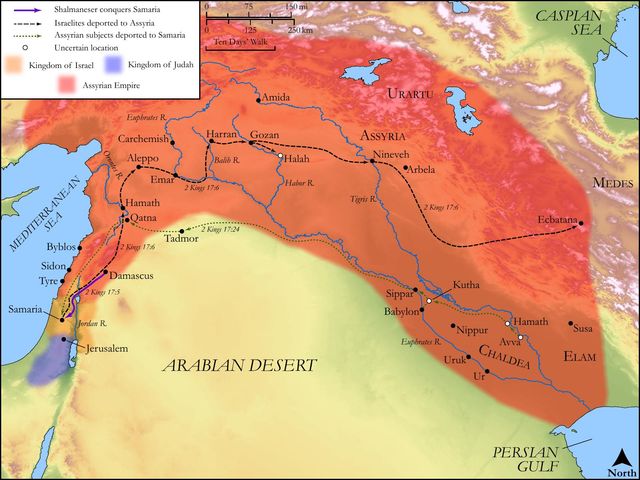
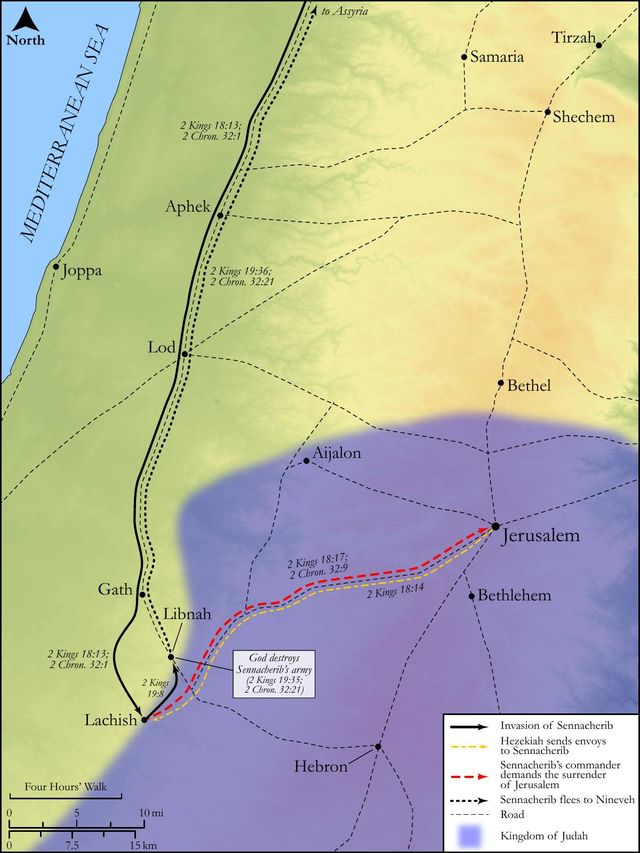
See on the biblical-era maps
Study this verse
Public-domain commentary
Matthew Henry
From his Commentary on the Whole Bible. Henry comments on passages, not single verses — this entry covers 2 Kings 18:9–16. His three-level outline is real structure in the source text, so it is rendered as structure.
The kingdom of Assyria had now grown considerable, though we never read of it till the last reign. Such changes there are in the affairs of nations and families: those that have been despicable become formidable, and those, on the contrary, are brought low that have made a great noise and figure. We have here an account,
I.Of the success of Shalmaneser, king of Assyria, against Israel, his besieging Samaria (Kg2 18:9), taking it (Kg2 18:10), and carrying the people into captivity (Kg2 18:11), with the reason why God brought this judgment upon them (Kg2 18:12): Because they obeyed not the voice of the Lord their God. This was related more largely in the foregoing chapter, but it is here repeated,
1.As that which stirred up Hezekiah and his people to purge out idolatry with so much zeal, because they saw the ruin which it brought upon Israel. When their neighbour's house was on fire, and their own in danger, it was time to cast away the accursed thing.
2.As that which Hezekiah much lamented, but had not strength to prevent. Though the ten tribes had revolted from, and often been vexatious to, the house of David, no longer ago than in his father's reign, yet being of the seed of Israel he could not be glad at their calamities.
3.As that which laid Hezekiah and his kingdom open to the king of Assyria, and made it much more easy for him to invade the land. It is said of the ten tribes here that they would neither hear God's commandments nor do them, Kg2 18:12. Many will be content to give God the hearing that will give him no more (Eze 33:31), but these, being resolved not to do their duty, did not care to hear of it.
II.Of the attempt of Sennacherib, the succeeding king of Assyria, against Judah, in which he was encouraged by his predecessor's success against Israel, whose honours he would vie with and whose victories he would push forward. The descent he made upon Judah was a great calamity to that kingdom, by which God would try the faith of Hezekiah and chastise the people, who are called a hypocritical nation (Isa 10:6), because they did not comply with Hezekiah's reformation, nor willingly part with their idols, but kept them up in their hearts, and perhaps in their houses, though their high places were removed. Even times of reformation may prove troublesome times, made so by those that oppose it, and then the blame is laid upon the reformers. This calamity will appear great upon Hezekiah if we consider,
1.How much he lost of his country, Kg2 18:13. The king of Assyria took all or most of the fenced cities of Judah, the frontier-towns and the garrisons, and then all the rest fell into his hands of course. The confusion which the country was put into by this invasion is described by the prophet, Isa 10:28-31.
2.How dearly he paid for his peace. He saw Jerusalem itself in danger of falling into the enemies' hand, as Samaria had done, and was willing to purchase its safety at the expense,
(1.)Of a mean submission: "I have offended in denying the usual tribute, and am ready to make satisfaction as shall be demanded," Kg2 18:14. Where was Hezekiah's courage? Where his confidence in God? Why did he not advise with Isaiah before he sent this crouching message?
(2.)Of a vast sum of money - 300 talents of silver and thirty of gold (above 200,000l.), not to be paid annually, but as a present ransom. To raise this sum, he was forced not only to empty the public treasures (Kg2 18:15), but to take the golden plates off from the doors of the temple, and from the pillars, Kg2 18:16. Though the temple sanctified the gold which he had dedicated, yet, the necessity being urgent, he thought he might make as bold with that as his father David (whom he took for his pattern) did with the show-bread, and that it was neither impious nor imprudent to give a part for the preservation of the whole. His father Ahaz had plundered the temple in contempt of it, Ch2 28:24. He had repaid with interest what his father took; and now, with all due reverence, he only begged leave to borrow it again in an exigency and for a greater good, with a resolution to restore it in full as soon as he should be in a capacity to do so.
Continue studying 2 Kings 18:10 across the web’s major study libraries — every link below opens this exact verse, chapter, or book on the destination site.
Read & Compare
 BibleGatewayThis verse in more than 200 translations and 70 languages.
 Bible.comThe YouVersion reader — hundreds of translations, reading plans, and highlights.
 ESV.orgCrossway's official English Standard Version reader.
 NET BibleThe NET translation with 60,000+ translators' notes on every rendering decision.
 STEP BibleTyndale House's free study tool — original text, vocabulary, and scholarly resources.
 BibliaLogos Bible Software's free web reader.
 USCCBThe New American Bible (Revised Edition) with the U.S. bishops' study notes.
Commentaries
 BibleHub CommentariesDozens of classic commentaries on this verse, gathered on one page.
 StudyLightMore than 100 commentary sets — the largest collection on the web.
 BibleRefPlain-English commentary on what this verse means, verse by verse.
 Enduring WordDavid Guzik's free commentary on this chapter, widely used by Bible teachers.
 Bible Study ToolsVerse commentary alongside Greek and Hebrew study aids.
Original Language & Research
- BibleHub InterlinearThe verse word by word — original language, transliteration, and English.
- BibleHub LexiconEvery word's original-language definition and Strong's entry.
 Blue Letter BibleDeep-study tools — Strong's numbers, concordance, and word studies.
 SefariaThe Hebrew text with Rashi and centuries of Jewish commentary.
Sermons, Hymns & Audio


TrulyRandomVerse is not affiliated with these sites and doesn’t control their content. They’re linked because they’re genuinely useful.
Summary
The climactic fall of Samaria, the capital of the Northern Kingdom of Israel, to the formidable Assyrian Empire after a grueling three-year siege, is precisely documented in this pivotal verse. It provides crucial chronological synchronisms, dating the city's capture to the sixth year of King Hezekiah's reign in Judah and the ninth year of King Hoshea's reign in Israel, thereby cementing its historical significance as the devastating culmination of God's long-prophesied judgment against a persistently unfaithful nation.
Context
ShowHideLiterary Context
This verse serves as the definitive resolution to the narrative of the siege of Samaria, which commenced in 2 Kings 18:9. The preceding verse establishes the siege's initiation by Shalmaneser V, King of Assyria, in the seventh year of Hoshea. 2 Kings 18:10 then provides the climactic resolution, detailing the duration and the precise dating of the city's capture. Immediately following this account, 2 Kings 18:11-12 elaborates on the dire consequences of the fall: the mass deportation of the Israelites to Assyria and a profound theological explanation for this devastating judgment, directly linking it to Israel's pervasive and persistent disobedience to the Lord's commandments. This strategic placement within the narrative underscores the theological rather than purely historical focus, framing the fall of Samaria as a divine act of righteous judgment against covenant unfaithfulness.
Historical & Cultural Context
The fall of Samaria in 722/721 BC occurred during an era of aggressive Assyrian expansion, spearheaded by powerful monarchs such as Tiglath-Pileser III, Shalmaneser V, and Sargon II. The Assyrian Empire was the unrivaled superpower of the ancient Near East, notorious for its brutal military tactics, including the systematic deportation of conquered populations. This policy aimed to dismantle national identity, prevent rebellion, and integrate diverse peoples into the imperial structure. Samaria, as the capital of the Northern Kingdom of Israel, had been a critical geopolitical flashpoint for decades, often caught precariously between the spheres of influence of Assyria and Egypt. King Hoshea, the final king of Israel, had unwisely attempted to rebel against Assyrian vassalage by seeking a futile alliance with Egypt, an act that directly provoked Shalmaneser V's final, decisive siege. The precise chronological synchronisms provided in the text—the sixth year of Hezekiah and the ninth year of Hoshea—are characteristic of biblical historiography, meticulously linking events in the Northern and Southern Kingdoms and aligning them with broader regional history, thereby demonstrating the meticulous record-keeping and historical grounding of the biblical authors.
Key Themes
ShowHideThe capture of Samaria in 2 Kings 18:10 serves as a powerful and somber testament to several overarching themes woven throughout the book of Kings and the broader Old Testament narrative. Foremost among these is Divine Judgment, where the catastrophic fall of the Northern Kingdom is presented not merely as a geopolitical outcome but as the direct and inevitable consequence of Israel's pervasive idolatry, spiritual apostasy, and covenant unfaithfulness. As extensively detailed in 2 Kings 17:7-23, Israel had repeatedly rejected God's righteous laws, worshipped foreign gods, and stubbornly ignored the urgent warnings of His prophets, leading directly to the fulfillment of the curses outlined in the covenant, particularly in Deuteronomy 28. This highlights the profound Consequences of Disobedience, demonstrating unequivocally that God's patience, while immense, is not infinite, and His covenant stipulations carry severe repercussions for persistent and willful rebellion. Furthermore, the precise dating and historical corroboration underscore the Sovereignty of God over History, revealing that even the actions of powerful, seemingly autonomous empires like Assyria are ultimately instruments in God's hands, serving to accomplish His righteous purposes and uphold His perfect justice.
Exposition and Analysis
ShowHideKey Word Analysis
ShowHideThis verb, translated as "took" and "was taken" in 2 Kings 18:10, fundamentally signifies "to catch (in a net, trap or pit)," and more broadly, "to capture or occupy." Its repeated use in the verse emphasizes the decisive, complete, and inescapable nature of the Assyrian conquest. In its initial appearance ("they took it"), it is in the Qal perfect, indicating a completed action by the Assyrians. In the second instance ("Samaria was taken"), it appears in the Niphal perfect, highlighting the passive voice—Samaria was the helpless object of the action, signifying its utter defeat and the finality of its overthrow. This precise linguistic choice underscores the irreversible nature of the city's fall and, by extension, the definitive end of the independent Northern Kingdom.
"Samaria" was far more than just a city; it was the strategically significant and politically symbolic capital of the Northern Kingdom of Israel, founded by King Omri (1 Kings 16:24). Its name became virtually synonymous with the kingdom itself. The fall of Samaria, therefore, represents the complete subjugation and the definitive end of the independent Northern Kingdom, symbolizing the culmination of centuries of spiritual decline, political instability, and covenant unfaithfulness. Its capture marked the end of an era for the ten tribes, leading to their eventual dispersal (the "lost tribes") and the subsequent rise of the "Samaritans" as a distinct, ethnically and religiously mixed people group in later history.
Verse Breakdown
ShowHide"And at the end of three years they took it:"
This opening clause refers to the arduous duration of the siege initiated by the Assyrians. The specification of "three years" indicates a prolonged, difficult, and determined military campaign, testifying both to Samaria's formidable defensive strength and to the relentless, overwhelming resolve of the Assyrian forces. The pronoun "they" refers implicitly to the Assyrian army, who successfully completed the capture of the city after this extended period.
"[even] in the sixth year of Hezekiah,"
This provides a crucial chronological marker, dating the event from the perspective of the Southern Kingdom of Judah. King Hezekiah of Judah was a righteous monarch who initiated significant religious reforms and sought to restore covenant faithfulness (2 Kings 18:3-6). Dating the fall of Samaria to his reign highlights the stark spiritual and political contrast between the two kingdoms at this time: one experiencing God's severe judgment, the other, under Hezekiah, experiencing a period of spiritual revival and divine favor.
"that [is] the ninth year of Hoshea king of Israel,"
This second chronological marker dates the event from the perspective of the Northern Kingdom, specifically to the reign of its last king, Hoshea. Hoshea's reign was characterized by political instability, intrigue, and ultimately, his ill-fated rebellion against Assyria, which directly precipitated the siege and fall of Samaria. The precise synchronism between Hezekiah's sixth year and Hoshea's ninth year provides a firm historical anchor for the event, placing it definitively around 722/721 BC.
"Samaria was taken."
This final, terse, and declarative statement reiterates the outcome with stark and devastating finality. It emphasizes the complete, irreversible, and absolute capture of the city, unequivocally signifying the end of the Northern Kingdom as an independent political entity and the definitive fulfillment of God's prophetic warnings against Israel's pervasive apostasy.
Literary Devices
ShowHideThe verse masterfully employs Synchronism, a common and effective biblical literary device, by providing two distinct chronological markers—the reigns of King Hezekiah of Judah and King Hoshea of Israel—to precisely date a single, momentous event. This technique not only anchors the narrative in specific historical time but also serves a profound theological purpose, implicitly inviting the reader to compare and contrast the divergent spiritual trajectories and destinies of the two kingdoms. The abrupt, declarative statement "Samaria was taken" at the conclusion of the verse functions as a powerful form of Climax and Resolution, bringing the long-foreshadowed narrative of Israel's judgment to its devastating and inevitable conclusion. The striking brevity of this final clause, despite the immense historical, political, and theological weight it carries, creates a palpable sense of Pathos and finality, underscoring the tragic and irreversible end of a nation that repeatedly turned away from its covenant God.
Theological and Thematic Connections
ShowHideThe fall of Samaria is a profound theological statement on divine justice, covenant faithfulness, and the dire consequences of persistent apostasy. It serves as a stark historical illustration of God's unwavering commitment to His covenant, demonstrating His character both in promised blessing for obedience and in righteous judgment for rebellion. For centuries, God had patiently warned Israel through His faithful prophets, calling them repeatedly to repentance and steadfast adherence to the Mosaic Law. Their pervasive idolatry, widespread oppression, and stubborn rejection of God's revealed Word ultimately led to the devastating fulfillment of the curses outlined in the covenant, particularly in Deuteronomy 28:64, demonstrating that God's warnings are not empty threats but expressions of His righteous character and His commitment to His own holiness. The event underscores that God is utterly sovereign over nations and history, using even powerful, pagan empires like Assyria as instruments of His divine will to bring about His righteous purposes and uphold His justice.
Reflection and Application
ShowHideThe fall of Samaria, as meticulously recorded in 2 Kings 18:10, stands as a solemn and enduring historical monument to the profound gravity of spiritual disobedience and covenant unfaithfulness. It serves as a powerful reminder that God is not only a God of boundless love, mercy, and grace, but also of perfect justice and unwavering holiness, who holds His people accountable to the covenant they have made with Him. For believers today, this sobering narrative serves as a powerful and urgent call to examine our own lives, our families, and our communities for any subtle or overt forms of idolatry—whether it be the worship of material possessions, self-advancement, power, comfort, or any other created thing that subtly or overtly supplants the rightful, supreme place of God in our hearts. It underscores the vital importance of diligently heeding God's Word, humbly embracing repentance when we stray, and striving to live in faithful, obedient discipleship, understanding that while God's grace is indeed abundant and freely offered, His patience is not infinite when faced with persistent, willful rebellion against His revealed will. We are called to learn profoundly from the tragic mistakes of ancient Israel, ensuring that our trust remains solely and unreservedly in the Lord and that our lives genuinely reflect His righteousness, lest we, too, face the natural and spiritual consequences of turning away from the One who alone is worthy of all our devotion.
Questions for Reflection
ShowHideFAQ
ShowHideWhat was the significance of the "three years" mentioned in the verse?
ShowHideThe "three years" refers to the duration of the protracted siege of Samaria. The siege commenced in the seventh year of King Hoshea (2 Kings 18:9) and concluded in his ninth year (2 Kings 18:10), confirming a three-year period of sustained military blockade and relentless assault by the formidable Assyrian forces. This prolonged duration indicates the city's strong fortifications and the fierce resistance put up by its inhabitants, yet ultimately, it could not withstand the overwhelming might and persistence of the Assyrian Empire.
Who were Shalmaneser V and Sargon II, and what was their role in Samaria's fall?
ShowHideShalmaneser V was the Assyrian king who initiated the siege of Samaria in the seventh year of Hoshea (2 Kings 18:9). However, extra-biblical historical records suggest that Shalmaneser V died during the siege or shortly before its conclusion. His successor, Sargon II, subsequently took credit for the final capture of Samaria and the mass deportation of its inhabitants in his own royal annals. While the biblical text attributes the initial siege to Shalmaneser, it implies that the city was "taken" by the Assyrians generally, without specifying the king who personally oversaw the final conquest. This aligns well with the broader historical understanding that Sargon II completed the task so relentlessly begun by his predecessor around 722/721 BC.
What happened to the people of the Northern Kingdom after Samaria was taken?
ShowHideFollowing the catastrophic capture of Samaria, the standard Assyrian policy of mass deportation was swiftly implemented. 2 Kings 18:11 states that the king of Assyria carried Israel away into exile to Assyria and settled them in various distant locations, including Halah, Habor by the river Gozan, and in the cities of the Medes. This systematic mass deportation aimed to utterly break the national identity of the Israelites and prevent any future rebellions. The demographic vacuum created in the land of Israel was then filled by foreign peoples brought in by the Assyrians from other conquered territories (2 Kings 17:24), leading to the eventual formation of the ethnically and religiously mixed population that would later be known as the Samaritans.
Christ-Centered Fulfillment
ShowHideThe fall of Samaria, a stark and somber testament to divine judgment against sin and persistent covenant unfaithfulness, finds its ultimate and glorious redemptive fulfillment in the person and work of Jesus Christ. While the Northern Kingdom experienced a devastating exile as a direct consequence of their rebellion and idolatry, Christ embodies the ultimate and perfect solution to humanity's pervasive sin problem, not through a final judgment upon His people, but through His perfect, substitutionary atonement. He is the true and faithful Israel, the obedient Son who perfectly fulfilled God's will where Israel tragically failed, living a life of complete righteousness and fulfilling all the Law's righteous demands (Matthew 5:17). The judgment that justly fell upon Samaria for its idolatry and disobedience powerfully points forward to the greater, ultimate judgment for sin that Christ Himself bore on the cross, taking upon Himself the full wrath of God that we, in our sin, so justly deserved (Romans 3:25). Through His unparalleled sacrifice, He inaugurated a new covenant, not written on perishable stone tablets but indelibly etched upon the hearts of all who believe, promising radical forgiveness, profound reconciliation with God, and the indwelling of His Spirit (Jeremiah 31:31-34). Thus, the tragic end of Samaria serves as a poignant historical backdrop, magnificently highlighting the glorious and abundant grace of God in Christ, who delivers us from the ultimate spiritual exile of sin and brings us into His eternal kingdom, establishing a new people—the Church—who are truly faithful and obedient, not by their own fleeting strength, but by the transformative power of His indwelling Spirit (Ephesians 2:19-22).