


Amos 3:11
- לָכֵןla·Khen<to> thereforeH3651Prep-l ¦ AdvAdverbלָ<to>כֵןtherefore
- כֹּהkohthusH3541AdvAdverb
- אָמַר'a·Marhe saysH559V-Qal-Perf-3msVerb Qal Perfect 3rd Singular Masculine
- אֲדֹנָי'a·do·Nai[the] LordH136N-properNoun Proper Title
- יְהוִהYah·wehYahwehH3069N-properNoun Proper Title
- צַרtzaran opponentH6862N-msNoun Singular Masculine Absolute
- וּסְבִיבu·se·Vivand aroundH5439Conj-w ¦ N-cscNoun Singular common gender Constructוּandסְבִיבaround
- הָאָרֶץha·'A·retzthe landH776Art ¦ N-fsNoun Singular Feminine Absoluteהָtheאָרֶץland
- וְהוֹרִדve·ho·Ridand he will bring downH3381Conj-w ¦ V-Hiphil-ConsecPerf-3msVerb Hiphil Consecutive Perfect 3rd Singular Masculineוְandהוֹרִדhe will bring down
- מִמֵּךְmi·meKhfrom youH4480Prep ¦ 2fsPrepositionמִמֵּfromךְyou
- עֻזֵּךְ'u·Zekhyour strengthH5797N-msc ¦ 2fsNoun Singular Masculine Constructעֻזֵּstrengthךְyour
- וְנָבֹזּוּve·na·Vo·zuand they will be plunderedH962Conj-w ¦ V-Niphal-ConsecPerf-3cpVerb Niphal Consecutive Perfect 3rd Plural common genderוְandנָבֹזּוּthey will be plundered
- אַרְמְנוֹתָיִךְ'ar·me·no·Ta·yikhyour fortressesH759N-fpc ¦ 2fsNoun Plural Feminine Constructאַרְמְנוֹתָיִfortressesךְyour
English is a literal word-by-word gloss of the Hebrew, not the KJV's wording. Why?
This is the original text the KJV's translators worked from — each Hebrew word with its own literal English meaning in this verse, prepared by scholars at Tyndale House, Cambridge. The KJV translates whole sentences, not word by word, so its wording differs: one Hebrew word can become several English words, and the KJV may choose “the LORD” where the gloss reads “Yahweh”. Both are faithful — they answer different questions. For the KJV's own rendering, switch to the KJV text.
Details
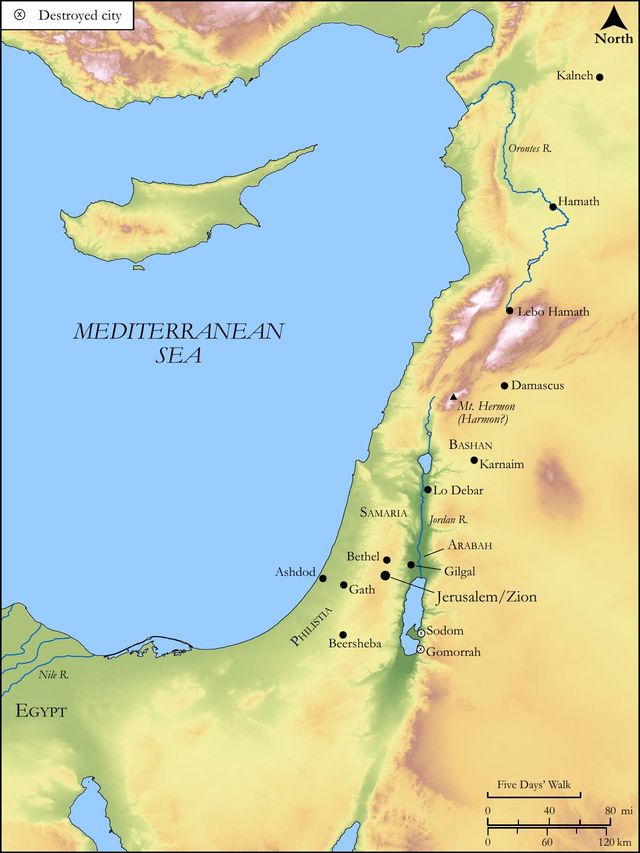
See on the biblical-era map
Study this verse
Public-domain commentary
Matthew Henry
From his Commentary on the Whole Bible. Henry comments on passages, not single verses — this entry covers Amos 3:9–15. His four-level outline is real structure in the source text, so it is rendered as structure.
The Israelites are here again convicted and condemned, and particular notice given of the crimes they are convicted of and the punishment they are condemned to.
1.Notice is given of it to their neighbours. The prophet is ordered to publish it in the palaces of Ashdod, one of the chief cities of the Philistines; nay, the summons must go further, even to the palaces in the land of Egypt. "The great men of both those nations, that dwell in the palaces, that are inquisitive concerning the affairs of the neighboring nations, and are conversant with the public intelligence, let them assemble themselves upon the mountains of Samaria," Amo 3:9. There, upon a throne high and lifted up, the judgment is set. Samaria is the criminal that is to be tried; let them be present at the trial, for it shall be (as other trials are) public, in the face of the country; let them make an appointment to meet there from all parts, to judge between God and his vineyard. God appeals to all impartial righteous men, Eze 23:45. They will all subscribe to the equity of his proceedings when they see how the case stands. Note, God's controversies with sinners do not fear a scrutiny; even Philistines and Egyptians will be made to see, and say, that the ways of the Lord are equal, but our ways are unequal. They are likewise summoned to attend, not only that they may justify God and be witness for him that he deals fairly, but that they may themselves take warning; for, if judgment begin at the house of God, as they see it does, what shall be the end of those that are strangers to him? Pe1 4:17. If this be done in a green tree, what shall be done in a dry? Or this intimates that the sin of Israel had been so notorious that the neighboring nations could come in witnesses against them, and therefore it was fit that their punishment should be so. "If it could have been concealed, we would have said, Tell it not in Gath; publish it not in the streets of Ashkelon;" but why should their friends consult their reputation, when they themselves do not consult it? If they have grown impudent in sin, let them bear the shame: "Publish it in Ashdod, in Egypt."
1.Let them see how black the charge is, and how well proved. Let them observe the behaviour of the inhabitants of Samaria; let them look off from the adjacent hills, and they may see how rude and boisterous they are, and hear how loud they cry of their sin is, as was that of Sodom.
(1.)Look into their streets and you will see nothing but riot and disorder, great tumults in the midst thereof; reason and justice are upon all occasions run down by the noise and fury of an outrageous mob, the dominion of which is the sin and shame of any people, and is likely to be their ruin.
(2.)Look into their prisons, and you will see them filled with injured innocents: The oppressed are in the midst thereof, thrown down and crushed by their oppressors, overpowered and overwhelmed, and they had no comforter, Ecc 4:1.
(3.)Look into their courts of justice, and you will see that those who preside in those courts know not to do right, because they have always been accustomed to do wrong; they act as if they had no notion at all of the thing called justice, are in no care to do justice themselves nor to see that others do justice.
(4.)Look into their treasures and stores, and you will see them replenished with violence and robbery, with that which was unjustly got and is still unjustly kept. Thus they have heaped treasures together for the last days, but it will prove a treasure of wrath against the day of wrath. It may well be said, Those know not to do right who think to enrich themselves by doing wrong.
2.Let them see how heavy the doom is, and how well executed, Amo 3:11, Amo 3:12.
(1.)Their country shall be invaded and ruined; and observe how the punishment answers to the sin.
[1.]Great tumults are in the midst of the land, and therefore an adversary shall be even round about the land; the Assyrian forces shall surround it and break in upon it on every side. Note, When sin is harboured and indulged in the midst of a people they can expect no other than that adversaries should be round about them, so that, go which way they will, they go into the mouth of danger, Luk 19:43.
[2.]They strengthened themselves in their wickedness, but the enemy shall bring down their strength from them, that strength which they abused in oppressing the poor, and doing violence to all about them. Note, That power which is made an instrument of unrighteousness will justly be brought down and broken.
[3.]They stored up robbery in their palaces, and therefore their palaces shall be spoiled; for what is got and kept wrongfully will not be kept long. Even palaces will be no protection to fraud and oppression; but the greatest of men, if they have spoiled others, shall themselves be spoiled, for the Lord is the avenger of all such.
(2.)Their countrymen shall not escape, Amo 3:12. They shall be in the hands of the enemy, as a lamb in the mouth of a lion, all devoured and eaten up, and they shall be utterly unable to make an resistance; and if any do make their escape, so as neither to fall by the sword or go into captivity, yet they shall be very few, and those of the meanest and least considerable, like two legs, or shanks, of a lamb, or, it may be, a piece of an ear, which the lion drops, or the shepherd takes from him, when he has eaten the whole body; so, perhaps, here and there one may escape from Samaria and from Damascus, when the king of Assyria shall fall upon them both, but none to make any account of; and those that do escape shall do so with the utmost difficult and hazard, by hiding themselves in the corner of a bed or under the bed's feet, which intimates that their spirits shall sneak shamefully in the time of danger. They shall not hide themselves in dens and caves, but in the corner of a bed, or the piece of a bed, such as poor people must be content with. They shall very narrowly escape, as it is foretold concerning the last destruction of Jerusalem that there shall be two in a bed together, one taken and the other left. Note, When God's judgments come forth against a people with commission it will be in vain to think of escaping them. Some make their dwelling in the corner of a bed, and in a couch, to denote their present security and sensuality; they are at ease, as in a bed, or on a couch, but, when God comes to contend with them, he shall make them uneasy, shall take them away out of the bed of their sloth and slumber. Those that stretch themselves lazily upon their couches when God's judgments are abroad shall go captive with the first that go captive.
II.Notice is given of it to themselves, Amo 3:13.
Let this be testified, and heard, in the house of Jacob, among all the seed of Israel, for it is spoken by the Lord God, the God of hosts, who has authority to pass this sentence and ability to execute it; let them know from him that the day is at hand when God will visit the transgressions of Israel upon him, when he will enquire into them and reckon for them: there will come a day of visitation, a day of punishment, and in that day all those things they are proud of, and put confidence in, shall fail them, and so they shall smart for the sins they have been guilty of about them.
1.Woe to their altars, for God will visit them. He will enquire into the sins they have been guilty of at their altars, and bring into the account all their superstition and idolatry, all their expenses on their false gods, and all their expectations from them; and he will lay the altars themselves under the marks of his displeasure, for the horns of the altar shall be cut off, and fall to the ground, and with them the altar itself demolished and broken to pieces. We find the altar at Bethel prophesied against (Kg1 13:2), and immediately rent (Amo 3:3), and that prophecy fulfilled with Josiah burnt men's bones upon it, Kg2 23:15, Kg2 23:16. This seconds that prophecy, and seems to point at the same event. Note, If men will not destroy idolatrous altars, God will, and those with them that had them in veneration. Some make the horns of the altar to signify all those things which they flee to for refuge, and trust in, and which they make their sanctuary: they shall all be cut off, so that they shall have nothing to take hold of.
2.Woe to their houses, for God will visit them too. He will enquire into the sins they have been guilty of in their houses, the robbery that have stored up in their houses, and the luxury in which they lived: and I will smite the winter-house with the summer-house, Amo 3:15. Their nobility, and gentry, and rich merchants, had their winter-houses in the city and their summer-houses in the country, so nice were they in guarding against the inconveniences of the winter when the country was thought too cold, and of the summer when the city was thought too hot, though the climate of that good land was so temperate, like that of ours, that neither the cold nor heat was ever in extremity. They indulged a foolish affectation of change and variety; but God will, either by war or by the earthquake, smite both the winter-house and the summer-house; neither shall serve to shelter them from his judgments. The houses of ivory (so called because the ceiling, or wainscot, or some of the ornaments of them, were edged or inlaid with ivory) shall perish, shall be burnt or pulled down; and the great houses shall have an end; the most splendid and spacious houses, the houses of their great men, shall no longer be, or at least be no longer theirs. Note, The pomp or pleasantness of men's houses will be so far from fortifying them against God's judgments that it will make them the more grievous and vexatious, as their extravagance about them will be put to the score of their sins and follies.
Historical interpretation
Historical reception
1 surviving comment on this verse from the historical church.
(Verse 11) Therefore thus says the Lord God: The land shall be troubled and surrounded, and your strength shall be taken away from you, and your houses shall be plundered. LXX: Therefore thus says the Lord God: Tyre and the surrounding land will be deserted by your strength, and your regions will be plundered. Regarding Tyre, which is written in Hebrew with two letters, Sade () and Res (); and it is called Sor (): which both Aquila and the Seventy translated similarly: a Hebrew who instructed me in the Holy Scriptures interpreted it as tribulation, and we did not reject his opinion: for Symmachus, who is accustomed to follow not the wordplay, but the order of meaning, says, siege and encirclement of the land. For the siege, which is called πολιορκία by him, was placed by Theodotion who thought not Sar and Sor (which is called tribulation, or Tyre, but Sur should be read: which properly refers to a very hard rock, which is called ἀκρότομος in Greek, and which we can call flint in Latin. Let us therefore speak about each one. The LXX said: Tyre and the land surrounding it. And the sentence seemed to hang: they added therefore of their own, it will be deserted: nor is it an error of the interpreters, where because of the ambiguity of the word, both tribulation and Tyre can be said. And the meaning is: Over the mountains of Samaria my people have done many insanities: slandering and completely ignoring what is right, and hoarding for themselves injustice and plunder: therefore they will be afflicted, or crushed, and surrounded by the Assyrian army, and, she says, strength will be taken away from you, o Samaria, o ten tribes, o once my people: and they will be plundered in your houses, which you have gathered through the tears of the wretched by means of slander. The heretics also will be afflicted on the day of judgment, and all their strength will be weakened, and what they had gained through plunder will be taken away, so that the people whom they had deceived may be freed: or certainly they will be afflicted every day by ecclesiastical men, and they will be surrounded by testimonies of the Scriptures, and strength of syllogisms, and clever words by which they had confirmed their own doctrine will be taken away from them. And their houses will be plundered: so that those who were taken from the Church may return to the Church.
Continue studying Amos 3:11 across the web’s major study libraries — every link below opens this exact verse, chapter, or book on the destination site.
Read & Compare
 BibleGatewayThis verse in more than 200 translations and 70 languages.
 Bible.comThe YouVersion reader — hundreds of translations, reading plans, and highlights.
 ESV.orgCrossway's official English Standard Version reader.
 NET BibleThe NET translation with 60,000+ translators' notes on every rendering decision.
 STEP BibleTyndale House's free study tool — original text, vocabulary, and scholarly resources.
 BibliaLogos Bible Software's free web reader.
 USCCBThe New American Bible (Revised Edition) with the U.S. bishops' study notes.
Commentaries
 BibleHub CommentariesDozens of classic commentaries on this verse, gathered on one page.
 StudyLightMore than 100 commentary sets — the largest collection on the web.
 BibleRefPlain-English commentary on what this verse means, verse by verse.
 Enduring WordDavid Guzik's free commentary on this chapter, widely used by Bible teachers.
 Bible Study ToolsVerse commentary alongside Greek and Hebrew study aids.
Original Language & Research
- BibleHub InterlinearThe verse word by word — original language, transliteration, and English.
- BibleHub LexiconEvery word's original-language definition and Strong's entry.
 Blue Letter BibleDeep-study tools — Strong's numbers, concordance, and word studies.
 SefariaThe Hebrew text with Rashi and centuries of Jewish commentary.
Sermons, Hymns & Audio


TrulyRandomVerse is not affiliated with these sites and doesn’t control their content. They’re linked because they’re genuinely useful.
Summary
Amos 3:11 serves as a stark divine pronouncement of impending judgment against the Northern Kingdom of Israel, declaring that an external adversary will encircle the land, dismantle its perceived might, and plunder its opulent palaces. This severe prophetic word underscores the direct and inevitable consequences of Israel's persistent oppression, moral corruption, and covenant unfaithfulness, revealing God's righteous response to a nation that had forsaken His ways.
Context
ShowHideLiterary Context
Amos 3:11 is strategically placed within a pivotal section of the prophet's message (Amos 3-6), where the focus shifts sharply from God's judgments upon surrounding pagan nations to a direct indictment of Israel, His covenant people. The preceding verses, Amos 3:9-10, lay bare the profound moral decay within Samaria, Israel's capital. God challenges the nations of Ashdod and Egypt to witness the "great tumults" and "oppressions" within Samaria, specifically noting that Israel's elite "know not to do right." This indictment highlights a deep-seated ethical blindness and a pervasive perversion of justice, where wealth was accumulated through violence and robbery. Therefore, Amos 3:11 immediately follows as the direct, divinely ordained consequence of this profound moral failure, signaling the inevitable retribution for their unrighteousness.
Historical & Cultural Context
During the mid-8th century BCE, the period of Amos's prophecy, the Northern Kingdom of Israel was experiencing a period of unprecedented economic prosperity under Jeroboam II (2 Kings 14:23-29). This affluence, however, was built upon oppression, exploitation of the poor, and a departure from the Mosaic covenant. Culturally, Israel had adopted pagan practices and syncretism, blurring the lines between Yahweh worship and Baal worship. Geographically, Samaria, with its fortified palaces, represented the heart of Israel's power and wealth. The "adversary" mentioned in Amos 3:11 is a veiled reference to the burgeoning Assyrian Empire, which was rapidly expanding its dominion and would soon become the primary instrument of God's judgment against Israel, ultimately leading to the fall of Samaria in 722 BCE (2 Kings 17). The mention of "palaces" is significant, as these were not merely royal residences but symbols of the wealthy elite's ill-gotten gains and oppressive lifestyles.
Key Themes
ShowHideThe prophecy in Amos 3:11 contributes significantly to several overarching themes within the book of Amos. Foremost is the theme of Divine Judgment, emphasizing God's absolute sovereignty and His righteous indignation against sin, particularly oppression and covenant infidelity. Unlike the surrounding nations, Israel's judgment is rooted in their unique covenant relationship, as highlighted in Amos 3:2. This verse also vividly portrays the Loss of Security and Strength, challenging Israel's false confidence in its military power and material wealth. The destruction of "strength" and "palaces" signifies the complete dismantling of their national identity and perceived invincibility, a direct consequence of their moral decay. Finally, it powerfully illustrates the Inevitable Consequences of Sin, demonstrating that God's warnings are not idle threats but will culminate in severe retribution for unrepentant rebellion, echoing the warnings found in Deuteronomy 28.
Exposition and Analysis
ShowHideKey Word Analysis
ShowHideMeaning "narrow," "tight place," "trouble," or "opponent." In this context, it refers to an external enemy or oppressor, a hostile force that will bring distress and confinement. It conveys the idea of being hemmed in and overwhelmed by an opposing power, emphasizing the inescapable nature of the coming judgment.
Denoting "strength," "might," "power," "security," or "majesty." This word encompasses both military prowess and national vitality, as well as the perceived invincibility and glory of the kingdom. Its removal signifies the complete dismantling of Israel's defenses, its capacity to resist, and its former glory.
A primitive root meaning "to plunder," "to rob," or "to take for a prey." This term vividly describes the violent confiscation of wealth and possessions, particularly from the "palaces" which symbolized Israel's ill-gotten gains. It signifies the complete desolation and economic ruin that would accompany the invasion, leaving nothing behind for the inhabitants.
Verse Breakdown
ShowHide"Therefore thus saith the Lord GOD;"
This opening clause establishes the divine authority and certainty of the prophecy. The phrase "thus saith the Lord GOD" (KJV) uses the divine titles 'Adonai' (H136) and 'YHWH' (H3069), emphasizing God's absolute sovereignty and His covenant relationship with Israel, which makes their judgment all the more significant. It signals that the following pronouncement is not merely Amos's opinion but a direct word from the Almighty.
"An adversary [there shall be] even round about the land;"
This declares the specific instrument and scope of God's judgment. The "adversary" (Hebrew: tsar) refers to an invading foreign power, historically understood as Assyria. The phrase "round about the land" (Hebrew: çâbîyb) indicates a complete encirclement, signifying a comprehensive and inescapable siege that will affect the entire nation, leaving no escape or refuge.
"and he shall bring down thy strength from thee,"
This specifies the primary effect of the adversary's presence. "Bring down" (Hebrew: yârad) implies a forceful descent, a reduction, or a humbling. "Thy strength" (Hebrew: ʻôz) refers to Israel's military might, national defenses, and any perceived security or power they possessed. This clause prophesies the complete dismantling of Israel's ability to resist or defend itself, rendering them vulnerable and helpless.
"and thy palaces shall be spoiled."
This final clause details the ultimate outcome of the invasion. "Palaces" (Hebrew: ʼarmôwn) represent the centers of wealth, power, and often, the sites of the very injustices condemned in preceding verses. "Spoiled" (Hebrew: bâzaz) means to be plundered or looted. This signifies not only the physical destruction of their grand structures but also the confiscation of their ill-gotten riches, symbolizing the utter desolation and economic ruin that would befall the nation as a direct consequence of their sin.
Literary Devices
ShowHideAmos 3:11 powerfully employs several Literary Devices to convey its message of impending judgment. The most prominent is Prophecy, as the verse functions as a direct divine declaration of future events, emphasizing God's foreknowledge and control over history. The vivid description of an "adversary... round about the land" and the subsequent actions of "bring down thy strength" and "palaces shall be spoiled" utilizes strong Imagery, painting a clear and terrifying picture of siege, defeat, and desolation. This imagery appeals to the reader's senses, making the consequences of sin tangible and immediate. Furthermore, the opening phrase, "Thus saith the Lord GOD," is a classic prophetic formula, serving as a pronouncement of Divine Fiat. It underscores that the judgment is not a random occurrence or a mere political outcome, but a direct, authoritative decree from the sovereign God, ensuring its certainty and inevitability. The adversary, though unnamed, acts as God's instrument, highlighting God's ultimate control even over destructive forces.
Theological and Thematic Connections
ShowHideAmos 3:11 stands as a profound theological statement on God's unwavering justice and His covenant faithfulness, even in judgment. It reveals that divine judgment is not arbitrary but a righteous response to persistent sin and a violation of covenant obligations. For Israel, their unique relationship with God (Amos 3:2) meant heightened accountability, and their failure to "know not to do right" (Amos 3:10) necessitated a divine intervention to uphold God's holy character. The coming adversary is not merely a political foe but an instrument in God's sovereign hand, demonstrating His ultimate control over nations and history to execute His purposes. This verse underscores the principle that true security and prosperity are found not in material wealth or military might, but in obedience and faithfulness to God, and that unrighteousness inevitably leads to national decline and ruin.
Reflection and Application
ShowHideAmos 3:11, though a prophecy of ancient judgment, carries enduring lessons for individuals and societies today. It compels us to critically examine the foundations of our perceived security and prosperity. Are we building our lives and communities on righteous principles, or are we, like ancient Israel, accumulating wealth and power through unjust means, ignoring the cries of the lowly, and presuming upon God's patience? The verse serves as a stark reminder that true strength and lasting security do not reside in material possessions, military might, or impressive infrastructures, but in a right relationship with God and a commitment to His justice and righteousness. It challenges us to cultivate a "knowledge of how to do right" (Amos 3:10), actively pursuing justice, loving mercy, and walking humbly with our God (Micah 6:8). When warnings, whether from Scripture, conscience, or circumstances, arise, the wise response is not complacency but humble repentance and a renewed commitment to God's ways, lest we, too, face the inevitable consequences of unaddressed sin.
Questions for Reflection
ShowHideFAQ
ShowHideWhat is the "adversary" mentioned in Amos 3:11?
ShowHideWhile Amos 3:11 does not explicitly name the adversary, historical and prophetic context strongly indicates the rising power of the Assyrian Empire. Assyria was a formidable military force that systematically conquered and deported nations in the ancient Near East. God frequently used foreign nations, even pagan ones, as instruments of His judgment against His disobedient people, as seen in Isaiah 10:5 where Assyria is called "the rod of my anger." The Assyrians eventually besieged and destroyed Samaria, the capital of the Northern Kingdom of Israel, in 722 BCE, fulfilling this prophecy (2 Kings 17:5-6).
Why is God bringing this judgment upon Israel?
ShowHideGod's judgment in Amos 3:11 is a direct consequence of Israel's pervasive sin and unfaithfulness to their covenant with Him. The preceding verses, Amos 3:9-10, accuse them of widespread injustice, oppression, and corruption, particularly among the wealthy elite who "know not to do right." Despite their unique covenant relationship with God (Amos 3:2), Israel had embraced idolatry, exploited the poor, and perverted justice. The judgment is therefore a manifestation of God's righteousness and holiness, demonstrating that He will not tolerate persistent rebellion and injustice, even from His chosen people.
What does "thy palaces shall be spoiled" signify?
ShowHideThe "palaces" (Hebrew: ʼarmôwn) in Amos 3:11 were not just grand buildings; they symbolized the accumulated wealth, power, and perceived security of Israel's elite. Often, these palaces were built through unjust means, exploiting the poor and vulnerable. To say they "shall be spoiled" (Hebrew: bâzaz) means they will be plundered, looted, and utterly desolated. This signifies a complete loss of material possessions, a dismantling of their social and economic structures, and the utter humiliation of those who trusted in their ill-gotten riches rather than in God. It represents the reversal of their prosperity and the public exposure of their unrighteous foundations, serving as a stark warning against placing trust in worldly security.
Christ-Centered Fulfillment
ShowHideWhile Amos 3:11 prophesied a temporal judgment on ancient Israel, its underlying principles find profound Christ-centered fulfillment and spiritual application. The "adversary" that brings down strength and spoils palaces can be seen as a foreshadowing of the ultimate judgment that falls upon all who reject God's rule, a judgment fully revealed in Christ. Yet, Christ does not merely bring judgment; He offers deliverance from the ultimate adversary, Satan, who seeks to spoil humanity's spiritual strength and enslave them in the "palaces" of sin and worldly systems (John 12:31). Through His atoning sacrifice on the cross, Jesus disarmed the powers and authorities, triumphing over them (Colossians 2:15). In Christ, believers find true and eternal security, a strength that cannot be brought down, and a spiritual inheritance that cannot be spoiled (1 Peter 1:3-4). He is the true "strength" of His people (Psalm 28:7), and His kingdom, unlike earthly palaces, is an unshakeable one, established not by human might but by divine grace (Hebrews 12:28). Thus, Amos's warning of impending destruction for those who trust in worldly strength ultimately points to the necessity of finding our refuge and strength in Christ alone, whose reign is eternal and whose salvation is complete.