


2 Kings 18:11
- וַיֶּגֶלvai·Ye·geland he took into exileH1540Conj-w ¦ V-Hiphil-ConsecImperf-3msVerb Hiphil Consecutive Imperfect 3rd Singular Masculineוַandיֶּגֶלhe took into exile
- מֶלֶךְMe·lekh[the] king ofH4428N-mscNoun Singular Masculine Construct
- אַשּׁוּר'a·ShurAssyriaH804N-properNoun Proper Location
- אֶת'et<obj.>H853DirObjMParticle Object Indicator
- יִשְׂרָאֵלYis·ra·'ElIsraelH3478N-properNoun Proper Location
- אַשּׁוּרָה'a·Shu·rahAssyria towardsH804N-proper ¦ SfxNoun Proper LocationאַשּׁוּרָAssyriaהtowards
- וַיַּנְחֵםvai·yan·Chemand he led themH5148Conj-w ¦ V-Hiphil-ConsecImperf-3ms ¦ 3mpVerb Hiphil Consecutive Imperfect 3rd Singular Masculineוַandיַּנְחֵhe ledםthem
- בַּחְלַחbach·Lachin HalahH2477Prep-b ¦ N-properNoun Proper LocationבַּinחְלַחHalah
- וּבְחָבוֹרu·ve·cha·Vorand on [the] HaborH2249Conj-w ¦ Prep-b ¦ N-properNoun Proper Locationוּandבְonחָבוֹר[the] Habor
- נְהַרne·Har[the] river ofH5104N-mscNoun Singular Masculine Construct
- גּוֹזָןgo·ZanGozanH1470N-properNoun Proper Location
- וְעָרֵיve·'a·Reiand [the] cities ofH5892Conj-w ¦ N-mpcNoun Plural Masculine Constructוְandעָרֵי[the] cities of
- מָדָיma·DaiMediaH4074N-properNoun Proper Location
English is a literal word-by-word gloss of the Hebrew, not the KJV's wording. Why?
This is the original text the KJV's translators worked from — each Hebrew word with its own literal English meaning in this verse, prepared by scholars at Tyndale House, Cambridge. The KJV translates whole sentences, not word by word, so its wording differs: one Hebrew word can become several English words, and the KJV may choose “the LORD” where the gloss reads “Yahweh”. Both are faithful — they answer different questions. For the KJV's own rendering, switch to the KJV text.
Details
See on the biblical-era maps
Study this verse
Public-domain commentary
Matthew Henry
From his Commentary on the Whole Bible. Henry comments on passages, not single verses — this entry covers 2 Kings 18:9–16. His three-level outline is real structure in the source text, so it is rendered as structure.
The kingdom of Assyria had now grown considerable, though we never read of it till the last reign. Such changes there are in the affairs of nations and families: those that have been despicable become formidable, and those, on the contrary, are brought low that have made a great noise and figure. We have here an account,
I.Of the success of Shalmaneser, king of Assyria, against Israel, his besieging Samaria (Kg2 18:9), taking it (Kg2 18:10), and carrying the people into captivity (Kg2 18:11), with the reason why God brought this judgment upon them (Kg2 18:12): Because they obeyed not the voice of the Lord their God. This was related more largely in the foregoing chapter, but it is here repeated,
1.As that which stirred up Hezekiah and his people to purge out idolatry with so much zeal, because they saw the ruin which it brought upon Israel. When their neighbour's house was on fire, and their own in danger, it was time to cast away the accursed thing.
2.As that which Hezekiah much lamented, but had not strength to prevent. Though the ten tribes had revolted from, and often been vexatious to, the house of David, no longer ago than in his father's reign, yet being of the seed of Israel he could not be glad at their calamities.
3.As that which laid Hezekiah and his kingdom open to the king of Assyria, and made it much more easy for him to invade the land. It is said of the ten tribes here that they would neither hear God's commandments nor do them, Kg2 18:12. Many will be content to give God the hearing that will give him no more (Eze 33:31), but these, being resolved not to do their duty, did not care to hear of it.
II.Of the attempt of Sennacherib, the succeeding king of Assyria, against Judah, in which he was encouraged by his predecessor's success against Israel, whose honours he would vie with and whose victories he would push forward. The descent he made upon Judah was a great calamity to that kingdom, by which God would try the faith of Hezekiah and chastise the people, who are called a hypocritical nation (Isa 10:6), because they did not comply with Hezekiah's reformation, nor willingly part with their idols, but kept them up in their hearts, and perhaps in their houses, though their high places were removed. Even times of reformation may prove troublesome times, made so by those that oppose it, and then the blame is laid upon the reformers. This calamity will appear great upon Hezekiah if we consider,
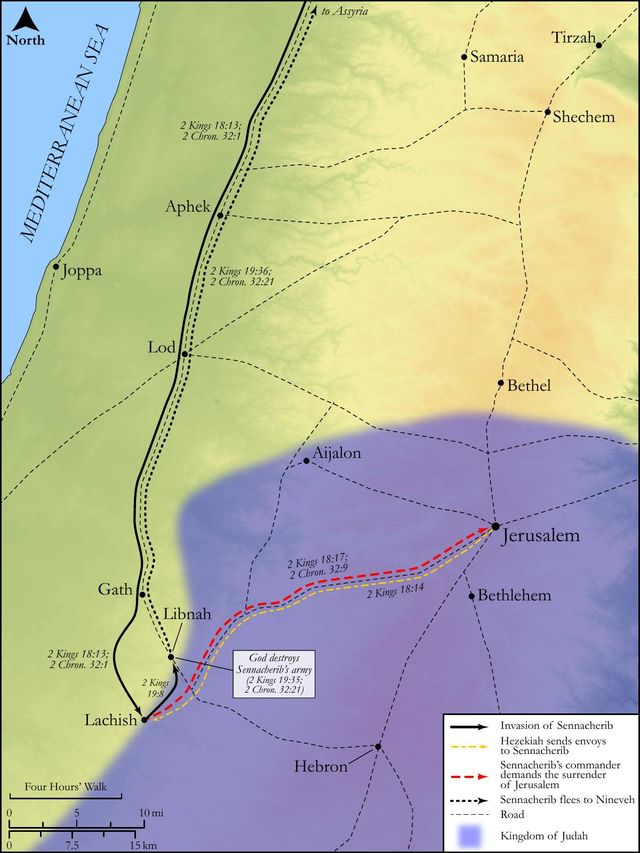
1.How much he lost of his country, Kg2 18:13. The king of Assyria took all or most of the fenced cities of Judah, the frontier-towns and the garrisons, and then all the rest fell into his hands of course. The confusion which the country was put into by this invasion is described by the prophet, Isa 10:28-31.
2.How dearly he paid for his peace. He saw Jerusalem itself in danger of falling into the enemies' hand, as Samaria had done, and was willing to purchase its safety at the expense,
(1.)Of a mean submission: "I have offended in denying the usual tribute, and am ready to make satisfaction as shall be demanded," Kg2 18:14. Where was Hezekiah's courage? Where his confidence in God? Why did he not advise with Isaiah before he sent this crouching message?
(2.)Of a vast sum of money - 300 talents of silver and thirty of gold (above 200,000l.), not to be paid annually, but as a present ransom. To raise this sum, he was forced not only to empty the public treasures (Kg2 18:15), but to take the golden plates off from the doors of the temple, and from the pillars, Kg2 18:16. Though the temple sanctified the gold which he had dedicated, yet, the necessity being urgent, he thought he might make as bold with that as his father David (whom he took for his pattern) did with the show-bread, and that it was neither impious nor imprudent to give a part for the preservation of the whole. His father Ahaz had plundered the temple in contempt of it, Ch2 28:24. He had repaid with interest what his father took; and now, with all due reverence, he only begged leave to borrow it again in an exigency and for a greater good, with a resolution to restore it in full as soon as he should be in a capacity to do so.
Continue studying 2 Kings 18:11 across the web’s major study libraries — every link below opens this exact verse, chapter, or book on the destination site.
Read & Compare
 BibleGatewayThis verse in more than 200 translations and 70 languages.
 Bible.comThe YouVersion reader — hundreds of translations, reading plans, and highlights.
 ESV.orgCrossway's official English Standard Version reader.
 NET BibleThe NET translation with 60,000+ translators' notes on every rendering decision.
 STEP BibleTyndale House's free study tool — original text, vocabulary, and scholarly resources.
 BibliaLogos Bible Software's free web reader.
 USCCBThe New American Bible (Revised Edition) with the U.S. bishops' study notes.
Commentaries
 BibleHub CommentariesDozens of classic commentaries on this verse, gathered on one page.
 StudyLightMore than 100 commentary sets — the largest collection on the web.
 BibleRefPlain-English commentary on what this verse means, verse by verse.
 Enduring WordDavid Guzik's free commentary on this chapter, widely used by Bible teachers.
 Bible Study ToolsVerse commentary alongside Greek and Hebrew study aids.
Original Language & Research
- BibleHub InterlinearThe verse word by word — original language, transliteration, and English.
- BibleHub LexiconEvery word's original-language definition and Strong's entry.
 Blue Letter BibleDeep-study tools — Strong's numbers, concordance, and word studies.
 SefariaThe Hebrew text with Rashi and centuries of Jewish commentary.
Sermons, Hymns & Audio


TrulyRandomVerse is not affiliated with these sites and doesn’t control their content. They’re linked because they’re genuinely useful.
Summary
Second Kings 18:11 records the tragic and definitive deportation of the Northern Kingdom of Israel by the Neo-Assyrian Empire, marking the culmination of centuries of covenant unfaithfulness and idolatry. This verse meticulously details the forced removal of the Israelite population by the Assyrian king, scattering them to distant imperial territories including Halah, Habor by the river Gozan, and the cities of the Medes. This act was a brutal but strategic Assyrian policy designed to dismantle national identity and prevent rebellion, serving as God's severe judgment and the ultimate end of Israel's independent existence in the Promised Land.
Context
ShowHideLiterary Context
This verse serves as the grim narrative climax to the long and tragic story of the Northern Kingdom's decline, immediately following the account of Samaria's three-year siege (2 Kings 18:9-10). While 2 Kings 17 provides the extensive theological justification for Israel's downfall, detailing their persistent idolatry and rejection of God's covenant, 2 Kings 18:11 functions as the historical fulfillment of those warnings. It is the final, devastating act of judgment, solidifying the end of the Northern Kingdom's presence in the land promised to their ancestors. The narrative then shifts abruptly to the reign of Hezekiah in Judah (2 Kings 18:13ff), drawing a stark contrast between the fate of the two kingdoms and highlighting God's preserving grace toward a faithful remnant.
Historical & Cultural Context
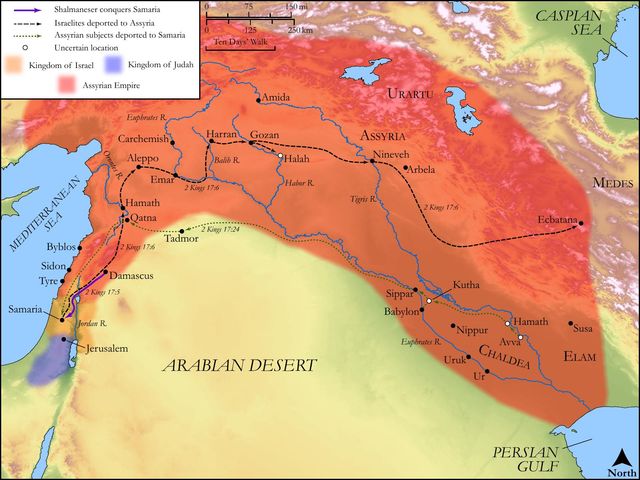
The deportation described in 2 Kings 18:11 was a hallmark of Neo-Assyrian imperial policy, a brutal but highly effective method of control over conquered territories. Unlike earlier empires, Assyria did not merely conquer; it aimed to utterly crush national identity and prevent future insurrections by forcibly relocating entire populations. By scattering diverse ethnic groups across vast distances and interspersing them among existing populations, Assyria sought to dilute ethnic cohesion, dismantle traditional social structures, and assimilate conquered peoples into its vast administrative and economic system. The specific locations mentioned—Halah, Habor by the river Gozan (in northern Mesopotamia, modern-day Syria/Iraq), and the cities of the Medes (in western Iran)—were strategically chosen to disperse the Israelites widely across the empire's eastern and northern frontiers, far from their homeland and any potential for organized resistance. This policy ensured that the Northern Kingdom, as a distinct political and religious entity, would never again rise in Canaan.
Key Themes
ShowHideThe most prominent theme underscored by this verse is Divine Judgment for persistent covenant infidelity. Despite centuries of warnings through prophets and cycles of judgment and restoration, Israel refused to abandon its syncretistic worship, oppression, and political alliances that violated God's commands. The exile is presented not as a random historical event, but as the inevitable and just consequence of their unfaithfulness, a direct fulfillment of the curses outlined in the Mosaic Covenant, particularly in Deuteronomy 28. This event also powerfully illustrates the Consequences of Disobedience, demonstrating that God's covenant relationship demands exclusive loyalty and that rebellion leads to severe repercussions, including the loss of land, identity, and freedom. Furthermore, it marks The End of an Era, as the Northern Kingdom of Israel ceased to exist as a sovereign entity, leading to the historical phenomenon of the "lost tribes." The narrative emphasizes God's Sovereignty over Nations, using Assyria as an unwitting instrument of His righteous judgment, even as Assyria pursued its own imperial ambitions (Isaiah 10:5-7).
Exposition and Analysis
ShowHideKey Word Analysis
ShowHideThis primitive root primarily means "to uncover," "to denude," often with a sense of disgrace or exposure. In the Hiphil stem, as used here (H1540), it specifically means "to lead into exile," "to deport," or "to go into captivity." The term powerfully conveys the forced, involuntary, and humiliating nature of Israel's removal from their homeland. It is a recurring term in prophetic literature describing the judgment of exile, emphasizing the complete uprooting of a people from their land, heritage, and identity.
In this specific context, "Israel" (H3478) refers exclusively to the Northern Kingdom, comprising the ten tribes that seceded from the united monarchy after the reign of Solomon (1 Kings 12). This distinguishes them from the Southern Kingdom of Judah. The use of "Israel" here underscores that the entire northern entity, the direct descendants of Jacob's namesake, was subjected to this comprehensive and devastating judgment, signifying the end of their national existence.
This refers to the Neo-Assyrian Empire (H804), the dominant geopolitical superpower of the ancient Near East during this period. Assyria was renowned for its formidable military, brutal conquest tactics, and sophisticated administrative policies, including mass deportation. In the biblical narrative, Assyria is consistently portrayed as an instrument of God's judgment, fulfilling His purposes even as its kings acted out of their own imperial ambitions.
Verse Breakdown
ShowHide"And the king of Assyria did carry away Israel unto Assyria"
This opening clause identifies the primary agent of judgment (the unnamed Assyrian king, historically Sargon II), the decisive action (deportation), and the victim (Israel, the Northern Kingdom). The destination, "unto Assyria," refers to the core territories of the Assyrian Empire, signifying a complete and irreversible removal from their ancestral land and integration into the imperial system, rather than a mere temporary relocation.
"and put them in Halah and in Habor [by] the river of Gozan"
This specifies the initial, primary locations of resettlement for the deported Israelites. Halah (H2477) is likely a region in northern Mesopotamia, possibly near modern-day Mosul or the upper Tigris. Habor (H2249), by the river Gozan (H1470), refers to the Khabur River region, a significant tributary of the Euphrates in northeastern Syria. These areas were chosen for their agricultural capacity and strategic importance within the Assyrian Empire, facilitating the assimilation and control of the deported populations.
"and in the cities of the Medes"
This phrase indicates a further, wider dispersal of the Israelite population into Media (H4074), a region east of Assyria, corresponding to modern-day western Iran. This detail highlights the thoroughness and strategic intent of the Assyrian policy: by scattering the Israelite population across disparate regions of their vast empire, they ensured that the deported people could not easily reconsolidate, foment rebellion, or maintain their distinct national and tribal cohesion.
Literary Devices
ShowHideThe passage employs several significant literary devices that amplify its theological and historical weight. It functions as a Fulfillment Narrative, starkly demonstrating the realization of long-standing covenant curses and prophetic warnings against Israel's persistent idolatry and disobedience (e.g., Deuteronomy 28:64). The precise geographical details ("Halah," "Habor," "Gozan," "cities of the Medes") provide Geographical Specificity, lending historical verisimilitude and emphasizing the thoroughness of the Assyrian policy and the vast extent of Israel's displacement. There is an underlying Irony in the narrative: Israel, chosen by God to be a holy nation and a light to the Gentiles, is now scattered among the very nations they were meant to influence, precisely because of their adoption of pagan practices. The brevity and declarative nature of the verse, following the detailed account of the siege, create a sense of Climactic Finality, marking an irreversible turning point in the history of God's people, a definitive end to the Northern Kingdom.
Theological and Thematic Connections
ShowHideSecond Kings 18:11 stands as a profound theological statement on God's unwavering justice and His covenant faithfulness, even in judgment. It underscores that while God is patient and merciful, His holiness demands a response to persistent sin, especially from His chosen people who were bound by a covenant of exclusive loyalty. The deportation of Israel is not merely a political or military event but a divine act, demonstrating that God holds nations accountable for their moral and spiritual conduct. It serves as a stark reminder that disobedience to God's revealed will carries severe consequences, fulfilling the warnings given centuries earlier at Sinai and through subsequent prophets. This tragic outcome highlights the seriousness of idolatry, syncretism, and the breaking of covenant, emphasizing God's commitment to His word, both in blessing and in curse, and His absolute sovereignty over human history and the rise and fall of empires.
Reflection and Application
ShowHideThe historical account of Israel's exile in 2 Kings 18:11 carries enduring spiritual lessons for believers today, serving as a potent reminder that God takes sin seriously, and there are real, often painful, consequences for persistent disobedience and spiritual apathy, even within the covenant community. We are called to learn from Israel's failures, recognizing that true worship involves wholehearted devotion to God alone, not a syncretistic blend of faith and worldly idols. This verse challenges us to examine our own lives for "idols" – anything that takes the place of God in our affections, priorities, or trust, whether it be materialism, self-reliance, comfort, or success. It compels us to cultivate a spirit of humility and vigilance, constantly returning to God's word for guidance and seeking to live in faithful obedience, trusting in His character and His revealed will. The judgment on Israel underscores God's absolute sovereignty and His faithfulness to His word, both in warning and in promise, reinforcing the importance of living a life that honors Him above all else, knowing that His discipline, though painful, is ultimately for our good and His glory.
Questions for Reflection
ShowHideFAQ
ShowHideWhat happened to the "lost tribes" of Israel after this deportation?
ShowHideThe term "lost tribes" refers to the ten tribes of the Northern Kingdom of Israel who were deported by Assyria. The Assyrian policy of mass deportation, as described in 2 Kings 18:11, was designed to break the national identity of conquered peoples by scattering them among different regions and integrating them into the existing population. Unlike the later Babylonian exile of Judah, which saw a distinct remnant eventually return to their homeland, the Assyrian exiles largely assimilated into the cultures and populations of their new homes. While some individuals or families may have maintained their Israelite identity through generations, and some may have eventually migrated south to Judah, the distinct national and tribal identity of the Northern Kingdom effectively ceased to exist in the land of Israel. Over time, many intermarried with other peoples, and their distinct lineage became obscured, leading to the popular notion that they were "lost."
Why did God allow this to happen to His chosen people?
ShowHideThe biblical narrative, particularly in 2 Kings 17, explicitly states that God allowed this devastating judgment to befall His chosen people because of their persistent and egregious unfaithfulness to the covenant. Despite numerous warnings through prophets, Israel repeatedly engaged in widespread idolatry, worshipping foreign gods and setting up high places, violating the very first commandments of the Decalogue. They rejected God's laws, practiced oppression, and stubbornly refused to repent. This exile was the fulfillment of the curses outlined in the Mosaic Covenant (e.g., Deuteronomy 28:15-68). God, in His holiness and justice, could not overlook such flagrant and prolonged rebellion from a people with whom He had made a solemn covenant. The deportation was a severe but righteous act of discipline, demonstrating that God holds His people accountable and that His word, both in promise and in warning, is always true and will be fulfilled.
Christ-Centered Fulfillment
ShowHideThe tragic scattering of Israel in 2 Kings 18:11, a direct consequence of their sin and rebellion against God, powerfully foreshadows the universal human condition of spiritual alienation and dispersion from God due to sin. Humanity, in its fallen state, is scattered and lost, unable to return to God on its own terms. However, the ultimate fulfillment of this narrative of scattering and gathering is found supremely in Jesus Christ. He is the true Israel, the faithful Son who perfectly obeyed God where the nation of Israel failed (e.g., Matthew 2:15). Christ came not to condemn the scattered, but to gather them. He lamented over Jerusalem, desiring to "gather your children together, just as a hen gathers her brood under her wings" (Matthew 23:37). Through His atoning sacrifice on the cross, Jesus became the Lamb of God who takes away the sin of the world, providing the means for all who believe to be reconciled to God and gathered into a new spiritual family. He breaks down the dividing wall of hostility, making "one new man out of the two" (Ephesians 2:14-15), uniting Jew and Gentile into one body, the Church. Thus, the scattering of Israel points to the greater spiritual scattering of humanity, which is ultimately overcome by Christ's redemptive work, gathering all who are His into the eternal kingdom, a people no longer defined by tribal lineage or geographical location, but by their shared faith in Him (Galatians 3:28-29).