


Amos 6:14
Bible text: King James Version (1769 Blayney text) · Public domain
Bible text: King James Version with Strong's numbers · Public domain
Bible text: Berean Standard Bible · Public domain
Bible text: American Standard Version (1901) · Public domain
Bible text: World English Bible, Messianic edition · Public domain
Bible text: Geneva Bible (1599) · Public domain
Bible text: Young's Literal Translation · Public domain
- כִּיkiforH3588PrtParticle Conditional
- הִנְנִיhi·Nihere IH2005Prt ¦ 1csParticle InterjectionהִנְhereנִיI
- מֵקִיםme·Kim[am] about to raise upH6965V-Hiphil-Prtcpl-msVerb Hiphil Participle Singular Masculine Absolute
- עֲלֵיכֶם'a·lei·Khemon youH5921Prep ¦ 2mpPrepositionעֲלֵיonכֶםyou
- בֵּיתbeitO house ofH1004N-mscNoun Singular Masculine Construct
- יִשְׂרָאֵלYis·ra·'ElIsraelH3478N-properNoun Proper Location
- נְאֻםne·'um[the] utterance ofH5002N-mscNoun Singular Masculine Construct
- יְהוָהYah·wehYahwehH3068N-properNoun Proper Title
- אֱלֹהֵי'e·lo·Hei[the] God ofH430N-mpcNoun Plural Masculine Construct
- הַצְּבָאוֹתha·tze·va·'ot<the> hostsH6635Art ¦ N-fpNoun Plural Feminine Absoluteהַ<the>צְּבָאוֹתhosts
- גּוֹיGoya nationH1471N-msNoun Singular Masculine Absolute
- וְלָחֲצוּve·la·cha·Tzuand they will oppressH3905Conj-w ¦ V-Qal-ConsecPerf-3cpVerb Qal Consecutive Perfect 3rd Plural common genderוְandלָחֲצוּthey will oppress
- אֶתְכֶם'et·Khem<obj.> youH853DirObjM ¦ 2mpParticle Object Indicatorאֶתְ<obj.>כֶםyou
- מִלְּבוֹאmi·le·Vo'from LeboH935Prep-m ¦ N-properNoun Proper LocationמִfromלְּבוֹאLebo
- חֲמָתcha·MatHamathH2574N-properNoun Proper Location
- עַד'adtoH5704PrepPreposition
- נַחַלNa·chal[the] wadi ofH5158N-mscNoun Singular Masculine Construct
- הָעֲרָבָהha·'a·ra·Vah<the> ArabahH6160Art ¦ N-properNoun Proper Locationהָ<the>עֲרָבָהArabah
English is a literal word-by-word gloss of the Hebrew, not the KJV's wording. Why?
This is the original text the KJV's translators worked from — each Hebrew word with its own literal English meaning in this verse, prepared by scholars at Tyndale House, Cambridge. The KJV translates whole sentences, not word by word, so its wording differs: one Hebrew word can become several English words, and the KJV may choose “the LORD” where the gloss reads “Yahweh”. Both are faithful — they answer different questions. For the KJV's own rendering, switch to the KJV text.
Details
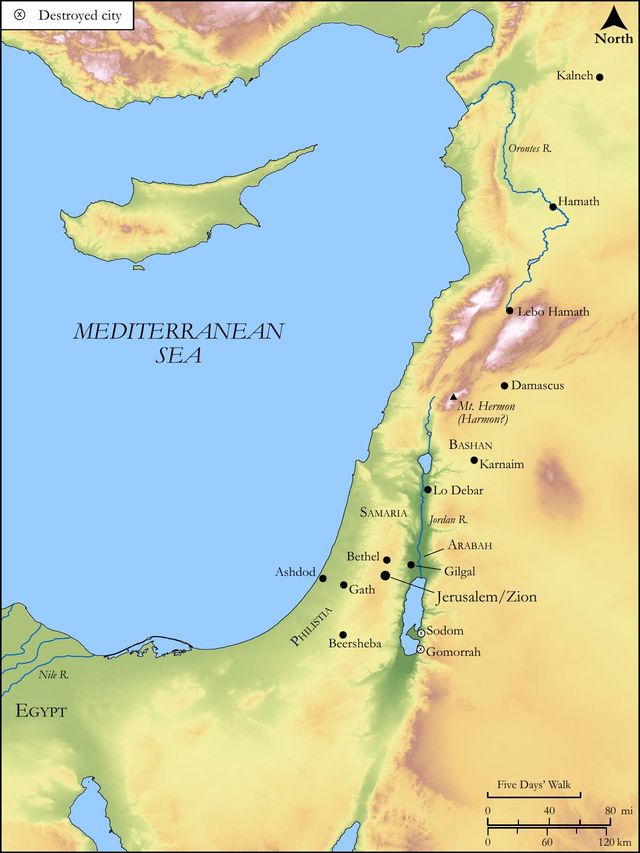
See on the biblical-era map
Study this verse
Public-domain commentary
Matthew Henry
From his Commentary on the Whole Bible. Henry comments on passages, not single verses — this entry covers Amos 6:8–14. His two-level outline is real structure in the source text, so it is rendered as structure.
In the former part of the chapter we had these secure Israelites loading themselves with pleasures, as if they could never be made merry enough; here we have God loading them with punishments, as if they could never be made miserable enough. And observe,
I.How strongly this burden is bound on, not to be shaken off by their presumption and security; for it is bound by the Lord the God of hosts, by his mighty, his almighty, hand, which none can resist; it is bound with an oath, which puts the sentence past revocation: The Lord God has sworn, and he will not repent, and, since he could swear by no greater, he has sworn by himself. How dreadful, how miserable, is the case of those whose ruin, whose eternal ruin, God himself has sworn, who can execute his purpose and cannot alter it!
II.How heavily this burden lies! Let us see the particulars.
1.God will abhor and abandon them, and that implies misery enough, all misery: I abhor the excellency of Jacob, all that which they are proud of, and value themselves upon, and for which they call and count themselves the chief of nations. Their visible church-membership, and the privileges of that, their temple, altar, and priesthood, these were, more than any thing, the excellencies of Jacob; but, when these were profaned and polluted by sin, God abhorred them; he hated and despised them, Amo 5:21. Note, God abhors that form of godliness which hypocrites keep up, while they abhor the power of it. And if he abhors their temple, for the iniquity of that, no marvel that he hates their palaces, for the injustices and oppression he finds there. Note, that creature which we take such a complacency and put such a confidence in as to make it a rival with God is thereby made abominable to him. He hates the palaces of sinners, for the sake of wickedness of those that dwell therein. Pro 3:33, The curse of the Lord is in the house of the wicked. And, if God abhor them, immediately it follows, He will deliver up the city with all that is therein, deliver it up into the hands of the enemy, that will lay it waste, and make a prey of all its wealth. Note, Those that are abhorred and abandoned of God are undone to all intents and purposes.
2.There shall be a great and general mortality among them (Amo 6:9): If there remain ten men in one house, that have escaped the sword of the enemy, yet they shall be met with another way; they shall all die by famine or pestilence. In the most sickly times, if there be ten in a house, one may hope that at least the one-half of them will escape, according to the proportion of two in a bed, one taken and the other left; but here not one of ten shall live to bury the rest. Another instance of the greatness of the mortality is (Amo 6:10) that the nearest relations of the dead shall be forced with their own hands to wind up their bodies, and bury them, for want of other hands to be employed in it; that is all that the next of kin, to whom the right of redemption belongs, can do for them, and with great reluctance will they do that. It intimates that the young people shall be cut off soonest; for the uncle that survives is, ordinarily, the senior relation. "When the uncle comes with the sexton (or him that burns), to bring out the bones out of the house, he shall say to him that he sees next about the house, 'Is there any yet with thee? Are there any left alive?' And he shall say, 'No, this is the last; now the whole family is cut off by death, and neither root nor branch remains."' But that which makes the judgment the more grievous is that their hearts seem to be hardened under it. "When he that is found by the sides of the house begin to enter into discourse with those that are carrying off the dead, they shall say, 'Hold thy tongue; do not stand preaching to us about the hand of Providence in this calamity, for we may not make mention of the name of the Lord; God is so angry with us that there is no speaking to him; he is so extreme to mark what we do amiss that we dare not so much as make mention of his name."' Thus the foolishness of men perverts their way, and brings them into distress, and then their heart frets against the Lord. Even then they will not take notice of his hand, nor suffer those about them to do it. Perhaps it was forbidden by some of the idolatrous kings to make mention of the name of Jehovah, as by the law of Moses it was forbidden to make mention of the names of the heathen-gods: "We may not do it without incurring the penalty." Note, Those hearts are wretchedly hardened indeed that will not be brought to make mention of God's name, and to worship him, when the hand of God has gone out against them, and when, as here, sickness and death are in their families. Thus those heap up wrath who cry not when God binds them.
3.Their houses shall be destroyed, Amo 6:11. God will smite the great house with breaches, and the little house with clefts; they shall both be cracked so as to lose their beauty and strength, and to be hastening towards a fall. The princes' palaces are not above the rebuke of divine justice, nor the poor men's cottages beneath it; neither shall escape. When sin has marked them for ruin God will find ways to bring it about. It is by order from him that breaches are made.
III.How justly they are thus burdened. If we understand the matter aright, we shall say, The Lord is righteous.
1.The methods used for their reformation had been all fruitless and ineffectual (Amo 6:12): Shall horses run upon the rock, to hurl or harrow the ground there? Or will one plough there with oxen? No, for there will be no profit to countervail the pains. God has sent them his prophets, to break up their fallow-ground; but they found them as hard and inflexible as the rock, rough and rugged, and they could do no good with them, nor work upon them, and therefore they shall not attempt it any more. They will not be reclaimed, and therefore shall not be reproved, but quite abandoned. Note, Those who will not be cultivated as fields and vineyards shall be rejected as barren rocks and deserts, Heb 6:7, Heb 6:8.
2.They had abused their power to the wrong and oppression of many, whose injured cause the sovereign Judge would not only right, but revenge: You have turned judgment into gall, which is nauseous, and the fruit of righteousness into hemlock, which is noxious; it would make one sick to see how those that were entrusted with the administration of public justice bore down equity with that power which they out to have defended and supported it, and so turned its own artillery against itself. Note, When our services of God are soured with sin his providences will justly be embittered to us.
3.They had set the judgments of God at defiance, and, confiding in their own strength, thought themselves a match for Omnipotence, Amo 6:13. They rejoiced in a thing of nought, pleased themselves with a fancy that no evil should befal them, though they had no ground at all for that confidence, nothing to trust to that would bear any weight. They said, "Have we not taken to us horns; have we not arrived to great dignity and dominion, have we not pushed down our enemies and pushed on our victories, and this by our own strength, our own skill and courage, our own wealth and military force? Who then need we be afraid of? Who then need we make court to? Not God himself." Note, Prosperity and success commonly make men secure and haughty; and those that have done much think they can do any thing, any thing without God, nay, any thing against him. But those who trust in their own strength rejoice in a thing of nought, and so they will find. Probably they did not say this with their lips, totidem verbis - in so many words, but it was the language of their hearts and of their actions, both which God understands.
IV.How easily and effectually this burden shall be brought upon them, Amo 6:14.
He that brings it upon them is the Lord the God of hosts, who both may do and can do what he pleases, who has all creatures at his command, and who, when he has work to do, will not be at a loss for instruments to do it with; though they are the house of Israel, yet he will raise up against them a nation which they feared not, but had many a time hoped in, even the Assyrians, and this nation shall afflict them, bring them into straits, and put them to pain, from the entering in of Hamath, in the north, to the river of the wilderness, the river of Egypt, Sihor or Nile, in the south. The whole nation has shared in the iniquity, and therefore must expect to share in the calamity. Note, When men are in any way instruments of affliction to us we must see God raising them up against us, for they are in his hand - the rod, the sword, in his hand. The Lord has bidden Shimei curse David.
Historical interpretation
Historical reception
1 surviving comment on this verse from the historical church.
(Verse 12 onwards) For behold, the Lord will command and strike down the great house with ruins, and the small house with breaches. Can horses run on rocks, or can it be plowed with oxen? For you have turned justice into bitterness, and the fruit of righteousness into wormwood. You who rejoice in nothingness, who say: Have we not taken horns for ourselves in our strength? Behold, I will raise up against you, O house of Israel, declares the Lord God of hosts, a nation, and they will oppress you from the entrance of Hamath to the brook of the wilderness. LXX: Therefore, behold, the Lord will command and will strike the great house with ruins and the small house with breaches. Will horses run on rocks? Will men be silent at women? For you have turned justice into bitterness and the fruit of righteousness into wormwood. You who rejoice in nothing good, who say, 'Have we not relied on our own strength?' For behold, I will raise up against you, O house of Israel, declares the Lord God of hosts, a nation, and they shall oppress you from Lebo-hamath to the brook of Egypt. Because you have sprung into such rage that, even in the time of death and impending evils, you were unwilling to utter the name of the Lord, therefore the Lord will command and strike the greater house with ruins, and the lesser house with divisions. If He commands, how does He strike? If He strikes, how does He command? But in that which He commands and orders to His ministers, He Himself seems to strike. Just as in commanding the Father and acting through the Son, He Himself who commanded does the work, the verse being fulfilled: He spoke, and they were made; He commanded, and they were created (Ps. 148:5). For all things were made through him, and without him was made nothing that was made (John 1). And in Egypt, where the firstborn who were killed by the destroyer are reported to be referred to, the Lord testifies that he himself killed them (Exodus 12). So also in the present place the Lord commands, and he himself strikes through his ministers the greater house with ruins, that is, the ten tribes, who were called Israel, and the lesser house with divisions, the two tribes, who were governed by the lineage of the house of David. And note the properties of each. Israel, because it had sinned more, is struck by ruins and is handed over to eternal captivity. But the house of Judah, in which the temple exists, and which had sinned in part, is held in captivity for seventy years and is not struck by ruins but by divisions. For a divided house can be repaired: ruins require not so much restoration as rebuilding. He compares the ruins and divisions of both houses to horses and oxen, of which the former cannot run on rocks, and the latter are so untamed that they do not accept the yoke on their necks, and since they are wild oxen, they are unwilling to plow the earth due to their fierceness. But you, though horses and buffalo cannot change their nature, have changed the nature of God, turning the sweet into the bitter and the fruit of his justice into wormwood, which is a very bitter herb. You who take delight in things that are nothing, like golden calves and idols, which are nothing, as Esther said to the Lord: Do not give your scepter to those who are not (Esther 14:11), or in nothing and falsehood. You who think you have taken horns and kingship and power by your own strength, with which you can scatter your enemies. Therefore, because you have done these things, behold, I will raise up against you, O great house and O lesser house, that will be struck by ruin and division, that is, O house of Israel and all twelve tribes, the most savage nation of Assyrians and Chaldeans, who will crush and overthrow you from beginning to end, from head to tail, from the borders of your land, which face the sun, to the desert river, or the West, as the LXX translated, that is, from Emath to Rhinocorura, between which the river Nile, or the stream coming from the desert, enters the sea. We have mentioned Emath above Epiphaniam, which got its name from Antiochus who was called Epiphanes. However, those who think that this refers to the house of Israel and the ten tribes, cannot explain how it is said in the threat against the ten tribes that they should be crushed from Epiphania to the borders of Egypt. These borders do not include only the ten tribes, but all twelve, including Judah and Benjamin. Some people, according to the allegory, believe that the large house and the smaller house symbolize the Jewish people and the Church gathered from the Gentiles. They are called 'great' because of their ancestors, the law, and the prophets. We are called 'lesser' because we were without the Testament and the commandments of God, of which we also read in the Song of Songs: 'My sister is little and has no breasts' (Song of Songs 8:8). If the great and small house, gathered into one family of God, does not have discipline and does not follow God's commandments, it will be struck by ruins and divisions. Whenever, therefore, the house of God, which is the Church, collapses and is torn apart, either in persecutions or in heresies and schisms, it shows the hand of God striking: which if we want to avoid, let us listen to and follow the comparison and example. They are not able to pursue on the rocks of the horse. Christ is the rock (I Cor. X), who gave to his apostles that they also be called rock: You are Peter, and upon this rock I will build my Church (Mat. XVI, 18). Those who are in these stones, called horses, about which we have spoken above, will not be able to pursue him, their courses hindered and falling down through each stone. Let us come to another comparison, according to our custom, discussing the edition of the Seventy Interpreters, lest if we adhere too much to the Hebrew, we seem to have deceived the reader's diligence, and by not mentioning the Vulgate edition, we appear to have proposed it in vain. But they will certainly be silent in women, he said, no doubt meaning horses, about which he had spoken above. If they pursue horses on rocks. These horses, that is, contrary strengths, who go mad for women when they see a masculine spirit, and having been strengthened by the power of God, are not bold enough to approach. But when they see a effeminate mind, weakened by ointments and pleasures, and turned towards feminine softness, they immediately go mad and cannot hold themselves back; and they long for lust. It follows: Because you have turned judgment into fury. Judgment turns into fury for the one who judges in anger, and the Lord says: You shall not show partiality in judgment (Deut. XVI, 19). And in another place: You shall not pity the poor in judgment; for it is God's judgment (Exod. XXIII, 3): with an angry mind he descends to judge, indeed, without knowing the cause, nor does he know the truth of the judgment, he prejudges what sentence he should pass: he also turns the fruit of justice, which is most sweet, into bitterness. What we have said about one virtue, let us understand about the others as well: prudence, courage, temperance. Whoever is angry cannot enjoy their fruits, and when they do, they will be bitter. Hence it is said in Isaiah: Woe to those who call sweet bitter, and bitter sweet (Is. 5:20). This is what those say who do not consider the causes in judging, but rather the individuals, and they turn the fruit of Christ's righteousness, which is most sweet, into bitterness. Therefore, whoever is guided in judgment by either blood ties or friendship, on the other hand, is led by hostile hatred or enmities, perverts the judgment of Christ, who is justice, and turns its fruit into bitterness. Those who do this rejoice in no good word, or, as Symmachus translated, irrationally, and proudly say: Have we not had horns in our strength? But let the righteous glory in the Lord and say: In you we will scatter our enemies with horns. And in another place (Al. in the same place): For I will not hope in my bow, and my sword will not save me (Ps. 43, 6, 7). Hence, in Exodus according to the Hebrew and the Aquila edition, we read: And Moses did not know that the appearance (Al. face) of his face was horned (Exod. 34, 29), which truly could be said: In you I blow away my enemies with a horn. We also read in another place: And he will exalt the horn of his people; And: He will exalt the horn of his Christ (Ps. 148, 14, and 1 Sam. 2, 10), and the horn of the altar, and clean horned animals, which are offered only to God, whose interpretation is not of this time. Because of these great sins and extreme pride, which speaks unrighteousness against God and exalts its mouth, the Almighty Lord God declares that he will raise up the most savage nation, which will crush and afflict them, indeed, even prevent them from entering into Emath, and as far as the Western torrent. Emath is interpreted as a wall or fortified town. Therefore, they will be forbidden from seeking refuge in the most savage nation, to whom punishments have been assigned, to flee to the fortified city, which is the celestial Jerusalem, lest they enter and be saved, similar to that chapter which we read in Genesis, where God placed Cherubim and a flaming sword (Gen. II), which turned to guard the way to the tree of life, so that the one who had been expelled from paradise would by no means enter there unworthy. And what follows: We will interpret the 67th Psalm, in which it is written: Sing to the Lord, sing a psalm to his name: make a way for him who ascends upon the west: the Lord is his name (Psalm 67:5). For unless evil works have died in us, Christ will not ascend upon us. And when they have died, and we have Christ as our charioteer: then as we make progress and advance to better things, it will be commanded in the same psalm: Sing to God, sing psalms to the Lord who ascends upon the heaven of heavens towards the east (Psalm 67:33, 34). And in the mysteries, first we renounce him who is in the West, and who dies for our sins, and thus turned towards the East, we make a covenant with the sun of righteousness, and we promise to serve him. Regarding the stream of the West, Symmachus interpreted it as a valley plain: Theodotio, a stream in Arabia: Aquila, a stream that is in the plain. With these words, it is shown that those who are not excluded from the walled city cannot die to sin, nor can they reach the plain and level stream of the desert, which is called the stream of pleasure, according to what we read: You shall make them drink from the stream of your pleasure (Psalm 36:9).
Continue studying Amos 6:14 across the web’s major study libraries — every link below opens this exact verse, chapter, or book on the destination site.
Read & Compare
 BibleGatewayThis verse in more than 200 translations and 70 languages.
 Bible.comThe YouVersion reader — hundreds of translations, reading plans, and highlights.
 ESV.orgCrossway's official English Standard Version reader.
 NET BibleThe NET translation with 60,000+ translators' notes on every rendering decision.
 STEP BibleTyndale House's free study tool — original text, vocabulary, and scholarly resources.
 BibliaLogos Bible Software's free web reader.
 USCCBThe New American Bible (Revised Edition) with the U.S. bishops' study notes.
Commentaries
 BibleHub CommentariesDozens of classic commentaries on this verse, gathered on one page.
 StudyLightMore than 100 commentary sets — the largest collection on the web.
 BibleRefPlain-English commentary on what this verse means, verse by verse.
 Enduring WordDavid Guzik's free commentary on this chapter, widely used by Bible teachers.
 Bible Study ToolsVerse commentary alongside Greek and Hebrew study aids.
Original Language & Research
- BibleHub InterlinearThe verse word by word — original language, transliteration, and English.
- BibleHub LexiconEvery word's original-language definition and Strong's entry.
 Blue Letter BibleDeep-study tools — Strong's numbers, concordance, and word studies.
 SefariaThe Hebrew text with Rashi and centuries of Jewish commentary.
Sermons, Hymns & Audio


TrulyRandomVerse is not affiliated with these sites and doesn’t control their content. They’re linked because they’re genuinely useful.
Summary
Amos 6:14 serves as a climactic declaration of divine judgment against the northern kingdom of Israel, detailing the Lord's direct intervention to raise up a foreign nation as an instrument of punishment. This nation would inflict widespread and severe oppression upon Israel, extending across the entire breadth of their land, from its northernmost boundary at Hamath to its southern border, signifying a comprehensive and inescapable national calamity for their persistent unfaithfulness and injustice.
Context
ShowHideLiterary Context
Amos 6:14 concludes a series of "woes" pronounced by the prophet Amos, beginning in Amos 5:18 and intensifying in Amos 6:1. The preceding verses condemn Israel's complacent elite, who indulged in luxury, disregarded the poor, and felt secure despite their moral and spiritual decay. This verse acts as the definitive pronouncement of the judgment that will shatter their false sense of peace, revealing the specific agent and the geographical scope of the impending destruction. It stands as a stark contrast to the earlier warnings, moving from rhetorical woe to a concrete, unavoidable divine decree.
Historical & Cultural Context
The prophecy of Amos was delivered during the reign of Jeroboam II (c. 786-746 BC) in the northern kingdom of Israel, a period characterized by remarkable economic prosperity and political stability. However, this outward success masked profound internal corruption, including rampant idolatry, severe oppression, and a widespread disregard for God's covenant laws. The nation had forgotten the warnings of the Law, such as those found in Deuteronomy 28:47-48, which foretold foreign invasion as a consequence of disobedience. The "nation" God would raise up is widely understood to be Assyria, a rising imperial power known for its brutal military campaigns, which would indeed conquer Israel in 722 BC. The geographical markers "Hemath" (Hamath) in Syria and "the river of the wilderness" (likely the Brook of Egypt or a similar wadi marking the southern border) delineate the traditional boundaries of the Promised Land, emphasizing the total and devastating sweep of the coming judgment across Israel's entire territory.
Key Themes
ShowHideAmos 6:14 powerfully contributes to several overarching themes within the book of Amos and broader biblical theology. Firstly, it underscores the theme of Divine Sovereignty and Justice, demonstrating God's absolute authority to orchestrate historical events and use nations as instruments of His righteous judgment against His own covenant people when they persist in sin. Secondly, it highlights the Consequences of Covenant Infidelity, illustrating that Israel's privileged status did not exempt them from the terms of their covenant with God; their persistent rebellion against divine law and justice, particularly their oppression of the poor and vulnerable, would inevitably lead to severe national punishment, as foretold in passages like Leviticus 26:14-39. Finally, the verse emphasizes the Comprehensive Nature of God's Judgment, signaling that the coming affliction would not be localized but would encompass the entire "house of Israel," from its northern to its southern extremities, leaving no part untouched by the divine decree.
Exposition and Analysis
ShowHideKey Word Analysis
ShowHideThis term (H1471) typically refers to a foreign nation or Gentile people. In this context, it signifies a non-Israelite entity, emphasizing that God will use an external, pagan power as His instrument of judgment. The choice of this word underscores the severity of Israel's apostasy, as they would be punished by those outside the covenant, fulfilling the warnings of the Law.
This verb (H3905) means "to press," "to distress," or "to oppress." It conveys a sense of severe, burdensome, and relentless hardship. The chosen nation would not merely conquer but would actively and cruelly oppress Israel, reflecting the very oppression Israel had inflicted upon its own poor and vulnerable.
This noun (H6635), often translated as "armies" or "multitudes," is part of the divine title "LORD the God of hosts." It signifies God's absolute dominion over all heavenly and earthly armies, stars, and the entire cosmos. Its inclusion here emphasizes that the coming judgment is not a random geopolitical event but a divinely orchestrated act by the Sovereign Commander of all creation.
Verse Breakdown
ShowHide"But, behold, I will raise up against you a nation,"
This opening clause signals an abrupt shift from Israel's complacent luxury to God's decisive action. The "behold" (KJV) or "indeed" (NIV) emphasizes the certainty and immediacy of the divine decree. God Himself, in His sovereign power, declares His intention to actively "raise up" (H6965, qûwm, to cause to stand or arise) a foreign power specifically against Israel, making it clear that this is not a natural consequence but a direct act of divine will.
"O house of Israel, saith the LORD the God of hosts;"
This identifies the direct recipient of the judgment: the "house of Israel," referring to the northern kingdom. The declaration is sealed by the authoritative pronouncement, "saith the LORD the God of hosts." This divine title, Yahweh Sabaoth, underscores God's supreme authority and power over all creation, including nations and armies. It asserts that the judgment is not merely a political event but a divinely orchestrated act by the omnipotent God of the universe.
"and they shall afflict you from the entering in of Hemath unto the river of the wilderness."
This clause specifies the nature and geographical scope of the coming judgment. The "affliction" (H3905, lâchats) will be severe and oppressive. The geographical markers "from the entering in of Hemath" (H2574, Hamath, a key city in northern Syria, often marking the northern extent of Israel's ideal territory) and "unto the river of the wilderness" (H5158, nachal, river/wadi; H6160, ʻărâbâh, wilderness/desert, likely referring to the Brook of Egypt or a similar southern boundary) indicate a comprehensive and total devastation. The entire traditional land of Israel would be overrun and oppressed, leaving no region untouched.
Literary Devices
ShowHideAmos 6:14 employs several potent literary devices to convey its message of impending judgment. Prophetic Oracle is the overarching form, characterized by the authoritative "saith the LORD the God of hosts," which stamps the declaration with divine authority and inevitability. The phrase "But, behold, I will raise up against you a nation" uses Divine Agency to emphasize God's direct and active role in orchestrating historical events, rather than attributing the coming invasion to mere geopolitical forces. The use of specific Geographical Markers—"from the entering in of Hemath unto the river of the wilderness"—serves as a form of Merism, where two extremes are named to represent the totality of something. In this case, it vividly portrays the comprehensive and inescapable nature of the coming affliction, indicating that the entire breadth of Israel's territory would be subjected to the foreign oppressor. This also functions as Hyperbole to underscore the severity and widespread nature of the devastation.
Theological and Thematic Connections
ShowHideAmos 6:14 is a profound theological statement on God's justice, sovereignty, and the consequences of covenant unfaithfulness. It reveals a God who is not merely a passive observer but an active participant in history, raising up and bringing down nations according to His righteous will. The judgment against Israel, though severe, is not arbitrary but a direct consequence of their persistent rebellion, oppression, and spiritual complacency. This verse underscores the biblical principle that privilege (being God's chosen people) brings greater responsibility, and failure to uphold the covenant leads to severe discipline. It serves as a stark reminder that true security lies not in material prosperity or military strength, but in faithful obedience to the Lord.
Reflection and Application
ShowHideAmos 6:14 delivers a timeless and sobering message that resonates deeply with individuals and nations today. It challenges the dangerous illusion that prosperity or a history of divine favor can insulate one from the consequences of moral and spiritual decay. For us, this means recognizing that God's justice is unwavering; He holds all accountable, and complacency in the face of sin is a perilous path. We are called to examine our own lives and communities for signs of spiritual apathy, oppression, or a false sense of security rooted in worldly achievements rather than in faithful obedience to God. This verse compels us to heed God's warnings, whether delivered through His Word, His Spirit, or the circumstances of life, and to respond with genuine repentance and a renewed commitment to righteousness. It reminds us that true blessing and security are found only in aligning our lives with God's will and actively pursuing justice, mercy, and humility.
Questions for Reflection
ShowHideFAQ
ShowHideWho is the "nation" God raises up against Israel in Amos 6:14?
ShowHideWhile not explicitly named in this verse, the "nation" God would raise up against Israel is widely understood by biblical scholars to be the Neo-Assyrian Empire. Historical and prophetic evidence strongly points to Assyria as the primary instrument of God's judgment against the northern kingdom of Israel, which ultimately led to their conquest and exile in 722 BC, as recorded in 2 Kings 17:6. Other prophets, like Isaiah, also explicitly identify Assyria as God's "rod of anger" (Isaiah 10:5).
What do "Hemath" and "the river of the wilderness" signify in this verse?
ShowHide"Hemath" (or Hamath) was a significant city in Syria, located in the Orontes Valley, which historically marked the northernmost boundary of the ideal territory promised to Israel (e.g., Numbers 34:8). "The river of the wilderness" likely refers to the Brook of Egypt (Wadi el-Arish) or a similar wadi that formed the traditional southern boundary of Israel's territory (e.g., 1 Kings 8:65). Together, these two geographical markers form a merism, signifying the entire breadth of Israel's land, from its northernmost point to its southernmost. This emphasizes that the coming affliction would be comprehensive and devastating, encompassing the entire nation and leaving no region untouched by the divine judgment.
Christ-Centered Fulfillment
ShowHideAmos 6:14, with its stark declaration of divine judgment against a complacent Israel, foreshadows the ultimate judgment of God against all sin, yet simultaneously points to the merciful provision found in Christ. While Israel faced a foreign nation as an instrument of affliction due to their covenant breaking, humanity's ultimate "affliction" is the consequence of sin, which separates us from a holy God (Romans 6:23). However, God, in His infinite love, "raised up" not a nation to condemn, but His own Son, Jesus Christ, to bear the judgment we deserved. Jesus, the true "house of Israel" in His person (Matthew 2:15), perfectly fulfilled the covenant requirements that Israel failed to keep. He became the Lamb of God who takes away the sin of the world (John 1:29), enduring the ultimate affliction on the cross, from the "entering in" of Gethsemane's agony to the "river of the wilderness" of death and the grave. Through His sacrifice, He offers a new covenant, not of judgment for unfaithfulness, but of grace and forgiveness for all who believe, ushering in a spiritual kingdom that transcends all earthly boundaries and offers true security and peace (Hebrews 8:6-13).