


Ezekiel 47:15
Bible text: King James Version (1769 Blayney text) · Public domain
Bible text: Berean Standard Bible · Public domain
Bible text: American Standard Version (1901) · Public domain
Bible text: World English Bible, Messianic edition · Public domain
Bible text: Geneva Bible (1599) · Public domain
Bible text: Young's Literal Translation · Public domain
- וְזֶהve·Zehand thisH2088Conj-w ¦ PrtParticle Demonstrativeוְandזֶהthis
- גְּבוּלge·Vul[is] [the] boundary ofH1366N-mscNoun Singular Masculine Construct
- הָאָרֶץha·'A·retzthe landH776Art ¦ N-fsNoun Singular Feminine Absoluteהָtheאָרֶץland
- לִפְאַתlif·'Atto [the] side ofH6285Prep-l ¦ N-fscNoun Singular Feminine Constructלִtoפְאַת[the] side of
- צָפוֹנָהtza·Fo·nahnorth -wardH6828N-fs ¦ SfxNoun Singular Feminine Absoluteצָפוֹנָnorthה-ward
- מִןminfromH4480PrepPreposition
- הַיָּםhai·Yamthe seaH3220Art ¦ N-msNoun Singular Masculine Absoluteהַtheיָּםsea
- הַגָּדוֹלha·ga·Dol<the> greatH1419Art ¦ Adj-msAdjective Singular Masculine Absoluteהַ<the>גָּדוֹלgreat
- הַדֶּרֶךְha·De·rekhthe direction ofH1870Art ¦ N-cscNoun Singular common gender Constructהַtheדֶּרֶךְdirection of
- חֶתְלֹןchet·LonHethlonH2855N-properNoun Proper Location
- לְבוֹאle·Vo'LeboH935V-Qal-InfVerb Qal Infinitive Construct
- צְדָדָהtze·Da·dahZedad towardsH6657N-proper ¦ SfxNoun Proper LocationצְדָדָZedadהtowards
English is a literal word-by-word gloss of the Hebrew, not the KJV's wording. Why?
This is the original text the KJV's translators worked from — each Hebrew word with its own literal English meaning in this verse, prepared by scholars at Tyndale House, Cambridge. The KJV translates whole sentences, not word by word, so its wording differs: one Hebrew word can become several English words, and the KJV may choose “the LORD” where the gloss reads “Yahweh”. Both are faithful — they answer different questions. For the KJV's own rendering, switch to the KJV text.
Details
See on the biblical-era map
Study this verse
Public-domain commentary
Matthew Henry
From his Commentary on the Whole Bible. Henry comments on passages, not single verses — this entry covers Ezekiel 47:13–23.
We are now to pass from the affairs of the sanctuary to those of the state, from the city to the country. 1. The Land of Canaan is here secured to them for an inheritance (Eze 47:14): I lifted up my hand to give it unto your fathers, that is, promised it upon oath to them and their posterity. Though the possession had been a great while discontinued, yet God had not forgotten his oath which he swore to their fathers. Though God's providences may for a time seem to contradict his promises, yet the promise will certainly take place at last, for God will be ever mindful of his covenant. I lifted up my hand to give it, and therefore it shall without fail fall to you for an inheritance. Thus the heavenly Canaan is sure to all the seed, because it is what God, who cannot lie, has promised. 2. It is here circumscribed, and the bounds and limits of it are fixed, which they must not pass over to encroach upon their neighbours and which their neighbours shall not break through to encroach upon them. We had such a draught of the borders of Canaan when Joshua was to put the people in possession of it, Num 34:1, etc. That begins with the salt sea in the south, goes round and ends there. This begins with Hamath about Damascus in the north, and so goes round and ends there, Eze 47:20. Note, It is God that appoints the bounds of our habitation; and his Israel shall always have cause to say that the lines have fallen to them in pleasant places. The lake of Sodom is here called the east sea, for it, being healed by the waters of the sanctuary, it is no more to be called a salt sea, as it was in Numbers. 3. It is here ordered to be divided among the tribes of Israel, reckoning Joseph for two tribes, to make up the number of twelve, when Levi was taken out to attend the sanctuary, and had his lot adjoining to that (Eze 47:13, Eze 47:21): You shall inherit it, one as well as another, Eze 47:14. The tribes shall have an equal share, one as much as another. As the tribes returned out of Babylon, this seems unequal, because some tribes were much more numerous than the other, and indeed the most were of Judah and Benjamin and very few of the other ten tribes; but as the twelve tribes stand, in type and vision, for the gospel-church, the Israel of God, it was very equal, because we find in another vision an equal number of each of the twelve tribes sealed for the living God, just 12,000 of each, Rev 7:5, etc. And to those sealed ones these allotments did belong. It intimates likewise that all the subjects of Christ's kingdom have obtained like precious faith. Male and female, Jew and Gentile, bond and free, are all alike welcome to Christ and made partakers of him. 4. The strangers who sojourn among them, who shall beget children and be built up into families, and so help to people their country, shall have inheritance among the tribes, as if they had been native Israelites (Eze 47:22, Eze 47:23), which was by no means allowed in Joshua's division of the land. This is an act for a general naturalization, which would teach the Jews who was their neighbour, not those only of their own nation and religion, but those, whoever they were, that they had an opportunity of showing kindness to, because from them they would be willing to receive kindness. It would likewise invite strangers to come and settle among them, and put themselves under the wings of the divine Majesty. But it certainly looks at gospel-times, when the partition-wall between Jew and Gentile was taken down, and both one in Christ, in whom there is no difference, Rom 10:12. This land was a type of the heavenly Canaan, that better country (Heb 11:16), in which believing Gentiles shall have a blessed lot, as well as believing Jews, Isa 56:3.
Historical interpretation
Historical reception
1 surviving comment on this verse from the historical church.
(Versed. 15 seqq.) This is the end of the land on the northern side, from the great sea, for those coming from Ethalon, Sadada, Emath, Berotha, Sabarim, which is between the middle of Damascus and the border of Emath: the courtyard of Thicon (Vulg. house of Atthicon), which is near the borders of Auran (or Auranitis). And the boundary will be from the sea to the courtyard of Enon (or Seraranan), the boundary of Damascus, and from the North to the North the boundary of Emath on the northern side (Vulg. and the boundary of Emath; on the northern side). Concerning the description of the land of the holy twelve tribes, commanded by Joshua the son of Nun, and which is now ruled by Ezekiel, it is worth noting that there the land is divided among the tribes by lot, as ordained by the Lord. In the Book of Numbers (Num. XXXIV), which divides the entire promised land into four regions in a brief discourse, the description of the northern region is as follows: Starting from the north, that is, the northern border, they will begin from the Great Sea, reaching up to the highest mountain, from which you will come to Hamath, to the borders of Zedad, they will go to Ziphrona and the town of Enam, also known as Aser Enon. And the Hebrews say that the northern region begins from the Great Sea, which extends along the coasts of Palestine, Phoenicia, the region called Coele Syria, and Cilicia, and stretches through Egypt to Libya. And when it says, 'The borders shall reach to the highest mountain' (Numbers 34:7), the same Hebrews interpret it to mean either Mount Amanus or Mount Taurus, which we think is more likely. From there, it is said, one will come to Emath, which is now called Epiphania, with the name changed by Antiochus, the most cruel of tyrants: for he had the surname Epiphanes. He says, 'They will go to the boundaries of Sadada, a place that is currently mentioned in the reading of Ezechiel, and they will reach the borders of Zephrona, which is today called Zephyrium, a town in Cilicia. And the next part, 'And the village of Enam,' is written in Hebrew as 'Aser Enon,' or 'Enan,' and the present location is included in this. And for now, it suffices to briefly summarize the historical context, and to connect the description in both Numbers and Ezechiel: so that a discerning reader understands in which places they mentioned the same, similar, or different things. Now that we have interpreted the names of each, let us follow the anagoge and discuss what seems to us in each, with the Lord providing. Ethalon is interpreted as the cradle of sorrow. Sadada, his side, understand not in terms of width but in terms of the side. Emath, fury, which is called in Greek, χόλος. Berotha, of the well. Sabarim, circuit of mountains. Damascus, blood of the bag and the kiss, or cup. But the house, or atrium Thicon, Symmachus interprets as the middle atrium, which extends to the borders of Auran. Therefore, Thicon, the middle one, resounds: Auran, which in Greek translates to Auranitidis, anger. Aser, however, Enon, which is the boundary of Damascus, is called the atrium of the fountain in our language. Therefore, the northern region begins from the great sea through the way of Ethalon, which means the cradle of sorrow, and through repentance it comes to Sadada, where there is a decline on the side. For we understand the impending Emath upon us, which is the wrath of God; or Emath, the truth being known, the wells of Berotha are opened for us, which were dug by the patriarchs, Abraham, Isaac, and Jacob: and after a long circuit we come to the mountains of Sabarim, which are located between Damascus, that is, the blood of the cilice, and the border of Emath, as we have said above, the truth. For just as we turn away from approaching evils through fear and avoid them on one side, so after the shedding of blood and the sackcloth of a bloody life, before we come to the borders of Emath, we circumscribe and arrive at the mountains, of which it is written: Mountains surround it, and the Lord surrounds his people (Psalm 124:2). This place is called the court of Thicon, that is, the middle court, as Symmachus has interpreted, near the borders of Auran, which means wrath, and let us say with the prophet: I will endure the wrath of the Lord, because I have sinned against him (Micah 4:9). And from the sea as far as the borders of Damascus; in which also the Apostle Paul (Acts IX) saw the light in blindness from the Jewish fury and the shedding of Ecclesiastical blood, and having taken up the sackcloth of old persecution, he preached the Gospel in order to reach the courtyard of the eternal fountain, and being placed in the North, he grasped the boundary of truth.
Continue studying Ezekiel 47:15 across the web’s major study libraries — every link below opens this exact verse, chapter, or book on the destination site.
Read & Compare
 BibleGatewayThis verse in more than 200 translations and 70 languages.
 Bible.comThe YouVersion reader — hundreds of translations, reading plans, and highlights.
 ESV.orgCrossway's official English Standard Version reader.
 NET BibleThe NET translation with 60,000+ translators' notes on every rendering decision.
 STEP BibleTyndale House's free study tool — original text, vocabulary, and scholarly resources.
 BibliaLogos Bible Software's free web reader.
 USCCBThe New American Bible (Revised Edition) with the U.S. bishops' study notes.
Commentaries
 BibleHub CommentariesDozens of classic commentaries on this verse, gathered on one page.
 StudyLightMore than 100 commentary sets — the largest collection on the web.
 BibleRefPlain-English commentary on what this verse means, verse by verse.
 Enduring WordDavid Guzik's free commentary on this chapter, widely used by Bible teachers.
 Bible Study ToolsVerse commentary alongside Greek and Hebrew study aids.
Original Language & Research
- BibleHub InterlinearThe verse word by word — original language, transliteration, and English.
- BibleHub LexiconEvery word's original-language definition and Strong's entry.
 Blue Letter BibleDeep-study tools — Strong's numbers, concordance, and word studies.
 SefariaThe Hebrew text with Rashi and centuries of Jewish commentary.
Sermons, Hymns & Audio


TrulyRandomVerse is not affiliated with these sites and doesn’t control their content. They’re linked because they’re genuinely useful.
Summary
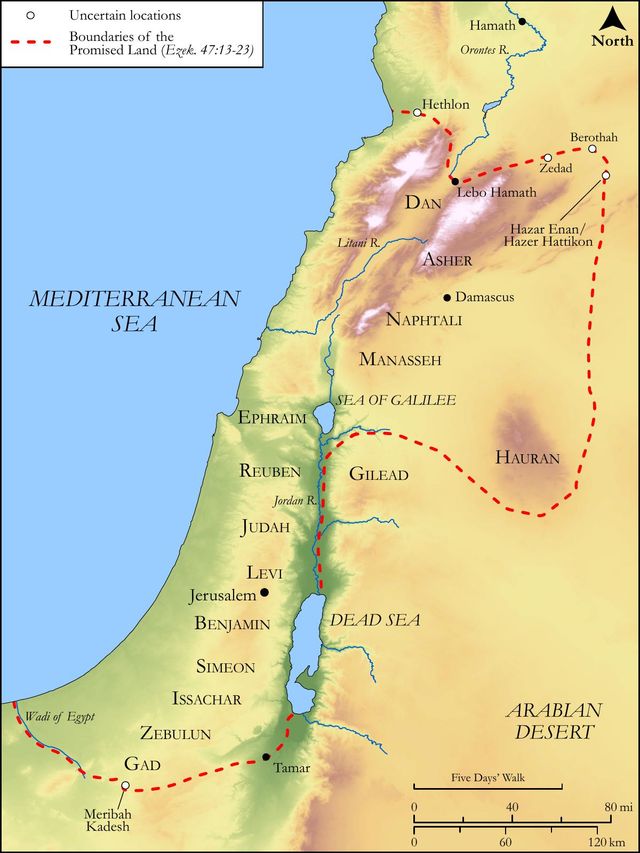
Ezekiel 47:15 meticulously outlines a segment of the northern boundary of the land promised to Israel in the prophet's sweeping vision of restoration. This verse, embedded within a detailed geographical description, specifies the starting point from the Mediterranean Sea and identifies key landmarks, Hethlon and Zedad, along this crucial border, underscoring the divine precision and comprehensive nature of God's future inheritance for His people.
Context
ShowHideLiterary Context
Ezekiel 47:15 is situated within the climactic section of Ezekiel's prophecy, specifically chapters 40-48, which detail a visionary blueprint for a restored Israel. Following the elaborate description of the new temple and its divine services in Ezekiel 40-46, chapter 47 introduces the miraculous, life-giving river flowing from the temple, transforming the desolate land into a fertile paradise, as seen in Ezekiel 47:1-12. Immediately after this depiction of spiritual and physical renewal, the prophet transitions to the precise allocation of the land among the tribes of Israel, detailed from Ezekiel 47:13-23 and Ezekiel 48:1-35. Verse 15, therefore, is an integral part of God's meticulous mapping of the promised inheritance, demonstrating the tangible reality and divine order of the restoration vision.
Historical & Cultural Context
Ezekiel prophesied during the Babylonian exile (c. 597-538 BC), a period of profound national despair for Israel. The loss of their land, temple, and sovereignty was seen as a direct consequence of their disobedience to God's covenant. In this context, a detailed vision of a restored temple and a precisely delineated land offered immense hope and reassurance. Ancient Near Eastern treaties and land grants often included meticulous boundary descriptions, reflecting the importance of defined territories for national identity, security, and agricultural prosperity. For the exiled Israelites, this level of detail in God's prophecy would have affirmed the certainty of His promise and the future re-establishment of their nation, not as a vague ideal, but as a concrete, divinely ordained reality that would definitively secure their place.
Key Themes
ShowHideThis verse significantly contributes to several overarching themes in Ezekiel and the broader biblical narrative. Firstly, it highlights Divine Order and Precision, demonstrating God's meticulous attention to detail in His redemptive plans. The exact naming of geographical markers, even those whose modern locations are debated, underscores that God's promises are not abstract but concrete and precisely defined. Secondly, it reinforces the theme of Covenant Fulfillment, echoing earlier divine promises of land to Abraham, such as in Genesis 15:18, and subsequent descriptions of Israel's ideal borders, as found in Numbers 34:7-9. This vision assures the exiles that God remains faithful to His ancient covenants, even in judgment. Finally, it powerfully conveys Hope for Restoration, providing a tangible vision of a secure, defined homeland for a people who had lost theirs, signifying God's unwavering faithfulness and His ultimate purpose to dwell among His people in a renewed creation.
Exposition and Analysis
ShowHideKey Word Analysis
ShowHideProperly, this term refers to a cord, as twisted, which by implication denotes a boundary. It can also extend to mean the territory enclosed by such a boundary. In Ezekiel 47:15, it signifies the precise, divinely ordained limit of the northern extent of the restored land, emphasizing its defined and secure nature as a landmark.
Derived from a root meaning "to be great," this adjective signifies magnitude in any sense. Here, it modifies "sea," referring to the vastness of the Mediterranean Sea, which serves as a prominent and unmistakable natural landmark for the western and northern boundaries of the land.
This word denotes a road or path, as trodden. Figuratively, it can refer to a course of life or mode of action. In this geographical context, it indicates a specific route or direction, "the way of Hethlon," implying a known passage or alignment that defines the border's trajectory towards Zedad.
Verse Breakdown
ShowHide"And this [shall be] the border of the land toward the north side"
This opening clause immediately establishes the subject of the verse: the northern boundary of the promised land. The demonstrative "this" points to the subsequent description as the definitive delineation. It highlights that the land's boundaries are not arbitrary but divinely ordained and precisely defined, signifying God's meticulous planning for His people's inheritance.
"from the great sea"
This phrase specifies the starting point of the northern border. "The great sea" unequivocally refers to the Mediterranean Sea, which historically formed the western boundary of the land of Israel. Its inclusion here anchors the prophetic vision in a recognizable geographical reality, indicating that the northern border originates from the coast and extends eastward. This detail grounds the vision in a tangible, identifiable landscape.
"the way of Hethlon, as men go to Zedad;"
This final segment provides specific geographical markers along the northern trajectory. "The way of Hethlon" suggests a route or region associated with Hethlon, a place whose exact location is debated but understood to be in the northern reaches of Syria or Lebanon. "As men go to Zedad" further specifies the direction and destination along this route, with Zedad also being a location generally placed north of Israel, indicating the precise eastward extension of the border. This level of detail underscores the concreteness and certainty of the promised inheritance.
Literary Devices
ShowHideThe primary literary device at play in Ezekiel 47:15 is Topographical Detail, which is a form of highly specific geographical description. The prophet meticulously names landmarks and directions ("north side," "great sea," "Hethlon," "Zedad") to paint a precise mental map of the future inheritance. This detailed mapping serves to ground the visionary prophecy in a tangible reality, making the promise of restoration concrete and believable for the exiled Israelites. Furthermore, there is an element of Precision in the language, emphasizing God's meticulous planning and unwavering commitment to His covenant promises. The lack of ambiguity in the boundary description reflects divine order and sovereignty, contrasting sharply with the chaos and displacement experienced by the exiles, offering them a vision of ultimate security and stability.
Theological and Thematic Connections
ShowHideEzekiel 47:15, with its detailed description of land boundaries, powerfully underscores God's faithfulness to His covenant promises, particularly those concerning the land given to Abraham and his descendants. This meticulous mapping serves as a tangible assurance that God's plans for His people are precise, ordered, and certain, even when they appear to be utterly lost or forgotten. It speaks to a God who remembers His word and meticulously fulfills it, providing a secure place for His people. This physical inheritance in the Old Testament foreshadows the spiritual inheritance and secure dwelling place God provides for His people in the New Covenant, where believers find their ultimate rest and security in Him.
Reflection and Application
ShowHideThe meticulous detail in Ezekiel 47:15, describing the precise borders of the promised land, offers profound spiritual lessons for believers today. Just as God had a clear, defined plan for the physical inheritance of Israel, He has a precise and purposeful plan for our lives and our spiritual inheritance in Christ. This verse reminds us that God is a God of order, not chaos; His promises are not vague hopes but certain realities, meticulously designed and faithfully executed. For those feeling lost, displaced, or uncertain about their future, this passage offers a powerful reminder of God's unwavering faithfulness and His commitment to secure a place for His people. It invites us to trust in His detailed providence, knowing that He has prepared an eternal inheritance that is far more glorious and secure than any earthly territory, an inheritance that transcends geographical boundaries and temporal limitations.
Questions for Reflection
ShowHideFAQ
ShowHideWhat is the significance of "the great sea" in this verse?
ShowHide"The great sea" unequivocally refers to the Mediterranean Sea, which served as the natural western boundary of the land of Israel throughout its history. Its mention here signifies that the northern border begins from this prominent and universally recognized geographical feature, extending eastward. It anchors the prophetic vision in a real, identifiable geographical context, making the described boundaries concrete and understandable to Ezekiel's audience and emphasizing the tangible nature of the promised restoration.
Are Hethlon and Zedad identifiable today, and why are they mentioned?
ShowHideThe exact modern locations of Hethlon and Zedad are debated among scholars, but they are generally placed in what is now southern Syria or Lebanon, north of modern Israel. Their inclusion highlights the extraordinary detail and specificity of God's plan for Israel's inheritance. Rather than giving a general direction, God names specific, known (or prophesied) landmarks, underscoring His meticulous attention to detail and the tangible reality of the promised land. This precision would have offered immense reassurance and hope to the exiled Israelites, demonstrating that God's covenant promises were not abstract but concrete and geographically defined. This level of detail is characteristic of ancient land grants and covenant descriptions, emphasizing the prophetic accuracy and certainty of the future restoration, much like the detailed instructions for the tabernacle in Exodus 25.
Christ-Centered Fulfillment
ShowHideWhile Ezekiel 47:15 describes a physical land inheritance for Israel, its ultimate fulfillment is found in Christ and the spiritual inheritance He secures for His people. The meticulously defined borders of the promised land foreshadow the secure and eternal dwelling place prepared for believers in God's kingdom, a "better country—a heavenly one" (Hebrews 11:16). Jesus himself declares, "In my Father's house are many rooms. If it were not so, would I have told you that I go to prepare a place for you?" (John 14:2). This "place" is not a physical territory bounded by seas and ancient towns, but the spiritual reality of salvation, eternal life, and co-heirship with Christ in the New Jerusalem, described in Revelation 21:1-4. The precise boundaries in Ezekiel symbolize the absolute certainty and security of the believer's inheritance in Christ, which is imperishable, undefiled, and unfading, kept in heaven for us, as promised in 1 Peter 1:4. Thus, the physical land vision points to the spiritual reality of God's people dwelling securely in His presence, fully redeemed and eternally provided for through the finished work of the Lamb of God, who takes away the sin of the world.