


Ezekiel 47:14
- וּנְחַלְתֶּםu·ne·chal·Temand you will divide as possessionH5157Conj-w ¦ V-Qal-ConsecPerf-2mpVerb Qal Consecutive Perfect 2nd Plural Masculineוּandנְחַלְתֶּםyou will divide as possession
- אוֹתָהּ'o·Tah<obj.> itH853DirObjM ¦ 3fsParticle Object Indicatorאוֹתָ<obj.>הּit
- אִישׁ'isheachH376N-msNoun Singular Masculine Absolute
- כְּאָחִיוke·'a·Chivlike his brotherH251Prep-k ¦ N-msc ¦ 3msNoun Singular Masculine Constructכְּlikeאָחִיbrotherוhis
- אֲשֶׁר'a·SherwhichH834RelParticle Relative
- נָשָׂאתִיna·Sa·tiI lifted upH5375V-Qal-Perf-1csVerb Qal Perfect 1st Singular common gender
- אֶת'et<obj.>H853DirObjMParticle Object Indicator
- יָדִיya·Dimy handH3027N-csc ¦ 1csNoun Singular common gender Constructיָדִhandיmy
- לְתִתָּהּle·ti·Tahto give itH5414Prep-l ¦ V-Qal-Inf ¦ 3fsVerb Qal Infinitive Constructלְtoתִתָּgiveהּit
- לַאֲבֹתֵיכֶםla·'a·vo·tei·Khemto your ancestorsH1Prep-l ¦ N-fpc ¦ 2mpNoun Plural Feminine Constructלַtoאֲבֹתֵיancestorsכֶםyour
- וְנָפְלָהve·Na·fe·Lahand it will fallH5307Conj-w ¦ V-Qal-ConsecPerf-3fsVerb Qal Consecutive Perfect 3rd Singular Feminineוְandנָפְלָהit will fall
- הָאָרֶץha·'A·retzthe landH776Art ¦ N-fsNoun Singular Feminine Absoluteהָtheאָרֶץland
- הַזֹּאתha·Zot<the> thisH2063Art ¦ PrtParticle Demonstrativeהַ<the>זֹּאתthis
- לָכֶםla·Khemto youPrep-l ¦ 2mpSuffix Personal 2nd Plural Masculineלָtoכֶםyou
- בְּנַחֲלָהbe·na·cha·Lah<in> an inheritanceH5159Prep-b ¦ N-fsNoun Singular Feminine Absoluteבְּ<in>נַחֲלָהan inheritance
English is a literal word-by-word gloss of the Hebrew, not the KJV's wording. Why?
This is the original text the KJV's translators worked from — each Hebrew word with its own literal English meaning in this verse, prepared by scholars at Tyndale House, Cambridge. The KJV translates whole sentences, not word by word, so its wording differs: one Hebrew word can become several English words, and the KJV may choose “the LORD” where the gloss reads “Yahweh”. Both are faithful — they answer different questions. For the KJV's own rendering, switch to the KJV text.
Details
See on the biblical-era map
Study this verse
Public-domain commentary
Matthew Henry
From his Commentary on the Whole Bible. Henry comments on passages, not single verses — this entry covers Ezekiel 47:13–23.
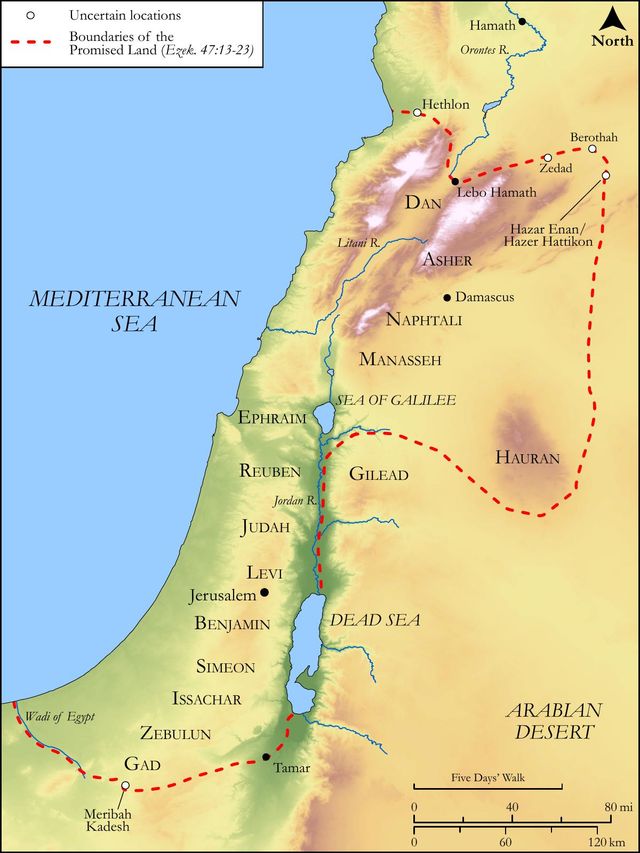
We are now to pass from the affairs of the sanctuary to those of the state, from the city to the country. 1. The Land of Canaan is here secured to them for an inheritance (Eze 47:14): I lifted up my hand to give it unto your fathers, that is, promised it upon oath to them and their posterity. Though the possession had been a great while discontinued, yet God had not forgotten his oath which he swore to their fathers. Though God's providences may for a time seem to contradict his promises, yet the promise will certainly take place at last, for God will be ever mindful of his covenant. I lifted up my hand to give it, and therefore it shall without fail fall to you for an inheritance. Thus the heavenly Canaan is sure to all the seed, because it is what God, who cannot lie, has promised. 2. It is here circumscribed, and the bounds and limits of it are fixed, which they must not pass over to encroach upon their neighbours and which their neighbours shall not break through to encroach upon them. We had such a draught of the borders of Canaan when Joshua was to put the people in possession of it, Num 34:1, etc. That begins with the salt sea in the south, goes round and ends there. This begins with Hamath about Damascus in the north, and so goes round and ends there, Eze 47:20. Note, It is God that appoints the bounds of our habitation; and his Israel shall always have cause to say that the lines have fallen to them in pleasant places. The lake of Sodom is here called the east sea, for it, being healed by the waters of the sanctuary, it is no more to be called a salt sea, as it was in Numbers. 3. It is here ordered to be divided among the tribes of Israel, reckoning Joseph for two tribes, to make up the number of twelve, when Levi was taken out to attend the sanctuary, and had his lot adjoining to that (Eze 47:13, Eze 47:21): You shall inherit it, one as well as another, Eze 47:14. The tribes shall have an equal share, one as much as another. As the tribes returned out of Babylon, this seems unequal, because some tribes were much more numerous than the other, and indeed the most were of Judah and Benjamin and very few of the other ten tribes; but as the twelve tribes stand, in type and vision, for the gospel-church, the Israel of God, it was very equal, because we find in another vision an equal number of each of the twelve tribes sealed for the living God, just 12,000 of each, Rev 7:5, etc. And to those sealed ones these allotments did belong. It intimates likewise that all the subjects of Christ's kingdom have obtained like precious faith. Male and female, Jew and Gentile, bond and free, are all alike welcome to Christ and made partakers of him. 4. The strangers who sojourn among them, who shall beget children and be built up into families, and so help to people their country, shall have inheritance among the tribes, as if they had been native Israelites (Eze 47:22, Eze 47:23), which was by no means allowed in Joshua's division of the land. This is an act for a general naturalization, which would teach the Jews who was their neighbour, not those only of their own nation and religion, but those, whoever they were, that they had an opportunity of showing kindness to, because from them they would be willing to receive kindness. It would likewise invite strangers to come and settle among them, and put themselves under the wings of the divine Majesty. But it certainly looks at gospel-times, when the partition-wall between Jew and Gentile was taken down, and both one in Christ, in whom there is no difference, Rom 10:12. This land was a type of the heavenly Canaan, that better country (Heb 11:16), in which believing Gentiles shall have a blessed lot, as well as believing Jews, Isa 56:3.
Historical interpretation
Historical reception
1 surviving comment on this verse from the historical church.
(Verse 13, 14) Thus says the Lord God: This is the boundary in which you shall possess the land according to the twelve tribes of Israel, for Joseph has a double portion. Each of you shall possess it equally as his brother, to whom I raised my hand to give it to your fathers; and this land shall fall to you as a possession. Because we said that Joseph has a double portion, the Septuagint translated it as an increase of the portion. For indeed Joseph is interpreted as increase; understanding the matter instead of the name, and confusing the mind of the reader. For when the Levite tribe was subtracted and delegated to temple sacrifices, there remained eleven tribes, of which the tribe of Joseph was divided into two, Ephraim and Manasseh, who said to Joshua the son of Nun: Why have you given me the possession of one lot and one portion, since I am of such a great multitude, and the Lord has blessed me? To which Joshua responded: If you are a large population, go up into the forest and clear for yourself the spaces in the land of the Perizzites and Rephaim, because the possession of the mountain of Ephraim is narrow for you (Joshua 17: 14, 15). And again, Joshua said to the house of Ephraim and Manasseh: You are a large and powerful people, you shall not have one portion, but you shall go to the mountain and clear for yourself spaces to dwell, and you will be able to advance further when you have driven out the Canaanite, who you say has iron chariots and is strongest (Ibid., 27). We say this for the following reason: because the Scriptures now mention Joseph, that is, Ephraim and Manasseh, as having a double portion. But each tribe, according to its own multitude, receives equal portions of land, not divided by the will of the divider, but by lot, which is in the power of the Lord. Finally, even Joshua himself, who was the divider of the land, did not separate for himself a particular piece of land, so as not to appear to have chosen the best; but he received from the leaders of all the tribes, Timnath-serah in the mount of Ephraim.
Continue studying Ezekiel 47:14 across the web’s major study libraries — every link below opens this exact verse, chapter, or book on the destination site.
Read & Compare
 BibleGatewayThis verse in more than 200 translations and 70 languages.
 Bible.comThe YouVersion reader — hundreds of translations, reading plans, and highlights.
 ESV.orgCrossway's official English Standard Version reader.
 NET BibleThe NET translation with 60,000+ translators' notes on every rendering decision.
 STEP BibleTyndale House's free study tool — original text, vocabulary, and scholarly resources.
 BibliaLogos Bible Software's free web reader.
 USCCBThe New American Bible (Revised Edition) with the U.S. bishops' study notes.
Commentaries
 BibleHub CommentariesDozens of classic commentaries on this verse, gathered on one page.
 StudyLightMore than 100 commentary sets — the largest collection on the web.
 BibleRefPlain-English commentary on what this verse means, verse by verse.
 Enduring WordDavid Guzik's free commentary on this chapter, widely used by Bible teachers.
 Bible Study ToolsVerse commentary alongside Greek and Hebrew study aids.
Original Language & Research
- BibleHub InterlinearThe verse word by word — original language, transliteration, and English.
- BibleHub LexiconEvery word's original-language definition and Strong's entry.
 Blue Letter BibleDeep-study tools — Strong's numbers, concordance, and word studies.
 SefariaThe Hebrew text with Rashi and centuries of Jewish commentary.
Sermons, Hymns & Audio


TrulyRandomVerse is not affiliated with these sites and doesn’t control their content. They’re linked because they’re genuinely useful.
Summary
Ezekiel 47:14 culminates a profound prophetic vision of Israel's eschatological restoration, definitively declaring the certain and equitable distribution of the Promised Land among all the tribes. This verse serves as a powerful divine assurance, reiterating God's unwavering faithfulness to His ancient covenant oath made to the patriarchs. It promises the exiles that the land, miraculously transformed and revitalized by the life-giving river from the temple, would indeed become their secure, permanent, and impartially shared inheritance, signifying a complete and just restoration.
Context
ShowHideLiterary Context
Ezekiel 47:14 is strategically positioned within the climactic final section of the book, chapters 40-48, which presents Ezekiel's elaborate vision of a new temple, a renewed priesthood, and the meticulous re-division of the land of Israel. Specifically, chapter 47 begins with the awe-inspiring depiction of a miraculous river flowing from the temple, progressively deepening and widening as it brings life, healing, and fertility to the desolate regions, even transforming the Dead Sea into a vibrant ecosystem teeming with fish (Ezekiel 47:1-12). Following this profound imagery of supernatural renewal, verses 13-23 transition to outline the precise boundaries of this revitalized territory and the divinely ordained method for its distribution. Verse 14 functions as the foundational divine decree, underscoring the absolute certainty and divine guarantee behind this future inheritance, thereby setting the stage for the detailed tribal allotments that follow, which even include provisions for resident aliens (Ezekiel 47:22-23). The verse thus bridges the miraculous transformation of the land with its practical, equitable re-possession.
Historical & Cultural Context
The prophecy of Ezekiel was delivered to the Jewish exiles in Babylon, a people profoundly disoriented and demoralized by the loss of their land, the destruction of their temple, and the shattering of their national identity. The concept of "land" (Hebrew: ʼerets) was not merely geographical but intrinsically tied to Israelite identity and their covenant relationship with Yahweh, stemming directly from God's foundational promises to Abraham (Genesis 12:7) and historically fulfilled under Joshua. The Babylonian exile represented the most profound disruption of this foundational promise, leading to questions about God's faithfulness and the future of His people. Therefore, the detailed vision of the land's restoration and its equitable division, as described in Ezekiel 47 and particularly in verse 14, would have offered immense hope, reassurance, and a tangible vision of future restoration to a dispossessed and despairing people. The phrase "lifted up mine hand" refers to a solemn, binding oath, a common and deeply significant practice in ancient Near Eastern treaties and covenants, here signifying God's unchangeable commitment to His word, a concept crucial for a people questioning divine fidelity amidst their suffering.
Key Themes
ShowHideThis verse powerfully encapsulates several pivotal themes prevalent throughout Ezekiel and the broader Old Testament narrative. Firstly, it highlights Divine Promise and Faithfulness, emphasizing God's unwavering commitment to His covenant with the patriarchs, a commitment that endures despite Israel's profound unfaithfulness and subsequent exile. The re-establishment of the land as an inheritance underscores God's ultimate fidelity to His word and His covenant promises. Secondly, the declaration "one as well as another" introduces the profound theme of Equitable Inheritance and Divine Justice. Unlike previous historical land divisions or societal injustices, this future distribution ensures fairness, inclusion, and impartiality for all tribes, reflecting God's perfect justice and comprehensive provision for His people. Lastly, the verse reinforces the theme of Restoration and Possession, affirming the absolute certainty of Israel's return to and secure possession of their divinely appointed territory. This signifies a complete national restoration—not merely spiritual, but also territorial, communal, and political—a testament to God's sovereign power to restore what was lost and even improve upon it, as vividly illustrated by the vision of the life-giving river in Ezekiel 47.
Exposition and Analysis
ShowHideKey Word Analysis
ShowHideThis primitive root signifies the act of receiving something by descent, occupying, or possessing. In the context of Ezekiel 47:14, it emphasizes the legal, permanent, and divinely sanctioned transfer of ownership of the land to the Israelites. It denotes a lasting possession, not a temporary lease, thereby underscoring the security, certainty, and enduring nature of the future restoration and the people's rightful claim to the territory.
While the Hebrew word yâd has a wide range of applications, in the idiomatic expression "lifted up mine hand," it represents divine power, authority, and, most critically, a solemn oath or sworn promise. When God lifts up His hand, it signifies an unshakeable, binding commitment, an unchangeable guarantee of His word. This makes the promise of the land's inheritance absolutely certain and inviolable, rooted in God's very character.
This term refers specifically to the patriarchs—Abraham, Isaac, and Jacob—to whom God first made the foundational covenant promise of the land. Its inclusion in this verse explicitly links the future inheritance of the land to this ancient, foundational covenant. It demonstrates God's long-term faithfulness across generations and His unwavering continuity in fulfilling His divine plan, assuring the exiles that the promise, though delayed, was never forgotten.
Verse Breakdown
ShowHide"And ye shall inherit it, one as well as another:"
This opening clause powerfully emphasizes the equitable and universal nature of the land's distribution among the people of Israel. It declares that there will be no favoritism, no exclusion, and no disproportionate shares based on tribal status or past merit. Each tribe, and by extension, each family unit within the tribes, will receive an equal and just portion of the land, signifying a divinely established order and perfect provision that stands in stark contrast to historical injustices or injustices in land distribution.
"[concerning] the which I lifted up mine hand to give it unto your fathers:"
This powerful declaration serves as the divine guarantee for the inheritance, grounding it in God's immutable character. The phrase "I lifted up mine hand" is an ancient Hebrew idiom signifying a solemn, binding oath. God is here reminding the exiles that the promise of this land is not a new, conditional offer but is deeply rooted in His unchangeable covenant made centuries earlier to Abraham, Isaac, and Jacob. It underscores His unwavering faithfulness and the absolute certainty that His word, once given and sworn, will be fulfilled, regardless of the intervening period of exile or the people's past unfaithfulness.
"and this land shall fall unto you for inheritance."
This final clause serves as a strong reiteration and reinforcement of the certainty of the promise. The phrase "shall fall unto you" (Hebrew: nâphal) implies a divinely ordained allotment, often by lot, ensuring its rightful and inevitable possession. It acts as a conclusive affirmation that the land, which was lost due to sin and disobedience, will indeed be restored and permanently become the secure inheritance of God's people. This tangible re-possession is a powerful manifestation of His restorative power and His unwavering covenant faithfulness.
Literary Devices
ShowHideEzekiel 47:14 is rich with literary devices that amplify its message of divine certainty and restoration. The most prominent is Repetition, with the terms "inherit" (H5157, nâchal) and "inheritance" (H5159, nachălâh) appearing multiple times within the concise verse. This deliberate repetition serves to underscore the central, non-negotiable theme of secure possession and the absolute certainty of the land's transfer to Israel. Another crucial device is Idiom, specifically the powerful phrase "I lifted up mine hand." This ancient Hebrew idiom functions as a profound declaration of a Divine Oath, emphasizing the unbreakable and unchangeable nature of God's promise. It transforms a simple statement into a solemn, covenantal guarantee, assuring the exiles of the absolute reliability of God's word. Furthermore, the phrase "shall fall unto you" employs Metonymy or Synecdoche, where the act of "falling" (as in lots falling to determine portions) represents the entire divinely orchestrated process of allotment and secure possession, making the future inheritance seem as inevitable and precise as a lot falling into its designated place.
Theological and Thematic Connections
ShowHideEzekiel 47:14 stands as a profound testament to God's covenant faithfulness and His unwavering commitment to His promises, enduring across generations and through periods of severe judgment. It illuminates the divine nature of inheritance, not as something earned by human merit, but as a gracious gift secured by God's solemn oath. The emphasis on equitable distribution, "one as well as another," speaks volumes about God's perfect justice and His desire for a harmonious, inclusive community where all His people are provided for without partiality. This physical inheritance of the land, while significant in its immediate context, profoundly foreshadows a deeper spiritual reality, pointing to the ultimate, eternal inheritance believers receive in Christ. This spiritual inheritance is likewise a gift of pure grace, secured by God's unchangeable word and distributed without any favoritism. The verse assures us that God's overarching plans for His people, both corporately and individually, will unfailingly come to fruition, powerfully demonstrating His sovereign power to restore, establish, and bless His kingdom.
Reflection and Application
ShowHideEzekiel 47:14 offers a profoundly encouraging message of hope, assurance, and divine certainty for all who place their trust in God's promises. For the exiled Israelites, it was a tangible, divinely guaranteed promise of return and restoration to their homeland, a powerful reminder that God had not forgotten His ancient covenant despite their sin and suffering. For us today, this verse serves as a foundational truth about God's immutable character: He is utterly faithful to His word, His promises are absolutely sure, and His provision is always just, equitable, and abundant. We are powerfully reminded that even in seasons of desolation, profound loss, or overwhelming uncertainty, God's ultimate plan for restoration, blessing, and inheritance remains perfectly intact. Just as the physical land was irrevocably secured for Israel by divine oath, so too are the spiritual blessings, the promise of eternal life, and our heavenly inheritance securely guaranteed for all who are in Christ. This verse profoundly encourages us to rest in God's unfailing faithfulness, trusting with unwavering confidence that He will fulfill every single promise He has made, both individually in our lives and corporately for His church, leading us into a glorious and eternal inheritance.
Questions for Reflection
ShowHideFAQ
ShowHideWhat is the significance of God "lifting up His hand" in this verse?
ShowHideThe phrase "I lifted up mine hand" (Hebrew: nasa'ti yadi) is a profoundly significant idiomatic expression in the Old Testament. It signifies a solemn, binding oath or a sworn promise made by God Himself. When God uses this phrase, it conveys His absolute commitment, His unchangeable character, and the inviolable nature of His word. It's an unshakeable divine guarantee, as seen in other crucial passages like Exodus 6:8 where God swears to bring Israel into the Promised Land. In Ezekiel 47:14, it powerfully underscores the divine certainty that the land, despite the intervening period of exile and destruction, would indeed be restored and given as a permanent inheritance to His people, thereby fulfilling His ancient covenant with their patriarchs.
How does this verse relate to the concept of "inheritance" in the Bible?
ShowHideThe concept of "inheritance" (Hebrew: nachălâh) in the Bible is multifaceted but primarily refers to a divinely granted possession, particularly the land of Canaan given to Israel. It signifies a secure, permanent, and often unearned gift from God, a tangible manifestation of His covenant faithfulness. In Ezekiel 47:14, it emphatically emphasizes the certainty of Israel's re-possession of their physical territory as a fulfillment of God's oath. Theologically, this physical inheritance serves as a powerful type or foreshadowing of the spiritual inheritance believers receive in Christ. This spiritual inheritance is also a gift of pure grace, secured by God's unchangeable promise, and eternal in its nature. Just as the land was a tangible sign of God's covenant faithfulness to ancient Israel, our spiritual inheritance in Christ is a tangible and eternal sign of God's New Covenant faithfulness to all who believe in His Son.
Christ-Centered Fulfillment
ShowHideEzekiel 47:14, with its promise of a secure, equitable, and divinely guaranteed inheritance of the land, finds its ultimate, glorious, and expansive fulfillment in the person and work of Jesus Christ. While the immediate context speaks to a physical land for the nation of Israel, the New Testament profoundly reveals that the true and eternal "inheritance" is not a geographical location but a spiritual reality experienced in and through Christ. Through His atoning sacrifice on the cross, Jesus, the true Lamb of God who takes away the sin of the world, has secured for His people an inheritance that is "imperishable, undefiled, and unfading, kept in heaven for you" (1 Peter 1:4). The promise made to the "fathers" (Abraham, Isaac, Jacob) was always, at its deepest level, about a spiritual seed and a heavenly city, as recognized by the author of Hebrews who speaks of Abraham looking forward to "the city that has foundations, whose designer and builder is God" (Hebrews 11:10). The equitable distribution "one as well as another" perfectly prefigures the reality of the New Covenant in Christ, where there is "there is neither Jew nor Greek, there is neither bond nor free, there is neither male nor female: for ye are all one in Christ Jesus" (Galatians 3:28), all equally heirs according to the promise (Galatians 3:29). Thus, the promised land in Ezekiel points to the new creation and the heavenly Jerusalem, where believers inherit eternal life and co-reign with Christ, a promise secured not by God's "lifted hand" in an oath to an earthly territory, but by the very blood of God's Son, establishing an everlasting and superior covenant (Hebrews 9:15).