


Ezekiel 48:29
Bible text: King James Version (1769 Blayney text) · Public domain
Bible text: Berean Standard Bible · Public domain
Bible text: American Standard Version (1901) · Public domain
Bible text: World English Bible, Messianic edition · Public domain
Bible text: Geneva Bible (1599) · Public domain
Bible text: Young's Literal Translation · Public domain
- זֹאתzotthisH2063PrtParticle Demonstrative
- הָאָרֶץha·'A·retz[is] the landH776Art ¦ N-fsNoun Singular Feminine Absoluteהָ[is] theאָרֶץland
- אֲשֶׁר'a·SherwhichH834RelParticle Relative
- תַּפִּילוּta·Pi·luyou will make fallH5307V-Hiphil-Imperf-2mpVerb Hiphil Imperfect 2nd Plural Masculine
- מִנַּחֲלָהmi·na·cha·Lahfrom [the] inheritanceH5159Prep-m ¦ N-fsNoun Singular Feminine Absoluteמִfromנַּחֲלָה[the] inheritance
- לְשִׁבְטֵיle·shiv·Teito [the] tribes ofH7626Prep-l ¦ N-mpcNoun Plural Masculine Constructלְtoשִׁבְטֵי[the] tribes of
- יִשְׂרָאֵלYis·ra·'ElIsraelH3478N-properNoun Proper Location
- וְאֵלֶּהve·'E·lehand theseH428Conj-w ¦ PrtParticle Demonstrativeוְandאֵלֶּהthese
- מַחְלְקוֹתָםmach·le·ko·Tam[are] their portionsH4256N-fpc ¦ 3mpNoun Plural Feminine Constructמַחְלְקוֹתָ[are] portionsםtheir
- נְאֻםne·'Um[the] utterance ofH5002N-mscNoun Singular Masculine Construct
- אֲדֹנָי'a·do·Nai[the] LordH136N-properNoun Proper Title
- יְהוִהYah·wehYahwehH3069N-properNoun Proper Title
English is a literal word-by-word gloss of the Hebrew, not the KJV's wording. Why?
This is the original text the KJV's translators worked from — each Hebrew word with its own literal English meaning in this verse, prepared by scholars at Tyndale House, Cambridge. The KJV translates whole sentences, not word by word, so its wording differs: one Hebrew word can become several English words, and the KJV may choose “the LORD” where the gloss reads “Yahweh”. Both are faithful — they answer different questions. For the KJV's own rendering, switch to the KJV text.
Details
See on the biblical-era map
Study this verse
Historical interpretation
Historical reception
1 surviving comment on this verse from the historical church.
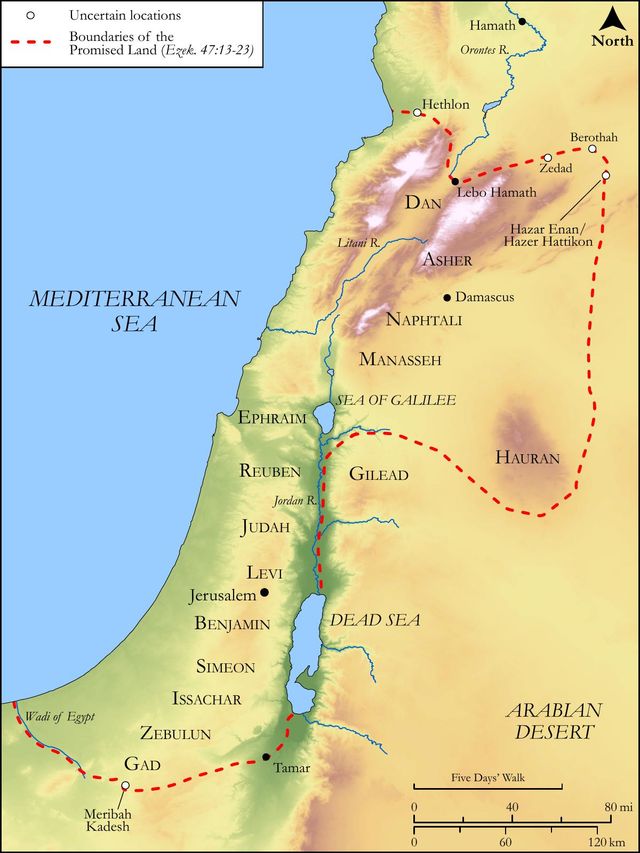
(Vers. 23 seqq.) And the rest of the tribes, from the eastern boundary to the western boundary, belong to Benjamin. And against the boundary of Benjamin, from the eastern boundary to the western boundary, belong to Simeon. And along the boundary of Simeon, from the eastern boundary to the western boundary, belong to Issachar. And along the boundary of Issachar, from the eastern boundary to the western boundary, belong to Zebulun. And along the boundary of Zebulun, from the eastern boundary to the sea, belong to Gad. And the border shall go to Gad towards the south side, and the end shall be at Thamar unto the waters of contradiction of Cades: the inheritance shall be against the great sea. This is the land which you shall divide by lot to the tribes of Israel, and these are their portions, says the Lord God. The portion which is always placed at the end in the numbering of the five and seven tribes is understood either as a part, a possession, or an inheritance: although Aquila and Symmachus interpret it as a neutral gender τὸ ὅριον, which means boundary. And it must be noted briefly that in the last five tribes, the tribe of Gad, which was mentioned earlier as being beyond the Jordan, is placed in the same area that Judas previously held, namely the southern region, and its boundary stretches from Thamar to the waters of contradiction at Kadesh, opposite the Great Sea: Thamar itself, which we have already mentioned, is now called Palmyra, and was built long ago by Solomon; for 'palm' in Hebrew is called Thamar, and some believe that it received this name because there are many palm trees there. And what follows: Even to the waters of contradiction of Cades, the inheritance against the great sea; for which seventy transferred from Theman, and the water of Mariboth, ((also Marimoth)) Cades, the inheritance even to the great sea, it is to be observed in the Hebrew language that the same word, Nehela (), is ambiguous, signifying both inheritance and torrent, and here it should be understood more as a torrent than as an inheritance. For this is the torrent that enters the great sea of Rhinocorura, as we have already mentioned. The place called Kadesh, which is also called Kadesh-Barnea in the book of Joshua, is in the desert, extending to the city of Petra. However, Mariboth, which means contradiction, is not a place name as many think, but a name for the waters in which the people contradicted the Lord and Moses offended God, as the Psalm says: They angered him also at the waters of strife, so that Moses suffered for their sins (Psalm 106:32). The entire inheritance of the Holy Land is bordered to the south by the boundaries of Egypt, Rhinocorura, and the River of Egypt. And because Gad is interpreted as temptation, in his possession we pass from the palm groves to the waters of contradiction, even to Kadesh, which is interpreted as holy, so that we may understand that even after the victory of the world we must be solicitous, and always in fear, and remember that verse: The life of man upon earth is a temptation (Job 7:1); and to attain holiness, resisting adversaries, and thus achieve victory, so that we may contemplate the nearby stream full of rain showers.
Continue studying Ezekiel 48:29 across the web’s major study libraries — every link below opens this exact verse, chapter, or book on the destination site.
Read & Compare
 BibleGatewayThis verse in more than 200 translations and 70 languages.
 Bible.comThe YouVersion reader — hundreds of translations, reading plans, and highlights.
 ESV.orgCrossway's official English Standard Version reader.
 NET BibleThe NET translation with 60,000+ translators' notes on every rendering decision.
 STEP BibleTyndale House's free study tool — original text, vocabulary, and scholarly resources.
 BibliaLogos Bible Software's free web reader.
 USCCBThe New American Bible (Revised Edition) with the U.S. bishops' study notes.
Commentaries
 BibleHub CommentariesDozens of classic commentaries on this verse, gathered on one page.
 StudyLightMore than 100 commentary sets — the largest collection on the web.
 BibleRefPlain-English commentary on what this verse means, verse by verse.
 Enduring WordDavid Guzik's free commentary on this chapter, widely used by Bible teachers.
 Bible Study ToolsVerse commentary alongside Greek and Hebrew study aids.
Original Language & Research
- BibleHub InterlinearThe verse word by word — original language, transliteration, and English.
- BibleHub LexiconEvery word's original-language definition and Strong's entry.
 Blue Letter BibleDeep-study tools — Strong's numbers, concordance, and word studies.
 SefariaThe Hebrew text with Rashi and centuries of Jewish commentary.
Sermons, Hymns & Audio


TrulyRandomVerse is not affiliated with these sites and doesn’t control their content. They’re linked because they’re genuinely useful.
Summary
Ezekiel 48:29 serves as the divine capstone to the elaborate vision of Israel's future land distribution, emphatically declaring that the meticulous allocation of territory among the twelve tribes is not a human arrangement but a direct, authoritative, and immutable decree from the Lord GOD Himself. This verse powerfully underscores God's absolute sovereignty, His unwavering faithfulness to His covenant promises, and the certainty of His comprehensive plan for His people's ultimate inheritance and secure dwelling in the restored land.
Context
ShowHideLiterary Context
Ezekiel 48:29 functions as the concluding affirmation of the book's final major section, which spans Ezekiel 40-48. This extensive prophetic vision meticulously details the blueprint for a restored temple, its intricate worship system, and the precise division of the land among the tribes of Israel. Following the detailed descriptions of the temple complex in Ezekiel 40 through Ezekiel 47, chapter 48 meticulously outlines the geographical boundaries and specific portions of land for each of the twelve tribes, culminating in the establishment of a holy district and the city named "The Lord Is There" (Ezekiel 48:35). Verse 29, therefore, acts as a powerful summary and divine validation, certifying the entire preceding vision of land distribution as God's own immutable word and plan, thereby sealing its authority and certainty.
Historical & Cultural Context
The prophecies of Ezekiel were delivered during the traumatic period of the Babylonian exile (circa 593-571 BC). The Jewish people had witnessed the destruction of Jerusalem and its sacred temple, and they were forcibly removed from their promised land. In this context of profound national despair and loss, the detailed vision of a meticulously restored temple and a divinely re-divided land offered immense hope and reassurance. It served as a powerful reminder of God's enduring covenant faithfulness, even in the midst of judgment and apparent abandonment. The practice of "dividing by lot" was a well-established method of land distribution in Israel, believed to reflect divine will and ensure impartiality. This method was famously employed in the allocation of Canaan among the tribes under Joshua's leadership (Joshua 14:2). By declaring that this future land division would occur "by lot" and was sanctioned by His own word, God further solidified the absolute divine authority and certainty behind this future inheritance, providing comfort and a tangible future for a dispossessed people.
Key Themes
ShowHideThis verse powerfully reinforces several overarching themes central to Ezekiel's prophecy and the broader biblical narrative. Firstly, it highlights Divine Sovereignty and Faithfulness, emphasizing that God's promises regarding the land—first given to Abraham in Genesis 12:7 and reiterated throughout the Pentateuch—are immutable and will be fulfilled despite Israel's disobedience and subsequent exile. Secondly, the concept of Inheritance and Possession is paramount; the land is presented not merely as a temporary dwelling but as a perpetual, divinely granted gift, signifying both physical dwelling and profound spiritual blessing for His covenant people. Thirdly, the meticulous division "by lot" underscores Divine Order and Justice, portraying God as one who establishes perfect order, equity, and a just allocation for each of His people. Finally, the entire vision, validated by this verse, speaks profoundly to Restoration and Future Hope, painting a comprehensive picture of renewal—not just spiritual, but also physical, communal, and geographical—for a people who had seemingly lost everything, culminating in the promise of God's enduring presence among them (Ezekiel 48:35).
Exposition and Analysis
ShowHideKey Word Analysis
ShowHideThis term, derived from a root meaning "to be firm," refers broadly to the earth, but specifically here denotes a particular territory or country. In the context of Ezekiel's prophecy, it signifies the promised land of Israel, which is central to God's covenant with His people. Its use emphasizes the tangible, geographical reality of the inheritance being described, assuring the exiles of a physical return and a secure dwelling.
A primitive root meaning "to fall," this word is used in a wide variety of applications, including "to divide by lot." The active sense here, "ye shall divide," implies human action, but the underlying method of "lot" (implied by the context of land distribution and the root's broader meaning of "to fall") indicates that this division is orchestrated or allowed to "fall" into place by divine providence. It signifies God's direct involvement and ultimate determination in the allocation process, ensuring it is not left to human caprice.
This term denotes something inherited, an heirloom, or an estate, derived from a root meaning "to inherit." It signifies a patrimony or portion passed down, emphasizing that the land is a divinely granted possession, a perpetual gift from God to His people. This concept connects directly to God's original covenant promises to Abraham, highlighting the enduring nature of God's commitment to provide for His people, not as a temporary dwelling, but as an eternal legacy.
Verse Breakdown
ShowHide"This [is] the land which ye shall divide by lot unto the tribes of Israel"
This opening clause directly refers to the preceding detailed descriptions in Ezekiel 48, affirming that the land described is indeed the one designated for distribution. The phrase "divide by lot" highlights the method of allocation, which, in ancient Israelite understanding, was a process guided by divine providence, ensuring fairness and God's ultimate determination of each tribe's territory. It underscores that this is not a human political maneuver or negotiation, but a sacred, divinely sanctioned act, assuring the exiles of a just and certain future.
"for inheritance"
This crucial phrase clarifies the purpose and enduring nature of the land division. The land is not merely a temporary dwelling place or a leased property, but a permanent, generational inheritance, a patrimony granted by God Himself. This concept connects back to God's original promises to Abraham and his descendants, emphasizing the enduring nature of God's covenant and His unwavering commitment to providing a secure and perpetual dwelling for His people, signifying both physical security and spiritual blessing.
"and these [are] their portions"
This reiterates and confirms the outcome of the division, emphasizing the meticulous and equitable nature of God's plan. The "portions" are the specific, divinely allocated shares of land for each tribe, demonstrating God's precise care for each segment of His people. It reinforces the idea that every tribe will receive its designated share according to His perfect will, ensuring order and justice in the restored community.
"saith the Lord GOD."
This concluding phrase serves as the ultimate stamp of divine authority and authenticity for the entire preceding vision. It is a common prophetic formula (Hebrew: nᵉʼum Yᵉhôvih ʼĂdônây), emphasizing that the entire vision and its intricate details originate directly from God Himself. This declaration removes any doubt about the certainty and immutability of the prophecy, assuring the audience that this future restoration is not merely a hopeful dream or human aspiration, but a guaranteed reality decreed by the sovereign, faithful, and covenant-keeping God.
Literary Devices
ShowHideEzekiel 48:29 employs several significant literary devices that amplify its message. The most prominent is the Divine Oracle Formula, signaled by the concluding phrase "saith the Lord GOD." This formula is a hallmark of prophetic literature, serving to authenticate the message as a direct word from God, thereby imbuing it with absolute authority, certainty, and immutability. The Repetition of key concepts like "land," "divide," "inheritance," and "portions" throughout chapters Ezekiel 40-48, culminating in this verse, creates a powerful sense of meticulous divine planning and emphasizes the tangible reality and precision of the promised restoration. There is also a strong element of Emphasis placed on the divine origin of the plan, which stands in stark contrast to human despair and inability, highlighting God's sovereign power to restore what was lost. Finally, the entire vision, summarized and sealed by this verse, functions as profound Symbolism, representing not just a literal future land division but also the ultimate, comprehensive restoration of God's people to a place of secure dwelling in His presence, under His perfect order, and in fulfillment of His abundant provision.
Theological and Thematic Connections
ShowHideEzekiel 48:29 powerfully encapsulates the profound theological truth of God's unwavering faithfulness to His covenant promises, even in the face of human failure and severe judgment. It demonstrates God's meticulous care for His people, providing not only spiritual restoration but also a tangible, ordered inheritance. The emphasis on the land being "divided by lot" and the concluding "saith the Lord GOD" underscores divine sovereignty over all circumstances, assuring that God's plans for His people's future are certain and will be perfectly executed according to His will. This verse speaks to the ultimate hope of a secure dwelling in God's presence, where His perfect order and justice prevail, and His people receive their divinely appointed portion, a testament to His enduring love and provision.
Reflection and Application
ShowHideEzekiel 48:29, though rooted in the specific historical context of Israel's restoration from exile, offers timeless and profound truths for believers today. It serves as a powerful reminder that God is a God of meticulous detail, unwavering faithfulness, and sovereign control over all things. Just as He had a precise and guaranteed plan for the physical inheritance of Israel, He has a perfect, sovereign plan for our lives, our spiritual inheritance, and the ultimate consummation of His kingdom. This verse calls us to trust implicitly in God's provision and divine order, even when our personal circumstances or the world around us seem chaotic, hopeless, or beyond human repair. It encourages us to find our ultimate security not in earthly possessions, human arrangements, or fleeting circumstances, but in the divine decrees of the Lord GOD, who promises an imperishable inheritance and a secure dwelling in His presence. We are invited to rest in the profound assurance that God's word is true, His promises are sure, and His ultimate plan for His people is one of complete restoration, perfect order, and eternal security.
Questions for Reflection
ShowHideFAQ
ShowHideWhat is the significance of the land being divided "by lot"?
ShowHideThe division of the land "by lot" (Hebrew: goral) was a common ancient practice, but in the biblical context, it carried profound theological weight. It was understood not as a random chance but as a method by which God's divine will and providence were revealed and confirmed (Proverbs 16:33). By stating that the land "ye shall divide by lot," Ezekiel 48:29 emphasizes that the allocation of territory to each tribe was not based on human negotiation, power, or preference, but was precisely ordained and determined by God Himself. This ensured impartiality, divine order, and the absolute authority behind the distribution, reinforcing that the land was a direct gift and perpetual inheritance from the Lord, secured by His sovereign decree.
Is the land division described in Ezekiel 40-48 a literal prophecy or symbolic?
ShowHideThe interpretation of Ezekiel 40-48, including the detailed land division, has been a subject of ongoing debate among biblical scholars. Some interpret it as a literal prophecy of a future, physical restoration of Israel, including a rebuilt temple and a re-divided land, which they believe will occur during a future millennial kingdom. Others view it primarily as symbolic, representing the spiritual restoration, order, and blessings of God's people under the new covenant, fulfilled in the church or ultimately in the new heavens and new earth. A mediating view suggests that while the details are highly symbolic of divine order, presence, and blessing, they also point to a future, tangible fulfillment that transcends the historical return from Babylonian exile. Regardless of the precise interpretive framework, the passage powerfully conveys God's unwavering commitment to His covenant people, His meticulous order, and His ultimate plan for secure dwelling and full restoration in His presence, sealed by the authoritative declaration "saith the Lord GOD" in Ezekiel 48:29.
Christ-Centered Fulfillment
ShowHideWhile Ezekiel 48:29 speaks directly to a future, physical inheritance for the tribes of Israel, its ultimate Christ-centered fulfillment transcends geographical boundaries and points to the spiritual inheritance and secure dwelling that believers receive in Christ. The meticulously divided land and the promise of a secure "portion" for each tribe foreshadow the "better country" (Hebrews 11:16) and the "imperishable, undefiled, and unfading inheritance" (1 Peter 1:4) that is reserved in heaven for those united with Christ. Jesus himself promised, "In My Father's house are many rooms; if it were not so, I would have told you. I am going there to prepare a place for you" (John 14:2), signifying a spiritual dwelling and secure portion for His followers. The "Lord GOD" who declares this inheritance in Ezekiel is the same God who, through Christ, "has qualified you to share in the inheritance of the saints in the kingdom of light" (Colossians 1:12). Ultimately, the vision of a land where God dwells among His people finds its glorious and eternal consummation in the new heaven and new earth, where the "dwelling place of God is with man, and He will dwell with them" (Revelation 21:3), and believers inherit eternal life and co-reign with Christ in a perfectly ordered, secure, and divinely provided reality.