


Ezekiel 48:30
Bible text: King James Version (1769 Blayney text) · Public domain
Bible text: Berean Standard Bible · Public domain
Bible text: American Standard Version (1901) · Public domain
Bible text: World English Bible, Messianic edition · Public domain
Bible text: Geneva Bible (1599) · Public domain
Bible text: Young's Literal Translation · Public domain
- וְאֵלֶּהve·'E·lehand theseH428Conj-w ¦ PrtParticle Demonstrativeוְandאֵלֶּהthese
- תּוֹצְאֹתtotz·'Ot[will be] [the] exits ofH8444N-fpcNoun Plural Feminine Construct
- הָעִירha·'Irthe cityH5892Art ¦ N-fsNoun Singular Feminine Absoluteהָtheעִירcity
- מִפְּאַתmi·pe·'Atfrom [the] side ofH6285Prep-m ¦ N-fscNoun Singular Feminine Constructמִfromפְּאַת[the] side of
- צָפוֹןtza·Fon[the] northH6828N-fsNoun Singular Feminine Absolute
- חֲמֵשׁcha·Mesh[will be] fiveH2568Adj-cscAdjective Numerical Singular common gender Construct
- מֵאוֹתme·'othundred<s>H3967Adj-fpAdjective Numerical Plural Feminine Absolute
- וְאַרְבַּעַתve·'ar·Ba·'atand fourH702Conj-w ¦ Adj-cscAdjective Numerical Singular common gender Constructוְandאַרְבַּעַתfour
- אֲלָפִים'a·la·Fimthousand [cubits]H505Adj-cpAdjective Numerical Plural common gender Absolute
- מִדָּהmi·Dah[the] measurementH4060N-fsNoun Singular Feminine Absolute
English is a literal word-by-word gloss of the Hebrew, not the KJV's wording. Why?
This is the original text the KJV's translators worked from — each Hebrew word with its own literal English meaning in this verse, prepared by scholars at Tyndale House, Cambridge. The KJV translates whole sentences, not word by word, so its wording differs: one Hebrew word can become several English words, and the KJV may choose “the LORD” where the gloss reads “Yahweh”. Both are faithful — they answer different questions. For the KJV's own rendering, switch to the KJV text.
Details
See on the biblical-era map
Study this verse
Historical interpretation
Two Centuries of Reception
2 surviving comments on this verse. Each one is dated, so this reads as a timeline rather than a list.
Select a marker to jump to its quote. Markers stagger vertically where authors wrote within a few decades of each other.
But we do confess that a kingdom is promised to us upon the earth, although before heaven, only in another state of existence; inasmuch as it will be after the resurrection for a thousand years in the divinely-built city of Jerusalem, "let down from heaven," [Revelation 21:2] which the apostle also calls "our mother from above;" [Galatians 4:26] and, while declaring that our πολίτευμα, or citizenship, is in heaven, he predicates of it that it is really a city in heaven. This both Ezekiel had knowledge of [Ezekiel 48:30-35] and the Apostle John beheld. [Revelation 21:10-23] And the word of the new prophecy which is a part of our belief, attests how it foretold that there would be for a sign a picture of this very city exhibited to view previous to its manifestation. This prophecy, indeed, has been very lately fulfilled in an expedition to the East. For it is evident from the testimony of even heathen witnesses, that in Judæa there was suspended in the sky a city early every morning for forty days. As the day advanced, the entire figure of its walls would wane gradually, and sometimes it would vanish instantly. We say that this city has been provided by God for receiving the saints on their resurrection, and refreshing them with the abundance of all really spiritual blessings, as a recompense for those which in the world we have either despised or lost; since it is both just and God-worthy that His servants should have their joy in the place where they have also suffered affliction for His name's sake. Of the heavenly kingdom this is the process. After its thousand years are over, within which period is completed the resurrection of the saints, who rise sooner or later according to their deserts there will ensue the destruction of the world and the conflagration of all things at the judgment: we shall then be changed in a moment into the substance of angels, even by the investiture of an incorruptible nature, and so be removed to that kingdom in heaven of which we have now been treating, just as if it had not been predicted by the Creator, and as if it were proving Christ to belong to the other god and as if he were the first and sole revealer of it.
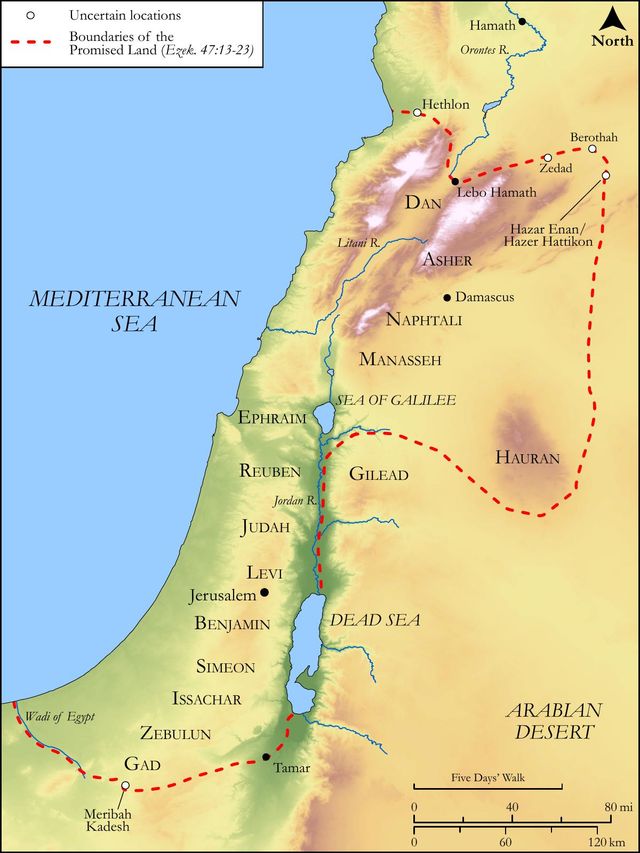
(Verse 30 and following) And you shall measure five thousand four hundred cubits outside the city on the northern side. And the gates of the city shall be named after the tribes of Israel: three gates on the north side. The gate of Reuben, one; the gate of Judah, one; the gate of Levi, one. And on the eastern side, you shall measure five thousand four hundred cubits, and there shall be three gates. The gate of Joseph, one; the gate of Benjamin, one; the gate of Dan, one. And on the southern side, you shall measure five thousand four hundred cubits, and there shall be three gates. The Gate of Simeon, one; the Gate of Issachar, one; the Gate of Zebulun, one. And on the west side, five hundred and four thousand, and their gates three. The Gate of Gad, one; the Gate of Asher, one; the Gate of Naphtali, one; in all eighteen thousand cubits round about the city. And the name of the city from that day shall be, The LORD is there. Now it is written that it was measured along each side, which is eleven thousand and eighty-five paces, that there were three gates, which Aquila, Symmachus, and Theodotion call διεξόδους (exit passages), and the LXX call διεκβολὰς (projections): we interpret them as the entrances and exits of the city. And first, it must be briefly noted that the same three tribes camped around the tabernacle in such a way that Judah, Issachar, and Zebulun, the sons of Leah, were to the east; and to the south, Reuben, Simeon, and Gad, the two sons of Leah, and the third son of Leah's handmaid, Zilpah. But towards the west Ephraim and Manasseh, and Benjamin namely, the two sons of Rachel; for Joseph, who was from the tribe of Levi, which was appointed for sacrifices, was divided into two tribes, Ephraim and Manasseh. But towards the north, there are Dan, Asher, and Naphtali, of whom the first and third are the sons of Bilhah, Rachel's maidservant, and the second is the son of Zilpah, Leah's maidservant, who are of lowly birth and are positioned towards the north, being descendants of maidservants who were in conflict with each other. According to the book of Numbers and the description of the tabernacle, which was dictated by God to Moses (Num. XXXIV). But our city, which is the city of the great king of which God is the artificer and the founder, of which the psalmist sings: Shall it be said of Sion: This man and that man is born in her? and the Highest himself hath founded her (Ps. LXXXVI, 5), has a different description of the tribes in the holy land, and the measurement of the city and the order of possessions, and the boundaries of each tribe. First, three gates or exits of the city are opposed to the blows of the North Wind, of which the firstborn is Reuben, and Judah the founder of the royal line, and Levi, over whose name nothing is said in the description of the tabernacle and the sacred things, so that as possessors of the firstborn, we may despise the cold of the North. Second, towards the East are Joseph, Benjamin, and Dan: both sons of Rachel, and one of her maidservant Bilhah. But towards the South, Simeon, Issachar, and Zebulun, who are three sons of Leah. Furthermore, towards the West, Gad, Asher, and Naphtali: the first two of whom are sons of Zilpah, Leah's handmaid, and the third son of Bilhah, Rachel's handmaid. Who is wise and understands these things? Understanding, will he know them? For the ways of the Lord are straight, and the just shall walk in them, but transgressors shall stumble upon them (Hosea, 14:10). I think that these twelve gates, or exits, were assigned to each tribe under the names of the Apostles and Patriarchs, according to the quality of their merits and virtues: of which it is written more explicitly in the Apocalypse of John, and many sacraments of the divine Scriptures testify (Apoc. 21). And it is necessary for such a city to hold eighteen thousand revolutions of calamities: under which number, and in the twenty-second Psalm, the natural law is written, and the grace of the Gospel is described: for which the Church, that is, the city of the Savior, is built. The name of this city will by no means be as before Jerusalem, which means vision of peace, but Adonai Sama ((Al. Adonaisan et Adonaisamia)) () which is translated into the Latin language, the Lord is there, who will never depart from it, as He said to the disciples before departing from the previous people: Arise, let us go from here (John XIV, 31). And to the Jews: Let your house be left desolate to you (Matt. 23:38): but let it have eternal possession, and let it be its own possession, promising the same to his disciples: Behold, I am with you always, even unto the end of the world (Matt. 28:20).
Continue studying Ezekiel 48:30 across the web’s major study libraries — every link below opens this exact verse, chapter, or book on the destination site.
Read & Compare
 BibleGatewayThis verse in more than 200 translations and 70 languages.
 Bible.comThe YouVersion reader — hundreds of translations, reading plans, and highlights.
 ESV.orgCrossway's official English Standard Version reader.
 NET BibleThe NET translation with 60,000+ translators' notes on every rendering decision.
 STEP BibleTyndale House's free study tool — original text, vocabulary, and scholarly resources.
 BibliaLogos Bible Software's free web reader.
 USCCBThe New American Bible (Revised Edition) with the U.S. bishops' study notes.
Commentaries
 BibleHub CommentariesDozens of classic commentaries on this verse, gathered on one page.
 StudyLightMore than 100 commentary sets — the largest collection on the web.
 BibleRefPlain-English commentary on what this verse means, verse by verse.
 Enduring WordDavid Guzik's free commentary on this chapter, widely used by Bible teachers.
 Bible Study ToolsVerse commentary alongside Greek and Hebrew study aids.
Original Language & Research
- BibleHub InterlinearThe verse word by word — original language, transliteration, and English.
- BibleHub LexiconEvery word's original-language definition and Strong's entry.
 Blue Letter BibleDeep-study tools — Strong's numbers, concordance, and word studies.
 SefariaThe Hebrew text with Rashi and centuries of Jewish commentary.
Sermons, Hymns & Audio


TrulyRandomVerse is not affiliated with these sites and doesn’t control their content. They’re linked because they’re genuinely useful.
Summary
Ezekiel 48:30 provides a precise measurement for the north side of the visionary holy city, detailing its perimeter as "four thousand and five hundred measures." This verse is part of the climactic final chapter of Ezekiel's prophecy, which meticulously describes the layout of a restored Israel, the new temple, and a divinely ordered city. It underscores the meticulous nature of God's plans for future restoration and the establishment of His dwelling among His people, emphasizing divine precision and order in the eschatological vision of His kingdom.
Context
ShowHideLiterary Context
Ezekiel 48:30 is situated within the culminating section of the Book of Ezekiel, specifically chapters 40-48. Following extensive prophecies of judgment against Israel and surrounding nations, these chapters pivot dramatically to a detailed vision of restoration and renewal. Chapters 40-43 describe the new temple and its intricate design, while Ezekiel 44-46 outline its ordinances, priestly service, and worship. Ezekiel 47 introduces the miraculous, life-giving river flowing from the temple, bringing healing and fruitfulness to the land. Chapter 48 then details the precise division of the land among the twelve tribes, culminating in the meticulous description of the holy city's dimensions and gates. This verse, therefore, serves as a specific architectural detail within a grand, divinely orchestrated blueprint for a future, ideal Israel, highlighting the comprehensive nature of God's restorative work.
Historical & Cultural Context
Ezekiel prophesied during the traumatic period of the Babylonian exile (c. 593-571 BC), a time of profound despair and displacement for the Jewish people. The destruction of Jerusalem and the First Temple by Babylon in 586 BC left the exiles questioning God's faithfulness, the permanence of His covenant, and the future of their nation. In this context of national trauma and theological crisis, Ezekiel's elaborate vision of a new temple, a re-divided land, and a holy city served as a profound message of hope, assurance, and divine sovereignty. The meticulous measurements and detailed descriptions, reminiscent of the instructions for the Tabernacle (Exodus 25-31) and Solomon's Temple (1 Kings 6), would have resonated deeply with an audience familiar with divine blueprints for sacred spaces. This precision underscored the reality and certainty of God's future restoration, contrasting sharply with the chaos and destruction they had experienced.
Key Themes
ShowHideEzekiel 48:30 contributes to several overarching themes that permeate Ezekiel's vision. Firstly, it highlights Divine Order and Precision. The meticulous measurements throughout Ezekiel 40-48, including the specific dimensions of the city's north side in Ezekiel 48:30, emphasize God's perfect planning and attention to every detail of His restored kingdom. This divine exactitude assures the reader of the certainty and reliability of God's promises. Secondly, it reinforces the theme of Restoration and Reestablishment. Coming after prophecies of judgment and desolation, this detailed vision offers a powerful message of hope for a future where Israel is not only re-gathered but also dwells in a perfectly ordered, holy city, signifying a complete reversal of their fortunes. Finally, the city itself is a central theme: The Future Holy City. Its symmetrical dimensions (4,500 measures on each of its four sides, as seen in Ezekiel 48:30-34) signify its perfection, holiness, and its ultimate name, "The Lord is There" (Yahweh Shammah), which is the crowning truth of the entire vision, promising God's perpetual presence among His people.
Exposition and Analysis
ShowHideKey Word Analysis
ShowHideThis term (H8444) refers to an "exit," but in a geographical context, it specifically denotes a "boundary" or "border." In Ezekiel 48:30, it indicates the perimeter or outward extent of the city's wall on the specified side. It emphasizes the defined and fixed nature of the city's dimensions, marking its precise limits.
The word (H5892) broadly means a "city," "town," or even an "encampment." It implies a guarded or watched place, suggesting security and order. In this prophetic vision, it refers to the holy city, distinct from the temple area, which is the dwelling place for God's people, meticulously planned and protected by divine design.
This feminine noun (H4060) signifies "extension," "height," "breadth," or a "measure" itself, including its standard. It refers to a unit of length, likely the measuring reed mentioned in Ezekiel 40:5, which was six cubits long. The use of "measures" here underscores the precise, quantifiable, and divinely ordained dimensions of the city, emphasizing its perfect design.
Verse Breakdown
ShowHide"And these [are] the goings out of the city"
This phrase introduces the description of the city's perimeter or boundary lines. The "goings out" signify the outer limits of the city, emphasizing that its dimensions are clearly defined and established. This sets the stage for the precise measurements that follow, indicating a divinely ordered and contained space, distinct from its surroundings.
"on the north side"
This specifies the particular side of the city being described. The city is presented as a perfect square in the subsequent verses, and this phrase focuses on one of its four equal sides. The mention of a specific direction highlights the systematic and comprehensive nature of the visionary blueprint, leaving no detail to chance and underscoring the divine architect's thoroughness.
"four thousand and five hundred measures"
This provides the exact length of the north side of the city. The "measures" refer to a specific unit of length (likely the measuring reed, approximately 10.5 feet or 3.2 meters), indicating a precise and substantial dimension. This numerical exactitude underscores the divine intentionality and perfection inherent in the design of the holy city, signifying its completeness, orderly nature, and the certainty of its future existence.
Literary Devices
ShowHideThe primary literary device at play in Ezekiel 48:30, and indeed throughout the latter chapters of Ezekiel, is Symbolism. The precise measurements and detailed architectural descriptions are not merely technical specifications but serve as powerful symbols of divine order, perfection, and the certainty of God's future restoration. The exact "four thousand and five hundred measures" for each side of the city (implied by the subsequent verses, Ezekiel 48:30-34) create a perfect square, a common ancient symbol of completeness, stability, and divine presence. This Precision in detail itself acts as a literary device, conveying God's meticulous care, His absolute control over the future, and the unwavering certainty of His prophetic promises. The entire vision is also a prime example of Prophetic Vision, a genre where divine revelation is communicated through elaborate, often symbolic, imagery that points to future realities, both literal and spiritual, designed to inspire hope and instruct the audience.
Theological and Thematic Connections
ShowHideEzekiel 48:30, though a seemingly technical detail, is profoundly significant in its theological implications. It speaks to God's ultimate intention to dwell among His people in perfect order and holiness. The meticulous precision of the city's dimensions reflects the divine character—a God who is sovereign, faithful, and brings about His purposes with absolute certainty and perfection. This vision of a perfectly ordered city, ultimately named "The Lord is There" (Ezekiel 48:35), assures believers of God's unwavering commitment to His covenant promises and His desire for intimate, perpetual fellowship with humanity. It points to an eschatological reality where God's presence is fully established, bringing peace, order, and life to His redeemed creation, a truth that resonates throughout biblical prophecy.
Reflection and Application
ShowHideEzekiel 48:30, with its precise measurements of the holy city, offers profound comfort and challenge for contemporary believers. In a world often characterized by chaos, uncertainty, and brokenness, this vision reminds us of God's ultimate reign, which is marked by perfect order, peace, and holiness. It assures us that God's plans are meticulous and certain, even when our circumstances feel anything but. This divine precision in the future city's design encourages us to trust in God's sovereign control over our lives and the world, knowing that His purposes will unfailingly come to pass. It inspires hope that despite present struggles, God is faithfully working towards a glorious future where His presence will be fully manifested, and all things will be set right. We are called to live in light of this future hope, striving for order and holiness in our own lives, knowing that our God is a God of perfect design and that our ultimate dwelling is with Him.
Questions for Reflection
ShowHideFAQ
ShowHideWhat is the significance of the "measures" in Ezekiel 48:30?
ShowHideThe "measures" (H4060, middâh) refer to a specific unit of length used in Ezekiel's vision, likely the measuring reed mentioned earlier in Ezekiel 40:5, which was six cubits long (approximately 10.5 feet or 3.2 meters). The precise number, "four thousand and five hundred measures," for each side of the city (implied by the subsequent verses describing the other sides in Ezekiel 48:31-34) emphasizes the divine order, perfection, and completeness of the future holy city. It signifies that this is not a vague promise but a meticulously planned reality, underscoring God's intentionality, faithfulness, and the exactitude of His eschatological design.
Is the city described in Ezekiel 48:30 a literal city or a symbolic one?
ShowHideThe interpretation of Ezekiel's temple and city vision, including the dimensions in Ezekiel 48:30, varies among scholars. Some interpret it as a literal, future temple and city that will be built during the millennial reign of Christ, emphasizing the physical fulfillment of prophecy. Others view it as primarily symbolic, representing the ideal spiritual reality of God's dwelling with His people in the New Covenant era or the New Heavens and New Earth, focusing on the spiritual truths conveyed. A third view sees it as an ideal blueprint that was never literally fulfilled in the post-exilic period, but whose spiritual truths about God's presence, order, and holiness remain eternally valid. Regardless of the literal-symbolic debate, the passage powerfully conveys the themes of divine order, restoration, and God's permanent presence with His people, culminating in the city's name, "The Lord is There" (Yahweh Shammah).
Christ-Centered Fulfillment
ShowHideEzekiel 48:30, with its precise description of the holy city's dimensions, finds its ultimate Christ-centered fulfillment in the person and work of Jesus Christ and the New Covenant reality He inaugurates. While Ezekiel's vision points to a future, divinely ordered dwelling place, the New Testament reveals that Christ Himself is the true Temple, the ultimate place where God dwells among humanity (John 2:19-21). Through His sacrificial death and glorious resurrection, Christ establishes the new spiritual reality where believers, as living stones, are built into a spiritual house (1 Peter 2:5), a holy temple in the Lord (Ephesians 2:20-22). The meticulous order and perfection of Ezekiel's city foreshadow the perfect order and holiness found in Christ, who is the foundation (1 Corinthians 3:11) and cornerstone (Ephesians 2:20) of God's eternal dwelling. Ultimately, the vision culminates in the New Jerusalem of Revelation 21, where there is no physical temple because "the Lord God Almighty and the Lamb are its temple" (Revelation 21:22). Thus, the "goings out" and precise measures of Ezekiel's city point forward to the boundless, perfect, and eternal presence of God fully realized in and through Christ, who is the very essence of "Yahweh Shammah" for all eternity, bringing God's perfect order to His redeemed people.