


Ezekiel 48:35
Bible text: King James Version (1769 Blayney text) · Public domain
Bible text: Berean Standard Bible · Public domain
Bible text: American Standard Version (1901) · Public domain
Bible text: World English Bible, Messianic edition · Public domain
Bible text: Geneva Bible (1599) · Public domain
Bible text: Young's Literal Translation · Public domain
- סָבִיבsa·Viv[the] circuitH5439N-csNoun Singular common gender Absolute
- שְׁמֹנָהshe·mo·Nah[will be] eight-H8083Adj-csAdjective Numerical Singular common gender Absolute
- עָשָׂר'a·SarteenH6240Adj-csAdjective Numerical Singular common gender Absolute
- אָלֶף'A·lefthousand [cubits]H505Adj-csAdjective Numerical Singular common gender Absolute
- וְשֵׁםve·shemand [the] name ofH8034Conj-w ¦ N-mscNoun Singular Masculine Constructוְandשֵׁם[the] name of
- הָעִירha·'Irthe cityH5892Art ¦ N-fsNoun Singular Feminine Absoluteהָtheעִירcity
- מִיּוֹםmi·Yomfrom [the] dayH3117Prep-m ¦ N-msNoun Singular Masculine Absoluteמִfromיּוֹם[the] day
- יְהוָהYah·weh[will be] YahwehH3068N-properNoun Proper Title
- שָׁמָּהSha·mah[Is] There <towards>H8033Adv ¦ SfxAdverbשָׁמָּ[Is] Thereה<towards>
English is a literal word-by-word gloss of the Hebrew, not the KJV's wording. Why?
This is the original text the KJV's translators worked from — each Hebrew word with its own literal English meaning in this verse, prepared by scholars at Tyndale House, Cambridge. The KJV translates whole sentences, not word by word, so its wording differs: one Hebrew word can become several English words, and the KJV may choose “the LORD” where the gloss reads “Yahweh”. Both are faithful — they answer different questions. For the KJV's own rendering, switch to the KJV text.
Details
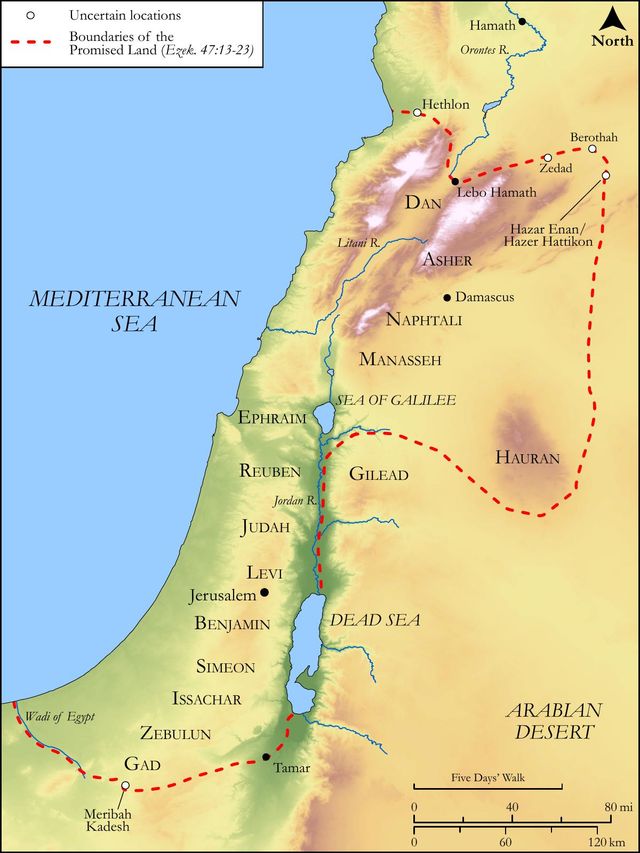
See on the biblical-era map
Study this verse
Public-domain commentary
Matthew Henry
From his Commentary on the Whole Bible. Henry comments on passages, not single verses — this entry covers Ezekiel 48:31–35.
We have here a further account of the city that should be built for the metropolis of this glorious land, and to be the receptacle of those who would come from all parts to worship in the sanctuary adjoining. It is nowhere called Jerusalem, nor is the land which we have had such a particular account of the dividing of any where called the land of Canaan; for the old names are forgotten, to intimate that the old things are done away, behold all things have become new. Now, concerning this city, observe here, 1. The measures of its out-lets, and the grounds belonging to it, for its several conveniences; each way its appurtenances extended 4500 measures 18,000 in all, Eze 48:35. But what these measures were is uncertain. It is never said, in all this chapter, whether so many reeds (as our translation determines by inserting that word, Eze 48:8, each reed containing six cubits and span, Eze 40:5, and why should the measurer appear with the measuring reed in his hand of that length if he did not measure with that, except where it is expressly said he measured by cubits?) or whether, as others think, it is so many cubits, because those are mentioned Eze 45:2 and Eze 47:3. Yet that makes me incline rather to think that where cubits are not mentioned must be intended so many lengths of the measuring reed. But those who understand it of so many cubits are not agreed whether it be meant of the common cubit, which was half a yard, or the geometrical cubit, which, for better expedition, is supposed to be mostly used in surveying lands, which, some say, contained six cubits, others about three cubits and a half, so making 1000 cubits the same with 1000 paces, that is, an English mile. But our being left at this uncertainty is an intimation that these things are to be understood spiritually, and that what is principally meant is that there is an exact and just proportion observed by Infinite Wisdom in modelling the gospel church, which though now we cannot discern we shall when we come to heaven. 2. The number of its gates. It had twelve gates in all, three on each side, which was very agreeable when it lay four square; and these twelve gates were inscribed to the twelve tribes. Because the city was to be served out of all the tribes of Israel (Eze 48:19) it was fit that each tribe should have its gate; and, Levi being here taken in, to keep to the number twelve Ephraim and Manasseh are made one in Joseph, Eze 48:32. On the north side were the gates of Reuben, Judah, and Levi (Eze 48:31), on the east the gates of Joseph, Benjamin, and Dan (Eze 48:32), on the south the gates of Simeon, Issachar, and Zebulun (Eze 48:33), and on the west the gates of Gad, Asher, and Naphtali, Eze 48:34. Conformable to this, in St. John's vision, the new Jerusalem (for so the holy city is called there, though not here) has twelve gates, three on a side, and on them are written the names of the twelve tribes of the children of Israel, Rev 21:12, Rev 21:13. Note, Into the church of Christ, both militant and triumphant, there is a free access by faith for all that come of every tribe, from every quarter. Christ has opened the kingdom of heaven for all believers. Whoever will may come and take of the water of life, of the tree of life, freely. 3. The name given to this city: From that day, when it shall be newly-erected according to this model, the name of it shall be, not, as before, Jerusalem - The vision of peace, but which is the original of that, and more than equivalent to it, Jehovah Shammah - The Lord is there, Eze 48:35. This intimated, (1.) That the captives, after their return, should have manifest tokens of God's presence with them and his residence among them, both in his ordinances and his providences. They shall have no occasion to ask, as their fathers did, Is the Lord among us, or is he not? for they shall see and say that he is with them of a truth. And then, though their troubles were many and threatening, they were like the bush which burned but was not consumed, because the Lord was there. But when God departed from their temple, when he said, Migremus hinc - Let us go hence, their house was soon left unto them desolate. Being no longer his, it was not much longer theirs. (2.) That the gospel-church should likewise have the presence of God in it, though not in the Shechinah, as of old, yet in a token of it no less sure, that of his Spirit. Where the gospel is faithfully preached, gospel ordinances are duly administered, and God is worshipped in the name of Jesus Christ only, it may truly be said, The Lord is there; for faithful is he that has said, and he will be as good as his word, Lo, I am with you always even unto the end of the world. The Lord is there in his church, to rule and govern it, to protect and defend it, and graciously to accept and own his sincere worshippers, and to be nigh unto them in all that they call upon him for. This should engage us to keep close to the communion of saints, for the Lord is there; and then whither shall we go to better ourselves? Nay, it is true of every good Christian; he dwells in God, and God in him; whatever soul has in it a living principle of grace, it may be truly said, The Lord is There. (3.) That the glory and happiness of heaven should consist chiefly in this, that the Lord is there. St. John's representation of that blessed state does indeed far exceed this in many respects. That is all gold, and pearls, and precious stones; it is much larger than this, and much brighter, for it needs not the light of the sun. But, in making the presence of God the principal matter of its bliss, they both agree. There the happiness of the glorified saints is made to be that God himself shall be with them (Rev 21:3), that he who sits on the throne shall dwell among them, Rev 7:15. And here it is made to crown the bliss of this holy city that the Lord is there. Let us therefore give all diligence to make sure to ourselves a place in that city, that we may be for ever with the Lord.
Historical interpretation
Two Centuries of Reception
2 surviving comments on this verse. Each one is dated, so this reads as a timeline rather than a list.
Select a marker to jump to its quote. Markers stagger vertically where authors wrote within a few decades of each other.
But we do confess that a kingdom is promised to us upon the earth, although before heaven, only in another state of existence; inasmuch as it will be after the resurrection for a thousand years in the divinely-built city of Jerusalem, "let down from heaven," [Revelation 21:2] which the apostle also calls "our mother from above;" [Galatians 4:26] and, while declaring that our πολίτευμα, or citizenship, is in heaven, he predicates of it that it is really a city in heaven. This both Ezekiel had knowledge of [Ezekiel 48:30-35] and the Apostle John beheld. [Revelation 21:10-23] And the word of the new prophecy which is a part of our belief, attests how it foretold that there would be for a sign a picture of this very city exhibited to view previous to its manifestation. This prophecy, indeed, has been very lately fulfilled in an expedition to the East. For it is evident from the testimony of even heathen witnesses, that in Judæa there was suspended in the sky a city early every morning for forty days. As the day advanced, the entire figure of its walls would wane gradually, and sometimes it would vanish instantly. We say that this city has been provided by God for receiving the saints on their resurrection, and refreshing them with the abundance of all really spiritual blessings, as a recompense for those which in the world we have either despised or lost; since it is both just and God-worthy that His servants should have their joy in the place where they have also suffered affliction for His name's sake. Of the heavenly kingdom this is the process. After its thousand years are over, within which period is completed the resurrection of the saints, who rise sooner or later according to their deserts there will ensue the destruction of the world and the conflagration of all things at the judgment: we shall then be changed in a moment into the substance of angels, even by the investiture of an incorruptible nature, and so be removed to that kingdom in heaven of which we have now been treating, just as if it had not been predicted by the Creator, and as if it were proving Christ to belong to the other god and as if he were the first and sole revealer of it.
(Verse 30 and following) And you shall measure five thousand four hundred cubits outside the city on the northern side. And the gates of the city shall be named after the tribes of Israel: three gates on the north side. The gate of Reuben, one; the gate of Judah, one; the gate of Levi, one. And on the eastern side, you shall measure five thousand four hundred cubits, and there shall be three gates. The gate of Joseph, one; the gate of Benjamin, one; the gate of Dan, one. And on the southern side, you shall measure five thousand four hundred cubits, and there shall be three gates. The Gate of Simeon, one; the Gate of Issachar, one; the Gate of Zebulun, one. And on the west side, five hundred and four thousand, and their gates three. The Gate of Gad, one; the Gate of Asher, one; the Gate of Naphtali, one; in all eighteen thousand cubits round about the city. And the name of the city from that day shall be, The LORD is there. Now it is written that it was measured along each side, which is eleven thousand and eighty-five paces, that there were three gates, which Aquila, Symmachus, and Theodotion call διεξόδους (exit passages), and the LXX call διεκβολὰς (projections): we interpret them as the entrances and exits of the city. And first, it must be briefly noted that the same three tribes camped around the tabernacle in such a way that Judah, Issachar, and Zebulun, the sons of Leah, were to the east; and to the south, Reuben, Simeon, and Gad, the two sons of Leah, and the third son of Leah's handmaid, Zilpah. But towards the west Ephraim and Manasseh, and Benjamin namely, the two sons of Rachel; for Joseph, who was from the tribe of Levi, which was appointed for sacrifices, was divided into two tribes, Ephraim and Manasseh. But towards the north, there are Dan, Asher, and Naphtali, of whom the first and third are the sons of Bilhah, Rachel's maidservant, and the second is the son of Zilpah, Leah's maidservant, who are of lowly birth and are positioned towards the north, being descendants of maidservants who were in conflict with each other. According to the book of Numbers and the description of the tabernacle, which was dictated by God to Moses (Num. XXXIV). But our city, which is the city of the great king of which God is the artificer and the founder, of which the psalmist sings: Shall it be said of Sion: This man and that man is born in her? and the Highest himself hath founded her (Ps. LXXXVI, 5), has a different description of the tribes in the holy land, and the measurement of the city and the order of possessions, and the boundaries of each tribe. First, three gates or exits of the city are opposed to the blows of the North Wind, of which the firstborn is Reuben, and Judah the founder of the royal line, and Levi, over whose name nothing is said in the description of the tabernacle and the sacred things, so that as possessors of the firstborn, we may despise the cold of the North. Second, towards the East are Joseph, Benjamin, and Dan: both sons of Rachel, and one of her maidservant Bilhah. But towards the South, Simeon, Issachar, and Zebulun, who are three sons of Leah. Furthermore, towards the West, Gad, Asher, and Naphtali: the first two of whom are sons of Zilpah, Leah's handmaid, and the third son of Bilhah, Rachel's handmaid. Who is wise and understands these things? Understanding, will he know them? For the ways of the Lord are straight, and the just shall walk in them, but transgressors shall stumble upon them (Hosea, 14:10). I think that these twelve gates, or exits, were assigned to each tribe under the names of the Apostles and Patriarchs, according to the quality of their merits and virtues: of which it is written more explicitly in the Apocalypse of John, and many sacraments of the divine Scriptures testify (Apoc. 21). And it is necessary for such a city to hold eighteen thousand revolutions of calamities: under which number, and in the twenty-second Psalm, the natural law is written, and the grace of the Gospel is described: for which the Church, that is, the city of the Savior, is built. The name of this city will by no means be as before Jerusalem, which means vision of peace, but Adonai Sama ((Al. Adonaisan et Adonaisamia)) () which is translated into the Latin language, the Lord is there, who will never depart from it, as He said to the disciples before departing from the previous people: Arise, let us go from here (John XIV, 31). And to the Jews: Let your house be left desolate to you (Matt. 23:38): but let it have eternal possession, and let it be its own possession, promising the same to his disciples: Behold, I am with you always, even unto the end of the world (Matt. 28:20).
Continue studying Ezekiel 48:35 across the web’s major study libraries — every link below opens this exact verse, chapter, or book on the destination site.
Read & Compare
 BibleGatewayThis verse in more than 200 translations and 70 languages.
 Bible.comThe YouVersion reader — hundreds of translations, reading plans, and highlights.
 ESV.orgCrossway's official English Standard Version reader.
 NET BibleThe NET translation with 60,000+ translators' notes on every rendering decision.
 STEP BibleTyndale House's free study tool — original text, vocabulary, and scholarly resources.
 BibliaLogos Bible Software's free web reader.
 USCCBThe New American Bible (Revised Edition) with the U.S. bishops' study notes.
Commentaries
 BibleHub CommentariesDozens of classic commentaries on this verse, gathered on one page.
 StudyLightMore than 100 commentary sets — the largest collection on the web.
 BibleRefPlain-English commentary on what this verse means, verse by verse.
 Enduring WordDavid Guzik's free commentary on this chapter, widely used by Bible teachers.
 Bible Study ToolsVerse commentary alongside Greek and Hebrew study aids.
Original Language & Research
- BibleHub InterlinearThe verse word by word — original language, transliteration, and English.
- BibleHub LexiconEvery word's original-language definition and Strong's entry.
 Blue Letter BibleDeep-study tools — Strong's numbers, concordance, and word studies.
 SefariaThe Hebrew text with Rashi and centuries of Jewish commentary.
Sermons, Hymns & Audio


TrulyRandomVerse is not affiliated with these sites and doesn’t control their content. They’re linked because they’re genuinely useful.
Summary
Ezekiel 48:35 serves as the climactic and profound conclusion to Ezekiel's extensive vision of a restored Israel, a new temple, and a holy city. Following meticulous descriptions of the city's vast dimensions and the divinely ordained tribal land divisions, this verse culminates the prophecy with a powerful declaration of the city's ultimate identity: "The LORD is there." This name signifies God's permanent, glorious, and intimate presence dwelling among His people, reversing the earlier narrative of His departure and establishing an era of divine indwelling, peace, and security that defines the very essence of this eschatological city.
Context
ShowHideLiterary Context
Ezekiel 48:35 provides the dramatic conclusion to the final major section of the book, chapters 40-48, which unveil an elaborate vision of a new temple, a re-allotted land for the twelve tribes, and a meticulously described holy city. This vision stands in stark contrast to the earlier prophecies of judgment, destruction, and the departure of God's glory from the first temple, vividly depicted in Ezekiel 8-11. The preceding verses in chapter 48 specifically outline the twelve gates of the city, each named after one of the tribes of Israel, emphasizing the comprehensive inclusion and unity of God's people in this restored community. The mention of "eighteen thousand measures" refers to the total circumference of this city, highlighting its immense, perfect, and divinely ordained scale, meticulously setting the stage for the ultimate declaration of its spiritual essence in the final, climactic phrase.
Historical & Cultural Context
Ezekiel prophesied during the traumatic period of the Babylonian exile (c. 593-571 BC), a time of profound national trauma and spiritual disorientation for Israel. Jerusalem and its sacred temple had been utterly destroyed, and the people were forcibly removed from their homeland, questioning God's faithfulness and their future as a covenant people. In this context of despair, Ezekiel's visions of restoration offered immense hope and reassurance. The concept of God dwelling among His people was absolutely central to Israelite identity, deeply rooted in the traditions of the tabernacle in the wilderness and the Solomonic temple in Jerusalem. The departure of God's glory from the temple, as described in Ezekiel 10, was the ultimate sign of judgment and abandonment. Therefore, the promise of His return and permanent indwelling, encapsulated in the city's new name, would have been an extraordinarily comforting and revolutionary message, signaling a new covenant era where the divine presence would be unshakeable and eternally secure.
Key Themes
ShowHideThe overarching and culminating theme of Ezekiel 48:35, and indeed the entire concluding vision of the book, is the restoration of God's presence among His people. This declaration directly reverses the tragic narrative of God's glory departing the temple in Ezekiel 10. The city's new and eternal name, "The LORD is there," powerfully underscores the permanence and intimacy of God's dwelling, signifying a renewed and unbreakable covenant relationship. This also speaks profoundly to themes of divine faithfulness in fulfilling His promises, even after judgment and exile, demonstrating His unwavering commitment to His redemptive plan. Furthermore, the meticulous details of the city and its precise dimensions contribute to the theme of divine order and perfection, suggesting a future state of ideal worship, communal harmony, and complete restoration. Ultimately, this vision foreshadows the ultimate reality of God dwelling with humanity, a theme profoundly developed and brought to its eschatological climax in the New Testament's description of the New Jerusalem.
Exposition and Analysis
ShowHideKey Word Analysis
ShowHideThis is a compound phrase, functioning as a symbolic title for the city. "Yᵉhôvâh" (Jehovah/Yahweh) is the personal, covenantal name of God, signifying His eternal, self-existent nature and His faithfulness to His promises. "Shâmmâh" means "there" or "present," often with a directive enclitic indicating "thither" or "to that place." Together, "Yᵉhôvâh shâmmâh" declares that the very essence and identity of the city are defined by the active, abiding, and glorious presence of God within it. It is not merely a descriptive appellation but a powerful theological statement of divine immanence, signifying God's permanent residence.
Translated as "name," this word carries immense theological and cultural weight in Hebrew thought. A "name" (shêm) is far more than just an appellation; it represents the character, authority, reputation, and the very essence of a person or thing. To name the city "The LORD is there" is to declare its fundamental identity and purpose as the place where God Himself resides, imbuing it with His honor, authority, and character, making it a memorial of His individuality and presence.
Translated as "day," this word can refer to a literal 24-hour period, but often in prophetic and eschatological contexts, it signifies a specific, defined period, an era, or a turning point. The phrase "from that day" suggests a new epoch, a definitive and irreversible turning point in history where God's presence will be permanently established. It marks a new phase in His redemptive plan for His people, indicating an enduring and unchanging reality.
Verse Breakdown
ShowHide"[It was] round about eighteen thousand [measures]:"
This opening clause describes the immense and precise circumference of the new, holy city. The "measures" (likely reeds, as used earlier in Ezekiel's vision for architectural measurements) signify a divinely ordained and meticulously exact dimension. The number eighteen thousand (18,000) is a significant multiple (12 x 1500), emphasizing the city's vastness, divine order, and symbolic completeness, reflecting God's perfect and comprehensive design for His dwelling place and His people.
"and the name of the city from [that] day [shall be],"
This transitional phrase introduces the climactic and ultimate declaration of the verse. The act of naming is profoundly significant, signifying identity, purpose, and destiny. The phrase "from that day" indicates a permanent and enduring change, marking a new and definitive era where the city's identity will be forever defined by the divine reality that follows, highlighting the lasting nature of God's renewed covenant relationship.
"The LORD [is] there."
This is the profound and ultimate declaration, the very essence of the verse. "The LORD is there" (Hebrew: Yahweh Shammah) is the city's new, eternal, and defining name. It signifies God's personal, active, and abiding presence within the city, not merely a visitation but a permanent indwelling. This statement powerfully reverses the earlier narrative of God's glory departing the temple and promises a future where His presence is not only restored but permanently established, bringing ultimate security, holiness, and blessing to His people.
Literary Devices
ShowHideEzekiel 48:35 masterfully employs several potent literary devices to convey its profound and climactic message. The most prominent is Symbolism, particularly evident in the city's new name, "The LORD is there" (Yahweh Shammah). This name is not merely a geographical marker but a powerful theological symbol representing the ultimate and permanent restoration of God's presence among His people, a complete reversal of the exile and a promise of perpetual, intimate fellowship. The "eighteen thousand measures" also functions as Symbolism, signifying not just physical size but divine perfection, completeness, and the vastness of God's provision and the boundless scope of His dwelling with His redeemed. The verse itself acts as a powerful Climax for the entire book of Ezekiel, providing the ultimate resolution to the prophet's visions that began with judgment and the departure of glory. It is the culminating statement that brings all the preceding detailed descriptions of the temple, land, and city to their spiritual apex, fulfilling the longing for God's return. Furthermore, the entire vision, culminating with this verse, serves as profound Foreshadowing, pointing beyond its immediate historical context to the ultimate dwelling of God with humanity in the New Heavens and New Earth, as described in the book of Revelation.
Theological and Thematic Connections
ShowHideEzekiel 48:35 encapsulates the profound theological truth of God's unwavering desire to dwell with His people. This culminating declaration, "The LORD is there," signifies the ultimate restoration of fellowship between God and humanity, a reversal of the separation caused by sin and judgment. It speaks powerfully to God's faithfulness in fulfilling His covenant promises, even after periods of severe discipline and exile, demonstrating His redemptive purpose to bring His people back into His glorious and intimate presence. This vision of divine indwelling is a foundational theme throughout biblical history, from the initial fellowship in the Garden of Eden to the Tabernacle in the wilderness, the Temple in Jerusalem, and ultimately finds its perfect and eternal realization in the New Testament. The name "Yahweh Shammah" is a promise that God's ultimate dwelling place is with humanity, bringing perfect joy, complete restoration, and unending security.
Reflection and Application
ShowHideEzekiel 48:35 offers a profound and enduring source of hope and encouragement for believers today. The promise that "The LORD is there" assures us of God's abiding and active presence, not merely in a physical structure or a distant heaven, but intimately in the lives of His people. It reminds us that God is utterly faithful to His promises, even when circumstances seem bleak, when we experience seasons of spiritual exile, or when we feel far from Him. This verse calls us to recognize that our ultimate identity, security, and purpose are found in God's indwelling presence, which transforms us individually and collectively into living temples of His Holy Spirit. It challenges us to cultivate a profound awareness of His nearness in every aspect of life—in worship, in service, in suffering, and in joy—trusting that where God is, there is true peace, profound purpose, and ultimate fulfillment. We are invited to live as those who carry the name of "The LORD is there" within us, reflecting His glory and the reality of His presence to a world desperately in need of His transforming power and love.
Questions for Reflection
ShowHideFAQ
ShowHideWhat is the significance of "eighteen thousand measures" in Ezekiel 48:35?
ShowHideThe "eighteen thousand measures" refers to the total circumference of the new, holy city described in Ezekiel's vision. While a literal interpretation suggests an incredibly vast city, its primary significance is deeply symbolic. The number 18,000 is a multiple of 12 (representing the twelve tribes of Israel, divine order, and completeness) and 3 (representing divine perfection and the Trinity). Thus, these dimensions emphasize the city's immense scale, its divine origin, and its perfect, divinely ordered design. It underscores the grandeur, completeness, and meticulous precision of God's restored dwelling place, setting the stage for the ultimate declaration of His permanent presence.
Is the city described in Ezekiel 40-48, culminating in Ezekiel 48:35, a literal future city or a symbolic one?
ShowHideInterpretations of the city described in Ezekiel 40-48 vary widely among biblical scholars. Some believe it describes a literal temple and city that will be physically built during a future millennial kingdom, based on the meticulous architectural and geographical details provided. Others view it primarily as symbolic, representing the spiritual reality of God's renewed and perfect presence among His people, the ideal perfection of His kingdom, or the church as God's dwelling place. A common approach is to see it as both: a literal vision given to Ezekiel that also carries profound spiritual and eschatological symbolism, ultimately foreshadowing the ultimate dwelling of God with humanity in the New Jerusalem, as seen in Revelation 21. Regardless of the literal-symbolic debate, the central theological truth of God's permanent, intimate, and glorious presence ("The LORD is there") remains paramount.
How does "The LORD is there" in Ezekiel 48:35 relate to earlier parts of Ezekiel where God's glory departs?
ShowHideThe declaration "The LORD is there" (Hebrew: Yahweh Shammah) in Ezekiel 48:35 is the climactic and redemptive reversal of a major, tragic theme in the earlier chapters of Ezekiel. In Ezekiel 8-11, the prophet vividly describes the departure of God's glory from the Jerusalem temple due to the rampant idolatry, moral corruption, and sin of Israel. This departure symbolized God's judgment and the impending destruction of the city and temple. Therefore, the concluding statement, "The LORD is there," signifies God's glorious return and the permanent re-establishment of His divine, covenantal presence among His people in a new, holy city. It represents the culmination of God's restoration promises and the ultimate triumph of His redemptive plan over sin, judgment, and separation, ensuring an eternal dwelling.
Christ-Centered Fulfillment
ShowHideEzekiel 48:35, with its profound declaration "The LORD is there" (Yahweh Shammah), finds its ultimate and most glorious fulfillment in the person and work of Jesus Christ. While Ezekiel's vision pointed to a future physical manifestation of God's presence, the New Testament reveals that God's dwelling with humanity is perfectly realized in Jesus. He is Immanuel, "God with us" (Matthew 1:23), the eternal Word who "became flesh and dwelt among us, and we beheld His glory" (John 1:14). In Christ, the very presence of God, which was once confined to a temple or a specific city, walked among humanity, fully embodying the divine presence. Furthermore, through His atoning sacrifice on the cross and the subsequent outpouring of the Holy Spirit, believers individually and collectively become the new temple of God, the dwelling place of the Spirit (1 Corinthians 6:19; Ephesians 2:21-22). The promise of Yahweh Shammah is not merely a future hope for a physical city, but a present spiritual reality in the church, the body of Christ, where God's presence truly dwells. Ultimately, this vision culminates in the eternal state, the New Jerusalem, where God Himself will "dwell with them, and they shall be His people, and God Himself will be with them and be their God" (Revelation 21:3), perfectly fulfilling the ancient longing for God's permanent and intimate presence among His redeemed.